Showing posts with label Art Gallery of Ontario. Show all posts

10 November 2020

RESPONDING TO COVID AT THE AGO

(Fun)draising | Samantha Summers


When COVID-19 closures began back in March, the GLAM community had to quickly evaluate how it approached philanthropy. With Canadians increasing their giving to front-line workers and directing it away from the arts, GLAM institutions had to put serious thought into what their needs were and how to support their donor community. I sat down with AGO Chief Development Officer Kate Halpenny to learn more about how the AGO acted quickly to address our new normal.


The AGO at dusk. (Source)


I’d love to hear more about how you’ve tackled the pandemic.


It hasn’t been easy, for sure. I think we all feel like this is the great leadership challenge of our careers. Hopefully we’re rising to it. I don’t know how other organizations are tackling it, but right from the get-go the AGO senior leadership team really shifted gears to work very closely together on a daily basis, to tackle every issue coming our way. It’s a very large organization and museums are very complex environments to work in. It’s been really great that the museum sector has a very strong network between the directors of the museums, and they’ve been on regular calls together to figure out strategy. In Toronto there’s been quite a strong connectivity between all the arts organizations, because we’re all facing similar situations.


How has this impacted development, specifically? I imagine there are opportunities and challenges created by this.


Yet to be determined. It’s an evolving question. What we found in the first months of the severe lockdown of the pandemic was that there was a shift amongst philanthropists to the front-line, with incredibly generous support to hospitals, poverty organizations, etc. It was a wonderful thing, and I think in the arts we all recognized early on that was not the point in time to be asking for gifts. It was the time to be there for our donors, be empathetic to their individual circumstances and what they’re going through, because everyone is going through this in a different way. We focussed on connectivity with our donors, so we were not just communicating with them, but engaging them with all that we are as an institution. Interestingly, our fiscal year ends March 31st, so we were pretty concerned that we weren’t going to be able to achieve our goals. We were very, very pleased and grateful that our donors really stuck with us, and everybody that had an outstanding commitment was able to meet that. We’ve done multiple budgeting scenarios. Things change. We found our major corporate partners have been amazing, really supportive. I think that on the corporate side, people are hanging on right now, but given the length of time this is going on there’s a potential for more job loss, potentially companies going bankrupt, they’re very tenuous in terms of future commitments. I wonder if the reverberations of the pandemic will be felt in the next fiscal, even, and not just this fiscal. Time will tell. The other softness will be in our annual giving. Those are gifts where people might be on a tighter budget, versus a major foundation that has to carry on with their giving. It’s changed our perspective on things. Definitely new strategies, and we have some projections but we don’t have a clear sense of whether it’s going to be possible. 


Interior shot of the AGO. (Source.)


And the same issues are playing out at every level in the sector.


We have to be really careful in what we’re asking right now and be super sensitive to the situations people are finding themselves in. We can’t assume that just because someone gave over the past few years they can this year, we need to be having those conversations. We’re just now going out to start doing major gifts requests, we’ve put a pause on them for a while, so it’ll be interesting over the next couple of months to see what happens from there.


This is the time to care, then.


I believe, particularly in the arts, the donor community is a real community. The communities that come together around art forms are really passionate. They’re people who are committed over long periods of time. This is a time to say thank you for all of that long-standing commitment.


You’ve touched on how the goal posts and the plans change every day. Seeing all of this play out, has it impacted or changed how you see or understand development in the sector?


It’s been a bit of a shake-up. I think we’ve had a couple of decades now in Canada where we have been very focused and reliant on major gifts, and really reliant on a very small segment of philanthropists in our city to be giving. I feel like right now we really need to have a more robust strategy. It can’t just be focussed on that. The whole fundraising pyramid, the whole goal has always been to bring people in at the bottom and bring them up, and the resources are focussed on major gifts. We need to look at how to expand our donor bases a lot more. The most interesting aspect of the time we’re in right now is that we have the pandemic, but layered on top of that we have this significant social change that’s happening, and the AGO certainly feels quite connected to that change. That’s begging many questions as well around the way we sustain ourselves through philanthropy. I think we’re all going to be reshaping our business. Like glitzy events. The arts are quite famous for incredible events, but maybe we can have another kind of special event. 


Interior shot of the AGO staircase. (Source.)


The AGO is coming out with endless social media materials, which have been really impressive.


That was a seismic shift, moving online that quickly. We really went for it. We wanted to shower people with content and to carry people through that time when everyone was at home and couldn’t go anywhere. As we look forward to the rest of this fiscal [year], the online piece is going to be much more significant than the in-person piece. I think we will always now have an online component to our work that engages people. We want them to come to the museum, but they can also engage from home.


What’s your favourite thing that has been achieved through your work at the AGO?


The AGO is an incredibly dynamic organization. There’s so much Toronto art history at the AGO, but it’s also so forward-thinking and progressive. We have a vision right now that’s all about opening up our doors and being as relevant to the Toronto that is now and will be in the future and everybody who lives here. Also, trying to lead more global conversations that can happen through art. That’s powerful. For me, as a development person, I’m most attracted to a really strong vision. There are so many brilliant people who are doing fascinating things at the AGO. To have so many voices at the table all the time to figure out what we’re doing is pretty rich. For all the people on our fundraising team, they would probably say the same thing. There’s never a dull moment, and we feel like we’re fundraising for exhibitions, for collections, for programming, but really? We’re fundraising for our art to be the voice of our time and to be this central meeting ground for people to be inspired by the power of art, but also to dialogue with each other and to figure out our world and how we’re going to respond to it. What better case for support can you have as a fundraiser? I get to think about that every day.

16 March 2020

BUT IS IT ART? ILLUSIONS: THE ART OF MAGIC AT THE AGO

Exhibition Reviews | Mary Wallace


Detail of Strobridge Lithographing Co.'s Kellar - Levitation, 1900. (Photograph courtesy of Mary Wallace.) 

A good magician has be adept at so many elements of performance while simultaneously appearing as though they are not performing any of them. They must be able to win the trust of the crowd despite explicitly being there to fool them; they must be able to handle their props gracefully and naturally, pretending that a hollow prop is solid or pretending that an envelope laden with secret pockets is perfectly ordinary. Most of what makes good sleight of hand, like good design, must be completely invisible.

In the AGO’s Illusions: The Art of Magic the curator’s hand is often more heavy than sleight but I don’t think that is necessarily a bad thing.


The Art of Magic is dramatic from the get-go; one enters through a velvet curtained hallway where turn of the century vaudeville tunes play softly. Inside the walls are painted a dark, velvety green, reminiscent of a pool table. The style of the exhibition space is appropriately theatrical; pieces are lit by spotlights in the dark exhibition space. Section labels are equipped with lenticular prints so thematically appropriate images “appear” as you walk past, however, the effect is somewhat hindered by the low lighting.

There are also several interactive elements in the show. Visitors may look through small peep holes in the walls to view tricks being performed or archival footage from the turn of the century. At about the halfway point of the show there is a station to “design your own magic poster” using various elements from the posters featured in the show.
Take a Peek! Featuring a video demonstrating some sleight of hand. (Photograph courtesy of Mary Wallace.)


The kitschy aesthetic brought back memories of flipping through Ripley’s Believe it or Not books in the school library, which is not a memory I ever thought I’d associate with the AGO. I had fun at The Art of Magic and I’d recommend it to others but I at several points I found myself thinking “I can’t believe I’m in an art gallery right now”. For all the times I’ve written essays railing against The White Cube and reviews complaining about galleries taking themselves too seriously, I was confronted with the fact that maybe I like white cubes more than I’d like to admit and that there was a small part of me that thought this show was too fun.
A lovely assistant hovers above the exhibition. (Photograph courtesy of Mary Wallace.)  

It’s not like the exhibition is unintelligent or shallow. With every successive room I thought to myself “I hope they have more information on this” and lo and behold there it would be. For instance, I was really taken with the incredible skill with which the posters were designed and printed. Most of the posters of this time were made with a process called “chromolithograph”, a precursor to modern CKMY printing, in which posters are successively printed with primary colours which layer to create depth. When you consider the technology of the time, the quality of images achieved is absolutely amazing, I was particularly struck but the sensitivity with which this portrait of Harry Kellar was rendered, rivalling that of any oil painting. Of course, very few of the artists behind these works are named but at least two text panels are devoted to explaining the printing process and acknowledging that the collaborative nature of producing these works would make naming an individual artist almost impossible.

Detail of Strobridge Lithograohing Co's Kellar, The Great Magician, 1894. (Photograph courtesy of Mary Wallace.)

Another aspect of this art form that I had hoped would get some attention in this show was the orientalism that pervaded early magic acts. In the very first room, a poster from around 1915 advertises Chung Ling Soo and his Ten Assistants, in which a man in a Chinese inspired costume holds up ten fingers. Later in the exhibition there is an entire selection devoted to Chung Ling Soo and other similar characters played by white men that were meant to capitalize on the fascination with Asian art and aesthetics. This section is accompanied by a short interview with Julie Eng, executive director of Magicana and a magician herself, as she discusses her experiences confronting these stereotypes in her own career.
James Upton Ltd.'s Chung Ling Soo and his Ten Assistants, around 1915. (Photograph courtesy of Mary Wallace.) 

Ultimately, I thought the objects on display were both interesting and aesthetically pleasing but more than that the exhibition pulled back the curtain just enough to add depth to the spectacle and make it more than just an amusing trick.
Detail of Strobridge Lithograohing Co's Kellar, 1899. (Photograph courtesy of Mary Wallace.) 

The AGO is unfortunately closed until April 5 but once it reopens, Illusions: The Art of Magic will be on until May 18, 2020.

17 January 2020

VOLUNTEERS: THE RESOURCE THAT KEEPS ON GIVING AT THE AGO

(Fun)draising | Samantha Summers


Last term, I attended an iSkills workshop with Melissa Smith, Assistant Curator, Community Programs, Public Programming & Learning. After learning about how Melissa organizes the Gallery Guide volunteer program at the Art Gallery of Ontario, I became intrigued by the idea of volunteering as a form of fundraising. After all, volunteers donate their time, which has a cash value. Interested in learning more, I sat down with Melissa to discuss the finer points of the volunteer programs.


The Art Gallery of Ontario, located at 317 Dundas Street West, Toronto. (Source.)

What do you guys do here? What is your mission?

With Stephen Jost, our new Director and CEO, we’ve shifted our mission more toward three words: access, art, and learning. We also want to lead important conversations that are based in Toronto that become more known throughout the world.

How many volunteers do you manage?

Typically there are anywhere from 600 to 800 volunteers in the building at any given time. My team is the gallery guides: the folks that offer tours, pop-up art conversations, and float in the galleries, of which there are 200.


And you estimated that just for the summer, the cash value of those volunteers was $2000 a month?

$2000 to $3000.

The main concourse of the Art Gallery of Ontario, where tours often begin. (Source.)

That’s hugely impressive. This is a well-established gallery, but I can’t imagine there’s room in the budget to pay for that kind of manpower.

Something I hear a lot from folks is, “Oh, you must have a lot of money.” You know, this program has no budget. But it would be sad if we didn’t have that volunteer commitment and that volunteer passion, and if we weren’t supporting that. We would not have the daily tours and the daily engagement. What I find most important about the gallery guides is that they lower barriers to the collection, and it’s really important that there’s someone there to support folks in seeing that they can make meaning in art. We know that the number one reason don’t come to art galleries isn’t cost, but that they feel they need to come equipped with art knowledge. If you have somebody there that’s there to greet you and has information to share, that’s wonderful. That’s fundamentally what I care about, and what our team does very well.


When I speak to development professionals who work with traditional donors they often have massive budgets to thank donors. They throw galas, private talks, and so on. Volunteer programs often don’t have that same leeway to throw huge events for volunteers.

That’s where we’re different. We have our Volunteer Annual Party. It’s a huge event supported internally. Our food and beverage team is involved, there are hors d'oeuvres, wine, and it’s all free. We often invite special speakers to give a talk about something the volunteers are interested in. There are activities and door prizes. Volunteers plan it with our budget team and with our food and beverage team, so it isn’t the staff dictating what we think volunteers want.

We have a reciprocal agreement for Toronto, Ontario, and certain institutions in the United States and Europe. We also have volunteer appreciation week in April, when the whole establishment is activated to show appreciation for volunteer contributions. We also have a long service program in place, where at a certain milestones volunteers receive a certificate that’s signed by the director and a letter of thanks. For people that are over 20 years there is an additional tea event hosted to thank them for their long service. When you might transition out the program we have an alumni tea event, which we host once a year. We also provide free tickets to special exhibitions which people can share with their friends and family. Finally, volunteers get discounts at the cafe, at the bookstore, and on courses.

The view on Dundas Street from the interior of the Art Gallery of Ontario. (Source.)

Often in museums you find that there’s a pizza party once a year for volunteers, and that’s all.

A big concern for volunteer management is volunteer burnout. When you have really robust, demanding placements, the longer someone is in a role the more they think, “What I’m contributing is really important, why aren’t you acknowledging this?”


What do you see other institutions get wrong about managing volunteers?

I think you have to be very clear about what the volunteer role is and really manage expectations in order to get good volunteer integration into the institution. Some of our legacy guides were recently invited to speak at a national symposium. They didn’t tell me they were accepted, and went and represented the gallery without approval. The folks that have come on with me have a better understanding of the scope of their work, how they integrate into the gallery, and what that relationship is. For a very long time, this type of integration - clear placement descriptions and managing expectations - wasn't as big a priority. These elements, when properly communicated, are what support the best integration into the program.

The viewing hall in the Tannenbaum Centre for European Art at the Art Gallery of Ontario. (Source.)


Do you find that the staff here value the volunteers as much as you think they should?

Certainly. The people that see the impact they have on the visitors, and they talk about this even at the Board level. They are very important elements in the building. However, I don’t know if people completely understand the true amount of effort and time and energy they put into their roles. I don’t know if it computes. It’s like trying to understand how much a million dollars is. For me to say I coordinate so many volunteers who do so many tours, and we talk to 64 000 people in the galleries every year, that’s huge. The amount of energy and passion that goes into that is huge. It’s probably undervalued, which isn’t to say it isn’t valued at all. I just know how much energy and effort the volunteers put in. I think it people really knew that they would be even more blown away, although they are already very appreciative.


Since you came on board here, what is the most exciting thing that has been accomplished through volunteering?

What I’ve been seeing lately is a shift in activations. What I’ve noticed is that curators are more apt now to ask for special projects for certain exhibitions or artworks that are put out on the floor. There was this stereoscopic viewer that Sophie Hackett [Curator, Photography] wanted to put on the floor. It required that you flip it by moving a certain element, but as a museum piece it was so delicate that it couldn’t be moved. Sophie asked the gallery guides to help support that object by activating it with visitors, by helping them look through the viewer but making sure they didn’t touch it. That way they were be able to see the slides in it, and those slides changed weekly. I thought that was a great way to activate an object which would have had lots of barriers, but could be engaged with through guidance from a gallery guide.

When we had our Brian Jungen exhibition and we wanted to have a more embodied experience for visitors and play with how visitors perceived the gallery. The gallery guides created multisensory bags, where we put scents and things in the bag to help activate the space in a different way. The gallery guides would have multisensory pop-up dots. Staff see volunteers as a resource now.

The entrance to the Art Gallery of Ontario. (Source.)

Visit the Art Gallery of Ontario at 317 Dundas Street West, and check out these upcoming events and exhibitions: Hito Steyerl: This is the Future, AGO Live: Music in the Galleries, Art & Ideas: Drawing. Drinks. Social.

18 December 2019

LET'S ERASE HISTORY: THE PRIVILEGE OF SAVING AND FORGETTING

Collections Corner | Jaime Meier 

It is a safe assumption that a majority of us have heard the classic quote attributed to Winston Churchill, "History is written by victors." While the ideas revolving around objectivity and the reinforcement of single narrative histories have rightfully come under fire, who and where can we learn about history? One of my amazing Art History professors, Felicia Gay, once told our class in relation with working with Indigenous peoples that we must "Speak with the community instead of for the community." This allows for a historical record to emerge that has been repressed by the colonization politics of Canada, a repression that Library and Archives Canada (LAC) continue to implement to this day.

LAC has been involved in several digitization projects with Nunavummiut (the peoples residing in Nunavut), including "Project Naming" and "Listen, Hear Our Voices." "Project Naming" was created by Nunavut Sivuniksavut with the eventual formation of a partnership between the Government of Nunavut and LAC. Since its inception in 2002, over 10,000 images have been digitized and thousands of Indigenous peoples, activities, and places have been identified by numerous generations. LAC acknowledges that this improves not only their own records but also "helps members of communities connect with their past and create inter-generational bridges."

Young Denis with his mother, Iqaluit, Nunavut. [Dennis Okpik and his mother, Rosie Okpik] (item 1)
"Young Denis and his mother" were identified through "Project Naming." (Source)
The foundation for what would become "Listen, Hear Our Voices" started with the work of Leah Otak, an Inuit woman who digitized hundreds of interviews with elders and made plentiful contribution to Arctic science. Instead of photos, this initiative focuses on saving the stories, songs, and other spoken word recordings captured on deteriorating tape records. These recordings are invaluable to the revitalization of traditional Indigenous languages and cultural growth. LAC is "proud to assist Indigenous communities in their efforts to secure a sustainable future for their heritage recordings."

Leah Otak digitizing recordings. (Source)
The financial support provided by LAC was monumental for the continued success of the projects, but it is a convenient way for LAC to focus on the documents they willingly share with the public instead of the many they have been accused of hiding. A majority of these "hidden" documents are related to residential schools, especially the abuses inflicted on the children attending. This has left survivors to fight for their right to have their histories accepted and understood. Even in a disappointingly bleak post-Truth and Reconciliation Commission Canada, the government and its collection continue to shrink away from the burden of the horrors of residential schools that they aided in perpetrating. 

Where the Canadian government has continuously failed, many museums are ready to step up. Myseum Toronto has completely abandoned the notion of a permanent collection. Nathan Heuvingh, Curatorial and Program Lead at Myseum, said that the non-traditional set up of Myseum does not allow for a space to hold objects, instantly overcoming the inherent problems that come with collecting certain objects over others. This allows the voice of Myseum to evolve with the needs of the communities they work with instead of imposing a strict model.

Some of the works from the AGO being deaccessioned for sale. (Source)
While the lack of collection succeeds at Myseum, in order for artists to thrive and produce new works, we need to financially support them. Art institutions, such as the Art Gallery of Ontario (AGO), have begun to deaccession works by artists who are over represented in their collections. By removing and selling these artworks, it allows for the collection to diversify and invest in underrepresented gender identities and people of colour. Art created by marginalized groups deserves to take up space and arguably demonstrates a more comprehensive representation of Canada's past and future.

As we move into the holiday season, be mindful of how one sided histories have affected your friends and families and create, at times, haughty discussions. This does not mean we avoid challenging their often ignorant, racist, and/or prejudice options but instead, meeting them where they are. Even if you do not succeed with these discussions, you can find solace in the fact that your history reflects so much more than the "victor."

9 February 2019

MOVING FORWARD WITH BOLDNESS: RISK, REDEFINITION AND RESERVATION IN THE MUSEUM

Jordan Fee | Weekend Edition


Risk in a professional setting is often perceived as something unwanted – something to avoid at all costs. We want to be calculated in our decisions, and to be sure of their successes. Rather than seeking risk out, many of us choose to cast doubt upon it.

Such is the mythology of risk.

However, on February 7th, the Museum Studies Students Association (MUSSA) took yet another step towards dispelling such myths. As part of the 50th Anniversary of the Museum Studies Program (MMSt50), MUSSA invited four incredible panelists – Jim Shedden (Manager of Publishing at the Art Gallery of Ontario), Shaniqua Liston (Operations Manager at Kingston Penitentiary Tours), Kathleen Brown (Chief Operating Officer of Lord Cultural Resources), and Karen Carter (Founding Executive Director of Myseum of Toronto) - to speak on their respective approaches to risk in professional settings.

From left to right: Melissa Smith (Moderator), Shaniqua Liston, Jim Shedden, Kathleen Brown and Karen Carter.
Photograph courtesy of Kesang Nanglu. 
Guided by moderator Melissa Smith, the panelists riffed and responded to questions such as: How do you define risk in your own setting? What is the biggest risk that you have taken in your career? and do types of museums tend to take more risks than others?

"At Kingston Penitentiary, we try to do something new everyday." -Shaniqua Liston
Photograph courtesy of Kesang Nanglu.
While we tend to think of risk as something that is intensely consequential, each of the speakers took time to underline - and celebrate - the smaller risks that are taken by a number of institutions on a daily basis. Speaking of the tours provided at the Kingston Penitentary, Shaniqua Liston noted that risk in her institution generally requires a constant negotiation with her visitors, each of whom bring their own unique perspectives to the institution’s history. Kathleen Brown also shed some light on this endeavour, noting how she, as an entrepreneur, takes risks everyday when consulting with her clients. Adding some humour to this discussion, Jim Shedden noted how in the museum business, many risks are in fact taken for us, rather than by us.

A member of the audience asks the panelists a question. Photograph courtesy of Kesang Nanglu.
So, it is clear that there is such as thing as risk-in-practice. However, as we know, taking risks isn’t only about acting, it’s also a question of approach. Many of the panelists spoke about a psychological approach to risk-taking, noting how important it is to prepare both ourselves and others for risk. Karen Carter offered some particularly insightful comments on her mental approach to risk-taking, where convincing others to take risks usually requires “translating a road-map” that she has already planned out in her head.

Ultimately, much of the discussion revolved around negotiating with risk. Some institutions can take bigger risks than others, and some are much more risk averse when it comes to exhibitions and collections. Also, some professionals in the field might have a much different understanding of risk, associating it with failure and loss, rather than excitement and learning.

Following the panel, attendees enjoyed food, drink and conversation. Photograph courtesy of Kesang Nanglu.
While museums may seem like calculated reservoirs of information and knowledge, we should all try to break the mold of purely logical thinking. Yes, we all want to be successful professionals, and rightly so. But being a successful museum professional isn’t just about following past practices; it's also about establishing new practices that help to extend the power of the museum and reach new audiences. Risk is about thinking outside of the box, being bold, and overall, getting outside of your comfort zone. Speaking of her own practice, Karen Carter noted how she is most comfortable when she is uncomfortable. (“I abhor comfort.”) I believe that we should all take a page out of her book, and approach situations that unnerve us and challenge our beliefs.

3 October 2018

10 THINGS TO DO IN OCTOBER

What's Happening Wednesdays |  Laetitia Dandavino-Tardif


1. World Press Photo 2018 Exhibition

Date: October 2 to 23, 2018
Location: Brookfield Place, Allen Lambert Galleria

Every year, the World Press Photo showcases the best visual journalism of the past year through an international exhibition, travelling to more than 100 cities and 45 countries. The contest celebrates the most striking, shocking and touching photographs showcasing compelling stories and insight into our world, while supporting the career of professional photojournalists.


Bev Koski's Ottawa #1 and Bearlin #1 (2014). Source.


2. Beads, they're sewn so tight

Date: October 10, 2018 to May 26, 2019
Location: Textile Museum of Canada

Curated by Lisa Myers, Beads, they're sewn so tight presents beaded works by contemporary artists Bev Koski, Katie Longboat, Jean Marshall and Olivia Whetung. Through innovative beading and threading techniques, these artists create new visual languages of pattern and surface design, while drawing attention to social and political issues.


Waterlitch (Official Video) by Daan Roosegaarde. Source.

3. Waterlicht

Date: October 12, 13 and 14, 2018, from 7-11PM
Location: The Bentway

After London, New York, Paris and Amsterdam, experience Dutch artist Daan Roosegaarde's monumental public art installation Waterlich, for its Canadian premiere in Toronto. Through the use of LEDs, special software and lenses, Roosegaarde creates an imaginary landscape illustrating the universal power, poetry, and danger of water. The travelling exhibition is site-responsive. It will be located at The Bentway, underneath the Gardiner Expressway highlighting the Lake Ontario shoreline.

4. The Power Plant's Fall 2018 Exhibition Season

Date: Friday, October 19, 2018, starting at 8:00 PM
Location: The Power Plant Contemporary Art Gallery

The Power Plant is hosting a free party for the launch of its Fall 2018 exhibition season, which includes the first solo exhibition of sculptor Karla Black, the first Canadian solo exhibition of Argentinian artist Vivian Suter and the ongoing exhibition of Abbas Akhavan's variation on a landscape. Be part of this seasonal opening party attracting large crowds from artists to museum professionals and art lovers!


 A tea bowl from Sir William Van Hornes's collection. Source.


5. Obsession: Sir William Van Horne’s Japanese Ceramics

Date: October 20, 2018 to January 22, 2019
Location: Gardiner Museum

Organized in partnership with the Montreal Museum of Fine Arts, Obsession brings together over 350 objects from Sir William Van Horne's exceptional Japanese pottery collection. The exhibition presents not only the fascination of one of the greatest Canadian collectors for Japanese objets d'art but also dives into the history of collecting in Canada at the end of the 19th century. 

6. Art Toronto

Date: October 26 to 29, 2018
Location: Metro Toronto Convention Centre

Art Toronto is an annual international contemporary and modern art fair showcasing leading Canadian and international galleries, such as from the United States, Germany, United Kingdom, Israel and Belgium. The programming of the fair also includes PLATFORM, Art Toronto’s original speaker series with prominent art world professionals.


A room from the Museum of Illusions. Source.


7. Opening of the Toronto Museum of Illusions

Date: Opens October 15, 2018
Location: 132 Front Street East, Toronto

First opened in Zagreb, Croatia in 2015, the Museum of Illusions is soon to open in Toronto joining other cities around the world, such as Vienna, Belgrade, New York, Dubai, Berlin, and Kuala Lumpur. The interactive rooms in this “museum” showcase various optical illusions, which are definitively Instagram-worthy.


And see it before it ends...

Iris van Herpen: Transforming Fashion at the  Royal Ontario Museum. Source.


8. Iris van Herpen: Transforming Fashion

Date: Ends October 8, 2018
Location: Royal Ontario Museum

Discover the extraordinary world of Dutch fashion designer Iris van Herpen at the ROM, as she pushes the boundaries of fashion and design through her use of new technologies such as 3D printing. The exhibition is presented alongside Canadian architect Philip Beesley’s interactive installations.


Rebecca Belmore's sister (2010). Source.


9. Rebecca Belmore: Facing the Monumental

Date: Ends October 21, 2018
Location: Art Gallery of Ontario

Curated by Wanda Nanibush, this exhibition explores contemporary Anishinaabe artist Rebecca Belmore's career. Belmore uses interdisciplinary artworks to respond to political issues such as Indigenous rights, land rights, violence towards Indigenous women, and the role of the artist in our contemporary society. 

10. Modernism on the Ganges: Raghubir Singh Photographs 

Date: Ends October 21, 2018
Location: Royal Ontario Museum

This exhibition showcases the life, culture and people of India, from 1960s to 1990s, through Raghubir Singh's vivid color photographs. Don't forget to also visit #MeToo & the Arts, in the lobby of the ROM, which was created in response to the sexual harassment allegations against Singh and exposes the ongoing gender inequity within the art world. 


9 April 2018

I'D LIKE TO PROPOSE A TOAST

A MUSE BOUCHE

BY: JENNIFER LEE

Delectable readers, our time has come: this is my last Musings article. Thank you for joining me at the table this year as I explored food in and out of museums and libraries. As my colleagues and I leave the iSchool and get ready to move up to the grown-ups’ table, I’d like to propose a toast. While I have your attention, and while our champagne flutes, wine glasses, and teacups are raised, perhaps we can use this last column to ponder an area of food history that I’ve neglected a little: the history and politics of drink.

I hope that I’ve managed to convince you in this column that food is political. What we eat (and what we don’t eat), when and how we eat it, how we talk about it, and who gets invited to sit at the table are not random happenstance, but the end results of historical processes that have been working for decades, centuries, or even millennia. Of course, drinks are political for the same reasons. What we serve, where it comes from, and who is drinking are all worth thinking, talking, and museum-ing about, because they tell us a lot about ourselves.

What is a museum for, if not to tell us about ourselves?

W.D. Cooper's engraving of the Boston Tea Party demonstrates how political a drink can be. Source. 

 I propose three ideas to bring drink history into the museum in ways that matter now and will matter more and more in the future. Gentle reader, let us slake the public’s thirst for knowledge together.

1. Make your narratives inclusive

Everyone needs to drink something, and all kinds of people have been involved in making and serving drinks. We’ve already talked about the work that Teresa McCulla is doing at the Smithsonian to diversify the history of early American beer brewing, bringing to light the role of women, enslaved people, and immigrants. When we research and talk about members of historically disenfranchised groups and their work, we emphasise their agency and make the stories we tell more interesting, more diverse, and more true to historical fact.

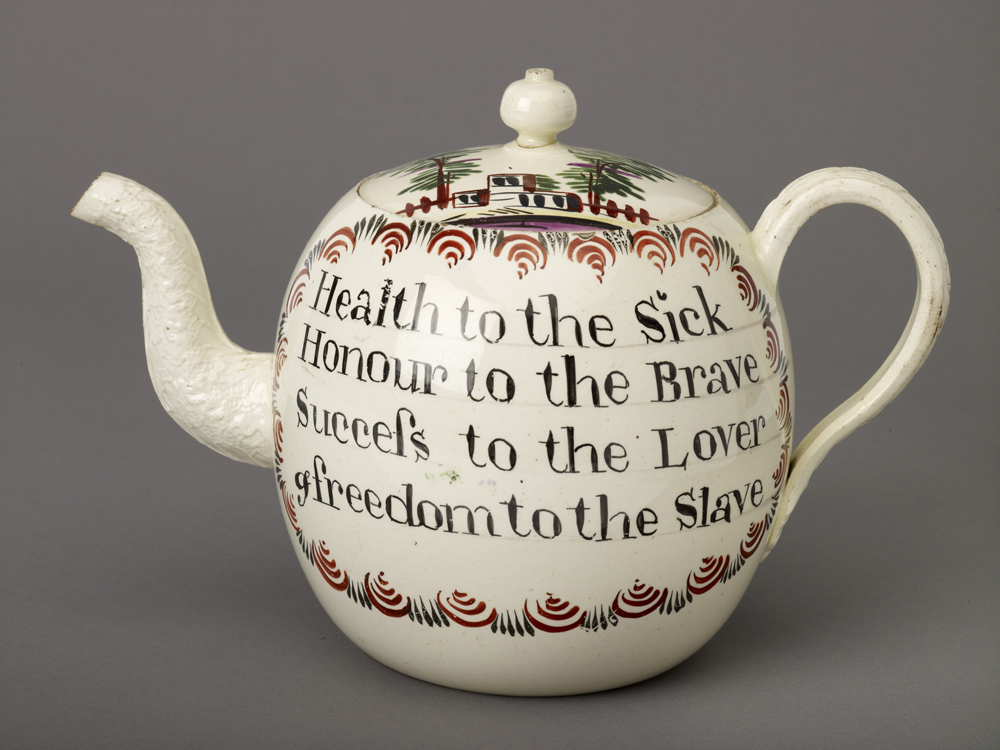
Abolition Teapot, by Josiah Wedgwood & Sons, c. 1760. Birmingham Museum and Art Gallery. Source. 

2. Find the politics in the everyday object

I’ve told everyone I know about this incredible article in Lapham’s Quarterly. Patricia A. Matthew writes about the late 18th-century consumer movement to boycott sugar from slave plantations. In the material record, this manifested as teapots and drinking utensils with snappy anti-slavery slogans, which allowed British women to organize around a political cause when they were not permitted to vote. Although we tend to think of teapots as the most domestic and innocuous of objects, their use speaks to complex issues of gender, colonialism, class, and globalization. Spin out the meanings of everyday objects, and you will often find that they have been more controversial than you think.

3. Make a political statement.

Indigenous water protectors protest the Dakota Access Pipeline at Standing Rock, ND; oil pipelines endanger drinking water and coastlines in addition to violating treaties. Source. 

It is not an accident that the communities without access to safe drinking water are disproportionately poor and non-white. In Canada, 107 First Nations reserves were affected by boil-water advisories at the end of last year. In the United States, citizens and water protectors are still fighting for access and regulation, and against fracking and pipelines, in communities like Standing Rock and Flint. Governments, regulatory bodies, and corporations have failed these communities. In a few decades we may all be in their position, with our access to fresh water jeopardized by government mismanagement and corporate interests.

Museums must work toward water justice – for disenfranchised communities now and for everyone in posterity. There are many ways to do this: through advocacy, ensuring that organizations obtain and sell water in ethical ways (Nestle’s water operation in Michigan, for example, violates a treaty which protects the land for Grand Traverse Band and Saginaw Chippewa tribal use), and, of course, through the interpretation of art and objects.

Ruth Cuthand's Don’t Breathe, Don’t Drink highlights the First Nations water crisis in Canada. 2016. Source.
The AGO’s acquisition and display of Ruth Cuthand’s arresting piece Don’t Breathe, Don’t Drink drew attention to the water crisis on reservations across Canada. Unless we resolve the inequalities that persist around access to safe drinking water, drawing attention to water justice and empowering visitors to act will only become more important in the future. While some necessary action, including divesting from fossil fuels and selling ethically-obtained water, represent big changes for museums, mindful acquisition and display of objects which speak to inequality is not only a possibility but a duty.

Cheers, santΓ©, and prost, Musings readers! This is my final Musings column; it’s been a pleasure to connect with you and with my wonderful fellow columnists this year. Stay hungry, thirst after knowledge, and feed your souls. I’ll see you around the table.

28 March 2018

A BLOOM OF EVENTS: WHAT'S HAPPENING WEDNESDAYS APRIL EDITION

WHAT'S HAPPENING WEDNESDAYS

BY: KELLY MANIKOTH

Hello friends! Welcome to the April edition of What’s Happening Wednesdays! With longer, brighter days and cherry blossoms officially in bloom, April is a month of transition and inspiration. This is especially true for us graduate students, as we embark on our summer internships or prepare for graduation and the career journey that lies ahead of us. This month’s column features events to help us celebrate our well deserved new chapter! I will also highlight MSL4000 exhibition projects taking place in April! For a full list of the openings this year, click here.

1. 4th Annual Corktown Egg Hunt

Source.
The first day of April is also Easter! Celebrate by attending the Corktown Egg Hunt; a massive Easter Egg hunt at the Corktown Common playground which will be fun for children all ages. Featuring a special appearance from the Easter Bunny, there will be free chocolate treats, Redline Coffee, live entertainment & more! Just be sure to BYOB (Bring your own Basket πŸ˜‰). For more information, contact Socrates@LivingToronto.ca

When: Sunday, April 1st, 2018, 10:00 AM – 12:00 PM. Hunt Starts @ 10:30am. Rain or Shine.

Where: Corktown Common, 155 Bayview Avenue, Toronto, ON

Tickets: This is a free event! You can register here.

2. The Slow Approach: Looking, Drawing and Making Together at the Textile Museum

Symphony of Light: The Universe, U/ Deep Space (1999); tie-dyeing, ink painting, embroidery and gold leaf on silk crepe (chirimen) with gold wefts; 198x139 cm Source.
Enjoy this three-part workshop series which is intended to help you slow down and appreciate the intricacies of Itchiku Kubota’s stunning kimono work. Through activities led by Textile Museum educator Susan Fohr, learn how to observe, sketch, and stitch in the gallery and experience a new way of looking. The workshops are titled Workshop #1: Slow Looking, Workshop #2: Slow Drawing, and Workshop #3: Slow Making. For more information, click here.

When: Workshop #1: Slow Looking, Wednesday April 4, 6-7 PM, Workshop #2: Slow Drawing
Wednesday April 11, 6-7 PM, and Workshop #3: Slow Making Wednesday April 18, 6-7 PM

Where: Textile Museum of Canada, 55 Centre Avenue, Toronto, Ontario, M5G 2H5

Tickets: Free with admission, no advance booking required. All materials will be provided.

3. Toronto Silent Film Festival

Film still from Hamlet. Source.
The Toronto Silent Film Festival's goal is to bring contemporary audiences and silent screen experiences together again. The four day festival features a variety of films from the early days of cinema. This year’s programme aims to show the range of characters played by women in the silent film era. For instance, the first screening in the festival is a German 1921 rendition of Hamlet, where the lead role is played by a woman. This was one of the first times in film that Hamlet was re-imagined as female. For a full list of screenings and locations, click here. 

When: The festival takes place from April 6th – April 9th . Hamlet plays on April 6th, at 7PM

Where: Various locations. Hamlet airs at the Royal Cinema, 608 College St. Toronto

Tickets: Individual Tickets are $15, $11 for students & seniors. Festival packages are also available. Tickets can be purchased here.

4. Ben & Jerry’s Free Cone Day

Source.
Celebrate the warm weather with FREE ice cream! Since 1979, Ben & Jerry’s have made it an annual tradition to give free ice cream away to thank their customers all over the world. So, take a much-needed break from final projects and essays and enjoy a delightfully free sweet treat!

When: Tuesday, April 10, 2018, 12:00 PM – 3:00 PM

Where: Ryerson University, Gould Street

Tickets: Free!

5. Ontario Science Centre: Great Conversation Speaker SeriesCultural Collisions: Science Engagement Through the Arts

Source.
The Ontario Science Centre’s Great Conversation Speaker Series brings global experts to Toronto to foster dialogue on important issues within the scientific community. On April 11th, Michael Hoch, PhD, physicist, artist and founder of art@CMS will give a talk entitled Cultural Collisions: Science Engagement Through the Arts. The lecture discusses the unity between the seemingly disparate subjects of art and science, showcasing how art and creative thinking can make complex scientific issues understandable while maximizing human innovation. Hoch discusses his work with art@CMS, an educational outreach program of the CMS experiment at the Large Hadron Collider, the world’s largest and most powerful particle accelerator at CERN, the European Laboratory for Particle Physics, where both artists and scientists examine particle physics research. For more information, click here.

Moderated by Molly Shoichet, award-winning researcher, science communicator and Ontario’s first Chief Scientist.

When: April 11th, Box office opens at 6 PM., Auditorium doors open at 7 PM., Presentation at 7:30 PM

Where: Imperial Oil Auditorium, Level , 770 Don Mills Rd, North York, ON M3C 1T3

Tickets: $20, $15 for Members, Purchase tickets here.

6. End of Year Museum Studies Celebration!

Source.
Come out and enjoy the End of Year Party hosted by the Exhibition Class! It’s been a whirlwind year, so be sure to celebrate by enjoying a night of food, drinks and fun with your fellow museum buddies! All MMSt and CRO students are welcome! If you have any photos you would like to share in the slideshow, please email them to Kathleen at kathleen.vahey@mail.utoronto.ca. Can’t wait to see everyone there!

When: Thursday, April 12th, 6:00 – 11:00 PM

Where: Hart House Debates Room

Tickets: Free! Please sign up through the Eventbrite page to give an estimate of numbers.

7. Art Gallery of Ontario Massive Illusion

Source.
AGO Massive is a huge annual contemporary art party which is now in its 14th year! This year’s ‘Massive’ is inspired by Yayoi Kusama’s: Infinity Mirrors, with the theme revolving around illusions and tricks of the eye. Guests will experience immersive, larger-than-life installations along with hypnotizing and mystifying performances and music from Toronto’s coolest DJ’s and creators. The event features a plethora of great food and drinks as well. With proceeds helping the gallery’s collection, future exhibitions and audience accessibility, this event is a total must-see! For more information, visit MassiveParty.ca

When: April 19, 9:00 PM – 1:00 AM

Where: Art Gallery of Ontario, 317 Dundas Street West

Tickets: General Admission $175, AGO Members $150 / limit 2 per member: 19+ / ID required . You can purchase tickets here.

8. Earth Day at Toronto Botanical Garden

Source.
Earth Day is an important reminder to care for the planet we call home. Celebrate the occasion at the beautiful Toronto Botanical Garden .There will be a ton of fun events for the entire family! You can help plant in the Teaching Garden, ride the 'blender' bike, make nature crafts and more! Find out more information here.

When: Saturday, April 21, 2018, 12:00 PM - 4:00 PM

Where: Toronto Botanical Gardens. 777 Lawrence Ave E, North York, ONAll activities take place in the Teaching Garden.

Tickets: Free! Registration is recommended. Register here

~* πŸŒΈπŸŒŸApril Exhibition Projects πŸŒŸπŸŒΈ*~

MSL4000 Exhibition Project Openings in April – Check out the list of ALL the openings here !

Case Studies: A history of physics innovation at the University of Toronto
When: Opening: April 4, 4-6 PM
Where: University of Toronto McLennan Laboratory
Who: Erin Beaubien, Daniel Rose

Made-Up Toronto
When: April 12-May 5, Opening: April 12, 5 PM
Where: Downtown Yonge BIA, Pop-Up Gallery
Who: Jessica Svenningson, Sarah Rolko

Art & Mindfulness
When: April 2018-2019, Opening: April 13, 5-7 PM
Where: University of Toronto, Bissell Building
Who: Tabitha Chan, Kelly Manikoth, Julia Zungri

Temple of Fame: Staging Women's Roles​
When: April 25-June 10, Opening: April 25, 5:30 PM
Where: Aurora Museum & Archives
Who: Kara Isozaki, Maeghan Jerry, Sarah Kelly

Redefining Language in African Art Scholarship
When: April 30
Where: Clara Thomas Archives & Special Collection, York University Libraries, online exhibit
Who: Susan Jama

Source.
This is my last post for Musings ever! πŸ’” Writing this column truly connected me to Toronto and I'm so grateful to have had the opportunity to experience grad school in such a vibrant and diverse city.
Congratulations MMSt family on completing another academic year, and I hope to see everyone at our Year End Party and the many exhibition openings taking place this month!

28 February 2018

SPRING BECKONS: WHAT'S HAPPENING WEDNESDAYS MARCH EDITION

WHAT'S HAPPENING WEDNESDAYS

BY: KELLY MANIKOTH

Welcome to the March Edition of What’s Happening Wednesdays! I’m sure we are all delighted to watch the snow melt away as our days get longer, warmer and brighter! Spring is one of my favourite seasons as it indicates new beginnings. As flowers bloom and leaves emerge on barren branches, the earth seems to be beckoning us out of hibernation to enjoy our renewed surroundings. So, without further ado, here are some fun events to check out in Toronto to swing into a sunny Spring!

1. Yoko Ono: The Riverbed Exhibition at the Gardiner Museum

Source.
Opening on February 23rd, the Gardiner Museum presents a special exhibition entitled Yoko Ono: Riverbed. The three-part installation welcomes visitors to participate and collaborate in transforming the pieces within the exhibit. For instance, in Mend Piece, visitors are invited to collectively repair broken pieces of ceramic with glue and string, resulting in new forms. The process is intended to incur contemplation on major themes of hope, dreams, life and death. For more information, visit Yoko Ono: Riverbed.

When: The exhibit opens February 23rd, and runs until June 3rd.

Where: The Gardiner Museum, 111 Queens Park, Toronto, ON M5S 2C7

Tickets: Adult Admission: $15.00, Senior (65+) Admission: $11.00, , Student Admission with valid Student ID: $9.00, Youth & Children under 18: FREE. You can purchase tickets here.

2. iSchool Student Conference - Information in the Air: Society and the Evolving Media

Source.
The annual iSchool Student Conference theme this year Information in the Air: Society and the Evolving Media. This event invites students to share their current research, showcasing what both museum and information professionals will bring to the field. The two-day conference deals with the evolution of both old and new media, and the effects such changes have had on society. The format will include a half day event with keynote speaker, Anabel Quan-Haase, and reception on the Friday evening, followed by one day of paper presentations, workshops and posters by students. For more information visit iSchool Student Conference and follow the conference on Twitter: @iStudentConfTO and on Facebook: www.facebook.com/iStudentConfTO/

When: Friday March 2nd and Saturday March 3rd from 11:30 AM – 6:30 PM

Where: University of Toronto - Faculty Information Office, 140 Saint George Street, Toronto, ON M5S 3G6

Tickets: $7 to $15. You can register here.

3. Yayoi Kusama's Infinity Mirrors Opening and Screenings at the Art Gallery of Ontario

Yayoi Kusama, Infinity Mirrored Room – The Souls of Millions of Light Years Away, 2013. Wood, metal, glass mirrors, plastic, acrylic panel, rubber, LED lighting system, acrylic balls, and water, 287.7 × 415.3 × 415.3 cm. Courtesy of David Zwirner, N.Y. © Yayoi Kusama Source.

One of the events I’m most excited for in March is the much-anticipated Infinity Mirrors exhibit by Yayoi Kusama at the Art Gallery of Ontario. This exhibition features Kusama’s infamous Instagram worthy Infinity Rooms – immersive kaleidoscope spaces where the visitor is continuously reflected within the installations. Along with the Infinity Rooms, the exhibition follows Kusama’s impressive 65-year career, from her early paintings to her recent work in soft sculpture. The AGO is the only Canadian stop for Infinity Mirrors which makes this an extra-special moment for the Toronto art scene this year. 

If you were unable to purchase your tickets thus far, don’t fret! There will be a few other opportunities for members and the public to purchase tickets online. If you still can’t snag a ticket, however, the AGO is hosting other events to ensure you get your Kusama fix. There will be screenings of the documentary Yayoi Kusama: I Adore Myself at the Jackman Hall which follows Kusama’s life and work process over several months as she completes a series of 50 paintings. For more information, please visit https://ago.ca/exhibitions/kusama

When: Opening day is March 3rd. The exhibition runs until May 27th.

I Adore Myself  Screenings: Wednesday, March 7, 6 pm & 8:30 pm, Friday, March 9, 6 pm & 8:30 pm, Wednesday, March 14, 6 pm & 8:30 pm, Friday, March 16, 6 pm & 8:30 pm, Friday, March 30, 6 pm & 8:30 pm

Where: The Art Gallery of Ontario, 317 Dundas St W, Toronto, ON M5T 1G4

Screenings: Jackman Hall

Tickets: Tickets will be available for sale through AGO.ca

The next block of tickets goes on sale online on March 6 at 10 am.
The next Members’ booking window is online on March 20 at 10 am.

Tickets for screening: Member Price $12.00, Public Price $14.00 Student Price $10.00
You can purchase tickets here

4. Celebrate Toronto Festival

Source.
Celebrate Toronto is a festival honouring Toronto’s 184th Anniversary. The festival will take place over four days at Nathan Phillips Square. There will be plenty of local vendors, food trucks with diverse cuisines, and fun activities. On March 3rd , enter the on-site photo contest for a chance to win a $1000 VIARail trip for 2 from Toronto to Montreal. On March 5th and 6th there will be a night skating party hosted by DJ Caff which will feature a blend of Motown and top 40 music. Celebrate Toronto is a non-profit organization that seeks to acknowledge the city's achievements through working with TO-based businesses and supporting local artists and grass-root start-ups that raise awareness towards green initiatives. For any questions/inquiries please contact info@celebratetoronto.ca or visit http://www.celebratetoronto.ca/

When: March 3rd & 4th 12:00pm - 8:00pm, March 5th & 6th 5:00pm - 10:00pm -

Where: Nathan Phillips Square

Tickets: Free!

5. International Women’s Day Conference

Source.
There have been so many inspiring moments of solidarity and empowerment within the Women’s Movement these past few years. Commemorate these milestones and celebrate International Women’s Day by attending the International Women's Day Conference. Held at Bellvue Manor in Vaughan, there will be vendors, prizes, a live DJ, dancing, hors d'oeuvres and cocktails. The event is co-hosted by Angel Freedman, a social worker, counsellor, parenting expert, public speaker and activist, and Merav Richter, an author, entrepreneur and philosopher. The conference supports the Women’s Support Network of York Region.

When: Thu, 8 March 2018, 7:00 PM – 11:00 PM EST

Where: Bellvue Manor, 8083 Jane Street, Vaughan, ON L4K 2M7

Tickets: To register, click here

6. St. Patrick’s Day Parade!

Source.
It’s St. Patty’s Day once again! The St. Patrick’s Day Parade will take place on March 11th, the route beginning at Bloor and St. George, going down Yonge and ending at Queen Street at Nathan Phillips Square. The parade features 30 marching bands and over 4,000 participants representing different communities in the city. The St. Patrick’s Parade Society hosts the parade every year, with their mission being to celebrate Ireland’s history, culture, and heritage through entertainment. 

When: Sunday, March 11 at 12 PM - 3 PM

Where: 65-520 Queen Street West, Toronto, Ontario M5H2M5. Click here for the parade route http://stpatrickstoronto.com/parade/

Tickets: Free!

7. Toronto: The Views are Different Here Opening at the John B. Aird Gallery


Source.

Toronto: The Views are Different Here
, curated by Nikita Lorenzo and Amanda McNeil, is one of the first shows opening from the MMSt Class of 2018’s Capstone Exhibition Projects! The exhibition showcases an all-encompassing picture of Toronto through displaying diverse narratives and experiences of the city. This exhibit is done in partnership with the John B. Aird Gallery and the City of Toronto Art Connections Program.

When: The opening reception takes place on Thursday March 8th, 6 to 8 p.m. The exhibition runs for one month, from March 6th to April 6th, 2018

Where: John B. Aird Gallery, 900 Bay St, Toronto, ON M7A 1C2

Tickets: Free!

8. Kortright Sugarbush Maple Syrup Festival


Source.
Another sweet way to ‘tap’ into Spring is to check out the Sugarbush Maple Syrup Festival. Running from March 10th to April 8th, there will be demonstrations on the maple syrup process, wagon rides, mazes, games, sno-cones and lots of pancakes enveloped in delicious real maple syrup. On select special dates (March 10, 17, 23 & 24), there will be a Maple Syrup by Lamplight Tour! These guided tours of  Kortright’s Maple sugar bush begin at twilight. After learning about old fashioned and modern methods of maple syrup production, enjoy syrup samples by a warm campfire. Other locations for the Maple Syrup Festival include Bruce's Mill in Stouffville, Terra Cotta in Halton Hills, and Island Lake in Orangeville. For more information, visit Maple Syrup Festival.

When: March 10 – April 8, 2018, 9:30 AM – 5:00 PM

Where: Kortright Centre for Conservation, 9550 Pine Valley Dr.

Tickets: General Admissions Adults (Ages 15-59): $8.85, Seniors (Ages 60+): $5.75, Children (Ages 5-14): $5.75  Children 4 years and under: FREE (with adult purchase), Parks Members FREE

You can purchase tickets here.

Twilight tours require advance tickets. Please call 416-667-6295 ext.3 or email: visitorservies@trca.on.ca for more information.

9. Spring Flower Show at Allan Gardens

Source.
Enjoy all the blossoms Spring has to offer at Allan Gardens with the Spring Flower Show! The Spring Show runs from February 25th to April 29th as the Cool House transitions to Spring. Some features are the vibrant tulips and aromatic hyacinths. From March 25th to the end of April, there will be a special Easter Flower Show. The Conservatory will be decked out in Easter decorations, and its dome filled with Easter lilies and hydrangeas. This is definitely a must-see for Spring!

When: February 25th to April 29th, The Easter Flower Show is March 25 to April 29. Open 10 A.M. to 5 P.M.

Where: Allan Gardens Park and Conservatory, 19 Horticultural Ave

Tickets: Free!

10. Dear Sadie: Love, Lives, and Remembrance from Ontario's First World War 

Source.
In commemoration of the last year of the First World War Centenary, Jay Young, PhD, hosts a special presentation at the Don Mills Library on their most current exhibition, Archives of Ontario’s Dear Sadie. The exhibit focuses on the personal experiences and stories of the war through exploring a series of letters written by Canadian soldier, Harry Mason, to his love back home, Sadie Arbuckle. For information, visit Toronto Public Library

When: Friday, March 23, 2018, 2:00 PM – 3:30 PM

Where: Don Mills Public Library, 888 Lawrence Ave. E.

Tickets: Call 416-395-5710 to register for the talk.

That’s all I have for now, friends. With the end of the term fast approaching, I hope this blissful Spring weather gives everyone a burst of energy and renewed inspiration to complete a successful academic year! From attending one of the many exhibit openings to observing the leaves peek out from the trees, I wish everyone a happy and productive March! 😊