Showing posts with label Michelangelo. Show all posts

14 June 2019

CULTURAL HERITAGE QUIZ: PART 2

Heritage Moments | Selin Kahramanoglu


Ready to test your knowledge?

This month's post will focus on the varying levels of significance associated with cultural heritage. Now, we could easily write a whole book series on this subject, but I want to give you a light-read for the summer. So... here is another quiz to get you thinking about it!

As mentioned in the last post, this quiz is a little challenging because the significance given to a cultural heritage item will be different for everyone. Often, museum professionals and archivists (my other love) are faced with the problem of limited storage space and resources. As much as we'd like to, we can't keep everything! This quiz will hopefully give you an idea as to why some cultural heritage is worth keeping over others.

Image result for holi
An image depicting Holi, the Hindu Festival of Colours. Source.
For the following items, decide whether we should SAVE or TOSS each example of tangible or intangible cultural heritage. Remember: Cultural heritage can be material or immaterial, and it represents the legacy of a group of people, which has been preserved for future generations.
  1. Oral History of Lake Saint Anne: A Métis story about the healing properties and spiritual energy associated with the waters.
  2. "The Entombment": An unfinished painting by Michelangelo, depicting the burial of Jesus Christ after the crucifixion.
  3. "Purple Rain" Cassette Tape: A 1984 song by Prince.
  4. Two thousand pieces of pumice stone: These tiny 3 cm x 3 cm pieces of volcanic debris are from Pompeii.
  5. Mapuche Language: Spoken primarily in parts of Chile and Argentina, there are approximately 100,000 speakers in the world.
Here we go! Answers will follow!


Oral History of Lake Saint Anne: SAVE

The whole purpose of oral histories is to keep telling them to the next generation! We cannot discard an example of intangible heritage that is closely linked to the present-day functions of a culture. Storytelling that is representative of a culture's ideologies and practices can be preserved by talking in-person, or by audio-visual recordings, and should be considered a priority. This is particularly important for indigenous groups, but intangible heritage is generally valuable for every culture.


"The Entombment": SAVE

Now, if an artwork is incomplete and we cannot communicate with the owner, there are all kinds of debates about whether the piece should be sold or displayed at all. However, unfinished work by a famous artist, such as Michelangelo, now that's definitely a keeper. For art historians, it is rare and fascinating to study the creative process of a well-known painter. To add, it is rumored that Michelangelo stopped working on this painting, because he was commissioned to start his best known work, the "David" sculpture. The context of the cultural heritage item is important!


"Purple Rain": TOSS

I'm not saying that Prince's music is bad. I'm saying that cassette tapes are not worth keeping. In this technological era, music is digitally preserved. If an archive chooses to keep a cassette tape, this means that they also need a cassette player, and they need to keep it in good condition for a long, long, time. How many cassette tapes should they keep? For how long? There will be a time when these formats are no longer accessible, so we should update these records to their latest versions, before discarding the old ones. 


Pumice Stones: TOSS

Do you know how many pumice stones exist from the eruption of Vesuvius? Many. I don't have space in my storage closet for all of those rocks. Not only that, but pumice stones are created all the time, and are not unique to just Naples. (You can even buy them at the drug store.) It's true that the ancient site of Pompeii is historically significant, which is why I suggest the local museums keeps a couple of stones from that particular event, if any. No more than that! It's interesting to preserve a piece of history, and perhaps new information can be discovered about the artifact in the future. Most importantly, this piece of natural heritage needs to stay at it's site of origin, preferably in situ.


Mapuche Language: SAVE

Real talk: The sad truth is that you don't always have the power to save cultural heritage. The amount of money your institution may have, the number of resources, or the level of expertise of your staff does not matter. Much like oral histories and ceremonies, languages are difficult to preserve because it depends on the participation of the public. You cannot keep having Mapuche speakers, if no one is willing to learn the language. We cannot force people to see the value in preserving cultural heritage. The best we can do is educate others on why it is important to keep, work as a team, and try to save it for as long as possible.


That's it for this month's post! Deciding to save or toss cultural heritage is never easy, because we hope to keep it all. Everyone has their own opinions on what is important to preserve. To help facilitate our choice, we assess the needs of the public, the item's importance to future generations, and our available resources for preservation. See you next time for our final quiz!

Further Reading
- "Lake Saint Anne" as told by Marge Friedel, a Métis Elder from Edmonton
- University of Saskatchewan Indigenous Studies Portal for oral histories
- More examples of unfinished artwork
- The Guardian's list of endangered languages in the world

8 March 2018

A SHERLOCKIAN APPROACH TO CONSERVATION

CONSERVATION TIPS & TRICKS

BY: JULIE DAECHSEL

This post wouldn’t exist without Sherlock Holmes – technically, the American adaptation of London’s detective. Most viewers are familiar with the BBC’s version of Sherlock Holmes (surprisingly called Sherlock), and not the less critically acclaimed series on CBS, Elementary, starring Jonny Lee Miller as Sherlock and Lucy Liu as Dr. Joan Watson.

Benedict Cumberbatch in Sherlock versus Jonny Lee Miller in Elementary. The two actors co-starred in a stage production of "Frankenstein" in which they alternated in the roles of Dr. Frankenstein and the Creature before starring in their Sherlock series. Source.
But what does Elementary have to do with conservation? Everything, my dear Watson. I’ll try to avoid any spoilers, although the upcoming scene is a flashback so it doesn’t reveal a major plot point. So during a flashback, we see how Sherlock meets Irene Adler.


While on a case, Sherlock consults Irene, a conservator, as to whether a Turner painting is a forgery (spoiler: it is). Sherlock identifies a painting in Adler’s studio that she claims to be a copy of one she restored for a museum (surprise, it’s actually the original). The museum wanted Adler to repair damage caused by shelling in WWI by filing down the paint, an act she argued “compromised what the artist had intended”. So she made a restored copy to return to the museum and kept the original in its damaged state.

This scene stuck with me. What is the line between damage and history? I’ve written in my previous posts about the responsibility conservators have to the object’s well-being, but Irene makes an intriguing point. What constitutes damage? And what is the effect aesthetic has on conservation?

What do museum professionals do in the face of uncertainty? Research.

Case #1: Saint Andrea Corsini (1630) by Giovan Francesco Barbieri looks, well, a little morbid – but for a good reason?

Detail from Saint Andrea Corsini that shows a bullet hole. The Corsini was as prominent as the Medici family - their family crest is at the top of the Trevi Fountain. Source.
This portrait of Saint Andrea Corsini has two bullet holes as badges of honour. During WWII German soldiers attempted to steal the painting for the Führermuseum from the Corsini family in Italy in 1944. Princess Elena Corsini feared this would happen, so she had hidden smaller works from the family collection in an empty crypt. Larger works were packed in a truck and driven to Villa Le Corti, where she hid them behind a false wall, except for this painting, which she hung on the wall in the hope that her ancestor would protect the artworks. German soldiers noticed the still-wet plaster but in the face of advancing Allied troops, couldn’t examine it further and shot the painting in frustration.

After the war, the Corsini family decided not to restore the work to serve as a reminder of the ravages of the war on both humanity and art.

Case #2: The Sistine Chapel is clean, but was that Michelangelo’s intention?

The Sistine Chapel ceiling post-restoration. Source.
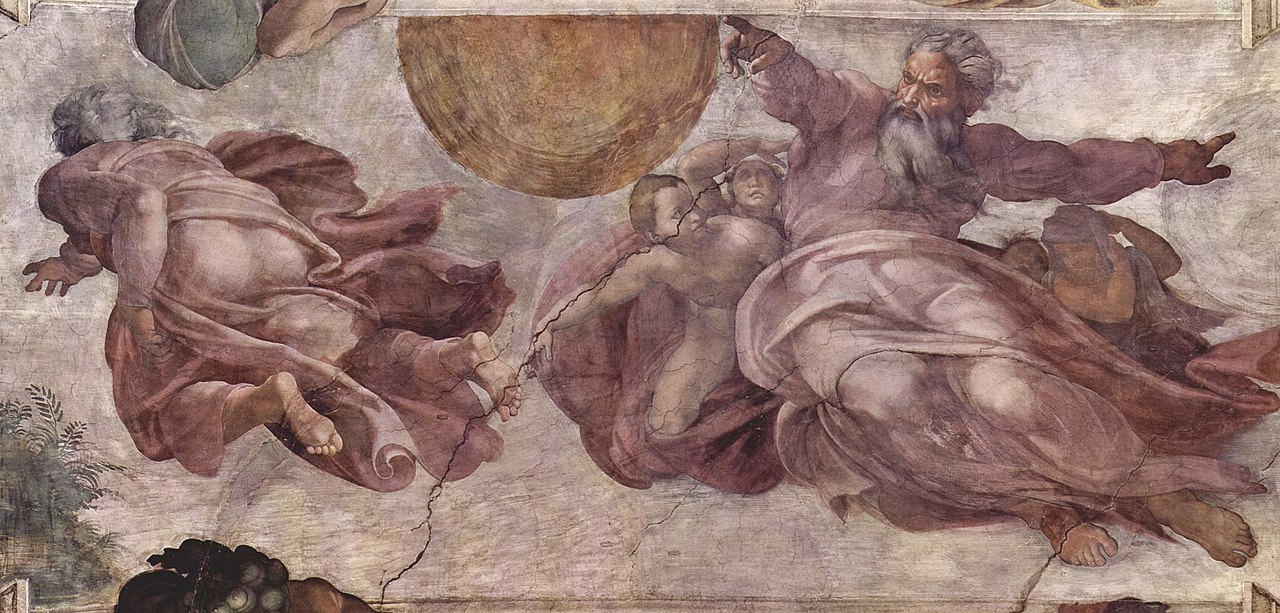
The Creation of the Sun, Moon and Vegetation from the image above, pre-restoration. Source.
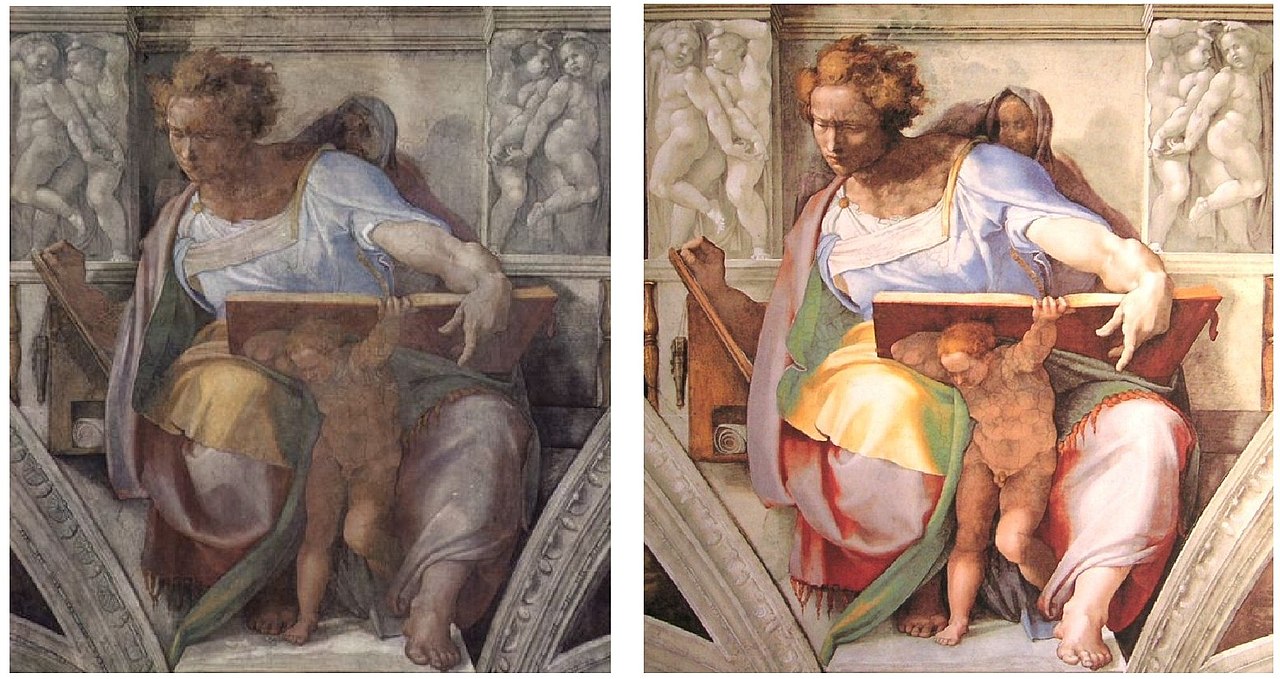
In the 1980s and 1990s, the Sistine Chapel underwent a cleaning to remove centuries of dust and candle soot. Critics feared that the cleaning process might damage the masterpieces, while some argued that visible age was part of the art. After the cleaning, people marvelled at the brighter colours and declared that the Michelangelo’s “true” masterpiece was revealed. But the cleaning, while removing dirt, had lifted away certain details and shadows (some to the extent of removing pupils from the eyes of figures). Any details that were added on top of the fresco, whether by Michelangelo or other artists, were removed.

Detail from Daniel. On the unrestored fresco, the red underpainting shows through the black a secco wash adding luminesce to the shadows. The form under the garment is achieved by the black wash which was removed during the restoration. Source.
While the colours were brighter, critics argued that the compositions were flatter and modelling on figures seemed cruder as shadows Michelangelo had intentionally painted were accidentally removed. As Michael Daley of ArtWatch noted, restorers removed layers of varnish Michelangelo had deliberately applied in order to harmonize and tone down his colours. Moreover, stripping these varnishes exposed the fresco surfaces to atmospheric pollution.

Now what?

Source.
We have an example from each group of thought. The Corsini family thought like Adler, that the painting’s damage added to its aesthetic: that its physical change enhanced the work’s intended meaning. In contrast, the Sistine Chapel restoration removed what was perceived as dirt and damage to reveal stunningly bright colours. But both actions have consequences. Saint Andrea Corsini will forever be known as the painting with a bullet through the head of a saint. The Sistine Chapel sacrificed arguable intention darkening varnishes and overpainting on the fresco.

If these posts have proven anything, it’s that conservation is much more complex than wiping off dust and rust. It’s knowing how to care for an object, and more importantly, when to. It’s knowing the difference between help and harm. But most importantly, it’s recognizing the consequences, permanent or impermanent, of our actions. Sometimes the hardest choice is not action but passivity. And sometimes it’s vice versa.