Showing posts with label edutainment. Show all posts

7 November 2017

PLEASE DO NOT FEED THE COLLECTION

BEYOND TRADITION

BY: HANNAH MONKMAN

Do you remember walking into a room at a museum and coming face to face with a piece of history or art that resonated with you? Perhaps you had the opportunity to visit the Rosetta Stone, to stand in the scenery of Starry Night, or to lock eyes with the Mona Lisa—or perhaps you can only still imagine as you save your pennies to travel to your dream museum.

Now think of the first time you went to a zoo. Seeing your favourite animals as they played with each other or were fed by their keepers—or maybe you left with a new favourite after you locked eyes with a young orangutan or an aging elephant. Regardless of what your experience was or what you dream it will be, there is no denying that both museums and zoos can create impactful and memorable experiences.

In both museums and zoos, we're often just looking for something—or someoneto connect with. Source.

Zoos have a lot in common with museums, to the point that they may be classified together as institutions. With a focus on education, conservation, and providing meaningful experiences for its visitors, museums and zoos have very similar goals with the primary difference being in the “collection” itself. It makes sense to refer to a zoo’s animals as its collection in this line of thinking, and certainly that’s what the animals were viewed as when the first zoos (or menageries) were established. But can we ethically place animals on the same level that we place any sort of artifact—regardless of its historic importance? While I would immediately answer “no”, it is worth thinking about the terminology since the words we use reflect our broader understanding of the concepts at hand.

Let's take a ride down the semantics slide. Source.

[Disclaimer: I am not arguing for or against zoos in general, nor delving into the highly problematic history of displaying humans in zoos / museum-like exhibitions; rather, I am simply musing about the ethical implications of classifying the animals they keep as a “collection” in the same sense as a museum’s collection.]

At least in North American zoos, the focus is mainly on conserving endangered species or individual animals who may be unfit to return to the wild while making these animals accessible to the public—much like a museum does with its objects. Zoos often embrace the “edutainment” aspect much more than the typical museum, but nonetheless, both aim to educate while providing some level of entertainment by providing unique experiences.

Where else can you learn about animals like red pandas up close and personal? Source. 

But if we use the same terms to refer to living collections as we do to standard collections of art and artifact, what does that mean from a collections management standpoint? Unlike the majority of museums (that make at least the core of their collections policy available to the public, if not a comprehensive document) I couldn’t find any similar policies available online for zoos in North America.

The lack of information on their collecting guidelines leads only to speculation. Are animals “deaccessioned” when they pass away? Are animals appraised before being acquired into the zoo’s collection? Which animals are determined to be relevant enough to the zoos mandate to house within the zoo, and does the appeal factor to visitors play a disproportionate role in selecting animals for display—and is this actually any different than current museum practice? And with each additional question in this line of thinking: what are the ethical implications of referring to animals as if they were on par with objects?

I firmly believe that by broadening our definition of museums to include a wider variety of informal education institutions, we can better understand our own practices at whatever kind of institution we happen to work at and improve our practices to reach a higher standard of professionalism. But in doing so, we need to be careful about which practices we’re equating, and what the implications of these comparisons may be.

Just something to muse about—until next time. Source.

9 February 2016

THE GREAT MUSEUM ESCAPE!

MUSEUM INNOVATIONS

BY: JENNY FORD

Tomorrow, I will be escaping through the tunnels of Casa Loma as a bootlegger. It will be my fourth escape game. I’ve been a Second World War spy, a pirate’s prisoner, and even a museum burglar. And, yes, I'm quite addicted.

Real life escape games emerged around 2012. The idea is you’re locked in a room (or series of rooms), solving puzzles with your friends as you try to escape. You take apart props, crack codes, and discover secret passages to get out of the room on time. Games have storylines—prison break, insane asylum, haunted house—that move forward as you progress through the game.

A jail cell escape game room.
A prison-themed escape room in Montreal. Source.

So, why is this in a museum blog? I’ve actually found many parallels between exhibition development and escape game development, especially when it comes to narrative experiences. I'd hazard they may not be so different, after all.

THE NARRATIVE MUSEUM

Over the last few years, museums have started to emphasize the role of narrative in exhibitions. As one blog outlines, narrativity plays a huge role in visitor learning, especially with information retention.

Humans are natural storytellers, and we love good dramas and good characters. Exhibitions that capitalize on these notions create emotional connections, which make the experience more engaging. Exhibitions are also easier to follow when they're designed after a storytelling arc.

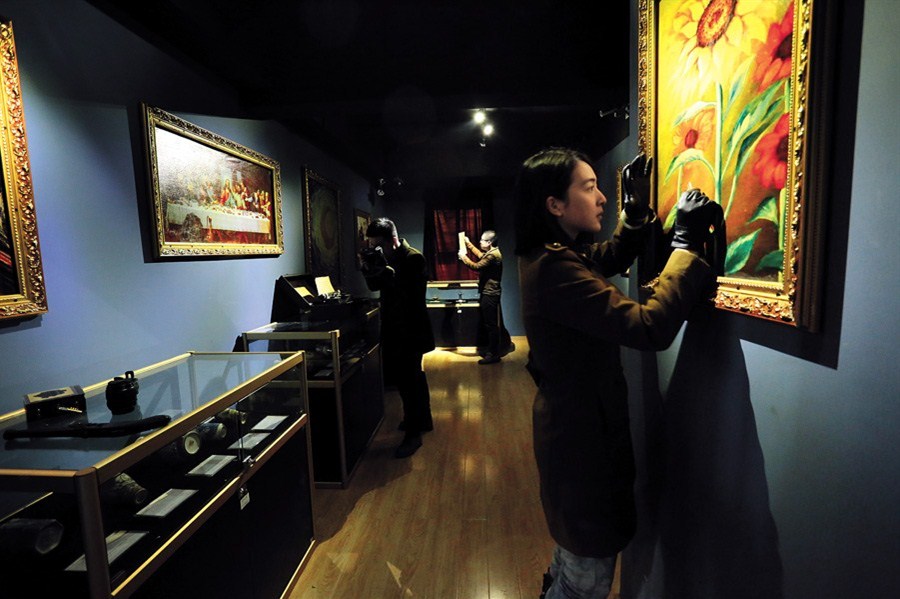
People solving puzzles in a museum-themed escape room.
A museum-themed escape game in Shanghai. Source.
Museum narrative experiences also aim to create “flow”, as defined by Mihály Csíkszentmihályi. This is when someone is so engrossed in an experience, they forget about time and space. Much like when you’re totally absorbed in a movie and forget where you are or how much time has passed.

These are still concepts museums are perfecting and experimenting with, in some cases. And this is where the escape experience comes in.

THE ESCAPE NARRATIVE

I should preface all this by saying there are some terrible escape games out there… just like there are bad exhibitions. In fact, designing a good escape game is extremely difficult. A designer has to create nesting and escalating intellectual challenges that interlink, allowing players to both feel challenged and successful. All the while, an escape game is carrying on a storyline that reveals more and more information.

An escape game room that has been torn apart by participants.
This game has been destroyed by an escape team! Source.

Now, read those last two sentences and replace “escape game” with “exhibit” and “players” with “visitors”. Aren’t exhibits much the same, in this way? A good exhibit is not necessarily supposed to be “easy”—it should be intellectually stimulating, while feeling like you’ve made breakthroughs. Too basic or too complex and you lose people.

Good escape games also have the narrative concept down. They often follow story arcs, get people emotionally involved, and definitely get you into the “flow”, although you are always aware of the ticking clock so you escape in time!

A GOOD ESCAPE GAME

Adam Clare, a George Brown instructor, wrote the how-to book on escape games, outlining how they’re designed and what makes a good one. There are lots of exhibit connections to some of these fundamentals that museums can draw on:
  1. An enticing theme that’s carried through the whole experience
    This almost goes beyond the big idea to the essence of a theme and how that theme feels as it's carried through every element of the experience. It's often a question of good 3D design.
  2. A narrative that engages players, where solving puzzles advances the storyline
    While this is akin to a story arc, it perhaps makes us look at objects differently. Instead of each object being an illustration of the main story, they effectively move the story forward, sharing more events that enhance the narrative.
  3. Rewarding ending
    Escape games embody this concept in a rewarding ending puzzle. Can exhibits capture this idea too once visitor get to the end? A surprise information reveal or object?
  4. Have surprises
    There are always surprises in escape games—a secret room, a tunnel, lasers. Exhibitions don’t have to be predictable. Have surprises and moments that maybe not everyone will see, but when they do it’s incredibly rewarding.
  5. Consider group size and timing
    This is crucial for escape games. Too many players and people are standing around. Too few and they can’t solve the puzzles on time. But we only sometimes consider these notions in museum exhibitions. What’s the average group and how will that change how they interact with the space?
There are of course challenges with this model. In exhibitions, most visitors won’t view every objects, while in an escape game, you have to solve every puzzle to succeed. Yes, there are challenges, but there are also things to learn and concepts to test out. Puzzling indeed!

LET THE DEBATE BEGIN! SHARE YOUR THOUGHTS.