29 January 2016

I, FOR ONE, WELCOME OUR DINOSAUR OVERLORDS

OBJECT OF THE WEEK

BY: ROWENA MCGOWAN

Anyone who knows me knows that I have a soft spot for a certain kind of animal.

IT'S BUTTERFLIES, GUYS.
Photo credit: Laura Babineau


Unfortunately for me, dinosaurs went extinct years ago (although of course it was quite fortunate for the human race as a whole, as after the dinosaurs came the rise of the mammals). But what if dinosaurs hadn’t gone extinct? What if they had survived to the present? Well, humans look quite different from their Cretaceous ancestors so it makes sense that dinosaurs would have evolved, too.

This week’s Object of the Week is the subject of a thought experiment addressing exactly this idea. Meet the dinosauroid.

Source.

It was based on a dinosaur called a Troodon. Troodon was a small theropod. Theropods were bipedal, carnivorous dinosaurs running the gamut from the Tyrannosaurus rex to the Velociraptor – they were also the ancestors of birds. Troodon, meaning ‘beautiful wounding tooth,’ was originally known from a single tooth, hence the name. It would have been about 2m long.


An up to date reconstruction of Troodon by Brian Cooley. Photo credit: Rowena McGowan


The reason Troodon is so special is its intelligence. Troodon had the largest brain in proportion to its body of any known dinosaur, meaning that it was probably also the smartest of the dinosaurs. Although it was much brighter than, say, a Stegosaurus, I wouldn’t worry about Troodon taking your jobs, even if it had stuck around. It was probably only as smart as a not particularly smart modern bird. Think ostrich rather than parrot.

Troodon also had binocular vision and grasping fingers that may have allowed it to manipulate objects, at least to a certain degree. All of these traits made it a perfect base for the dinosauroid.

The dinosauroid was created by Dale Russell and Ron Seguin in 1982 and was displayed at the Canadian Museum of Nature in Ottawa. It posited a hypothetical evolution of Troodon if its brain had continued to grow. Its head is quite large, of course, to carry that big brain and the snout is shortened to compensate. Russell and Seguin gave the dinosauroid an upright bipedal posture with a severely reduced tail because they argued that this was the best way to carry the enlarged skull. They also made it viviparous (giving live birth, rather than laying eggs), because a placenta helps in cranial development. The hips are enlarged to accommodate giving birth to a large-headed baby.

Source.

Looks very human, doesn’t it? Is the human form really the default for an intelligent being? Some people say yes. But plenty of other scientists have said that the answer is no. The dinosauroid has been accused of being biased and far too humanoid. Paleontologists like Darren Naish see no reason why a dinosaur’s body plan should change so dramatically in order for its intelligence to increase. Naish believes that human posture was less the ideal form for an intelligent creature and more an artifact of our evolution. Had a dinosaur’s brain grown similarly, it might easily have retained its tail and horizontal posture and manipulated objects with snout and feet instead of hands. 

Of course, this is all speculation. The truth is, we don’t and will never know what hyper-intelligent dinosaurs would have looked like. But, if parallel universes do exist and in one of them, that comet never hit, I personally kind of hope that the dinosauroids looked a little bit like this:

Species go extinct but style is forever. Photo credit: Mike Ryan. Source.

Works Consulted

http://blogs.scientificamerican.com/tetrapod-zoology/dinosauroids-revisited-revisited/

Russel, D. & Sguin, R. 1982. Reconstruction of the small Cretaceous theropod Stenonychosaurus inequalis and a hypothetical dinosauroid. Syllogeus 37, 1-43.


28 January 2016

"FRIVOLOUS" OLD BOARD GAMES, ANCIENT OR OTHERWISE

MUSEUM MYSTERIES

BY: CHRISTOPHER WAI

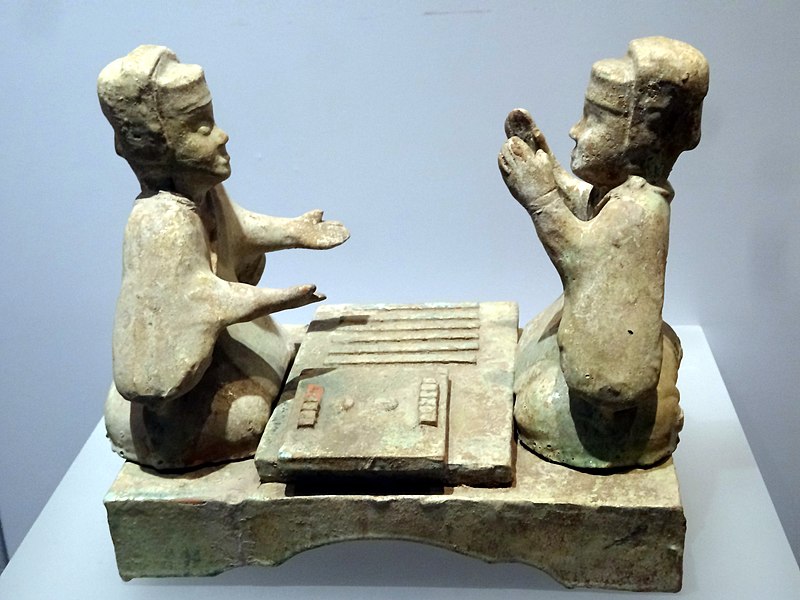
"Green-glazed pottery figurines representing Liubo players" unearthed in tomb at Lingbao, Henan Museum, China. Sources:  1 , 2
 "Hence some friends drink or dice together, [...] for wishing to live in their friends’ society, they pursue and take part with them in these occupations as best they can."  
-Aristotle, Nicomachaean Ethics. 9.12
“...Are there not gamesters and chess players? To be one of these would still be better than doing nothing at all.”
-The Analects of Confucius
If documentaries, movies and TV shows are anything to go by, every ancient or historical pastime must surely have been the most exciting spectacle of life, death and all the rest. But how about the more quiet day to day pastimes? Something like ancient board or table-top games perhaps?

It seems so mundane at one level, away from the grand spectacles of say, gladiator battles, ritual ball games, ceremonial feasts, chariot races, festivals, theatrics, dance or music. And yet, if you'll indulge me, it seems on some level so much more intimate. 

Imagine just a few players, probably friends, maybe some onlookers and a few conversations be they light, serious or raucous- little things that don't get recorded in great detail in monuments and texts. "It's the little things in life", as the saying goes. The game may even hold subtleties about the world they lived in, be they social, political or ritual.

"Wall-painting of game-players from a bar on the Via di Mercurio", Pompeii. Source
 Mural of Liubo players from an Eastern Han Tomb, Henan Province, China. Source
 

Of course, I don't want to read too much into it and make grand assumptions about daily life or cast it as the de-facto representation of daily pastimes for all classes, cultures, times or places. Some games may have held far more ritual and/ or symbolic meaning than that which we can imagine in our present day for example.

But there are surviving boards, game pieces and scenes depicted here and there, and the hints of the stories behind them.

Here are an idiosyncratic collection of games of from across the world. Individually, there isn't always much known, but collectively, it's a little more than I had anticipated when I started. I suppose that only shows how such games have had some presence in many cultures in one form or another.

Feel free to skim or look in detail, you'll no doubt find something of interest!
In China cultured men and women were expected to master the Four Arts – four cultural pursuits that took years to perfect: playing the qin (zither)...playing weiqi (a type of chess)...writing fine Chinese calligraphy... making, appreciating and critiquing classical Chinese painting.- British Museum
Silk painting of a woman playing weiqi (Go), from the Astana Graves, Tang Dynasty. Xinjiang Uighur Autonomous Region Museum . Source
"Polybius relates with regret what occurred at the capture of the city, and speaks of the indifference the soldiers showed for works of art, and the sacred offerings of the temples. He says, that he was present, and saw pictures thrown upon the ground, and soldiers playing at dice upon them." -Strabo, Geography. 8.6.
"Achilles and Ajax playing a board game. Attic black-figure amphora, ca. 500 BC", Staatliche Antikensammlugen Museum, Munich. Source
"Lay not my bones apart from thine, Achilles, but let them lie together, even as we were reared in your house, when Menoetius brought me, being yet a little lad, from Opoeis to your country, by reason of grievous man-slaying, on the day when I slew Amphidamus' son in my folly, though I willed it not, in wrath over the dice." - Homer, The Iliad 23.85

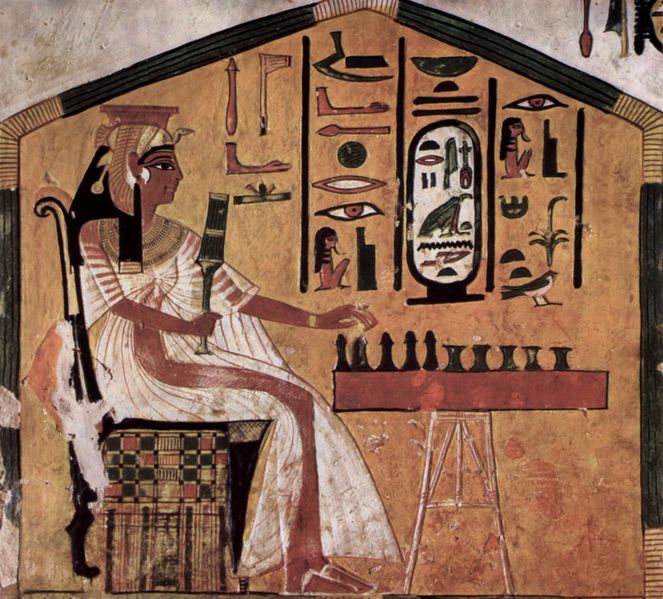
Painting of Queen Nerfertari playing a game of Senet from her Tomb, New Kingdom, Egypt Source. Additional: Facsimile
Formulae for elevation and transfiguration, for going out from the necropolis, for being in the following of Osiris, and being content with the food of Wennefer, going out by day, taking any form desired to be taken, playing the board-game senet, being in the pavilion, a living soul, the Osiris N among the revered before the great Ennead which is in the west, after he moors. This is good for the one who does it on earth. The words come to pass, in completion. Words spoken by the Osiris N:” 
-Egyptian Book of the Dead, Chapter 17

Tutankhamun's "travelling" Senet set. Source: BBC
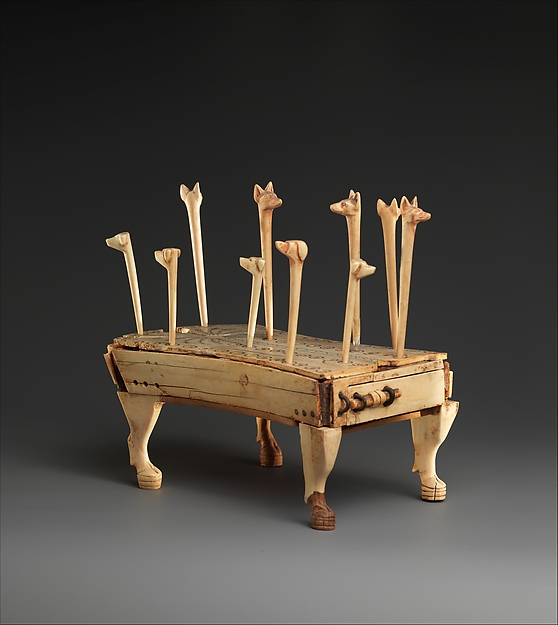
Hounds and Jackals game set, found by Howard Carter and Lord Carnarvon in 1910. Middle Kingdom, Egypt. Metropolitan Museum of Art
"Egyptians likened the intricate voyage through the underworld to a game. This made gaming boards and gaming pieces appropriate objects to deposit in tombs." 
Metropolitan Museum of Art
Game board for playing Mehen (name of Egyptian Snake God), Early Dynastic Egypt. Game pieces were shaped like lions and marbles. British Museum.

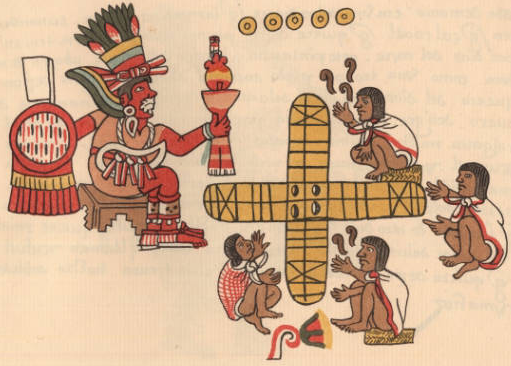
The Mesoamerican game of Patolli overseen by the god Macuilxochitl, Aztec Codex Magliabecchiano. Source
The Royal Game of Ur. 2500 BC-2400 BC. Royal Cemetery of Ur, Mesopotamia. British Museum.
"The board lay face upwards in the soil [...] when the presence of the object was recognized we worked along it a square or so at a time, pouring hot wax over it as we went, and finally the whole was secured with waxed cloth and lifted..." 
-Leonard Woolley on the discovery of the Royal Game of Ur

Board Game, Indus Valley Civilization (3500-1700 BCE). Source 
Maze and Dice, Indus Valley Civilization (3500-1700 BCE).Source

Conclusion

One of my grade school teachers, thinking that it was Ancient Egyptian, once tried to engage us with ancient history through a game called Alquerque using penciled in sheets of paper and a pile of black and white beans. I'm not sure how effective it was, but here I am still thinking about it.

These game boards and pieces seem to challenge anyone trying to learn more about them to actually engage with them by default.

One can hardly just stare at them and read about the rules or talk about them in a vacuum anymore than one can just hear of chess or poker as a novice and be an expert. We can certainly analyze the possible symbolism, source the raw material(s), the processes involved in their manufacture, and their distribution, but it is a game after all.  It's designed to be played and when it was played, there was a social element that was once there.

Left to right: Shogi, Go, Ban-Sugoroku games, Japan. ca. 1780. Source

More Info:

Digital versions of Aztec Pattoli: 

Article on Knucklebones:

http://archaeologicalmuseum.jhu.edu/the-collection/object-stories/archaeology-of-daily-life/childhood/knucklebones

Fantastic collection of images of depictions of the Chinese Liubo game in the English language:


27 January 2016

THE TROJAN HORSE OF TREASURE FINDS

COLLECTIONS CORNER

BY: JENNIFER MAXWELL

Who Owns the Treasure of Troy?

Discovered at Troy in Turkey, smuggled to Greece, bestowed to Germany, and confiscated by the Soviet Union – the treasure of Troy is still causing conflict. Forget Hollywood’s numerous adaptations of the Trojan War (Brad Pitt anyone?), the ownership debate over the treasure of Troy is equally impressive.

Heinrich Schliemann's wife, Sophia, wearing the "Jewels of Helen". Source.

The treasure had its origins in Heinrich Schliemann’s excavations at the site of ancient Troy in northwestern Anatolia (Turkey) in the 1870s. Here, he discovered the ruins of a series of ancient cities, as well as a spectacular cache of gold. The treasure included golden earrings, necklaces, pots of silver and gold and other items. The most impressive of these were two gold diadems, referred to as the “Jewels of Helen”. By most accounts, Schliemann did remove the finds from his digs without permission. The treasure moved through several countries before showing up at the Pushkin Museum in 1993. But the story is not over. The following is a summary of the ongoing claims to the Trojan treasure:

The Turkish Claim

The Ottoman Government, which constituted Government of Turkey at the time, gave Schliemann permission to dig at Hissarlik and share the artefacts he found. However, a week after Schliemann found the treasure, he smuggled it out of Turkey in 1873.

In 1874 the Ottoman Government began a lengthy legal and political battle against Schliemann for illegally removing the treasure to his home in Greece. An out-of-court settlement was eventually reached in 1876. As of 2015, the treasure is located in 44 countries (notably Russia), and Turkish officials at the Ministry of Culture and Tourism aim to bring back as many of the artefacts as possible.

Heinrich Schliemann's excavations at the site of ancient Troy, as sketched in the late 1800s. Source.

The German Claim

In 1880, Schliemann decided the treasure was to go to “the German people in perpetual possession and inalienable custody”. But the war and the arrival of the Soviet Union's Red Army, it was taken from Berlin in 1945. For their part, Germany is making strong claims under Article 16 of an existing 1990 bilateral agreement with Russia that provides for the return of all “missing or unlawfully removed art treasures” seized during the Second World War. On a political level, as of 2011, nothing has happened.

The Treasures of Troy, as first displayed. Source.

The Russian Claim

As mentioned, Russia is technically bound by a 1990 bilateral agreement that provides for the return of all pilfered art and artefacts back to Germany. But the return of the treasure is blocked by museum directors in Russia who defer to the 1998 Russian Cultural Property Law.

One of the gold diadems on display at the Pushkin Museum. Source.

Conclusions…?

More than 20 years after its reappearance in Russia, the question still remains as to where the treasure of Troy rightfully belongs. Other claims for the treasure have been made by Greece and other archaeologists, but no updates have been given. As for the return of artefacts, a 24-piece gold accessory from the Penn Museum is already on “indefinite loan” to the Republic of Turkey.

With the construction of the Museum of Troy nearing completion, I hope more of the treasure makes its way back to the site of ancient Troy. As archaeologist Manfred Korfmann once said: “[N]ot only finds of Schliemann but also every single one of the objects extracted from Troy should be gathered in one place”.

What are your thoughts?

Sources Consulted

Goldman, Klaus, Özgen Agar, and Stephen K. Urice. “Who Owns Priam’s Treasure?: An Odyssey Debate.” Archaeology Odyssey July/August 1999.
Moorehead, Caroline. 1994. The Lost Treasures of Troy. London: Weidenfeld and Nicolson.

26 January 2016

JOHN DIEFENBAKER AND HIS NOT-SO-SECRET COLD WAR HIDEOUT

WALK OF FAME

BY: AMANDA BARBOSA 

How excited was I to find out that approximately 30 minutes away from downtown Ottawa there lies the Diefenbunker Museum (Canada’s Cold War Museum)? Pretty excited! Over the winter break I spent three days in Ottawa with hopes of visiting Canada's National museums, which I sadly have not yet had the opportunity to explore. My top three were the Canadian Museum of History (actually located in Gatineau), Canadian Museum of Nature and the Canadian War Museum. To my disappointment, the same three days I was in the city were the same days all three museums were closed for annual maintenance. It appears that I need to work on my planning skills.

The Diefenbunker Museum. Source. 

My ranting aside, I was happy to have discovered the Diefenbunker Museum, which I thought was a great experience. There’s something about a 75-foot “top-secret” bunker meant to accommodate and protect military and government personnel from impending nuclear and radiation destruction that I just couldn’t resist. The focus of this week’s Walk of Fame article, however, is not on the museum itself but on the individual it is named after, Canada’s 13th Prime Minister, John Diefenbaker.

Prime Minister John Diefenbaker. Source.

Diefenbaker started his early career as a respected defence lawyer, but he felt his true calling was in politics. Although he would have to walk a long road before he would succeed to office, he pushed himself harder and in the end was able to prove himself a capable leader. He and the Conservatives succeeded Louis St-Laurent and the Liberals. (The Liberals had been undefeated for 20 years!) Diefenbaker had a solid vision and kept a firm ground on Canada’s role during the Cold War, even with the United States on his case. He believed in civil rights for everyone and introduced the Canadian Bill of Rights in 1960. Under him, the federal vote was extended to Indigenous individuals and the first Native member of Senate, James Gladstone, was appointed. Diefenbaker also nominated the first female cabinet minister. Not to mention, he also involved himself with the anti-apartheid movement in South Africa. Clearly he concerned himself enough with those who have historically been disenfranchised. 

Panel from one of the main exhibitions in the museum. Photo credit: Amanda Barbosa. 

The era in which Diefenbaker came to power was one of uncertainty and suspicion, when countries were threatening each other with bomb invasions and technological advancements. As Canada became more and more involved with the United States during the 1950s, tensions arose. Diefenbaker was not sure whether or not he should allow nuclear weapons on Canadian territory. He did not always see eye to eye with President John F. Kennedy, especially when it came to dealing with Cuba. In response to this volatile atmosphere during the post-war years, Diefenbaker decided to build the Diefenbunker as the federal government bunker and a number of other “Emergency Government Headquarter” bunkers in other cities and provinces across Canada. Funnily enough, the Prime Minister himself never actually got to step foot in it.

The blast tunnel. (Main entrance to the bunker). Photo credit: Sam Marshy.

The Diefenbunker was meant to be “top-secret,” but it’s true goal was exposed by a Toronto Star journalist. Those sneaky Torontonians! The facility had enough resources and space to keep about 500 individuals for 30 days. I couldn't help thinking, (and the tour guide certainly pointed this out), how crowded those 500 individuals would have felt. Although it was a large area, (100,000 square foot, with four levels), the bedrooms especially were quite small and contained bunk beds (and not very comfortable ones I must add). What I liked about the museum, however, is it’s ability to really capture the realities of those unstable years.  

One of the bedrooms. Photo credit: Sam Marshy.

The Prime Minister's bedroom. A little more spacious but still quite small. Source.

If you would like to find out more information on the museum, visit the website, where you can explore some of the current exhibitions and even play some Cold War games

Sources Consulted: 

Cox, Fiona Sinead. (2013). “The Diefenbunker: Canada’s Cold War Museum.” Retrieved from http://publichistorycommons.org/preview-2/ 

Diefenbunker: Canada’s Cold War Museum. (n.d.). “History of the Diefenbunker.” Retrieved from http://diefenbunker.ca/history-of-cfs-carp/ 

Ghent, Jocelyn Maynard. (1979). Canada, the United States, and the Cuban Missile Crisis. Pacific Historical Review, 48 (2), 159-184.

McKercher, Asa. (2011). Dealing with Diefenbaker: Canada-US Relations in 1958. International Journal, 66 (4), 1043-1060.

The Canadian Encyclopedia. (n.d.). “John Diefenbaker.” Retrieved from http://www.thecanadianencyclopedia.ca/en/article/john-diefenbaker/ 

25 January 2016

CURATING IDENTITIES IN A BARBERSHOP

AFRICAN CANADIAN HISTORY

BY: ANNISSA MALVOISIN

In admiration. (Image Source: Hawa Noor)

This past weekend, I floated into a collaborative art show entitled Come Up To My Room. As part of the Toronto Design Offsite Festival and held at the uniquely preserved Gladstone Hotel on Queen West, the Gladstone Gallery opened its rooms to numerous artists of various disciplines to exhibit their works.

Style and Profile Barbershop and Identity Lab exhibit. (Image Source: Annissa Malvoisin)

I not only decided to focus on Nigerian-Canadian Chinedu Ukabam's Style & Profile: Barbershop and Identity Lab exhibit in support of my dear friend who helped work on it but because of its irrefutable connection to Black culture as well as its profound messages of self-identity in the face of contemporary societal self-representation. I was (and quite honestly still am) so overwhelmed by the complex connections between historical and cultural contextualizations to the modern day that I knew no other way to explain this installation to you than by breaking it down visually accompanied by my exact emotions.

Bafflement: Futuristic Nostalgia


The exhibit was inspired by the look of barbershops found in the African continent beginning in the 1930's. This aesthetic has continued contemporarily. The room was tiled with a Bakuba print from the Congo that distributed triangular forms equally in black and white. Portraits of the popular futuristic-looking late 19th- early 20th-century Amasunzu hairstyle, most commonly worn among Rwandans, mirrored each other on the wall. The entire vibe of the space brought me elsewhere. Ukabam recreated a barbershop that donned the African aesthetics of what one would look like from the 20th century to the present day, and then placed it in 2050. This caused me to find myself into the past, the present, and the future - as the artist took elements of each period and strategically positioned them into a single space. This was freedom to further examine contemporary issues with identity in all three periods of time.

"There’s something powerful about imagining a future where we are still there, and thriving, and having reverence for past culture. Whenever I create work that deals with the future, I always inject a lot of what could be considered ancient because that is my hope for the future. I envision a future that involves a lot of going backwards to reclaim the things that have worked in the past." (Chinedu Ukabam, Interview, 2016).

The Amasunzu hairstyle walks the line between an early 20th century norm and common contemporary perceptions of futuristic norms. (Image Source: Annissa Malvoisin)

Congolese Bakuba print line the walls of the space, creating the aesthetic of barbershops in the African continent. (Image Source: Annissa Malvoisin)


Amazement: The Barbershop as a Space for Self-Curation


This was possibly the most meaningful connection that I made with the exhibit. One of its clear messages was taking a space traditionally meant to change hairstyles and facial grooming to another level by giving customers the opportunity to change their entire identity. This is where the Identity Lab side of the barbershop comes in. A clever installation listed a number of ID Chips that customers could insert in order to construct a particular identity. The exhibit played with Futuristic Nostalgia and took the appearance-changing aspect of the barbershop literally. Through it, Ukabam played with the idea of curating identity to its extremities.


(Image Source: Annissa Malvoisin) 

(Image Source: Annissa Malvoisin)

(Image Source: Annissa Malvoisin)

(Image Source: Annissa Malvoisin)

(Image Source:Annissa Malvoisin)

(Image Source:Annissa Malvoisin)

(Image Source:Annissa Malvoisin)


Bewilderment (because this was too real): The Impostor


Hair was addressed as a method of self-curation through the artist's use of the Afro. Painted portraits of individuals who have worn the hairstyle were accompanied by titles that described how they were viewed by others and possibly how they viewed themselves.

How do you interpret hair as a method of curating identity?

Arisa Cox - Not Safe for Work? Her employer asked her to straighten her hair for work. 
(Image Source:Annissa Malvoisin)

Rachel Dolezal, a woman born White, adopted a Black identity through many ways, one of which was by changing her hair. 
(Image Source:Annissa Malvoisin)

Angela Davis was a leader in the Civil Rights Movement in the United States.
(Image Source: Annissa Malvoisin)
Assata Shakur was a member of the Black Liberation Party and the Black Panther Party. 
(Image Source:Annissa Malvoisin)


Understanding: Cultural Contextualization in relation to Contemporary Societal Norms


Lastly, the exhibit spoke to how the acceptance or rejection of appearances differ depending on who or what the individual is. It also depends on context. I saw this in two mixed-media portraits that utilized the decorative trend of putting flowers in one's hair. Wherein Ethiopia, certain tribes bear floral headdresses that look extremely similar to those who take it as a fashion trend in the countries of the West. Ukabam puts the visitor in the position to ask themselves if this is prmtv or avnt grd?

(Image Source:Annissa Malvoisin)

My favourite interactive were these amazing ID Shades that were representational of a future product of 2050. As part of the Identity Lab, you could try these on in order to gain the ability to view people as they would like to be seen rather than how they themselves portray themselves to be. Amazing, right?!

(Image Source: Hawa Noor) 

While standing in this small space, I wondered how so much was captured and communicated so simply but so powerfully - all through a few words and objects. Although the exhibit has been deinstalled, I hope that I brought enough of it to you to enjoy as much as I did.


The Festival ran from January 18th - 24th, 2016 (sorry!).
The exhibit installation was supported by Chinedu Ukabam's company SUPAFRIK.

22 January 2016

A FINE MESS: 18TH C. UPPER CANADA

HISTORIC KITCHEN
CANADA PART 1: 18TH C. UPPER CANADA

BY: LEAH MONCADA

Selected Recipes
Chocolate Cream
Shrewsbury Cakes

This term I shall explore Canadian Cuisine, in three parts.

Firstly, I would like to say that yes! Such a thing as Canadian Cuisine does exist. This country has a huge variety of regionally uniquebeloved, and sometimes iconically controversial food items. Unfortunately, Canada has long fought against bad stereotypes or a disbelief in good cuisine. Colonel Sanders famously loathed Canadian food, calling it "plumb tasteless!" This series shall feature Canadian recipes of the late 18th and early 19th centuries in this post, and followed by posts exploring the 19th and 20th centuries.

Secondly, I would like to make a brief statement about where I am starting my journey in this three part exploration of Canadian cuisine. Many books, histories, and recountings of Canadian history begin with the First Nations, Inuit, (and later,) Metis, before moving onto settler topics. In order to highlight some of the rich and diverse foods of these three nations, I am going to feature their foodways not in the earliest post, but rather in a later post. Instead of relegating their cultures to the distant past, I want to highlight the continuous presence of their traditions throughout all of Canadian history, and into the modern day. Therefore, it is amongst the 20th century that I shall explore their recipes.

The Garrison at Fort York in 1804. Source.

The following two recipes are both from my favourite Christmas present this year, the locally published work Setting a Fine Table: Historical Desserts and Drinks from the Officers' Kitchens at Fort Yorka delicious undertaking by the Food Historians at Fork York. According to the introduction, these recipes would have been served from the Mess Kitchen during social events hosted by the Fort, to which many prominent families and figures would have been invited. The attached dining and sitting rooms were an exclusive social club for early York citizens. While this social program began in the very early 19th century, most of the recipes date from the mid-late 18th century, with a few peaking into the 19th. These foods would have been found in early Canadian homes before gracing the tables of Fort York. 

Unlike our interpretation, the word mess at this time did not mean a chaotic or disorganized state (this would not come to be until the early 20th century). When we picture a mess hall before 1900, our modern understanding of mess likely skews our understanding. According to my brief etymological research, the mess of military terminology likely stems from the Middle English mes, literally meaning "food for one meal" or "one portion or course". Etymologists can trace the word even further back into Old English, Old French, and even Latin. A mess hall of the 18th century, such as the one found at Fort York should not be associated with chaos, but remembered by the fine dishes served there during the aforementioned prominent social events.

For a map of late 18th c Toronto, find one here from the Toronto Archives.

Chocolate Cream
Hannah Glasse, The Complete Confectioner; or The Whole Art of Confectionery Made Plain and Easy, 1760

Chocolate Cream. Photo: Leah Moncada.

"Take a Quart of Cream, a Pint of white Wine, and a little Juice of Lemon; sweeten it very well, lay in a sprig of Rosemary, grate some Chocolate, and mix it all together; stir them over the Fire till it is thick, and pour it into your Cups."

1 cup fruit white wine (Ontario Riesling)
1/4 cup granulated sugar
2 tsp fresh lemon juice
2 cups whipping cream
4 oz unsweetened chocolate, finely chopped
one 4-inch sprig of fresh rosemary

In a heavy bottomed sauce-pan, dissolve the sugar in the wine and lemon. Stir in the whipping cream, chocolate, and rosemary.
Raise to medium heat and whisk constantly until the chocolate melts and the mixture comes to a simmer. Simmer until the chocolate coats the back of a metal spoon (about 5-10 minutes). Strain through a fine sieve and pour into small cups or ramekins. Let cool, cover, and refrigerate. 
Can be prepared up to two days ahead when stored in the fridge.

As a chocolate junkie, boy was I looking forward to this one! However, my idea of what it would be was very different from the end result. The richness of this dessert limited my consumption to very small, spread out moments. If you're looking for a sweet French chocolate mousse, keep searching my friend, because this is not your standard chocolate pot. The rosemary and wine create a nice flavour, but not one I've ever imagined in chocolate!

The preface to Glasse's work reveals it is actually a British cookbook, but the Food Historians at Fort York are quite correct in including it, given the predominantly english background of the early residents of the town of York. This is one of the earliest cookbooks for the English household (in Britian, Ireland, or Upper Canada) that provided such a variety of recipes using sugar. It was around this time that sugar entered widespread use amongst the middle class. Recipe books from the early 18th century seem to mostly be for exclusive use in the great households.

Hannah Glasse was a prolific author throughout the second half of the 18th century, publishing multiple editions of The Complete Confectioner, including a compilation edition published as a serial over ten weeks in 1799. The title of this edition, in the practice of the time, served as full introductory paragraph:
"The complete confectioner, or, Housekeeper's guide to a simple and speedy method of understanding the whole art of confectionary : the various ways of preserving and candying, dry and liquid, all kinds of fruit, nuts, flowers, herbs, &c. And the method of keeping them fresh and fine all the year round; the different ways of clarifying sugar; with directions for making fruit pastes, bomboons, pastils, compotes, fruit ices, cream ices, marmalades, jellies, jams, cakes, puffs, biscuits, tarts, custards, cheesecakes, sweetmeats, fritters, creams, syllabubs, blanc-mange, flummeries, ornaments for grand entertainments, dragees, syrups of all kinds, nicknacks and trifles for desserts, strong cordials, oils, simple waters, milk punch that will keep 20 years, and all sorts of English wines. Also, the art of making artificial fruit, with the stalks in it, so as to resemble the natural fruit. To which are added, some bills of fare for desserts for private families / by Mrs. H. Glass, author of The art of cookery, with considerable additions and corrections, by Maria Wilson."

Shrewsbury Cakes
John Farley, The London Art of Cookery, 1800


Shrewsbury Cakes. Photo: Leah Moncada.

Beat half a pound of butter to a fine cream, and put in the same weight of flour, one egg, six ounces of beaten and sifted loaf of sugar, and half an ounce of caraway seeds. Mix them into a paste, roll them thin, and cut them round with a small glass or little tins; prick them, lay them on sheets of tin, and bake them in a slow oven.

1 cup unsalted butter, softened
1 cup granulated sugar
4 tsp caraway seeds
1 medium egg
2 1/4 cups all-purpose flour

Line 2 rimless baking sheets with parchment paper, or grease lightly.
In a large bowl beat the butter and sugar until light and fluffy. Beat in the caraway and then the egg. In three batches, stir in the flour. Press the dough together and gently knead until smooth. Divide in half and shape into two disks. Wrap separately and store in the fridge until ready to roll, keeps up to one day. Soften to room temp before rolling.
Roll out the dough one disk at a time on a well floured surface, up to 5mm (1/4 inch) thickness. With a fluted 5cm (2 inch) diameter cookie cutter, cut the dough into rounds. Arrange 2.5cm (1 inch) on prepared sheets. (Optional: using a skewer and a comb, press a diamond and dot pattern on each cake, as seen here.) Form the scraps into a new disk and reroll for more cookies until finished.
Bake in the middle rack at 350F until light golden on the bottom, about 12-15 minutes. Let firm on the sheet for 3 minutes, and transfer to racks to cool.
Lasts in the fridge up to 3 days, the freezer up to two weeks.

Shrewsbury cakes are originally from Shropshire England, and could be flavoured with savoury herbs, spices, and sometimes brandy. The inclusion of caraway, an herb familiar to those who read this post, reminds us of the long-lasting influence of Roman trade and cooking in Roman Britain. Upper Canada saw the beginnings of caraway cultivation in the early 19th c, given its immense popularity in British biscuits and cakes. It has become much less popular in the 20th and 21st centuries, found only in some breads. Personally, I thought these were delicious!

If you pay attention to the original recipe, you will see that as usual, there is no oven temperature given. I was intrigued by this "slow oven", as I have seen it named before in other recipes, and had just assumed it was a particular construction or type of stone oven. However! I have discovered my error! "Slow" and "fast" were actually used as descriptors for temperature in the days before electric ovens with our gas marks and C/F designations. "Slow oven" likely means something between 300F - 325F, though definitions of slow have varied throughout the centuries and in different parts of Europe. Cooks of my generation are likely unfamiliar to this terminology,  though my mother and grandmother's generation would have been familiar with it. The internet doesn't say where the "slow" or "fast" terminology comes from, but my mother suggests (quite logically) that it refers to the length of time it would take to cook something. (I.e. a lower temperature would cook more slowly.) As she says "it is a term that would have been very meaningful to those generations who used ovens that did not have temperature displays, but it has generally fallen out of use."

Next time on Historic Kitchen: 20th c Canada Part 1! In this post I shall explore the radical shift in culinary practices during the early twentieth century!