Showing posts with label tea. Show all posts

22 October 2018

HOT OFF THE (FRENCH) PRESS


A Muse Bouche | Alexandra Forand


The phrase “let’s get coffee” has many meanings. It can mean “hey, I haven’t seen you in a while and I want to reaffirm our connection,” or it can mean “we do not really have a connection, but I want to get to know you better.” While this phrase has many meanings, it is usually a sign of friendliness, interest, and a desire to bond with another person. So dear readers, I hope my first article is a way for us to get that proverbial cup of coffee and help us get to know each other a little better.
I was interested in how the act of “getting coffee” became the standard for getting to know someone. It occurred to me that drinking coffee in a social sphere is not new, but has a long history. The most notable evidence of this obsession with coffee (and other hot drinks) is a vast amount of ceramics. In Bruno Blondé and Wouter Ryckbosch's chapter entitled “Arriving to a Set Table: The Integration of Hot Drinks in the Urban Consumer Culture of the Eighteenth-Century Southern Low Countries,” the authors assert that the relative abundance of hot caffeinated drinks (such as coffee) led to significant expansion of the retail market. In other words, the love of coffee created an unprecedented desire to show off the fact that you could afford this luxury, thereby spurring the growth of the ceramics industry.
Tea Pots at the Gardiner Museum. Photo courtesy of Alexandra Forand.

With this in mind, I headed down to the Gardiner Museum to check out the 18th century European porcelain collection. According to the exhibit there were three culprits that led to the mass production of ceramics or “porcelain fever” in Europe during the mid 18th century. These refreshments were coffee, tea, and chocolate (while solid chocolate was available, liquid chocolate, similar to a thicker hot chocolate we know today, was popular at this time). These goods were so readily sought after that vast amounts of porcelain were produced for the upper class in the form of full tea sets, so that they could enjoy their liquid luxuries in a way they were accustomed to. I was surprised to find out that another popular way a wealthy person could enjoy their tea, coffee, or chocolate was from their own personal solitaire. A solitaire is a tea set made for a single person with the intention of having tea alone. The thought of having tea alone seems like a dismal affair, especially since I have always seen it as a social situation.
Tea Cups. Photo courtesy of Alexandra Forand.

I noticed the solitaires were intricately designed. In many cases the designs featured on the pieces were unique to that specific article of the set. While these intricate drawings on the ceramics might feel disconnected to food studies, they are very important. Firstly, the pieces themselves are essentially primary sources. They show the availability of tea, coffee, and chocolate, which varies from nation to nation  For instance, “chocolate cups” like the one below were common in Austria, and tea cups were popular in France.
Cups designed for drinking liquid chocolate. Photo courtesy of Alexandra Forand.

Secondly, the pictures engraved on the piece usually depict social scenes. At first glance they might seem like amusing portrayals, representing what the artist was seeing at the time. For instance, the piece below depicts a crowd sharing a meal. Perhaps this is a family or a group of friends. On a different piece from the same solitaire, the scene is perhaps a festival or circus. What caught my attention was the women holding waffles with the two dogs begging nearby (a scene all too common in my house)!

Solitaires. Photo courtesy of Alexandra Forand.


No matter what your beverage of choice, I hope you enjoyed coming along to learn a little about the history of “getting coffee” and think about it next time you invite someone to do the same!

9 April 2018

I'D LIKE TO PROPOSE A TOAST

A MUSE BOUCHE

BY: JENNIFER LEE

Delectable readers, our time has come: this is my last Musings article. Thank you for joining me at the table this year as I explored food in and out of museums and libraries. As my colleagues and I leave the iSchool and get ready to move up to the grown-ups’ table, I’d like to propose a toast. While I have your attention, and while our champagne flutes, wine glasses, and teacups are raised, perhaps we can use this last column to ponder an area of food history that I’ve neglected a little: the history and politics of drink.

I hope that I’ve managed to convince you in this column that food is political. What we eat (and what we don’t eat), when and how we eat it, how we talk about it, and who gets invited to sit at the table are not random happenstance, but the end results of historical processes that have been working for decades, centuries, or even millennia. Of course, drinks are political for the same reasons. What we serve, where it comes from, and who is drinking are all worth thinking, talking, and museum-ing about, because they tell us a lot about ourselves.

What is a museum for, if not to tell us about ourselves?

W.D. Cooper's engraving of the Boston Tea Party demonstrates how political a drink can be. Source. 

 I propose three ideas to bring drink history into the museum in ways that matter now and will matter more and more in the future. Gentle reader, let us slake the public’s thirst for knowledge together.

1. Make your narratives inclusive

Everyone needs to drink something, and all kinds of people have been involved in making and serving drinks. We’ve already talked about the work that Teresa McCulla is doing at the Smithsonian to diversify the history of early American beer brewing, bringing to light the role of women, enslaved people, and immigrants. When we research and talk about members of historically disenfranchised groups and their work, we emphasise their agency and make the stories we tell more interesting, more diverse, and more true to historical fact.

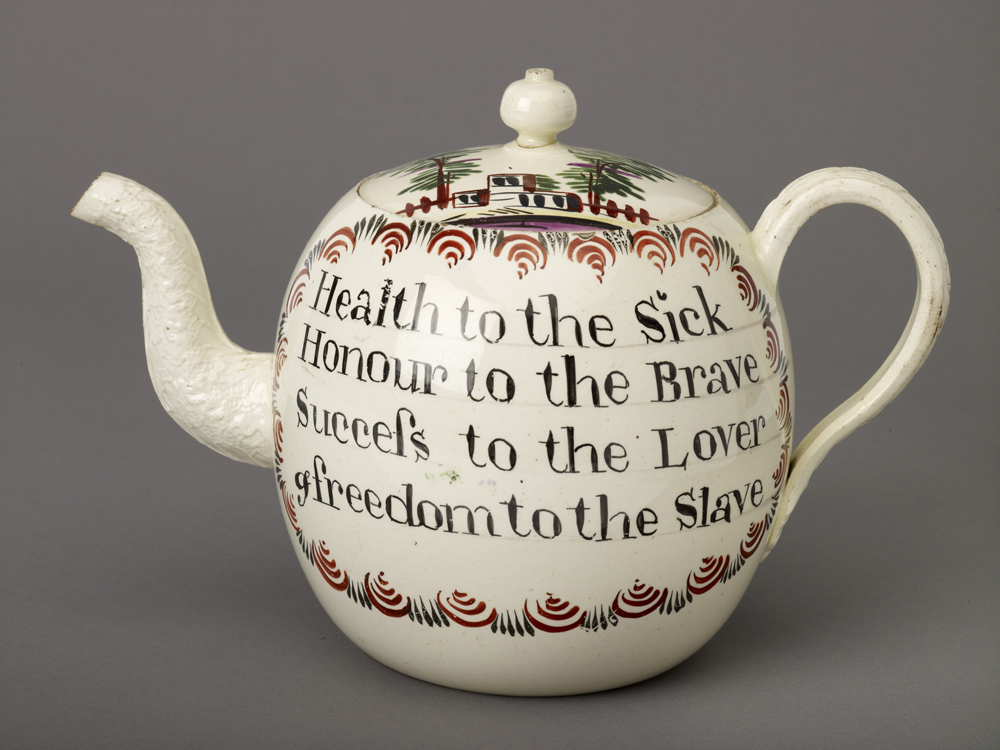
Abolition Teapot, by Josiah Wedgwood & Sons, c. 1760. Birmingham Museum and Art Gallery. Source. 

2. Find the politics in the everyday object

I’ve told everyone I know about this incredible article in Lapham’s Quarterly. Patricia A. Matthew writes about the late 18th-century consumer movement to boycott sugar from slave plantations. In the material record, this manifested as teapots and drinking utensils with snappy anti-slavery slogans, which allowed British women to organize around a political cause when they were not permitted to vote. Although we tend to think of teapots as the most domestic and innocuous of objects, their use speaks to complex issues of gender, colonialism, class, and globalization. Spin out the meanings of everyday objects, and you will often find that they have been more controversial than you think.

3. Make a political statement.

Indigenous water protectors protest the Dakota Access Pipeline at Standing Rock, ND; oil pipelines endanger drinking water and coastlines in addition to violating treaties. Source. 

It is not an accident that the communities without access to safe drinking water are disproportionately poor and non-white. In Canada, 107 First Nations reserves were affected by boil-water advisories at the end of last year. In the United States, citizens and water protectors are still fighting for access and regulation, and against fracking and pipelines, in communities like Standing Rock and Flint. Governments, regulatory bodies, and corporations have failed these communities. In a few decades we may all be in their position, with our access to fresh water jeopardized by government mismanagement and corporate interests.

Museums must work toward water justice – for disenfranchised communities now and for everyone in posterity. There are many ways to do this: through advocacy, ensuring that organizations obtain and sell water in ethical ways (Nestle’s water operation in Michigan, for example, violates a treaty which protects the land for Grand Traverse Band and Saginaw Chippewa tribal use), and, of course, through the interpretation of art and objects.

Ruth Cuthand's Don’t Breathe, Don’t Drink highlights the First Nations water crisis in Canada. 2016. Source.
The AGO’s acquisition and display of Ruth Cuthand’s arresting piece Don’t Breathe, Don’t Drink drew attention to the water crisis on reservations across Canada. Unless we resolve the inequalities that persist around access to safe drinking water, drawing attention to water justice and empowering visitors to act will only become more important in the future. While some necessary action, including divesting from fossil fuels and selling ethically-obtained water, represent big changes for museums, mindful acquisition and display of objects which speak to inequality is not only a possibility but a duty.

Cheers, santé, and prost, Musings readers! This is my final Musings column; it’s been a pleasure to connect with you and with my wonderful fellow columnists this year. Stay hungry, thirst after knowledge, and feed your souls. I’ll see you around the table.