Showing posts with label Cooper Hewitt. Show all posts

26 March 2021

MUSEUMS AS PLATFORMS IN A POST COVID WORLD

 Beyond Tradition | Erika Serodio


The many closures and lockdowns of this past year have forced museums to literally think outside their boxes. Museums have long been considered containers for the many artifacts and objects that tell stories about culture. As museums lost access to those containers this year, their storehouses became just that – places for objects, not people. There is mounting pressure to rethink the ways that these institutions engage with culture. A shift from object-based collections to visitor-centred programming is not a new idea in museums. However, a shift from the museum container to museum as platform has become an essential idea for a post-covid world.


Platforms can take us many places | Sources


Earlier this week I attended a zoom panel that was part of the Bihar Museum Biennale. The title of the panel was “Container vs Platform: Museum as an open space for conversation.” The panelists spoke of the importance of this idea in visitor research studies and how not so long ago, the idea of museums being for people was radical. The shift in thinking throughout the last few decades has been gradually moving in this direction, but the pandemic has heightened the need for urgent change in the museum sector.

The Cooper Hewitt responded to this critical moment for museums by convening with over a dozen museum professionals to create a toolkit titled “Tools and Approaches for Transforming Museum Experience.” In the toolkit, the authors describe the necessity and direction for change as follows:
“The rapidly shifting conditions of this past year have disrupted the sense of safety and familiarity offered by the creation and re-creation of formulaic museum experiences, but have not yet resulted in the kind of self-aware examination necessary for museums to break out of the hierarchical paradigms reinforced by those formulas. How might we interrogate the idea that expertise should be seated squarely in the hands of museum experts, or that audiences should learn from us instead of the other way around?”

Museums all over the world are finally asking their communities, their visitors, what they want to engage with and how. The Bentway has recently released a new initiative for its community called Digital and/as Public Space. The project, still in its development phase, invites anyone to contribute ideas on what it could and should be through a digital platform called Are.na. (You need to make an account to access it, but it’s free and easy and I highly recommend checking it out.)

Many museums have been transitioning to the platform mentality long before physical institutions were forced to close their doors. And some museums have formed without any building at all. Myseum of Toronto, Toronto’s museum without walls, creates programming and exhibits that incorporate the community at every step. Everyone is invited to share ideas, stories, art, music, and artifacts with the museum for its future programming. The Myseum website claims that "the more you get involved, the better the experience of Myseum will be." 

Places for people Source

The future of museums is unclear right now but it's exciting. The pandemic has created an opportunity for a wild reimagining of cultural institutions that will centre on visitors like never before. And we certainly aren't short on ideas. 

17 January 2017

NOT JUST FOR PLASTICS

SEW WHAT

BY: BRENNA PLADSEN

In the latest instalment of exhibitions I wish I could go to we have Scraps: Fashion, Textiles and Creative Reuse at the Cooper Hewitt, Smithsonian Design Museum. Scraps is currently on view until April 16, 2017. The exhibit highlighted, in one of the Cooper Hewitt’s small temporary exhibition spaces, is global in scope and features works from Italian label Riedzioni, founded by Luisa Cevese; Christina Kim, founder of dosa, inc., in Los Angeles; and Reiko Sudo, of Japanese textile firm NUNO.
Installation View of Scraps: Fashion,Textiles, and Creative Reuse.
Photo credit: Cooper Hewitt (source)
Each designer interrupts the typical mass production cycle at a different point to produce luxury products from the cast offs of a notoriously wasteful industry. While all three companies are commercially successfully, their approach towards their shared material, pre-consumer industrial textile waste created during garment manufacturing, and aesthetics differ dramatically. When placed together, they demonstrate differing but viable approaches to reducing waste in contemporary manufacturing.

NUNO textile Kibiso Stripe from 2008. Designed by Reiko Sudo. NUNO uses materials usually discarded in the silk production process to make their textiles.
Photo credit: Matt Flynn for the Smithsonian Institution (source)
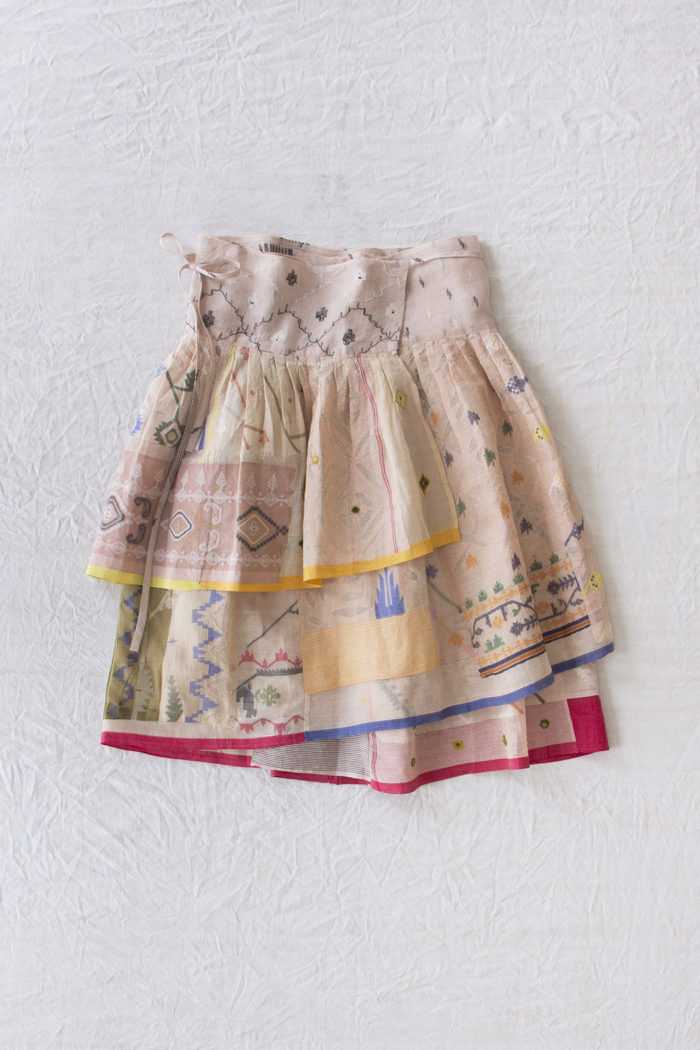
dosa skirt, 2008. Desiged by Christina Kim. This particular skirt is made from material discarded during industrial garment making. There is also a line made from the discarded materials used to make these garments.
Photo credit: dosa (source)

Large rectangular bag and very small bag by Riedizioni. 2013.
Luisa Ceverse, under the label Riedizioni, uses the discarded edges off rolls of silk and other waste textiles to create patterns in polyurethane.
Photo credit: Riedizioni (source)

There are two niggling thoughts that demand I address them. The first is to point at the tapestries of Hannah Ryggen and the works featured in Soft Monuments at KODE in Bergen as other examples of textiles as a feminine medium for political art, in part because of its status as craft or otherwise outside art. But I’ll leave/challenge Natania to tackle that in a She’s My Muse.

The second thought is more a series of questions: where else could this exhibit live? Where can we celebrate and worry at contemporary society before it becomes history?

The featured creators in Scraps point towards an answer. These three designers were selected in part because of the longevity of their environmentally motivated design practice. [source] This history is also closely tied with the art museum and gallery sector. NUNO has a decades long affair with museum exhibitions, including another show at the Cooper Hewitt in 1990. [source] Riedzoni products slide nicely into that art museum store niche. [source] dosa, the newest of the three companies, has already done collaborations with LACMA and a Pulitzer Art Foundation

Installation view of dosa's floor pillows for the Pulitzer Art Foundation in St. Louis.
The pillows are patched together and some are dyed with tea!
Photo credit: Carly Hilo for the Pulitzer (source)
So we see two potential roles of palaces of art: exhibitors and incubators/clients. Inside of the museum exhibition, visitors are asked to contemplate objects outside of their immediate use value, to take a moment and consider the networks and systems that created them, move them, and inscribe them with value. In the case of new objects, this is one place where this can be done without the immediate question of how this thing can be bought and consumed, where we can take a moment to think about how we fit into larger systems and our actions reverberate out into the world.

Final notes: if you'd like more content, including traditional upcycling textile techniques, Scraps includes blog posts by textile researcher Magali An Berthon. It looks like the digital content is updated regularly, including today's post on greenwashing! If you're on the cusp of a closet clean out but don't want to contribute to landfill, try any of these charities and shops if you're in the Toronto area.  

Resources