Showing posts with label Curating Science. Show all posts

12 January 2016

FEELING THE HEAT: MUSEUMS AND CLIMATE CHANGE

MUSEUM INNOVATIONS

BY: JENNY FORD

Sign at Ellis Island noting that exhibits have been removed because of Hurricane Sandy.
Sign at Ellis Island. Source: Jenny Ford
In May 2015, I took a trip to Ellis Island off the coast of New York City. The former immigrant inspection station is a museum and historic site today—but one that was quite bare when I visited. Empty display cases and missing panels were replaced with signs reading: "museum objects temporarily removed from exhibit", referencing damage by Hurricane Sandy in 2012.

I reflected on this sign as I flipped through the American Alliance of Museum’s 2015 Trendswatch guide in December, contemplating another year gone by. Out of the 2015 trends, climate change stood out to me.

The Paris talks are more than a month behind us now, and I began wondering what museums’ roles are in this climate change crux we are up against like never before.

CLIMATE AND COLLECTIONS

The AAM’s Trendswatch concentrates on the practical here—a sort of “batten down the hatches” call for museums to prepare collections for the imminent disasters ahead, from flooding to tornadoes.

In the case of Ellis Island, the hurricane flooded the first floor and basement of the historic site, only destroying one exhibit and thankfully leaving most of the collection untouched. However, most objects had to be removed because the hurricane damaged the climate control system. The fact the cases are still empty speaks to the damage (and cost) and perhaps the feat to make the collection hurricane ready in future.
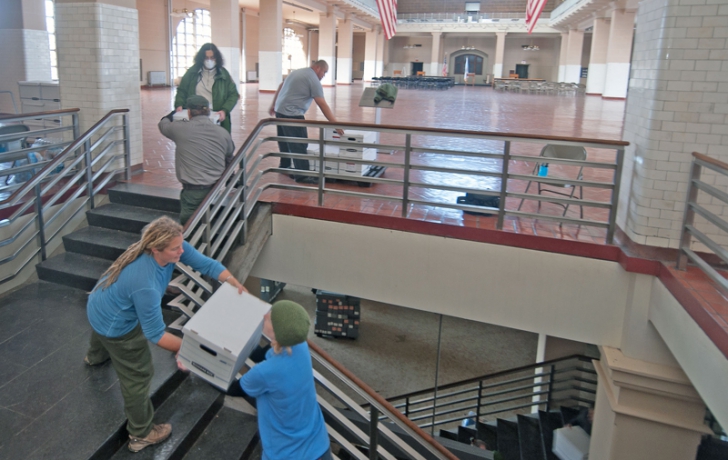

Staff removing objects from Ellis Island after Hurricane Sandy.
Staff removing archives and artifacts after the hurricane hit Ellis Island. Source.


There are a number of initiatives tackling these climate change issues, however. There's even an upcoming U.S. conference called Keeping History Above Water. The Future of Museums blog also recently posted an article about risk management tips for collections given climate change threats.

ENVIRONMENT AND EXHIBITS

But the other side to this climate change challenge is education. When I got thinking, I could list a number of permanent climate-change-related exhibits in museums. The entire story line for the Royal Ontario Museum’s permanent Schad Gallery of Biodiversity is dedicated to the effects of climate change on biodiversity.
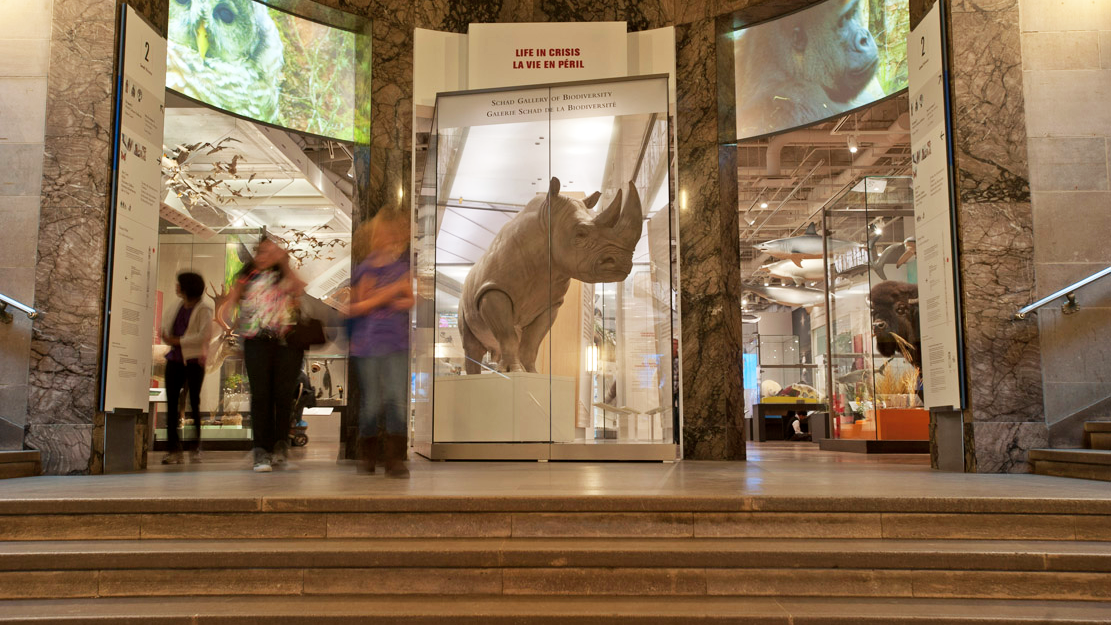
The entrance to the ROM Biodiversity Gallery, showing a rhino.
The ROM's Schad Gallery of Biodiversity. Source.

In the states there are also a number of efforts, including the Field Museum's 2010 Climate Change exhibition in Chicago. The exhibition addressed the contributors to and consequences of climate change.

Perhaps most importantly, there's the ambitious Climate Change Museum in New York that launched in July 2015. The museum aims to create "a hub for climate science, art and dialogue: a beacon for solutions."

An exhibit showing rising sea levels at the Chicago Field Museum.
An exhibit at the Field Museum's Climate Change exhibition. Source.

The estimated opening date is 2020. By then, many of the commitments outlined at the Paris Conference will be on their way... if this round of agreements actually sticks. That being said, there are plans for pop-up exhibits, including one slated for summer 2016 that delves into fossil fuel use in the U.S. An interim museum is also planned for 2017 until the full-fledged museum is ready.

DOING OUR PART?

So, we're attempting to educate the masses, we are planning for disaster, but is the message really sticking? Or is it all falling on deaf ears?

In one skeptical Guardian article earlier this year, author Jonathan Jones questions if museums can "deal with this topic in a way that is genuinely informative, intelligent, honest and accessible without being patronising".

Many science museums, accuses Jones, have done a poor job overcoming these communication obstacles, with poorly designed interactives that concentrate more on fun than practical solutions. Specifically, he calls out the London Science Museum, which he argues is more of a playground than actually a showcase for science.

A gallery in the London Science Museum with a giant globe and rover.
Inside the London Science Museum. Source.
He advocates that in order for climate museums (and exhibits) to work, they need to reinvent the museum itself—educational, interactive, informative, and solution driven. Science and not entertainment needs to be at the core. There needs to be hope beyond the despair, but a hope that's informative, as well.

Whether this is the best or most useful path is a debate for another article. It seems innovation is still wanting when it comes to climate change and museums.

WHAT NEW MUSEUM INNOVATIONS ARE NEEDED TO COMBAT THE CLIMATE CHANGE CRISIS?

22 September 2015

ODE TO THE MUSEUM PRIZE EXCHANGE

MUSEUM INNOVATIONS

BY: JENNY FORD

Welcome to the first Museum Innovations column of the year! The first innovation of the season actually isn’t new at all. In fact, it celebrated its 30th birthday last year. But this underrated innovation still has a lot of un-tapped potential.

Nature Exchange in Sudbury. Shelves with trading items.
Nature Exchange at Science North. Source. 

The Nature Exchange reminds me of the prize counter at Chuck E. Cheese's – you’ve just played a bunch of games and have clambered together a couple hundred tickets to trade for prizes based on points.

Flip that to the museum. The Nature Exchange is the museum version of a prize counter. And it has SCIENCE! The exchange was the brain child of Science North in Sudbury, Ont. way back at its opening in 1984. Since then, the idea has been adopted in institutions from Las Vegas to Kamloops, B.C.


HOW IT WORKS

The goal of the exchange is for visitors to explore the natural world around them and bring that knowledge back to the museum. The Nature Exchange exhibit (if you can call it that) asks visitors to bring in their own natural history objects – rocks, shells, fossils, pinecones, etc. You then share your knowledge about the object with Nature Exchange staff.

People looking at objects at the Nature Exchange in Springs Preserve Las Vegas.
Nature Exchange at the Springs Preserve in Las Vegas. Source.
The more you know, the more points you get. The nicer or more curious the specimen, the more points you get. Visitors then cash in their points for other cool natural history objects at the exchange, like geodes or nifty shells. Bank points for some of the bigger objects.


KNOWLEDGE OUTSIDE-IN

What's fascinating about the Nature Exchange is how the experience spans beyond the museum walls. Usually, museums aim to transfer information from the inside-out; you learn something at the museum and then transfer that to your community.

But the Nature Exchange is the opposite. Visitors are learning outside the museum and bringing that knowledge into the institution. It's helping people learn more independently from the museum, you could say, while still using the institution as a forum for idea-sharing. However, I'm sure Nature Exchange staff share tidbits of information, as well.

The trading counter at the Nature Exchange at the Woodlands Park Zoo in Seattle.
Another version of the Nature Exchange at the Woodland Park Zoo in Seattle. Source. 

As far as I know, this outside-in approach is not too common in museums. You could say it happens when visitors share their experiences and memories about objects, but this is often knowledge they already possess.


HOW TO RE-APPLY

So, how would this model look in other museum settings? I'm not too sure of the answer to that. Maybe an "Art Exchange", like this mini-museum below, is in order.

The Mini-Art Exchange with art objects in Sudbury.
The Mini Art Exchange... also curiously from Sudbury. Credit: Jenny Ford

The applications are interesting to speculate, and there are advantages to thinking of museums not as disseminators of knowledge but forums, like at the Nature Exchange.


LET ME KNOW WHAT YOU THINK!

6 December 2014

iSCHOOL EVENT YOU MAY HAVE MISSED: CURATING SCIENCE POSTER SESSIONS

BY: ANYA BAKER

If you have friends in MSL2050, Professor Hooley McLaughlin's Curating Science course, you probably have heard about some of the cool stuff we've been doing this semester. After weeks of classes and student-led seminars on various topics in science, and some great field trips to the AGO's Frum Collection and the ROM's Invertebrate Lab, the class was ready to present their final individual projects in the Poster Session. Your elementary school science fair had nothing on this--the posters were highly professional, very creative, and demonstrated one of the most important things we developed in the course: a love of discovery.

We could interpret the word 'poster' in whatever way we desired, and so our projects ended up including posters, related images, demonstrations, a canine companion, multimedia elements, kinaesthetic activities, interactive elements, and even food! Topics ranged wildly, as you will see; it was a wonderful evening of learning and sharing, and everyone was delighted to show off what they had been researching and interpreting for the past few weeks.

Some projects and activities are represented below:

Photo of a woman standing in front of a science project.
Kristen Atkins presented on rainbows; you could make your own rainbow using a flashlight and the globe of water! Next to her is Camille Sharp's project on imagined geographies. Photo credit: Anya Baker. 
Photo of women standing around a science project related to food.
Kate Roughley presented on food pairings and taste. I found out that I have an average number of taste buds, and am not a super taster. Photo credit: Anya Baker. 
Photo of a man and a woman standing in front of a 3D printer and a poster board.
Professor McLaughlin with Meaghan Dalby interacted with her project on 3D printing; she brought in a small 3D printer to demonstrate how it worked. Photo credit: Anya Baker. 
Photo of two women standing in front of a small globe and a poster board.
Cady Moyer (right) explained the migration of monarch butterflies; she even made small clay models of the different stages of the caterpillar's life cycle. Photo credit: Anya Baker. 
Photo of a woman standing next to a poster board.
Dylan Dammerman guards the cookies that were part of her exhibit on expertise concerning chronic illness. Photo credit: Anya Baker. 

Leah Moncada developed her own board game for her project on speech impediments. 

Photo credit: Anya Baker. 


Photo of three women standing around a poster board.
Mary Kate Whibbs and Cady Moyer interacted with Rowena McGowan's presentation on robotics. Mary Kate's project on fish is beside them on the table; she created a dating site for fish, to describe their mating habits! Photo credit: Anya Baker. 
Photo of two women interacting with a dog in a classroom.
Kasey Ball brought in a furry friend for her project on therapy animals. Photo credit: Anya Baker. 
Photo of a man and a woman in a classroom.
Lindsay Small presented on colonizing Mars; her t-shirt was appropriately themed! Photo credit: Anya Baker. 
Photo of a woman playing a keyboard in a crowded room.
Bethea Penny and Victoria Stoneman interacted with Bethea's project on music. Photo credit: Anya Baker. 
Photo of a table covered in photos of a man making various expressions.
Can you guess Tim Roth's micro-expressions? (from Veronica Stoneman's project on micro-expressions). Photo credit: Anya Baker.

I was unable to photograph all the projects--if you attended and have photos of what I missed, I would love to add them to this article; email me at anya.baker@mail.utoronto.ca. Thanks to all who attended the Poster Session!