Showing posts with label Emma Hoffman. Show all posts

20 March 2017

ARTS FUNDING IN THE TRUMP ERA: WHERE DO WE GO FROM HERE?

MUSEUM MONDAYS

BY: EMMA HOFFMAN

Every December, my family and I watch the Kennedy Center Honors: an annually televised program at the John F. Kennedy Center for the Performing Arts in Washington, D.C., during which artists are awarded a lifetime achievement in the arts and are celebrated for their careers and contributions. It is a formal event: the U.S. President and First Spouse are always present, and the cameras always pan back to them so audiences can see how they're enjoying the show. This past Honors, I felt a bittersweet feeling as the cameras kept showing the Obamas dancing, mouthing the words to songs, and generally being #couplegoals. As the inaguration of Donald Trump loomed in near future, we wondered, what would the new president's response to the arts be?

Barack and Michelle groovin'. Source.

I wanted to discuss this topic because last Thursday, President Trump announced in his first federal budget plan, a proposal to terminate the National Endowment for the Arts (NEA) and the National Endowment for the Humanities (NEH). In the U.S. there is a longer and deeper tradition of private funding for the arts than in Canada, and as much of private funding goes to larger, more profitable institutions, there is a fear that smaller museums, galleries, institutions, and arts organizations will be the most detrimentally affected by Trump's proposal.

Although not the most glamorous topic for today's edition of Museum Mondays, grants and other types of financial support from government agencies help support artists and arts organizations. In Toronto, the Toronto Arts Council, the Ontario Arts Council, the Ontario Trillium Foundation, and the Canada Council for the Arts helps provide much-needed financial support to people in the arts who display their work in, and collaborate with museums and institutions, and to museums and institutions themselves.

The 'artist' in question. Source. 
Let's look at the numbers. While 40% of the NEA's current funding goes directly to state-wide arts agencies, the rest of the NEA's funding is awarded directly to arts agencies and 65% of that direct funding goes to small and medium-sized organizations (NEA Quick Facts 2017). Furthermore, much of the aforementioned direct funding goes towards organizations who support under-served populations who have the opportunity to benefit from community arts programming.

I'm not yet 100% convinced that Trump's proposal to eliminate these critical funding structures will proceed in practice however, as an Emerging Museum Professional, I'm worried that the job prospects and opportunities for many arts professionals in the United States will be compromised by severe cuts to public funding. Although there is no easy solution to these complex issues at hand, I'm thinking about ways to support our colleagues south of the border while marinating on the real possibility that come December 2017, there might be no Kennedy Center Honors at all, or, even worse, Trump might be dancing in the stands.

My girl Carole King at the Kennedy Center Honors. Source.
As usual, I'd love to hear your comments below! So as not to end on such a somber note, I am planning on graduating after this semester, and this is my last time writing Museum Mondays! Have fun and stay cool my awesome readers! Emma Hoffman: signing out.

References
Deb, S. (2017, March 15). "Trump Proposes Eliminating the Arts and Humanities Endowments." The New York Times. Retrieved from https://www.theatlantic.com/entertainment/archive/2017/03/what-eliminating-the-arts-and-humanities-endowments-would-really-mean/519774/.

Gilbert, S. (2017, March 16). "The Real Cost of Abolishing the National Endowment for the Arts." The Atlantic. Retrieved from https://www.theatlantic.com/entertainment/archive/2017/03/what-eliminating-the-arts-and-humanities-endowments-would-really-mean/519774/.

NEA. (2017). "NEA Quick Facts." National Endowment for the Arts. Retrieved from https://www.arts.gov/sites/default/files/nea-quick-facts.pdf.



13 February 2017

STORIES OF LOVE AND LOSS AT THE MUSEUM: THE MUSEUM OF BROKEN RELATIONSHIPS

MUSEUM MONDAYS 

BY: EMMA HOFFMAN

Hey y'all! Today I'm back with a special Valentine's Day edition of Museum Mondays. Whether your V-day plans include spending some one-on-one time with your boo, telling your family and friends how much you love them, and/or practicing self-care to show yourself some love, join me this Monday for quick power-walk through the history of heart day and a visit to the Museum of Broken Relationships.

This was too appropriate. Source.
From the seasonal decor aisle at your local dollar store to the proliferation of diamond commercials on T.V., the facade of love has been used and abused to advertise chocolate, candy, and sparkly things. Despite this, Valentine's Day's origins are in fact not found in consumerism. The ancient Roman fertility festival: Lupercalia, was appropriated by the Catholic Church and turned into "Saint Valentine's Day". The saint-day memorialized Saint Valentine of Rome: a priest who was executed for performing marriages for people who were prohibited from tying the knot, for a variety of reasons. In Europe, Valentine's Day notes and letters were first exchanged during the fifteenth-century, and this trend transformed into the act of exchanging Valentine's Day cards that has remained popular throughout the past few hundreds of years.

Source.
Now that we know that Ancient Roman parties, martyrs, Christianity, and letter-writing have all contributed to the development of the Valentine's Day we experience today, let's check out The Museum of Broken Relationships together.

I first came across The Museum of Broken Relationships while surfin' the old 'web last year. The museum is "a global crowd-sourced project," that consists of online exhibits as well as two physical locations in Zagreb, Croatia, and in Los Angeles, California. The objects displayed are regular, everyday items belonging to everyday people, but their shtick is that these items are representative of donor's romantic relationships, break-ups, and heartbreak. The objects are donated to the museum's physical collection, or images of personal items can be uploaded to the museum's website.

Object from the Museum of Broken Relationships' online collection. Source.

Source.

The visitor-centred model that the Museum of Broken Relationships uses is backed by theories in current museological discourse, such as Nina Simon's 'the participatory museum'. Simon argues that the display of 'social objects' can encourage participatory experiences in museums: objects that, can engage visitors by, "tapping into pre-existing stories and connections between visitors and collections." Stories discussing matters of the heart are something that the majority of potential visitors can relate to, and therefore, an exhibit made by visitors, for visitors, can both attract visitors through the museum's active effort to make their collections relevant to visitors' lives, and can encourage visitors to participate in the experience by sharing artifacts from their own break-ups.

Although the objects and accompanying labels from the Museum of Broken Relationships can be both funny and devastating, they acknowledge the similitude between people's experiences, regardless of location, and provide an example that the people sharing their break-up stories in the Museum's exhibits are not actually alone in their feelings of loneliness.

Would you ever contribute an object to the Museum of Broken Relationships or take part in a similar participatory experience? Let me know in the comments and Happy (almost) Valentine's Day to all the readers out there.

Bonus: Nick Viall and some of the Bachelor season 21 cast at the Museum of Broken Relationships in L.A. Source.
Resources:
Hanes, E. (2013, Feb. 14). "6 Surprising Facts About St. Valentine." History. Retrieved from  http://www.history.com/news/6-surprising-facts-about-st-valentine .
Simon, N. (2011). The Participatory Museum. Retrieved from  http://www.participatorymuseum.org/chapter1/. 


25 January 2017

TORONTO STORIES FROM THE ONTARIO JEWISH ARCHIVES

TORONTO STORIES

STORIES BY: EMMA HOFFMAN, HAYLEY MAE JONES, KRISTINA KARAKOLIS, CLAUDIA PALERMO, AND NATANIA SHERMAN

COMPILED BY: BRENNA PLADSEN

The series of digital stories about Toronto history and culture which make up this project are the work of fifty-three Master of Museum Studies (MMSt) graduate students. The project was inspired by the 2015 Myseum Intersections – Telling Toronto’s Stories and invited each storyteller to select an object from local collections which has significance to Toronto’s past and present. The objects inspired the authors to connect historical events with contemporary context so that they tell stories about the multiple intersections that happen in the city.

Musings will be posting collected stories once a cycle. We hope that, after reading the stories, you will know Toronto a little bit better. And perhaps you will find similar stories in your own objects!

Our partners for this project, to which we are extremely thankful, are:
Now, without further ado, object stories from Ontario Jewish Archives.

FROM GEFILTE FISH TO GRILLED CHEESE: UNITED BAKER'S AND JEWISH CULTURE IN TORONTO


BY: EMMA HOFFMAN

The smell of beet borsht and the savoury taste of cheese inside a blintze… that’s what Jewish culture tastes like at United Baker’s, a true Torontonian institution.

A dairy restaurant [1] serving traditional Ashkenazi [2] fares, United Baker’s was originally located in Kensington Market until it closed in 1986, but still maintains a location uptown at 506 Lawrence Avenue West. The Ladovsky’s, a Polish-Jewish family, established the original United Baker’s in 1912 when Kensington Market was the centre of the Jewish community in Toronto and the population of Kensington Market was almost 100% Jewish. [3]

The copy of the last menu [4] used at United Baker’s in Kensington Market, can be found in the Ontario Jewish Archives (OJA). Herman Ladovsky, the second-generation owner of the restaurant and his daughter Ruthie Ladovsky donated this object to the archives when the downtown location closed in 1986. Herman and Ruthie have signed the menu with the message: “With fond memories of a long history.” 

United Bakers Dairy Restaurant menu, cover. (1986).
Ontario Jewish Archives, fonds 83, file 8. Scanned copy of object by OJA.
Although similar dishes can be found on United Baker’s 1986 menu and on their current menu, this object is significant because it represents the migration of the Toronto Jewish community north during the past 60 years. [5] By the end of the Second World War, Jewish peoples had prospered from their businesses in Kensington Market and began moving to wealthier neighbourhoods uptown, while new immigrants displaced by the War were moving into the more affordable houses in Kensington Market, at the same time Jewish families were relocating from the area. [6]

Today, United Baker’s still provides a meeting place for Jewish immigrants to Toronto and their descendants. Ruthie Ladovsky, the third-generation co-owner of United Baker’s, gives insight into why the restaurant originally gained popularity: “It was a real meeting spot. The same as it is today.” [7]

United Bakers Dairy Restaurant menu, inside. (1986).
Ontario Jewish Archives, fonds 83, file 8. Scanned copy of object by OJA.
Herman Ladovsky was a great supporter of the Ontario Jewish Archives, [8] so much that after his death in 2002, the Ladovsky family installed a plaque at the OJA that reads: “A Jew is not a Jew unless he is a member of a community.” [9] With continued support from a community of customers from all cultures, United Baker’s still remains a central place for schmoozing [10] and for enjoying delicious homemade food.

Footnotes
1. A restaurant that does not serve meat or meat-products to accommodate those who follow the Kosher laws of kashruth that disallow milk and meat from being consumed together.
United Baker’s. (2012). “United Baker’s Dairy Restaurant: Celebrating 100 Years, a Toronto Tradition Since 1912.” United Baker’s. 21. Retrieved from http://unitedbakers.ca/wp-content/uploads/2012/08/united-bakers-celebrating-100-years1.pdf.
2. Jewish peoples originating from Central and Eastern Europe.
3. N. Li, (2015), Kensington Market: Collective Memory, Public History, and Toronto’s Urban Landscape, Toronto: University of Toronto Press, 15.
4. United Bakers Dairy Restaurant menu. (1986). Ontario Jewish Archives, fonds 83, file 8. Scanned copy of object by OJA.
5. E. Roher, (1986, August 4), “A Spadina tradition, restaurant to close,” The Globe and Mail. Ontario Jewish Archives.
6. Li 2015, 17.
7. Li 2015, 54.
8. Li 2015, 72.
9. Ibid.
10. Socializing and chatting in a group setting.

SENDING OFF CRIMINALS, COMMUNISTS, REBELS, SOLDIERS AND HEROS


BY: HAYLEY MAE JONES

Personal Photo of Mackenzie Papineau Battalion Pin Taken at the Ontario Jewish Archives
Hidden away in the Ontario Jewish Archives (OJA) is a Mackenzie Papineau Battalion pin. The pin is small, about the size of a dime, but the colours are bold, and it is smooth to the touch. Despite the size, the artifact has a powerful message: No Pasaran. Translated from Spanish, the passage means: "they shall not pass". These words were the slogan of men and women who fought against fascism during the Spanish Civil War.

The pin's origin is a mystery. Archivists claim that little is known about how the object fell into the Joseph Baruch Salsberg fonds at the OJA. Many members of the Jewish community were actively involved with the labour movement, including Joseph Salsberg. Salsberg's files provide copious information about his political involvement with the Communist Party of Canada, but show little information about how he acquired the pin. This being said, the pin reveals the Mackenzie Papineau Battalion’s strong connection to the city of Toronto.

The Mackenzie Papineau Battalion was made up of almost 1,600 Canadians who defied the Canadian government, broke the law, and fought against the fascists in the Spanish Civil War. Spain became politically divided after the abdication of King Alfonso XIII in 1931, which escalated into the Spanish Civil War after a fascist coup d'état in 1936. Many nations, including Canada, wanted to avoid aggravating the conflict at all costs. As a result, the Mackenzie King government imposed the Foreign Enlistment Act, to bar any Canadian involvement. However, the members of the Battalion foresaw the dangers of fascism, and knew they must act.

Toronto was one of the two meeting points for these soldiers when they left their lives behind, and began their journey to Spain. In Toronto, these men prepared to be smuggled out of Canada while hiding from the RCMP. This was done with the help of the Communist Party of Canada. The story goes that the Communist Party would meet volunteers in Toronto or in Montreal and travel with the volunteers until they reached Spain, providing them with clothing, and travel tickets. As they were being smuggled out of Canada, volunteers were under threat of being arrested by the RCMP for attempting to disobey the Foreign Enlistment Act.

Once in Spain, the Mackenzie Papineau Battalion faced even greater challenges. The fascists led by General Francisco Franco were being supported by Adolf Hitler and Benito Mussolini. Ultimately, many members of the battalion were captured, wounded or killed. Having lost the War, the surviving members eventually returned to Canada only to face discrimination for their actions. They were placed under RCMP surveillance and deemed to be criminals, communists and rebels.

Regardless of how they are perceived, the memory of the Mackenzie Papineau battalion lives on through artifacts scattered across Toronto, the city where their journey began in 1936.

For more information on the Mackenzie Papineau Battalion:

Secondary Sources

Beeching, William C. (1989). Canadian Volunteers: Spain 1936-1939. Regina: Canadian Plains Research Center.

CBC radio. (2012) Canada's 'MacPaps' and the Spanish Civil War (Promo) [Podcast] Retrieved from: http://www.cbc.ca/player/Radio/The+Sunday+Edition/ID/2302691551/?page=4&sort=MostPopular

Frohn-Nielsen, Thor Erik. (1982). “Canada’s Foreign Enlistment Act: Mackenzie King’s Expedient Response to the Spanish Civil War” Masters dissertation. Available from UBC Theses and Dissertations. University of British Columbia. DOI: 10.14288/1.0095528

Howard, Victor. (1987). The Mackenzie-Papineau Battalion: the Canadian contingent in the Spanish Civil War. Ottawa: Carleton University Press.

Jones, Hayley Mae. (2014). Final Paper: The Canadian Spanish Civil War Volunteers. (Unpublished Undergraduate paper). University of Ottawa: Ottawa.

Petrou, Michael. (2008). Renegades: Canadians in the Spanish Civil War. Vancouver: UBC Press.

Poggi, Mathew. "Spanish Civil War Veteran’s and the Pursuit of Recognition." Masters dissertation. (n.d.) url: http://www.albavolunteer.org/wp-content/uploads/2013/01/Poggi_Watt-Essay_2012.pdf

The Friends and Veterans of the Mackenzie-Papineau Battalion. (n.d.). Canadian Volunteers in Spain 1936-1938. Retrieved from: http://web.net/~macpap/volunteers.htm.

The Friends and Veterans of the Mackenzie-Papineau Battalion. (n.d.) Bibliography. Retrieved from: http://web.net/~macpap/bibliography.html

The Friends and Veterans of the Mackenzie-Papineau Battalion. (n.d.) La Pasionaria (Dolores Ibarruri, Member of the Spanish Parliament) Farewell to the International Brigades in Barcelona, Spain. Retrieved from: http://web.net/~macpap/texts/Farewell.htm.

The Friends and Veterans of the Mackenzie-Papineau Battalion. (n.d.) Poetry, Speeches, Texts on Individual Brigadistas. Retrieved from: http://web.net/~macpap/texts/texts.htm.

Wikipedia. (2014). No Pasarán Speech (1936) by Dolores Ibárrui Spanish Civil War, Speeches. Retrieved from: https://en.wikisource.org/wiki/No_Pasaran

Wikipedia. (2015). They shall not pass. Retrieved from: https://en.wikipedia.org/wiki/They_shall_not_pass

Primary Sources
Blum, Leon. (September, 1936). 5697 - Approaching the Crisis. The Jewish Standard. (p. 5, 40-43). Ontario Jewish Archives.

International Workingmens Association an Archosyndicalists. Events In Catalonia. Ontario Jewish Archives. Fonds 32, series 3-3, file 24.

Mackenzie Papineau Battalion pin [object] – [195-?].Ontario Jewish Archives. Fonds 92, Series 3, Item 2.

Workers Party of Marxist Unification of Spain. (October 1936). The Spanish Revolution. Ontario Jewish Archives. Fonds 32, series 3-3, file 24. 

Workers Party of Marxist Unification of Spain. (November 1936).  The Spanish Revolution. Ontario Jewish Archives. Fonds 32, series 3-3, file 24.

DORA TILL, THE WOMEN'S AUXILIARY, AND BAYCREST: A GLIMPSE INTO THE TORONTO'S JEWISH COMMUNITY


BY: KRISTINA KARAKOLIS

Dora Till could be defined best as a leader in the Jewish community in Toronto. From her early commitment to community service, her advocacy for women, children, and the elderly, Till aimed to make changes and fulfil a need within her community wherever possible. According to Ontario Jewish Archives (OJA) Archivist Donna Bernardo-Ceriz, Till emphasised the welfare of youth and elders in the Jewish community and urged others to give back through donations, volunteer work, or by participating in community events.

During her long and inspiring philanthropic career, Dora Till, participated and created a number of organisations that directly helped Jewish mothers and children. From the Federation of Jewish Philanthropies of Toronto, the United Jewish Welfare Fund (UJWF), and The Women’s Service Council, Till actively donated her services, skills, and passion wherever she was needed. Till later served as the vice-president for the Maternity Hebrew Aid Society and later become president of Women’s Auxiliary at Baycrest Heath Sciences.

The Ontario Jewish Archives, Blankenstein Family Heritage Centre is currently displaying an exhibit entitled Polyester, Pattern, and Perms: Fashion from the 1960s and 70s. The exhibit highlights women, their fashions, and their lifestyles during the 60s and 70s, giving viewers a glimpse into Toronto’s history and it’s Jewish community.

The “Visit of Constance Bennett to Baycrest Women's Auxiliary, 1961” is one of the photographs displayed in the exhibit and depicts six women in the midst of conversation. Taken by Famous Portrait Studio, a significant institution in the Toronto Jewish community, the photograph features Constance Bennett, who during her career as an actress started in over 60 films, standing in the center, wearing a glamorous fur coat, and Dora Till, who stands to Bennett’s left. The photograph was taken during an annual fundraiser held by the Women’s Auxiliary in honour of Baycrest hospital. 

Jewish Home for the Aged hosts Constance Bennett, 13 Dec. 1961.
Ontario Jewish Archives, fonds 18, series 3-4, file 11.
The Women’s Auxiliary, which operated separately from Baycrest, helped to encourage female participation, leadership, and aided in the foundational work for the hospital. Through various initiatives, from program development to running the hospital’s gift shop, the women at Baycrest filled an important role in the operation of the hospital. One of the Women’s Auxiliary main initiatives was an annual fundraising event, and under Till’s leadership, the Auxiliary was able to directly aid in the build and development of their new facilities on Bathurst, which is still in use today.

Jewish Home for the Aged hosts Constance Bennett, 13 Dec. 1961.
Ontario Jewish Archives, fonds 18, series 3-4, file 11.
Due to her long-standing commitment to the Jewish community and her unwavering leadership, Dora Till was the first woman to ever receive the UJWF’s Ben Sadowski Award for Jewish Community Service in 1969. Till was a central figure to her community, a prominent women through her philanthropic work, and was instrumental in the rebuilding of Baycrest hospital.

The Ontario Jewish Archives, Blankenstein Family Heritage Centre is the largest repository of Jewish life in Canada. Check out their website to learn more about Till and other prominent figures in the Jewish community.

PHILANTHROPY IN THE GTA: THE LEGACY OF SYLVIA SCHWARTZ


BY: CLAUDIA PALERMO

Sylvia Schwartz, 1950.
Ontario Jewish Archives, fonds 80, series 5-1, item 17.
A quick search in the Ontario Jewish Archives reveals some fascinating information about the photographic work of Sylvia Schwartz. Schwartz, pictured in the photograph below was born with a medical condition known as dwarfism. [1] She is best known for capturing wonderfully creative formal portraits of servicemen during the war, families, brides, and eventually carved out her own niche specializing in child portraiture.

Schwartz had the ability to connect with children on a level that most adults could not. She could get children to sit quietly and pose in creative and charming positions and the result was formal children’s portraiture with exceptional lighting, props, and posing. After the death of her sister, Sylvia Schwartz established the Ruth Schwartz Children’s Book Awards, which was later changed to the Ruth & Sylvia Schwartz Children’s Book Awards [2] to honor both sisters. For over 35 years, this award has recognized artistic excellence in Canadian children’s literature and features two awards, which are presented annually, for picture books and for young adult readers.

The Ontario Jewish Archives holds the records of individuals who have made important contributions to the Jewish communities of Ontario, and Sylvia Schwartz serves as a reflection of the important role that Jewish citizens played in the artistic history of Toronto. Sylvia’s is also the story of female artists in Toronto during the 1940’s. Through both her life and her work, Sylvia Schwartz has demonstrated her involvement and engagement with the philanthropic community in Toronto. Personal philanthropy has been a mainstay of funding art programs in the City of Toronto, and through her partnership with the Ontario Arts Foundation, [3] Schwartz has helped build a stronger art community.

Her legacy continues to touch the lives of numerous gifted children around the Toronto area. Alan Walker, the Executive Director of the Ontario Arts Foundation writes, “We hear time and time again from Ruth and Sylvia Schwartz Children’s Book Award winning authors at how moved they are by the insight and sophistication shown in the school-age jurors. These awards have a profound impact on all involved, and we thank the Ruth Schwartz Foundation and the Ontario Arts Council for helping to make these awards such a memorable experience for all.” [4] Her story leaves us wondering just how many other less known female artists have also left a lasting legacy on the city? To learn more information about Sylvia Schwartz or other prominent Jewish Torontonians, visit the Ontario Jewish Archives at ontariojewisharchives.org.

Footnotes
1. “Dwarfism.” 2015. Wikipedia. Wikimedia Foundation. https://en.wikipedia.org/wiki/dwarfism.
2. “PERSONAL PHILANTHROPY Ruth & Sylvia Schwartz Children's Book Awards.” 2015. Ontario Arts Foundation / Fondation Des Arts l'Ontario. Ontario Arts Foundation / Fondation des Arts l'Ontario. Accessed. http://www.ontarioartsfoundation.on.ca/pages/ruth-sylvia-schwartz-awards.
3. “Sylvia Schwartz.” 2015. Sylvia Schwartz. Ontario Jewish Archives. Accessed. http://ontariojewisharchives.org/explore/people/sylvia-schwartz.
4. “Shortlist For 2015 Ruth and Sylvia Schwartz Children's Book Awards Announced.” 2015. Shortlist For 2015 Ruth and Sylvia Schwartz Children's Book Awards Announced. Ontario Arts Council. Accessed. http://www.arts.on.ca/page5833.aspx.

LIFE IN THE SHMATA BUSINESS: THE STORY OF TIP TOP TAILORS AND ITS WORKERS


BY: NATANIA SHERMAN

This two inch sliver of silver engraved with the words “Tip Top Tailors: Canada’s Largest One Price House” was brought to the Ontario Jewish Archive (OJA) by a collector. It is a small pocketknife from the 1960s. There is no record of who owned and used the pocketknife. Instead, I started to think about all the people who might have owned it, and the company that made it. From trendy Tip Top Lofts downtown to the old Jewish furriers on Queen West, there is no question that the garment trade physically altered the city of Toronto. Tip Top Tailors’ history is the story of the Dunkelman family who owned it, of the Jewish immigrants who worked there, and of the labour and Zionist movements that shaped their experiences.

Tip Top Tailors Pocketknife from the Ontario Jewish Archives, Blankenstein Family Heritage Centre,
circa 1960’s, photo by author
A Jewish immigrant named David Dunkelman founded Tip Top Tailors in 1909. His concept was to sell one-price suits tailored to measure. This business model quickly became a success, transforming Dunkelman into a leading manufacturer of men’s clothing in Canada. Until 1967, Tip Top Tailors was owned and operated by members of the Dunkelman family. The Dunkelmans were well known Zionist leaders in Toronto, and maintained a strong commitment to assisting Jews in the diaspora.

While the Dunkelmans had built a comfortable life in Toronto, many of their Jewish employees had a very different experience when they settled in Canada. After World War Two ended in 1937, a large number of Jews who had lost their homes to the Nazis, were displaced. Many of these Jews had been tailors in Europe because that was one of the few professions open to Jewish people. Meanwhile, Canada was experiencing a shortage of skilled labourers in factories because so many men had joined the war effort. From 1946 to 1948, an initiative by the Canadian Overseas Garment Commission, called the Tailor Project, provided sponsorship and housing to displaced Jews from Europe to work in Canadian garment factories. Tip Top Tailors was one such company. [1]

Tip Top Tailors factory interior, Toronto, [ca. 1933].
Ontario Jewish Archives, Blankenstein Family Heritage Centre, item 2373.
While the Tailor Project certainly helped many displaced people find shelter and work in Canada, Jewish immigrants to Toronto had few options. Not only did they face anti-Jewish sentiments in their new homes, they faced the reality of harsh labour conditions in the garment factories. In Sweatshop Strife, Ruth Frager describes the sweatshops of 20th century Toronto as places where “…women toiled alongside men, and Jews toiled side by side with non-Jews…” Eventually, workers in the sweatshops unionized in order to build better working conditions. In today’s culture of imported fast fashion, it is easy to forget that our city was shaped by the local garment industry. We may never know who used this pocketknife, but its history tells the stories of the industrialists and workers at Tip Top Tailors.

Footnotes
1. A Daily News article from November 6th, 1947 described Tip Top Tailors taking on 75 displaced persons.

Works Consulted
Charles, Alana, “Condo of the Week: The Tip Top Lofts Building,” BlogTO, June 25, 2015 http://www.blogto.com/city/2015/06/condo_of_the_week_the_tip_top_lofts_building/. Retrieved on November 13, 2015

Frager, Ruth A. “Sweatshop Strife: Class, Ethnicity and Gender in the Jewish Labour Movement of Toronto 1900-1939.” University of Toronto Press, Toronto 1992, pages 1-24

Gladstone, Bill, “Tailor Project brought displaced persons to Canada.” February 19 2015, Canadian Jewish News, Toronto ON

Tip Top Tailors, “Homepage” 2015, http://www.tiptoptailors.ca/. Retrieved on November 13th 2015

Wigoder, Geoffry, Ed. “The New Encyclopedia of Zionism and Israel.” Fairleigh Dickinson University Pr; Rev Sub edition, 1994

(ca. 1960’s) Tip Top Tailors pocket knife, Morris Norman Collection, The Ontario Jewish Archive, Fond 22, item 165, Toronto ON.

Various authors, 195-?-1996, “Biographies of Dunkelman Family Members,” Benjamin Dunkelman Fonds, Ontario Jewish Archives, fond 2, series 1-1, file 9, Toronto, ON.

Various Authors, “Mrs. D. Dunkelman obituaries,” Benjamin Dunkelman Fonds, Ontario Jewish Archives, fond 2, series 1-1, file 3, Toronto, ON.

Tip Top Tailors, 1941-1949, “Tip Topics, Vol 9 No. 3,” Benjamin Dunkelman Fonds, Ontario Jewish Archives, fond 2, series 3-1, file 1, Toronto, ON.Meduiau, Walter and Thomas Aplin, Overseas Garment Workers Commission Correspondence1946-1948. Men's Clothing Manufacturers' Association of Ontario fonds, Ontario Jewish Archives, fonds 31, file 1, Toronto ON,

9 January 2017

NEW YEAR, NEW ME, NEW MUSEUMS

MUSEUM MONDAYS

BY: EMMA HOFFMAN

Something you all should know about me is that every single year my new year's resolution is to "eat a sandwich". Why, you ask? Because sometimes it feels good to achieve a goal with minimal effort, to check something off your list or pat yourself on the back for completing that ONE thing you've set out to do. I have high expectations and goals for pretty much every other aspect of my life so I like to keep things ~chill~ when it comes to my new year's resolution.

However, for me a new year usually means reflecting back on the 365 calendar days that have just passed, and planning for the year to come. Since 2017 might be one of my last years to travel without having to consider vacation days, I'm thinking that I should take advantage of that fact. It almost feels sacrilegious for me to visit a new locale without checking out a local museum, or three, so I want to share a short-list of potential museums I'm hoping to visit in 2017, or hopefully sometime in the near future. Here's a special song to guide you through this journey of museum wanderlust with me:

Let's belt this out together. Source.

1. The National World War II Museum, New Orleans
I've encountered the WWII Museum in N'Orleans on several lists of the top museums in the U.S. and I've always wanted to go. As much of my research is based on Holocaust museums and I'm interested in how museums use empathy and testimony to immerse audiences in an historical narrative, I'm curious to see what this museum has to offer in terms of visitor immersion. It doesn't hurt either that my post-museum meal would inevitably consist of some Louisiana jambalaya and perhaps a beignet to top it all off.

The WWII museum's facade. Source.


2. Vancouver Art Gallery, Vancouver, B.C.
I've sadly never visited Canada's West Coast. That's why the next stop on my museum tour of 2017 will be Vancouver, B.C. where I'll take in the sights and sounds at the Vancouver Art Gallery. I'm hoping to make it there in time for the show We Come to Witness: Sonny Assu in Dialogue with Emily Carr: a series of digital works that Assu has appended onto pieces in the Art Gallery's collection of works by the Group of Seven West-coast painter.

Spaced Invaders, 2014. Source. 
3. Peggy Guggenheim Collection, Venice, Italy
I've been to Venice once before, but it was only for a day-trip and I didn't get to see any museums (I know, it's a real sob story). Since the collection named for this enigmatic 20th-century woman is located in Venezia, I wouldn't mind taking a closer look. Upcoming exhibitions of note include a showcase of Picasso's beach-themed paintings and another exhibition later this summer examining the late eighteenth-century and early nineteenth-century French mystical symbolist artists. 


A very casual view of the Peggy Guggenheim museum. Source. 

That's all for now, folks! Please share any museums that you're planning to visit, or wish that you could visit in 2017 in the comments below, and stay fabulous! 

5 December 2016

IT'S A SMALL WORLD AFTER ALL: LOOKING AT OBJECTS USING VIRTUAL REALITY AT THE AGO

MUSEUM MONDAYS

BY: EMMA HOFFMAN

Remember that scene from Alice in Wonderland where Alice drinks from a bottle labeled "drink me" and shrinks down to the size of a peanut? Or how about the crazy antics that resulted from a household experiment gone wrong in the 1990's classic, Honey, I Shrunk the Kids? If you've ever imagined what it would feel like to be able to wear a lentil as a hat, use a raisin as a bean bag chair, or hang-glide on a Dorito (Marcel the Shell references intended), look no further than the virtual reality (VR) experience that is being offered this week as part of Small Wonders: Gothic Boxwood Miniatures at the Art Gallery of Ontario.

Watch the magic happen at 1:20. Source.

The Gothic boxwood carvings on display at the AGO are intricate sculptures, originally whittled from the wood of evergreen trees (hence, boxwood). Most of the sculptures in the collection date to the 1500's and comprise miniature Christian and Catholic religious paraphernalia, including pocket-sized prayer beads, altarpieces, and rosaries (AGO, 2016). 

The VR experience of Small Wonders debuted at the December edition of AGO First Thursdays, and will run throughout this week, until Sunday December 11th. According to the AGO's website, the Canadian Film Centre's Media Lab, Seneca College School of Creative Art and Animation, the AGO, and artist Priam Givord have collaborated to produce a VR experience where visitors can actually walk through a prayer bead (!!!). It's basically the real-life manifestation of Alice sipping from that "drink me" bottle, except instead of galavanting through Wonderland, the experiencer literally becomes immersed within the artifacts on display. 

One of the prayer beads in the exhibition. Source.
The inside of the above prayer bead. Amazing: I know. Source.
As a self-professed technophobe and lifelong skeptic, I'm always a bit cautious to put myself in a situation during which my sense of reality might become compromised. The director of Stanford's Virtual Human Interaction Lab, Jeremy Bailenson, argues that, "Immersion comes at a cost...it's perceptually taxing at times, and it's not something that we can use the way we use other media, for hours and hours and hours a day" (Manjoo, 2016). Surely, not everyone wants to give up being able to see their immediate surroundings to traverse unfamiliar territory. However, for those brave enough to put on a pair of VR goggles and step outside of their comfort zone, VR can be an enthralling experience. VR experiences like Clouds Over Sidra: an experience that takes the participant into a Syrian refugee camp; have the potential to engender empathy in the participant through their immersion within a new reality. In the case of experiencing boxwood miniatures, the AGO's VR experience could possibly imbue participants with a better visualization of the sculptures presented in the exhibition and could incite participants to engage in further learning and research on the artifacts and related topics outside of the gallery space. Check out Small Wonders: The VR Experience for yourselves, and make sure to holler at me with your thoughts about using VR in museums and galleries in the comments!


Resources:
AGO. (2016). Small Wonders: Gothic Boxwood Miniatures. The Art Gallery of Ontario. Retrieved from https://www.ago.net/small-wonders-gothic-boxwood-miniatures. 

Manjoo, F. (2016, June 22). Tripping Down a Virtual Reality Rabbit Hole. The New York Times. Retrieved from http://www.nytimes.com/2016/06/23/technology/tripping-down-a-virtual-rabbit-hole.html. 


31 October 2016

MUSEUM MONDAYS: HALLOWEEN EDITION - BOG BODIES: A REAL LIFE HORROR STORY

MUSEUM MONDAYS

BY: EMMA HOFFMAN

Welcome, welcome, welcome, to the spooOOOOoooOoookiest day of the year! There have been some spooktacular Halloween-themed articles on Musings, and I highly suggest you check them out (if you haven't already) after reading this article. Today, I want to talk about one of my favourite real life horror stories: bog bodies. I first became interested in bog bodies during my undergrad while studying Irish poet Seamus Heaney's series of poems: "The Bog People"; in a survey course on the history of English literature. My inexplicable fascination with this subject only grew from there. For those who are unfamiliar with bog bodies, I am giving advanced warning that this post might give you nightmares.

As you ghoulish readers know from my previous post, I went to Ireland this past summer and while I was there, I encountered the aforementioned Bog Body at the National Museum of Ireland. For those unfamiliar with the term, Bog Bodies are human bodies dating back to the Bronze Age and Iron Age, whose remains have been preserved in bogs for thousands of years. Unlike your average dead body that was buried in the ground, their body parts failed to decompose due to the chemical composition of the bog in which they were buried, speculatively as part of a human sacrifice ritual. The bodies I saw on display at the National Museum of Ireland were unintentionally excavated in 2003 by companies trying to sift peat out of rural Irish bogs. Imagine going about your day as a peat sifter and finding—within your daily quota of boggy soil—the hand depicted below:

The perfectly preserved fingernails of "Oldcroghan Man". Source.
As one can imagine, visiting the bog bodies was a totally terrifying experience. The bodies are kept in low-light environments, to slow the decomposition process of the skin, nails, and flesh that comprise these once-living people. Furthermore, these environments are located in small, dark, circular pod-like structures, surrounded by high walls, that visitors have to descend a shallow ramp to enter. Once in this pod-like structure, the visitor (me in this case) cannot avoid making eye contact with the bog body. Yes, the curator and exhibition designer had the genius idea that it would be best practice to enclose the visitor in a small dark space with nothing to look at but the slowly decomposing body of someone who died a violent death thousands of years ago.

"Clonycavan Man". He is terrifying. Source. 
So what did I learn during my short yet horrifying experience with bog bodies? I learned that although the narrative surrounding the bog bodies is off-putting to say the least, they embody (pun intended) a wealth of information about past peoples and the potential continuity of the past with our present experiences. For example, using x-ray, MRI, and dating technology, scientists and archaeologists discovered that many of the victims' final meal before they met a violent end, was a breakfast of cereal: the same breakfast I eat almost every single morning. If that's not continuity, then I don't know what is!

The face of "Tollund Man". Source.
The moral of this super scary story is that even the creepiest of museum objects can have relatable histories. So the next time you see a truly terrifying object in a museum, make sure to check out the related didactic panels and curatorial information provided by museum staff, because you never know what connections you might make.

See you lovely readers next Museum Monday and feel free to post in the comments below with your own spine-tingling museum experiences. Happy Halloween!

26 September 2016

BACK TO COOL: MUSEUMS AND GALLERIES IN FORMER SCHOOLS

MUSEUM MONDAYS

BY: EMMA HOFFMAN

            Ahhh Autumn. The crispness in the air, the falling of the leaves, and the pumpkin spicing of every baked good and caffeinated drink in sight. It's also "back-to-school" season which means that classes have started again at our beloved iSchool. Welcome back second-years and to incoming first-year students, make sure to check out my previous column, The Grad School Guide, where you can hopefully find some helpful info about life as a Museum Studies student.

            This particular September marks an immense milestone in my academic career: my last first day of school and the last time I can thrive on the sense of possibility, opportunity, and excitement that accompanies a new school year—at least for the foreseeable future. Ever since I was a kid, I always loved the feeling of going back to school and to this day, this season is a nostalgic reminder of the strange sentimentality that comes with buying school supplies, creating new schedules, and contemplating future learning activities. School has always been fun for me, and so have museums, so I thought to myself: "this edition of Museum Mondays should address something that is an amalgamation of both schools AND museums!"

Not me at all. Source.
            Enter the fact that there are many museums and galleries established in buildings that were former public schools or school houses, and in current academic institutions. I first became curious about this idea during my internship at the Koffler Centre of the Arts, which is in the office and library of a former public school. The similarities in practice between schools and museums, such as using primary sources to ignite students' learning experiences, make the establishment of a museum in a school an intriguing, and decidedly apropos concept. Now let's discuss a few galleries and institutions, located in schools, that I think have employed the school-museum shtick to the fullest. Please reply in the comments with your favourite museum-school hybrids!!!

Stavanger School Museum
            As a fan of Scandavian design and culture (hygge anyone?), I was more than pleased to read about the Stavanger School Museum in southwestern Norway. Located in a 1920's-era school house that formerly housed the Kvaleberg school building, the museum exhibits the history of the Norwegian elementary school system from the 1800's until today. The museum also possesses a large collection of school-related artifacts, and is home to a collection of over 25,000 historic textbooks (Source). Imagine purchasing 25,000 textbooks at the UofT bookstore! A girl can only dream.

The lovely-looking Stavanger School House. Source. 
MoMa PS1
               Once home to the first public school in Long Island City, Queen's, New York, MoMA PS1 is now the location of one of the foremost contemporary art institutions. The gallery is dedicated to "displaying the most experimental art in the world" (Source), and is also one of the oldest contemporary art institutions, dating back to the 1970's, prior to its affiliation with MoMA (Source). MoMA PS1 definitely plays up the fact that it functions in a former school house in its public programming. From a summertime workshop and lecture series titled "Summer School" to the "Warm Up" party series reminiscent of gym classes of yore, PS1 seems to emphasize its origins and weave this narrative throughout its current operations.

MoMA PS1. Source.
Old Library Building at Trinity College, Dublin
                Part of Trinity College in Dublin: the oldest university in Ireland; the Old Library Building at this school is home to an exhibition on the Book of Kells and the library holds an extensive book collection comprising a copy of every book ever written in Ireland. I had the opportunity to visit the Old Library and exhibition space this past summer, and words can hardly describe the feeling of being surrounded by that many historic books all at once. If you are a book-lover and a "back-to-school" aficionado, like myself, prepare to be awestruck by this old school (pun intended) library.

An image of the Library's Great Hall from my travels this summer. 

15 July 2016

THE GRAD SCHOOL GUIDE: KNIGHTS OF THE VIRTUAL ROUND TABLE

THE GRAD SCHOOL GUIDE

BY: EMMA HOFFMAN

Dearly beloved, we gather here to say our goodbyes, here she lies: the third, and final edition for Summer ‘16 of the Grad School Guide *sheds a single tear*. If you can even see your computer/phone/tablet screen through what I’m sure is now a fountain of salty eye water, you should know that three fabulous MMSt-ers from the class of 2017 helped me write this article by generously sharing their experiences, dilemmas, successes, and realizations looking back on the first year of the program. Thanks so much to Alyssa Trudeau, Brenna Pladsen, and Kelly MacKenzie for making this “round-table discussion” happen, and for providing their insight into the program, that I think and hope will be helpful for all of you first-year’s reading this article. As I say, and will say again, “Let’s do this!” 

Emma 
Let's do this! I'm gonna start off with an ice cold icebreaker question: are you guys familiar with the "starter pack" meme?

Kelly 
No

Alyssa 
Generally yes, like the "College Starter Pack" or what have you

Kelly 
Oh that, yes

Source.
Emma 
What would you guys say is in the MMSt starter pack?

Alyssa 
Caffeine.

Kelly 
Chocolate covered coffee beans.

Emma 
My answer would be a key fob, Starbucks from Robarts, and a million tabs open on my laptop.

Brenna
Seconding fob! Cliff notes on British colonialism?

Alyssa 
I feel like everyone has a Swell water bottle also haha, can they be intangible? Patience? 

Emma 
Yes, patience is definitely a key one. Moving on since the ice has been broken: What is your area of interest in the program thus far? What advice would you give to someone who wants to go into this area? Or if you don't have an area of interest, what advice would you give to someone who is figuring their career path out?

Kelly 
My area of interest has been programs and education. My advice would be to not worry if your classes don't seem to focus on this area very much in your first year because you can get an internship with that as your focus and you learn so much. More than a class could teach you because you are learning it through real-life experience.

Alyssa 
I think volunteering and networking is key. I think that most people assume they know fully what each 'museum worker' does...curator, collections manager, etc. But most of the time it's an idealised or uninformed list of tasks. I'm looking forward to getting to know more about Interpretive Planning - something that I had initially assumed was done by a curator. Since reading more about interpretive planning I've met with several professionals in the field for informational interviews to learn more and get my facts right. So if you have an idea of what you may want to pursue I would say research it, network with those in the field and see if you can get yourself a volunteering gig to check it out. I guess by 'field' I mean someone with that job and/or title - field may be confusing as we are all in the same field. Haha, sorry.

Brenna 
Networking yes, also making sure the people you network with know what skills you have and want to do in case something comes up. Advice wise: it’s amazing how essentially any field or area of interest can be applicable in museums. Museums are multifaceted and we need all sorts.

Emma 
Thanks guys, that advice really resonates with my experiences as well. I think connecting with professionals and trying to gain experiences are crucial to being able to discern what you like or don't like, and a little research goes a long way.

Kelly 
I would also recommend getting to know the professors. They can give you contacts you may not have had access to and they are a great way to begin growing your network, especially if you are nervous about approaching people

Emma 
Yes, totally Kelly!
Let's get into discussing the program: within the program, what's the one course/experience/reading/realization that has been the most valuable to you so far?

Alyssa 
I can see why Museums and Cultural Heritage: Context and Critical Issues [MSL 2370H]  is a mandatory course for students. It provided me with a thorough introduction to cultural heritage which is irrevocably linked to museums and museum studies. Most arts kids (and others I'm sure) are introduced to the agonising question of, "yes, but what IS culture?" Unanswerable, I swear. But I loved this class, most of the questions brought up in this course fully confronted the touchy topic of early collecting and the fundamentals of museums which I enjoyed a lot.

Kelly 
Dr. Barbara Soren's Museums and their Publics [MSL 1350H]. It connects theory and experience in a very useful way through conducting a visitor study. You assign group roles, meet with your client, do a walk-through of the area you will be studying, conduct the study, analyze your results, and your final report is sent to your client/institution. The class really lets you see how much work goes into a visitor study and how you have to be flexible and able to change your observation tools and methodology. We had to change our tracking map in some way about five or six times before it was the most useful.

Brenna 
See above. Also good safe exposure to working in the field. 

Alyssa 
I like that Kelly and I picked very different courses! Kelly's covers the very practical and hands-on 'lived' aspect of working within the museum sector and mine was more theory-based.

Kelly 
As much as I was not a fan of the Ethics course [MSL 1230H], it was useful in understanding the different governing structures we could encounter. I am stronger in hands-on learning, that may be why. :)

Emma 
Yeah I also like how there is the option for hands-on learning in an academic setting where one might not necessarily think that would be the case.

Kelly 
Exactly, it was one of the parts I liked about Collections Management [MSL 1150H]. 

Emma 
I also really enjoyed Museums and Their Publics and have tested as a kinesthetic learner so I think we're on to something here, Kelly. And same. I definitely still can't quite answer the question of what culture IS, Alyssa, but I have at least some insight after taking 2370.

Kelly 
Completely unanswerable, at least definitively.

Brenna 
I had a prof in undergrad say “culture is power” and then mic dropped and ended class. Just as a post-script: I don’t know if this reading is only relevant after Alan Stanbridge’s Theories of Art and Culture, but Raymond William’s structure of feeling (The Analysis of Culture) kind of is the summary of the conceptual heavy lifting I did this year. 

Emma 
Penultimate question. Did you guys work or volunteer this year? If so, did you find it difficult to balance work/volunteering with the demands/hours of school and homework? Also what tips would you give to students who want to stay organized and have a work/life balance?

Alyssa 
I worked part-time in retail and also held a volunteer position at the ROM. I also tried to secure a work-study. For me having a little income was necessary and the break from school work and studying was refreshing. Some weeks were more difficult than others and my time was thin at times but it was doable. That being said, I think you need to be organized and really have it together in order for it to work.

Kelly
I was involved with a short-term contract project last year. I plan to work this year, and I know I'll need to be very organized.

Brenna 
I was able to land a work-study at the Inforum, which was amazing peek into the MI side of the program. I’m also a docent at the Bata Shoe Museum. Both are great because they’re flexible and really accommodating of the weird hours of student life and well… can’t complain about the commute.

Alyssa 
Like anything, I would tell first-years to have some balance! A job, evening activity or even visiting the gym. Something that removes you from that classroom setting and mindset.

Kelly 
I agree, you need something that takes your mind of school every so often

Brenna 
Gym, gym gym gym. With someone not in the program, then you have a date for First Thursdays! (because those and FNL tix are “starter pack” material).

Emma 
I had a part-time job first semester working for the Distillery's event company and I was also working on a project with Irina [Professor Mihalache]. Let's just say I had NO WORK LIFE BALANCE first semester, but I learned my lesson the hard way and made sure to indulge in a lot of self-care and time with friends and fam during second semester.

Alyssa 
Yes! Weekly Wednesday night trivia at Sneaky Dee's kept me sane!

Kelly 
The gym and baking :)

Emma
Would y'all agree that the first semester of courses was much busier than the second?

Kelly 
I did find that

Alyssa 
I would say so.

Emma
I think there might be a consensus here. 

Kelly 
I think it could also be because the first half was mostly required courses. 

Brenna
And at terrible times. M: 6:30-9:30, T: 9-12. WHO DOES THAT!

Emma 
Yes that could be it as well.
Last question: if you could give three words that sum up your experience during first year, what would they be?

Alyssa 
Caffeine, Determination, Exploration.

Kelly 
Busy, growth (personal, educational, and professional), chocolate

Brenna 
Nap when possible. 

Emma 
Mine are: read, write, and repeat.

Alyssa
Hah!! yessssss

That’s all folks! Shalom, sayonara, and au revoir! Don’t cry because it’s over, smile because it happened, etc. Should you have any further questions or just want to chat, please comment below! Emma Hoffman - signing off of the Grad School Guide - but be I’ll be back with a hot new byline in the Fall. See you in September and stay cool, first year friends. 

17 June 2016

THE GRAD SCHOOL GUIDE: VIEWS FROM THE STACKS

THE GRAD SCHOOL GUIDE

BY: EMMA HOFFMAN

            Hey friends! Welcome back to The Grad School Guide: a place where you can sit back, relax, and learn about all things related to the wonderful world of higher education. In the second edition of the 2016 guide, we’re going to talk about the best places on campus to eat and study: perhaps the two things that take up most of a grad student's time (other than classes, that is).

            I have always been a notorious and un-repenting “in-class eater” and I want to share the passion I have for food with all of you lovely readers. During my undergrad, I was known as “that girl who always eats during class” and my reputation has not changed as I have become older, and hopefully wiser, during the first year of my MMSt. This article also serves as an apology to anyone who has been stuck beside me during a lecture and had to listen to me masticating everything from a granola bar to a full-sized bowl of udon noodle soup.

           As we know, our good ol’ Faculty of Information is located in the Claude Bissell Building, connected to Robarts Library. We second years also know that as grad students, sometimes we feel like we don’t have time (even though we definitely do) to wander beyond the walls of this building (especially during the winter!) on our everyday quest for basic sustenance. Although our faculty has a library of its very own (the Inforum, located on the fourth floor), UofT has a whopping total of 44 libraries with copious amounts of resources and interesting study spots galore.

           With this article, I aim to introduce MMSt students, new and old, to spaces other than the Robarts cafeteria and the Inforum. Why? Because we all need to break out of our normal routines and change it up once in a while. If you want to cue up the song “Breaking Free” from High School Musical and play it while reading the rest of this article, now would be the time to do so.

Helping you lovely readers enjoy this article more than I presume you already are. Source.

            Together, we are about to embark on a journey towards curating the ideal grad school experience, outside of the classroom. So without further ado: let’s get to studeating (a portmanteau of studying and eating that I just made up for my own entertainment, and because I enjoy laughing at my own jokes way too much).

WHERE TO STUDY...
Gerstein Library
7 King's College Circle
Although this library is known as the “science and information centre,” it’s anything but a sterile environment. With glass enclaves that face directly onto Queen’s Park Crescent, this library can provide a quiet and serene study space for anyone who wants to study in a bit more of an anonymous setting and change it up from the chatty environment that the Inforum can often foster.

A view of one of the quiet study enclaves in Gerstein. Source.

John W. Graham Library at Trinity College
6 Hoskin Ave.
Another nice and quiet spot to indulge in a study session (sensing a theme here?), Graham Library is a great place to hunker down in a cubicle and seriously get your study on. Its beautiful early-19th century facade doesn't hurt either. I recommend taking a study break to contemplate your life choices in front of the reflective pool and fountain (!) at the front of the building, or at one of the tables outside in the courtyard.

A view of Gerstein and its reflective pool from the courtyard. Source.

Goldring Centre for High Performance Sport
100 Devonshire Place
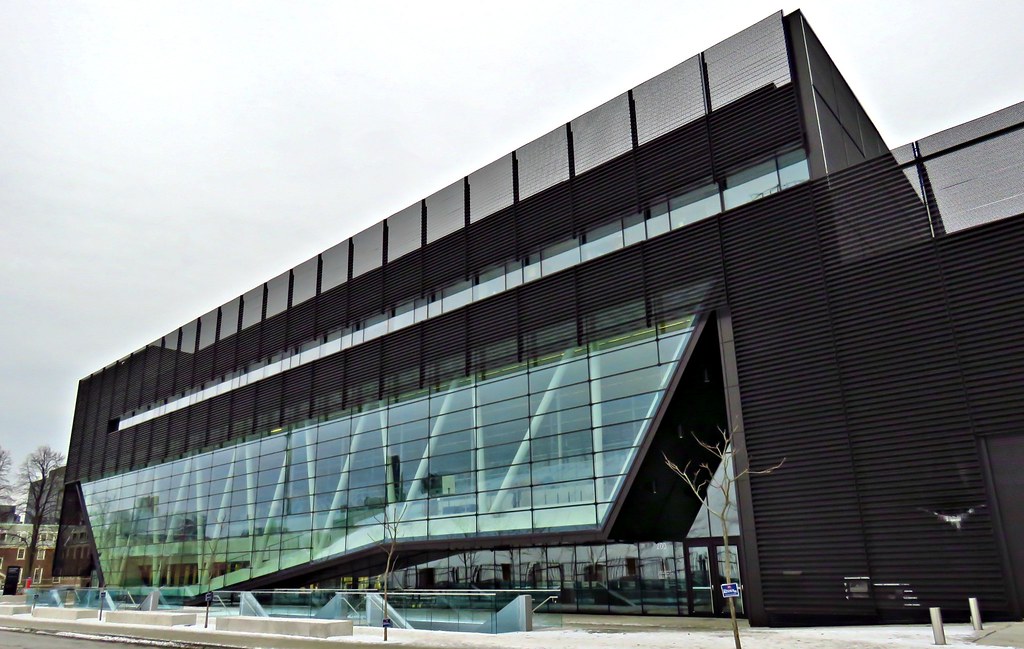
I know what you're thinking: "studying at the gym? That's just nuts." Well I'm here to prove you wrong. Not only is Goldring a hip new athletic facility, it also has a seating section on the main floor that is ideal for some post-cardio essay-writing, and that overlooks the Kimel Family Field House where basketball and volleyball games are played.

Goldring in all its glory. Source.

WHERE TO EAT...
Innis Café
2 Sussex Ave.
Located on the opposite side of Sussex Ave. from the Faculty of Information, this family-run café serves up healthy and hearty meals, made-to-order. The super sweet caf staff supply a menu of everything from breakfast sandwiches and freshly squeezed juices to burgers and quesadillas, all for a student-friendly price.


Someone else snapped an awesome photo of my favourite meal at Innis: the chicken skewers with salad and grilled vegetables. Source.

Diabolos Coffee Bar
15 King's College Circle
This student-run, fair-trade coffee shop in the Junior Common Room at University College sells coffee and snacks that will make you feel good too. If you're looking to "break free" (hope you're still listening to High School Musical!) from your usual caffeine-run to the Starbucks in Robarts cafeteria (and you might want to after a while), this is a great alternative.

View of Diabolos. Source.
Food Trucks
Looking for a break from the great indoors of the Faculty of Information but don't have time to head too far away? Roll on over to any of the food trucks that line the streets of St. George from Bloor to College. Anyone who has seen me during lunchtime knows that I eat the shwarma platter from the food truck right outside the entrance to Claude Bissell more often than I would like to admit in a public blog post. 
·
Kee's food truck on St. George. Source.

This article serves as a mere appetizer to the varied array of restaurants and study spots in and around UofT campus, so please sound off in the comments if you have any recommendations that you wish to share. Stay tuned for the next edition of the Grad School Guide on July 15th and stay cool, first-year friends.