Showing posts with label Metropolitan Museum of Art. Show all posts

4 March 2021

MUSEUMS AS PORTALS BETWEEN WORLDS?: THEMES IN FANTASY AND FICTION

Museum Mysteries | Jefimija Vujcic


Over this past Reading Week, I finally picked up one of my highly anticipated books, an historical fantasy titled The Invisible Life of Addie La Rue (2020) by V.E. Schwab. Looking for a break from coursework, I was amused to find a museum catalogue entry on the second page of the book! The notion of the museum – connected to themes of material memory, the act of collecting, and what it means to be (un)able to leave a mark – was recurring and so intriguing that it led to me writing this article.

A lot of us in the MMSt program are probably aware of some fiction prominently featuring museums, or can recall Night at the Museum (2006) as at least one example. The film’s premise is that the museum comes to life at night, prompting security guard Larry to quip, “Isn’t everything in this museum supposed to be, you know, dead?” Watched with a critical eye, the movie brings up questions around the purpose museums are meant to fulfill and how that purpose is viewed by the public. Also sticking out to me from childhood are The Lightning Thief (2005) and The Red Pyramid (2010). Both by Rick Riordan, the opening scene and the inciting incident respectively take part in museums. Museums set the necessary stage for these books, wherein tales from mythology are in fact true, bridging the past and the present.

Source.

For me, a few more recent reads drive home the metaphor of museums as doors or portals in fiction. In the urban fantasy Neverwhere (1996), there exists London Above (the world we know) and London Below (one just beneath it). These two worlds intersect and blur throughout the story, with one such memorable scene taking place in the British Museum. Moreover, one of the least likeable characters of the novel has big ambitions in the museum field. To this end, she constantly drags the main character Richard along museum-hopping. This leads Richard to regretfully conclude that, “the great art treasures of the world all blur into each other after a while.” With the foregrounding of a fantastical element, the mundane is brought into even greater focus. This is also the case for Metropolitan Stories by Christine Coulson. Read by the Museum Studies book club back in the summer, this magical realism collection sheds light on the eccentric staff who keep the Metropolitan Museum of Art running, often in very unexpected ways… Again, here is the idea that museums house objects that can bridge divergent times, worlds, and realities.

In addition to a number of other fantastical and adventure stories, many museum-related literary fiction titles have stuck out to me over the years. The Goldfinch (2013) begins at the Met and the main character’s connection to one particular painting from the Dutch Golden Age forms the core of the novel. From Dubravka Ugrešić’s experimental work Museum of Unconditional Surrender (1997) to Heather Rose's performance art-inspired Museum of Modern Love (2016), museum-related fiction takes advantage of the cultural baggage surrounding museums, both real and imagined.

The exterior of the Museum of Innocence, Istanbul, Turkey. Source.

The transformation of a fictional museum to one existing in real life is the journey of Nobel-prize-winning author Orhan Pamuk’s The Museum of Innocence (2008). Set in Istanbul in the 1970s, the story focuses on the everyday objects collected by one man after a devastating heartbreak. Off the page, Pamuk had begun collecting items in the 1990s. The building which came to house them was given the title of European Museum of the Year in 2014. Far from just a marketing gimmick, this “museum, based on a novel, based on a museum” now exists and serves to start thought-provoking conversations about the city’s history.

Beyond providing a few more books to add to your reading lists (even more can be found here and here), I hope that this look at non-academic literature can spark useful critical consideration of how museums are (mis)interpreted and where all our preconceptions come from. In Emily St. John Mandel’s pandemic-focused novel Station Eleven (2012) and All the Light We Cannot See by Anthony Doerr (2014), museums are projected to have lasting significance even in futures following apocalypse and devastating war. In our present, perhaps this literary reflection would assist us in creatively imagining a better future for museums. As one museum professional writes in a blog focusing on decolonization and Afrofuturism, “By reframing a museum as a portal, there is the potential for us to see ourselves as time travelling inventors capable of creating a different world.”

15 October 2020

CLOUT-Y WITH A CHANCE OF MET BALLS: FASHION AND FUNDRAISING’S BIGGEST NIGHT

Sew What | Chloé Houde


I might be late in realizing this, but I only recently found out that the Met Ball is an annual fundraiser for the Metropolitan Museum of Art in New York, and not just a fancy red carpet night for designers and celebrities to show off beautiful, over-the-top, statement-making outfits. The Met Ball, also known as the Met Gala or the Costume Institute Benefit, is an annual themed event held on the first Monday of May to raise funds for the Met's Costume Institute and to kick off its annual exhibition. The event raises enormous amounts of money annually, which goes towards funding exhibitions, acquisitions, and capital improvements for the Institute. The Gala raised $US12 million in 2014 and over US$13 million in 2019. The Costume Institute is also the Met's only curatorial department that is responsible for its own fundraising, presumably due to the Gala's success. I was struck by the contrast between what I thought a fundraising event looked like and what the Costume Institute hosts every year. How did a museum fundraiser become one of the most mainstream, exclusive, and anticipated global fashion events of the year while also becoming ubiquitous in popular culture?

Gown by Chinese designer Guo Pei in the "China: Through the Looking Glass" exhibition at the Metropolitan Museum of Art in 2015 | Source

The Costume Institute, originally the Museum of Costume Art, joined the Metropolitan Museum of Art in 1946. At the time, charity events were hugely popular with New York socialites, who used philanthropic events to elevate their social status and retain relevance in high society. From its first iteration in 1948 as a benefit party, the Costume Institute's annual fundraiser remained an attractive socialite-centered event for decades. From 1972 to 1989, Diana Vreeland, special consultant to the Institute, greatly elevated the event. She transformed the benefit supper into a theme party linked to the theme of the Institute's yearly exhibition. The event garnered more notoriety and excitement throughout Vreeland's time at the Met, as both an art and social affair that became more international and open to celebrity. When Anna Wintour became the co-chair of the Met Gala in 1995, and took over leadership in 1999, the event veered its trajectory towards what we know it to be today. Anna Wintour has been the editor in chief of Vogue Magazine since 1988 and the artistic director of Condé Nast since 2013. Wintour wields an undeniable grip on the world of fashion through these positions, and the Met Gala is no exception. 

The Costume Institute's website | Source

Under Wintour's direction, the event has become much more exclusive. Over the years, Wintour has implemented a strict dress code, banned personal photography during the event (although some celebs sneak selfies in the bathroom), has made ticket and table prices more expensive (individual tickets jumped from US$15,000 to US$25,000 in 2014, up to US$30,000 in 2018, and tables went for US$275,000 in 2019), and she personally approves every single guest that attends (there are between 600-700 guests annually). Wintour is also responsible for making the event celebrity-focused, in a stark departure from the socialite event it had previously been (which some have lamented). It is now virtually impossible to buy individual tickets to the Gala, since companies and designers will buy tables and invite Wintour-approved celebrities to the event to model their creations. Wintour exerts immense control over the Gala, which has received criticism over the years.

The Met Gala is now inextricably tied to the contemporary world of fashion and design, more than it had ever previously been. Being seen at this event has long carried a heavy social importance for individuals, but nowadays, having a presence at the fashion event of the year is an unmissable marketing opportunity for designers, brands, and companies. It also carries much significance in determining a celebrity's relevance at a particular moment. The Met Gala is closely followed by millions of spectators, and has resulted in unforgettable and iconic moments for many celebrities that persist in popular memory.

Recent tweets highlighting Met Gala outfits worn by Kacey Musgraves, Zendaya, and Emily Ratajkowski from the past few years | Source, Source, Source

It is easy to miss the fact that the Met Gala is a museum fundraiser when there is so much notoriety, popularity, celebrity, and exclusivity tied to the event. Nicknamed "the Oscars of the East Coast," the Costume Institute Benefit is now considered part of the roster of yearly red carpet events, where famous people parade designer clothing. Anna Wintour's control looms large over the event, which has had the effect of closely associating the Met Gala with Vogue Magazine. Wintour has employed similar strategies for popularizing the Met Gala and Vogue; she was one of the first fashion magazine editors to have celebrities on cover pages, rather than models, and was the one who made the Gala the celebrity-saturated affair it is today. This association to celebrity has had the effect of bringing these cultural products out of their respective niches and into popular culture. It seems to be a symbiotic relationship masterminded by Anna Wintour; Vogue benefits from being associated with the enormously high profile Met Gala, celebrities add notoriety while adding to their own relevance, and the Costume Institute reaps the funding and exposure generated by this ever-prominent event. The Gala and the corresponding exhibition are so reliant on big corporate sponsorships that Wintour is consulted and signs off on the theme of the Costume Institute's yearly exhibition so that she can find appropriate sponsors. Her impact is present at every level. This degree of commercialism and control isn't without criticism, however.

Another important factor in the Met Gala's popularity is its relationship to fashion, which, as a topic of interest, is popular, visually engaging, and accessible to wide audiences. Fashion affects us whether we realize it or not, which the fictional Miranda Priestly (based on the real life Anna Wintour) reminds us of in the famous "Blue Sweater" scene from the movie The Devil Wears Prada. Fashion is ubiquitous in celebrity culture as well, and seeing both come together so obviously and opulently at the Met Gala makes for a blockbuster affair. Every year (except this year, for obvious reasons), on the first Monday of May, the world watches as the Costume Institute Benefit congregates a themed flurry of celebrities, artists, high-powered individuals, designers, brands, outfits, works of art, innovations, and lots and lots of money to create a monumental spectacle. Hard to believe it all started as a benefit supper, right? 

I may be wrong, but I (sadly) can't imagine a fundraiser for any other museum generating a cultural impact (or as much money) as the Met Gala.

Viral tweets about the Met Gala from 2018-2019 | Source, Source, Source


30 March 2020

DIGITAL FASHION: THE BEST ONLINE TEXTILE COLLECTIONS

Sew What | Natalie Heaton


Source Kyoto Costume Institution 

The cancellation and closures due to the COVID-19 virus have left people inside their homes and the doors to cultural institutions are closed. While the closure of these institutions is devastating, many museums as using this as an opportunity to highlight their digital collection and online resources such as tours and education resources. In this article, I will highlight the top 5 best online fashion and textile collections!

5. FIDM Museum and Galleries, Los Angeles, USA


19th Annual Art of Motion Picture Costume Design, 2011
Source FIDM
Founded in 1978, Fashion Institute of Design and Merchandising Museum (FIDM) has a collection of over 12,000 costumes. This institution is known for its collection which specializes in early Hollywood costumes, with items such as Norma Sherer’s gown for the 1936 film Romeo & Juliet. Every year the FIDM holds an exhibition in the spring called Art of Motion Picture Costume Design. This exhibition features costume from top Hollywood Films, including The Great Gatsby (2013) and The Young Victoria (2009). FIDM’s online collection is sorted into different collections and images from past exhibitions. All photos are high resolution and feature pieces from the collection that date back to the 18th century, through to contemporary fashion.


4. The Kyoto Costume Institution (KCI), Kyoto, Japan

The KCI aims to collect, preserve and understand Western and Asian fashion and textiles. Their online collection highlights stunning gowns and garments from the museum along with access to all the institution’s publications, past exhibition catalogues, and more! Anyone that holds an interest in fashion and textiles, especially in the museum sector, this is a webpage that one could easily spend hours on! The museum also has a very active Instagram account that is filled with photos of the collection, the building, and different events that are taking place at the KCI.


View this post on Instagram

3. The Victoria & Albert Museum, London, England

The Victoria & Albert Museum (V&A) is one of the leading institutions in the world. The museum is known for having a massive collection of over 2.2 million objects with over half of them being digitalized and available in their online collection. A good number of these artefacts are textiles and garments. They have gowns that would have been worn near Marie Antoinette, to original Balenciaga, to Alexander McQueen, there is something that is bound to spark everyone’s interest!

Fashion "Search Collection" Home Page.
Source: Victoria and Albert Museum Website.

If stunning images wasn’t enough to intrigue you to check out of there website, there are also great articles, behind the screen videos and catalogues from past exhibitions.


2. Palais Galliera, Paris, France

Photo From Palais Galliera's Online Collection
Source: Palais Galliera

This institution has no permanent exhibitions due to conservational issues, so they only put on temporary exhibitions. Palais Galliera’s focus is on historical fashion and the fashion industry. Since the museum isn’t often open unless there is a temporary exhibition on, there is a lot of effort that goes into their website, and the viewers can tell. The website is organized into various categories to make for a smoother search, and help the viewer find exactly what they are looking for. Like many of the other institutions on this list, Palais Galliera offers past exhibition’s catalogues and publications, as well as workshops. What makes this online content stand out is that is it focused on French fashion history. With this narrow scope, the institution is able to dive into the content in a way that encyclopedic museums, such as the V&A or MET are unable to do.


Photo from Palais Galliera's Online Collection
Source: Palais Galliera


1. The Metropolitan Museum of Art, New York City, USA

The first thing that pops into a lot of people’s heads when talking about fashion and museums is the annual MET Gala. This fundraising event for The Metropolitan Museum of Art’s (MET) costume institute.

With the MET being so well known for their costume institute, it is no surprise that their website and the online collection is fabulous! I have spent many hours on it, and I know that as I continue in this field, I will spend many more. This website not only has thousands upon thousands of high-quality photographs of textiles, but they also have an Art History timeline, numerous publications, blog posts, videos, and much more. If you only end up visiting one website, the MET would be my top choice!

Costume Institute's Past Exhibitions
Source: Metropolitan Museum of Art webpage


Overall, even with museums around the world having to close their doors, their online resources are always open. From reading about past exhibitions, searching through thousands of stunning images, or reading more into the institution itself, there is always something new to learn in the museum, despite your location.

19 November 2019

RIGHT UNDER YOUR NOSE: AWARENESS & ACCESS IN MUSEUM LIBRARIES


GLAM Guide | Madison Carmichael


On our faculty’s recent trip to Ottawa, I was enlightened to the existence of the museum library. My fellow students and I saw many; we visited in the Military History Research Centre at the Canadian War Museum, and we spent time in the Resource Centre at the Canadian Museum of History. Upon further digging, I discovered that the National Gallery of Canada and the Canada Science and Technology Museum – other stops on our whirlwind tour of Ottawa – also contained library collections.

These libraries had been hiding right under my nose. But I’m not the only one. Lisa Harms, a former Assistant Museum Librarian at the Museum of Metropolitan Art, wrote something similar for the MET’s blog nearly a decade ago: 

“It does not occur to most Museum visitors that museums usually have libraries. In fact, until I saw the job opening for my position, it had not really occurred to me either."

Lisa Harms worked at the Thomas J. Watson Library at the MET. Like myself – and many other members of the public – she hadn’t considered a ‘museum library’ until working in one. (Source.)

When the GLAM sector speaks of collaboration between the museum and the library, these conversations often settle around the notion that museums could benefit from the public-oriented spirit of the public library. Thinking back on my time in various museum libraries in Ottawa, I wonder what these conversations might mean for these seemingly hidden collections; and I wonder why they seem hidden from us at all.

In 1999, Jan van der Wateren wrote on the importance of the museum library. He explained that as museums grew in number in the 19th-century, the library formed an integral part of these growing institutions. These libraries were established in conjunction with the museum’s collection, either to document the objects within it or to provide further context for them. In essence, van der Wateren tells us, the museum library was – in its earliest incarnation – meant to compensate for the inherent limitations of the museum in comprehensively researching, documenting, and even interpreting an object.

Jan van der Wateren wrote from a position at the library within Victoria and Albert Museum, which was established in the mid-1850s to hold illustrated books for the School of Design. (Source.)

Historically, this has been their purpose, and as a result, their purveyors largely remain within the realm of scholarship and research. Esther Roth-Katz, who completed a survey study of art museum library websites, concurred. Within the museum library, research collections developed to meet the needs of their institution’s staff and researchers. The access guidelines of the websites in her survey reflected this: while over half the libraries she looked at allowed public access, 25% made no mention of who was allowed or else limited their user groups to scholars and researchers.

I’d argue that in part, Ms. Harms had the right of it: for many, the existence of a museum library doesn’t occur to them. But it's also worth considering that because museum libraries are grounded in a research-oriented history, this lack of awareness may also stem from the fact that many members of the public don't identify with terminology like scholar or researcher; and so they do not consider museum libraries as a space open to the public more broadly.  

The German National Museum was created in 1852, alongside a library and archive to better document the history the German art in its collection. (Source.)

All of this is to say that museum libraries are an interesting facet of any conversation about opening up GLAM institutions to greater visitor access. Many institutions are using digitization and the internet more broadly to increase the visibility of their collections. However, as Roth-Katz puts it, visibility does not accessibility make. While libraries have a vested interest in sharing their knowledge with the public, the materials they hold are oftentimes rare and valuable. There is a tension between the preservation and protection of those materials and the belief that the public is entitled to access them as well. It speaks to the conversation that museums are having more broadly about their collections; as repositories of history, what do they hold those histories for? And more pertinently, for whom?

It’s a difficult question, one mitigated by the necessity to protect and preserve objects within a library’s collection. But such a necessity does not mean keeping library doors closed. Museum libraries allow public access to their collections, either by visit or by appointment, and the growing initiative of GLAM institutions to digitize their collections or else grow their digital presence works to increase awareness of their library collections and resources.

I was discussing this topic with a colleague last week, and she offered up a quote I’d like to close with. Augustus de Morgan said the following in his book, “Arithmetical Books from the Invention of Printing to the Present Time,” of the library in the British Museum:

“If it be wanted, it can be asked for; but to be wanted it must be known.” (Augustus de Morgan. 1806-1871)

It’s all well and good for the public to have access to the museum library. But considering that Ms. Harms wrote of a discovery much like my own nearly a decade ago, I would argue that it is just as important that we know about these wonderful collections in the first place, so that we might think access them at all.

29 October 2018

SAUDI ARABIA: HUMAN RIGHTS VIOLATION MEET MUSEUM ETHICS

Muse News | ​Amy Intrator


The Metropolitan Museum of Art and the Brooklyn Museum recently cancelled funding from groups tied to the Saudi government. These institutions stand with many others in refusing to support a government accused of violating human rights. Will other museums follow suit and take a responsive stance amidst a developing global controversy?

Exterior of The Metropolitan Museum of Art. Source


Background: The Death of Jamal Khashoggi

The past few weeks, the world has been watching Saudi Arabia since discovering journalist Jamal Khashoggi died at the Saudi Arabian consulate in Istanbul on October 2nd. World leaders and organizations have voiced their anger and suspicion. Khashoggi was a vocal critic of the crown prince, Mohammed bin Salman, and many believe the prince and the highest ranking government officials were involved in Khashoggi’s death. Saudi Arabia has presented several different official narratives from initially suggesting Khashoggi left the consulate alive, to stating his death was the event of a fistfight, and now admitting that the murder of Khashoggi was premeditated.

Jamal Khashoggi in March 2018 offering remarks at panel hosted by Project on Middle East Democracy. Source.

The situation has put Saudi Arabia at the center of a global dispute, but this is one event among many where Saudi Arabia has been accused of human rights violations. Just this summer, Chrystia Freeland, Canada’s Minister of Foreign Affairs, made a public statement via Twitter about the alarming news that the sister of Raif Badawi, a vocal critic of Saudi Arabia, had been imprisoned. The tweet caused a great rift between Canada and Saudi Arabia, but now Canada is one nation among many condemning the country.

In light of the growing concerns about human rights violations in Saudi Arabia, many institutions across the world are taking a stance, including museums.


Today: Museums Making Bold Statements

On October 18th, both the Brooklyn Museum and the Metropolitan Museum of Art made statements that they would not be using money from groups tied to the Saudi government to support upcoming programs. The Brooklyn Museum is hosting an exhibition about Syrian refugees and the Met is hosting a seminar on Middle Eastern art. Both programs are a part of the 2018-2019 Arab Art and Education Initiative, and both programs will proceed without the initial support of Saudi money. Cutting funding sources in light of the recent news developments is a bold move on the part of both museums. This is by no means the first time museums have been forced to confront morally ambiguous funding sources, but rarely do museums take such a bold public position on the matter.

While some museums have refused Saudi funding, other museums have remained notably silent in light of recent developments. One museum that has been accused of strategic silence is the Natural History Museum, London. The museum refused to cancel a booking made by the Saudi embassy that took place on October 11th. The museum defended their decision stating that the museum does not endorse private events but relies on this “external funding.”


The different responses in the museum community should spur a larger discussion about museums’ responsibility as institutions of public trust.


The Future: Museums as Responsive Institutions

While some may think of museums as institutions focused on looking backward, many museums have taken actions to become more responsive institutions. Increasingly, museums have weighed in on developing issues in the form of timely exhibits, such as #MeToo & The Arts at the ROM. Other museums have become more responsive through their approach to collecting, such as the V&A where contemporary objects are collected in response to recent history (e.g. the Pussyhat that entered the collection after the 2017 Women's March in Washington).

But museums are not just platforms to discuss topical issues. A truly responsive museum is one that critically assesses its own governance and adapts to the times.

The Met and the Brooklyn Museum responded to a current issue by severing ties to a funding source suspected of egregious human rights violations. The Natural History Museum opted for impartiality.

Museums across the world are now faced with the same choice: respond to a global controversy as it unfolds or comply with an ethically dubious government to secure funding.

12 February 2018

UNLOCKING THE DINING ROOM AT THE METROPOLITAN MUSEUM OF ART

A MUSE BOUCHE

BY: JENNIFER LEE

The Dining Room at the Metropolitan Museum of Art, formerly the Members Dining Room, opened to the public for the first time in mid-2017. If you were not aware that the Met had a members-only dining room, then you are not alone: it was notoriously well-hidden, requiring visitors to navigate several extensive galleries on the ground floor and take an elevator from the European Sculpture Galleries to the fourth floor. Members who successfully completed this odyssey through world art were treated to a meal in a quiet dining room whose huge glass windows overlook Central Park.

The restaurant, rechristened the Dining Room at the Met, will now take your money whether you have a membership or not, from 12-2:30 on weekdays, on Friday and Saturday nights, and for Sunday brunch. By all accounts, opening up the restaurant and the resulting press has livened up the dining room considerably.

Was it ridiculous for a twenty-first century public institution to maintain a separate restaurant for its members? Arguably, yes, so opening the restaurant might be taken as more pragmatic than political: a statement for economics, not access. But what’s changed since the restaurant’s inception in 1991 to make a members’ dining room untenable, and what does this move say about the Met and the way we think about museum visitors?

Grilled octopus from the Dining Room menu, now available to any visitor with $21 (plus tax and tip) and a blazer. Source. 
This development comes at an interesting time in the Met’s history; it’s been dogged by deficits as it undergoes a sea change in institutional culture, and recently announced in a spectacularly unpopular move that it would introduce mandatory admissions fees for out-of-town visitors. Previously, admission to the museum was pay-what-you-wish at the door: anyone willing to stand in line could enjoy the Met at whatever price point they felt was appropriate.

It’s important to read the existence of the Members’ Dining Room in this context. Providing a service limited to members only is a good way to convince people to pay for membership when they know that they can get in for free. (Annual membership to the museum currently starts at $100 USD, more or less on par with institutions like the ROM or the AGO but higher than other New York institutions such as the Whitney, MoMA, or the Guggenheim, which all charge for admission.) 

The few other major institutions that maintain exclusive food and drink facilities for members – the British Museum and the V&A among them – work on a free-admission model and are crowded with visitors, so offering a quiet place to sit can help to justify buying a membership to a nominally-free museum. The Met, indeed, continues to maintain a member’s lounge and rooftop bar. However, ending a perk which was underused even by members seems like a natural move for a museum which struggles to stay both relevant and solvent.


The Dining Room at the Met. Does the stunning view save the restaurant’s otherwise humdrum décor? Source. 

The Dining Room is the only one of the Met’s dining options with a designated dress code (smart casual), and the most expensive by far. Brunch, available through a prix fixe menu only, will run you $55, and dinner for two could easily cost several hundred. This is not, of course, astronomical for a meal in New York, but it does raise the question: is this restaurant really so much more accessible than before? How many people are going to eat here who would be unable to afford a museum membership?

Perhaps it’s the optics of exclusivity, rather than the economics, which makes for inaccessibility in this case. The democratic rhetoric of the twenty-first century is that museums are there for everyone to enjoy, and the more exclusive the perks available to – let’s be honest – rich people, the more uneasy we feel about them. This is a problem for institutions which are trying to balance wide public accessibility with the feeling of exclusivity and belonging that drives membership sales.

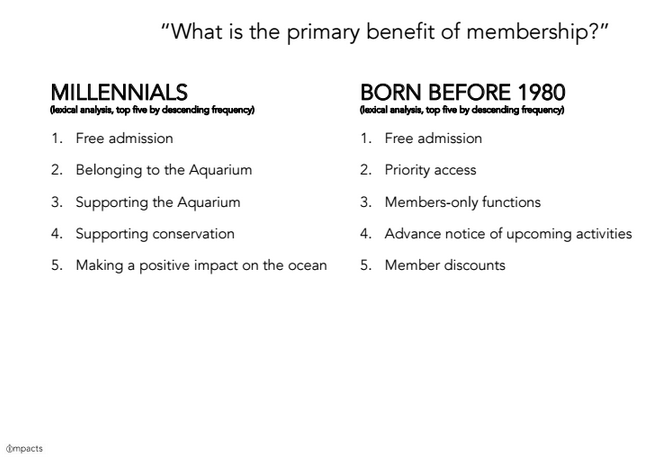
Millennials, in particular, invest in non-profit membership for completely different reasons to the generations before us: we’re interested in seeing the impact of our money and supporting a cause, while those born before 1980 want VIP treatment.

The primary benefits of aquarium membership, according to millennials and non-millennials. Source.

So opening up the Dining Room makes a statement that this museum is, in fact, for us; it recognizes that young audiences want a different experience at the museum than their parents and grandparents, and that it's possible to love and support a museum without investing in membership. 


Time will tell whether young patrons take to the restaurant, although I suspect that the museum might need to consider a gentle redesign if it wants to attract an Instagram-happy crowd. The Dining Room’s décor is fairly underwhelming: beige walls, beige carpet and rather dowdy wall sconces make it feel more like a mid-1990s hotel lobby, or the Scarborough dim sum restaurants of my youth, than an exclusive Manhattan hotspot. Like an astonishing number of museum restaurants, it is devoid of the very thing patrons have come to see, i.e. art. If it can find the money, the Met might want to take a leaf from the books of art museums like the Guggenheim, the Centre Pompidou, or the new gallery on the block, the National Gallery of Singapore, all of which boast restaurants which are attractions in their own right. 


National Kitchen by Violet Oon, a ridiculously beautiful restaurant serving Singaporean favourites at the National Gallery of Singapore. I mean, can you even. Source.
While older patrons may be content with beige carpet and a good view, the combination of good food and beautiful surroundings are especially important to the 20- and 30-somethings that museums are desperately trying to attract. People visit museums to be surrounded by beauty, and also to take pictures and put them on social media so that other people know how cultured they are, and they visit high-end restaurants for the same reasons. The Met has yet to catch on, but at least they've got good natural light. 

15 November 2017

THE MET'S MICHELANGELO

COLLECTIONS CORNER

BY: KATLYN WOODER

As of Monday, November 13, 2017, the Metropolitan Museum of Art in New York City has produced a new exhibit for public consumption, Michelangelo: Divine Draftsman and Designer. You have to make your way past some attention-grabbing art collections, the raw sculptures of Rodin and the image conversations taking place in the Talking Pictures Exhibit. The experience is, by necessity, a practice in patience as you wait for other patrons to take their pictures and move along so that you can take your own pictures. I know I probably was the source of multiple eye rolls.


Photo courtesy of Katlyn Wooder.
Michelangelo di Lodovico Buonarroti Simoni (1475-1564) was a high renaissance artist who excelled in sculpting, painting, poetry and architecture design. His vision enabled him to flourish in his field. He is known for his sculpture David, found in the Louvre, and his paintings that decorated the ceiling of the Sistine Chapel, found in the Vatican. He was known as the greatest artist of his time, and remains one of the most recognized figures in western art.

Walking through an exhibit that is fundamentally based on a large collection of centuries-old drawings is an experience in behind-the-scenes decision making process. From the thematic and chronological order of the exhibit, to the props added to place the drawings in context, to the underlining story of a great, popular artist and a multitude of his relationships with other artists (such as his mentor Domenico Ghirlandaio); each decision is well calculated to build on the one before it to inform the visitor of the multidimensional figure of Michelangelo. Who his teacher was, who he influenced, and the legacy in architecture and marble that he left behind, as seen through his drawings. 

Photo courtesy of Katlyn Wooder.


One of the highlights of the exhibit was the 1/4 model of the Sistine Chapel that hung illuminated above Michelangelo’s original studies. Situated halfway through the exhibit below the ceiling there are torsos twisting, legs extending, and faces drawn in red chalk. It is a moment where the exhibit showcases the celebration of the work that went into Michelangelo's final pieces, while treating each draft, letter, poetry, drawing as an individual piece of art.

The large space of the exhibit (with its towering grey walls, low lighting and white wall text) helps unify a collection that comes from multiple sources. Each 2D artwork is held within a different frame. Some are modern and sleek, and others ornate and decorative. The long procession of works had the potential to become disparate from each other, even though most were done by the artist's own hand. The uniformity of the mounting helped to create a story between them, one that I found easy to follow.

   
Photos courtesy of Katlyn Wooder.

One of my favorite details of the exhibit was that when the MET bolted artwork or frames down they painted the securing material to make it aesthetically noninvasive. It managed to erase the security practices from jostling the viewer experience.

 Photo courtesy of Katlyn Wooder,

Michelangelo is not only explored through his artwork, but also through his work in architecture, as well as the unusual and unexpected pieces, such as a wooden model of the dome of Fabbrica di San Pietro in the Vatican City. It is situated well within the architectural plans that demonstrate Michelangelo’s legacy, and his identity beyond a figure artist.

The exhibit was an experience. It was a unique perspective on the Michelangelo's work. It didn't concentrate on his finished product. Instead, it focused on the raw, imperfect work that demonstrates process and techniques. The exhibit didn't concentrate on the genius of Michelangelo, but on the man who toiled to create masterpieces.

1 November 2016

DO IT FOR THE FASHION, IF NOTHING ELSE

(FUN)DRAISING

BY: MAYA DONKERS

Oh, Met Gala *insert dreams*. The universal 'we' all wait in anticipation for the red carpet fashions, celebrities, and Instagram photos that accompany the grand opening of the Costume Institute's annual fashion exhibit.

Although it often goes unacknowledged amidst all the media buzz, the Met Gala (or Met Ball) is in fact a fundraising gala for the benefit of the Metropolitan Museum of Arts Costume Institute in New York City.

Fashion drools. Source.

So, why a black tie extravaganza? 


The Costume Institute is the only one of the Met's curatorial departments that has to fund itself! Unofficially, the festivities in New York on the first Monday of May, have been called many things, including “the party of the year,” and an "A.T.M. for the Met,” by publicist Paul Wilmot.

A scene from the exhibition "China: Through the Looking Glass". Source.

And - what makes it the "party of the year"? 


Anna Wintour, the editor of American Vogue and the artistic director of Condé Nast, took over as chairwoman in 1999. Since then, she has been instrumental in transforming the philanthropic event into a "celebrity power cocktail".

Madonna making an entrance at the exhibition "Punk: Chaos to Couture". Source.

Then... How much does it cost?


According to the New York Times, tickets last year were $30,000 apiece, and tables were $275,000 (more than $12.5 million was raised). The party and exhibit are sponsored, so all the money raised from ticket sales goes to the Costume Institute. Not everyone has to pay for a ticket as brands often invite celebrities to be their guests and Anna Wintour also invites up-and-coming designers who might not be able to afford a ticket.

Anna Wintour at the 2014 Met Gala. Source.
That is some serious fundraising. Dream job anyone?

Also, check out the Netflix documentary, The First Monday in May, for an in-depth look at the exhibition planning and design that goes into the Met Gala!

Source: 

Friedman, Vanessa. 2016. "'What is the Met Gala, and Who Gets to Go?" The New York Times. http://www.nytimes.com/2016/05/03/fashion/what-is-the-met-gala-and-who-gets-to-go.html.

9 June 2016

SEW WHAT: LEARN FROM YOUR ELDERS

SEW WHAT

BY BRENNA PLADSEN

So I may have dropped the ball a little. Last month, while I was thinking about lingerie, the Met Gala happened.

For brief context, the Met Gala is a fundraiser for the Costume Institute and celebrates the opening of their annual exhibition, which also supplies the theme for the evening. The annual event began in 1948 and while it has been a social staple since the 70s, the intense scrutiny and expense surrounding the event are much more recent (source). Now, while the event is technically open to the public, it’s $30,000 for an individual and $275,000 for a table and there are only ~ 600 tickets. The exclusivity surrounding the gala in part because the guest list is tightly controlled by the chair, who uses it to continue the tight immersion of the fashion industry into the event. Anna Wintour, editor-in-chief at Vogue, chairs the event and celebrity designers are often brought in as co-chairs. Unsurprisingly, this results in monied fashion labels contributing and vying for publicity via their guests. (source) The resulting coverage of guests arriving rivals is comparable to the Academy Awards, and is the only time I've seen the Met on E! Entertainment.

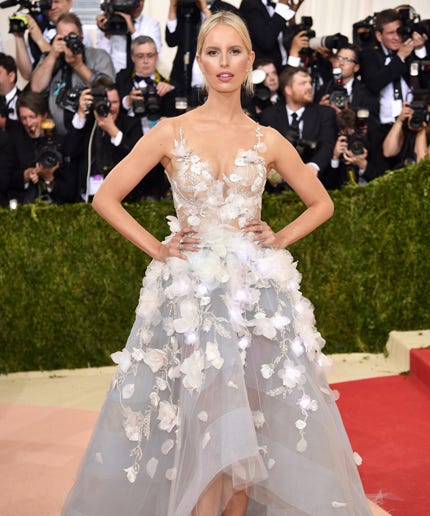
The 2016 theme, “Manus x Machina: Fashion in an Age of Technology” yielded interesting, glittery confections that are simultaneously 22nd century and gilded age glamour. A few outfits addressed the thesis of the exhibit, which looks at how technology influences high fashion. These range from Beyonce in an unexpected use of latex to Karolina Kurkova in a gown partially designed by IBM’s Watson (source). This ambiguous use of the theme is better than last year, where “China: Through the Looking Glass” resulted in some stunningly tone-deaf outfits that demonstrate how costume parties can go wrong. But comparing the two galas and exhibits is surprisingly difficult. Both exhibitions end at the present and look towards the near future but China: Through the Looking Glass has a much grander scale, moving through the entirety of a history from the other side of the world. The 2015 gala in turn demonstrated how surprisingly shallow aesthetic influence can be. Manus x Machina is more focused on the internal mechanisms of fashion as an industry. Working towards this theme requires a deconstruction of creation process, as the collaboration between Kurkova, IBM, and design house Marchesa demonstrates (source).

Kurkova at the 2016 Met Gala. Photo by Dimitrios Kambouris/Getty Images. Source.
Kurkova also introduced the dress on her Instagram, since it responded to emotions tweeted at her that night. 

So, what does it mean to create a dress to the theme? Every new, often laboriously and meticulously created garment speaks to the historic objects on display (or rather, speaks to an imagining of the objects on display, since this is the preview and these garments can take years to make). Further, it reveals how the circus of designers, celebrities, and press understand the theme and the scope of the exhibit. But most clearly, it demonstrates how the internet loves to spread images, and how the Met has leveraged the Costume Institute’s connection to the popular to enter into that economy of circulation. Last year, Rihanna, in a golden Guo Pei gown, demonstrated how the intersection of celebrity, novelty, and the gravitas of a space and time can be leveraged towards a mutual increase in social currency for everyone involved. For the Met, it attracts the eyes of a wide audience, and encourages a different way of engaging with the collections and understanding objects as living objects.

Rihanna's "Omelette dress"from the 2015 Met Gala. Photo by Josh Harner/New York Times. Source 

So, what can I apply to my smaller scale practice? Well, I have to understand what I have, what I don’t have, and how that distance can be bridged so that when it blows up on the internet, I have a good reason for doing it. Also: before posting, remember things on the internet have a long half-life (notice how meticulously documented the arrivals are but how mysterious the actual Gala is). This is why I’m not posting about my latest sewing project until I can figure out how this historical pattern can be updated gracefully. Hopefully it will probably be the subject of my next musing.

Preview/My cat "helps." Photo by author.
      

20 November 2015

FIGHTING WORDS: THE GUERRILLA GIRLS TAKE ON THE MET

OBJECT OF THE WEEK

BY: NATANIA SHERMAN


The year is 1989 and in the wake of not only the culture wars but the booming art market of the 80’s, an anarchic group of masked crusaders were taking the art world and many of its institutions to task. The group, an anonymous art collective called the Guerrilla Girls, became enraged by the prejudice and privilege they saw in arts institutions and they decided to take action. Guerrilla Girls created this poster entitled “Do women have to be naked to get into the Met?” in ’89 from statistics compiled from visits to the Metropolitan Museum of Art in New York. The poster is shocking yellow and features a reproduction of Jean August Dominique Ingres’ Odalisque, wearing a snarling gorilla mask. The content of the poster is the Guerrilla Girls’ “Weenie Count,” that is the count of male artists on display at the Met, which revealed that of the collection on view, just 5% were by female artists while 85% were paintings of female nudes. Unfortunately this was and to some extent still is the norm in most collections.

http://www.sparksummit.com/wp-content/uploads/2014/09/P78793_10.jpg
The Guerrilla Girls take on the Met (source)

The story of the Guerilla Girls actually begins in 1985, when the Museum of Modern Art (MOMA) held an exhibition titled, "An International Survey of Recent Painting and Sculpture." Just 13 of the 169 artists included in the exhibit were female which prompted the original members of the Guerrilla Girls to protest in front of MOMA. Finding that tactic ineffective, the girls started a poster campaign across Manhattan and formed an artist-activist group that is still active some 30 years later.

The Guerrilla Girls
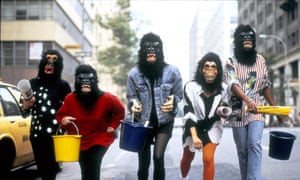
The Guerrilla Girls in "uniform" (source)

The Guerrilla Girls’ early work is characterized by a black and white info-graphic style. They used posters, stickers and billboards as well as their signature gorilla masks to combat the troubling prejudices inherent in the New York art market. The Guerilla Girls retain their anonymity by donning gorilla masks. The masks protect the members of the group, many of whom were afraid of losing their positions in the New York art world, but also poke fun at feminine stereotypes and beauty standards. The girls further retain their secret identities by taking on the names of deceased women artists. The group includes a Georgia O’Keeffe, a Kathe Kollwitz, an Emily Carr and a Lee Krasner, as well as GG1, who eschewed the pseudonym for true anonymity. The apocryphal story of the gorilla mask, as told in an interview with Kathe Kollwitz is “We were Guerrillas before we were Gorillas. From the beginning the press wanted publicity photos. We needed a disguise. No one remembers, for sure, how we got our fur, but one story is that at an early meeting, an original girl, a bad speller, wrote 'Gorilla' instead of 'Guerrilla.' It was an enlightened mistake. It gave us our “mask-ulinity.”

The Guerilla Girls made and still make art that is humourous, enraging, and timely. Masked and united, they weren’t afraid to take on the art institutions of New York and the world. Their posters and billboards take on pop culture, high culture and museum culture. Their use of collaboration and anonymous creation are an antidote to the dominant narrative of the white male genius working alone in their studios. They didn’t only protest feminist issues, they also made work that addressed race and class as well. The overall cut and paste aesthetic and use of humour in their activism can’t help but recall their contemporaries the Riot Grrrls in the alternative music scenes of Washington and Seattle in the 1990’s. Like the Guerrilla Girls, the Riot Grrrl aesthetic used zines, posters, newsletters, collaboration, research and statistics to present an ethos of inclusion of women, and people of colour in creative spaces.

The Guerrilla girls poster, “Do women have to be naked to get into the Met?” is arguably one of their best known works, but it’s certainly not the only one. Ironically, 30 years later, artwork by the Guerrilla Girls now resides in the collections of the very institutions that they so strongly critiqued in the 1980’s and 1990’s. But given this about-face has the anonymity and research and work been worth it? Well, sort of. The Guerrilla Girls’ posters are both an artwork and a document of very specific points of time in the art world. The Guerrilla Girls created the below poster which compares museums stats from 1985 and 2015 in terms of their representation of women. There is a slight improvement, but is it really enough?

The Guerrilla Girls use statistics to reveal the current state of the art world (source)

I hope in looking at the Guerrilla Girl’s artwork and activism it will force us museum professionals to confront our own privilege and question the narratives we present to the public. I can’t help but sneak another object in here, so I’d like to leave you with a publication by the Guerrilla Girls’ from their website. It’s called the Guerrilla Girls Art Museum Activity Book and the astuteness of it’s observations and “activities” is both humorous and dismaying at once, especially when the cover pointedly asks, “Do women still need to be naked to get into the Met. Museum?”

The Guerrilla Girls' Art Museum Activity Book (source)