Showing posts with label Rowena McGowan. Show all posts

25 March 2016

THESE ARE A FEW OF MY FAVOURITE THINGS

OBJECT(s) OF THE WEEK

BY: ROWENA MCGOWAN

It’s that time of the year. I, too, am graduating and moving on from Musings. Unfortunately for me, I haven’t come close to running out of objects to rant about. So I thought I’d change up the formula and talk a bit about several of the objects I love but ran out of time to devote a full column to. So, without further ado:

Source

Robovie 


Source

We’ve thought a lot about the industrial and economic consequences of an increasingly automated world but what about the cultural ones? How will people relate to the robots who are probably in our very near future? Is our robotic world going to be more I, Robot or Terminator?

Robovie was part of an experiment to determine how children (ages 9, 12 and 15) reacted to a robot which acts like a human and in particular, how they reacted to a perceived injustice being done to that robot (although Robovie was not technically a robot, since it was actually controlled by a technician in another room).

Each child interacted individually with Robovie. Robovie showed them an aquarium, taught them about the ocean, asked them for a hug and played ‘I Spy’ with them. During Robovie’s turn to guess, a technician would come in and tell Robovie that it was time to get into the closet. Robovie would respond that it was unfair to make him go into the closet before the game finished and that he was frightened.


Afterwards, the children were given a questionnaire to see what their opinions of Robovie were. Over 2/3 of the children were willing to be friends with Robovie but only a little over half of them thought that it was wrong to put Robovie in the closet (compared to putting a person in the closet, which almost all of them thought was wrong).

As robots become more advanced, we’re going to have to grapple with how we treat them and eventually, perhaps, what it means to be human. As for me, I got upset just watching the video!

The Great Omar 

Source

Sorry to any bibliophiles that I just made cry by reminding them of this book. The Rubáiyát of Omar Khayyám is actually the name given to a collection of poems written by Omar Khayyám, a Persian poet, astronomer and mathematician, and first translated by Edward Fitzgerald.

In the early twentieth century, Sangorsky and Sutcliffe, a British bookbinding company, were commissioned to bind a copy of The Rubáiyát of Omar Khayyám, money no object. The spectacularly beautiful final product was called The Great Omar.

In 1912, the book was sold to an American collector. Since the book was so valuable, they sent it over on the safest ship available at the time.

Source


Yeah. That didn’t go so well. The book has never been found but the legend of the ‘priceless book’ lost on the Titanic lives on.

Not the quitting type, Sutcliffe created a second version of The Great Omar and, taking no chances, it was locked in a bank vault for safekeeping. The vault was subsequently bombed to smithereens in World War II, because some objects can’t get a break.

A third copy is currently resting in the British Library. If I was them, I would be very, very nervous.

Apatosaurus tail 

Source

If I had any Photoshop skills whatsoever, I would put an Indiana Jones hat on an Apatosaurus. Why? Well, partially because I have an extremely weird sense of humour but mostly because, like Indy, the Apatosaurus was a master of the whip.

Recent research has suggested that Apatosaurus and its relatives could crack its tail hard enough to break the sound barrier, much like a bullwhip.

The evidence comes from tail vertebrae. Tails have been found with fusions of the bones between the thick, muscular section and the thin, flexible part. These kinds of fusions are often caused by stress – like the stress of being repeatedly cracked. Recently, paleontologists have built and tested a model of the tail, which proves that such a whip crack was physically possible.

The model in action. Source.
 Why did an Apatosaurus need a whip? Probably not to fight Nazis. The latest theory is that they used them for communication and especially courtship.

Shiri 


Source

No, this hasn’t become a porn blog. Shiri is a robot (yes, I’m having two robots. It’s my swansong and I like robots). Shiri was created by the University of Electro-Communications in Tokyo and responds to stimuli in the same way a human would. When touched unexpectedly, it flinches. When struck, it clenches.


But what’s the point of making a robot butt? It’s not the reason you’re thinking! Shiri is actually an innovation in expressing sensation organically. The hope is that through Shiri, researchers will eventually be able to create a robot which responds exactly like a human. Freaky? Yes. But a robot that behaves like a human is also easier for a human to interpret and understand.


And that’s it for me! Thanks, everyone, it’s been a treat. And, when things get tough, remember:


Source


References

http://www.forbes.com/sites/daviddisalvo/2012/05/14/meet-shiri-the-freakishly-realistic-robotic-buttocks/#62b8d14c6794

Kahn, P. H., Jr., Kanda, T., Ishiguro, H., Freier, N. G., Severson, R. L., Gill, B. T., . . . Shen, S. (2012). “Robovie, you'll have to go into the closet now”: Children's social and moral relationships with a humanoid robot. Developmental Psychology, 48(2), 303-314.

26 February 2016

THIS IS THE DROID WE'RE LOOKING FOR

OBJECT OF THE WEEK

BY: ROWENA MCGOWAN

Last year, a little movie came out that you might have heard of.

You know, if you were really paying attention, you might have caught a whisper. Source.

I jest, of course. Disney’s marketing kicked into high gear last year to make sure that everyone was excited about the new Star Wars movie. A lot of the marketing focused on BB-8, the adorable new droid starring in the film, who premiered in the first teaser released in November 2014.

BB-8
It doesn't even have cheeks and I want to pinch them. Source.

 Of course, people got excited about BB-8. Somehow, the filmmakers had made a droid even cuter than R2-D2. And BB-8 had a cool, if apparently impractical, design. BB-8’s lower body is a sphere, the head a small dome perched on top. As the body rolls, the head stays perfectly in place. It was a pretty weird design but hey, with CGI you can produce anything, no matter how physically impossible, so people were mostly nonplussed.

Then, during the Star Wars Celebration 2015, BB-8 rolled out on stage.


http://i.imgur.com/umSzUjp.gif
Source

People went nuts. It had actually already been confirmed, in December 2014, that BB-8 was a physical prop but I don’t think people were really expecting it to actually be able to move autonomously. Somehow, this weird little thing could move, look around and interact with the world without its head falling off. The Internet being the Internet, the race was on to figure out how BB-8 works.

With all of nerddom bent on solving this problem, we must know by now, right? Not so much. Disney has never confirmed exactly how BB-8 works so we’re still just guessing.

People pretty quickly connected BB-8 with the Sphero, another spherical rolling robot. This seemed like a pretty safe guess, since Disney had actually contributed funds to start the company behind it. However, Sphero didn’t have a head on top, which is the truly amazing part of BB-8, and Lucasfilm released a statement saying that, in fact, Sphero’s mechanism was not used because it didn’t produce the expressiveness that BB-8 demanded.


The Sphero. Source

So, how does BB-8 work? Magic? Giant hamster ball? (Don’t laugh, it was suggested!). The best guess comes from howbb8works.com, which is run by Carlos Sánchez and Emilio Gelardo.

They discovered a patent filed by Disney for a magnetic spherical balancing robot drive. One of the descriptions pretty closely matches BB-8. The body rolls using omni wheels (wheels which can roll in any direction) and relies on accelerometers and gyroscopes to know its position in space. The body also has a mast inside, which swivels around as the body moves so the head can reposition itself (for a video of how it works, click here). How does the head stick to the mast? That’s still the biggest question but the general consensus is magnets.
 

BB-8 drive mechanisms (Copyright and trademark Lucasfilm Ltd, all rights reserved. Image: Carlos Sanchez and Emilio Gelardo / howbb8works.com). Source

This is all very cool but is all this pop culture and techy stuff really relevant to the museum world? I think so. Museums are unique because of their focus on objects but lately, especially with the rise of digitization, we’ve been wondering how much the physical object really matters. Can people form the same connection from just looking at a picture or a digital model?

I think BB-8 and the broader Star Wars movie proves how much the object still matters. It would have been far easier for the filmmakers to just use CGI to create BB-8, just as it would have been easier for them to skip many of the physical effects they used. But they didn’t. They took the time to make a functioning prop. They played with it. They innovated. They poured their hearts and souls into BB-8. And people responded. They got excited. They got curious. They started theorizing how it worked and sharing ideas. They researched. They built websites. They built working models. None of that would have happened if BB-8 had been just a collection of pixels on a screen.

CGI creates marvels. But objects, physical objects, still have the ability to connect with people in a special way. BB-8 would always have been cute. But the magic happened when we found out it was real.

Also, when tired MMSt students misspoke the name. That was pretty magical, too. Credit: Olivia Gawron

Sources

howbb8works.com

http://www.forbes.com/sites/jvchamary/2015/12/30/how-bb8-works-star-wars/#769ef102ab2e

Want to try making one of your own?


29 January 2016

I, FOR ONE, WELCOME OUR DINOSAUR OVERLORDS

OBJECT OF THE WEEK

BY: ROWENA MCGOWAN

Anyone who knows me knows that I have a soft spot for a certain kind of animal.

IT'S BUTTERFLIES, GUYS.
Photo credit: Laura Babineau


Unfortunately for me, dinosaurs went extinct years ago (although of course it was quite fortunate for the human race as a whole, as after the dinosaurs came the rise of the mammals). But what if dinosaurs hadn’t gone extinct? What if they had survived to the present? Well, humans look quite different from their Cretaceous ancestors so it makes sense that dinosaurs would have evolved, too.

This week’s Object of the Week is the subject of a thought experiment addressing exactly this idea. Meet the dinosauroid.

Source.

It was based on a dinosaur called a Troodon. Troodon was a small theropod. Theropods were bipedal, carnivorous dinosaurs running the gamut from the Tyrannosaurus rex to the Velociraptor – they were also the ancestors of birds. Troodon, meaning ‘beautiful wounding tooth,’ was originally known from a single tooth, hence the name. It would have been about 2m long.


An up to date reconstruction of Troodon by Brian Cooley. Photo credit: Rowena McGowan


The reason Troodon is so special is its intelligence. Troodon had the largest brain in proportion to its body of any known dinosaur, meaning that it was probably also the smartest of the dinosaurs. Although it was much brighter than, say, a Stegosaurus, I wouldn’t worry about Troodon taking your jobs, even if it had stuck around. It was probably only as smart as a not particularly smart modern bird. Think ostrich rather than parrot.

Troodon also had binocular vision and grasping fingers that may have allowed it to manipulate objects, at least to a certain degree. All of these traits made it a perfect base for the dinosauroid.

The dinosauroid was created by Dale Russell and Ron Seguin in 1982 and was displayed at the Canadian Museum of Nature in Ottawa. It posited a hypothetical evolution of Troodon if its brain had continued to grow. Its head is quite large, of course, to carry that big brain and the snout is shortened to compensate. Russell and Seguin gave the dinosauroid an upright bipedal posture with a severely reduced tail because they argued that this was the best way to carry the enlarged skull. They also made it viviparous (giving live birth, rather than laying eggs), because a placenta helps in cranial development. The hips are enlarged to accommodate giving birth to a large-headed baby.

Source.

Looks very human, doesn’t it? Is the human form really the default for an intelligent being? Some people say yes. But plenty of other scientists have said that the answer is no. The dinosauroid has been accused of being biased and far too humanoid. Paleontologists like Darren Naish see no reason why a dinosaur’s body plan should change so dramatically in order for its intelligence to increase. Naish believes that human posture was less the ideal form for an intelligent creature and more an artifact of our evolution. Had a dinosaur’s brain grown similarly, it might easily have retained its tail and horizontal posture and manipulated objects with snout and feet instead of hands. 

Of course, this is all speculation. The truth is, we don’t and will never know what hyper-intelligent dinosaurs would have looked like. But, if parallel universes do exist and in one of them, that comet never hit, I personally kind of hope that the dinosauroids looked a little bit like this:

Species go extinct but style is forever. Photo credit: Mike Ryan. Source.

Works Consulted

http://blogs.scientificamerican.com/tetrapod-zoology/dinosauroids-revisited-revisited/

Russel, D. & Sguin, R. 1982. Reconstruction of the small Cretaceous theropod Stenonychosaurus inequalis and a hypothetical dinosauroid. Syllogeus 37, 1-43.


4 December 2015

THE DARKER SIDE OF 3D PRINTING

OBJECT OF THE WEEK

BY: ROWENA MCGOWAN

Before I get into the meat of this post, there is something that I want to make absolutely clear: Semaphore has never made a functional gun. Semaphore will never make a functional gun, unless it is legal and in full cooperation with the police.

Now that’s over with – man, is 3D printing the coolest thing ever or what?

3D printing is just what it sounds like – printing 3-dimensional objects. An object is built up through the laying down of thousands of thin layers. It’s most commonly done in plastic but objects can also be printed in nylon, metal and other materials. It’s a wild new frontier in manufacturing. It’s even been suggested that 3D printing could overthrow the current capitalist system by putting the means of production in the hands of ordinary people.

We made it, guys! It's the future! Source.

It sounds wonderfully utopian in theory. Who wouldn’t want to print their own toys, their own clothes, even their own food? But what happens when a less desirable pattern becomes available?

That question jumped to the forefront of many people’s minds on May 5, 2013, when Cody Wilson released his pattern for a 3D printed gun, which he named the Liberator. I wouldn’t call it a panic exactly but people began to ask questions about what 3D printing was really capable of. There are currently no regulations on 3D printer ownership and use. And, unlike a traditional gun, the Liberator can be printed completely out of plastic, making it undetectable using traditional methods.

The Liberator in the process of being printed. Photo credit: Daniel Southwick.

I’ll be the first to admit that the idea of anyone being able to print a gun at any time is pretty scary. But how much of that fear is just hype? Is it actually possible to just download the pattern and go?

The iSchool’s own Semaphore, a research cluster dedicated to investigating emergent technologies and society’s relationship with them, decided to wrestle with that question. A team consisting of Dr. Matt Ratto, Isaac Record, ginger coons and Daniel Southwick attempted to print the Liberator.

The original plan was to print a fully functional gun and see just how easy it was to create such a thing. But, unfortunately for the team (although perhaps fortunately for us!), gun control laws in Canada are pretty strict. The team did attempt to partner with the police but things just didn’t work out in the timeframe they had.

So, they altered the pattern, to make sure that their gun didn’t actually function. The gun they eventually came up with had several parts reoriented, a plug glued into the slot for the firing pin and was printed in clear resin, a far more delicate material than called for in the pattern. It took 17 hours to print the full gun.

Showing off some of the Liberator's alterations. Photo credit: Daniel Southwick.

Can anyone print a gun now? The team concluded that, theoretically, yes. But in practice, no.

3D printers are not cheap, especially 3D printers which are good enough to make large and complex prints. And 3D printing does in fact require skill. It took four people who study 3D printing three days to get the gun printed and together. And even if they hadn’t altered the final product, the team doesn’t consider the gun to be particularly dangerous. As Dr. Ratto pointed out, you could kill someone with it. . . if they were only three feet away.


The Liberator, before assembly. Photo credit: Daniel Southwick.

Does that mean that we never have to worry about 3D printed weapons? Of course not. 3D printing is advancing in leaps and bounds. Someday, it probably will be that easy to print a gun (or a sword or a bomb). And that means we’ll have to grapple with these big questions of control. How do you keep someone from printing a gun? The simplest answer is to ban or regulate 3D printers. But is that really the route we want to go? 3D printing has the potential to be dangerous but it also has the potential to be amazing. Let’s take the time to really think about how society should and will adapt to 3D printing, before we panic and outlaw something that could literally revolutionize our world.

The team with the fully assembled Liberator. From left: Matt Ratto, Isaac Record, Daniel Southwick and ginger coons. Source.


Works Consulted:

Record, I., Southwick, D., coons, g., & Ratto, M. (2014). Regulating the Liberator: Prospects for government regulation of 3D printing. Journal of Peer Production.

Giovannetti, J. (2013, July 2). U of T team's DIY handgun tests the potential of 3-d printing. The Globe and Mail. Retrieved from http://www.theglobeandmail.com/technology/u-of-t-teams-diy-handgun-tests-the-potential-of-3-d-printing/article12943852/


Special thanks to Daniel Southwick and Dr. Matt Ratto, two men I would trust with a 3D printer any day of the week.


If you would like to experience the wonders of 3D printing for yourself, Semaphore holds an open Critical Making Lab almost every Friday from 9:30 - 11:30. I can personally attest that everyone in the lab is knowledgeable, patient and willing to answer endless questions.

6 November 2015

REMARKING ON THE UNREMARKABLE

OBJECT OF THE WEEK

BY: ROWENA MCGOWAN

There are some artifacts that are universally acknowledged as pretty darn cool. No one is going to give you a strange look if you say you love Tutankhamun’s mask, the Venus de Milo or the Antikythera Mechanism. But then there are the other objects in museums – the small ones, the obscure ones, the ones that most people breeze right past. This is one such object:

Tomb figure at the Royal Ontario Museum. Photo by Rowena McGowan

It’s a Ming tomb figure located in the Chinese Architecture Gallery at the Royal Ontario Museum and, even if you’ve been to the ROM a hundred times, you may have missed it. It’s not set apart in any way. It’s in a case with a bunch of other, incredibly similar figures. It’s not even a particularly centrally placed case.

Culturally, there’s nothing particularly special about this particular figure either. It’s a tomb figure, which have been used in China since the Western Zhou Dynasty (1046–771 BC). Tomb figures are fairly interesting as a broad cultural phenomenon. They were figures of people, animals or household implements placed in the tomb. They were also, in many ways, a compassionate item – before the introduction of tomb figures, those servants in the afterlife would be living humans and animals, buried alive to serve their master in death as they had in life.

Tomb figures arguably reached their zenith during the Tang Dynasty. They were produced en masse and there were actually rules governing how many figures a person of each rank could place in their tomb. These rules tended to be ignored, of course, because people are people. Aesthetically, Tang figures were beautifully made, with a great deal of life and movement.

Tang tomb figure in the British Museum. Source.

By the Ming Dynasty, the creation of tomb figures was not so skilled. A quick history lesson: the Ming Dynasty was the first dynasty after Mongol rule was overthrown in China.

Yep, these guys. Source.

The creation of tomb figures hadn’t stopped during Mongol Rule but it had declined. The Mongols had different burial traditions, less rooted in ancestor worship and feng shui. However, after so many years under the rule of invaders, it was important to the Ming government to return to more traditional Chinese culture. Cultural cues were deliberately taken from both the Song and Tang Dynasties, which means that tomb figures were very much back in fashion.

Unfortunately, the figures produced during the Ming Dynasty were not nearly as aesthetically beautiful as those from the Tang Dynasty. Figures were much stiffer and had far less personality. You can see that stiffness in my figure; the movement of the horse is quite unnatural.

So, having established that there is absolutely nothing remarkable about this particular figure, either historically or aesthetically, why on Earth is it the Object of the Week?

Put simply, because I like it and even I’m not really sure why. Is it because it’s ever so slightly different from the other figures? Is it that little face turned up towards mine or the horse tossing its head, be it ever so stiffly?

It’s easy to see why a person would fall in love with a big, romantic artifact like the Parthenon Marbles. But I don’t think I’m alone in also occasionally falling in love with something completely and totally unremarkable. And why not? We’re museum people. We are all about the objects. Let’s celebrate not only the big but the small, not only the well-known but the obscure. Let’s love unremarkable objects without having to justify ourselves. Let’s love objects just because we do.


Shine on, you crazy diamond.


Works Consulted:

Vainker, S. J. (1991). Chinese pottery and porcelain: From prehistory to the present. New York: George Braziller.

Jacobsen, R. D. (2013). Celestial horses & long sleeve dancers: The David W. Dewey collection of ancient Chinese tomb sculpture.

9 October 2015

THE WORLD'S OLDEST COMPUTER?

OBJECT OF THE WEEK

BY: ROWENA MCGOWAN

What came first, the printing press or the computer? What a silly, obvious question, right? It’s clearly the computer!

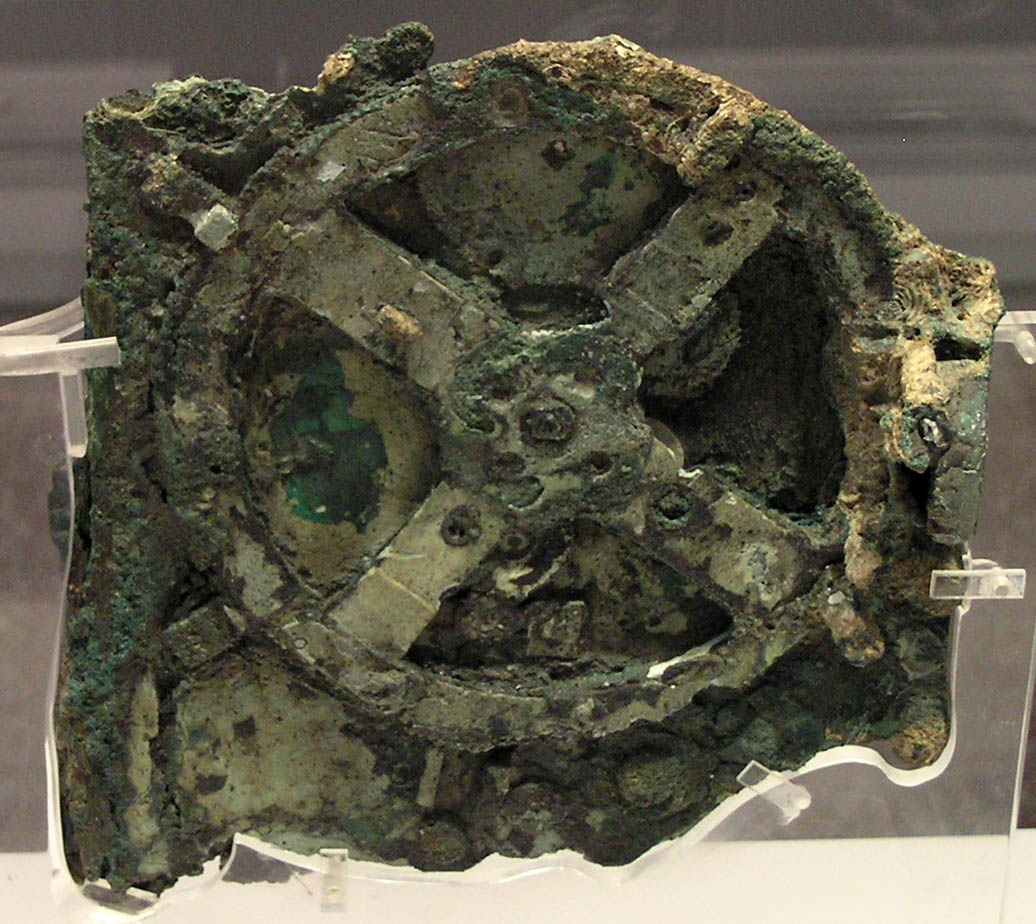
Meet the Antikythera Mechanism, which could have been made as early as 220 B.C. (yes, that’s B.C.). Looks a bit steampunk, doesn’t it?

 
Fragment of the Antikythera Mechanism. Source.

The Antikythera Mechanism comes from a submerged Roman-era shipwreck, which was discovered by sponge divers off the coast of Antikythera, Greece (hence the name) in 1900. Excavations of the ship started later that year and continued until 1901, although it has been investigated many times since, including this year! Since the ship was a merchant vessel, it was filled with statues and other artifacts.

The Antikythera Mechanism wasn’t a particularly impressive sight when it was first found, just lumps of corroded metal. 82 fragments were recovered. They, along with the rest of the shipwreck’s objects, were sent to the National Museum of Archaeology in Athens, where they remain to this day.

 
Fragments of the Antikythera Mechanism on display at the National Museum of Archaeology. 
Photo by Rowena McGowan.

It didn’t take researchers long to discover that the mechanism was something special. The development of techniques such as radiography and CT scans allowed the interior of the mechanism to be examined, which revealed new details about how it might have worked and inscriptions on the inside.

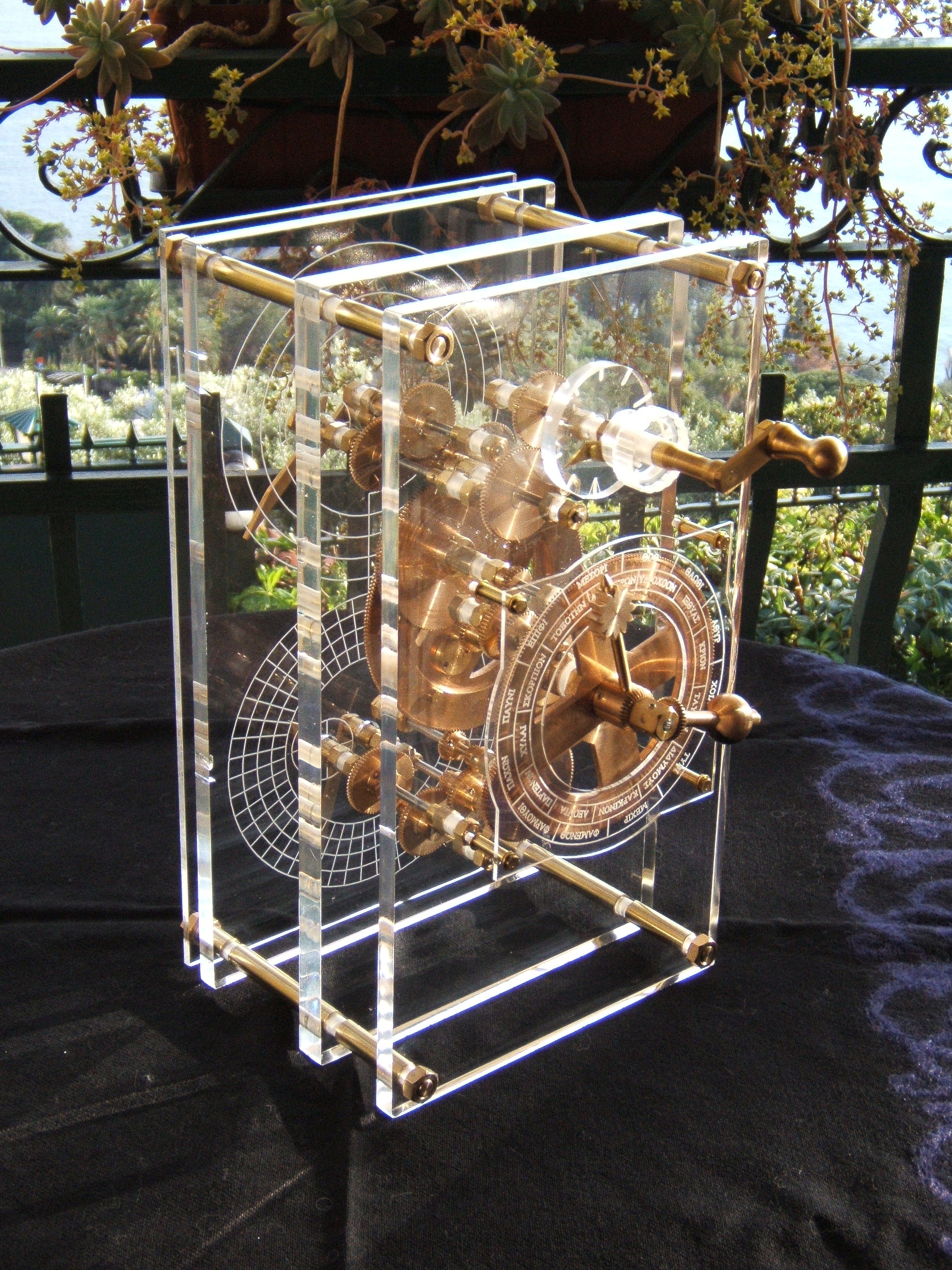
Calling it a ‘computer’ is actually a bit of an exaggeration and I’ll explain why I deliberately used that word in a paragraph or two. That doesn’t mean it’s not a complex and important piece of technology, however. The mechanism is more correctly referred to as an astronomical calculator. It was capable of showing lunar and solar cycles, as well as the positions of various stars and planets. We still aren’t completely sure how it worked or what the full mechanism would have looked like, although various theories have been proposed.

 Reconstruction of the mechanism. Source.

The story of the Antikythera Mechanism provides an interesting lesson on spin and publicity. Some accounts of the mechanism like to dress it up as centuries before its time, an ancient marvel (hence why I initially referred to it as an ancient computer). In fact, three of the top frequently asked questions on the Antikythera Mechanism Research Project website are ‘Is it fake?’, ‘Is it evidence of time travel?’ and ‘Was it left by aliens?’ The answer to all of these questions is a resounding NO!

The Antikythera Mechanism is an extraordinary artifact and, yes, unique – but only because of its survival. Ancient Greece had a long and well-documented history of scientific, mechanical and astronomical development. The mechanism, far from being ahead of its time, fits neatly into that history. We have evidence from no less a person than Cicero that Archimedes was making astronomical machines, years before the creation of the Antikythera Mechanism. The strangest thing about the mechanism is that it managed to survive into the 21st century – it’s special because of its uniqueness now, not because of its uniqueness at the time it was made.

Which raises an interesting question about the way we perceive the ancient world. Why are we so likely to assume that people who lived in the past were primitives, incapable of the same complex reasoning and technological skill that we are today? Why is it more logical to some people that aliens came to Earth and left their technology behind, rather than that people back then were just as curious, just as clever and just as inventive as we are today?


Sources

Academic Team of the Antikythera Mechanism Research Project. (2015).The Antikythera Mechanism Research Project. Retrieved from http://www.antikythera-mechanism.gr

Edmunds, M. G. (2014). The antikythera mechanism and the mechanical universe. Contemporary Physics, 55(4), 263-285. doi:10.1080/00107514.2014.927280

Freeth, T. (2009). Decoding an Ancient Computer. Scientific American. Retrieved from http://www.cs.virginia.edu/~robins/Decoding_an_Ancient_Computer.pdf