Showing posts with label Sadie MacDonald. Show all posts

24 July 2019

"AN ARGUMENT FOR SOMETHING ELSE": CORRECTIVE ART HISTORY RIGHT NOW

Breaking the Glass Case | Alexandra Forand


This summer the Minneapolis Institute of Art (MIA) presented “Hearts of Our People: Native Women Artist.” Believe it or not, this exhibit was the first major showcase of indigenous women (I am intentionally using small "I" indigenous, because the artists range in location and community). The exhibit features 115 objects, that span 1,000 years including paintings, sculptures, textiles and more.

This exhibit took my Facebook and Twitter feed by storm. Every time I logged into a social network platform to mindlessly scroll through articles and memes for a couple minutes I would see friends and acquittances posting pictures, think pieces authored by magazines like Vogue, and scholarly articles mentioning this exhibit. Words, like “ground-breaking,” “awe-inspiring,” and “revolutionary,” were often affixed to posts about this exhibit. But it was one term discussing Hearts of Our People: Native Women Artist, that really caught my eye. This term was “Corrective Art History.” 


Let’s back up for a moment. What is Corrective Art History? Corrective Art History is meant “to provide an affirmation for those who do not regularly see themselves portrayed in media or art.” Moreover, it is an effort to combat the lasting, damaging impacts of underrepresentation.

This term is often used to describe Kerry James Marshall’s work, who is both redefining the Western cannon and creating his own. He explains it better than I ever could: “My work is not an argument against anything; it is an argument for something else.”

Kerry James Marshall, Mastry, source.


Mickalene Thomas is another notable artists who could described as working within Corrective Art History. Thomas vividly and actively inserts black female bodies into art, a place she argues is traditionally white and patriarchal. Furthermore, there are many Indigenous artists who work within Corrective Art History. Arguably one of the most well-known artists working within this realm is Kent Monkman (Cree). Monkman’s Shame and Prejudice: A Story of Resilience, is an epic revision of a Western colonial history that is still taught in schools today. If you want to learn about Shame and Prejudice, Sadie Macdonald wrote an exhibition review and you can click here to read it!

Hearts of Our People: Native Women Artist, is not the only Indigenous led exhibition which operates within Corrective Art History. More and more exhibitions are gaining attention in a post-TRC world. In the Spring of this year, an exhibition on the Poundmaker Cree Nation focused on the story of Chief Poundmaker, who was arrested after the colonial government of Canada failed to honour treaty promises. After six months, Chief Poundmaker was released from prison after contracting a fatal respiratory disease. For nearly 135 years the Western cannon wrote Chief Poundmaker as the villain of his story. The exhibition successfully sets the historical record straight and brings in First Nation voices to the Western cannon. While the state of Canada exonerated Chief Poundmaker on May 23, 2019, this exhibit shows that everyone from artists, researchers, and curators to ordinary everyday people can work against these harmful historical inaccuracies.

Chief Poundmaker,  Source. 
The exercise of Corrective Art History is important and necessary. As museum professionals we need to become uncomfortable with our own learned knowledge and let these exhibitions and art rewire our own inherent biases of history. We, like Kerry James Marshall, Mickalene Thomas, Kent Monkman, and the indigenous run exhibits, have to argue for something else.

Have you seen any of these exhibitons? What challenged you and how did you deal with these challenges? What are your thoughts? I really want to know! Leave a comment, send me an email (allyforand@gmail.com), or if Twitter and Instagram are more your speed my handle on both is @Ally_but_online.

19 March 2018

YELLOW BIRDS AND PAINTED STOVES: THE MAUD LEWIS GALLERY AT THE ART GALLERY OF NOVA SCOTIA

EXHIBITION REVIEWS

BY: SADIE MACDONALD

For my last exhibition review for Musings, I decided to turn to an exhibition that's close to my heart: the Maud Lewis Gallery at the Art Gallery of Nova Scotia in Halifax.

Maud Lewis is Nova Scotia's most famous folk artist, and she is currently enjoying something of a moment after the release of the excellent film Maudie starring Sally Hawkins and Ethan Hawke in 2016. The 2017 discovery of a Lewis painting in a thrift store in New Hamburg, Ontario, also couldn't have hurt the increasing interest in her life and work.

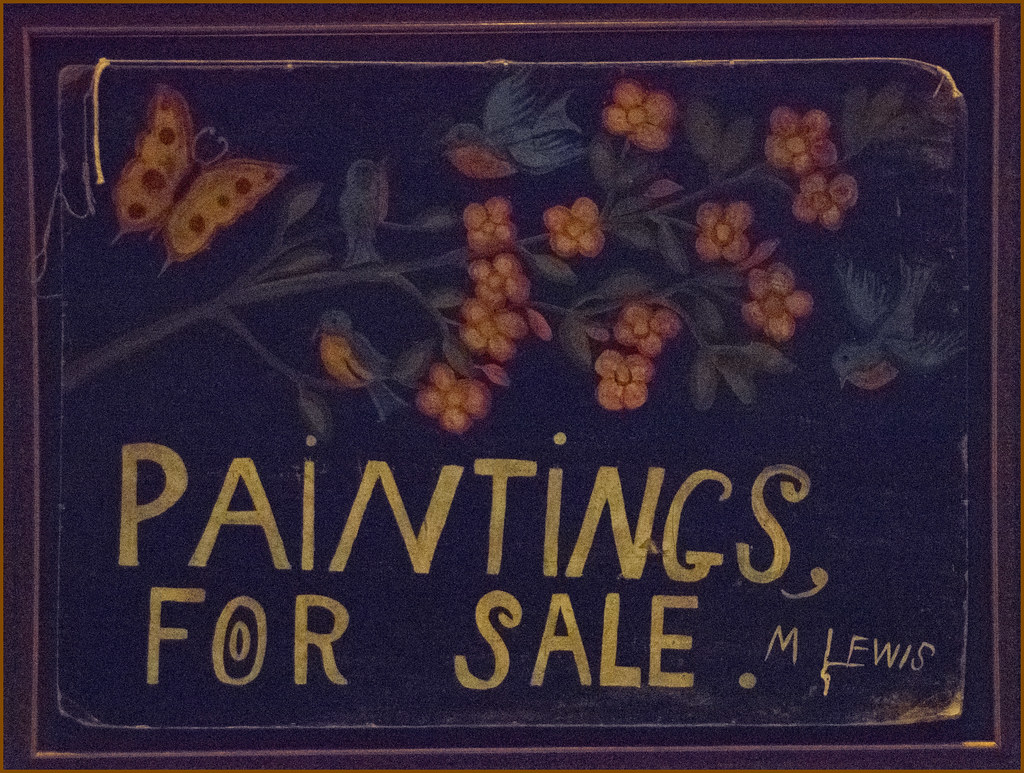
Lewis's story is atypical for an artist. She never received formal art training and spent her entire life within the radius of Yarmouth and Digby County in Nova Scotia. After marrying Everett Lewis in 1938, the couple lived together in a small house without electricity or plumbing, which Maud lovingly covered with her own painted designs. To help bring some money, Lewis began selling paintings from her home, propping up a sign by the road that proclaimed "Paintings, for sale."

Maud Lewis's sign. Source.

Lewis's bright paintings of animals and rural Nova Scotian scenes, as well as her cheerful demeanour, caught the eye of the Canadian public. In 1965, she was the subject of a CBC-produced documentary, a clip from which you can find below. Lewis died in 1970 after contracting pneumonia. While Lewis typically sold her paintings at about $2 apiece in her lifetime, her works now sell for up to $45,000, and firmly occupy a place in the Canadian pantheon of art.


Lewis's paintings are simple and happy, qualities which appear to form a contrast to her own life experiences. Lewis was born with physical disabilities and developed juvenile rheumatoid arthritis, which worsened with age. Mocked by other schoolchildren for her disabilities as a youth, Lewis left school early. As a young woman she became pregnant out of wedlock, with the baby being put up for adoption; despite her daughter's attempts to make contact, Lewis never had a relationship with her child. Lewis's relationship with her husband, which is the focus of the film Maudie, is said to have been volatile. This all stands in juxtaposition to her sweet, smiling disposition and cheerful, colourful art.

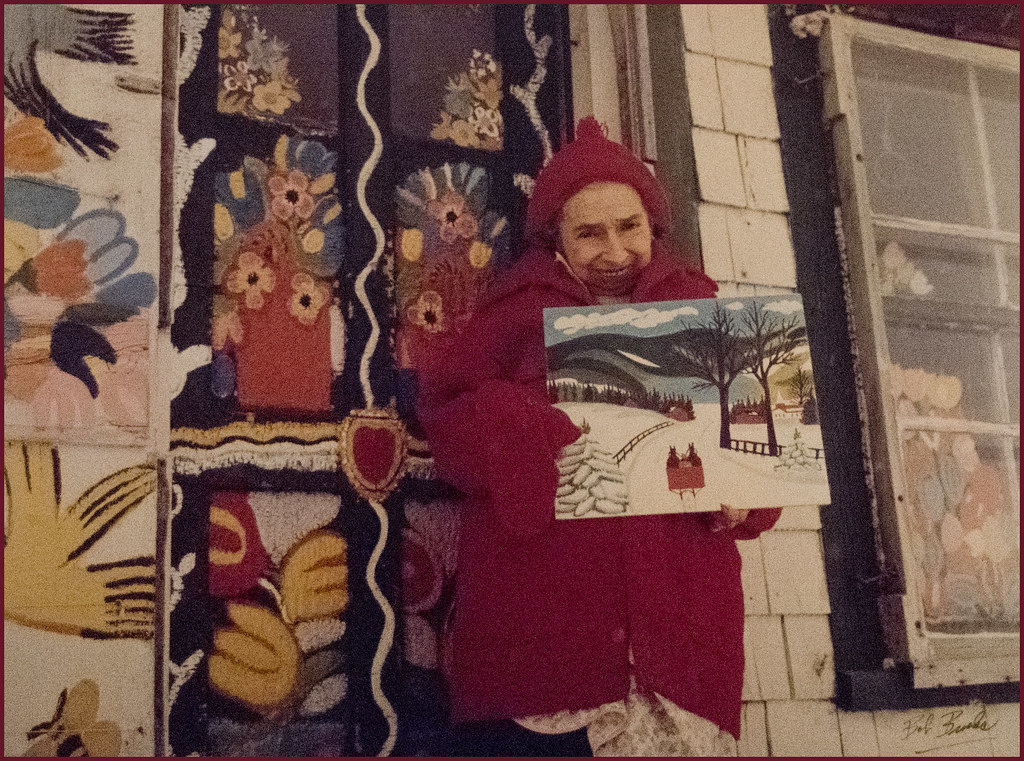
Maud Lewis holding one of her paintings in front of her house. Source.

Lewis's art is simplistic in form, but it has understandably captured the affection of many. It makes you happy.

Maud Lewis. Three black cats, 1955. Oil on rpulpboard. Private Collection. Photo courtesy of the Art Gallery of Nova Scotia.

Many of Lewis's paintings can be found at the Art Gallery of Nova Scotia in their permanent exhibit of her work. Lewis's most famous artwork, however, is not a painting, but rather her house. Like her other works, this house too can be found at the Art Gallery of Nova Scotia!

Maud Lewis House. Mixed Media, 4.1 x 3.8 m. Collection of the Art Gallery of Nova Scotia. Photo courtesy of Steve Farmer.

Throughout her lifetime Lewis covered every surface of the house, inside and out, with paintings of birds and flowers. Sadly, the house lay abandoned after Lewis's husband Everett was killed in a struggle with an intruder in 1979. Years later a Digby group, the Maud Lewis Painted House Society, organized with the goal of saving the house. In 1984, the house was sold to the provincial government of Nova Scotia and placed in the care of the Art Gallery of Nova Scotia. Restorations began in 1996, and the house was eventually moved to the Gallery. It has remained there on permanent display since 1998.

Standing next to the tiny house, a visitor to the Gallery can peer into the window and door and see Lewis's paintings on the stairs, walls, and furniture. Made to look as it would have been when the Lewises lived in it, the house offers an intimate glimpse into their lives. One might wonder how Maud and Everett could have managed in this low, small space; I am barely over 5 feet tall, and I would have felt crammed living here. The house, however, has its own beauty. After looking at the house, I feel the urge to paint my everyday surroundings like Lewis did.

Maud Lewis House. Mixed Media, 4.1 x 3.8 m. Collection of the Art Gallery of Nova Scotia. Photo courtesy of Steve Farmer.

The house itself exemplifies why Maud Lewis is so fondly regarded. She made the rural world around her artistic by capturing everyday scenes in her paintings and physically transforming her own domestic surroundings into art. Not all of us are so lucky to see things in this way.

Thus ends my run with Musings. While I will now vacate the position of Exhibition Reviews contributor, I'm sure there will be other writing adventures in the future!

Source.

16 March 2018

WHO'S IN THE KITCHEN? EXPLORING CANADA'S CULINARY CULTURE AT THE THOMAS FISHER RARE BOOK LIBRARY

A MUSE BOUCHE

BY: JENNIFER LEE

It's exhibition opening season, gentle readers! My colleagues Cassandra Curtis and Sadie MacDonald graciously answered my questions about their project, an upcoming exhibition at the Thomas Fisher Rare Book Library and a banquet of associated programming (both public and digital). Join us to talk about complementary interpretive vehicles, making exclusion visible, and a really, really cool cookbook. 

JL: Hello! Can you describe the project and your specific roles in it?

SM: Our exhibition is entitled Mixed Messages: Making and Shaping Culinary Culture in Canada. We explore Canadian culinary texts, objects, and ephemera with a focus on the individuals and communities who participated in and influenced - or were excluded from - that wider culinary culture.

Image used with permission of Rogers Media Inc., All Rights Reserved.
Cassandra and I are responsible for curating an interactive exhibition in the MacLean Hunter room, the lower gallery/classroom space of the Thomas Fisher. We are also preparing a public program connected to the exhibition at Fort York for Doors Open Toronto 2018.
Officially, Cassandra is in charge of all digital content (such as our exhibition blog, which Cassandra built on Omeka and coordinated content for) and I am coordinating physical content (I researched the culinary print material in the Fisher), but we basically have been working on everything together and jumping in to support each other when needed. As curators we have been working under the direction of Irina Mihalache, Nathalie Cook, and Elizabeth Ridolfo, who are curating the upper gallery space.

Our external partners are the programming team at Fort York. We have been working closely with Bridget Wranich and Jocelyn Kent to develop programming for Doors Open Toronto. 

JL: This is a multifaceted project, using digital content and public programming alongside more traditional exhibition models. How have you found the process of working with so many different interpretive vehicles? How does each enhance the exhibition as a whole?

SM: It has been a bit of a learning curve working with these multiple project components (before this project, neither of us had extensive experience with programming, for example), but Cassandra and I have both been really enjoying the process so far.

Each component - digital, programming, and traditional - has unique qualities that add to the exhibition. For example, this an exhibition that is all about food and cooking, but obviously we can’t have any of that take place in a rare book library space! This is why the Doors Open public program is so valuable; it gives us an opportunity to actively participate in the culinary culture explored in this exhibition, and invite others to do so as well. We will be serving food based on recipes in the exhibition at this event.

A bottle of Crosse and Blackwell curry powder, estimated to be from the Edwardian period. On loan to the Thomas Fisher Rare Book Library from the Collection of Mary Williamson. Photo courtesy of Sadie MacDonald.

The digital content provides an additional way to share the themes and stories of this exhibition with our audiences. There will be an iPad in the gallery that visitors can use to explore culinary texts - not all of which will be explored in detail in the physical gallery displays. The exhibition blog also adds a personal, “behind the scenes” touch to our exhibition, as it is a way for those involved in curating the exhibition to share their experiences bringing the project together.

The digital, programming, and traditional aspects all play into each other and reference each other, but each adds something special to the exhibition using the unique qualities provided by that medium.

CC: It really has been very valuable how multifaceted this project has been for us. I never would have chosen solely a public programming project but I've found it surprisingly fun and engaging to put together!

JL: You mentioned that the exhibition discusses individuals and communities who were excluded from culinary culture, not just those who were visible. It can be difficult to tell these stories when marginalization and erasure affect the material available to us. Has this been an issue for you?


CC: Interesting question! Like a lot of collections, what's absent is what stands out sometimes when it comes to marginalized communities. We've been trying to find a constructive way to talk about the fact that so many of these recipes reference ingredients from these communities without giving them any credit. Then there are some opposite examples too, where a surprising amount of credit is given.

SM: Yes, there is more material out there than one might anticipate. Dr Mihalache and Liz Ridolfo will be discussing Indigenous community cookbooks in the upstairs gallery, for example. And there is one fascinating cookbook, a “crowd-sourced” recipe collection of “Canadian Favourites” organized by the Co-operative Commonwealth Federation (a forerunner party to the NDP) in the 1940s. This book includes a wide variety of recipes from many cultures present in Canada, including Indigenous and immigrant cultures, and more importantly, credits those cultures and the individual who provided each recipe.

However, this is something of an exception. A lot of the cookbooks we look at fail to credit the original cultures, or superficially or erroneously make reference to the recipe’s cultural context (for example, the trend of cookbooks referring to recipes with pineapple in them as “Hawaiian”).

So that in itself provides a way to open this conversation about marginalization - by talking about the gaps and oversights themselves and looking at what they tell us.

Canadian Favourites: CCF Cookbook. Ottawa: CCF National Council, 1947. Collection of the Thomas Fisher Rare Book Library.
JL: Is there an object or story that you've found particularly meaningful or delightful?

CC: For myself I've most enjoyed thinking about these cookbooks in the context of the real women who used them and how much they were asked to do. One of the angles we're looking at this from is the resourcefulness that was demanded of women in terms of domestic work, from angles such as rationing and technology. The feminist in me has been really enjoying doing research about women and domesticity! 

SM: I already mentioned the CCF cookbook, and I think that’s my favourite object because of how surprising it is in the context of this exhibition. While many cookbooks from our period of study (1860-1960) appropriate recipes and fail to credit their cultures of origin, that isn’t the case with this cookbook. There are a few Indigenous recipes provided by the Fisher River Reserve in Manitoba, for example - and they are given credit for it. Recipes from immigrant communities are also credited, and the names of the dish in their original languages are often given as well. It’s a very multicultural cookbook - you can find Chinese and Russian recipes on the same page! Reading this cookbook, which was produced in a political context, one gets the sense that it is attempting to speak to the multicultural make-up of 20th-century Canada.

JL: I'm so excited to see this woke proto-NDP cookbook, I can't even tell you.


Mixed Messages: Making and Shaping Culinary Culture in Canada will open on May 21st at the Thomas Fisher Rare Book Library and run until August 31st. The Doors Open event will take place on May 26th and 27th at Fort York. You can find more information about the exhibition here and read blog posts from Sadie, Cassandra, and other project team members at the exhibition blog.

19 February 2018

THROUGH DARKNESS AND LIGHT: CURRENT EXHIBITIONS AT THE ART MUSEUM AT THE UNIVERSITY OF TORONTO

EXHIBITION REVIEWS

BY: SADIE MACDONALD

This week, I decided to take a break from studying and visit the exhibits up for offer at the Art Museum at the University of Toronto. At the moment, there are two major exhibitions: Figures of Sleep and Morning Star. One exhibition, dimly lit and shadowed in quiet darkness, investigates concepts of sleep; the other, located on a brightly-lit upper floor, focuses on illuminating Indigenous artists.

Figures of Sleep is on display at the University of Toronto Art Centre location. Curated by Sarah Robayo Sheridan, this exhibition “considers the cultural anxieties manifest in the popular and critical imagination around the collapsing biological function of sleep under economic, social and technological transformation.” I must say, as a graduate student with an utterly wrecked sleep schedule, the topic of sleep has been a personal concern for me for a while, so I was interested in visiting this show.

When you first walk into the Art Museum, you'll notice that the the gallery has black walls and very little lighting, creating a unique exhibition experience as you explore the space in darkness. This is an interesting and highly appropriate design choice for an exhibit that's all about sleep. This strategy does have its drawbacks, however, as some of the labels are faintly lit. In any case, even if you are able to read them, they will not tell you much about the context of the works on display. 

Insomnia Drawings by Louise Bourgeois. Photo courtesy of Sadie MacDonald.

Some of the images may not need context, and will be bolstered by the visitor’s own interpretations. Louise Bourgeois’s Insomnia Drawings certainly evoked for me the feelings of an overactive, tired mind struggling to fall asleep. For other works, I was keen to learn more about what I was seeing. On Kawara’s I Got Up series consists of a collection of postcards, written and sent between 1968 to 1979; in this series, Kawara recorded the times he woke up each day as he travelled around the world. I recognized that the postcards on display in this exhibition were collected in Halifax (one even featuring my alma mater!). I wish that more in-gallery context had been provided regarding the artist’s journey and goals, which certainly intrigued me as I examined the postcards.

Dream Catcher by Rebecca Belmore. Photo courtesy of Sadie MacDonald.

Lack of context aside, the exhibition will make you think as it offers explorations of other themes branching off from the basic topic of sleep. Rebecca Belmore’s Dream Catcher caught me in my tracks. This textile image depicts an Indigenous person sleeping on a concrete sidewalk, and has several details speaking to the urgency of current Indigenous activist movements such as Idle No More.

Figures of Sleep features many works that confront ideas related to sleep, from many different times and places. This exhibition may be all about sleep, but it certainly will not put one to sleep.

Untitled (old woman in bed) by Ron Mueck almost gave me a heart attack. Photo courtesy of Sadie MacDonald

If you want to visit Morning Star, you will have to make a journey to the Jackman Humanities Institute. The exhibition is so called because it “ascends to shine light on presence, visibility and collective Indigenous agency to renounce naïve impressions of (re)conciliation that continue to be discussed throughout much of the settler culture across Turtle Island.” Curated by Jason Baerg and Darryn Doull, Morning Star features the works of established Indigenous artists such as Alex Janvier and Garry Todd as well as contemporary artists like Adrian Stimson. My colleague, Amy Intrator, will write about this exhibition in depth later this week, but I will briefly introduce it here.

ᐁᑳᐃᔹ ᓀᐯᐃᓸ (ēkāwiya nēpēwisi) by Joi T. Arcand. Photo courtesy of Sadie MacDonald.

Joi T. Arcand
’s neon channel signs capture one’s eye immediately. They are not translated for non-Indigenous comfort of viewing. As such, the illuminated text perfectly encapsulates the exhibition’s themes of “shining a light” on Indigenous agency. The photography of Nadya Kwandibens, which features Indigenous people fearlessly walking the streets of Toronto, likewise challenges settler perceptions. 

One captivating work on display is Bracken Hanuse Corlett’s animated film Ghost Food. There is no dialogue, just a soundtrack of haunting music, but the story of two characters attempting to hunt for food in an urban wasteland offers an intriguing visual journey nonetheless. You can view the video below.


Morning Star was created in partnership with the Jackman Humanities Institute, but the 170 St. George Street location may not have been the most visible space for displaying this exhibit. Housed on the tenth floor of the building, it is only open from 9am to 4 pm from Monday to Friday. Fortunately, Morning Star has a long run, ending later this summer, which does provide more opportunities for seeing it. The Jackman Humanities Institute is also not a typical gallery space; you might have to squeeze past chairs and tables to get a closer glimpse at some of the work on display, which gave me reason to worry about its accessibility. Once you are able to engage with the works on display, the results are worth it.

Though both exhibits have logistical flaws, the works that compose the exhibit are powerful and captivating. Figures of Sleep’s run will end on March 3rd, so I suggest that you see it sooner rather than later. Drop-in tours are offered every Friday at 2pm. Morning Star will run until August 14, 2018.

24 January 2018

AN EMPATHETIC VISION: HACKING BLACK FUTURES AT BAND GALLERY

EXHIBITION REVIEWS

BY: SADIE MACDONALD

This weekend, accompanied by Musings Editor-in-Chief Serena, I paid a visit to BAND Gallery and Cultural Centre in the Parkdale region of Toronto to see the exhibition Hacking Black Futures. BAND partnered with the Toronto Design Offsite Festival to host this exhibition from January 15th to the 21st this year.

Approaching BAND. Photo courtesy of Sadie MacDonald.

It was the first time that I had encountered a project associated with BAND. Founded in 2009, BAND (which stands for Black Artists' Networks in Dialogue) "is dedicated to supporting, documenting and showcasing the artistic and cultural contributions of Black artists and cultural workers in Canada and abroad." The BAND Gallery is located in an old Victorian house painted entirely black on the outside, and its familiar, comforting interior space is a far cry from the traditional “white cube” style of art galleries. When Serena and I walked into the BAND Gallery, we were warmly greeted by Addae, who was assisting in the gallery, and invited to engage with the exhibition.

Hacking Black Futures invites speculation on what a Black-centric future society could look like. The exhibition houses multimedia artistic projects by artists of colour and is informed by the values of Afrofuturism. This philosophy draws on Black cultural perspectives and Black imaginations to create optimistic visions of the future that challenge white-centric speculative models. Through this lens, the exhibition artists examine concepts such as food sovereignty, which is expressed through the idea of Black societies determining and controlling their own food systems. Other concepts on display include social economy, as explored through works such as Addae Nurse’s intimate photography. A form of sustainability is present in Renée Mathews’ Denim Wigs, which notes the importance of hair in Black cultural expressions and repurposes old jeans to create hairstyles that serve as an alternative to synthetic methods of styling.

A common thread throughout the exhibition is the belief that personal and community connections will ultimately form the lifeblood of equitable futures.

One of Renée Mathews' Denim Wigs. Photo courtesy of Sadie MacDonald.

While we were at the gallery, Serena and I had an opportunity to chat with Andre Baynes, who curated Hacking Black Futures with Chiedza Pasipanodya. Andre told us how he approached artists of colour from the OCAD community and invited them to contribute works that support the exhibition’s themes. In addition to Andre Baynes and Chiedza Pasipanodya, the artists featured in Hacking Black Futures include the aforementioned Addae Nurse and Renée Mathews, along with Ene Agi, Denzel Arthur, Toni Cater, Lequanne Collins-Bacchus, Daejuawn Hamilton, Thomas Graham, Ashley Jane Lewis, Maisha Marshall-Ende, Kelvin Mendie, Michael Otchie, Kimani Peter, Peter Scott, and Olivia Spence.

A view of Living Lab by Andre Baynes and Ashley Jane Lewis. Photo courtesy of Sadie MacDonald.

In addition to curating the show, Andre also collaborated with Ashley Jane Lewis to make the plant-covered piece shown in the photo above, entitled Living Lab. Andre told us that this work started with him envisioning a typical desk workspace and then imagining it supporting living plant life. Serena and I were mesmerized by this piece. You become transfixed by the soothing fluidity of the moisture spreading out over the greenery. Living Lab is truly living, and never stagnant; it is maintained by the generated streams of gentle fog, and Andre also gave it a spritz of water during our visit. He told us that the look of the lab can change during the day depending on the humidity and temperature in the air. By having a miniature ecosystem occupying a desk, nature is beautifully incorporated into a home environment.

Tree Tank by Ashley Jane Lewis. Photo courtesy of Sadie MacDonald.

Another exhibit that blended science with domestic-focused art was Ashley Jane Lewis’ Tree Tank, which contains a living Jamaican orange tree bearing bright fruit. An accompanying booklet explains how some people of colour “want to feel connected to their heritage through the food they eat, while avoiding the oppression that comes from the growth, production, and transit of that food from its country of origin to their plate.” The orange tree on display is housed in a tank made of accessible materials, and as such provides a tangible vision of what it might look like for people to grow food from their own cultures within their own homes.

As Serena and I explored the exhibit, we also had the pleasure of speaking to Toni Cater, one of the artists in the show. A designer by trade, Toni created for this show a textile-inspired wallpaper design that envisions a connected unity between Black people and illustrates how community narratives are woven together through storytelling and sharing. Toni also explained to us the initiative behind another work on display, the LOUD Micro Studio Kiosk presented by Kimani Peter. This transportable kiosk contains a sound booth for Black artists to record their own music in, the output of which is then managed through the app produced by LOUD. This Black-owned initiative provides hopeful artists with an accessible way to make their voices heard, and supports them through every step of the process.

Artists are invited to sign up to use the LOUD Micro Studio Kiosk. Photo courtesy of Sadie MacDonald. 

The LOUD Micro Studio Kiosk, along with the other works in Hacking Black Futures, demonstrate the core meaning of the exhibit. Hacking Black Futures uplifts and mobilizes mindful community empathy. The artworks on display aim to show that marrying this communal empathy to new technologies and ideas will be the key to realizing a better Black future.

Hacking Black Futures ended its run at BAND on January 21st. However, I encourage you to visit BAND Gallery to explore its other offerings. Black History Month is approaching, but that doesn't mean you should only engage with the ideas of Black creators in February. These ideas are always present at any time, and everyone should become familiar with them. As Addae told us, “everyone is welcome” at BAND Gallery.

I also suggest you keep an eye on the artists involved in this show and see how they will continue to create new futures.

20 November 2017

IT ALL COMES TOGETHER: AUTUMN 2017 EXHIBITIONS AT ARTSCAPE YOUNGPLACE

EXHIBITION REVIEWS

BY: SADIE MACDONALD

Last year I visited Artscape Youngplace for the exhibition Yonder. Recently I returned to the centre to see the current shows on display: Soft: transformative queer love and care; Katrina Jurjans: for a moment it all comes together (and you’re the only one); Staring Back at the Sun: Video Art from Israel, 1970-2012; and Fermenting Feminism. Many of the exhibitions explore the intersections between social action and intimate relationships, and offer unusual sensory and emotional experiences for visitors.

Information on the exhibitions currently on display at Artscape Youngplace. Photo courtesy of Sadie MacDonald.

What I like about the exhibitions at Artscape Youngplace is the way the artists and curators use the building’s features to their advantage. Exhibitions take over spaces that are not conducive to traditional art displays, including the hallways and stairwells of the building. Installations by Josée Pedneault and artist team Maggie Groat and Jimmy Limit feature vinyl wall decals wrapped into corners and plastered over the stairwell windows.

A component of Josée Pedneault's installation envisioning an imaginary island. Photo courtesy of Sadie MacDonald. 

The second floor hallway is dedicated to Soft, an exhibition by Morgan Sears-Williams that displays photos of nightlife in queer spaces.* The hallway lends itself to unusual spacing of the works, a feature which is further embraced in the non-traditional displays; one panel is a long paper banner that trails on the floor. These design choices highlight the exhibition’s themes of gentleness and makeshift spaces.

One wall section of Soft. Photo courtesy of Sadie MacDonald.

Sears-Williams explores the transformative nature of love in queer spaces and relationships. Past work by Sears-Williams has focused on trauma experienced by queer communities, but this exhibition branches off those ideas to examine the concept of queer people finding comfort and strength in each other.

In addition to the documentary photographs, Sears-Williams created an installation with old telephones. Visitors can hold the phone to their ear and hear recordings of interviews the curator conducted with queer people they know. The effect is that of listening in on an intimate conversation. One telephone plays a recording of Sears-Williams speaking to their partner Marie. The two have a discussion on how to dismantle oppression in their own thoughts. They also note how exhausting it can be for queer identities to be constantly subject to politicization. As Sears-Williams says, sometimes the most transformative and subversive part about queer identities is just about love: “I’m just so in love with you,” and that love is what is “keeping ourselves alive.”

The wall display in Soft with a silent telephone. Photo courtesy of Sadie MacDonald.

This exhibition balances love and positivity with exclusive politics and conscious critique. One phone in the installation is silent; are there some voices we are not hearing? Sears-Williams and the people they interview grapple with the concept of oppression those in the queer community may be complicit in perpetuating. Soft is a quiet celebration of transformative queer love, but is not uncritical when exploring the parameters of that transformative quality.

Political critique and artistic validation continue to dovetail in the Koffler Gallery’s exhibit Staring Back at the Sun, which features Israeli video art from four different periods, spanning from 1970 to 2012. Some artists whose work is shown in the exhibition include Doron Solomons, Ruti Sela and Maayan Amir, Gilad RatmanAvi Mograbi, and Sigalit Landau. The videos cover about 3 hours of material, and visitors can walk through four dark rooms and observe at their own pace.

Some of the early videos are purely experimental artistic endeavours, but several videos tackle difficult topics. A few focus on how the Israeli-Palestinian conflict has affected the worldviews and morality of ordinary people. For example, Boaz Arad’s video Gefilte Fish shows his mother preparing and explaining a traditional Ashkenazi dish while occasionally making prejudiced statements as she cooks; these scenes are intercut with Arad mouthing his mother’s words, showing how mindsets can be inherited. The videos in Staring Back at the Sun are frequently troubling and perplexing, but always thought-provoking.

The view from one of the four rooms in Staring Back at the Sun. Photo courtesy of Sadie MacDonald

Human relationships continue to be explored in Katrina Jurjans’s third-floor hallway exhibition. Her colourful paintings depict tension and instability as well as intimate moments in relationships.

Fermenting Feminism presents a dialogue on an unusual relationship: the connection between feminism and fermentation. Curated by Lauren Fournier and featuring work by Sharlene Bamboat, Hazel Meyer, Leila Nadir and Cary Peppermint, Sarah Nasby, Kayla Polan, Walter Scott, and Agustina Zegers, this visceral exhibition engages the senses of sight, smell, and sound as the artists explore concepts like consumerism and festering emotions through a feminist lens.

Sarah Nasby's display in Fermenting Feminism shows kombucha fermenting inside found ceramic vessels. Photo courtesy of Sadie MacDonald.

It is important to note that many of the exhibitions currently at Artscape Youngplace feature work by emerging curators and artists. Sears-Williams is the recipient of the 2017 Artscape Youngplace Career Launcher prize, as is Madison Leeson, who wrote the text for Soft. Katrina Jurjans received the Artscape Award at the 2017 Toronto Outdoor Art Exhibition. Fermenting Feminism and the stairwell installations are associated with Critical Distance Centre for Curators, a not-for-profit initiative that supports “the advancement of curatorial inquiry and practice in Toronto, Canada, and beyond.” Check out the space to see what new artists and curators are doing in Toronto!

I also recommend visiting Artscape Youngplace for your own benefit. The exhibitions show that being emotionally troubled and emotionally uplifted are not mutually exclusive experiences.

Artscape Youngplace and its associated galleries are free to visit, and while some exhibitions are subject to limited hours, the hallway and stairwell exhibitions can be seen every day until 9:00 pm. 

* The artist/curator uses the term "queer" in their writing on the exhibition, so the author has done the same in this article when referring to the LGBTQ+ community.

23 October 2017

FEAR AND LOATHING IN GREEN BAY: THE IMPACT OF FRIGHTENING MUSEUM EXPERIENCES

EXHIBITION REVIEWS

BY: SADIE MACDONALD

A couple of weeks ago, several students from the Master of Museum Studies program attended the OMA Conference in Kingston. While we were there, a few of us decided to check out Fort Henry’s Fort Fright experience. While it was more of an entertaining experience rather than an educational one, this visit got me thinking about the role of emotions and affect in museums.

Some of my strongest memories of museum visits as a kid were those that were especially emotionally effective – or affective, if you will. In particular, my most memorable museum experiences center around “negative” emotions, such as fear, horror, and sadness. Feeling these emotions in a museum space is not necessarily a bad thing. I’d like to explore how fear and horror can be used positively in museums, drawing from my own memories.

Montshire Museum of Science

In Norwich, Vermont, there is a science centre called the Montshire Museum of Science. As a child, my mother took my sister and me to this museum for fun, educational outings. We played with bubble wands and learned about gravity using golf balls. I have many happy memories of this museum, but one visit in particular stands out to me more than 20 years later.

An interior view of the Montshire Museum. Photo courtesy of Andrew Wellman.

The Montshire Museum has a space called Andy’s Place that is geared towards preschool-aged children. There are tactile activity stations, as well as a shallow cave to crawl into. On one visit, I scrambled inside the cave, which was a dark, confusing space where I could not stand up fully. As I scooted along, I reached out and my fingers touched fur. There was a bear in the cave with me – or rather, a bear pelt. I began to cry and desperately made my way out of the cave just as confusedly as I had crawled in. I eventually realized that the bear was "asleep." It was meant to be hibernating.

This bear den still exists today and, in addition to teaching children about hibernation, is intended to be a quiet space for children in need of a sensory break. Other people seem to have had more positive memories of the cave. Unlike me, my little sister had no fear of the bear skin, which I’m sure was the intended effect. My frightening experience, however, was memorable.


Heritage Hill State Historical Park

On one occasion when I lived in Wisconsin as a kid, my class went on a field trip to Heritage Hill State Historical Park in Green Bay. This site is made up of multiple historical buildings. One building on the site is Fort Howard Hospital, which was constructed between 1834 and 1835.

Fort Howard Hospital in a typical Wisconsin winter. Source.

I remember the lines of crisp, clean beds inside the hospital. The docent explained what it was like for a patient to spend time in this space. I learned how nurses helped shave patients’ faces, and what a bedpan was. We next went to the operating room, where the docent showed us the doctors’ tools. She then proceeded to explain in extreme detail how the tools would be used in surgery. I remember her describing doctors digging into scalps and eyes without modern anesthetic. My head started swimming and I panicked. A chaperone helped me out of the room to catch some air outside.

An approximation of the author at 9 years old running from the Fort Howard Hospital. Source.

The experience may have been horrific for me, but I still learned about historical medical practices. I had also empathized with the patients who had once been treated at this hospital as I imagined what their pain must have been.

I have vague memories of the open outdoor spaces of Heritage Hill. However, the experience at the hospital has stuck in my memory 16 years later.

United States Holocaust Memorial Museum

In grade 9, my school band went on a field trip to Washington D.C. One day, we were allowed to form groups and explore the city’s museums and memorials. One place my friends and I visited was the United States Holocaust Memorial Museum.

We experienced an emotional whirlwind at the USHMM. I was horrified when I inspected models of the gas chambers. I felt sadly aware of interrupted lives and mourning families as I viewed a wall of photos, and a room containing candles placed in memory of genocide survivors. Most affective of all was the display of shoes taken from Holocaust victims at the Majdanek concentration camp. In the mass pile of discarded shoes, I caught a glimpse of a child’s white sandal, and lost my composure.

The walls of photos depicting Holocaust victims at the USHMM. Source.

I had learned about the Holocaust before this visit. I had read books written by survivors and seen films. My visit to the USHMM, however, affected me in a visceral way. The museum communicated to me the individuality of the victims and the mass scale of death. It was an empathetic experience like none I’d ever had before.

These horrifying experiences may have been emotionally unpleasant for me, but I remembered them, and what they taught me. For me, fear and horror also played a role in creating empathy. Affect and empathy are both topics of discussion in the museum field, and I believe they are well worth pursuing.

What are some effectively affective exhibits you remember visiting?

28 September 2017

A CASE OF IDENTITY: POP SHERLOCK AT THE TORONTO REFERENCE LIBRARY

EXHIBITION REVIEWS

BY: SADIE MACDONALD

When I learned that there was a Sherlock Holmes exhibit at the Toronto Reference Library this fall, I knew I had to see it.
An approximation of the author's reaction to a Sherlock Holmes exhibit, as demonstrated by actors Viktor Yevgrafov and Vasily Livanov from the 1979-1986 Russian Sherlock Holmes series. Source.

Pop Sherlock explores the popularity of the famous fictional detective and his many appearances across different forms of media. The Toronto Reference Library (fun fact: the library was designed by architect Raymond Moriyama, who also designed the Bata Shoe Museum, the Ontario Science Centre, and Museum London) has an Arthur Conan Doyle Room, which past contributing editor Stephanie Read reviewed on Musings in 2016. Pop Sherlock, a temporary exhibit, offers a more colourful and playful look at Doyle's most well-known creation. In this exhibit, visitors can explore the pop culture phenomenon of Sherlock Holmes and see how the character has inspired an unwavering outpouring of adaptations over the past 130 years.

A display case showing original playbills from stage adaptations of Sherlock Holmes. Photo courtesy of Sadie MacDonald.

Pop Sherlock is on display in the airy TD Gallery on the first floor of the library. The exhibition has a bold colour palette reminiscent of a pop art aesthetic. I was surprised when I first saw the bright blue walls, which seem antithetical to the typical aura expected of Sherlock Holmes. It definitely adds an air of excitement and freshness to a body of Victorian literature that is being constantly reinvented. This atmosphere is augmented by instrumental music playing on speakers throughout the exhibit, which changes in tone from ominous to bombastic. These design choices help bring the exhibition story to life.

I was amazed by the selection of artifacts on display in the exhibition, as I walked into the library exhibit expecting to see mostly books in cases. Pop Sherlock does have books, but it also has framed original movie posters, old playbills, comic books, and several items of collectible paraphernalia. There is even a letter written by Sir Arthur Conan Doyle himself. I was especially excited at the inclusion of animation cels from The Great Mouse Detective and Sherlock Hound.

A selection of unusual (and adorable) Holmes-inspired objects are on display. Photo courtesy of Sadie MacDonald.

By showing this range of materials, Pop Sherlock effectively communicates how the spirit of Sherlock Holmes has endured in the public consciousness since the first story was published in 1887. Even in the twenty-first century, people have continued to love Sherlock Holmes. The exhibition doesn’t delve into exactly why Sherlock Holmes has been so popular, aside from a didactic panel which insinuates that “There is no time in human history when a cool head and a brilliant mind are not invaluable.” Judging by the presence of other visitors in the exhibit during my visit on a late Saturday afternoon, there probably is no need to investigate why the stories are popular. People going into this exhibition are likely already intrigued by the subject material, and prove that Sherlock Holmes is still beloved and a subject of interest.

A label next to a movie poster of The Private Life of Sherlock Holmes. Photo courtesy of Sadie MacDonald.

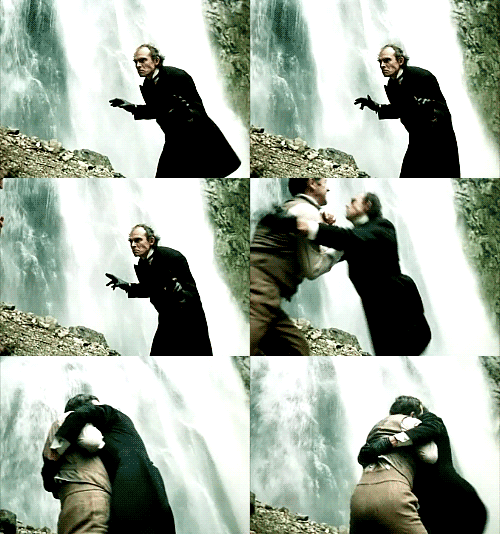
I wish the exhibition had touched on the feelings of Sir Arthur Conan Doyle, the creator, in regards to the popularity of Sherlock Holmes. During his heyday, Doyle became famously disgruntled over the public adoration for Holmes and the continuing demand for more stories featuring the detective. Doyle's attempt to kill off Holmes in The Final Problem was met with mass fan despair, which eventually led Doyle to begrudgingly write more Holmes stories again. Below is a filmed interview with Sir Arthur Conan Doyle in which he touches upon the popular response to Sherlock Holmes (as well as spiritualism).


I appreciate how Pop Sherlock encourages visitors to explore the world of Sherlock Holmes through literature, whether you’ve read all the stories or none. Several Holmes pastiches were brought to my attention throughout the exhibit. Near the entrance of the gallery is an interactive touchscreen where users can discover stories about Holmes. Those interested in pastiches are provided clickable prompts denoting narrative angles the user could be interested in reading. I expressed my interest in reading about a female sleuth and was recommended The Beekeeper’s Apprentice by Laurie R. King (which, incidentally, I’ve been meaning to read one of these days when my grad school duties aren't so pressing).

An image of the interactive app in the exhibition. Photo courtesy of Sadie MacDonald.

However, while there was plenty of material provided for those who have already read the original Sherlock Holmes stories, I found that this interactive device lacked options for those who might be reading the stories for the first time. A visitor new to Holmes is only offered The Adventures of Sherlock Holmes when using this app. Why not model the pastiche section of the app by asking readers their interests and recommending them a particular Holmes story? For example, those wanting a female-focused story could be encouraged to read “The Adventure of the Copper Beeches” (my personal favourite) or “A Scandal in Bohemia”, or someone interested in adventure tales could be told to try “The Adventure of Charles Augustus Milverton” or “The Adventure of the Speckled Band.” The stand-alone novels like A Study in Scarlet and The Hound of the Baskervilles could have also been brought to users’ attention.

After all, this is an exhibit that shows that when it comes to Sherlock Holmes, there is much to discover.

Source.

Whether you're headed to the Toronto Reference Library for studying or for a break from studying, check out the exhibit while you're there and pick up some new reading material. If you can’t make it out to the library, most of the original Sherlock Holmes stories are in the public domain, and links to pdfs can be found online. I encourage you to check Pop Sherlock out!


Pop Sherlock will be on display until October 22. Free guided tours are offered every Tuesday at 2pm.

3 July 2017

THE WOODSTOCK ART GALLERY: THREE MONTHS OF ART AND LEARNING

EXHIBITION REVIEWS

BY: SADIE MACDONALD

Well, that certainly was an interesting birthday weekend. The museum world along with the rest of the country will continue to feel the impact of Canada 150, as the initiatives it funded and the conversations it sparked will not go away anytime soon. It was a similar story 50 years ago during the nation's centennial, as many museums and galleries were established as a direct result of that milestone anniversary to help foster Canadian national identity and pride. I'd like to take a look at one of the galleries born out of the centennial celebrations and observe what it is doing for its own microcosm of Canada at the time of the country's 150th anniversary.

I also feel that it would be fitting for my final exhibition review of the summer to turn my sights to the gallery I’ve been interning at for the past two months: the Woodstock Art Gallery! Though the Woodstock Art Gallery is relatively small, it uses its resources wonderfully, and for an emerging museum professional, it is the perfect place to learn how to bring exhibitions to life. Its exhibitions also demonstrate how to tell stories on both a local and national scale.

The Woodstock Art Gallery in Woodstock, Ontario began as a centennial initiative and started life in the basement of the town library before growing to become the institution it is today. The Gallery collects Canadian art, but it is particularly focused on exhibiting artists connected to Oxford County, and a community focus shines through clearly in its exhibition concepts. By channeling these voices through multiple lenses, the gallery is able to tell vibrant stories.

A view of the Character Sketches exhibition in the Dr. Leonard Reeves Gallery on the first floor. Photo courtesy of Sadie MacDonald.

The first floor of the Gallery is dedicated to exhibiting works from the permanent collection on regular rotation. At the moment, the centre gallery space is dedicated to Character Sketches, which features portraits in various styles from different periods. Two of these portraits depict Commander Andrew Drew and his wife, Mary, and are originally from the Portrait Gallery of Canada’s collection. There were once plans to create a permanent space for the Portrait Gallery, but the Harper government put the project on hold; instead, works from the collection go on display through loans to other Canadian institutions. The Woodstock Art Gallery’s Head of Collections Roberta Grosland felt that the Drew portraits would be well-served in Woodstock, as Commander Drew was one of the town’s founders. It goes to show that what may lie forgotten in some collections can have new life breathed into it at a smaller gallery.

The Drew portraits, attributed to H. Holmes, circa 1842-1846. Photo courtesy of Sadie MacDonald.

The gallery adjacent to the first floor centre space is dedicated to displaying works by Florence Carlyle and is currently showing the exhibition Miss Carlyle’s Success. Florence Carlyle is an important artist at the Woodstock Art Gallery and for the Canadian art world as a whole. Though she led a fascinating life travelling around the world and garnering acclaim as a Canadian artist, she is fondly remembered as a child of Woodstock, having spent a great deal of time in the town throughout her life. Carlyle often painted women in an impressionist style. I particularly like this painting of a cheerful washerwoman:

Joy of Living by Florence Carlyle, 1910. Photo courtesy of Sadie MacDonald.

If you’ve been to the Art Gallery of Ontario recently, you may have noticed that there is an empty space in one of the salon-style Canadian galleries with a notice stating that The Tiff is at the Woodstock Art Gallery. The Government of Ontario gifted this significant large-scale painting to the Art Gallery of Ontario in 1972, and in 2016 the AGO loaned the work to the Woodstock Art Gallery for the latter's 50th anniversary. The Tiff was part of a kaleidoscope of works displayed in a classic salon style at the AGO, but at the Woodstock Art Gallery, it is given a place of honour as the centrepiece of the Carlyle exhibit.

The Tiff by Florence Carlyle (circa 1902) with the original table in the foreground. Photo courtesy of Sadie MacDonald.

What I love about Miss Carlyle’s Success is its use of artifacts to complement the art on display. For example, the wooden table positioned near The Tiff was the original model used by Carlyle when she was painting the piece. There are also letters written by Florence Carlyle and a photograph of Russell Carlyle, the artist’s brother and the model for the male figure in The Tiff. It is an interesting example of the intersections between museum and gallery pieces, showing that art and artifacts can converse with each other to add layers to the stories being told.

The Woodstock Art Gallery, interestingly, is also home to a growing collection of Inuit art, which it uses to tell a wider array of Canadian stories. I have been working closely with the gallery’s Inuit art, so I feel a particular attachment to the first floor exhibit Isumannivit: Your Own Thoughts. Inuit have no word for “art” but rather use the word isumannivit, which means “your own thoughts.” This exhibit features works by artists you may know, such as Kenojuak Ashevak. I have grown to love the work of Elisapee Ishulutaq and Malaya Akulukjuk, two artists from Pangnirtung, Nunavut. The Woodstock Art Gallery recently acquired works by Elisapee and Malaya from the Museum of Inuit Art after it sadly closed down last year. However, there is now a new life for these works, most of which had never been exhibited before, at the Woodstock Art Gallery.

Four untitled works by Malaya Akulukjuk, circa 1973. Photo courtesy of Sadie MacDonald

On the second floor of the Woodstock Art Gallery, the community gallery is the first exhibition space the visitor comes across. It last hosted Art Beat 2017, an annual exhibit of works created by students from Oxford County working in collaboration with professional local artists. This space stands as a visible reminder of the Woodstock Art Gallery’s focus on community. Another second-floor gallery space is currently exhibiting photography by Dr. Roberta Bondar, a highly accomplished Canadian astronaut, neurologist, and nature photographer. I especially enjoy this work by Dr. Bondar, because it takes a humble subject and makes it appear as a landscape (also, I just really like blueberries):

Boreal Blueberries by Dr. Roberta L. Bondar, 1999. Photo courtesy of Sadie MacDonald.

The temporary galleries will be changing over later in July. Upcoming exhibitions include the annual juried show Visual Elements 59, which is comprised of works submitted by regional artists (and for which I am providing curatorial assistance), and an exhibit of recent work by local artist Michael Hunter; both shows indicate the level of involvement at the Gallery of the surrounding Oxford County community. A set of gallery window boxes currently housing artifacts related to Dr. Bondar's career will soon hold an exhibit featuring objects from the Gallery’s permanent collection that tell stories of female connections in art (and is curated by yours truly). Downstairs in the first floor foyer, an eye-catching pop art exhibit will welcome visitors to the Woodstock Art Gallery.

Small Canadian galleries like the Woodstock Art Gallery have much to offer visitors and their communities. By driving its focus on its community and constantly reimagining its collections to tell new stories, the Woodstock Art Gallery shows what a small town gallery can achieve.