Showing posts with label Thomas Fisher Rare Book Library. Show all posts

4 October 2018

MONSTERS ON DISPLAY: AN EXHIBITION AT THE THOMAS FISHER RARE BOOK LIBRARY

Special Feature | Selin Kahramanoglu

Interested in unicorns? Giant sea creatures attacking sailing ships? The tales of world travels and scientific discoveries? The Thomas Fisher Rare Book Library has a new exhibition open, called De Monstris: An Exhibition of Monsters and the Wonders of Human Imagination. This month's post will be a featured article about this exciting new exhibition, including some of my insights as an intern with the project!

Photo courtesy of Selin Kahramanoglu.
Curated by Fisher librarian, David Fernandez, this exhibition explores how the West came to understand monsters and ideas of monstrosity throughout history and varying disciplines. The exhibition utilizes literature and illustrations from areas such as science, religion, philosophy, and arts. The exhibition incorporates texts from the classical period, up until the modern age.

Through physical displays and interactive iPads, the exhibition highlights five main themes:
  1. On Monstrous People: Classical and medieval texts explore the creation of monsters through topics like divine rejection and prodigies. 
  2. On Monstrous Encounters: Journals of exploration and geographies tell the tales of finding monsters while discovering the world. 
  3. On Monstrous Nature: Philosophers and natural historians ponder the origins of monsters, and how society understands them.
  4. On Monstrous Bodies: Medical theorists debate whether human deformities and diseases are elements of monstrosity. 
  5. On Monstrous Stories: Items such as children's storybooks and illustrative pamphlets reveal artists' creations of monsters in recent popular culture.
Is it starting to catch your interest? Let me tell you how much I enjoyed working on this project...
As a summer intern, I had the privilege of assisting the curator with this project by preparing the digital exhibition content. The goal of my work was to digitize images for the online catalogue, some of which are used in the iPads. With these devices, visitors can "flip through" the iPad and see more hidden illustrations from the books behind the glass cases. Here is how I helped with this component of the exhibition:

Research & Curation: David already had a preliminary list of items he wanted to include in the exhibition, so I started from there. I searched the catalogues of the University of Toronto and other institutions to find items that suited David's criteria. Then, I would request the items, and sift through every page to find suitable imagery to display. I created a list of items that didn't have the appropriate exhibition requirements, so that I wouldn't repeat myself and search for them again.
  • This was the exhibition phase that took the longest to complete. However, as a book nerd, I often admired the large stack of 18th century books with intricate bindings and cover art on my desk. 
Data Documentation: All illustrations and texts have data associated with them, and I needed to record this information accurately and efficiently. It was important for library visitors to clearly understand the labels, and for future scholars to be able to retrieve all necessary information. I made two metadata documents with differing levels of detail - one document had only the necessary "tombstone" information for the labels, while the other document had all the detailed data for all researched items.
  • This phase was very rewarding, because it allowed me to apply all the knowledge that I gained from my Archives & Records Management courses up to that point. 
Digitizing: I can tell you first hand that all of the illustrations that I scanned have stunning artistry. By consulting my metadata document with the tombstone information, I digitized all the illustrations that were meant for the iPad displays. I also did some basic editing like cropping the image, resizing it to a standard measurement, and changing the file format.
  • This phase was the most enjoyable for me, because I got to work with beautiful illustrations and bindings. My favourite item is a map of a sea voyage, where a sailor documented an encounter with a female marine creature (and it's on display, so go see it)!
Uploading: Once all the items were selected, with their data collected, and then digitized, all of this information was finally uploaded to the library's server. I met with other colleagues involved with the project and we discussed the iPad interface, and how to best organize the data so that it makes sense to visitors and is visually appealing.
  • This phase was finished last, and it was also the quickest to complete. I really felt like a true library professional, especially by contributing to staff discussions and by utilizing modern library technologies.

Even though I'm biased, this exhibition is not only interesting, but is also easy to access and has free admission! The Thomas Fisher Rare Book Library also showcases some of their rarest and most famous items, like the illustrations of Ulisse Aldrovandi. Visiting the exhibition is a great way to discover the library, if you haven't already visited it.

Lucky for iSchool students and visitors to Toronto, the Thomas Fisher Rare Book Library is located in the middle of the University of Toronto's St. George campus. If you need to take a class on a field trip, you have an hour until your lunch meeting, or if you're excited about the topic, stop by the exhibition! Grab a friend and go to the main Robarts Library building, head up to the second floor's south wing and see for yourself.


Let me know what you think about the exhibition in the comments below! Stay tuned for the return of my column, Conservation Tips & Tricks, starting up next month.

31 March 2018

MMSt 2018: EXHIBITION PROJECTS PART III

RESEARCH COLUMN

BY: SERENA YPELAAR

Hello again, and to those who celebrate, Happy Easter weekend! We are back with our final installment of #MMSt2018 project coverage, in which our students tell you all about their theses and exhibitions!

In this edition, we will explore the last batch of exhibitions and projects launching across the city. You know what to do - read about the stories in the group members' own words below!


Mixed Messages: Making and Shaping Culinary Culture in Canada (May 21-August 31, 2018) 
Sadie MacDonald, Cassandra Curtis 
Image used with permission of Rogers Media Inc.,
All rights reserved. 

Location: Thomas Fisher Rare Book Library, 120 St. George Street, University of Toronto

We are curatorial assistants for Mixed Messages, which will display rare cookbooks and culinary objects from the 1820s to the 1960s. Through a combination of traditional object displays, digital media, and public programming, this exhibition will explore the stories of those who participated in - or were excluded from - making and shaping culinary culture in Canada.


ROAM Audio Tours (Project; May 2018) 
Breanna Stephenson 

Location: Toronto

My concept, ROAM Audio Tours, is a start-up e-business aimed at creating unique and accessible museum audio tours. The company will be privately launching its first exclusive tour Crafting Culture: Tools of Humankind through the Age at a Toronto institution this spring. With embedded directional cues and insightful audio, ROAM will invite you to explore museums from a different perspective, fostering new connections between you and collections.

As the founder, I am responsible for several tasks to develop ROAM into a publishable product, such as in this photo where I am pictured revising the tour script before it's recorded. Photo courtesy of Breanna Stephenson. 
Partners: ROAM Audio Tours could not exist without the collaboration of my resource partners. I would like to thank my contacts at MH Studios Toronto, BigServe Graphx, and my web developer Connor McKinnon for all of their amazing support so far.


Snapshots of Change: The Influence of the CNE on Toronto (June 21-September 29, 2018) 
Bretton Weir, Marlee Yule

Kids look at Ferris Wheel, 1962. Photo courtesy of CNE
Archives, Alexandra Studio Fonds, MG5-F770-I3.
Location: Withrow Common, 200 Princes’ Blvd (Canadian National Exhibition), Toronto
Exhibition Hours: Thursdays 1 pm – 5 pm (exhibit will be closed during the CNE – see withrowcommon.ca for details)
Opening Reception: TBD

Our exhibition is a retrospective look at the massive photo collection of the Canadian National Exhibition (CNE). As a historical landmark in our city, we were inspired by the changes to Toronto we have seen reflected in the past 139 years of the CNE. Join us in discovering the past, present, and future influence of Toronto’s hidden neighbourhood!


A Tradition of Giving: Sir Henry Pellatt and The St. George's Society of Toronto (July-August 2018) 
Samantha Eadie, Jennifer Lee, Kathleen Vahey, Serena Ypelaar 

(From left) Serena, Kathleen, Jenny, and Samantha, fundraising
for the exhibition by speaking at the St. George's Society
Christmas Dinner. Photo courtesy of Serena Ypelaar. 
Location: Casa Loma, 1 Austin Terrace, Toronto
Opening Reception: TBD

Our exhibition explores the history of Toronto’s oldest charitable organization, the St. George’s Society of Toronto, and the legacy of notable life member and President, Sir Henry Pellatt. Using archival material, photographs, and historical objects connected to the Society, we will illustrate both its evolution since its inception in 1834 and its lasting legacy in the city.

Partners: The St. George's Society of Toronto; Casa Loma


Mazel Tov! A Celebration of Jewish Weddings and Marriage in Ontario (July 5-August 6, 2018) 
Katie Paolozza, Leore Zecharia 

Leore in the archives at the OJA.
Photo courtesy of Katie Paolozza.
Location: The Gallery at the J, located in the Jacobs Lounge on the main floor of the Miles Nadal Jewish Community Centre, sponsored by the Ontario Jewish Archives
Opening Reception: TBD

Our project combines the joyful chaos of weddings with the social history of Jewish families in Ontario. We've used the traditional steps of Jewish weddings to thematically frame our narrative, inviting our audience to join us on a multi-generational journey through time. Our exhibit uses photographs and engaging ephemera ranging from old advertisements to legal documents to tell the story of how weddings symbolize the hopes and dreams we have for our families.


Doris McCarthy Symposium (Project; November 2018) 
Alexis Moline 

Location: Doris McCarthy Gallery, University of Toronto Scarborough, 1265 Military Trail, Toronto

For my project, I'm working with the Doris McCarthy Gallery to host a symposium offering fresh perspectives on the life and work of Doris McCarthy. I am responsible for research, communication, advertising and organizing the event and will continue to work on this project throughout the year. This symposium will open in conjunction with an exhibition of McCarthy's work in the fall of 2018.

Doris McCarthy, Iceberg with Icicles, 2000. Oil on canvas, 152.4 cm x 213.4 cm. Gift of the artist. Collection of the Doris McCarthy Gallery. 

Looking Back, Going Forward (Project; Date TBD)
Madeleine Long 

My project involves going through a personal archive that belonged to Harlan I. Smith, who was, among other things, an archaeologist and photographer. I'm working on organizing information from the collection so that it can eventually go somewhere where researchers can have easier access.  

______

And with that, we're done featuring all of the #MMSt2018 projects. Thank you to every student who spoke about their work, and thanks to you, the readers, for your support. I hope you found this series as insightful and fascinating as I did, and I hope to see you at the opening receptions!

21 March 2018

iGINSBERG: BEYOND TRADITION ON CAMPUS (PART THREE)

BEYOND TRADITION

BY: AMY INTRATOR

Welcome to the final edition of Beyond Tradition on Campus! For my last post this year, I will be venturing inside the Thomas Fisher Rare Book Library. The library opened in its current location in 1973, and has established a reputation for its extensive collection of rare books and dedication to research. Over the years, the Fisher library has also held several special exhibitions. Its current exhibition displays pieces of the collection but also integrates technology and interpretive materials in new and exciting ways.

Fleeting Moments, Floating Worlds, and the Beat Generation: The Photography of Allen Ginsberg is currently on display on the at the Thomas Fisher Rare Book Library. The exhibit explores Allen Ginsberg, a poet known for his defining role in the Beat literary movement. Ginsberg’s poetry is familiar to many, especially his poem Howl, but the exhibit explores the familiar poet through his  less familiar photography. The library is home to the largest collection of Ginsberg prints in the world, and the exhibition displays over 100 of these photographs. 

Poster for the current exhibit at the Thomas Fisher Rare Book Library: "Fleeting Moment Floating Worlds, and the Beat Generation: The Photography of Allen Ginsberg. Photo courtesy of Amy Intrator.
The scope of the exhibit is phenomenal. The exhibit displays photographs taken throughout Ginsberg’s long literary life, from early photographs taken before his seminal works were published, to portraits of friends and fellow Beat poets in the 1950s and onwards, to photographs taken up to Ginsberg’s death in 1997. The exhibition takes on the major task of contextualizing Ginsberg’s photography, which captures everything from same sex relationships in the mid-twentieth century, to the Beat movement and its poets, to the counter-culture movements in the 1960s, to social justice in the late twentieth century. The extended timeline makes for a lot of content, but the exhibit is also full of interpretive tools that make this material more accessible, like the iPads dispersed throughout the exhibition space.

The first display case of the exhibit, which includes photographs and poetry by Ginsberg. Photo courtesy of Amy Intrator. 

The iPads help make the information in the exhibit accessible in new forms. The digital content doesn’t repeat the information available in the display cases, but rather, provides new forms of digital interaction. The iPads offer the visitor a menu of options, from listening to an audio recording of Howl, to viewing the pages of the poem’s manuscript, to scrolling through a detailed timeline of Ginsberg’s life. For a visitor who may not have the time to read every panel, or who prefers to navigate material at their own pace, the iPads offer new opportunities to interact with Ginsberg the man, the poet, and the photographer. 

One of the iPads on display at the exhibit. Photo courtesy of Amy Intrator.

Beyond the iPads, the library also offers free audio tours of the exhibition available on iTunes and Soundcloud. The curator-led tour offers another way to interact with the exhibition and supplements the material on display with additional insights. On the library’s Soundcloud page, anyone can access tours from the last five exhibitions. These tours supplement current exhibitions, but they also provide a way to interact with previous exhibitions that are no longer on display.

Poster for the exhibition's audio tour. Photo courtesy of Amy Intrator.

The Thomas Fisher Rare Book Library may be primarily known for its amazing collection, but this exhibit opened my eyes to the library’s innovative use of its exhibition space. The library’s next exhibition, Mixed Messages: Making and Shaping Culinary Culture in Canada, will also feature a digital component. You can read more about the exhibition’s innovative approach in Jenny’s most recent article Who’s In the Kitchen? Exploring Canada’s Culinary Culture at the Thomas Fisher Rare Book Library.

With that final glimpse at an innovative space on campus, it’s time for me to bid farewell to this special edition series of Beyond Tradition. Thank you for joining me in my exploration of campus spaces. Through my campus journey, I learned that while campus may not be the first place I look for museum innovation, there are countless spaces that are incorporating exciting museum practices. I hope next time you embark on a museum adventure, you consider paying a visit to campus.

16 March 2018

WHO'S IN THE KITCHEN? EXPLORING CANADA'S CULINARY CULTURE AT THE THOMAS FISHER RARE BOOK LIBRARY

A MUSE BOUCHE

BY: JENNIFER LEE

It's exhibition opening season, gentle readers! My colleagues Cassandra Curtis and Sadie MacDonald graciously answered my questions about their project, an upcoming exhibition at the Thomas Fisher Rare Book Library and a banquet of associated programming (both public and digital). Join us to talk about complementary interpretive vehicles, making exclusion visible, and a really, really cool cookbook. 

JL: Hello! Can you describe the project and your specific roles in it?

SM: Our exhibition is entitled Mixed Messages: Making and Shaping Culinary Culture in Canada. We explore Canadian culinary texts, objects, and ephemera with a focus on the individuals and communities who participated in and influenced - or were excluded from - that wider culinary culture.

Image used with permission of Rogers Media Inc., All Rights Reserved.
Cassandra and I are responsible for curating an interactive exhibition in the MacLean Hunter room, the lower gallery/classroom space of the Thomas Fisher. We are also preparing a public program connected to the exhibition at Fort York for Doors Open Toronto 2018.
Officially, Cassandra is in charge of all digital content (such as our exhibition blog, which Cassandra built on Omeka and coordinated content for) and I am coordinating physical content (I researched the culinary print material in the Fisher), but we basically have been working on everything together and jumping in to support each other when needed. As curators we have been working under the direction of Irina Mihalache, Nathalie Cook, and Elizabeth Ridolfo, who are curating the upper gallery space.

Our external partners are the programming team at Fort York. We have been working closely with Bridget Wranich and Jocelyn Kent to develop programming for Doors Open Toronto. 

JL: This is a multifaceted project, using digital content and public programming alongside more traditional exhibition models. How have you found the process of working with so many different interpretive vehicles? How does each enhance the exhibition as a whole?

SM: It has been a bit of a learning curve working with these multiple project components (before this project, neither of us had extensive experience with programming, for example), but Cassandra and I have both been really enjoying the process so far.

Each component - digital, programming, and traditional - has unique qualities that add to the exhibition. For example, this an exhibition that is all about food and cooking, but obviously we can’t have any of that take place in a rare book library space! This is why the Doors Open public program is so valuable; it gives us an opportunity to actively participate in the culinary culture explored in this exhibition, and invite others to do so as well. We will be serving food based on recipes in the exhibition at this event.

A bottle of Crosse and Blackwell curry powder, estimated to be from the Edwardian period. On loan to the Thomas Fisher Rare Book Library from the Collection of Mary Williamson. Photo courtesy of Sadie MacDonald.

The digital content provides an additional way to share the themes and stories of this exhibition with our audiences. There will be an iPad in the gallery that visitors can use to explore culinary texts - not all of which will be explored in detail in the physical gallery displays. The exhibition blog also adds a personal, “behind the scenes” touch to our exhibition, as it is a way for those involved in curating the exhibition to share their experiences bringing the project together.

The digital, programming, and traditional aspects all play into each other and reference each other, but each adds something special to the exhibition using the unique qualities provided by that medium.

CC: It really has been very valuable how multifaceted this project has been for us. I never would have chosen solely a public programming project but I've found it surprisingly fun and engaging to put together!

JL: You mentioned that the exhibition discusses individuals and communities who were excluded from culinary culture, not just those who were visible. It can be difficult to tell these stories when marginalization and erasure affect the material available to us. Has this been an issue for you?


CC: Interesting question! Like a lot of collections, what's absent is what stands out sometimes when it comes to marginalized communities. We've been trying to find a constructive way to talk about the fact that so many of these recipes reference ingredients from these communities without giving them any credit. Then there are some opposite examples too, where a surprising amount of credit is given.

SM: Yes, there is more material out there than one might anticipate. Dr Mihalache and Liz Ridolfo will be discussing Indigenous community cookbooks in the upstairs gallery, for example. And there is one fascinating cookbook, a “crowd-sourced” recipe collection of “Canadian Favourites” organized by the Co-operative Commonwealth Federation (a forerunner party to the NDP) in the 1940s. This book includes a wide variety of recipes from many cultures present in Canada, including Indigenous and immigrant cultures, and more importantly, credits those cultures and the individual who provided each recipe.

However, this is something of an exception. A lot of the cookbooks we look at fail to credit the original cultures, or superficially or erroneously make reference to the recipe’s cultural context (for example, the trend of cookbooks referring to recipes with pineapple in them as “Hawaiian”).

So that in itself provides a way to open this conversation about marginalization - by talking about the gaps and oversights themselves and looking at what they tell us.

Canadian Favourites: CCF Cookbook. Ottawa: CCF National Council, 1947. Collection of the Thomas Fisher Rare Book Library.
JL: Is there an object or story that you've found particularly meaningful or delightful?

CC: For myself I've most enjoyed thinking about these cookbooks in the context of the real women who used them and how much they were asked to do. One of the angles we're looking at this from is the resourcefulness that was demanded of women in terms of domestic work, from angles such as rationing and technology. The feminist in me has been really enjoying doing research about women and domesticity! 

SM: I already mentioned the CCF cookbook, and I think that’s my favourite object because of how surprising it is in the context of this exhibition. While many cookbooks from our period of study (1860-1960) appropriate recipes and fail to credit their cultures of origin, that isn’t the case with this cookbook. There are a few Indigenous recipes provided by the Fisher River Reserve in Manitoba, for example - and they are given credit for it. Recipes from immigrant communities are also credited, and the names of the dish in their original languages are often given as well. It’s a very multicultural cookbook - you can find Chinese and Russian recipes on the same page! Reading this cookbook, which was produced in a political context, one gets the sense that it is attempting to speak to the multicultural make-up of 20th-century Canada.

JL: I'm so excited to see this woke proto-NDP cookbook, I can't even tell you.


Mixed Messages: Making and Shaping Culinary Culture in Canada will open on May 21st at the Thomas Fisher Rare Book Library and run until August 31st. The Doors Open event will take place on May 26th and 27th at Fort York. You can find more information about the exhibition here and read blog posts from Sadie, Cassandra, and other project team members at the exhibition blog.

22 May 2017

CONVERSATIONS ABOUT CONVERGENCE PART I: EXHIBITIONS IN LIBRARIES & ARCHIVES

MUSEUM MONDAYS

BY: KARA ISOZAKI & MAEGHAN JERRY

The summer edition of Museum Mondays will be a three-part series focusing on the convergence of libraries, archives, and museums (LAMs). Convergence has been a popular topic in Canada since the early 2000s. While the three fields have somewhat different histories, values, and methods, LAM institutions are all involved in collecting and preserving materials for the benefit and use of the public. Kara and Maeghan will bring their perspective as students of both Museum Studies and Archives & Records Management to publicly visible areas of overlap and interaction between LAMs. 

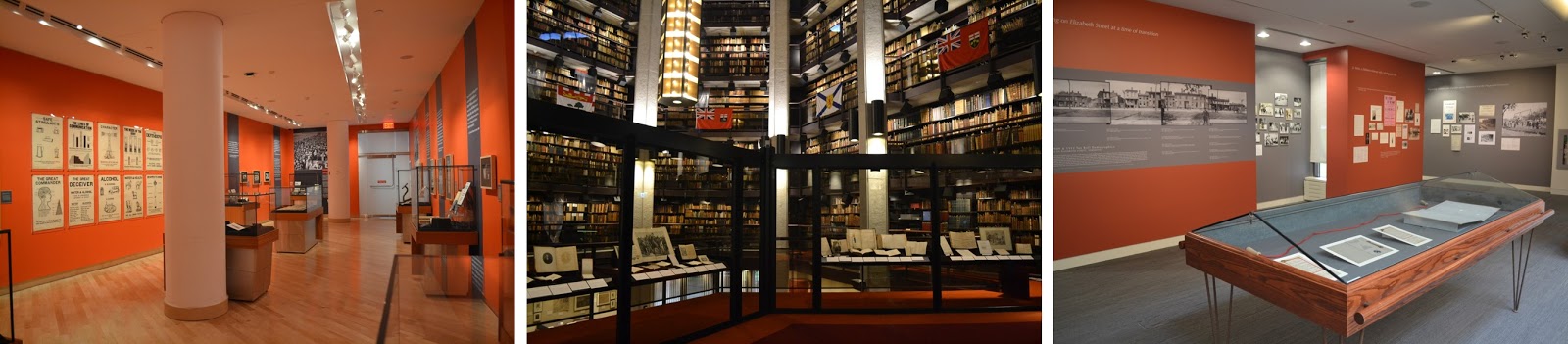
One of the most visible overlaps between libraries, archives, and museums is the use of exhibitions to display and promote library and archival holdings. There are numerous examples of archives and libraries in Toronto that put on regular exhibitions, and we chose to visit three to check out how different institutions were exhibiting their holdings: Vice & Virtue at the Toronto Reference Library (TRL), Struggle & Story: Canada in Print at the Thomas Fisher Rare Book Library, and From Streets to Playgrounds: Representing Children in Early 20th Century Toronto at the City of Toronto Archives. 

Gallery spaces (left to right): Toronto Reference Library, Thomas Fisher Rare Book Library, and City of Toronto Archives. Photo by Kara Isozaki.

Maeghan: All of these exhibitions featured primarily print materials, and yet they all made things really dynamic.

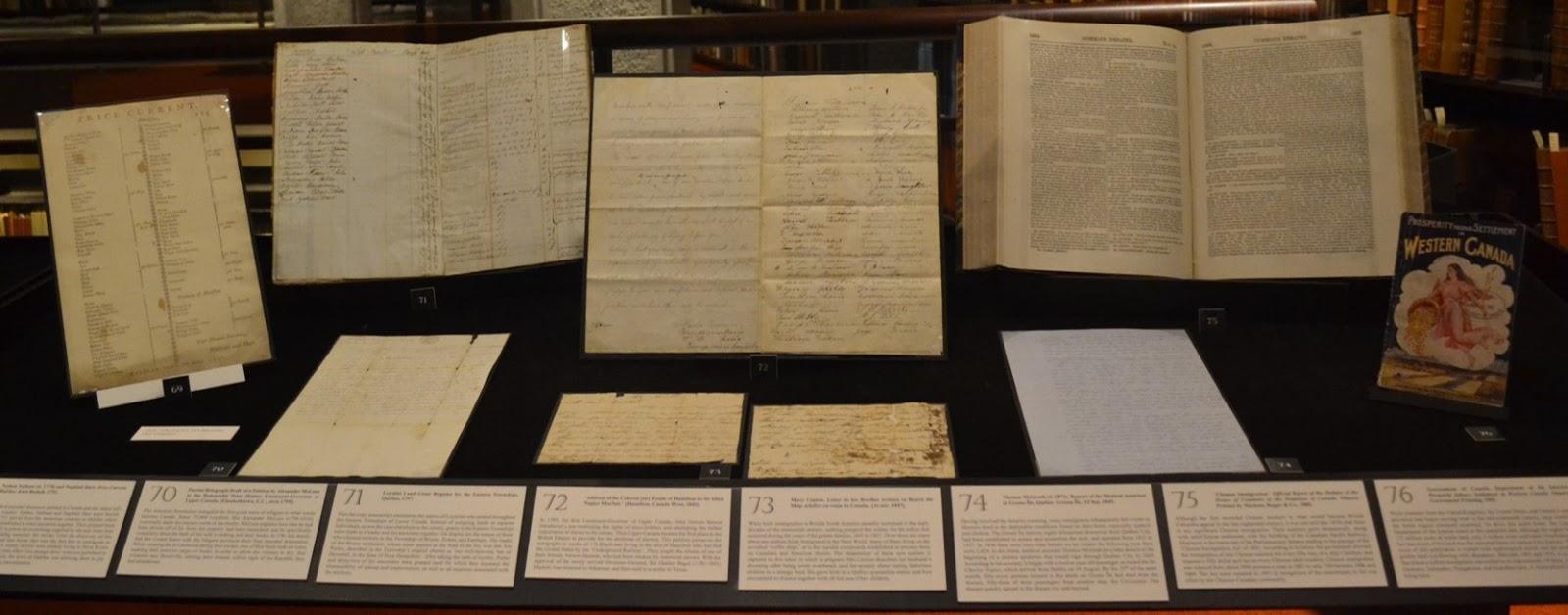
Kara: Yeah, all three institutions had objects on the walls and in cases, propped up or laying flat. The TRL and Archives mounted reproductions by sticking them directly to the walls and nailing them on like public notices.

M: Those two institutions were really creative in the layouts of the wall mounts, mixing different sizes to create visual interest. Also, the Archives showed rotating photographs on screens which added movement to the exhibition.

K: I think that using reproductions made it easier to create the diverse wall layouts. Fisher’s exhibition was different because nearly all the objects on display were originals. I wonder if they were able to do that because the display area is light controlled.

M: Yeah, I think the whole building is climate controlled as well because part of the collection is housed in open shelving. Fisher also brought in artifacts to add to their display cases, which we didn’t really see in the other exhibitions. 

Wall display at the City of Toronto Archives. Photo by Kara Isozaki.

K: I noticed each exhibition took a different interpretive approach.

M: Yeah, it ended up being a spectrum, where TRL had what would be the most museum-like interpretation and Fisher was more like an essay in exhibition form, and then the Archives fell in between.

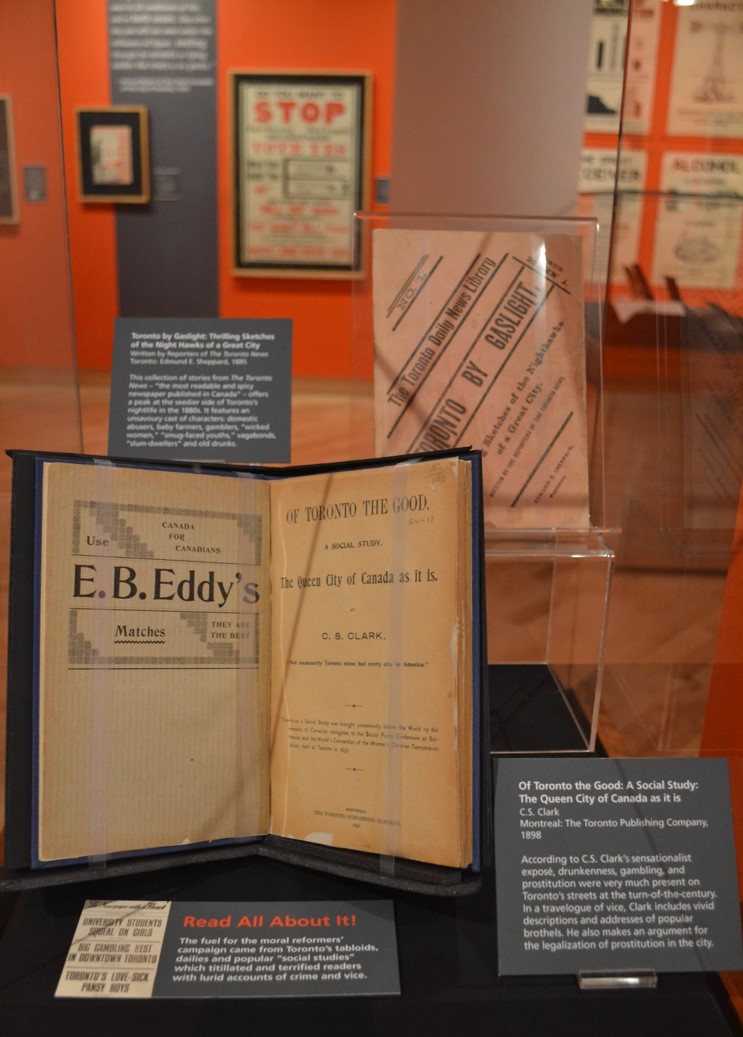
K: I found the TRL was more accessible because it had a clear theme with subsections. They used a mix of section panels, object labels, and infographics to give you multiple ways to access the information.

M: The Archives was pretty good in terms of having clear sections, but it lacked an overall story or theme. It seemed like the sections were focused on the records and creators represented in their collection rather than on the topic presented in the title.

K: Yeah, that might be because the content is based on the results of a research project and what information the Archives has about the records. The Archives might know more about the records creators than the people affected by the creation of playgrounds.

M: That’s very true, but would a visitor who doesn’t have a background in archival work know and recognize that? It wasn’t a bad exhibit overall, it was just that it seemed to lack a core theme. They should have named it something different. That might have provided a better connection between the sections.

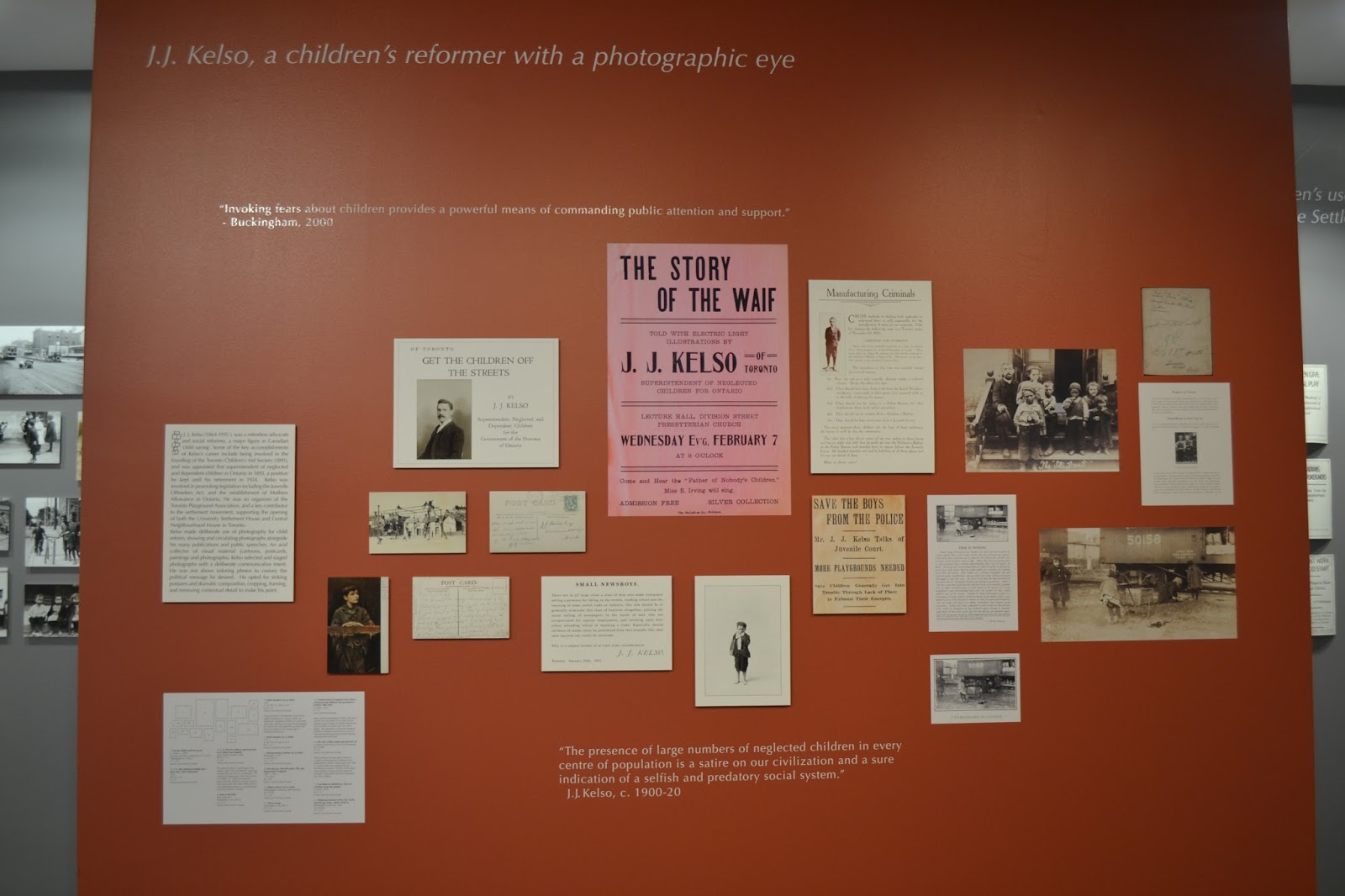
K: The Fisher, on the other hand, took a really different approach. Their exhibition was way more text-heavy than the other two. They chose to present their information through object labels instead of section panels. It diverged the most from the museum interpretive techniques we learned.

M: The amount of information and text format felt more like an exhibition catalogue than a label. The catalogue was actually placed in a more prominent location than the introductory panel.

Case display with text-heavy labels at the Fisher Rare Book Library. Photo by Kara Isozaki.

K: I suspect the different interpretive approaches reflect the institutions’ different ideas about their audiences. With the Fisher, I think they’re writing for a more academic audience since they’re part of the university.

M: I agree. I imagine that they do get tourists, but they probably come to see the grandeur of the space itself, and the exhibition just acts as an example of what’s inside all the books on the shelves.

K: The TRL probably has the most diverse audience, since the building has been designed to be a community space, with a comic book store and coffee shop also on the first floor. The exhibition definitely felt like it was designed for an audience of the general public. Everything was really accessible.

M: The Archives was also aimed at the general public, but I think most of the visitors are people who are coming to the archive for other purposes, like research.

Case display at Toronto Reference Library. Photo by Kara Isozaki.
K: So what did we learn?

M: It seems to me that the institutions are picking up on display methods faster than they’re picking up on interpretive methods. We saw a lot of really great material displayed in creative and engaging ways, but the institutions differed in the ways that they presented associated information.

K: That’s true, but we are judging these exhibitions from a museological perspective, which comes with a lot of assumptions and history that these other institutions may not operate on.

M: But I think it’s fair to do that because all of the institutions we visited advertised their exhibitions as exhibitions with themes and in dedicated gallery areas. We didn’t just stumble across a “recent acquisitions” shelf.

K: Either way, I thought they were effective overall. We enjoyed visiting each of them and I feel like I learned something from each one.

Have you visited these exhibitions or others in libraries or archives? What did you think? Let us know in the comments!

24 January 2017

HIDDEN IN PLAIN SIGHT: CAMPUS EXHIBITIONS

COLLECTIONS CORNER

BY: KATIE PAOLOZZA

There is only one month left to go and see the Thomas Fisher Rare Book Library's exhibition on Thomas Hardy, called "Moments of Vision: The Life and Work of Thomas Hardy." Aside from his rare books, manuscripts, and (my current personal obsession) ephemera, the exhibition space itself is really beautiful and befitting a special collection of antiquated literary significance.

Here is the official poster for the exhibition:


The Fisher Library has hosted some amazing exhibitions in recent years. For obvious reasons, they tend to focus on Book History, like "All in a Golden Afternoon", which featured their collection of rare Lewis Carroll material. 


They also look at the design of the books themselves, and not just the content or author, like they did with "Elegant Editions: Aspects of Victorian Book Design." 


Two of my favourite exhibitions they have featured have been a celebration of the University of Toronto's discovery of insulin and one called "Ars Medica: Medical Illustration Through the Ages," which I believe can still be viewed by tour groups who are accessing the archives. 


Even if you weren't able to catch these great shows, the material and ethos of each exhibition is captured in the library's commemorative exhibition catalogues, which are not only accessible through various U of T Libraries but for sale through the Fisher's website. Just last week in my Book History course we were discussing the value of these catalogues as interdisciplinary treasure troves. They feature research from a variety of fields and have gorgeous, delightfully curated visuals to accompany the engaging stories that are being told. Almost all major exhibitions anywhere have these catalogues for sale, and they are so much more than a way to bolster profits. The amount of work, care, passion, blood, sweat, and tears that go into exhibitions both large and small should be celebrated and remembered. They're not pointless nostalgia, they're records of research and archival materials, not to mention the fact that for relatively inexpensive prices people who are not able to travel the world and see these exhibitions can still experience them in context. 

Lastly, if you're one of the many, many students who are struggling to make ends meet and cannot afford to pay for special exhibitions or TTC around the city every time one opens, remember that there are dozens of pop-up exhibitions that are easily accessible and free all around campus. Robarts, UTAC, The U of T Art Museum, Massey College, The Jackman Humanities Building, Victoria College, Hart House, and St. Mike's are just some of the buildings that have permanent spaces reserved for temporary exhibitions. It's one the many things we pay for in our student fees and often neglect because we get so busy with our studies.

A suggestion: next time a meltdown is imminent, wander around campus and take in a small or large exhibition. Take 2 hours or 5 minutes, just treat yourself. You'll be surprised at how many wonderful things the university has to display and share. And if you have time in the next month, go and see the Thomas Hardy exhibition at the Fisher Library, before it's too late...