Showing posts with label City of Toronto Archives. Show all posts

18 May 2020

UNCOVERING UNION EXHIBITION


People walking outside of Union Station. 2018.
Photo courtesy of Elizabeth Cytko
Writing about the exhibition I created with fellow classmates is bittersweet. The winter semester of 2020 certainly ended abruptly. We did not get to attend many of the exhibition openings of our peers, and sadly have mostly parted ways without the chance to properly say goodbye. I want to acknowledge the hard work of my classmates, and say thank you for providing me with such an amazing time at the Faculty of Information. In the future I look forward to seeing everyone again, and celebrating our successes!


A group of attentive students on the Ottawa Museum trip. November 2019.
Three cheers for my amazing cohort!
Photo courtesy of Elizabeth Cytko

My group, which includes myself, Erika Ilse and Karen Macke, is fortunate — our exhibition is digital. This meant that while we were not able to meet physically, we still had privilege of Skyping and putting together the website Uncovering Union.


The Battle for Union Station.
Courtesy of the City of Toronto Archives, Courtesy of City of Toronto Archives, Fonds 265, Series 1269, Subseries 7, File 2

For those interested in how a digital exhibition is put together, I will highlight some of the steps, so in future you can create one too!
  1. Be on the same page as your team. Figure out your themes and what you want your exhibition to say. With Union Station we narrowed our focus to the social history, of the people who have a connection to the place. 
  2. Make sure you know who your audience is. This will affect the style of writing and what sort of information you will include. If you will work with an educator, include them from the beginning! This will make the process much smoother!
  3. Research! This involved delving deep into Proquest to dig up newspapers, taking out every book possible, and visiting the local archives! I spent most of my time at the City of Toronto archives reading up on my three stories – the archivists there are friendly and very helpful. 
  4. Set a word limit and stick to it while writing your articles. 
  5. Editing! Editing! Editing! Sometimes it is necessary to cut amazing ideas in order to fit the word count. That's ok! If you have too much information to share you're on the right track.
  6. Somewhere around here, or maybe even earlier think about the overall design of the website. Choose your colours, fonts, logos! 
  7. Make sure you have all the proper permissions in place for the images and multimedia aspects you plan to use. 
  8. User testing! Have some people unfamiliar with the website go through it and make sure everything works. 
  9. Launch!
In between all of those steps you are meeting your team at least once a week, and checking in with everyone. Things will unexpectedly crop up (such as a worldwide pandemic) so it’s important to give yourself some extra time.


Union Station food court, 2019.
Photo courtesy of Elizabeth  Cytko
This exhibition has given us the opportunity to peek into Toronto history, and learn how interconnected Union Station is to the very fabric of the city. Uncovering Union centres on nine social histories with stories that vary from soldiers returning from war and new families coming together to civic activists uniting to save the station from destruction. The station itself is not just a terminus for the end of a journey, but the impetus for a new one.

If you miss the hustle and bustle of Toronto life, those moments where you could walk down the street and pass by others whose stories you could barely imagine, I invite you to view our exhibition.

3 February 2020

THE MEMORABLE FASHION OF THE ROARING 1920’s

Sew What | Natalie Heaton


Photo courtesy of Natalie Heaton

Last month marked a century since the beginning of the roaring 1920s. This decade was marked by the end of the First World War, flappers, women’s liberation, and a booming economy. The fashion of this era is often portrayed through novels and movies, like The Great Gatsby, focusing on the edgy style of the flapper fashion. The museum sector is one of the best places the fashion of the 1920s is remembered, represented, and recognised.


Since the 1920s was a very prosperous time for the economy and many individuals, it is not uncommon for museums to represent this lavish era. The Spadina House Museum is an example of such a museum. In the house, there is an Art Deco feel, and women's dresses from the different time periods are placed strategically. The dresses that are displayed represent different trends of the decade, with dropped waists, raised hemlines, and overall, showing more skin. These dominated 1920s fashion, as they represented the new women.

Photo courtesy of Natalie Heaton


Today, the fashion of the 1920s makes for a great Halloween costume or party theme, these trends were deeply tied to what was happening in Western society. During the First World War, women entered the public sphere. After the First World War, the number of women in post-secondary institutions was on the rise,  and they had opportunities that had not been available to them prior to the war. Women needed clothing that would be practical for work and allowed freedom of movement. This newfound liberation is reflected in the clothing, head to foot. This decade saw the exile of corsets, hair being cut into short bobs, and women drinking, smoking and dancing. If only their grandmothers saw them, oh the scandal!


With women’s style being so distinct during this decade, it is a favourite topic mentioned or on display in exhibitions on the 1920s. The City of Toronto Archives currently has an exhibition focusing on the 1920s. This exhibition looks at everything from advertising, old photos of Toronto, people living their day-to-day lives, and fashion trends. While looking at all the photos of old Toronto and the people that use to call this city home, it is hard to not notice the distinct fashion trends.

Photo courtesy of Natalie Heaton

9 April 2019

FINDING FOODWAYS, PART III.

Research Column | Casarina Hocevar


For the last installation of this research column, I would like to touch upon some of the challenges of historical research. The challenges of researching can be both frustrating and thrilling. For example, the availability of information may have us swinging between an overabundance of materials to absolute dead ends, leaving the research process inconsistent and difficult. This urges us, as researchers, to be careful notetakers, well organized and creative in how we go about our next avenue of inquiry. But as research comes together like pieces in a puzzle, it can lead to satisfying and exciting results, assuring us that the effort was worth it all along. The following will illustrate an example of this process from my research for Storefront Stories.

Missing Percy’s

As part of Storefront Stories, we have 9 participating businesses in Kensington Market that will feature a poster with information of a historical Jewish-owned storefront once located at their same address, with an additional 11 businesses featured online. Dividing the 20 businesses between myself and my teammates, we each wrote the narratives to a selection of storefronts. Some storefronts focus on stories of immigration, others on the success of the business, and others on more intimate family details. Our narratives have largely been informed by materials available at the Ontario Jewish Archives (OJA), but have also been supplemented by additional research from the field of Jewish Studies, history and through resources available at the City of Toronto Archives and various media outlets. Our goal is to illuminate a concise and engaging history of these storefronts to the best our ability, while respecting the limitations of available materials. 

One of the storefronts I was paired with is located at 234 Augusta Ave., where today Dolce Gelato stands. Initially, the photograph I was working with was an image of “Percy’s Fruit” - a Jewish grocery shop from mid-century Kensington Market. In the archive, the image was dated from 1959. As I began researching its history, I only found dead ends - there never seemed to be any trace of a Percy’s Fruit at 234 Augusta Ave in 1959. Shifting strategies, I searched through city directories to see if the image was perhaps incorrectly dated.


Image used with permission from the Ontario Jewish Archives: Percy's Fruit Market, Augusta Avenue and Nassau Street, 16 May 1959. Ontario Jewish Archives, Blankenstein Family Heritage Centre, fonds 18, series 2, item 2.

What I found throughout the directories were listings for different shops at 234 Augusta Ave, not Percy's Fruit. From the earliest entry in the directory until the early 1930s, there were butcher shops at 234 Augusta Ave. Then in the late 30s, Joe’s Fruit Market appears in that exact location, and remains listed for several decades. According to the city directory records, which are available through the Toronto Public Library, the information accompanying the archival image of Percy’s Fruit (e.g. date/location) did not match with the information in the directories, prompting me to reconsider whether the information I had for Percy's was even correct.

Comparing Images

Returning to the image of Percy’s Fruit, I enlarged the image and began noting the structure of the building: the roof’s slant, the location of the windows, any trimmings, etc. Then I googled 234 Augusta Ave., opened up Google Street View and compared the contemporary building to that of Percy’s. They were not the same building. Is it possible that in the 60 years that passed between this photograph of Percy’s Fruit and Dolce Gelato, the building may have changed? -Sure! However, considering there was no mention of Percy's Fruit at 234 Augusta Ave. in the city directories, I was doubtful this image belonged.

Curious, I searched for images of Joe’s Fruit Market. I was able to locate a couple within the City of Toronto Archives, whose building looked very similar to that of today’s Dolce Gelato. Noting that, I returned to the 1959 City Directory to see if a Percy’s Fruit was located elsewhere in Kensington Market. I was able to find a Percy’s Fruit listed nearby 234 Augusta Ave., with Joe’s Fruit Market at 234. Following that, I returned to the map of Kensington and began comparing the building that is listed in the 1959 directory for Percy’s to the image I had of the grocery shop. Save for a few modern updates, the two buildings - that featured on Google Maps and that of the archival image - were the same.

Conclusions

In short, after several winding research paths, I assumed the following:
  • - 234 Augusta Ave. had previously been home to multiple Jewish butcher shops in its earliest days
  • - In the late 1930s, Joe’s Fruit Market moved into 234 Augusta, where it remained until the 1970s
  • - Percy’s Fruit Market was located nearby 234 Augusta

After some consultation with my teammates and with OJA, we concluded that my research was likely correct, and unfortunately, Percy’s Fruit had been incorrectly labelled. For the purposes of our exhibition, we decided to discard the image of Percy’s for the poster, but inquired further into the story of Joe’s Fruit Market. Thankfully - and still with a couple more archival hiccups - we were able to provide a narrative of Joe’s Fruit Market, that will be featured on the exhibition poster at 234 Augusta Ave. this May.

This nugget of research has a bittersweet end. In many ways, it was satisfying as it still led me to a story I can share through the exhibition. However, I am disappointed I was never able to locate more information about Percy’s Fruit. While I found the correct address and its approximate dates of operation, the story behind the grocery shop remains largely a mystery. As researchers and museum practitioners, there are moments we need to recognize when to close one door, so we can open another: in this case, the door to Percy’s Fruit closed, while another to Joe’s Fruit Market was opened.

27 October 2017

THE REAL GHOSTS OF TORONTO

GHOSTS OF TORONTO'S PAST

BY: KATIE PAOLOZZA

Seeing as this will be my last posting before Halloween, I thought it appropriate to explore the ghosts of the past in a more literal way. Canada may be one of the youngest developed nations on the planet, but we have our own extensive lexicon of spooky stories.

First I want to delve a little into why we're so preoccupied with ghost stories in the first place, and why it's been such an enduring cross-cultural fixation.

Source
Joseph O. Baker and Christopher D. Bader wrote a fascinating paper in 2014 called "A Social Anthropology of Ghosts in Twenty-First-Century America," where they posit that supernatural entities are important cultural constructs:

                                     By definition, ghosts violate a number of binaries held as 
                                     central tenets of human, and especially Western, thought. 
                                     Primary examples include body/soul, life/death, past/present,                                                                       presence/absence, human/inhuman, and material/ethereal. 
                                     This violation of fundamental categories of thought, this 
                                     ‘in-between-ness’ (liminality) lends spirits a potentially powerful 
                                     cultural position onto which varying cultural manifestations can 
                                     be projected.

Another, simpler way of looking at it is this: when we stop dismissing the concept of ghosts and spirits as foolish superstition, it becomes clear that we have no way to properly classify them in any empirical sense. Therefore they are malleable concepts and can be shaped and twisted into whatever we need them to be as a culture. 

This is also why Toronto is such an interesting place to ghost-hunt. The city has grown so much both physically and as a culture in such a short span of time; relatively new parts of the city are already dead and gone with ghosts of their own. Look at these views of the skyline in 1914 and 1990, from the ever bountiful blogTO:

Source

Source
I remember what the city looked like in the 1990s, and at first glance it looks pretty much the same. But look at this photo from last year:

Source
There isn't one neighbourhood you can visit that isn't mired in construction, which in turn ratchets up the anxiety on the streets and on the TTC. Things have been real tense lately, and I personally think that one reason the business of Halloween has grown so exponentially the last few years is because culturally we are in greater need of escape and catharsis. That's true of Toronto, and that's true of western and global culture in general. I don't share these ghost stories to exploit legitimate tragedies, I share them to fill the void of drudgery and uncertainty with something deliciously extrasensory.

O Torontonians, we are truly spoiled with our share of the macabre. Does everyone remember Mr. Christie? He made good cookies and did his part to develop the city as we know it today, but after he was interred in Mount Pleasant Cemetery he gave his business and mansion to his son, who supposedly locked his mistress in a secret room hidden behind a panel so he could visit her at his leisure. She eventually hung herself, and her body was then smuggled out. 

Source
The building is now Regis College, and the space where the poor woman was rumoured to have been kept prisoner is referred to as Room 29, with wildly varying legends about how her and the younger Mr. Christie's ghosts haunt the grounds. A popular article about the story can be found here

Has anyone ever eaten at the Keg Mansion? Diners have reported seeing the ghost of a woman, maybe Lillian Massey, maybe her devoted maid, in the upstairs halls and in the bathroom. People have also reported seeing/hearing children run and laugh around the main staircase. I've been there several times and have never seen a thing. 

I've also never seen any hint of the ghosts that haunt University College, despite numerous reports of students seeing both Paul Diabolos and the slain Ivan Reznikoff roaming the quad. Visit this page and this page for a more detailed history of U of T ghosts.

Source
I can't speak for anyone else, but I like the idea of ghosts or any bonafide supernatural activity because I like knowing that we have limitations as a species. I tend to follow empiricism and be highly skeptical, but I would love to be proven wrong. I would love for something beyond the realm of human understanding to exist and confound us in all our righteous glory as an intellectual species. I don't ever want my search for truth to come to an end, or be so vain as to think I can truly know it all.

Besides, who doesn't love a good mystery?

References

Baker, Joseph, and Christopher Bader. 2014. "A Social Anthropology of Ghosts in Twenty-First-Century America." Social Compass 61 (4): 569-593, 584-                                5. http://resolver.scholarsportal.info/resolve/00377686/v61i0004/569_asaogita.

22 May 2017

CONVERSATIONS ABOUT CONVERGENCE PART I: EXHIBITIONS IN LIBRARIES & ARCHIVES

MUSEUM MONDAYS

BY: KARA ISOZAKI & MAEGHAN JERRY

The summer edition of Museum Mondays will be a three-part series focusing on the convergence of libraries, archives, and museums (LAMs). Convergence has been a popular topic in Canada since the early 2000s. While the three fields have somewhat different histories, values, and methods, LAM institutions are all involved in collecting and preserving materials for the benefit and use of the public. Kara and Maeghan will bring their perspective as students of both Museum Studies and Archives & Records Management to publicly visible areas of overlap and interaction between LAMs. 

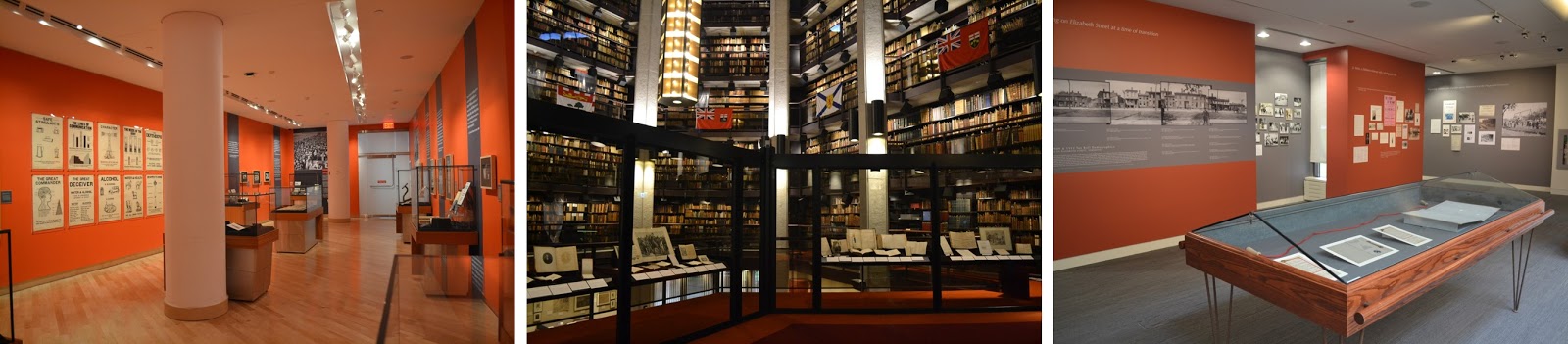
One of the most visible overlaps between libraries, archives, and museums is the use of exhibitions to display and promote library and archival holdings. There are numerous examples of archives and libraries in Toronto that put on regular exhibitions, and we chose to visit three to check out how different institutions were exhibiting their holdings: Vice & Virtue at the Toronto Reference Library (TRL), Struggle & Story: Canada in Print at the Thomas Fisher Rare Book Library, and From Streets to Playgrounds: Representing Children in Early 20th Century Toronto at the City of Toronto Archives. 
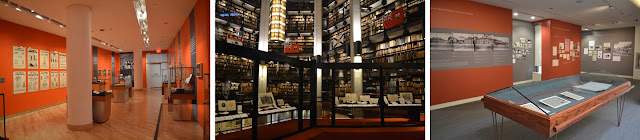
Gallery spaces (left to right): Toronto Reference Library, Thomas Fisher Rare Book Library, and City of Toronto Archives. Photo by Kara Isozaki.

Maeghan: All of these exhibitions featured primarily print materials, and yet they all made things really dynamic.

Kara: Yeah, all three institutions had objects on the walls and in cases, propped up or laying flat. The TRL and Archives mounted reproductions by sticking them directly to the walls and nailing them on like public notices.

M: Those two institutions were really creative in the layouts of the wall mounts, mixing different sizes to create visual interest. Also, the Archives showed rotating photographs on screens which added movement to the exhibition.

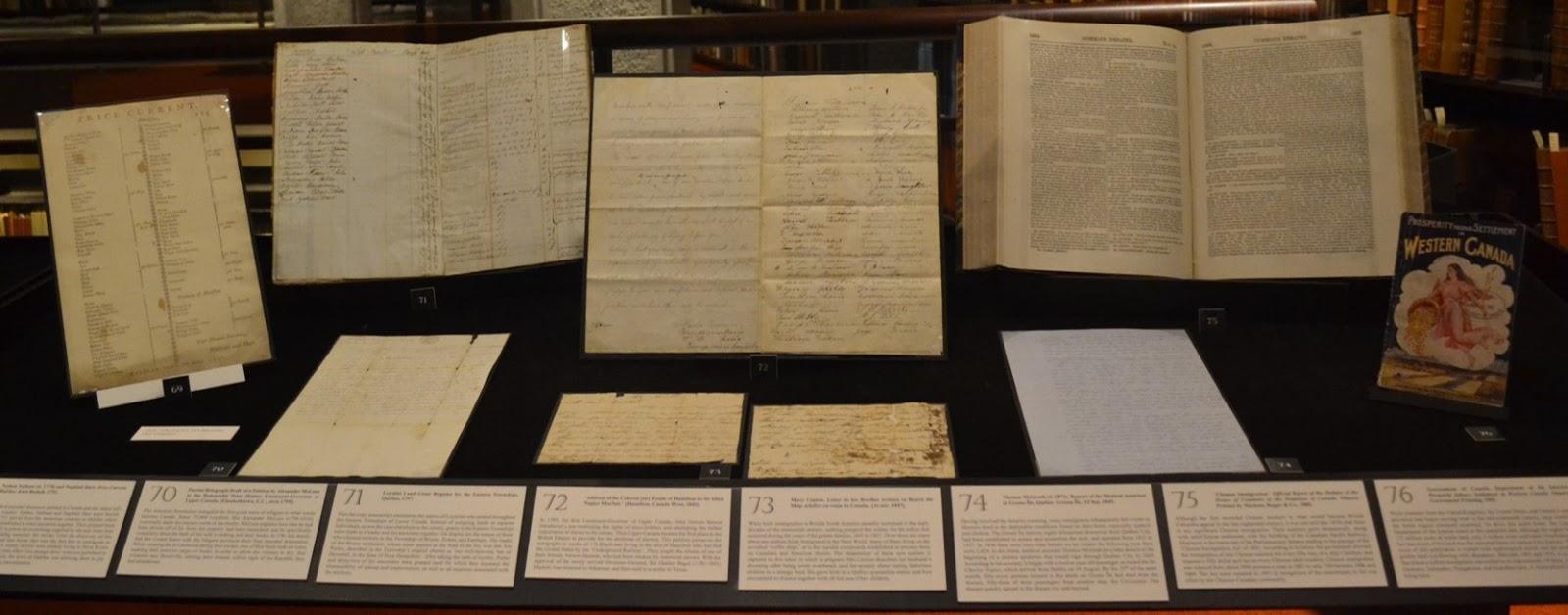
K: I think that using reproductions made it easier to create the diverse wall layouts. Fisher’s exhibition was different because nearly all the objects on display were originals. I wonder if they were able to do that because the display area is light controlled.

M: Yeah, I think the whole building is climate controlled as well because part of the collection is housed in open shelving. Fisher also brought in artifacts to add to their display cases, which we didn’t really see in the other exhibitions. 
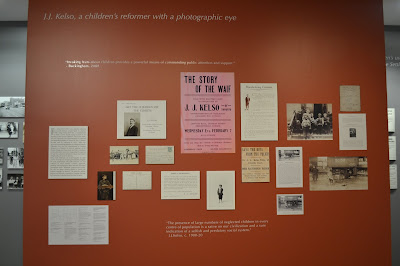
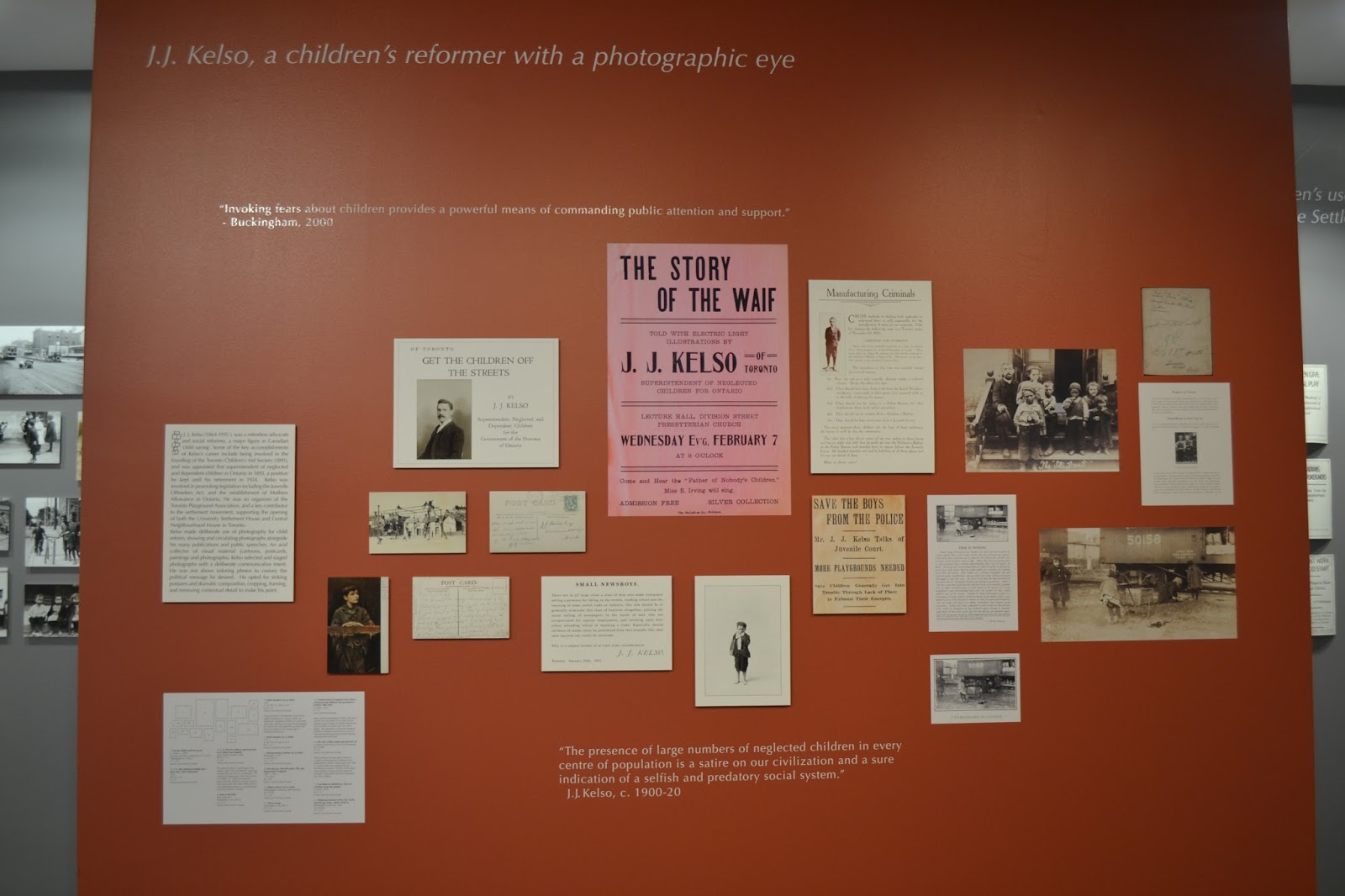
Wall display at the City of Toronto Archives. Photo by Kara Isozaki.

K: I noticed each exhibition took a different interpretive approach.

M: Yeah, it ended up being a spectrum, where TRL had what would be the most museum-like interpretation and Fisher was more like an essay in exhibition form, and then the Archives fell in between.

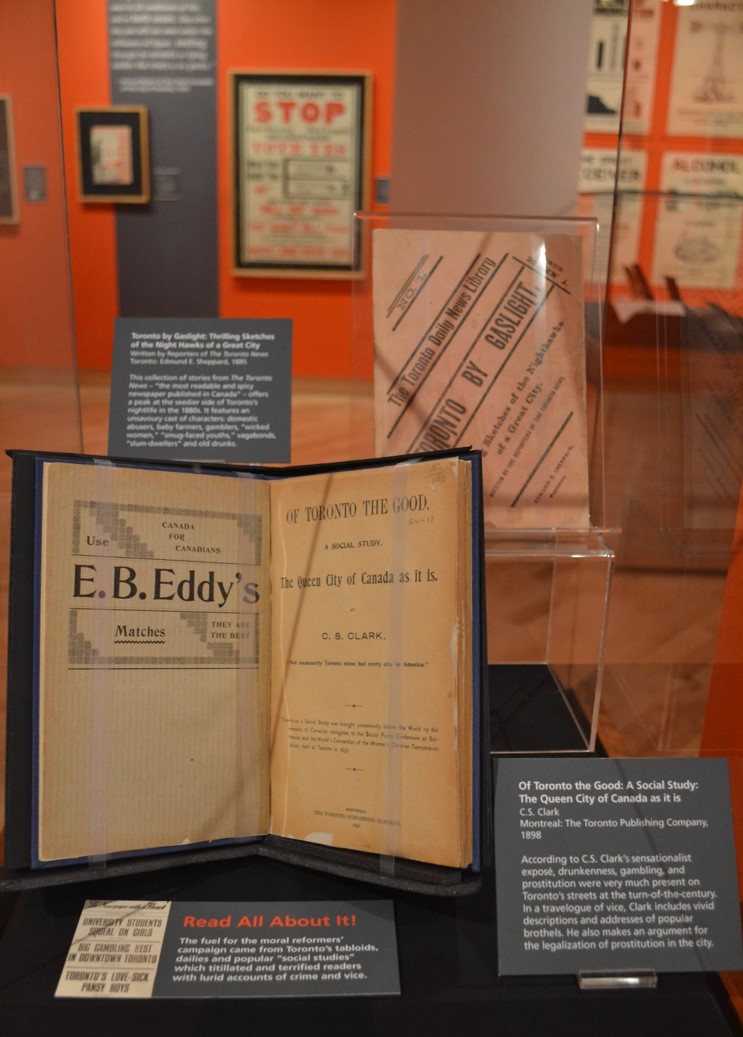
K: I found the TRL was more accessible because it had a clear theme with subsections. They used a mix of section panels, object labels, and infographics to give you multiple ways to access the information.

M: The Archives was pretty good in terms of having clear sections, but it lacked an overall story or theme. It seemed like the sections were focused on the records and creators represented in their collection rather than on the topic presented in the title.

K: Yeah, that might be because the content is based on the results of a research project and what information the Archives has about the records. The Archives might know more about the records creators than the people affected by the creation of playgrounds.

M: That’s very true, but would a visitor who doesn’t have a background in archival work know and recognize that? It wasn’t a bad exhibit overall, it was just that it seemed to lack a core theme. They should have named it something different. That might have provided a better connection between the sections.

K: The Fisher, on the other hand, took a really different approach. Their exhibition was way more text-heavy than the other two. They chose to present their information through object labels instead of section panels. It diverged the most from the museum interpretive techniques we learned.

M: The amount of information and text format felt more like an exhibition catalogue than a label. The catalogue was actually placed in a more prominent location than the introductory panel.
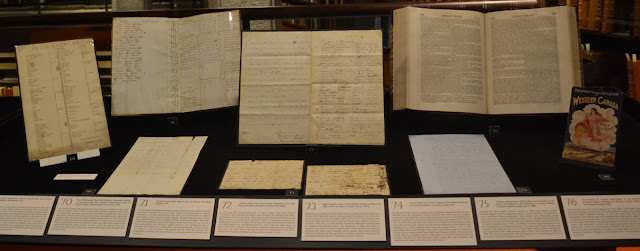
Case display with text-heavy labels at the Fisher Rare Book Library. Photo by Kara Isozaki.

K: I suspect the different interpretive approaches reflect the institutions’ different ideas about their audiences. With the Fisher, I think they’re writing for a more academic audience since they’re part of the university.

M: I agree. I imagine that they do get tourists, but they probably come to see the grandeur of the space itself, and the exhibition just acts as an example of what’s inside all the books on the shelves.

K: The TRL probably has the most diverse audience, since the building has been designed to be a community space, with a comic book store and coffee shop also on the first floor. The exhibition definitely felt like it was designed for an audience of the general public. Everything was really accessible.

M: The Archives was also aimed at the general public, but I think most of the visitors are people who are coming to the archive for other purposes, like research.
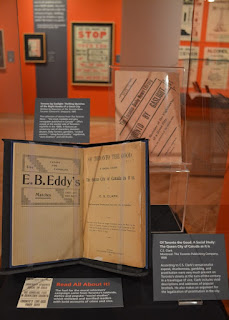
Case display at Toronto Reference Library. Photo by Kara Isozaki.
K: So what did we learn?

M: It seems to me that the institutions are picking up on display methods faster than they’re picking up on interpretive methods. We saw a lot of really great material displayed in creative and engaging ways, but the institutions differed in the ways that they presented associated information.

K: That’s true, but we are judging these exhibitions from a museological perspective, which comes with a lot of assumptions and history that these other institutions may not operate on.

M: But I think it’s fair to do that because all of the institutions we visited advertised their exhibitions as exhibitions with themes and in dedicated gallery areas. We didn’t just stumble across a “recent acquisitions” shelf.

K: Either way, I thought they were effective overall. We enjoyed visiting each of them and I feel like I learned something from each one.

Have you visited these exhibitions or others in libraries or archives? What did you think? Let us know in the comments!

13 October 2014

PHOTOGRAPHIC COLLECTIONS - LET'S GET VISUAL

MUSEUM MONDAY
BY ALEXANDRA JEFFERY

New British immigrant to Canada having a bottle of Coca-Cola and a cigarette,
1947, Archives of Ontario (I0002997.jpg)

It's no secret that we are living in a world that is primarily visual; the things that grab our attention are often bright, colourful and loud. Photographic collections have the same impact in archives; they represent some of the most accessible parts of the collections. Archives (and museums) have a really fantastic resource at their finger-tips (in my humble opinion). So, for this Museum Monday, I thought I might post a list of some interesting photograph collections!

1. The City of Toronto Archives has a collection of their favorite photographs, but they also have the photographic collection of Ellis Wiley. This particular collection contains photographs from 1945-1993 of many different areas of Toronto like Kensington and St. Lawrence Market, Ontario Place, the CN Tower…

EDIT: the City of Toronto Archives also has a pretty awesome Flickr page, if you want to see a fair number of photographs without having to search in their database.

St. Lawrence Market, Ellis Wiley fonds (Fonds 124), File 12

Campbell House, Ellis Wiley fonds (Fonds 124), File 2

Ontario Place, Ellis Wiley fonds (Fonds 124), File 9

2. The New York City Department of Records has a collection of Police Department and Criminal Prosecution photographs. The website includes a disclaimer, and I’ll put one here too, be aware that there are photographs that include some graphic images such as homicide crime scene photographs.


Street view, gun in street, political posters in windows, 1916-20 (pde_0127)

George Marthens mugshots #67095, 1916-20 (pde_0390)

Front view of house with door open and footprints in snow, 1916-20 (pde_0187)

3. The McCord Museum has a collection of William Notman photographs. During Notman’s career he “built up the largest photographic business in North America” with 7 permanent studios in Canada at one point or another. Notman's business was held by his family until 1935 when Willam Notman’s son Charles sold the business.


Foot race, Dawson City, about 1900 (MP-0000.2360.36), McCord Museum

Ice shove, Commissioners Street, Montreal, QC about 1884
(VIEW-1498), McCord Museum

Quebec Bridge, Quebec City, QC, 1917(?) (VIEW-6191), McCord Museum

4. The Glenbow Museum has a large photographic collection as well, including photos related to my favorite subject: agricultural labour.


Children picking sugar beets in field, Raymond, Alberta, September 1953
Glenbow Archives (NA-4510-191)

Men model women's clothes in fashion show, Calgary Alberta
Glenbow Archives (NA-5600-7229a)

Threshing crew, Southern Alberta, Glenbow Archives (NA-4548-2)

5. The Toronto Reference Library was just donated a huge collection of photographs (1900-1999) from the Toronto Star. The collection is in the Baldwin Collection of Canadiana. The library has not digitized the collection yet, although I’m not sure if that will even be part of the plan for the collection. However, the Toronto Star did do an online gallery of the highlights of the collection.

Gordie Howe with sons Mark and Marty, February 27, 1976
Toronto Star, Dick Darrell

Queen Elizabeth II with Pierre Trudeau, October 15, 1977
Toronto Star, Jeff Goode

Woman on corner of Bay St. and Front St., March 4, 1985
Toronto Star, Tony Bock