BY: KARA ISOZAKI & MAEGHAN JERRY
The summer edition of Museum Mondays will be a three-part series focusing on the convergence of libraries, archives, and museums (LAMs). Convergence has been a popular topic in Canada since the early 2000s. While the three fields have somewhat different histories, values, and methods, LAM institutions are all involved in collecting and preserving materials for the benefit and use of the public. Kara and Maeghan will bring their perspective as students of both Museum Studies and Archives & Records Management to publicly visible areas of overlap and interaction between LAMs.
For our final post we spoke to two professionals working in convergent institutions to learn more about the excitement and challenges they face. Dr. Amy Furness is the Rosamond Ivey Special Collections Archivist and Head of the Library & Archives at the Art Gallery of Ontario (AGO). She received her PhD from the Faculty of Information. Dr. Brendan Edwards is the Head of the Library & Archives at the Royal Ontario Museum (ROM). He previously served as director of libraries at First Nations University of Canada and as special collections librarian at the University of Saskatchewan.
What motivated you to take a position in the library & archives of a major museum?
Dr. Furness: I had an academic background in art history and working at the AGO library was a dream job. The most compelling aspect of the work was getting to know the raw materials of art history - the evidence of the people, activities and communities that have played a role in the Toronto (and wider) art world - and realizing the potential of these collections to support the writing of histories. I’ve long been fascinated by artists’ studios and the work that happens there, and the puzzle of how to move archives out of that space into a research institution without losing the essential qualities of the material.
Dr. Edwards: I previously worked in a specialized academic institution with a similar collection size, budget, staff, and relationship to a larger institution. I was looking to branch out from the specialized subject area in which I was previously working. I wanted an opportunity to dabble and think more broadly. Working at the ROM, an internationally recognized and well-regarded museum, was an opportunity that I could hardly pass up.
 |
| Illustration of a sea lion and lioness from the ROM Library & Archives’ collection. They’re excited to be held in a converged institution. Source. |
Do you find that there is a difference between working in a library/archives that is part of a museum compared to one that is an independent institution?
Dr. Furness: This is a hard one because I've been at the AGO since the beginning of my career, with a short stint at the Archives of Ontario. In the early years of my job I was acutely aware of the way that different museum professionals - including curators, librarians and registrars - viewed collections. I was more of an archival purist then in terms of trying to implement my professional learning. It’s pretty usual that an archivist will need to adapt to the culture of their institution. I guess what is distinct about a museum setting is how complementary the wider institution can be to archival work.
Dr. Edwards: My ideas about libraries/archives/museums are constantly evolving. In an academic setting, the library/archive is a central part of the institution’s main goal of attracting and retaining students and faculty. At the ROM, the Library & Archives is not viewed as central to the museum’s primary goal of attracting visitors. We play a supporting role to the varying research goals of the museum, so our main audience are research staff, external researchers, and graduate students. Our collections reflect our audience. I rely very much on the recommendations and expertise of curators and staff for collection development. Since the value of a library/archives is not always intrinsically perceived or well understood, I have to do a lot more “salesmanship” than I would like.
What are the biggest challenges you see working in a combined library & archives department?
Dr. Furness: I see way more opportunities than challenges, but information systems pose an issue in the sense that a small department has a hard time supporting more than one specialized system to serve both the library and the archives. It's not easy to make the case for the resources that would be involved.
Dr. Edwards: Library and archives working together is not a big challenge. We have a shared interest in collecting, preserving, and providing access to information. Modern museums, for better or for worse, are as much (or more) business and spectacle as they are mere collections and information providers. This poses a challenge to the Library & Archives - to commodify our collections and services is a severe challenge.
What is the relationship between the library & archives’ collection and the museum’s collection?
Dr. Furness: To a large extent the museum's collection defines the scope of the Library & Archives collection. Much of the book collection exists to document and support research on the museum’s collections and exhibitions. The acquisition criteria for Special Collections are related to the wider representation of the artist's work in the AGO's collection.
The Library & Archives also has some distinct areas of specialization that are complementary to the art collection but unique to our department. The Library & Archives has greater breadth in terms of documenting the Canadian art world - there are far more artists represented in our book and file collections than the art collection.
We use the AGO's The Museum System software to support digitization and tracking of Library & Archives materials for exhibition and loan purposes. It's a secondary information system for us, but has growing importance.
Dr. Edwards: In theory, the library’s collections reflect the museum’s collections, since our primary mandate is to support staff research activities. However, as curators and research staff come and go, and new/bigger/better exhibitions are staged, the collection activities fluctuate. From an archives’ collection perspective, the material is 100% related to the museum’s collection, since all of the material is generated in-house, or by organizations or people directly tied to the ROM.
One of our greatest challenges is drawing direct connections between our collections and the museum’s collections. We don’t have direct access to the curatorial or registration departments’ information management systems. Presently the museum is working towards migrating the various systems around the institution into one. We don’t know at this point to what extent our library catalogue information can be integrated or linked. We have our work cut out for us.
Thank you to Dr. Edwards and Dr. Furness for sharing your time and experience with us.
Dr. Furness: This is a hard one because I've been at the AGO since the beginning of my career, with a short stint at the Archives of Ontario. In the early years of my job I was acutely aware of the way that different museum professionals - including curators, librarians and registrars - viewed collections. I was more of an archival purist then in terms of trying to implement my professional learning. It’s pretty usual that an archivist will need to adapt to the culture of their institution. I guess what is distinct about a museum setting is how complementary the wider institution can be to archival work.
Dr. Edwards: My ideas about libraries/archives/museums are constantly evolving. In an academic setting, the library/archive is a central part of the institution’s main goal of attracting and retaining students and faculty. At the ROM, the Library & Archives is not viewed as central to the museum’s primary goal of attracting visitors. We play a supporting role to the varying research goals of the museum, so our main audience are research staff, external researchers, and graduate students. Our collections reflect our audience. I rely very much on the recommendations and expertise of curators and staff for collection development. Since the value of a library/archives is not always intrinsically perceived or well understood, I have to do a lot more “salesmanship” than I would like.
 |
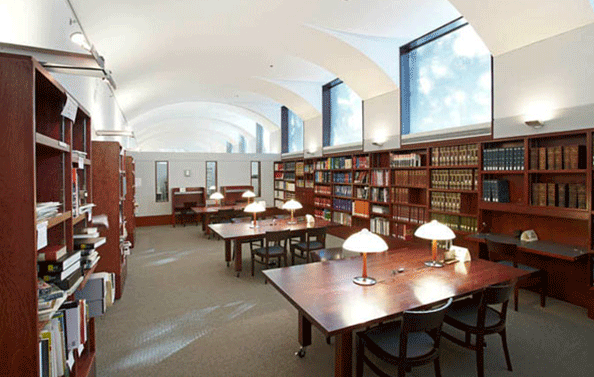
| Photo of AGO reading room. Source. |
What are the biggest challenges you see working in a combined library & archives department?
Dr. Furness: I see way more opportunities than challenges, but information systems pose an issue in the sense that a small department has a hard time supporting more than one specialized system to serve both the library and the archives. It's not easy to make the case for the resources that would be involved.
Dr. Edwards: Library and archives working together is not a big challenge. We have a shared interest in collecting, preserving, and providing access to information. Modern museums, for better or for worse, are as much (or more) business and spectacle as they are mere collections and information providers. This poses a challenge to the Library & Archives - to commodify our collections and services is a severe challenge.
 |
| Upon his death in 1940, amateur ornithologist James Henry Flemming donated his books and specimens to the ROM. His donation of books became the nucleus of the ROM Library’s rare book collections. Sources: left and right (modified). |
What is the relationship between the library & archives’ collection and the museum’s collection?
Dr. Furness: To a large extent the museum's collection defines the scope of the Library & Archives collection. Much of the book collection exists to document and support research on the museum’s collections and exhibitions. The acquisition criteria for Special Collections are related to the wider representation of the artist's work in the AGO's collection.
The Library & Archives also has some distinct areas of specialization that are complementary to the art collection but unique to our department. The Library & Archives has greater breadth in terms of documenting the Canadian art world - there are far more artists represented in our book and file collections than the art collection.
We use the AGO's The Museum System software to support digitization and tracking of Library & Archives materials for exhibition and loan purposes. It's a secondary information system for us, but has growing importance.
Dr. Edwards: In theory, the library’s collections reflect the museum’s collections, since our primary mandate is to support staff research activities. However, as curators and research staff come and go, and new/bigger/better exhibitions are staged, the collection activities fluctuate. From an archives’ collection perspective, the material is 100% related to the museum’s collection, since all of the material is generated in-house, or by organizations or people directly tied to the ROM.
One of our greatest challenges is drawing direct connections between our collections and the museum’s collections. We don’t have direct access to the curatorial or registration departments’ information management systems. Presently the museum is working towards migrating the various systems around the institution into one. We don’t know at this point to what extent our library catalogue information can be integrated or linked. We have our work cut out for us.
Thank you to Dr. Edwards and Dr. Furness for sharing your time and experience with us.