Showing posts with label Lambton House. Show all posts

15 July 2020

INTERNSHIP CHECK-IN


With all that is going on in the world right now, many of our summers have not turned out the way we originally planned. Usually, in the summer between 1st and 2nd year, MMSt students embark on an internship within a cultural heritage organization in order to gain hands on experience within their chosen environment. This year, with the restrictions in place, many opportunities were placed on hold or eliminated completely.  However, a few of my fellow classmates were fortunate enough to find internships to complete this summer in different aspects of the cultural sector. I recently sat down with two students from the 2021 cohort, Jessica and Alynese, to talk about their internships and how COVID-19 has impacted the internship experience for them.


Jessica Lanziner is currently doing her internship remotely as the Research Fellow at the Museum of Health Care. Knowing nothing about healthcare, she applied on a whim after LinkdIn creeping someone from her undergraduate degree, who she noticed had the position before.

No description available.
Workplace set-up. Photo courtesy of Jessica Lanzier

Jessica: I noticed it said you don’t need to know anything about healthcare – I know nothing, but the internship was still going forward and it’s a stipend pay so I applied and got a call back which was awesome. It's not what I was planning, but it’s a huge research role, and I am learning a lot that I never thought I would be learning about. I had to apply to the fellowship with a topic, propose a research idea, and I figured let’s be timely and connect it to the current COVID-19 pandemic. I selected the history of PPE and Infectious diseases in Canada, looking at PPE and how it has evolved. Since I knew that museums would not be opening I proposed to do things entirely remotely.

AM: Where did you gain inspiration for your research topic?

Jessica: Like lots of people, I had been reading a lot during lockdown. I read the Butchering Art by Lindsey Fitzharris, a scholar with a PhD in the History of Science, Medicine & Technology from the University of Oxford. I read her book and went off of that, listening to different talks and podcasts she had been on. She was on the Joe Rogan podcast, blowing his mind explaining the history of surgery. From this appearance she gained a large following. For my research proposal, I thought I will make it timely and do PPE and Infections, and explore the history of the use of PPE within Canada in regards to infections diseases.

Jessica’s current manuscript, titled after some reworking, is called “Histories of Personal Protective Equipment and Strategies in the Fight to Control Infectious Disease,” which once completed will be available on the Museum of Healthcare Website (where you can also see past Research Fellow Manuscripts). As a research fellow, Jessica is required to write a large paper at the end of her fellowship and create 4 blog posts about aspects of her research.

AM: What is your paper about?

Jessica: The history of different PPE and how it has evolved. The last chapter is on infectious disease outbreaks and how we have managed them in Canada using the history of PPE from before. My manuscript will look at Canadian responses to the 1918 influence, HIV, Tuberculosis, Sars, COVID-19. It's weird that I am currently living my research. For COVID-19, no archival materials are available so it’s all my own pictures and such.

AM: What have you found challenging about this experience?

Jessica: It’s been hard because I eat sleep and breathe pandemic. It's good and I have learned a lot but it makes me frustrated in my daily life. Stuff we have known to be science since the 1880s is not new or difficult! Because in their galleries they currently have vaccines and infectious disease information so it will be interesting to see how they will incorporate the stuff from this year.

AM: What interesting facts have you learned?

Jessica: [about] Respirators and disposable respirators. In the past, they had a similar issue to today with people being like my child is afraid of wearing masks, kids very afraid of gas masks so [the government] decided to make child friendly gas masks modelled off of Mickey mouse, that has ears and polka dots, and it makes them even more scary. They didn’t end up using them, there are still some in military archives, so they are hard to find but even more scary than a regular gas mask.

AM: Have you encountered any difficulties in your research?

Jessica: I have been conscious in trying to talk about how epidemics affect different racial groups in Canada, but I am only finding limited resources online. Papers just aren’t available for research online, it's hard to find diverse viewpoints about how historically pandemics affected minority communities in Canada. It's been frustrating, but that’s how it is with doing online research right now. Since I can’t go into the archives I have to rely on just what I can find online.

AM: Any advice for future people in your role?

Jessica: Not advice, but we all need to give more credit to those students who have spent their time doing those boring hours on long digitization projects, the only thing online saving us right now! Manual labour from cataloging students is really paying off for me right now.

AM: What skills have you employed from classwork?

Jessica: In our indigenous material heritage course, we looked at questions of who created this heritage and what does it mean for people to be using it who are from a different culture? I have been trying to follow the things from there and use broader viewpoints within my research.

AM: Anything surprising in what you have learned?

Jessica: I am learning a lot about copyright! I have had to deal with copyright and infringement, and that made me realize I wasn’t always doing it right before. I have learned how to actually get rights for images and reproduction rights, I’ve had to email a ton of places for certain images and I have become attached to having certain images! Some places like the city of Toronto allow you to use them for free for research if they’re online. I have been very attached to getting the correct photo rights!


Alynese Nightingale is interning at Lambton House Museum as an Archives Technician.

No description available.
Lantern Slide/Glass negative from Lambton House Museum. Photo courtesy of Alynese Nightingale

AM: Tell me about your internship position.

Alynese: I applied in late April and didn’t hear back until June. I’m an Archive Technician – they merged two positions. I am by myself everyday, go in to do what I need to do, no one bothers me or anything. They usually hire two interns but only one this year —due to COVID-19 they have combined the positions. Since I am working alone I get to go into the office everyday. I am very lucky that the pandemic has not affected the daily roles of my job.

AM: What a day in the life looks like for you?

Alynese:  I am organizing collections so I like to start by going back and double checking my work from the pervious day for any mistakes. I don’t have concrete things I need to do everyday, I have creative control so I can choose what to work on. Today I finished cleaning out the archive room and started organizing collections which I will spend the next few weeks doing. I am helping the Lambton House Museum create a foundation for their archives, putting collection management policies in place, making finding aids so that museum workers can access things and researchers can come in. Doing that and getting it into an online database so it's all catalogued, they currently do not have accession numbers, so I'm creating a system for them that works and is easy for researchers and museum staff to navigate. I have been applying a lot of what I’ve learned in collections management from this past year.

I have always wanted to do collections so I was very excited for the opportunity when they were like “here are all of our collection things, do something with it!” In smaller museums sometimes collections are neglected for other more important things, and now I have time to focus on this and get it organized.

At the end of the week I do a report on what I did that week. I like the work because I can listen to music and podcasts! I listened to a lot of Dateline but it started to get too heavy so switched to Things You Missed in History Class.

AM: What is your favourite aspect of the job so far?

Alynese: Accessioning, going through and doing inventory reports, itemizing. I like seeing a new historical thing for the first time, it’s exciting to be the first person to see it.

AM: Is there anything that has surprised you about the job?

Alynese: I am surprised by how much control they have given me and how much they respect my opinion, not treating me like a student – they are treating me like an expert in the field and they are confident in the schooling and experience I have to do the job.

AM: What are you most excited to accomplish?

Alynese: I am most excited to accomplish organizing the collection. I am excited to create a concrete policy they can follow in the future, and have an impact on the organization and to be able to contribute a legacy to the future.

AM: What are some of the interesting objects you have found in the collection so far?

Alynese: Lots of photographs of the Humber River area and lots of cool photography glass negatives from the Kodak Archives showcasing the Humber River area, very cool. They have around 400 glass negatives or lantern slides showcasing very cool historic photos or paintings from the early 1900s. They are film negatives that layer onto a piece of glass and encased and can slide into a projector.  They cover scenes of the Humber River, paintings, children’s drawings on a project for pollution, houses in the area that students went and took pictures of, lots of different areas of local history that they have recorded.

No description available.
Lantern Slide/Glass negative from Lambton House Museum. Photo courtesy of Alynese Nightingale

AM: Any advice for future people in your position?

Alynese: Keep a lot of notes and be really organized because it is easy to get confused! I have had plenty of times where I work on something and get disorganized and have to start over, so I have learned the importance of detailed notes!

The interviews have been edited for length and clarity. 

26 July 2019

TEACHING AND LEARNING AS INTERNS: FROM TORONTO TO NAPLES

 Internship Check-In | Joanna Wreakes


Hello Pals, back again for another Internship Check-In. I’m super stoked to share what some of my colleagues are up to in the diverse roles they’re tackling for their internships. Read on to grab a small taste of the kinds of work an MMSt internship can lead to!

In this edition we'll be hearing from:

Amelia Smith: Japanese Canadian Cultural Centre, Toronto, ON

Defne Inceoglu: Lambton House (Heritage York), Toronto, ON

Revital Weiss: Koffler Gallery, Toronto, ON

Selin Kahramanoglu: Colegio Oficial de Doctores y Licenciados en Filosofia y Letras y Ciencias de Valiencia y Castellon,  Naples, Italy

This photo featuring Lambton House juxtaposes the historic and modern found all around Toronto. Source.

Please introduce yourself and tell us about your internship role.

Amelia: I'm Amelia and I have been interning at the Japanese Canadian Cultural Centre as a research assistant. The JCCC has begun redesigning their permanent exhibition on Japanese diaspora, and I've been taken on to research Japanese migration into Imperial Manchuria.

Defne: Defne Inceoglu here, I’m the archives and records intern at Lambton House, which is a historic house run by the charity Heritage York. While my title says archives and records, I’m ALSO a collections manager, library cataloger, website designer, photographer, policy writer, exhibition designer, provenance researcher, cleaner, resident neighbourhood expert, admin worker… I wear a lot of fun, fun hats.

Revital: My name is Revital and I’m an urban-planner-turned-Museum-Studies-student. This summer, I’m working as a Gallery Education Assistant at the Koffler Gallery, a contemporary art gallery. Together with a devoted education team, I am responsible for making our summer show accessible to our diverse visitors through engaging tours and conversation. I also help create and facilitate workshops that highlight some major themes in the exhibition, and research for the development of education packages.

Selin: I am entering my third year in the CDP (Combined Degree) program this September, with a concentration in Archives and Records Management. I had the great fortune of joining a dig in Naples this summer. My internship role is to clean, label, store, and inventory all of the artifacts recovered from our excavation site in Pompeii, for the local museum's use.

Defne in the Blue Room at Lambton House, surrounded by the library to be catalogued. Photo courtesy of Defne Inceoglu.
What is a typical day like at your institution?

Amelia: My average day is not very exciting to write about. Most days consist of endless reading and making as many notes as I think necessary. I usually get in at 8:30 AM and the reading doesn't stop until around 4:30 PM (excluding a break for lunch around 12/12:30 PM).

If feel I need a break from reading, I will usually go on a search for artefacts that could make it into my section of the exhibition. As I cannot read Japanese, the places I can search are limited. Nevertheless, I have been able to find a load of excellent items through The Library of Congress and Harvard Libraries.

Defne: My day starts early in the morning, as I throw my thermos of coffee into my backpack and take my bike ride through High Park/the Humber River trails and the surrounding neighbourhood. The Humber River and the former City of York is incredibly important to us at Heritage York, our mandate is centered around the history of this area. Plus, the exhibition I am designing is about the City of York. I like to spend time every morning getting to know the neighbourhood better. Once I get to work, I start up on one of my projects. I type-type away at my desk. We open to the public around 12:30-1 PM until around 3:30 or 4. At this time myself or the other intern (CDP student Devin Benczik!) will greet people, chat and give tours. However, much of my day is spent at my desk, cataloging books or objects, writing copy for my exhibition, researching provenance or designing the website.

Revital: Each day is slightly different and there have been phases of work throughout the internship. Ahead of the exhibition opening, my typical day was spent on various activities related to the summer show, like helping complete the education package used for tours, building the summer workshops, and reaching out to cultural and academic organizations to offer a tour and workshop.

Selin: Typically, we leave our residence by 7:00 AM and head to the dig site. I gather all the materials excavated the day before, and take the boxes to another on site lab. There, the materials undergo general conservation treatment and are recorded. In the evenings, our team has a debriefing, or we tour another local site, before having dinner by 9:00 PM!

Amelia looking beautiful in yukata at the JCCC's Natsu Matsuri. Photo courtesy of Amelia Smith.
Is there anything that’s surprised you about your internship?

Amelia: I was surprised by how quickly I started locating artefacts that could make it into the exhibition. Within my first couple of weeks, I had found a book at Downsview library that I felt would be perfect. Granted, about a week later I realized that books from the first half of the 20th century might not be the best choice for a permanent exhibition at the JCCC, but you win some, you lose some.

Defne: I am surprised at how trusting and supportive my supervisors are. As a volunteer Board, they care very much about their work and in return they care very much about us interns. They let me run around with my ambitions and guide my ideas without restricting the limitations. It has been a fun process getting to create my own projects and implement them. Their expertise and kindness has been very valuable.

Revital: I am surprised about the level of autonomy I have been given and the amount of responsibility with which I have been entrusted. My supervisor is always available to answer questions and checks in occasionally, but I am mostly self-monitoring to complete my tasks. I am especially surprised and appreciate that my supervisor has faith in the work I produce and accepts ideas that I bring to the table.

Selin: I was surprised to learn that my supervisor was willing to take my advice in regards to improving some workplace practices. Mostly, the project is well-organized and progressing smoothly, but I was able to make some suggestions about better practices. For example, I've been helping with improving the code of the photographs in the hard drive so that they're easier to find, using archival standards.


Selin hard at work cleaning artifacts excavated from the dig in Naples. Photo courtesy of Selin Kahramanoglu.
What are you excited about accomplishing throughout your internship?

Amelia: I'm excited to write the essay that will be the basis for my portion of the exhibition. With the amount of time I have put into the research and the multiple dimensions I have imagined for it, I am confident this will be an essay unlike any other I've written in the past. And that is exciting to me.

Defne: I am excited to lock down the accession and storage frameworks that I am currently helping to develop and/or improve. It has been a fun, challenging process. We are currently getting ready to start accessioning more of the objects in the collection. The best part about this is the provenance research. I have been doing a big research project on a William Notman/John Arthur Fraser painting that we have. It's like playing detective and I am excited for what else is left to be turned up.

Revital: The Koffler maintains ideals of social justice, equality and inclusivity. I am most excited about fulfilling this mandated practice and have already done so through giving tours that highlight the need for social change, providing arts programming to children in underserved communities, and contributing to a lecture about erased art history that centres on marginalized and oppressed communities. I very much look forward to continuing this social practice both at the Koffler and future workplaces.

Selin: I'm most excited about seeing the full lifecycle of these artifacts. So far, these very interesting objects have been recovered after thousands of years, cleaned like new, catalogued, and shipped to the museum. I'd like to know more about how the museum displays these objects, and how they hope to tell the story of Pompeii, using our archaeological data and modern exhibition techniques.

Revital leading some young visitors through a guided meditation. Photo courtesy of Revital Weiss.
Do you have any words of wisdom for someone entering a similar position?


Amelia: Don't be afraid to see where a position will take you. I knew nothing about the Japanese occupation of Manchuria before I started this position, and now I've got Manchurian postcards indelibly burned into my mind's eye for all eternity.

Defne: Pacing your work is important. It can get a bit hectic with lots of projects on the go, so remember to take your time and plan accordingly.

Also, when you work in a food desert, don’t forget to pack your lunch!

Revital: The best tours are those that feel like a conversation, so ask your audience questions and listen when they have something on their mind; you will not only learn new pieces of information that you can incorporate into the show, but your day will go by much faster when you treat visitors like friends!

Selin: Don't be afraid to speak up. You are more qualified than you realize, and you've got some great ideas to offer. Keep an open mind when it comes to learning something new, but don't forget that you might end up being a teacher too!
 
The interviews have been edited for length and clarity. 


Edit: A previous version of this article linked Selin's internship to Archaeological Institute of America. This has since been updated to accurately reflect the organization she is working with. 

11 January 2017

TORONTO STORIES FROM LAMBTON HOUSE

TORONTO STORIES

STORIES BY:  ANTHONY BADAME, ALEXIE BROWN, BRIDGET COLLINGS, KELLY MACKENZIE, TAYLOR NOBLE

COMPILED BY: BRENNA PLADSEN

The series of digital stories about Toronto history and culture which make up this project are the work of fifty-three Master of Museum Studies (MMSt) graduate students. The project was inspired by the 2015 Myseum Intersections – Telling Toronto’s Stories and invited each storyteller to select an object from local collections which has significance to Toronto’s past and present. The objects inspired the authors to connect historical events with contemporary context so that they tell stories about the multiple intersections that happen in the city.

Musings will be posting collected stories once a cycle. We hope that, after reading the stories, you will know Toronto a little bit better. And perhaps you will find similar stories in your own objects!

Our partners for this project, to which we are extremely thankful, are:


Now, without further ado, object stories from Lambton House.

THE CURIOUS CASE OF THE LAMBTON HOUSE SIGN


BY: ANTHONY BADAME

Have you ever gone treasure hunting in your home? Toronto's history may be buried there. It may sound silly, but you'd be surprised what you might find. As a city created from former townships and villages, Toronto's heritage is made up from the histories of these old municipalities. What may seem like an ordinary object to some may actually have great story to tell about one of Toronto's neighbourhoods. This was the case for the old sign that hung outside of Lambton House, a historic hotel and tavern in Toronto's west end community of Lambton Mills

Lambton House operated as a tavern and hotel for 140 years (photo credit: Anthony Badame, 2015).
The wooden sign hung outside Lambton House from around 1950 until at least the 1960s (the exact dates are unclear) and welcomed weary travelers from all over Ontario to the hotel. By this point, Lambton House was well established and respected in the community. Like the sign says, Lambton house is An Old York Landmark, referring to the former municipality of York which encompassed Lambton Mills. York legally became part of Metropolitan Toronto in 1953- around the time the sign was in use. Known for its good food and entertainment, Lambton House opened in 1848 and became a stop on the stagecoach route from Toronto to Dundas. The painted horse on the sign is a reminder of this period in Lambton House's history. Lambton House operated for 140 years until its closure in 1988. It was transformed into an interpretive centre by Heritage York in the early 1990s.

It was at some point between the 1960s and the closing of the hotel that the sign mysteriously disappeared. Madeleine McDowell, Membership Secretary for Heritage York and lifelong resident of Lambton Mills, recalls that many things went missing or were taken as souvenirs during this time. Years passed and the sign became a distant memory; but, as luck would have it, the sign returned to Lambton House.

Now residing in an upstairs room, this sign hung outside of Lambton House in the 1950s 
(photo credit: Anthony Badame, 2015).
McDowell remembers the call she received one summer a few years ago from a man in Perth, Ontario. The man grew up in the area and wanted to bring his granddaughters for a tour of Lambton House to learn about her family history. Gladly, McDowell accepted. After the tour, the man presented McDowell with the sign. "I thought he was just showing it [to me]", she remembers. However, the man returned the sign to Lambton House, because he felt that's where it belonged. For preservation reasons, the sign now sits in an upstairs room in Lambton House. Excitingly, Heritage York is planning on recreating the sign in order to hang it outside. The Lambton House sign will once again welcome visitors to this treasured spot in Lambton Mills.

It is thanks to residents and former residents of Toronto, like the man from Perth, that Toronto's history is so rich. So what bits of Toronto's history are hiding in your house? You'll never know unless you look!

Works Cited

City of Toronto. (2015). A History of Toronto: An 11000 Year Journey. Retrieved from: http://www1.toronto.ca/wps/portal/contentonly?vgnextoid=24f42118b7412410VgnVC M10000071d60f89RCRD.

Harris, D. (2014). Etobicoke History Corner: Lambton Mills Named for the Earl of Durham. Inside Toronto. Retrieved from: http://www.insidetoronto.com/news- story/4576117-etobicoke-history-corner-lambton-mills-named-for-the-earl-of- durham/.

Heritage York. (2015a). Lambton House [website]. http://www.lambtonhouse.org.

Heritage York. (2015b). Heritage York [website]. http://www.lambtonhouse.org/HY.

"Lambton Mills". (2015). Wikipedia. Retrieved from: https://en.wikipedia.org/wiki/Lambton _Mills.

Magel, R. (2008). 200 years Yonge: A history. Natural Heritage/Natural History Inc: Toronto.

McDowell, M. (2015). [Interviews October 13 October 27]. Lambton House, Toronto.

"York, Toronto". (2015). Wikipedia. Retrieved from: https://en.wikipedia.org/wiki/York,_ Toronto.

DISHING OUT ROYAL MEMEMTOES: CELEBRATING THE CORONATION OF GEORGE VI AND ELIZABETH TORONTO-STYLE


BY: ALEXIE BROWN

Do you remember the anticipation surrounding Prince William and Kate Middleton’s marriage back in 2011? Perhaps you even bought a special commemorative memento. Even if you weren’t among those who did, the royal wedding wasn’t the first time Toronto obsessed over a royal event. Flashback to 12 May 1937 - Toronto was abuzz with coronation fever! From rallies to decorated shop windows at the Eaton Centre, no area of the city was bereft of celebratory spirit for the coronation of George VI and the Queen consort, Elizabeth. Needless to say, Torontonians embraced that coronation just as enthusiastically as they did the recent 2011 royal wedding. In honour of the 1937 coronation, a variety of bric-a-brac souvenirs were produced and sold, ranging from textiles to ceramics, but the most notable were commemorative plates.

The Lambton House, a small hotel along the Humber River, was not left untouched by the coronation fever gripping Toronto to the south. To commemorate the royal event, Louis Epstein, owner of the Lambton House at the time, commissioned Alfred Meakin, a manufacturing company in Britain, to produce porcelain plates depicting the newly minted royal couple to gift to his visitors, guests, and staff.

1937 Commemorative Plate from Lambton House celebrating the 1937 Coronation, Photograph. (2015). 
Photography by Bridget Collings.

According to local historian Madeline McDowell, Mr. Epstein gave this particular 1937 commemorative plate to the cook, Mrs. Shaw, to show his appreciation of her services to Lambton House. The plate depicts colour-transferred images of the royal couple amidst a crown, flags, and an English rose on the front with the manufacturer stamp and an inscription that reads “courtesy of Lambton Hotel” on the back.

‘Compliments of Lambton Hotel’ inscription on back of the plate, Photograph. (2015).
Photography by Bridget Collings.
In Fifty Years of Royal Commemorative China 1887-1937, M.H. Davey and D.J. Mannion explain that “royal souvenirs were made to be kept as a reminder of the event and reflect the popularity of the monarch of the day…they not only chronicle our national heritage, but represent, through their designs and inscriptions, part of our social history.” The Lambton House’s plate also commemorates a time in history when Toronto was part of the British Empire. The plate, with its depictions of English symbols and portraits of George VI and Elizabeth, would be proudly displayed in Torontonian homes and serve as a constant reminder of Toronto’s British cultural heritage.

Collecting royal memorabilia continues to be a passion for some Canadians to this day. Do you remember the excited Torontonians who were celebrating Prince William’s marriage to Kate Middleton by holding tea parties and buying souvenir china, and cooking dinner menus inspired by the wedding? Although the British monarchy doesn’t hold as much sway in the governance of Canada today, they remain an important icon in the lives of many Canadians.

One mystery yet remains to be solved regarding the 1937 commemorative plate at the Lambton House: How many were actually produced by Alfred Meakin for Louis Epstein to ‘dish’ out to esteemed guests, visitors, and staff?

To learn more about this 1937 commemorative plate, please visit the Lambton House.

Works Cited
Davey, M.H. & Mannion, D.J. (1988). Fifty Years of Royal Commemorative China 1887-1937. Hemel Hempstead: Dayman.

ROOTS AND ROADS: A TALE OF TORONTO'S TRANSPORTATION HISTORY AND THE HORSECHESTNUT TREE


BY: BRIDGET COLLINGS

Before GPS, Google Maps, and Siri, other objects guided travellers on their journeys: plaques, signs, landmarks, and even trees. Instead of Siri’s voice giving travel directions, these objects would act as physical indications that travellers were on the right path. One such marker unique to Toronto and the greater area of south-western Ontario was the Horsechestnut tree. Commonly used in the 19th century to outline stagecoach routes, Horsechestnut trees lined the once main east-west highway for Southern Ontario and stood in front of stagecoach stations such as the Lambton House. 

Horsechestnut tree in spring. Source: [Horsechestnut tree in spring, Photograph]. (n.d.).
Retrieved from: Soil-net.com
According to local historian Madeleine McDowell, Horsechestnut trees were presumably planted in a certain vicinity of stagecoach stations to inform the driver that he was close to a stop, and therefore it was time to slow down. Horsechestnut trees can still be found on streets that were once part of the old stagecoach route that ran east - west throughout Southern Ontario, particularly in front of old stagecoach stations.

The Lambton House was one such station along south-western Ontario’s old stagecoach route. Opening in 1848, Lambton House operated as a stagecoach station on Dundas Street until the advent of the railroad in the 1880’s. As one of the major stagecoach stops for Toronto, Lambton House had Horsechestnut trees lined along Dundas Street and in front of the house. Based on McDowell’s recollections, the last Horsechestnut tree on the street stood in front of Lambton House until it was hit by lightning in 2006. While this resulted in the tree’s demise, a piece of the tree is displayed in front of the entrance to the house to tell the story of Lambton House's history as a stagecoach station in south-western Ontario. 

The piece of the Horsechestnut tree on display at Lambton House. 
Source: A piece of Lambton House’s Horsechestnut tree, Photograph. (2015). Taken by Bridget Collings.
But why Horsechestnut trees?

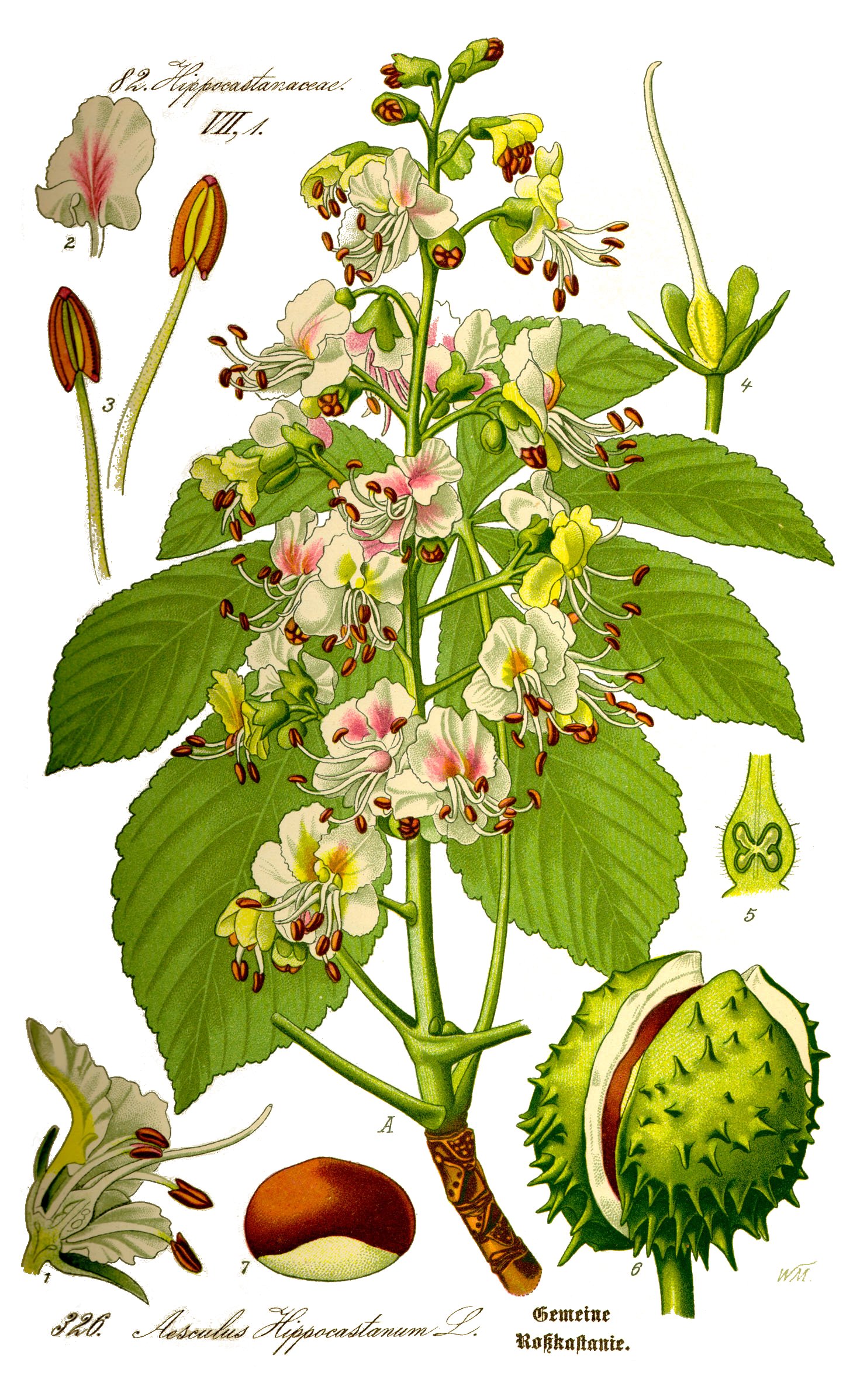
McDowell recalls that the tree was used as a marker because it was not indigenous to Ontario, thus making it easy for drivers to spot amongst the foliage. Another reason is its very distinctive look: the tree boasts candle-like formations of white flowers in the spring and spiny husked chestnuts in the fall. Besides its looks, the history of how the tree came to Ontario is also pretty neat. 

Illustration of a Horsechestnut tree’s candle shaped blossoms and spiny husked chestnut.
Source: [Aesculus hippocastanum, Illustration]. (n.d.). Retrieved from: Wikimedia.org 
The story goes that in the early 19th century, British settlers planted the trees in Ontario to recreate the landscapes of their homeland. When Edward VI, the Prince of Wales, came for the ceremonial opening of Queens Park in 1860, he was greeted by over 500 Horsechestnut trees, icons of the British landscape, lining University Avenue, College Street, and Carlton Street.

Horsechestnut trees, like the one that once stood in front of Lambton House, was the original “GPS” and a prominent feature of Toronto’s natural landscape. While there are not as many Horsechestnut trees in the city today, see if you can spot a Horsechestnut tree while wandering around Toronto!

To see Lambton House’s Horsechestnut tree and learn about its role in Toronto's transportation history, please visit the Lambton House.

Works Referenced
Lambton House (n.d.). History of Lambton House. Retrieved from: http://www.lambtonhouse.org/History.html

Canadian Tree Tours. (n.d.). Horsechestnut in Toronto. Retrieved from: http://canadiantreetours.org/species-pages/Horsechestnut.html#toronto 

LAMBTON HOUSE MEN'S BEVERAGE ROOM: HOW MEN SOCIALIZED IN 19TH CENTURY TORONTO


BY: KELLY MACKENZIE

Men’s Beverage Rooms, once a popular space in Canadian hotels, usually served working-class men as middle-class men often had their own liquor cabinets at home. [1] Lambton House, operating as a hotel from 1848 to 1988 in the former village of Lambton Mills, currently York, Ontario, featured one of these rooms on its main floor. Here men could come to eat, drink, and socialize.

The Men’s Beverage Room (Howland Room) at Lambton House, set up for the monthly Community Pub Night.
Image taken by Taylor Noble.

Local farmers would go to the Beverage Room for a celebration meal after receiving pay for their harvest. Farmers operated on credit and when they took their grain to the Lambton Mill, they would take some flour, the amount specified by their wife for home, pay off their credit debt, and have a celebration meal in the Lambton House Men’s Beverage Room. While there, these farmers would interact with a wide range of men, including teamsters, travelers, as the House was a stop for stagecoaches and others, fellow farmers, working men, veterans, and more.

Two men local farmers might have seen were Mr. Ostrander and a local veteran. The Ostranders of Brantford both came from loyalist families who received crown land grants and travelled through Lambton Mills often. Local historian and Membership Secretary of Lambton House, Madeleine McDowell remembers the Ostranders coming to town. When they arrived, Mrs. Ostrander, also known as Granny, would appear in fine clothes, every inch a lady. She and the children would eat in the dining room while her husband went to the Men’s Beverage Room. Women were not permitted, by law, to enter a Men’s Beverage Room and could be arrested if they did. Those who did, or attempted to, were seen as having low morals or were prostitutes. [2] As a result, if a family or couple was passing through, the man could go to the beverage room and his female companion would go to dining room.

Therefore, the farmers may have rubbed elbows with a man of a higher status, like Mr. Ostrander. However, he also could have socialized with veterans from the Boer or Crimean War. McDowell recalls the story of a veteran riding his horse to Lambton House, a common sight. What was unseen was that this man had lost both arms in the cavalry. Although McDowell is not sure in which war he was injured, she did recall that he would enter the hotel and go to the Men’s Beverage Room to socialize. He would grip his mug in his teeth, lift it up, and tip back his head to drink. When finished for the night, he would mount his horse and ride home. Although Men’s Beverage Rooms seem outdated now because they did not permit women, they show how men socialized at the turn of the century. The Lambton House Men’s Beverage Room hosted teamsters, farmers, travellers, and the bourgeoisie. It was a place where men of different backgrounds and occupations could meet, eat, and drink.

Footnotes
1. Heron, C. (2003). Booze: A Distilled History. Toronto: Between the Lines, 284.
2. Ibid., 289.

PROJECTION PROJECT: ONE MAN'S LASTING LEGACY IN YORK TOWNSHIP

BY: TAYLOR NOBLE

It’s 1954. The children of King George Public School have been waiting all week for this moment. Their principle, Mel Bryce, enters the classroom, a large brown case in hand. The room, which had been buzzing with excitement, falls silent. Mr. Bryce walks to the back of the classroom, all eyes on him. He opens the case and places a large metal device on a back table. A few students whisper as he searches for an outlet and organizes his materials. Finally, he signals for the lights to be turned off and the students roar with applause.

What could cause so much excitement? Believe it or not, it is a history lesson…with a new twist!

But let’s start at the beginning.

Mel Bryce began his work at King George Public school in the York Township Board of Education in the 1930s. A lover of history, he wanted to find a way to bring history to life for his students. So he did what many today are using to engage the younger generations – he used the latest technology.

Delineascope Slide Projector, circa 1940s. Photo credit Taylor Noble.
In the 1940s, Bryce acquired a Delineascope slide projector made by the Spencer Lens Company. He believed that pairing local history lessons with images would be a more engaging experience for the children. Bryce put a call out to his colleagues and consulted various public and private collections, many of which are now in the City of Toronto Archives, to compile a large collection of historical photographs of York Township. He then went to Ryerson Press and had the images turned into glass mounted slides. By the time of completion, his collection had several hundred slides featuring images of historic buildings, landscapes, people, and events.

Lambton House membership secretary Madeleine McDowell describes how Bryce’s slide collection and presentations became a prominent fixture of the York Township community. During his tenure as principal, he helped hundreds of children learn more about their local heritage and roots. Bryce also gave lectures to adults outside of the school, and even had his images featured in J.C Boylen’s York Township: An Historical Summary 1850-1954.

In the early 2000s, Bryce’s daughter donated both the projector and slides to Lambton House. The slides are still used for children’s programing in their new home at Lambton House, as their educational value is twofold. McDowell observes that children are “absolutely fascinated” not only with the images on the slides, but the slides themselves. The collection is thus useful for teaching the history of York Township, and the history of media and technology.

It is amazing to think that after all this time the slide collection is still being used as an aid to help children engage with their local heritage. What is even more compelling is that Bryce’s project reflects many of the values of the Myseum of Toronto itself – using different forms of media to engage with Toronto’s heritage.