Showing posts with label Exhibition Elements. Show all posts

22 January 2019

NON-MUSEUM EXHIBITIONS

Special Feature | Selin Kahramanoglu

Welcome back, our holiday hiatus is over! The third part of my “alternative conservation” series will be completed in the following two articles of Conservation Tips & Tricks. However, this month, we will briefly turn our attention to a special feature about non-museum exhibitions!

Gucci store front window reminds of a museum display. Photo courtesy of Selin Kahramanoglu.
Let’s consider the “non-museum” exhibition, which is a type of exhibition that is outside the realm of the museum. This does not mean outdoor installations, or art gallery exhibitions, because those are still museum-context exhibitions. I am talking about exhibitions that are on display for public viewing, which have no association to any cultural institution (meaning, they have nothing related to museums and galleries of art, history, or science).

What are you talking about Selin? Has your brain stopped working from eating too many chocolate chip cookies over the holiday break? That may be true, but I’m also very interested in this topic! Whether you’ve noticed it or not, you’ve probably come across these special kinds of exhibitions.

Hermes' store front window resembling an art display. Photo courtesy of Selin Kahramanoglu.
If it’s outside of the museum world, then what do I mean by an “exhibition”? Based on my own knowledge, I’ve generated some criteria that is necessary to define exhibitions...
To me, an exhibition would:
  • Present a “big idea” or main topic
  • Display a select number of objects from a larger collection, which interprets the main topic
  • Be curated for a particular public audience
  • Correlate with the larger organization’s mission and/or vision
  • Seem aesthetically and/or intellectually stimulating
  • Likely have an explanatory panel, or curatorial statement
Sounds like a museum exhibition, doesn’t it? Except, we can apply these criteria to non-museum displays. Think about these two cases:

1) The department store window. 

Have you ever passed Swarovski, Louis Vuitton, or Holt Renfrew on Bloor Street and thought, “Wow, that’s some display they’ve got” and then sigh because you can't afford such extravagances? Is that just me, then? In any case, these clothing displays are an example of a non-museum exhibition! 


Some stores even have a statement by the store’s artistic director about the collection on display: If it is an especially expensive brand, there can be an easel mounted in the store’s entrance, where a poster can explain the reasons behind the mannequins’ poses, colour palette, and quality of items selected in the window display. Have a look at Amy's article about Muji, the Japanese retail store, for an example of in-store curatorial statements!

When it comes to the department stores, the goal is to inspire upper-middle purchases, by advertising the store’s products in the window. The displays catch the attention of a passerby, and draws their interest for the items being sold. Here, the department store’s motivation is commercial, which is also frequently seen in museum gift shops. To add, the display is a direct reflection of the store’s vision of their own brand, and the type of customer that would purchase their merchandise.


2) The trade show or fair.

There’s a reason why the Exhibition Place in Toronto is given that name. Consider the motorcycle and boat shows, or a fair with food stalls. How many times have you passed by a poutine stand and thought, “Ohh, that looks good,” before you bought two orders? Recall the world fairs, where people from all over the world would have their own booth to present their newest innovations. These scenarios also present non-museum exhibitions.


Again, a select number of items are being displayed in the hope that the audience finds it interesting, appealing, and worth seeing. There are even pamphlets and maps being handed out to provide more information, similar to museum guides. All the items for sale at these shows and fairs, are set up in a way that is easily seen and accessible for visitors. Sometimes, there may be labels describing the items and wayfinding signs to help navigate the space.

There are “tour guides” that exist, providing you with context for the items on display: Think about the farmer at the food fair who is eager to tell you about his best produce, and how much care and effort it took to make his famous peach jam. These people have a target audience, and a pitch, as they try to draw in a customer to look at the items on display.

Non-museum exhibitions are mimicking the cultural institution's approach to attracting customers, through their displays of objects. I hope you take a good look around the next time you go shopping, or when you visit a fair. Think about which items are on display and how they are organized in a way to attract your attention. Do the objects reflect the organization’s brand or their mission? Are there any contextual guides that help you understand the items better? 

Keep an eye out for other non-museum exhibitions, because there are many all around us!

5 April 2016

MUSEUMS WITHOUT OBJECTS OR WORDS

MUSEUM INNOVATIONS

BY: JENNY FORD

The title of this blog post seems rather impossible. If there’s not one there has to be the other, right? Without objects or text, doesn’t that just give us an empty museum?

The Virasat-e-Khalsa Museum
The Virasat-e-Khalsa Museum. Source. 

Two weeks ago, I had the pleasure of sitting in on a talk from George Jacob, currently the president of the Philip J. Currie Museum in Grand Prairie, Alta. In a former role, Jacob was the first director of Virasat-e-Khalsa, a religious museum in the state of Punjab in India, which opened in 2011. The museum traces 500 years of Sikh history. The massive complex has 14 galleries all without a single word or artefact.

NO TEXT, NO STUFF, NO PROBLEM


So, how does the museum get away with this? Jacob described how he and his team chose to concentrate on custom art and symbolism, audio guides, and on-site interpreters to help get the messages across to the public. This helped get around issues of multiple languages, varying dialects, and avoiding the museum becoming a potential religious shrine if it had objects.

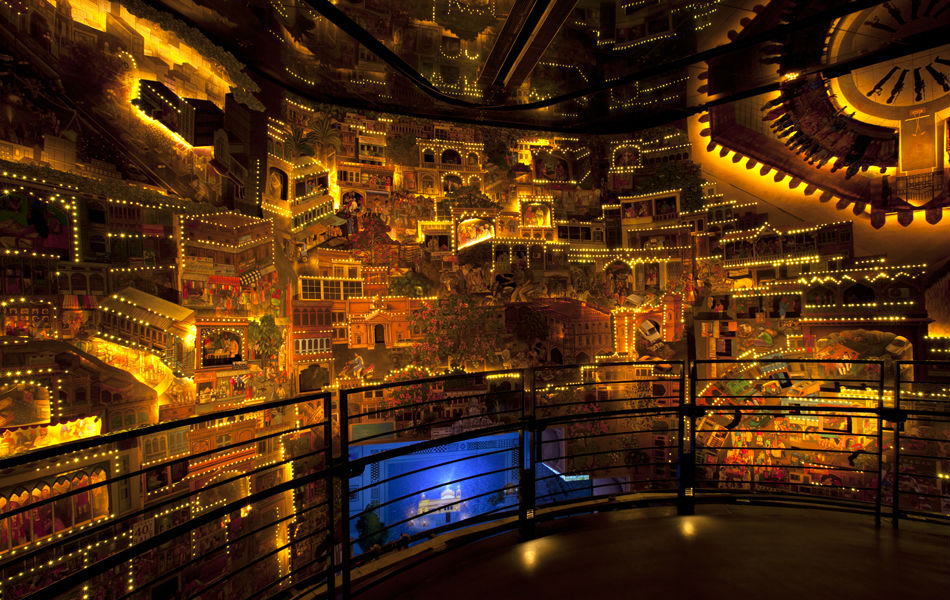
First gallery with a giant 360-mural and walkway winding through.
The giant 360-mural in the first gallery. Source.

The first gallery, for instance, features a giant hairpin walkway surrounded by an intricate 360-mural that depicts the history of the community and the religion. Visitors are led through the mural's stories with the help of an audio guide. Another gallery relies on symbolism to tell the story of the martyrdom Guru Arjun, who was roasted alive when he wouldn’t stop preaching. The gallery features an empty wok and stylized smoke, representing this story.

Although those from the Sikh community may be able to pick out the symbols and piece together the interpretive messages, it's true others may be a bit lost. To overcome this issue, the museum provides gallery attendants and audio guides for more information.

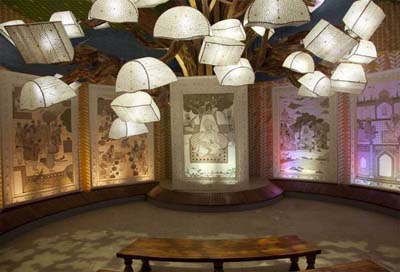
Gallery #5 with handing lights and murals.
Gallery 5 for Guru Nanak. Source. 

DOING MORE WITH LESS

Some of these notions have been thrown around before in museums. In Steven Conn’s book Do Museums Still Need Objects?, he discusses how museums are moving away from 'things' to programs. Museum are focussing on creating other experiences that are no longer object driven. Furthermore, many disciplines (art history aside) are no longer reliant on objects to tell their stories like they were in the past. Technology has also redefined how interpretation and curation can be done, diversifying the toolbox to engage the public and create meaning.

Missing and Murdered Women installation with hanging red dresses.
The missing and murdered women installation at the CMHR. Source: Jenny Ford

Although not strictly object-free, the Canadian Museum for Human Rights (CMHR) has very few artifacts on display and relies mostly on art, symbolism, and technology to engage and educate audiences. In its Canadian Journeys Gallery, alcoves rely on custom-made art to tell different human rights stories. One alcove uses red dresses hanging in a forest to represent the stories of Missing and Murdered Women. However, there is text to explain the symbolic displays.

The Albis: Sigmar Polke 1963-2010 at MoMA has no text. Source.

On the other side, art museums have long played with the decision of “to label or not to label”, especially as content seems to be increasingly politicized. In many of the Art Gallery of Ontario’s galleries, for instance, labels are absent from cases and walls in favour of cards with tombstone information that visitors can pick up if they so desire. The art is not obstructed by text but perhaps provides more opportunity for reflection and personal meaning-making.

However, what the Virasat-e-Khalsa Museum shows is that museums are still thinking inside the box, in many ways. Messages (even in science centres) are always delivered in an object-text pairing. But are there other unexplored ways we can do this? And are there dangers in letting go of this age-old formula?

Thanks to all the readers and the Musings team! Signing off from my final post.

9 February 2016

THE GREAT MUSEUM ESCAPE!

MUSEUM INNOVATIONS

BY: JENNY FORD

Tomorrow, I will be escaping through the tunnels of Casa Loma as a bootlegger. It will be my fourth escape game. I’ve been a Second World War spy, a pirate’s prisoner, and even a museum burglar. And, yes, I'm quite addicted.

Real life escape games emerged around 2012. The idea is you’re locked in a room (or series of rooms), solving puzzles with your friends as you try to escape. You take apart props, crack codes, and discover secret passages to get out of the room on time. Games have storylines—prison break, insane asylum, haunted house—that move forward as you progress through the game.

A jail cell escape game room.
A prison-themed escape room in Montreal. Source.

So, why is this in a museum blog? I’ve actually found many parallels between exhibition development and escape game development, especially when it comes to narrative experiences. I'd hazard they may not be so different, after all.

THE NARRATIVE MUSEUM

Over the last few years, museums have started to emphasize the role of narrative in exhibitions. As one blog outlines, narrativity plays a huge role in visitor learning, especially with information retention.

Humans are natural storytellers, and we love good dramas and good characters. Exhibitions that capitalize on these notions create emotional connections, which make the experience more engaging. Exhibitions are also easier to follow when they're designed after a storytelling arc.

People solving puzzles in a museum-themed escape room.
A museum-themed escape game in Shanghai. Source.
Museum narrative experiences also aim to create “flow”, as defined by Mihály Csíkszentmihályi. This is when someone is so engrossed in an experience, they forget about time and space. Much like when you’re totally absorbed in a movie and forget where you are or how much time has passed.

These are still concepts museums are perfecting and experimenting with, in some cases. And this is where the escape experience comes in.

THE ESCAPE NARRATIVE

I should preface all this by saying there are some terrible escape games out there… just like there are bad exhibitions. In fact, designing a good escape game is extremely difficult. A designer has to create nesting and escalating intellectual challenges that interlink, allowing players to both feel challenged and successful. All the while, an escape game is carrying on a storyline that reveals more and more information.

An escape game room that has been torn apart by participants.
This game has been destroyed by an escape team! Source.

Now, read those last two sentences and replace “escape game” with “exhibit” and “players” with “visitors”. Aren’t exhibits much the same, in this way? A good exhibit is not necessarily supposed to be “easy”—it should be intellectually stimulating, while feeling like you’ve made breakthroughs. Too basic or too complex and you lose people.

Good escape games also have the narrative concept down. They often follow story arcs, get people emotionally involved, and definitely get you into the “flow”, although you are always aware of the ticking clock so you escape in time!

A GOOD ESCAPE GAME

Adam Clare, a George Brown instructor, wrote the how-to book on escape games, outlining how they’re designed and what makes a good one. There are lots of exhibit connections to some of these fundamentals that museums can draw on:
  1. An enticing theme that’s carried through the whole experience
    This almost goes beyond the big idea to the essence of a theme and how that theme feels as it's carried through every element of the experience. It's often a question of good 3D design.
  2. A narrative that engages players, where solving puzzles advances the storyline
    While this is akin to a story arc, it perhaps makes us look at objects differently. Instead of each object being an illustration of the main story, they effectively move the story forward, sharing more events that enhance the narrative.
  3. Rewarding ending
    Escape games embody this concept in a rewarding ending puzzle. Can exhibits capture this idea too once visitor get to the end? A surprise information reveal or object?
  4. Have surprises
    There are always surprises in escape games—a secret room, a tunnel, lasers. Exhibitions don’t have to be predictable. Have surprises and moments that maybe not everyone will see, but when they do it’s incredibly rewarding.
  5. Consider group size and timing
    This is crucial for escape games. Too many players and people are standing around. Too few and they can’t solve the puzzles on time. But we only sometimes consider these notions in museum exhibitions. What’s the average group and how will that change how they interact with the space?
There are of course challenges with this model. In exhibitions, most visitors won’t view every objects, while in an escape game, you have to solve every puzzle to succeed. Yes, there are challenges, but there are also things to learn and concepts to test out. Puzzling indeed!

LET THE DEBATE BEGIN! SHARE YOUR THOUGHTS.

17 November 2015

THE INNOVATIVE FOOD MUSEUM

MUSEUM INNOVATIONS

BY: JENNY FORD

Food in museums has become all the rage. Just look at Fort York’s historic cooking classes or the ROM’s showcase of Italian food in honour of its Pompeii exhibition. But these are often one-off programs that are staff heavy and make lots of dirty dishes.

So, how do food museums do it? More so, how do food museums capture the intangible experience of enjoying and experiencing food in a museum world that doesn’t usually involve tasting the exhibits?

Willy Wonka saying "Try some more, the strawberries taste like strawberries! The snozberries taste like snozberries!"
Not quite sure we're at this point yet. Source.

Many food museums follow the traditional artifact and panel set-up that dominates non-food museums. Highlights at The SPAM Museum in St. Austin, Minn, for instance,  include a giant SPAM distribution map, and a SPAM game show quiz. Nothing too exciting or out of the ordinary.

FOOD REVOLUTION

So, what does food museum innovation look like? Enter the Museum of Food and Drink (MOFAD) in Brooklyn, which opened its doors after much fundraising in late October. The museum’s inaugural exhibition, Flavor: Making it or Faking it, has interactive smell exhibits with scent stations and pellet machines that allow you to taste food without creating a mess.

Smell exhibit on the left, pellet machine on the right at MOFAD. Source.

There are a few other innovative exhibit techniques food museums are trying out. Take the Ramen Museum in Yokohama, Japan. It features a replica of a 1958 Tokyo street, the year instant noodles were invented. Here, you can purchase different types of ramen from nine different stalls.

City street at the Ramen Museum in Japan.
The streets of the Ramen Musem. Source.

There’s also the Currywurst Museum in Berlin, celebrating the local snack of sausage topped with curry sauce. The museum includes smell stations, like MOFAD, an interactive currywurst making game, and an experimental kitchen. Each ticket also comes with a currywurst in a cup. Also, did I mention they have a giant sausage couch?

 German video advertising the Currywurst Museum in Berlin. Source.

INTEGRATING WHAT YOU EAT

But these nifty food experiences don’t have to be confined to specialized museums. As fellow Musings contributor, Leah Moncada, has shown over and over again in her column, Historic Kitchen, food is an integrated part of culture.

Should food exhibits, like the ones described, make more of an appearance in more 'mainstream' museums? Should food be in our collections and in our galleries? There’s also the amazing accessibility benefits of incorporating more smells and tastes.

CAN WE TASTE OUR WAY THROUGH OTHER MUSEUM EXHIBITS?

25 May 2015

VISIT A MUSEUM LIKE A MASTER

THE GRAD SCHOOL GUIDE

BY: JENNY FORD

I am probably the worst person to visit a museum with. I question everything and notice the smallest details. To be honest, I wouldn’t visit a museum any other way. Museum Studies has taught me to look at museums differently. It has taught me to appreciate the careful thought and balance that goes into an exhibition. But for those who can’t wait to get started, here’s how to visit a museum like a master's student.

Person walks by art installation made up of thousand of magazine pictures.
Exhibit at the National Gallery of Canada, Ottawa. Credit: Jenny Ford

THE HOOK

Panel text
The introductory panel to Brain. Credit: Jenny Ford
The first thing I notice in an exhibition are the words on the introductory panel. Does it capture my attention? Does it tell me what the exhibition is about? Sure you may have a lot of pretty objects, but I’m not going to learn anything if the text is poorly written.

Take this good example from the American Museum of Natural History's traveling exhibition Brain: The Inside Story. The introductory panel hooks you in and invokes all your senses. In the words of John Veverka, it provokes the visitor's interest, relates it to their lives, and reveals something new. On top of all this, it tells me what the exhibition is about.

CAREFUL OBSERVATION

People watching is also an important part of my museum experience. I take note of other people’s behaviours when they enter an exhibition, which way they turn, what objects they gravitate towards, and what text they end up reading (if any). Are visitors missing out on the most important object simply because of where it’s placed or how it’s presented? Sometimes, if I’m feeling bold, I eavesdrop on their conversations to see what's of interest to them, and if the exhibition's point is getting across.

Canadian Journeys Gallery at the Canadian Museum for Human Rights.
 Canadian Journeys Gallery at the Canadian Museum for Human Rights. Credit: Jenny Ford

WHO'S IN AND WHO'S OUT

Objects, places, people, and organisms have a thousand stories, but which one(s) is the museum telling? I always pay attention to who’s talking in an exhibition. Is it the curator? The artist? The people connected to the objects? I’ve definitely been to some one-sided museums, where the curator’s voice is loud and clear, but the people who used, for instance, are nowhere to be found.

I also look for the visitor’s voice in an exhibition. Is it a one-sided dialogue, or can the visitor contribute? Are they given time to reflect on diverse opinions or share their own? The picture below from the Parliament Interpretive Centre in Toronto is a lovely example of the multiplicity of voices in an exhibition.

Panel at the Parliament Interpretive Centre.
Panel at the Parliament Interpretive Centre. Credit: Jenny Ford

PUTTING THE WORLD ON DISPLAY

There are so many ways to showcase objects and stories. How this is done says a lot. I not only look where an object is displayed, but also what goes along with it. Accompanying labels, videos, and pictures can change how we view an object.

A taxidermy zebra in a glass case by itself is removed from its natural habitat. Does this give us an isolated sense of a zebra? But does placing it within a diorama, like the one below, give us an unrealistic and idealistic view of its natural world? You can now see why people love to hate visiting museums with me...

Diorama of African mamals at the American Museum of Natural History.
Diorama at the American Museum of Natural History. Credit: Jenny Ford

WHY AM I HERE AGAIN?

Finally, as I exit a museum or exhibition, I think back to what I’ve learned. Can I sum up the exhibition or was it just a blur of “stuff”? If it's the latter, we have a problem. It means the exhibition wasn’t successful in getting its message across, and something was lost in translation. A good exhibition should always leave you capable of answering the question “what was that all about”?

HAVE A TIP FOR VISITING A MUSEUM LIKE A PRO? SHARE IT IN THE COMMENTS!

31 March 2015

WHAT MAKES AN EXHIBITION GREAT?

EXHIBITION REVIEW

By Meaghan Dalby

I find it bittersweet that school is coming to a close. I thought long and hard about what I wanted to talk about in my final Musings post, and I realized I needed to talk about why I wanted to write for the Exhibition Review column. So let’s break down what, for me, makes an exhibition great.
How to get that "Meaghan Dalby Seal of Approval"
Source: Meaghan Dalby
INTERESTING TOPICS
I feel like many of us take this one for granted. Of course, we find the topic we’re working on exciting and special, especially when you work on it for 8 months straight, you tend to adopt that topic as your own. Who wouldn’t want to come to an exhibition on an obscure 18th century technique to get rid of mice from wheat fields?? THAT’S INTERESTING STUFF!

I think we can all agree that the topic is what will either draw visitors in, or repel them. So a great exhibit has a topic that is relevant, interesting, and thought provoking to their public.

GOOD DIDACTICS
An exhibition loses me if the text is too dry or too long. I want to get to the point, and quickly.
Give me some context, give me some quotes, and give me the most important facts so I can wow my friends later.

VISUALLY PLEASING
Let’s be honest here, design matters. If your colour scheme is neon green and orange you better have a really good reason. And, there’s nothing worse than an exhibition that tried to jam too many things in their cases because they couldn’t bear to cut some things out. Or perhaps there’s no way-finding directions and you’re not sure where you’re supposed to go. Find a good designer and never let them go.
I just... I don't .... ugh
Source: http://www.homeschooling-ideas.com/images/cabinet-of-curiosities-2.jpg

SOME HANDS-ON STUFF
This is so so so important for me. The best exhibit’s I have ever been to, all had some kind of interactive element for me to fool around with. I’m a firm believer in having a variety of learning channels available to your visitor. For some, reading isn’t the best way to learn. Maybe it’s building something, touching something, or listening to something. One of my most memorable museum experiences was listening to the difference between a happy swarm of bees and an angry swarm of bees at the Museum of Food and Agriculture .

Admit it, you want to know what the difference sounds like...
Source: Meaghan Dalby
A POWERFUL MOMENT
This one is harder to come by. It can depend a lot on your topic, and it 100% varies visitor to visitor. It’s that magic moment where a visitor experiences something new, or discovers something mind blowing. It’s the Stanley Cup for museum professionals; the whole reason we’re here is to try to make an impact. And every great exhibit creates one.

BUT ULTIMATELY...
As one of my exhibition teammates and I were sitting on my livingroom floor eating Smartfood, veggies, and sipping on wine asking ourselves “What makes a meaningful visitor experience?” and “How can we create interactives which extend learning?” I realized I was excited about answering these questions. As we kept shooting our own ideas down, and building them up to be better, it suddenly became clear that passion and dedication is what makes an exhibit great. The people who eat, sleep, and breathe exhibition design and interpretive planning are why the best exhibitions are the best. At the risk of sounding corny (ok, definitely sounding corny), I hope one day I will be one of those people.