Showing posts with label Interpretive Planning. Show all posts

5 April 2016

MUSEUMS WITHOUT OBJECTS OR WORDS

MUSEUM INNOVATIONS

BY: JENNY FORD

The title of this blog post seems rather impossible. If there’s not one there has to be the other, right? Without objects or text, doesn’t that just give us an empty museum?

The Virasat-e-Khalsa Museum
The Virasat-e-Khalsa Museum. Source. 

Two weeks ago, I had the pleasure of sitting in on a talk from George Jacob, currently the president of the Philip J. Currie Museum in Grand Prairie, Alta. In a former role, Jacob was the first director of Virasat-e-Khalsa, a religious museum in the state of Punjab in India, which opened in 2011. The museum traces 500 years of Sikh history. The massive complex has 14 galleries all without a single word or artefact.

NO TEXT, NO STUFF, NO PROBLEM


So, how does the museum get away with this? Jacob described how he and his team chose to concentrate on custom art and symbolism, audio guides, and on-site interpreters to help get the messages across to the public. This helped get around issues of multiple languages, varying dialects, and avoiding the museum becoming a potential religious shrine if it had objects.
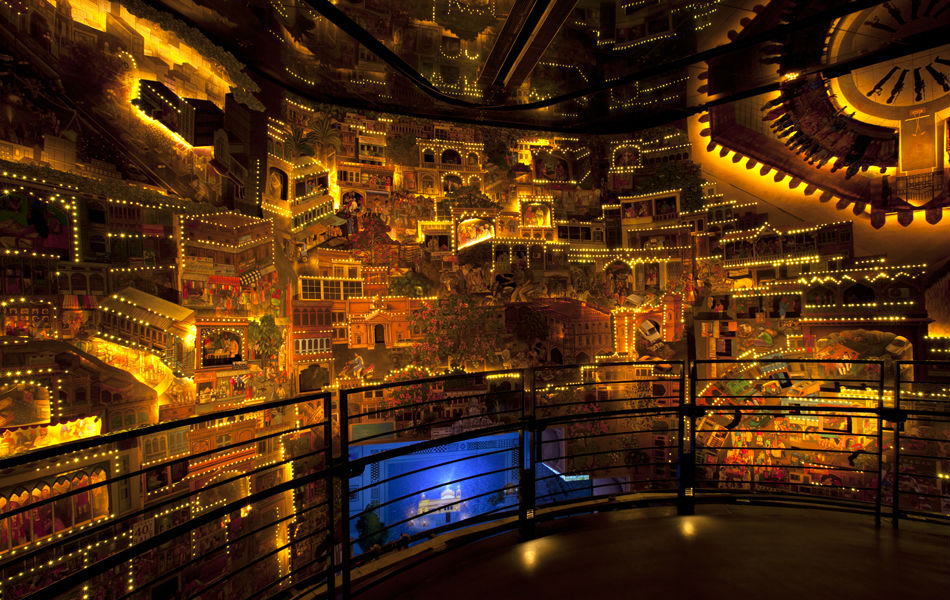
First gallery with a giant 360-mural and walkway winding through.
The giant 360-mural in the first gallery. Source.

The first gallery, for instance, features a giant hairpin walkway surrounded by an intricate 360-mural that depicts the history of the community and the religion. Visitors are led through the mural's stories with the help of an audio guide. Another gallery relies on symbolism to tell the story of the martyrdom Guru Arjun, who was roasted alive when he wouldn’t stop preaching. The gallery features an empty wok and stylized smoke, representing this story.

Although those from the Sikh community may be able to pick out the symbols and piece together the interpretive messages, it's true others may be a bit lost. To overcome this issue, the museum provides gallery attendants and audio guides for more information.
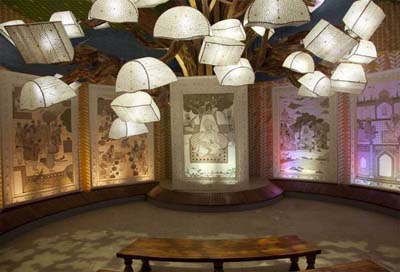
Gallery #5 with handing lights and murals.
Gallery 5 for Guru Nanak. Source. 

DOING MORE WITH LESS

Some of these notions have been thrown around before in museums. In Steven Conn’s book Do Museums Still Need Objects?, he discusses how museums are moving away from 'things' to programs. Museum are focussing on creating other experiences that are no longer object driven. Furthermore, many disciplines (art history aside) are no longer reliant on objects to tell their stories like they were in the past. Technology has also redefined how interpretation and curation can be done, diversifying the toolbox to engage the public and create meaning.

Missing and Murdered Women installation with hanging red dresses.
The missing and murdered women installation at the CMHR. Source: Jenny Ford

Although not strictly object-free, the Canadian Museum for Human Rights (CMHR) has very few artifacts on display and relies mostly on art, symbolism, and technology to engage and educate audiences. In its Canadian Journeys Gallery, alcoves rely on custom-made art to tell different human rights stories. One alcove uses red dresses hanging in a forest to represent the stories of Missing and Murdered Women. However, there is text to explain the symbolic displays.

The Albis: Sigmar Polke 1963-2010 at MoMA has no text. Source.

On the other side, art museums have long played with the decision of “to label or not to label”, especially as content seems to be increasingly politicized. In many of the Art Gallery of Ontario’s galleries, for instance, labels are absent from cases and walls in favour of cards with tombstone information that visitors can pick up if they so desire. The art is not obstructed by text but perhaps provides more opportunity for reflection and personal meaning-making.

However, what the Virasat-e-Khalsa Museum shows is that museums are still thinking inside the box, in many ways. Messages (even in science centres) are always delivered in an object-text pairing. But are there other unexplored ways we can do this? And are there dangers in letting go of this age-old formula?

Thanks to all the readers and the Musings team! Signing off from my final post.

28 November 2014

iSCHOOL EVENT YOU MAY HAVE MISSED: INTERPRETIVE PLANNING PANEL

BY: ANYA BAKER

Last Thursday, November 20, the Faculty of Information was host to a wonderful panel of speakers, presenting various approaches to interpretive planning, and a large crowd of museum professionals, academics, Museum Studies students, and other interested parties. It was a great evening. There were cookies the size of your hand.

The panel, organized by Professor Irina Mihalache and Andrea Ott, was called "Reflections on Contemporary Practices in Interpretive Planning"and included speakers Maria Piacente from Lord Cultural Resources, Judith Koke from the Art Gallery of Ontario, Katherine Molineux from Lord Cultural Resources, and Courtney Murfin from the Royal Ontario Museum. The event was moderated by Prof. Mihalache.

A group of women standing in a line in front of some classroom desks.
Prof. Irina Mihalache, Maria Piacente, Katherine Molineux, Courtney Murfin, and Judith Koke.
Photo credit: Anya Baker
Getting a peak at someone else's work process--how they work around challenges and constraints, and how they bring their most creative ideas in to a coherent plan--is always a thrill, and the speakers that evening had some really interesting case studies to share. From Piacente's work with the Heritage Center and State Museum of North Dakota in developing a thematic exhibit of the state's history, to Koke's work at the Art Gallery of Ontario, to Molineux's involvement with the Canadian Museum of Immigration at Pier 21, to Murfin's work developing the ROM's popular "Forbidden City" exhibit--these professionals had some great advice and opinions about the role of interpretive planning in the museum experience.

As the evening moved in to a question-and-answer period, the speakers were able to go into more detail about challenges in establishing intellectual pathways into exhibits that did not alienate too many audiences, tensions between museum departments, incorporating interpretive planning into smaller museums that have limited budgets and time, and the intersections between interpretive planning and other fields like museum education and visitor research.

I was able to speak to a few attendees about their thoughts on what was being presented about interpretive planning. One attendee was very interested in the tensions between different departments as interpretive planning becomes more prominent in museum environments; it certainly helped me to hear from both consultants and one-site staff about fitting into institutions unused to having a planner. It was also eye-opening to hear the speakers suggest interpretive planners can act as defacto project managers, given the depth of knowledge they have on the project and exhibit story as a whole, and the overlap the field has with so many other departments. I can see where tensions might develop as interpretive planning is making a space for itself in the museum, but it's also very exciting to see how far people are pushing the practice.

Karla Corrigan, from the Halton Region Museum was happy to have a chance to talk to people in the field and see what kind of interpretive plans were being developed and used; she thought it was nice to build resource sharing into the field, which I agree with completely. One of the speakers, Piacente, actually had a new resource available for sale: Manual of Museum Exhibitions, which she edited with Barry Lord. Corrigan also said that an event like this was a nice entry point for people interested in starting interpretive planning practices in their museums.

I had a hoot speaking to the ladies from the Lang Pioneer Village Museum: Julia Gregory, Audrey Caryi, Carol Hamilton, and Laurie Siblock. They said they had been instinctively implementing many of the practices suggested throughout the evening, but with an interesting twist. As a small museum dedicated to live historical interpretation, they changed the interpretive plan constantly. That is, according to season, time period represented, special events, theme weeks, and in keeping with any new information they developed through these interpretations or from research. They noted that as time passes, visitors get further and further away from the time period and practices represented in the museum; what would seem at least familiar to a visitor fifty years ago needs a much more in-depth interpretation for a visitor today. They see the need to interpret continuously, providing as many intellectual pathways into the exhibit as the day requires.

I'll be thinking about this panel for a while, and I'll surely be drawing on what I learned from the speakers and attendees in any future interpretive planning I do.


Note: Because they really were so good, I have to mention the cookies again; they were from Almond Butterfly Gluten-Free Bakery on Harbord Street, which is becoming the Museum Studies' favourite bakery. Coffee was from the Innis Cafe, which I feel most Museum Studies people already know about because it's right across the street from the Bissell building and everyone goes there for lunch.