Showing posts with label Games. Show all posts

21 October 2018

INDIGENOUS, INGENIOUS, iNDIGITAL

Weekend Edition | Samantha Summers


Now nineteen years old, the imagineNATIVE Festival is best known for its wide variety of Indigenous films from across the world, engaging with Indigenous artists both here on Turtle Island and abroad. However, films are not the only medium represented at imagineNATIVE. As I discovered in the iNdigital Space, this festival also provides a platform for Indigenous virtual reality (VR), game, and media artists beyond film and from around the world.


The iNdigital Space is a carefully curated and interactive exhibit which is free to visit, located on the ground floor of the TIFF Bell Lightbox at 350 King Street West, Toronto. The Space is headed by Meagan Byrne, the Digital + Interactive Coordinator for imagineNATIVE. A game designer by trade and founder of Achimostawinan Games, Byrne joined the imagineNATIVE team in April 2018 with a vision to expand the space allotted to game and digital artists at the festival. This year’s iNdigital Space, the first-ever, is a prototype of her vision: to see the best of VR, gaming, and interactive digital art by Indigenous artists from around the world brought together in one space. “Let’s keep supporting our new wave of Indigenous creators,” Byrne says. The best way to do that? By providing spaces dedicated to Indigenous creators and creations, and by making it clear that these creators are priorities at imagineNATIVE and within the Canadian media scene more broadly.


A visitor in the iNdigital Space playing Abenaki creator Ashlee Bird's One Small Step.
Photo courtesy of Samantha Summers.

Byrne’s commitment to the idea that screen-based media goes way beyond the box office is attested to with every piece in the iNdigital Space. Helpful and friendly volunteers pointed me toward experience after experience, each unique and profound. While the website Fafswagvogue.com (by Tanu Gago, a Samoan artist based in Aetearoa) had me coordinate and then judge a vogue battle, it also allowed me to engage with the artists represented (all real vogue dancers) and learn about their stories. ~2700 was designed by Métis artist Travis Mercredi as a tribute to the approximately 2700 missing and murdered Indigenous people in Canada. This experience had me walking through a large field, passing by 2700 white tombstones. It was a sombre and important reminder of a major human rights crisis. In Biidaaban: First Light, on the other hand, Anishinaabe artist Lisa Jackson allows visitors to experience a Toronto in which nature has reclaimed much of our modern infrastructure, and Indigenous languages - Wendat, Kanien’kehá:ka, and Anishinaabemowin - provide a path forward through reconciliation.


These are just a few among the many incredible experiences awaiting you at the iNdigital Space, an exhibit that is equal parts fun, thought-provoking, and awe-inspiring. These experiences can be capped off with a laser-cutting demonstration provided by the Maker Bean Cafe in the iNdigital Makerspace. See cookies and coasters laser-cut with the Festival logo and Festival pins 3D-printed before your very eyes, all free to visitors of the Space.


Aided by imagineNATIVE staff, a visitor to the iNdigital Space experiences Ngarluma artist Tyson Mowarin's VR simulation, Thalu: Dreamtime is Now. Photo courtesy of Samantha Summers.


When we sit down to talk, Byrne emphasizes the importance of spaces like this. Speaking as a Métis creator, she is familiar with the kind of pain, anger, and conflict Indigenous peoples across Turtle Island face, and she is familiar with the power of art to explore and confront those experiences. She speaks to the challenges of Indigenous creators, who she says are often forced to ask themselves, “Do I belong? Where do I belong?” Here in this incredible exhibition during this very special festival, Byrne creates a space in which Indigenous artists and their art not only belong, but thrive.


Sugar cookies are marked with the imagineNATIVE logo and slogan ("Original. Indigenous.") by representatives from the Maker Bean Cafe. Photo courtesy of Samantha Summers.


The imagineNATIVE Film + Media Arts Festival closes on Sunday, October 21.

The author would like to acknowledge and thank the staff, volunteers, and attendees of the iNdigital Space for their cooperation and for the use of their images. 

28 January 2016

"FRIVOLOUS" OLD BOARD GAMES, ANCIENT OR OTHERWISE

MUSEUM MYSTERIES

BY: CHRISTOPHER WAI

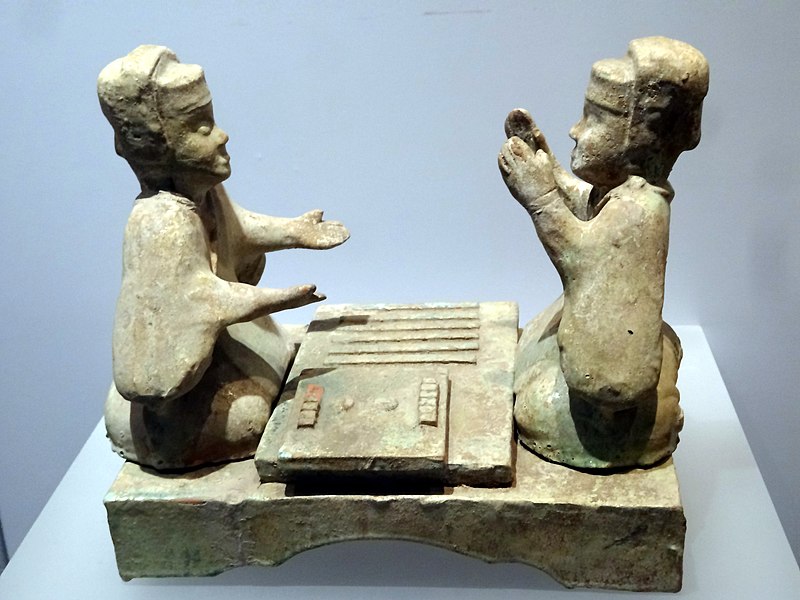
"Green-glazed pottery figurines representing Liubo players" unearthed in tomb at Lingbao, Henan Museum, China. Sources:  1 , 2
 "Hence some friends drink or dice together, [...] for wishing to live in their friends’ society, they pursue and take part with them in these occupations as best they can."  
-Aristotle, Nicomachaean Ethics. 9.12
“...Are there not gamesters and chess players? To be one of these would still be better than doing nothing at all.”
-The Analects of Confucius
If documentaries, movies and TV shows are anything to go by, every ancient or historical pastime must surely have been the most exciting spectacle of life, death and all the rest. But how about the more quiet day to day pastimes? Something like ancient board or table-top games perhaps?

It seems so mundane at one level, away from the grand spectacles of say, gladiator battles, ritual ball games, ceremonial feasts, chariot races, festivals, theatrics, dance or music. And yet, if you'll indulge me, it seems on some level so much more intimate. 

Imagine just a few players, probably friends, maybe some onlookers and a few conversations be they light, serious or raucous- little things that don't get recorded in great detail in monuments and texts. "It's the little things in life", as the saying goes. The game may even hold subtleties about the world they lived in, be they social, political or ritual.

"Wall-painting of game-players from a bar on the Via di Mercurio", Pompeii. Source
 Mural of Liubo players from an Eastern Han Tomb, Henan Province, China. Source
 

Of course, I don't want to read too much into it and make grand assumptions about daily life or cast it as the de-facto representation of daily pastimes for all classes, cultures, times or places. Some games may have held far more ritual and/ or symbolic meaning than that which we can imagine in our present day for example.

But there are surviving boards, game pieces and scenes depicted here and there, and the hints of the stories behind them.

Here are an idiosyncratic collection of games of from across the world. Individually, there isn't always much known, but collectively, it's a little more than I had anticipated when I started. I suppose that only shows how such games have had some presence in many cultures in one form or another.

Feel free to skim or look in detail, you'll no doubt find something of interest!
In China cultured men and women were expected to master the Four Arts – four cultural pursuits that took years to perfect: playing the qin (zither)...playing weiqi (a type of chess)...writing fine Chinese calligraphy... making, appreciating and critiquing classical Chinese painting.- British Museum
Silk painting of a woman playing weiqi (Go), from the Astana Graves, Tang Dynasty. Xinjiang Uighur Autonomous Region Museum . Source
"Polybius relates with regret what occurred at the capture of the city, and speaks of the indifference the soldiers showed for works of art, and the sacred offerings of the temples. He says, that he was present, and saw pictures thrown upon the ground, and soldiers playing at dice upon them." -Strabo, Geography. 8.6.
"Achilles and Ajax playing a board game. Attic black-figure amphora, ca. 500 BC", Staatliche Antikensammlugen Museum, Munich. Source
"Lay not my bones apart from thine, Achilles, but let them lie together, even as we were reared in your house, when Menoetius brought me, being yet a little lad, from Opoeis to your country, by reason of grievous man-slaying, on the day when I slew Amphidamus' son in my folly, though I willed it not, in wrath over the dice." - Homer, The Iliad 23.85

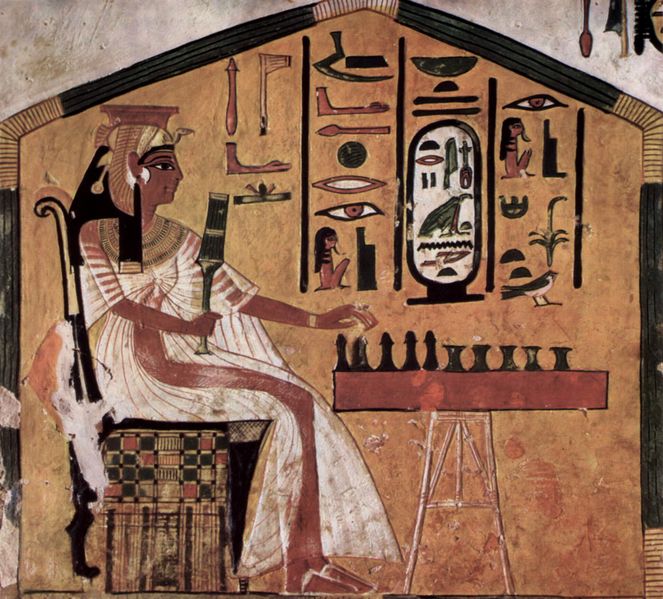
Painting of Queen Nerfertari playing a game of Senet from her Tomb, New Kingdom, Egypt Source. Additional: Facsimile
“Formulae for elevation and transfiguration, for going out from the necropolis, for being in the following of Osiris, and being content with the food of Wennefer, going out by day, taking any form desired to be taken, playing the board-game senet, being in the pavilion, a living soul, the Osiris N among the revered before the great Ennead which is in the west, after he moors. This is good for the one who does it on earth. The words come to pass, in completion. Words spoken by the Osiris N:” 
-Egyptian Book of the Dead, Chapter 17

Tutankhamun's "travelling" Senet set. Source: BBC
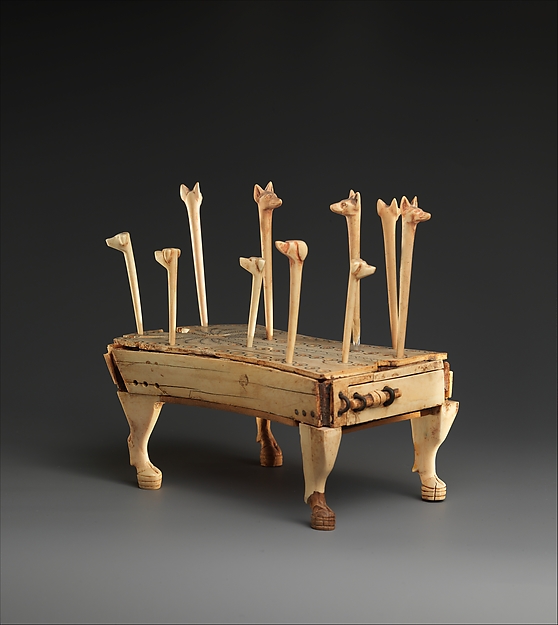
Hounds and Jackals game set, found by Howard Carter and Lord Carnarvon in 1910. Middle Kingdom, Egypt. Metropolitan Museum of Art
"Egyptians likened the intricate voyage through the underworld to a game. This made gaming boards and gaming pieces appropriate objects to deposit in tombs." 
- Metropolitan Museum of Art
Game board for playing Mehen (name of Egyptian Snake God), Early Dynastic Egypt. Game pieces were shaped like lions and marbles. British Museum.

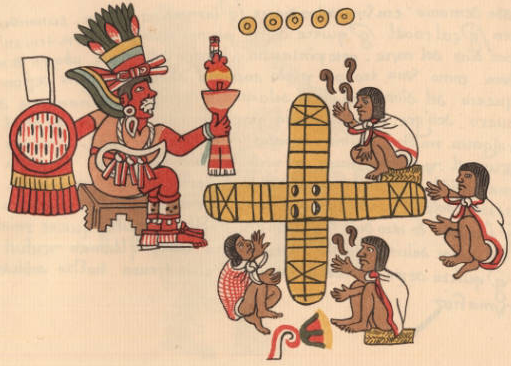
The Mesoamerican game of Patolli overseen by the god Macuilxochitl, Aztec Codex Magliabecchiano. Source
The Royal Game of Ur. 2500 BC-2400 BC. Royal Cemetery of Ur, Mesopotamia. British Museum.
"The board lay face upwards in the soil [...] when the presence of the object was recognized we worked along it a square or so at a time, pouring hot wax over it as we went, and finally the whole was secured with waxed cloth and lifted..." 
-Leonard Woolley on the discovery of the Royal Game of Ur

Board Game, Indus Valley Civilization (3500-1700 BCE). Source 
Maze and Dice, Indus Valley Civilization (3500-1700 BCE).Source

Conclusion

One of my grade school teachers, thinking that it was Ancient Egyptian, once tried to engage us with ancient history through a game called Alquerque using penciled in sheets of paper and a pile of black and white beans. I'm not sure how effective it was, but here I am still thinking about it.

These game boards and pieces seem to challenge anyone trying to learn more about them to actually engage with them by default.

One can hardly just stare at them and read about the rules or talk about them in a vacuum anymore than one can just hear of chess or poker as a novice and be an expert. We can certainly analyze the possible symbolism, source the raw material(s), the processes involved in their manufacture, and their distribution, but it is a game after all.  It's designed to be played and when it was played, there was a social element that was once there.

Left to right: Shogi, Go, Ban-Sugoroku games, Japan. ca. 1780. Source

More Info:

Digital versions of Aztec Pattoli: 

Article on Knucklebones:

http://archaeologicalmuseum.jhu.edu/the-collection/object-stories/archaeology-of-daily-life/childhood/knucklebones

Fantastic collection of images of depictions of the Chinese Liubo game in the English language: