
 |
| Illustration courtesy of Defne Inceoglu. |
Last time, we talked about language and need - using research done at the Royal Ontario Museum. For Part III of this series, we will explore other institutions who are using their natural history collections to teach about climate change.
The museum has also provided resources for visitors to their website on how they can make individual impacts. By giving their audience resources, the museum is really coming through for their visitors.
In addition to their new hall, their biodiversity permanent exhibition contains information for visitors on how biodiversity is in jeopardy.
III. University of Oslo: Natural History Museum
The University of Oslo's Natural History Museum is opening what they are calling a "Climate House" in their botanical garden section.
It's always good to learn by example. By researching other institutions that are doing work in climate education, we can select and learn new strategies for our own work. That being said, there are still lots of areas to improve in and grow. It is important to consider how the above three institutional strategies could be combined or adjusted - this tapestry of opportunity is still in the works. It's good to start keeping it in mind.
\\\
Check out the Coalition of Museums for Climate Justice, an active group that brings together museum professionals tackling the crisis.
\\\
Natural history museums stand as a legacy to the 18th and 19th centuries. Classifying and actively collecting specimens has carried through from the past two hundred years, imbuing many museums with large collections of animals. (I wrote about birds in a museum collection over the Summer of 2019 - find the article here). These specimens sit in collections or in displays across many institutions, which has always left me wondering about the role that these complicated objects play in the 21st century.
Some museums, like the Royal Ontario Museum (ROM), have re-purposed their collection to teach climate change. The Schad Gallery of Biodiversity groups animals into ecosystems and discusses human impact on the environment.
There is good intent with an idea such as this: show off the natural world in order to create interest and advocacy. If a person visits a museum and sees a polar bear, will they be inclined to do something to save them?
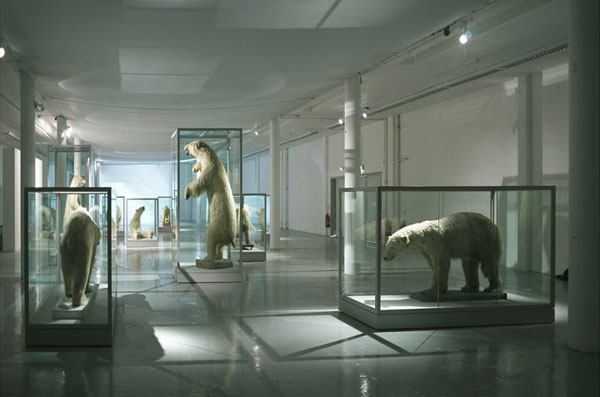 |
| Exhibition view from nanoq: flat out and bluesome. Artists Bryndís Snæbjörnsdóttir and Mark Wilson: (Source). |
Does the visitor here need something extra, like a didactic or interactive element which will tell them how the polar bear is at risk?
Or will they be able to make the connection on their own?
Is a visitor as affected by a small rodent at risk than they are at a whale skeleton?
How do visitors give meaning or value to the objects they are seeing, what is impactful and how do they take away information?
These questions are always spinning around in my head as I go through the effectiveness of using an animal specimen or taxidermy to teach visitors about climate change. I only have the ROM's example to go by, so I decided to take a look at other big natural history institutions to see how they are using their collections to tackle this area of education.
I will highlight three institutions that have created climate-focused exhibitions or resources for visitors, all just in the past couple years.
I. Natural History Museum at South Kensington (London, England)
 |
| This ADORABLE illustration is from the Natural History Museum's article on how to live sustainably: Source. |
The Museum has declared a planetary emergency, in recognition of humanity's failure to combat our destructive impact on the planet's survival systems.
The museum has also worked in climate advocacy into their strategic plan.Climate change, biodiversity loss, habitat destruction, pollution and deforestation are just some of the crises caused by unsustainable human activity. These add up to an emergency on a planetary scale.
Five strategic priorities will be at the core of the Museum's activities until 2031:
1. securing the future of the collection
2. transforming the study of natural history
3. developing the gardens and galleries
4. creating a resilient and sustainable organisation
5. engaging and involving the widest possible audience
II. American Museum of Natural History (New York City, USA)
The American Museum of Natural history re-imagined their Hall of Planet Earth in 2018. In an official press release, they write:
The American Museum of Natural History is re-opening its climate change exhibit in the David S. and Ruth L. Gottesman Hall of Planet Earth with comprehensive updates to a section about one of the most urgent scientific issues of our time. The new installation, which opens to the public on Saturday, July 7, is anchored by a dynamic media wall featuring large-scale imagery, animations, text and graphics, and interactive panels where visitors can engage with the evidence for climate change. Updates, which have been in planning and development since 2016, also include new content in the hall’s sections on past climates as well as on convection.
 |
| Exhibition view of "What Causes Climate Change" component of the new gallery. "The climate change section features a media wall comprised of 36 high-definition 55-inch screens with “big-picture” messages about climate change. Below them, content panels and interactive stations based on data from organizations including NASA and NOAA (the National Oceanic Atmospheric Administration) explore three main themes: How Climate Works, Our Warming World, and Consequences of Climate Change": (Source). |
In addition to their new hall, their biodiversity permanent exhibition contains information for visitors on how biodiversity is in jeopardy.
III. University of Oslo: Natural History Museum
The University of Oslo's Natural History Museum is opening what they are calling a "Climate House" in their botanical garden section.
The Climate House opens in the Botanical gardens in Oslo spring 2020. The Climate House will be a new and exciting arena for communicating research on climate and environmental issues. Children, teenagers and their whole families will be able to learn more about what climate change means, to get to know the several solutions that exist and to get inspired towards action. From early morning until late at night, the Climate House will showcase research-based exhibitions, lectures, films and debates.This approach caught my attention, as it is programming-focused rather than re-purposing their collection.
It's always good to learn by example. By researching other institutions that are doing work in climate education, we can select and learn new strategies for our own work. That being said, there are still lots of areas to improve in and grow. It is important to consider how the above three institutional strategies could be combined or adjusted - this tapestry of opportunity is still in the works. It's good to start keeping it in mind.
\\\
Check out the Coalition of Museums for Climate Justice, an active group that brings together museum professionals tackling the crisis.



