Showing posts with label military history. Show all posts

19 January 2017

HUZZAH! RE-ENACTMENT THROUGH THE AGES

THROWBACK THURSDAY

BY: SERENA YPELAAR

When visiting historic sites, I’m always trying to visualize what they might have looked like centuries ago, back when the surrounding area was devoid of parking lots, gift shops, and camera-toting tourists. Many of my fondest museum memories involve military demonstrations or costumed interpretation, which led me to wonder: when and how did re-enactment first begin? Read on to learn how historical re-enactments evolved from an early form of showmanship to an interpretive tool to animate historic sites.

Historic interpreters at the Fortress of Louisbourg in Cape Breton, Nova Scotia. Louisbourg highlights storytelling as an interpretive approach and immerses visitors in the 18th century French fort. Source.
Earliest Re-enactments

The origins of re-enactment date back to the Roman Empire, when re-enactment was a public spectacle involving the recreation of well-known battles. Just as contemporary gladiator films often depict hand-to-hand combat in a crowded amphitheatre, staged battles also served as public entertainment in Roman society. This tradition of dramatizing battles carried on into the medieval period, in which tournaments were fought with thematic elements from Ancient Rome. 

This lithograph by Edward Henry Corbould, titled The joust between the Lord of the Tournament and the Knight of the Red Rose, illustrates the Eglinton Tournament of  1839, a re-enactment of a medieval joust. Source.

Widespread Romanticism

By the 17th century, these historical displays had become popular in England, specifically as military re-enactments. Both during and after the English Civil War in the 1640s, re-enactments sought to demonstrate recent battles such as the battle at Blackheath in 1645.

Alongside the recreation of high profile military conflicts, the 19th century saw another shift as the Middle Ages were celebrated once more. In light of the Enlightenment and the Industrial Revolution, a fascination with the medieval era emerged and was perpetuated by shows that romanticized medieval jousts (not unlike the present-day dinner and tournament at Medieval Times). In this sense, nostalgia for centuries gone by informed a cultural phenomenon in Great Britain. But this longing for the glamour of the past did not completely eclipse the present, as the 1815 conclusion of the Napoleonic Wars inspired a public re-enactment of the Battle of Waterloo at Astley’s Amphitheatre in 1824. 

An illustration of Astley's Amphitheatre in London, published c. 1808-1810 and held by the British Library.  Source.

Celebrating Military Efforts

While re-enactment had become prevalent in the United Kingdom and the United States by the late 19th century, re-enactments now offered a way for military regiments to display specific, more recent conflicts, rather than reflect on the romanticism of past societies. In 1895, the Gloucester Engineer Volunteers re-enacted the famous British victory at Rorke’s Drift (1879).

American Civil War Re-enactment of the Battle of Chancellorsville in Spotsylvania County, Virginia. Source.
Not all regimental performances were sentimental or self-congratulatory, however. The U.S. 7th Cavalry Regiment re-enacted their defeat at the Battle of Little Bighorn within a year of its occurrence, meaning that the re-enactors were the actual survivors of the battle. In this case, the re-enactment was photographed, and its purpose was more educational than spectacular.

Education and Commemoration

After the American Civil War, veterans demonstrated famous battles to educate people on the conflicts and to pay tribute to their fellow soldiers who had been killed. This tradition developed into commemorative events whereby re-enacting groups continued to stage significant battles for an audience – the 50th anniversary of the Battle of Gettysburg in 1913 was attended by 50,000 veterans, both Union and Confederate.

Also in the early 20th century, re-enactments gained popularity in Russia, with demonstrations of conflicts such as the Siege of Sevastopol (1854 to 1855), re-enacted in 1906. Alongside educating audiences, the re-enactments were a means of forming national identity through military commemoration. They perform similar functions today, as re-enactment groups often partner with historic sites to commemorate military anniversaries. (I myself had the chance to attend the re-enactments of the Battle of Queenston Heights at Fort George in 2012, and the Battle of York at Fort York in 2013, both for the Bicentennial of the War of 1812.) 

Today, re-enactments commemorate significant historical battles, such as the Battle of Queenston Heights (1812) in Niagara, Ontario. (Photo courtesy of Serena Ypelaar)

Despite its origins as a form of visually impressive entertainment, re-enactment has transformed into a storytelling technique we recognize at historic sites and commemorative events today. I'm looking forward to seeing how re-enactment will continue to change in the future!

20 March 2015

WHEN FASHION KILLS: DISPLAYING MILITARY DRESS AFTER THE BATTLE

SEW WHAT?

BY: ANYA BAKER

Fashion is not just a means of personal expression. It is also a tool for guiding public thought and remembrance, and in the hands of the state can be a powerful means of building useful national narratives around highly traumatic events. Let us then briefly look at three instances where the use and display of military dress influenced the narratives of battles, even after the battles themselves had taken place.

1. Sir Isaac Brock's scarlet coat at the Battle of Queenston Heights, Canada

The towering Brock's Monument at Queenston Heights is a testament to early Canada's veneration of one of the great heroes of the War of 1812: Major General Sir Isaac Brock. His coat, with an intact bullet hole, is at the War Museum.
Colour photograph of a red military jacket, a rifle, and a hat.
Sir Isaac Brock's coat on display at the Canadian War Museum, Ottawa.
Photo credit: Lone Primate on flickr.
His death--he was shot in the chest by an American sharpshooter as he led a charge up Queenston Heights--was a terrible loss for the Canadian and British forces. But the figure of Brock, resplendent in his attention-getting scarlet coat and the various accoutrements of his officer's uniform, lived on as part of a Canadian narrative of heroic sacrifice and resistance to American invasion. It is understandable then, to display a relic of Brock's heroic final act at a national museum.

And yet, it is also an uncomfortable display. Brock did not decide his own uniform, and yet, he fought and died for that same uniform. The iconic red coats of the imperial British army, with scarlet reserved at this time for officers like Brock, was a means of branding, and of gaining a psychological advantage over the opposing force. It is a highly attractive uniform, fashionable both in its appearance and for what it stands for: alliance to the British Empire, heroism and resistance to invasion.

It is also hard to miss on a battlefield. The imposed uniform, the glorification of a resultant death, and the continued use of the remaining jacket to stand in for the same values of the imposed uniform create a fascinating cycle of narrative-building.

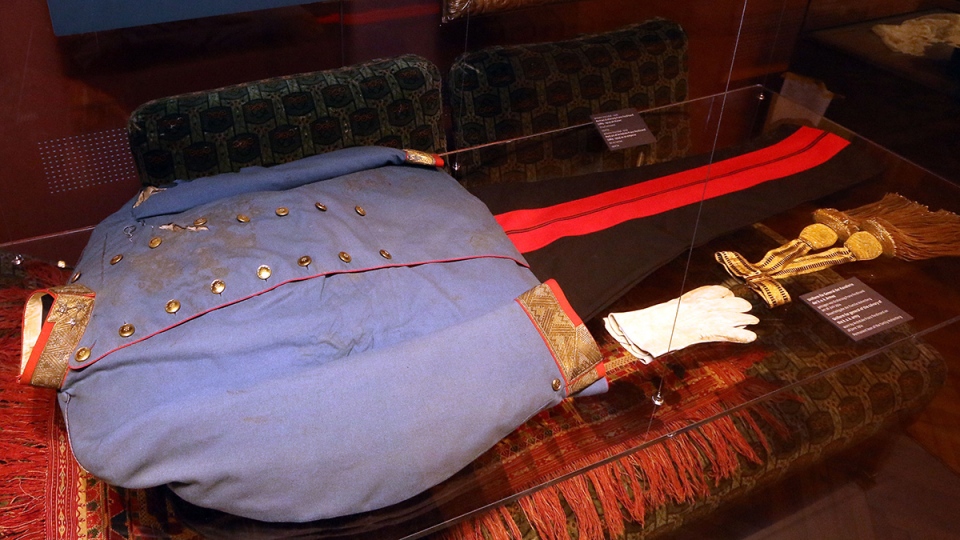
2. Archduke Franz Ferdinand's blue jacket at Sarajevo

Archduke Franz Ferdinand's jacket is displayed at the Museum of Military History, Vienna, for much the same reasons as Brock's jacket is on display at the War Museum. The blood stain spread across the chest of the jacket embodies the violent changes in world geopolitics resulting from Ferdinand's assassination; it bridges the 'before' and 'after' in our understanding of the start of WWI.

Colour photograph of a blue military uniform, with a stain on the chest.
Archduke Franz Ferdinand's jacket on display at the Museum of Military History, Vienna.
Photo credit: AP/Ronald Zak.
If the bullet hole in Brock's jacket is unsettling, then the prominent stains on Ferdinand's jacket are downright macabre.

Ferdinand was a victim of both human will and mysterious circumstance; an assassination attempt had been mangled throughout the day, and his eventual assassin, Gavrilo Princip, had, in fact, given up on killing the archduke. A series of bizarre coincidences later--a changed route for the archduke's car, Princip's decision to stop for a sandwich--and suddenly Ferdinand appeared right before his assassin, who took his opportunity to fire on the car. Interestingly, many sources offer a harsh aside, that it was Ferdinand's vanity that hastened his death, and subsequently, the onset of war.

You see, Ferdinand had reportedly been sewn in to his jacket, in order for it to look more streamlined. Unable to strip the archduke of his clothes in order to see the wound, those who tried to help him were apparently forced to waste time cutting the jacket off of him.

As with Brock, the jacket was not the cause of the man's death, but its display is tangled up in notions of narrative-building and representation; the (possibly untrue!) story of the coat has become caught up with the representation of the archduke, and by extension, the history of Europe.

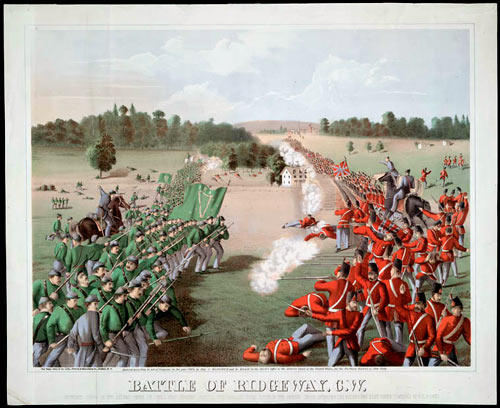
3. Red wool coats at the Battle of Ridgeway, Canada

In the fifty-odd years between 1812 and 1866, red coats did not disappear for anyone involved in the British army.  

Illustrated print, showing a battle, with soldiers in green on the left and soldiers in red on the right.
Fenians on the left in green, the 13th Battalion and the Queen's Own Rifles in red on the right.
Image credit: The Sage, Sons & Co. Lith. (Library and Archives Canada, Acc. No. 1946-35-1).

Unfortunately, the Battle of Ridgeway was in June. Sent out to battle without canteens for water, and wearing wool greatcoats on top of their red jackets, the soldiers were nearly overcome with heat. They eventually took to carrying the coats over their arms, before leaving them in piles when they neared a battle site.

It is not so much the wearing of wool in the summer or the wearing of the red coats that I want to focus on--obviously, as in 1812, the Canadians were highly visible on the battlefield--but the depiction of the two sides in highly publicized, highly inaccurate illustrations of the battle. The redcoats, in their usual bright splendour, face off against green-coated, Irish-American Fenians. In reality, the Fenians largely wore repurposed uniforms from the American Civil War, in greys and blues that easily blended in with the landscape. The display of such images build a narrative around the battle and the combatants, as if the Fenians engaged in using clothing to define their cause and character in a manner similar to the British. The display of the ubiquitous redcoats influences what is displayed around it--and thus the narrative grip of fashion can entirely muddle reality.

Sources Consulted: 

Barnes, Major R.M. 1972. A History of the Regiments & Uniforms of the British Army. London: Sphere Books Ltd.

Houze, Rebecca. 2015. Textiles, Fashion, and Design Reforms in Austria-Hungary Before the First World War: Principles of Dress. The Histories of Material Culture and Collecting, 1700-1950. Burlinton, V.T.: Ashgate Publishing Company. 

Marsh, James H. 2013. "Isaac Brock: Fallen Hero." The Canadian Encyclopedia. http://www.thecanadianencyclopedia.ca/en/article/isaac-brock-fallen-hero-feature/

Vronsky, Peter. 2012. Ridgeway: The American Fenian Invasion and the 1866 Battle that Made Canada: The History of Canada. Penguin Global.