30 June 2017

PORTRAYING MEMORY: SOUTHEAST ASIA

MUSINGS ABROAD

BY: KRISTEN MCLAUGHLIN

How do we deal with painful topics in museums? Is it the duty of a museum to memorialize atrocities? What do we validate? Who is the victor and who is the victim, and how do we make those choices to present these issues?

This is not just an issue in North America. We have our own dark histories on this continent to face and come to terms with, such as the residential school system, the Chinese head tax, Japanese internment camps, and more. However, in thinking about how we should tell these stories in Canada or the United States of America, I believe looking abroad can be helpful. Too often institutions turn in on themselves to try and figure out the best way to present a painful story without realizing that help with difficult topics or problems can be found with the aid of other institutions.

After all, it is sad to say, but dark and painful histories reside in almost all corners of this world.

Remembering

The concept of museums and remembering is an interesting and important topic. The idea of collective/national memory is not a real thing, and yet museums often simplify their stories to sound this way in order to get a point across, even with good intentions. "Collective" implies that that dominant narrative concerning memory is the only narrative, particularly with regard to traumatic times. It is a fine line that a museum must walk when displaying atrocities, taking particular care that stories that might not otherwise be told are brought to light. 

In Southeast Asia there are many museums dedicated to memory, contentious or not. With histories of colonialism, war, occupation, and genocide, there are a variety of museums that try to tackle these topics in different ways. I am looking at only 3 examples, but there are many more.


1. Phnom Penh, Cambodia: Tuol Sleng Genocide Museum and the Killing Fields of Choeung Ek

Having visited these sites myself, I can say that I've never experienced anything like what I did here. Tuol Sleng is a school-turned-prison during the Pol Pot and Khmer Rouge Regime in the 1970s. After Pol Pot was overthrown, some sites were kept in their state, which was often abysmal. Tuol Sleng, for example, has cells that had been built for prisoners and objects like torture tools are left in the rooms they were used in. There are photographs of all of the Cambodians still missing as you walk the space.

.Cells built in the old classrooms. Photo courtesy of Kristen McLaughlin

Tuol Sleng. Photo courtesy of Kristen McLaughlin

The Killing Fields at Choeung Ek are approximately a half an hour away from Tuol Sleng. It is a memorial that was built around the mass graves of thousands of Cambodians. There are informative signs and tributes throughout the park.

The Killing Fields Memorial and mass graves. Source.

These two are not quite museums but rather monuments of memory with information for visitors unfamiliar with the history. They stand to remind visitors and younger generations of the genocide and that it can never be forgotten or repeated. The subject matter is incredibly difficult and sometimes nearly impossible to imagine. However, the impact of the Khmer Rouge is still being felt throughout Cambodia and the country feels such reminders are necessary.

2. Tokyo, Japan: Women's Active Museum on War and Peace

This is a private museum focusing on the tense subject of comfort women. Comfort women, as they are euphemistically called, were girls and women captured by the Japanese army (in South Korea, Manchuria, and the Philippines, mainly) who were then forced into militarized sexual slavery in World War II. For many years, the Japanese government ignored these events and still argue against the facts. This lack of acknowledgement for years of abuse against women is intricately tied into the idea of nationalist pride in Japan and how the nation commemorates memory. For example, the Yasukuni Shrine--a museum-type shrine dedicated to the memory of Japanese veterans--is also the burial site of war criminals; Japanese leaders continue to visit the site, which has become a source of debate. They acknowledge the controversial figures as heroes and ignore more difficult topics.

WAM Museum in Tokyo, Japan. Source.

This museum is a strong statement against the government memory. The exhibits are stories told by survivors, many of whom have struggled their entire lives to get over the trauma. It is the only museum in Japan that collects, saves, and exhibits evidence and materials concerning comfort women. It holds special exhibitions once a year. It is also a socially active museum against sexual violence. This is an example of a museum that must take a political stand to get the point across and to make sure that certain events in history are not forgotten. After all, silencing and forgetting can be just as politically charged as remembering.

Recently, the Japanese government has agreed to pay surviving comfort women for their pain. However, this is not enough for the women and they want Japan to admit it committed crimes, which the government continues to refuse to do. Read more here.


Different women who suffered, during occupation and today.
Photo 1 source and photo 2 source.


3. Seoul, South Korea: Architecture, the Seoul Museum of History, and The National Museum

South Korea was officially occupied by Japan from 1910-1945. Although South Koreans were theoretically Japanese citizens, they were more frequently treated as a conquered nation. From the 1930s until 1945, a process of assimilation was implemented by Japan, forcing them to speak Japanese and attempting to erase many aspects of South Korean culture. This also led to much South Korean art and artifacts to be taken by Japan and subsequently placed into their museums. Today there is still a fight to regain ownership of these by South Korea.

So how does South Korea attempt to tell this story of colonialism through their museums?

Despite the horrors and repression under Japanese colonialism, South Korean museums do not focus heavily on this time period, focused more on obtaining their artifacts. Still, unlike Japan, the painful occupation period is noted in museums, such as in the Seoul Museum of History permanent exhibitions. Korea's National Museum has also held exhibitions on Japanese colonialism, such as "Collecting Asian Objects in Colonial Korea, 1910-1945" that ran in 2014. However, even then the museum director adamantly denied the exhibition was political.

Architecture

Buildings can also be places of memory, whether they are kept as reminders or demolished. The South Korean government demolished the Governor-General's Building in 1995, a building that was created under Japanese occupation. It was decided this demolition would create a new "national spirit and energy"; another way of looking at how countries choose to remember (or not remember) events. This also led to the creation of the new National Museum, which was at one point housed in the GGB.


 The GGB before it was demolished in 1996. Source.

Summary

Through the examples of Cambodia, Japan, and South Korea, we can see how museums, memorials, and buildings are used to remember (or not remember) past trauma. These examples are not meant to show a better or worse way of memorializing such histories, but rather, simply to demonstrate the different ways in which they are told. In some cases, the government is the big push behind remembering, such as in South Korea; in other cases, they are the very obstacle to overcome, such as in Japan.

It is nearly impossible to lump a nation and its people all into one mentality; where some people may want to remember, others may not. Where some want to be political, others may not. It is a fine line that museum professionals must walk when dealing with sensitive and painful issues and memories. What I find important to remember is that heritage institutions all over the world must deal with such issues and that museums should keep up international dialogue to better understand how to (or not to) exhibit such issues. 



28 June 2017

CELEBRATING CANADA, FROM SEA TO SHINING SEA

WHAT'S HAPPENING WEDNESDAYS

BY: KELLY MANIKOTH

Hello everyone and welcome to the special Canadian edition of What’s Happening Wednesdays! July is full of celebrations in honour of Canada’s 150th year of Confederation, and this article will take us from Southern Ontario to the West Coast, highlighting different ways Canadians are commemorating this important anniversary.

Many of our fellow classmates are completing internships across the country, and this month’s column will feature events in cities such as Hamilton, where Hannah Hadfield (Hamilton Civic Museums) and Aurora Cacioppo (Art Gallery of Hamilton) are completing internships, Fort Smith in the Northwest Territories, where Serena Ypelaar and Connor Kurtz are interning (Northern Life Museum), London, Ontario, where Meagan Fillmore and Jessica Baptista are interns (Museum London), the township of Woodstock, Ontario, where Sarah MacDonald is currently interning (Woodstock Art Gallery), Ottawa, where Charlotte Gagnier (Canadian Photography Institute) is completing an internship, and Vancouver, where Alexis Moline (Museum of Vancouver) is an intern!

1. Celebrate Heritage in Hamilton with the Parade of Sails!

The Parade of the Tall Ships! Source.
Celebrate Canada’s heritage by viewing The Tall Ship Parade of Sails in Hamilton. Eleven tall ships, which are traditionally rigged vessels, from Canada, the States, and Europe will make their way down Hamilton’s harbour on Friday afternoon, eventually docking at Pier 8. Some of the stars of the show will include the Pathfinder, a Canadian ship built in 1963 and the first ship built for Toronto Brigantine Inc., and Black Jack, a Scottish team tug from the turn of the twentieth century! There will be free deck tours, tickets for harbour cruises on Empire Sandy, food vendors and music on the Waterfront stage. The Canadian Warplane Heritage Museum’s Avro Lancaster will also conduct multiple fly-overs of the Waterfront on July 1! For more information, visit www.hamilton.ca

When: Friday, June 30: The Parade of Sail takes places from 2pm – 4pm, with music performances from 6pm – 10 pm
Saturday, July 1 – Aviation show takes place between 11:30am – 2:30 pm. Music performances on the Waterfront Stage take place from 6pm – 10 pm.

Where: Pier 8, 57 Discovery Drive, Hamilton, Ontario

Cost: Free! 

2. Northern Life Museum and Cultural Centre Canada Day Parade in the Northwest Territories 

The Radium King at its launch in 1937. Source.
The Northern Life Museum and Cultural Centre is taking part in Fort Smith’s Canada Day Parade with their very own float! The float is themed after the Radium King, a giant heritage ship that is preserved on the museum grounds. The Radium King is the last survivor of a fleet of 12 boats in the Radium Line. Created in 1937 by the Northern Transportation Company, it was one of the first diesel powered steel tugboats to tow barges on the Mackenzie River. The ship serves as a landmark for the town of Fort Smith and the museum is actively trying to preserve it. The Radium King float is one of the ways the Northern Life Museum is giving the preservation project exposure. The Fort Smith Canada Day parade also features music, local food vendors, and ends off with a fish fry! For more information on the Save Our King project, click here and for details on the parade, visit www.fortsmith.ca

When: Saturday, July 1st, Parade Marshalling at 11:00 am, Parade Starts at 11:30 am
Ceremony at Riverside Park - 12:30 pm
Water Park, Market and Music at Riverside Park - 1- 4 pm
Fish Fry at Riverside Park - 2 pm

Where: Riverside Park, Fort Smith, Northwest Territories

Cost: Free!

3. Museum London’s ‘Cottage Staycation’

Visitors explore the Witness Blanket exhibition at Museum London! Source.
If you were looking to escape the heat during Canada Day celebrations, Museum London has the perfect alternative to outdoor events. Explore their new exhibition Canada and London: 150 Years of Growing Together and play with an over-sized beach ball, lounge in Muskoka chairs, and listen to the 'sounds of Canada'. There will also be an art hunt where participants can earn maple sugar cookies and contribute to an interactive mural which invites visitors to share moments that capture London’s history! For more information, visit www.museumlondon.ca

Where: Museum London
421 Ridout Street North
London, Ontario

When: Saturday July 1st and Sunday, July 2nd, 11am – 5pm

Cost: Admission to the museum is through personal donation

4. The National Gallery – Our Masterpieces, Our Stories

Fireworks at the gallery. Source.
If you are lucky enough to be in the nation’s capital for Canada Day, visiting the National Gallery of Canada is a must! The Gallery is offering free admission and hosting plenty of fun, family-friendly activities throughout the day, such as scavenger hunts and arts & crafts stations. Their major exhibition, Our Masterpieces, Our Stories, features nearly 1,000 works of art that express the stories and legends which shaped our land. The highlight of the exhibition is the new Canadian and Indigenous Galleries, which was unveiled on June 15th, 2017. For more information, visit www.gallery.ca

Where: National Gallery of Canada
Scotiabank Great Hall
380 Sussex Drive
Ottawa, Ontario

When: Saturday, July 1, 2017, 9:30 am to 4:00 pm, Our Masterpieces, Our Stories runs from Thursday, June 15, 2017 to Monday, September 4, 2017

Cost: Free on Canada Day! Regular Admission: $15, $7 for students with valid student ID.

5. 2017 Visual Elements 59: Annual Juried Exhibition - Woodstock Art Gallery

Woodstock Art Gallery. Source.
The Woodstock Art Gallery’s Visual Elements 59: Annual Juried Exhibition celebrates the diversity and talent of the residents in Oxford County. In 1959, a group of Woodstock citizens organized a call for art which had an overwhelmingly popular response. The highly successful exhibition led to the formation of the Oxford County for Art Association, an organization that paved the way for the creation of the Woodstock Art Gallery. The Gallery carries on the tradition of an open call for art through an annual juried exhibition. This is the exhibition's 59th year, and the jury is made up of curator, Corinna Ghaznavi, and artists, Gary Evans and Michael Hunter.

When: Opening Reception: July 19, 2017,  5pm - 7pm
Exhibition Dates: July 15 — September 23, 2017

Where: Woodstock Art Gallery, 449 Dundas St, Woodstock, Ontario

Cost: Free!

6. Kensington Krawl Food Tour

Source.
If you’re in Toronto for the summer, celebrate the diverse and multicultural cuisine the city has to offer by attending the Kensington Krawl Food Tour. Learn about the history and heritage of one of Toronto’s most unique and eclectic neighbourhoods while sampling a variety of food and drinks. Attendees are also able to meet the local shopkeepers and chefs. For more information and to purchase tickets, visit savourtoronto.com

Where: Meeting place near Baldwin & Spadina (exact location given when registered)

When: Friday, July 14th and Saturday, July 15th, 2017, 11:30am – 3:00 pm

Cost: $65.00 + taxes which includes 8 food and drink tastings.

7. Honda’s Celebration of Light in Vancouver

Source.
Explore Canada's western coast and see the Vancouver for the 27th Annual Celebration of Lights, the largest international fireworks competition in the world! Taking place at the waterfront around English Bay and Burrard Inlet, a spectacular display of fireworks is launched up above the mountains and the Vancouver skyline. The evening begins with a free music festival at Sunset Beach, LG 104.3’s Shorefest, which features an entirely Canadian lineup. Countries participating in the competition are Japan, the United Kingdom, and Canada. For more information visit www.hondacelebrationoflight.com

Where: English Bay, Vancouver, Canada

When: Saturday, July 29, 2017 - Japan
Wednesday, August 2, 2017 - United Kingdom
Saturday, August 5, 2017 – Canada
The concert starts in the afternoon, and the fireworks begin at 10 pm on each day.

Cost: Free! You can also reserve VIP sections on the beach for $49.99 + tax. These areas range from all-ages bleacher stands to private cabanas that serve appetizers and drinks.

Whether you’re in a small community or reside in the city, Canada Day celebrations are bigger and better than ever. From commemorating the country’s Indigenous origins, to our Francophone heritage and our diverse and multicultural identity, I hope these events help you make the most of your Canada 150 experience! To see more events in cities near you, check out Passport 2017. Happy Canada Day, everyone!

Canadian Puppy Pride! Source.

26 June 2017

"THE PEOPLE'S OWN REMEDY FOR STRESS, LONELINESS, AND ALIENATION": THE MUSEUM AS THIRD PLACE?

RESEARCH COLUMN

BY: JENNIFER LEE

“If we valued fraternity as much as independence, and democracy as much as free enterprise, our zoning codes would not enforce the social isolation that plagues our modern neighbourhoods, but would require some form of public gathering place every block or two.” (Ray Oldenburg, The Great Good Place)

Think of the last museum you visited. Did everyone look comfortable, at ease? How quiet was it? Could you hear conversation? What about laughter? Did strangers strike up conversation with each other, or stick to their own groups? As financial and political pressures on the museum change, some museums are looking to become social ‘living rooms’ where visitors can meet and congregate. The phrase ‘third place’, taken from the vocabulary of urban planners and sociologists, is often thrown around in these discussions, conjuring up a picture of museums as shiny, Starbucks-like lounges full of happy millennials. Unsurprisingly, this is not a vision that everyone finds attractive. What do museums stand to gain – and lose – by pursuing the ideal of the third place? 

Millennials enjoy a relaxed third place. Laughter is an important element of social bonding. Source.

The sociologist Ray Oldenburg defined the concept of the third place (or third space) in his book The Great Good Place, published in 1989. The first place, he theorized, is home, where our personal lives play out; the second place is work or school, where we live our professional lives. The third place is neither: it’s the neutral 'watering holes' such as coffee shops, bars, barber shops, parks, and other spaces between work and home where we congregate. The most important features of the third space are that they are accessible spaces open to everyone, and that they allow for shared social experience and the breaking-down of social boundaries. They are convivial and free: a remedy "for stress, loneliness, and alienation"(40).

Robert Putnam’s Bowling Alone: The Collapse and Revival of American Community (published 2000) complements Oldenburg’s work, tracing Americans’ increasing disengagement from public life and community structures (such as political parties, charities, and parent-teacher organizations) throughout the late 20th century. Putnam found widespread decline in what he called ‘social capital’ – Americans’ personal social networks were smaller and their sense of mutual trust, respect, and altruism had eroded over time. He also warned, presciently, that “if participation in political deliberation declines – if fewer and fewer voices engage in democratic debate – our politics will become more shrill and less balanced” (342). Part of the problem, he theorized, was mass media: the more time we spend watching television, the less time we spend engaging with our communities. (Reading this book seventeen years later, I have to wonder what Putnam makes of that 21st-century institution, the Netflix binge.)

One way to combat the death of social capital, of course, is through the third place: if people are given neutral spaces to socialize and get to know each other, to work through their differences, it follows that trust and respect will increase, residents will feel they have a stake in their communities, and civic engagement will follow. This is the thinking that leads some museums like MOMA and the Worcester Art Museum to pursue third-place-ness, hoping to bolster a sense of community and engagement - and tempt some new visitors into the museum.

A blind-date 'conversation meal' between strangers at the Oxford Museum of Natural History. Source. 

But by Oldenburg’s criteria, many museums don’t qualify as third places: in the still, hushed atmosphere of the average art gallery or history museum, complete with security guards, visitors rarely feel like they can let down their guard enough to engage in the kind of convivial, free discussion Oldenburg describes. Although museum cafes and atriums might have a lighter atmosphere, high entry fees, program registration fees, and membership costs may also present a barrier to those who can’t afford to attend regularly. Unfortunately, the success of a third place depends on regulars who create a shared culture and welcome newcomers. Many people, for reasons of class, race, or social and educational background, simply don’t feel comfortable walking into a museum, let alone visiting one regularly as a social event. Creating a third-place atmosphere could mean rolling back entrance fees and relaxing or changing our expectations of visitor behaviour, altering the atmosphere of the museum.

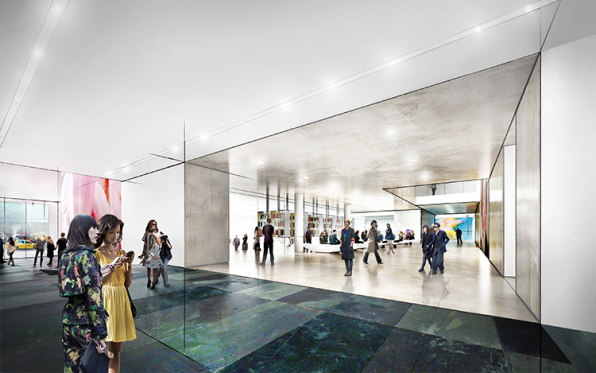
There’s also the problem of the art. When the Museum of Modern Art released their plans for an expansion in 2014, they were heavily criticized for the amount of room given to social and performance space, much of it accessible without paying an entrance fee. Vulture critic Jerry Saltz commented that the new space was designed “so people can look at other people looking at other people looking at people.” Surely the point of visiting a museum, the skeptics asked, was to look at the collections? In response, director Glenn Lowry defended the museum as a space of experience, reflection, and conversation. Creating a third place in the museum may contradict ideas (even among museum staff, and especially among visitors) of what a museum is and does: is it, as Saltz believes, primarily a space for people to look at art? Is it a community living room? Can it possibly be both?

Plan for the MOMA expansion by architectural firm Diller Scofidio + Renfro. Admittedly, there is a conspicuous lack of art in this art museum. Source. 

The truth, as usual, may lie somewhere in the middle. Museums certainly have a role to play in dialogue, engagement, and forming relationships – some particularly excellent programs rose in the wake of the U.S. election, like the National Civil Rights Museum's vow to engage in "difficult and uncomfortable" conversations with volunteers about prejudice and systemic inequality. As civic institutions, we can’t divorce ourselves from civic life and our communities. But we’re not Starbucks or a neighbourhood pub, and likely couldn’t be if we tried. As Nina Simon writes, “Museums are explicitly about something, and third places are about nothing in particular”. We may even do ourselves a disservice by competing with other public spaces as a watering hole rather than a repository of beauty and human knowledge (which is, after all, our great strength). Obviously, museums need to make themselves more accessible and encourage people outside of their traditional audience to visit – but in the interest of being a better museum rather than a third place.


Suggested Reading

Ferro, Shaunacy. “MOMA’s redesign won’t destroy the museum”. Co.Design. January 13, 2014. https://www.fastcodesign.com/3024679/momas-redesign-wont-destroy-the-museum

Freeman, Terri Lee. "Twentyseventeen." National Civil Rights Museum. http://www.civilrightsmuseum.org/news/posts/twentyseventeen

Oldenburg, Ray. 1991. ‘The Character of Third Places’. Reprinted in Common Ground? Readings and Reflections on Public Space, edited by Zachary P. Neal and Anthony M. Oren, 40-48. New York: Routledge.

The Project for Public Spaces. https://www.pps.org

Putnam, Robert. 2000. Bowling Alone: The Collapse and Revival of American Community. New York: Simon and Schuster.

Simon, Nina. 'The Great Good Place Book Discussion Part 1: Can Museums Be Third Places?' Museum 2.0. June 1, 2010. http://museumtwo.blogspot.ca/2010/06/great-good-place-book-discussion-part-1.html


23 June 2017

MMSt 2017 INTERNSHIPS: PART THREE

INTERNSHIP CHECK-IN

BY: TABITHA CHAN

Part three of Internship Check-In is here. Let's see what our peers are up to!

Today's post features:

Emilie Albert-Toth: The Bata Shoe Museum - Toronto, ON
Erin Canning: Art Gallery of Ontario - Toronto, ON
Samantha Eadie: Doris McCarthy Gallery, U of T Scarborough - Scarborough, ON
Anna Kawecka: Markham Museum - Markham, ON
Jenny Lee: Theatre Museum Canada - Toronto, ON

Describe what a typical day is like for you at your institution. What are some of your main duties and responsibilities?

Emilie: 
A typical day involves setting up for the tours booked for the day. Depending on the grade level, the program includes a craft activity, a hands-on workshop and a tour of our permanent gallery or First Nations gallery. The craft is introduced through a brief discussion of symbolism and identity; we use a painted clog from Holland to talk to the kids about these ideas. We then ask the kids what symbols they think represent Canada and themselves and have them paint a miniature wooden clog with the symbols they think best represent them. Then, we lead a hands-on workshop where the kids can touch and handle different kinds of shoes from our collection. The program wraps up with a 30-minute tour of either the permanent gallery or the First Nations gallery depending on the curriculum connection. Following the program, I might work the front desk for an hour or so and spend the afternoon being trained in the galleries, learning about the collection in more depth and practice giving tours. My main duties include delivering guided tours, facilitating interactive hands-on workshops, front desk and visitor services, encouraging visitor participation in family programs through children’s craft activities, preparing education and family program materials and resources.

Erin: Currently, I am involved in three projects to do with the expansion of the AGO’s collections information systems: the implementation of the Exhibitions module in TMS [The Museum System]; the addition of a large number of artists to the system; and linking artist Constituent records with Linked Data identifiers such as ULAN (Getty Union List of Artists) and VIAF (Virtual International Authority File) ID numbers. I spend most of my day at my computer, or in the Archives doing research for the Exhibitions project. I don’t really have a “typical day” in terms of how and when I do my work, but each day tends to involve a little research (online and/or in the Archives), data cleaning, running the scripts I have written on the cleaned data – and finessing a script if necessary – and working to write some new programming processes to automate the Linked Data project. The purpose of this is make feasible projects that involve digital data, and that are too large to approach manually.

Samantha: My internship focuses primarily on an archival project at the Doris McCarthy Gallery, specifically the organization of the Cold City fonds. The project is in its earliest stages so my main responsibilities are rehousing the archival material (which is comprised of fourteen boxes) in order to ensure proper storage standards are implemented. Once the material has been assessed and transferred to archivally approved folders, the material is logged in a database which documents all of the important details of the individual records. The database is intended to inform the creation of a finding aid which will assist researchers in the future.

Anna: In the past few weeks I've been working on developing my own exhibit here at the museum. I usually spend my days researching, designing, and editing everything I've been putting together. In terms of main duties and responsibilities, preparing for exhibition development meetings and getting this exhibit finished are top priorities at the moment.

Jenny:  I have a few projects going on at the moment, so a typical day can range from organizing a box of donated theatre programs for the education collection to writing up audience survey data. The museum itself is still under construction, so we do a lot of planning - a favourite project has been mapping through what visitors will think, feel, and do at every stage of the experience so we can anticipate their needs early on. I've also been helping out our affiliate, the Toronto Theatre Database, to get some programs online as they prepare for the Fringe Festival next month.

Say hello to Emilie and The Bata Shoe Museum!
What is something you have learned in your first few weeks of your internship?

Emilie: I’ve learned a lot about the Ontario school curriculum and the ways in which the museum’s educational programming can enhance children’s learning experience through alternative ways of learning including hands-on activities or simply through a change in setting or environment.

Erin: I have really seen in practice how supportive and enthusiastic the museum data community is, and how open people are to helping out their peers, even across institutions and country borders. In particular, for the Linked Data project, I was reaching out to people working in the field that I have never met at institutions across North America, and received nothing but support and offers of assistance.

Samantha: The most important lesson that I have learned in my first few weeks at the gallery is the importance of archival standards. In my first week I was able to spent some time researching archival standards and the archival description process. This early research has informed all of my work and helped me to construct an efficient structure for the logging of the material details. The amount of archival material that is included in these fonds is vast and I have developed a great appreciation for all archivists and the tedious work that they do.

Anna: My internship has been a whirlwind of opportunities! I've learned a ton of practical skills that I can apply to future projects. Trying my hand at the responsibilities of installation and conservation has shown me a few skills I never knew I had, and a few things I know I'll have to practice (curse you, scissor skills!).

Jenny: How grant-writing works! Most grant application websites are labyrinthine, and the information you need is invariably spread out over twelve different pages, so even the research is a bit of a process.

Erin taking a selfie at her work station.
What is something that has surprised you about museums that you did not know before working in a real one?

Emilie: The biggest surprise was finding out that The Bata Shoe Museum, despite being a mid-size institution, actually runs on a very small staff, only about one person per department. I was also surprised at the wide range of educational and public programming that comes out of such a seemingly niche institution, a shoe museum. It’s very impressive.

Erin: Is it bad to say nothing? Over the time of my undergrad, and in the years between the end of it and when I returned for my Masters, I worked in museums in a couple of different provinces, an artist-run centre, an auction house, a commercial gallery, and an artist estate… I feel like those experiences prepared me for what this internship experience would be like, at least in terms of the culture and behind-the-scenes practices of arts institutions and museums.

Samantha: I have worked at a number of museums of varying sizes and with very different scopes and mandates and I think that the thing that has struck me most is the diversity and dynamic nature of Canadian cultural institutions. Although there are particular standards that govern museum work in this country, every institution has a different approach to how they present and preserve their collection, how they engage with visitors and the wider community and how they conserve our history. I think that’s one of the things that makes this field so exciting to be a part of and it certainly makes the work more interesting.

Anna: The community is very close-knit. This goes both ways in terms of the museum and its local community, as well as the museological community. Everything (and everyone) seems so intertwined and although I knew that was true already, I didn't know it was to this extent!

Jenny: The optimum temperature for collections storage rooms is actually quite uncomfortably cold for humans. I think I knew this before, but now I am acutely aware of it.

Samantha hard at work at the Doris McCarthy Gallery
What do you enjoy most about your internship?

Emilie: I really enjoy being with the people I work with. We’re a small group of four students along with our two supervisors who are extremely devoted to providing us with a meaningful experience and teaching us skills that we can apply to our future career. I also really enjoy working with the kids. They’re so smart and funny.

Erin: Getting the opportunity to write implementable script to the systems, and watching it run and do what it is supposed to do! I love the satisfying feeling of seeing a large pile of data become part of a working system, and the kinds of new insights that the influx of information can bring.

Samantha: I really enjoy working independently and being able to directly oversee the progress of a project like this. I think that having the trust of my supervisor and the wider gallery staff is an incredible thing and it has certainly helped to instill a level of confidence in myself and in my work that would not be easily constructed by anything other than practical experience and positive feedback.

Anna: It's a close tie between all the amazing things I've been able to take part in (installations, archival research, conservation, etc.) and having such a great team to work with. I literally could not have chosen a better internship.

Jenny: I get to do a lot of research (through reading museum journals and just looking at other museums' websites and blogs to see what they do and if it works) which is just about my favourite thing to do.

Anna interning at the Markham Museum.
How has being in your specific institution changed or affirmed what you want to do in your future career?

Emilie: I definitely went into the whole internship experience not knowing exactly what I wanted to be doing but I’ve always been really interested in the museum’s role as an educational institution and one that is engaged in society and its community, so I think the internship in the education department has been a really excellent fit and a career path that I will likely pursue. Based on the size of the Bata Shoe Museum and the familiarity that comes with a smaller staff, I definitely would want to work at a small institution. I wasn’t sure what exactly to expect from an education department at a museum, let alone a shoe museum, but leading up to the start of my internship, my supervisors outlined their program and explained how they developed their programs to connect directly to the school curriculum in their own unique way.

Erin: This internship experience has really highlighted for me, how few tools currently exist to support this bigger-picture version of museum data work, especially for people who are less technologically inclined. In order to make this kind of work feasible for institutions, we need to both hire people with the skills, and develop products that are accessible for those without the skills and educational background. There is a lot that the perspective of museum professionals can bring to these discussions, which is getting left out if we do not support the industry as a whole, as opposed to only select individuals working within it. I would be interested in continuing to do this kind of work, and then leveraging that experience to support software development in this area, so that museum informatics companies can support the wide breadth of information work that is occurring in the industry, beyond the day-to-day cataloguing and constituent-management needs.

Samantha: I think that this position has helped to confirm that my career path is in collections management. I enjoy working with the physical material and analyzing it for important details and it’s so incredible to see how all of the bits and pieces of the fonds fit together in order to construct a wider narrative. Additionally, interning at a contemporary art gallery for a second summer has also confirmed my desire to work within an institution dedicated to the arts as I think that they are important spaces for dialogue and engagement.

Anna: I can definitely see myself working in a curatorial role more than ever. It's something that has been on my radar since I started the program, but now that I've gotten some first-hand experience, I'd love to continue down the same path. I've also come to appreciate the environment of a smaller institution. I really like the ways they interact with their community/audience.

Jenny: It's opened me up to aspects of education, programming, and visitor services, which wasn't something I had given a lot of thought to previously.

Jenny with a mini theatre at Theatre Museum Canada!
What’s your passion?

Emilie: I would say my passion is working with the community to increase the accessibility of art and public programs and I’ve found that working with children in the education department is a very mutually fulfilling way of doing that.

Erin: My passion is data of all kinds about visual arts institutions – collections data, visitor experience data, and (what interests me most) the intersection between the two, i.e. affective metadata. I love to find the patterns and potential cause-effect relationships that can be gleaned from large amounts of information, that are otherwise hidden from the ground-level view. If you have not yet had me chatter at you about affective metadata, trust me when I say you will, as I will (hopefully) be spending the next year writing my thesis on the subject.

Samantha: What I find most interesting about museum work and, therefore, what I am most passionate about, are the stories that are contained within all cultural material. There is so much that can be learned through the study and documentation of objects and being able to share that with museum audiences and the wider community is an incredible thing. I’m looking forward to working more with collections in order to discover our country’s diverse narratives.

Anna: Oh man, that's a heavy question. I think I can safely say that I have a real passion in artefact conservation. I helped restore a cast iron stove for one of the newly unveiled exhibits and it has definitely been one of the highlights of this internship. There's a certain feeling of pride attached to making an artefact live up to its potential.

Jenny: I have a bee in my proverbial bonnet about accessibility in museums - from physical accessibility to programming for visitors with disabilities.

Thank you Emilie, Erin, Samantha, Anna and Jenny for sharing honestly about your experiences and taking the time to participate in this interview. See you in two weeks for Part Four!