Showing posts with label accessibility. Show all posts

9 November 2021

LANGUAGE ACCESSIBILITY, COMMUNITY ENGAGEMENT, AND INCLUSION


 Colour the CanvasJingshu Helen Yao


During the winter of 2020, I worked as a volunteer at Agincourt Community Services Association for their project Recipe for (Climate) Change. The project used video recordings to document senior community members’ knowledge of cooking, food preservation, and gardening, as well as its connection to their personal history. Youth participants then utilized the material to create a series of cooking lessons and a cookbook. 


Most of the senior participants were immigrants with minimum English and I was brought in to be a Chinese translator. While there were second generation Chinese speakers among the youth participants, they either didn’t have or were not comfortable enough using the language abilities required to transcribe full meetings and recipes. During my time spent working with the participants, I realized the challenges of documenting storytelling and oral history in the face of the language barriers, technical difficulties, and the social isolation of COVID 19.

Translation sample for a workshop survey. Courtesy of the author.

I had a background in translation studies as an undergraduate student, but I had only been trained to translate written text in an academic context. Translating unscripted speech was challenging and I often encountered unfamiliar vocabularies when cooking ingredients and techniques were involved. The language barrier was intensified by technical difficulties. It was already difficult to communicate with seniors through zoom call; the process became more challenging when we had to instruct them to turn on cameras, set up their phone or laptop at a correct angle, and start recording. It would have been much easier if we were able to communicate with them face to face, help them set up recordings, and give them direct assistance. However, none of these could have happened due to COVID-19 safety concerns. 


Facing these difficulties, I had to use an extra amount of time to email back and forth with staff members and make multiple phone calls with senior participants. Still, I wasn’t satisfied with my work. Sometimes I failed to translate phrases and sentences during workshops or video calls, which took more time to communicate again later on. The deadline was pushed back once and once again due to these delays. However, the senior participants still expressed their gratitude despite the frustrating communication situation. They mentioned that they often felt isolated and lonely during the pandemic and were grateful to be able to participate in the project. 

Example of a transcription for a cooking video. Courtesy of the author. 


A year ago, I joined the MMSt program without knowing much about the demographic of museum workers. The summer before my admission, the iSchool conducted research on the diversity and inclusion of the faculty. The working group formed by 3 students identified various issues. The adjustments to the curriculum were made and, in many of my first-year courses, the topic of diversity, inclusion, and decolonization in the culture sector was the centre of discussion. 


Compared with the previous cohort, I wasn’t feeling as isolated, but I was still overwhelmed initially. Getting to know the statistics of underrepresentation of the BIPOC community and white dominance in art and culture-related careers was a setback. I almost lost hope in being employed at museums as an international student because a lot of institutions specified that the jobs are funded by YCW or Canada Summer Jobs. I also felt confused when we discussed “the lack of representation in the GLAM sector” and “how to diversify the museum field” in class. These conversations made me feel invisible at times and misplaced at others. I wasn’t sure how to approach these topics as a racialized person since it seemed like a conversation about us, not with us. 


When I thought of diversity and inclusion before, it occurred to me more as recognition and representation, more on a psychological level than a physical level. Working with these senior participants made me realize that language was the key point for their engagement and in this case, the risk of exclusion wasn’t on an emotional but a physical level. 


We always discussed engaging the community, sharing their voice, and making them feel included. However, in reality, how could we approach them if we don’t even speak their language, how could we share their voice if their voice is not accessible to the rest of the community, and what is “inclusion” when only the space is shared but not knowledge and thoughts? Through the time I volunteered as a translator, the participants tended to approach me with any questions, including information about compensation and confidential agreement that I wasn’t capable of answering. Even when the staff members sent out translated information through email, they tend to approach me for confirmation. The simple fact of a familiar tongue made me seem more approachable, thus granting me authority and trust. 


It was with this new understanding that I joined Museum Professionals of Colour, students aimed at addressing the lack of racial diversity and representation within the MMSt program and GLAM sector at large. I’ve long followed their activities and was tempted to reach out several times during my first year. I was held back by my fear of not having an understanding of my role as a racialized museum professional as well as what changes I could possibly bring with my effort. The experience working as a translator didn’t fully address my doubts, but it allowed me to realize that diversity and inclusion is not a conversation about big ideas – but, rather, small tasks that could be exhausting and troublesome. That’s why it requires effort from as many individuals as possible, and I need to be one of them. 


10 February 2021

SMELL IN MUSEUMS AROUND THE WORLD

 Musings Abroad | Jingshu Helen Yao


With a new semester starting, I began several new courses. For Dr. Hooley McLaughlin’s Curating Science course, we were asked to keep a smell journal, a daily recording of odours and fragrances around us. While the idea of documenting scent is rather interesting, the assignment also made me realize that olfaction — sense of smell — might be underrated among all of our sensory organs. In school, we were often taught that human olfaction is inferior to many animals due to evolutionary reasons. Compared with vision, hearing, and touch, our ability to smell seems to be less salient. Though I imagine the loss of smell could bring potential problems to our daily lives, those problems seem less severe than the loss of sight or hearing. However, during my research for the smell journal, I came across many recent studies that suggested human olfaction is much more powerful than previously thought and in some cases even compatible with that of dogs. This discovery made me interested in how smells and our abilities to smell are presented in the museums, from both scientific and nonscientific angles. 


   Visitors sniffing scent sample at museum | Getty Image


The most recent news about "smell museums" is surrounding the creation of Odeuropa. The project aims to research smell in the context of both human biology and computer science. In November 2020, Odeuropa received a $3.4 million grant from European Union as a part of the Horizon 2020 Programme. The project will make use of AI to research the documentation of smell between the 16th and 20th century. Their mission is to create an online museum of smell and preserve the olfactory heritage of Europe. 


    Odeuropa Historical Smell Project | Yahoo News

In Search of Lost Scents” is an exhibition at the Stedelijk Museum Amsterdam in the Netherlands. It is the PhD project of Caro Verbeek, whose primary interest is to study the use of smell as a medium of art, especially among futurists and surrealists. The exhibition features smell in historical arts, which were distributed to visitors by facilitators on strips of test paper. A scentman, the artist who uses smell as the method of artistic expression, also performed on site. It was an eye-opening experience for the visitors and an interesting application of Verbeek’s study. 


    Stedelijk Museum Amsterdam | Getty Image

Other than treating smell as an object, it can also be used as a tool to create a more accessible museum space. In “Seeing by Smelling,” Caro Verbeek explains the ways in which smell, touch, and storytelling could facilitate the interpretation of visual art for low sighted people. For example, the smell of myrrh was added to the exhibition of the 'Adoration of the Magi' painting. Myrrh is not only an element presented in the painting, offered to Jesus by the three kings, it was also burnt in ritual to honor kings and gods. Adding the smell to the storytelling allows visually impaired participants to establish a connection to the artwork. Even for visitors who have no visual accessibility needs, the element of smell created a multi-sensory experience. Verbeek quoted neuro-scientist Richard Stevenson who says “scents are known to elicit intense historical sensations... even more so than images or sounds.”

5 March 2019

TOUCHABLE PAINTINGS: MAKING ART ACCESSIBLE TO ALL


Collections Corner | Carly Hall


Art is, obviously, a visual experience. Unfortunately, this excludes persons who are blind or visually-impaired from engaging with many of our art collections. Museums and art galleries have taken steps to be more accessible and inclusive by including audio aids for visitors and special access to their collection, inviting those who are blind or with poor vision to touch objects and sculptures. However, experiencing a painting is a completely different issue. One may be able to feel textures created by brush strokes or read/listen to a description of the piece, but “seeing” the work through touch is largely impossible.

I came across the Unseen Art Project for the first time on social media. According to the first article I read, Unseen Art sought to create tactile copies of famous artwork using 3-D printing. Spear headed by Marc Dillion, this project would open multiple doors for increased accessibility of art collections for the public. Particularly, the project targeted those who are blind and visually-impaired, a community which inspired Dillion to embark on this venture. Dillon’s ambition was that 3-D artists could upload famous works to a software platform which will be accessible to anyone wishing to download and print a 3-D version. Oh, and did I mention that the software and downloadable model would be free?

This assumes that individuals have access to a 3-D printer, which can be expensive. However, institutions could take full advantage of this software and create exhibitions of tactile paintings. Certainly, these exhibitions would appeal to everyone, especially those of us who long to reach out and touch things on display. In a 2016 interview with TechCrunch, Dillon stressed that these 3-D paintings could not include every single detail from the 2-D work: “there needs to be some depth of touch, and there needs to be some limitation to detail – a perspective on the art, or an impression of the art, for people to really understand it. If you took any typical painting…and you made the whole thing – every bit of detail in there – then people aren’t really going to get a lot out of it.” The first painting Unseen Art intended to make downloadable is Da Vinci’s Mona Lisa. Here is how Da Vinci’s most famous work would look in 3-D.

Source.
Source.
The wrench in this whole project is that Unseen Art has seemed to have lost traction. After briefly researching the company, I discovered the crowdfunding campaign on Indiegogo is now closed (without meeting it’s flexible goal of $30,000.00), and the website domain has either expired (http://www.unseen-art.org), or doesn’t seem to exist at all (http://unseenart.org).

Perhaps I'm just late to the Unseen Art party. I'd like to think that the company joined another organization devoted to creating accessible museum and gallery experiences. Despite the possible end to Unseen Art, some institutions like the Museum of Madrid, have already begun temporarily displaying touchable replicas of famous artworks, using 3-D printing techniques to create a raised relief effect.

Goya, The Parasol. Source.
I hope Unseen Art will be able to continue their mission of accessibility to artwork, and that more institutions will incorporate these touchable paintings into their permanent collections. Personally, I like Dillon's vision for touchable paintings better, as it provides a truly 3-D experience/interpretation of a painting. I also agree with Dillon: works of art should be accessible to anyone. Clearly, establishing touchable paintings in our permanent collections is just one way institutions can create and enhance the experience of all museum and gallery visitors. 

4 June 2018

EXHIBITING BANKSY: ACCESSIBLE ART OR VIOLATION OF ARTISTIC INTENT?

MUSE NEWS

BY: AMY INTRATOR

This past month, Toronto received some exciting exhibit news: a major exhibition of Banksy’s work will open in Toronto in June. The exhibit will feature over 80 original works, which will make it “the largest Banksy exhibit ever assembled." The catch? The show is unauthorized, and the curator, Steve Lazarides, has openly discussed the fact that Banksy wouldn’t approve of the exhibit.

In this edition of Muse News, I’ll be exploring The Art of Banksy, an exhibit that provides access to a large body of artwork at the cost of overriding the will of the artist.


The Art of Banksy

The massive exhibit, The Art of Banksy, will open in Toronto on June 13th and run until July 11th. Instead of a gallery or traditional museum space, the exhibit will be held in an empty warehouse. The warehouse aesthetic seems like a perfect fit for the artwork of Banksy, as the artist is known for their graffiti artwork, often on the exteriors of derelict buildings in cities across the world.

The show’s impressive display of artwork may give the exhibit an air of authenticity, after all, how could such a large collection be displayed without the involvement of the artist? The impressive display, in actuality, comes down to the show’s curator, Steve Lazarides, who managed to involve over 40 private art collectors to mount this one-of-a-kind show. Lazarides’ storied connection to Banksy made this exhibit possible, but also problematic.


Balloon Girl (pictured above) is one of the works that will be featured in the upcoming exhibit. Source.


Lazarides and Banksy

Steve Lazarides is the owner of a gallery in London, but he is most famously known as Banksy’s former manager. Between 1997 and 2009, Lazarides worked for Banksy in multiple capacities including manager, dealer, spokesperson and gallerist.

The personal connection between Lazarides and Banksy may have ended in 2009, but today, Banksy still plays a central role in Lazarides’ career in the art world. In addition to exhibiting unauthorized shows of Banksy’s works (this exhibit is by no means the first), in December 2016, Lazarides opened the Banksy Print Gallery in London. While Lazarides emphasizes his “historical link to the artist,” Banksy himself has been silent about the upcoming exhibit. The only hint that Banksy denounces Lazarides’ continued efforts is a small-print message on the official Banksy website stating, “Banksy is NOT on Facebook, Twitter or represented by Steve Lazarides or any other commercial gallery.” This message may just be a typical disclaimer, but the fact Lazarides is mentioned by name seems like a direct jab at the gallery-owner who continues to profit off Banksy’s work.


Exhibiting Banksy

The problematic relationship between Lazarides and Banksy is further complicated by the politics of exhibiting a graffiti artist. If you’re like me, you might assume that it is counterintuitive to exhibit an artist primarily known for creating street art. I am most familiar with the Banksy works painted on the sides of buildings, not contained within gallery walls. Banksy’s works are extremely political, commenting on everything from global warming, to poverty. The work becomes even more political as a piece of graffiti, on display for anyone passing by.

Exhibiting Banksy behind closed doors may seem like a violation of his artistic intention, but the artist himself has created many exhibits over the years. Most of the works in this show were exhibited and sold at early Banksy shows. Some of Banksy’s shows were fairly conventional, but other shows were as radical as the art itself. One of Banksy’s first major shows, Turf War (2003), involved painting on live animals. Another show, Barely Legal (2006), was held at a vandalized warehouse and featured a live elephant. These radical exhibits created by Banksy are decidedly different from the upcoming show. Banksy’s shows became part of an artistic statement, whereas this upcoming show is completely divorced from Banksy the activist.

An image of the live elephant that was a part of Banksy's 2006 show Barely Legal. Source.


The Cost of Accessible Art

When discussing the upcoming Toronto show, Lazarides stated, “I want this to go to as many cities as possible, to get [Banksy’s] message out there," and Lazarides is making a great effort to make works in private collections accessible to a general audience. However, I am left wondering if making this art visible comes at the cost of violating Banksy’s artistic integrity.

25 July 2017

TALKING TO ROBOTS ABOUT ART: A VISITOR RESEARCH ROUND-UP

RESEARCH COLUMN

BY: JENNIFER LEE

As summer internships wrap up and August approaches, you may already be itching to get back to class. Fear not: it’s not too early to start hitting the academic journals again! My own summer internship has involved some visitor research projects, and it’s fascinating to see what kinds of information we can miss about our publics until we think to ask. In the spirit of inquiry, here are some recent developments in visitor-centred research to get us thinking about museum users in the wild.

"There's one! Crikey." Source. 

Our first stop is Pittsburgh, where staff at the Carnegie Museums of Pittsburgh are currently developing a mobile experience (working title MUSE) which they describe as “a friendly, knowledgeable and charming chatbot extension”. MUSE would use native systems on users’ mobile phones, including cameras and SMS/messaging clients, as a platform to answer questions and make conversation about museum objects and facilities. The idea is reminiscent of Brooklyn Museum’s ASK system, but would use artificial intelligence rather than real-time human expertise.

This strategy removes a substantial obstacle to getting users to engage with museum apps, i.e. that very few living humans have ever intentionally downloaded a museum app. The Carnegie Museums found that 93% of the visitors they surveyed were carrying a mobile device, and virtually all of them had Facebook Messenger, iMessage, or both. If they can leverage those numbers to provide as frictionless an experience as possible, there’s reason to be optimistic about MUSE’s success. The recent popularity of SFMOMA’s ‘Send Me SFMOMA’ service, which texted artwork in response to user requests and emojis, proves that there’s quite a niche for whimsical digital experiences with museum collections.

Art on demand from the San Francisco Museum of Modern Art (Send Me SFMOMA). The future has arrived, and it is *heart eyes emoji*. Source. 

After an intensive visitor study, CMP have kindly made their visitor research data, methodology, and infographics available on GitHub, where they might be useful for other museums looking to develop similar programs (and they’re an interesting read for the inquisitive – the incidence of selfies will surprise you).

Next we move to New York and this month’s issue of the Journal of Museum Education (vol. 42, July 2017), centred on the theme ‘Does Museum Education Have a Canon?’ In the article “Well-Chosen Objects Support Well-Being for People with Dementia and Their Care Partners”, Carolyn Halpin Healey of Arts and Minds, a non-profit which works with people with dementia and their caregivers in New York museums, explains staff concerns in selecting artworks for these programs.

In keeping with the issue’s theme, much of the article’s focus is the tension between the canonical objects of a museum’s collection and the need for an accessible and enjoyable experience for participants, ultimately the more important factor. The most famous, visible, and ‘important’ objects in a museum are there for all visitors to enjoy; visitors with cognitive impairments are often unable to access them for physical reasons or because of fear and stigma associated with their impairments. While it’s important to push back against this stigma and increase access to the canon, there is also much to be gained from looking outside the canon and with specific groups’ histories and personalities in mind. 

An Arts and Minds program at the New York Historical Society. Successful programs for visitors with cognitive impairment have tangible benefits for all participants, including caregivers, but what makes a successful program, and how does the choice of art factor in? Source. 

My main takeaway came from the author’s testament to the importance of thoughtfulness: “While the “wrong” choice will certainly not cause harm, the “right” choice has the potential to catalyze self-exploration as well as provide the opportunity to reflect on the past, to empathically connect with others, and to imagine new ways of being as one ages, particularly in the face of life-altering cognitive impairment.” Even when the risks of curation are low, the payoffs may be substantial; all museum visitors deserve the best we can give them. The article draws usefully on existing education, visitor and neurological research, and is a neat example of how theory can be used to guide and bolster practice.

On our final stop, we move from understanding and shaping visitor experience to directly influencing visitor behaviour. In “Fostering customers’ pro-environmental behaviour at a museum” (Journal of Sustainable Tourism, 25.9), Heesup Han and Sunghyup Sean Hyun explore the factors which predict pro-environmental decisions like recycling, water conservation, waste reduction and transport choice while visitors are in the museum.

The authors identified five cognitive dimensions (environmental value, concern, awareness, knowledge, and self-efficacy, or the belief in one’s own ability to act toward goals) and two affective dimensions (the expectation of positive versus negative feelings after completing actions) which impact eco-friendly intentions and behaviour, as well as two additional factors, willingness to sacrifice and interconnectedness to nature. Using survey results from several South Korean museums, they produced a model which showed the relationships between all these factors in visitor decision-making.

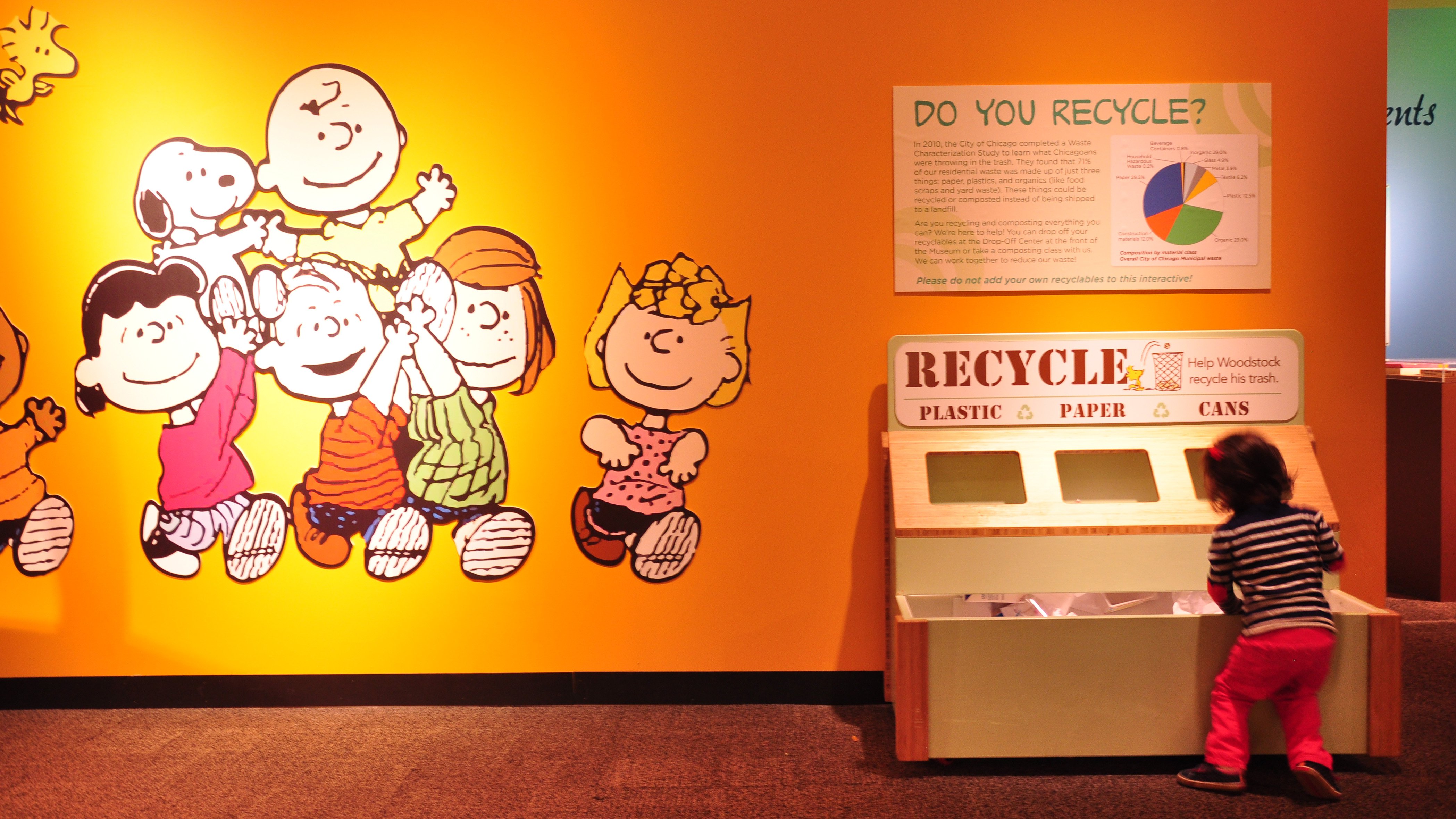
A young visitor acts on the expectation of positive affect at the Peggy Notebaert Nature Museum in Chicago, IL. Source. 

It turned out that the factor with the largest impact on pro-environmental behaviour was negative anticipated affect, or the expectation of feeling guilty, remorseful, and bad after they took action or failed to take action. The second most important factor was positive anticipated affect: visitors were motivated to recycle or reduce waste because they knew they would feel good afterward. The cognitive dimensions were also crucial. An effective strategy might be to let visitors know that recycling, creating less waste, and choosing friendly transport options is the decent and worthwhile thing to do, while making other choices has adverse consequences. As we have always secretly suspected, the best way to make sure visitors act ecologically in the museum might be with some gentle shaming. Perhaps someone could develop an ecologically-minded chatbot to remind them to recycle?


SUGGESTED READING 

Halpin-Healy, Carolyn. "Well-Chosen Objects Support Well-Being for People with Dementia and Their Care Partners." Journal of Museum Education 42, no. 3 (July 14, 2017): 224-35. doi:10.1080/10598650.2017.1342189.

Han, Heesup, and Sunghyup Sean Hyun. "Fostering customers' pro-environmental behavior at a museum." Journal of Sustainable Tourism 25, no. 9 (November 25, 2016): 1240-256. doi:10.1080/09669582.2016.1259318.

Inscho, Jeffrey. "No App Required: Toward a Utilitarian Museum Mobile Experience." The Studio. May 18, 2017. Accessed July 23, 2017. https://studio.carnegiemuseums.org/introducing-muse-20a6f11c7c35.

Inscho, Jeffrey. "Field Study: Benchmarking Visitor Behaviors and Mobile Device Usage in the Museum." The Studio. July 18, 2017. Accessed July 23, 2017. https://studio.carnegiemuseums.org/chatbot-field-study-91fcbb1d4875.

26 June 2017

"THE PEOPLE'S OWN REMEDY FOR STRESS, LONELINESS, AND ALIENATION": THE MUSEUM AS THIRD PLACE?

RESEARCH COLUMN

BY: JENNIFER LEE

“If we valued fraternity as much as independence, and democracy as much as free enterprise, our zoning codes would not enforce the social isolation that plagues our modern neighbourhoods, but would require some form of public gathering place every block or two.” (Ray Oldenburg, The Great Good Place)

Think of the last museum you visited. Did everyone look comfortable, at ease? How quiet was it? Could you hear conversation? What about laughter? Did strangers strike up conversation with each other, or stick to their own groups? As financial and political pressures on the museum change, some museums are looking to become social ‘living rooms’ where visitors can meet and congregate. The phrase ‘third place’, taken from the vocabulary of urban planners and sociologists, is often thrown around in these discussions, conjuring up a picture of museums as shiny, Starbucks-like lounges full of happy millennials. Unsurprisingly, this is not a vision that everyone finds attractive. What do museums stand to gain – and lose – by pursuing the ideal of the third place? 

Millennials enjoy a relaxed third place. Laughter is an important element of social bonding. Source.

The sociologist Ray Oldenburg defined the concept of the third place (or third space) in his book The Great Good Place, published in 1989. The first place, he theorized, is home, where our personal lives play out; the second place is work or school, where we live our professional lives. The third place is neither: it’s the neutral 'watering holes' such as coffee shops, bars, barber shops, parks, and other spaces between work and home where we congregate. The most important features of the third space are that they are accessible spaces open to everyone, and that they allow for shared social experience and the breaking-down of social boundaries. They are convivial and free: a remedy "for stress, loneliness, and alienation"(40).

Robert Putnam’s Bowling Alone: The Collapse and Revival of American Community (published 2000) complements Oldenburg’s work, tracing Americans’ increasing disengagement from public life and community structures (such as political parties, charities, and parent-teacher organizations) throughout the late 20th century. Putnam found widespread decline in what he called ‘social capital’ – Americans’ personal social networks were smaller and their sense of mutual trust, respect, and altruism had eroded over time. He also warned, presciently, that “if participation in political deliberation declines – if fewer and fewer voices engage in democratic debate – our politics will become more shrill and less balanced” (342). Part of the problem, he theorized, was mass media: the more time we spend watching television, the less time we spend engaging with our communities. (Reading this book seventeen years later, I have to wonder what Putnam makes of that 21st-century institution, the Netflix binge.)

One way to combat the death of social capital, of course, is through the third place: if people are given neutral spaces to socialize and get to know each other, to work through their differences, it follows that trust and respect will increase, residents will feel they have a stake in their communities, and civic engagement will follow. This is the thinking that leads some museums like MOMA and the Worcester Art Museum to pursue third-place-ness, hoping to bolster a sense of community and engagement - and tempt some new visitors into the museum.

A blind-date 'conversation meal' between strangers at the Oxford Museum of Natural History. Source. 

But by Oldenburg’s criteria, many museums don’t qualify as third places: in the still, hushed atmosphere of the average art gallery or history museum, complete with security guards, visitors rarely feel like they can let down their guard enough to engage in the kind of convivial, free discussion Oldenburg describes. Although museum cafes and atriums might have a lighter atmosphere, high entry fees, program registration fees, and membership costs may also present a barrier to those who can’t afford to attend regularly. Unfortunately, the success of a third place depends on regulars who create a shared culture and welcome newcomers. Many people, for reasons of class, race, or social and educational background, simply don’t feel comfortable walking into a museum, let alone visiting one regularly as a social event. Creating a third-place atmosphere could mean rolling back entrance fees and relaxing or changing our expectations of visitor behaviour, altering the atmosphere of the museum.

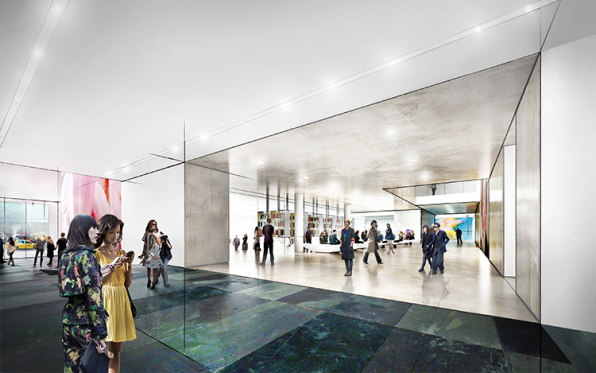
There’s also the problem of the art. When the Museum of Modern Art released their plans for an expansion in 2014, they were heavily criticized for the amount of room given to social and performance space, much of it accessible without paying an entrance fee. Vulture critic Jerry Saltz commented that the new space was designed “so people can look at other people looking at other people looking at people.” Surely the point of visiting a museum, the skeptics asked, was to look at the collections? In response, director Glenn Lowry defended the museum as a space of experience, reflection, and conversation. Creating a third place in the museum may contradict ideas (even among museum staff, and especially among visitors) of what a museum is and does: is it, as Saltz believes, primarily a space for people to look at art? Is it a community living room? Can it possibly be both?

Plan for the MOMA expansion by architectural firm Diller Scofidio + Renfro. Admittedly, there is a conspicuous lack of art in this art museum. Source. 

The truth, as usual, may lie somewhere in the middle. Museums certainly have a role to play in dialogue, engagement, and forming relationships – some particularly excellent programs rose in the wake of the U.S. election, like the National Civil Rights Museum's vow to engage in "difficult and uncomfortable" conversations with volunteers about prejudice and systemic inequality. As civic institutions, we can’t divorce ourselves from civic life and our communities. But we’re not Starbucks or a neighbourhood pub, and likely couldn’t be if we tried. As Nina Simon writes, “Museums are explicitly about something, and third places are about nothing in particular”. We may even do ourselves a disservice by competing with other public spaces as a watering hole rather than a repository of beauty and human knowledge (which is, after all, our great strength). Obviously, museums need to make themselves more accessible and encourage people outside of their traditional audience to visit – but in the interest of being a better museum rather than a third place.


Suggested Reading

Ferro, Shaunacy. “MOMA’s redesign won’t destroy the museum”. Co.Design. January 13, 2014. https://www.fastcodesign.com/3024679/momas-redesign-wont-destroy-the-museum

Freeman, Terri Lee. "Twentyseventeen." National Civil Rights Museum. http://www.civilrightsmuseum.org/news/posts/twentyseventeen

Oldenburg, Ray. 1991. ‘The Character of Third Places’. Reprinted in Common Ground? Readings and Reflections on Public Space, edited by Zachary P. Neal and Anthony M. Oren, 40-48. New York: Routledge.

The Project for Public Spaces. https://www.pps.org

Putnam, Robert. 2000. Bowling Alone: The Collapse and Revival of American Community. New York: Simon and Schuster.

Simon, Nina. 'The Great Good Place Book Discussion Part 1: Can Museums Be Third Places?' Museum 2.0. June 1, 2010. http://museumtwo.blogspot.ca/2010/06/great-good-place-book-discussion-part-1.html


1 July 2016

ACCESSING INFORMATION: ONE BUMP AT A TIME


OBJECT OF THE WEEK

BY: HAYLEY MAE JONES

This might sound dull, but my objects for the week are actually some of the exhibit panels in the Canadian Museum of Nature's temporary exhibit: Ultimate Dinosaur.


Personal Photo: Hayley Mae Jones
I liked the panels because the lettering was very clear and easy to read. However, I was really captured by the fact that the panels have Braille embossed underneath the printed letters.

Personal Photo: Hayley Mae Jones
I liked the fact that the Canadian Museum of Nature made a conscious effort to make the exhibit more inclusive and accessible to those with impaired vision. The Braille was placed in the same location as the written information, meaning that those who need the Braille did not have to go to a separate panel to read about dinosaurs. I also enjoyed the fact that the Braille did not blur the information for those wishing to visually read the English and French texts, or for those wishing to take pictures of the panels.

The Canadian Museum of Nature also made sure that the accompanying children's activity was accessible to those who have visual impairments.

Personal Photo: Hayley Mae Jones
Instead of providing children with a sticker scavenger hunt (which is only exciting to those that can see the stickers), the Canadian Museum of Nature made children find different embossing stations. Children would push down on a lever and make a 3D imprint into their paper. These bumps, although not brightly coloured like stickers, allowed for those with limited visibility to feel the dinosaur prints. It also added another tactile element to the exhibit. 

Personal Photo: Hayley Mae Jones
In addition to being accessible, this interactive activity seemed to be relatively sustainable. The Museum would not have to continuously replace ink pads for stamps, or purchase new stickers. Once the embossing machine was built all they needed was the paper worksheet.

Overall it is a great exhibit, one that everyone should check out if you are in Ottawa this summer!

8 March 2016

WHAT THE TOP MUSEUM TRENDS MEAN FOR CANADA

MUSEUM INNOVATIONS

BY: JENNY FORD

It's finally here! Last week, the American Alliance of Museums (AAM) released its 21016 TrendsWatch guide—an outline of the top museum trends to watch for in 2016. But how does the list stack up against Canadian institutions? Are we lagging, challenging, or overcoming these shifts?

1. THE CHANGING WORKFORCE

Quite depressingly, the first trend for 2016 is the changing nature of employment. Many full-time, permanent jobs are transitioning to a “gig” economy, the report states. In other words, more contracts and less job security, no matter what field you're in.

Man dusting T. rex nose.
The dream, right? Source.

It’s no secret this is affecting the museum world in Canada. Jobs are highly competitive and contracts are becoming the norm. Especially at this time of year, museum job boards are peppered with Young Canada Works posts and volunteer positions—roles that don't necessarily translate to positions after graduation.

The Ontario Museum’s Association acknowledges in their initial Looking Ahead Initiative that the workforce is changing, however it doesn't yet address what this new work will look like. The question is, should we be shifting our expectations about what is a museum job?

2. ACCESSIBILITY AND ABILITY IN MUSEUMS

Increasing accessibility is the next trend. Accessibility is not an "add on" but a thoughtful part of the total experience. While many museums have a long way to go in becoming totally accessible, some Canadian museums are making pretty amazing strides.

The design team at the Canadian Museum for Human Rights, for instance, developed a universal keypad so visitors with visual impairments, physical disabilities, or hearing loss can adjust volume, have images described, or interact with touch tables in all their exhibits. Bluetooth technology also allows museumgoers with visual impairments to have text and artifacts described to them as they move through the museum. This is just the start of what our museums can do. 

Person looking at panel with universal keypad buttons.
You can see the CMHR's keypad in the corner. Source.

3. EXPLORING NEW REALITIES

We’ve seen augmented reality (AR) and virtual reality (VR) at museums before. Take the ROM’s Ultimate Dinosaurs exhibition back in 2012-2013, which used AR to bring dinosaurs to life. According to the 2016 TrendsWatch, AR/VR are becoming increasingly prevalent, so how can museums capitalize?

While the report does raise some concerns about VR replacing the need to visit museums, it also notes the huge benefits for accessing new audiences and experiences. The company Mobius Virtual Foundry created a VR experience which puts users on a bus as Rosa Parks, for instance. Other technology may let visitors manipulate and "touch" objects, further enhancing museum experiences and accessibility.

People try on virtual reality devices to see what it was like being on the bus as Rosa Parks.
The Rosa Parks Experience. Source.

The trend doesn't seem to have taken off in Canadian museums quite yet (please share examples if you have them). Either way, it’s something to watch for in an increasingly technology-focused museum world.

4. IDENTITY AND COMMUNITY


The world last year was moved by questions of race, culture, and identity. We are redefining ourselves and how others perceive us. As the TrendsWatch guide states, museums “find themselves enmeshed in the struggle over representation, identity and material culture.” This is just as true in the Canadian context, where these questions are at the forefront like never before.

There are countless discussions we could have here, but I'm gong to focus on the Truth and Reconciliation Commission (TRC) report released last year. Part of the report outlines how museums and archives play a role in reconciliation through education and deconstructing imperialist narratives.

Panels from the Balance Lost exhibit at PAMA, which looks at the genocide of Aboriginal Peoples.
The PAMA exhibition. Source.
Recently, on a visit to the Peel Art Gallery, Museum and Archives, I was inspired to see how they addressed the TRC's the questions in their permanent exhibition We Are Here, even using the word "genocide". We all know this is a loaded term. Just look at the Canadian Museum for Human Rights' experiences. But perhaps we need pay closer attention to how museums are (and are not) coming out of the shadows on these issues.

5. THE HAPPY MUSEUM

The final trend for 2016 is happiness. Yes, happiness. Really, this speaks to a trend where countries are moving away from measuring economic success to measuring citizen well being.

People int the Happy Show Exhibition
Stefan Sagmeister: The Happy Show. Source.

Museums can equally work off this idea. The Museum of Vancouver even brought in The Happy Show in 2015. Not only can we help foster this happiness and well-being through positive and enlightening interactions, we can also start measuring our own success based on it. It’s long been argued that numbers and dollars are not true assessments of a museum’s success—we can take a page from the happiness philosophy, as well.

WHAT IS YOUR TAKE ON CANADIAN MUSEUMS TRENDS?