Showing posts with label MoMA. Show all posts

12 March 2020

CALLING IT ART: PHOTOGRAPHY AND MARCEL DUCHAMP

Beyond Tradition | Erika Serodio


It is hard to bring up Marcel Duchamp in conversation without eliciting a series of groans from a crowd of MMSt friends. I recently made this mistake at a bar after attending the You Are Here gallery opening with some colleagues.

Dust Breeding at the RIC | Photograph courtesy of Erika Serodio

“You all need to see the exhibition on right now at the Ryerson Image Centre,” I told them. “It’s about dust and photography… And it’s all built around this one photograph of dust by Marcel Duchamp.”

I am met with a few polite nods.
“Oh yes, I’ll check it out.”
“Sounds abstract.”
And finally,
“it’s just that I really hate Marcel Duchamp.”

Bicycle Wheel by Marcel Duchamp | Source

My knowledge of art history is rudimentary; I was first introduced to Marcel Duchamp in Abbi Jacobson’s highly relatable podcast, A Piece of Work.  Jacobson brings up Duchamp at the start of her first episode, where she explains that his sculpture titled Bicycle Wheel, is one of the starting places for modern art. Bicycle Wheel is an example of art made with common, everyday objects which the artist has selected and designated as art – an artistic movement or style called “Readymades.” People get skeptical when they walk into New York’s MoMA, and come across a bicycle wheel amidst the abundance of masters that adorn the museum’s walls. How can this be art?

Throughout my first year in the Museum Studies program, I have wrestled with the question of what a museum can and should be. There is an inherent institutional rigidity to museums that deters some people from ever entering, regardless of what’s on view inside. I think of how exhibitions or art pieces in alternative spaces might reach people who do not feel like “art” is for them. Coming back to Duchamp’s Bicycle Wheel at this point in the semester felt necessary. Jacobson explains in her podcast how Duchamp was trying to make a point about the way that art has been historically viewed as rare and elite. The inclusion of his readymade bicycle wheel in a gallery defied that idea, and instead claimed that anything could be art, and anyone could be an artist. For Duchamp, the ideas behind the art were more important than the physical realization of that art.

128 Photographs of a Painting by Gerhard Richter | Photograph courtesy of Erika Serodio
This idea is especially relevant when thinking about photography as art today. The impressive quality of the cameras embedded in our everyday cellphones has made it so that photographs are ubiquitous and everyone can be a photographer. How then, does an exhibition space that focuses on photography maintain its prestige? The answer might be that it doesn't. The photographs in the Ryerson Image Centre's current exhibition, A Handful of Dust, "highlight quotidian details of life." Everyday elements take on new meaning with the accumulation of and deterioration by tiny, unimportant specks of dust. This exhibition feels like something that anyone could be a part of and there is something undeniably beautiful about that idea. 

A Handful of Dust: From the Cosmic to the Domestic runs from January 22nd to April 5, 2020, and is free to attend.

25 March 2019

EAT YOUR VEGETABLES: SOWING SEEDS AND GROWING GREENS AT THE MOMA

A Muse Bouche | Jordan Fee

Last week, the MoMA presented a new project to the public. No, it wasn’t a new exhibition, nor did it have anything to do with art. Rather, this massively influential museum took a moment to acknowledge the fact that it now grows vegetables as part of its mission. You may not find it in their mandate, but the MoMA now wishes to grow tomatoes and mustard greens.

This announcement comes directly from Abram Bissell, who stands as executive chef and director of The Modern, which is the museums high-end destination for dining. The restaurant currently boasts two Michelin stars, and offers a 7-course dinner meal which intends to “bring a sense of surprise to our meal.”


According to Bissell, who was interviewed for this project by Content Producer Lindsay Saito, this new endeavour has allowed the restaurant to go a step beyond in terms of sustainability measures. He is quick to note that there is a particular sense of joy that comes with “seeing something go from a seed to the plate." This comment shows that many chefs and diners are now eager to participate in the growing process, which was unavailable to them in the past.

So how exactly does the MoMA get these little seeds to these beautiful plates?

Well, instead of growing these plants hydroponically (where the plants are grown without soil, feeding instead off of a water-based, nutrient-rich fluid), the Modern grows their plants using aeroponics. This means that the roots are submerged in a circulating mist of water, which apparently allows for greater nutrient absorption and in turn, faster plant growth. Furthermore, as you can see from the pictures posted by the MoMA, the aeroponic system has a certain aesthetic quality to it, which I believe can draw people in and get them interested.

Aeroponic root systems grow in a cloud of mist (Source)
Last semester, I wrote a post about Canada’s first fully-automated indoor farm, which sits on Toronto’s doorstep in East York. In this post, I asked readers to consider how farms like this could be used in an educational setting, and to ask themselves whether or not sites like this should in fact be considered as museums. Systems like this, where light, sound, and smell blend together could help to create a holistic educational experience for the viewer that most museums find difficult to achieve.

A glimpse inside Canada's first fully-automated indoor farm (Photograph courtesy of Jordan Fee)
The benefits are not limited, however, to aesthetic qualities. In his interview with Saito, Bissell mentions that his aeroponic systems “can grow about a kilo of herbs or lettuces with less than a gallon of tap water, which is about 20% of the normal consumption of water.” This level of efficiency was also echoed by Guy Rubino, who runs the indoor farm in East York. Clearly, these techno-agricultural systems provide an exciting alternative to traditional methods of growing, allowing farmers and producers to grow these plants with a previously unforeseen level of success.

After doing some research on the subject of aeroponics, I have discovered that this technology has been adopted by farmers in a number of countries including Bolivia, Colombia, Peru, Ecuador, Ethiopia, Kenya, Uganda, and Malawi. The same efficiencies noted earlier in this article were reported by farmers in all of these countries, and studies have shown that while the technology needed for aeroponic systems is complex, this complexity has a direct correlation with those same efficiencies. In other words, good things take hard work.

However, the system is not perfect. According to a report published by the American Journal of Potato Research in 2013, aeroponic systems are much more likely to be damaged by water or power cuts than hydroponic systems. In order to grow plants – in this case, the researchers were growing potatoes – you need a continuous source of energy. This brings us back to the MoMA, where a two Michelin-star chef sits comfortably in his well-funded institution.

While aeroponic systems are being used by farmers throughout the world, it is difficult to ignore the privilege that comes with working at the MoMA. What does it mean for a chef to use these technological systems to grow “specialty greens” when farmers around the world are using this technology to fight global hunger on a local level? While the comparison is slightly reductive, I do think it is important to think about how these technologies can be used by high-end restaurants to improve their public image and promote their branding to the world at large. Moreover, it is important to think about what it means for such a chef to tout sustainable values when he sits in his ivory tower of modern art.

Tuna
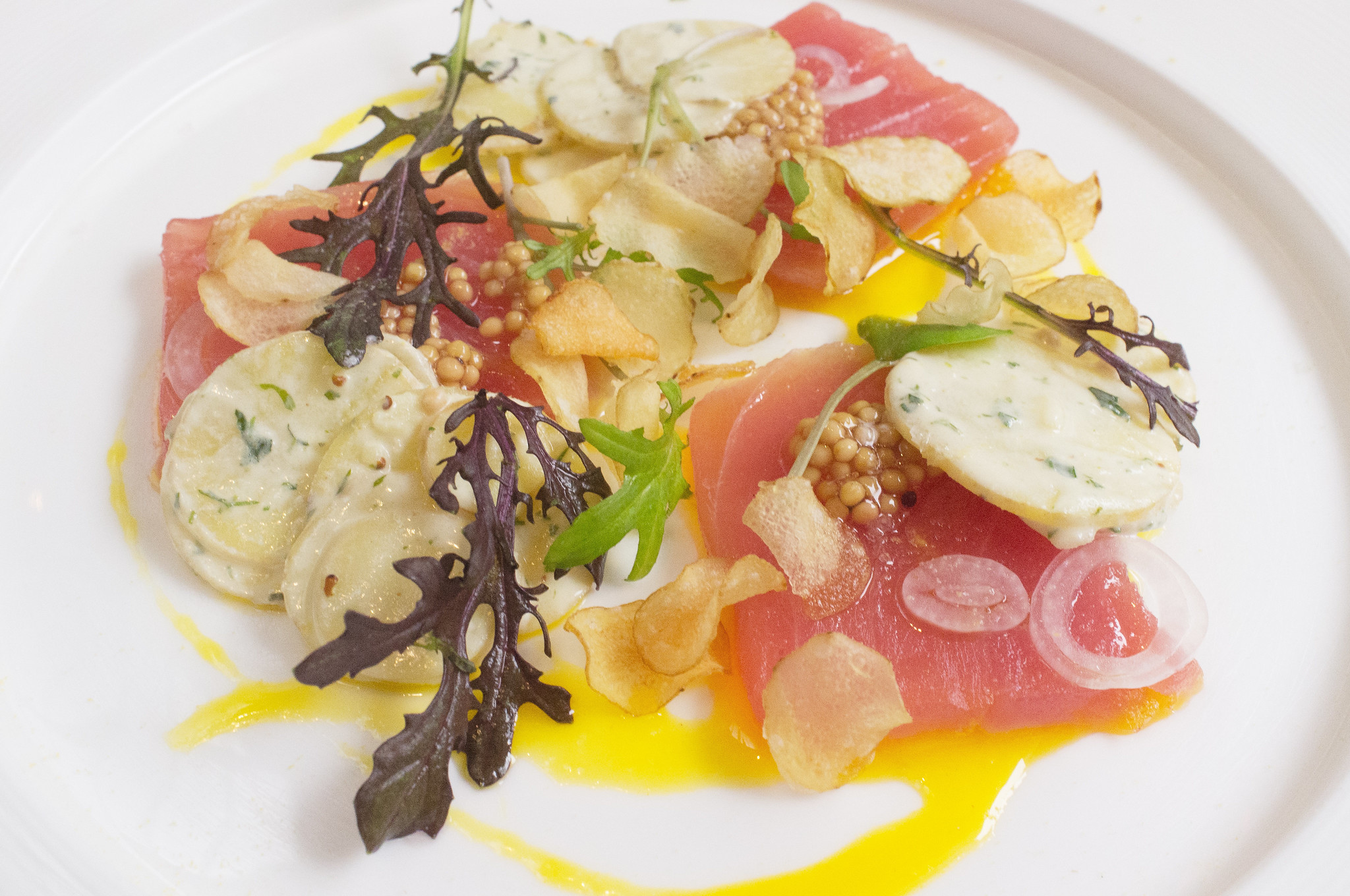
A lovely (and probably expensive) plate of Cured Tuna with Potato and Egg (Source)

Let me be clear: I am extremely happy about the fact that museums have begun to focus on sustainability in all areas of their practice. However, I do believe that the MoMA could potentially improve upon this new project by doing some outreach, showing how these technologies can do much more than grow mustard greens for a $75 plate of fish. Chefs in these kinds of restaurants can sometimes get foot-in-mouth syndrome when they begin talking about affecting change in society, as they are essentially ignoring the fact that the only people who can be changed by food such as this are those who are able to pay the $250 bill at the end of the night.

In order for the MoMA’s new project to be fully successful, it would – in my opinion – have to be extended outside of the walls of the institution. Beyond doing some outreach, they could also begin to donate funds to organizations that are actively working to combat hunger through the use of aeroponics. Doing this would show that the institution is truly invested in sustainable practices, and that this new project isn't simply a PR move meant to bring more people into The Modern.

26 June 2017

"THE PEOPLE'S OWN REMEDY FOR STRESS, LONELINESS, AND ALIENATION": THE MUSEUM AS THIRD PLACE?

RESEARCH COLUMN

BY: JENNIFER LEE

“If we valued fraternity as much as independence, and democracy as much as free enterprise, our zoning codes would not enforce the social isolation that plagues our modern neighbourhoods, but would require some form of public gathering place every block or two.” (Ray Oldenburg, The Great Good Place)

Think of the last museum you visited. Did everyone look comfortable, at ease? How quiet was it? Could you hear conversation? What about laughter? Did strangers strike up conversation with each other, or stick to their own groups? As financial and political pressures on the museum change, some museums are looking to become social ‘living rooms’ where visitors can meet and congregate. The phrase ‘third place’, taken from the vocabulary of urban planners and sociologists, is often thrown around in these discussions, conjuring up a picture of museums as shiny, Starbucks-like lounges full of happy millennials. Unsurprisingly, this is not a vision that everyone finds attractive. What do museums stand to gain – and lose – by pursuing the ideal of the third place? 

Millennials enjoy a relaxed third place. Laughter is an important element of social bonding. Source.

The sociologist Ray Oldenburg defined the concept of the third place (or third space) in his book The Great Good Place, published in 1989. The first place, he theorized, is home, where our personal lives play out; the second place is work or school, where we live our professional lives. The third place is neither: it’s the neutral 'watering holes' such as coffee shops, bars, barber shops, parks, and other spaces between work and home where we congregate. The most important features of the third space are that they are accessible spaces open to everyone, and that they allow for shared social experience and the breaking-down of social boundaries. They are convivial and free: a remedy "for stress, loneliness, and alienation"(40).

Robert Putnam’s Bowling Alone: The Collapse and Revival of American Community (published 2000) complements Oldenburg’s work, tracing Americans’ increasing disengagement from public life and community structures (such as political parties, charities, and parent-teacher organizations) throughout the late 20th century. Putnam found widespread decline in what he called ‘social capital’ – Americans’ personal social networks were smaller and their sense of mutual trust, respect, and altruism had eroded over time. He also warned, presciently, that “if participation in political deliberation declines – if fewer and fewer voices engage in democratic debate – our politics will become more shrill and less balanced” (342). Part of the problem, he theorized, was mass media: the more time we spend watching television, the less time we spend engaging with our communities. (Reading this book seventeen years later, I have to wonder what Putnam makes of that 21st-century institution, the Netflix binge.)

One way to combat the death of social capital, of course, is through the third place: if people are given neutral spaces to socialize and get to know each other, to work through their differences, it follows that trust and respect will increase, residents will feel they have a stake in their communities, and civic engagement will follow. This is the thinking that leads some museums like MOMA and the Worcester Art Museum to pursue third-place-ness, hoping to bolster a sense of community and engagement - and tempt some new visitors into the museum.

A blind-date 'conversation meal' between strangers at the Oxford Museum of Natural History. Source. 

But by Oldenburg’s criteria, many museums don’t qualify as third places: in the still, hushed atmosphere of the average art gallery or history museum, complete with security guards, visitors rarely feel like they can let down their guard enough to engage in the kind of convivial, free discussion Oldenburg describes. Although museum cafes and atriums might have a lighter atmosphere, high entry fees, program registration fees, and membership costs may also present a barrier to those who can’t afford to attend regularly. Unfortunately, the success of a third place depends on regulars who create a shared culture and welcome newcomers. Many people, for reasons of class, race, or social and educational background, simply don’t feel comfortable walking into a museum, let alone visiting one regularly as a social event. Creating a third-place atmosphere could mean rolling back entrance fees and relaxing or changing our expectations of visitor behaviour, altering the atmosphere of the museum.

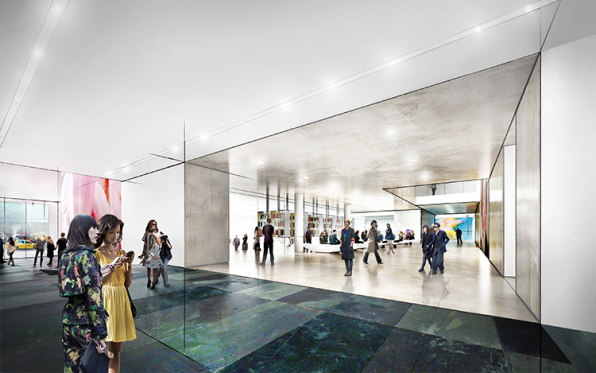
There’s also the problem of the art. When the Museum of Modern Art released their plans for an expansion in 2014, they were heavily criticized for the amount of room given to social and performance space, much of it accessible without paying an entrance fee. Vulture critic Jerry Saltz commented that the new space was designed “so people can look at other people looking at other people looking at people.” Surely the point of visiting a museum, the skeptics asked, was to look at the collections? In response, director Glenn Lowry defended the museum as a space of experience, reflection, and conversation. Creating a third place in the museum may contradict ideas (even among museum staff, and especially among visitors) of what a museum is and does: is it, as Saltz believes, primarily a space for people to look at art? Is it a community living room? Can it possibly be both?

Plan for the MOMA expansion by architectural firm Diller Scofidio + Renfro. Admittedly, there is a conspicuous lack of art in this art museum. Source. 

The truth, as usual, may lie somewhere in the middle. Museums certainly have a role to play in dialogue, engagement, and forming relationships – some particularly excellent programs rose in the wake of the U.S. election, like the National Civil Rights Museum's vow to engage in "difficult and uncomfortable" conversations with volunteers about prejudice and systemic inequality. As civic institutions, we can’t divorce ourselves from civic life and our communities. But we’re not Starbucks or a neighbourhood pub, and likely couldn’t be if we tried. As Nina Simon writes, “Museums are explicitly about something, and third places are about nothing in particular”. We may even do ourselves a disservice by competing with other public spaces as a watering hole rather than a repository of beauty and human knowledge (which is, after all, our great strength). Obviously, museums need to make themselves more accessible and encourage people outside of their traditional audience to visit – but in the interest of being a better museum rather than a third place.


Suggested Reading

Ferro, Shaunacy. “MOMA’s redesign won’t destroy the museum”. Co.Design. January 13, 2014. https://www.fastcodesign.com/3024679/momas-redesign-wont-destroy-the-museum

Freeman, Terri Lee. "Twentyseventeen." National Civil Rights Museum. http://www.civilrightsmuseum.org/news/posts/twentyseventeen

Oldenburg, Ray. 1991. ‘The Character of Third Places’. Reprinted in Common Ground? Readings and Reflections on Public Space, edited by Zachary P. Neal and Anthony M. Oren, 40-48. New York: Routledge.

The Project for Public Spaces. https://www.pps.org

Putnam, Robert. 2000. Bowling Alone: The Collapse and Revival of American Community. New York: Simon and Schuster.

Simon, Nina. 'The Great Good Place Book Discussion Part 1: Can Museums Be Third Places?' Museum 2.0. June 1, 2010. http://museumtwo.blogspot.ca/2010/06/great-good-place-book-discussion-part-1.html


3 October 2016

WILLIAM KENTRIDGE: FIVE THEMES

EXHIBITION REVIEWS

BY: TABITHA CHAN

For my first post writing in the Exhibition Reviews column, I’m featuring an artist that has heavily influenced my own drawing practice. The exhibition titled “William Kentridge: Five Themes” was presented at the Museum of Modern Art in 2010, but is still one of my favourite exhibitions to date. Explore the full interactive exhibition here.

(Source)


Kentridge was born in 1955 in Johannesburg. He is a multidisciplinary artist that has a vast practice of drawing, film animation, printmaking and theatrical performance. His work is melancholic, self-reflective and poetically honest.


His series titled, “drawings for projection” feature 9 short animated films that he created over the course of 14 years. This series tells a story of what life was like in Johannesburg during and after the years of apartheid. Apartheid, meaning “separateness”, was a system of racial segregation enforced by the National Party from 1948 to 1994 in South Africa. This film is titled, “Johannesburg, 2nd Greatest City After Paris” and is the first of the series.


Kentridge is of Lithuanian-Jewish descent and is the son of 2 anti-apartheid lawyers who were heavily involved with the civil rights cases at the time. In his films, Kentridge boldly navigates the social and political tensions of South Africa with attentiveness to the complex identities of what it meant to be a victim, bystander and oppressor.

When describing the city of Johannesburg, he says, “It is a city that deconstructs itself the whole time, it’s busy erasing itself the way you erase a drawing.” (Source)

Production stills from the film, “Sobriety, Obesity & Growing Old.”
(Source)
For Kentridge, drawing is a way to think rather than only a physical gesture. These films are a repetitive and meditative cycle of drawing, erasing and photographing stills.

The technique he used to create these films is through a process of stop motion animation (the film is made up of many drawings which become photographs), where each sequential movement is drawn on the same sheet of paper. This means that there is always a trace of the previous drawing, each layer acting as a memory of the past that cannot fully be erased.

In these films, Kentridge only uses charcoal and highlights of blue and red pastel. The charcoal gives him the ability to transform drawings quickly as his process is extremely immediate and intuitive. He allows moments of chance to enter into his drawings.

Production stills from the film, “Felix In Exile.”
(Source)
The narrative of these films is told through 2 recurring fictional characters: Soho Eckstein, an elite and powerful businessman and his alter ego, Felix Teitlebaum, an introverted artist who is the lover of Soho’s wife. Soho is drawn with confident black lines and is characterized by a pinstripe suit, while Felix is drawn in a softer washed out gray and is most often portrayed nude.

(Source)


Kentridge arranges these recognizable good and evil archetypes in order to break them down to reveal that human beings cannot be understood as binary oppositions. In traumatic cultural narratives, everyone is implicated and no one is innocent. As the series progresses, the viewer sees Soho’s identity fall apart as the apartheid collapses.


In 2003, Kentridge created a number of films that featured himself in the studio and his drawing process. These films are a poetic expression of the intersection between drawing and cinema as they implement techniques such as reversing footage, overlaying fade scenes and split screens.

In this particular work, titled, “Invisible Mending,” Kentridge has drawn his self-portrait, deliberately effacing it by drawing harsh lines overtop and then rips the paper. The footage is reversed so that the film actually looks like he is mending his own self-portrait as opposed to destroying it. In the final scenes of the film, his real self seemingly steps out of the drawn self through an overlaying fade.


Through self-portraiture, Kentridge examines the “artist split." Kentridge uses the studio as a metaphor to demonstrate that this separation of the self is actually how we operate in everyday life. This split between artist and viewer is how we make sense of the world, emphasizing how we are never fully complete and always to a certain extent absent from our bodies.

(Source)


“I believe that in the indeterminacy of drawing – the contingent way that images arrive in the work – lies some kind of model of how we live our lives. The activity of drawing is a way of trying to understand who we are and how we operate in the world.”