Showing posts with label @jessicasven. Show all posts

15 March 2018

ICONIC FASHIONS: WHERE ARE THEY NOW?

SEW WHAT

BY: JESSICA SVENNINGSON

Iconic people are often marked by their iconic clothing. Once these people are no longer wear those fashions – have you ever wondered what happened to their fashion items? Most of these find their ways into museums – lets look at 5 of the world’s iconic fashion items and where they are now.


Jackie Kennedy's Watermelon Pink Suit


Jackie Kennedy arriving at John F. Kennedy's
Inauguration.  Source
Jackie Kennedy was an American style icon. The outfit she is most known for was her watermelon pink Coco Chanel suit and matching pillbox hat she wore the day her husband John F. Kennedy was assassinated on November 22, 1963. The pink suit was covered in John F. Kennedy’s blood, and despite repeated suggestions to change her clothes, Jackie Kennedy refused and said, “No, let them see what they’ve done”. When Jackie finally stepped out of the suit, it was collected and preserved by the National Archives in Maryland. Stored there out of sight, the suit is under the purview of the Kennedy family, who have confirmed it will not be publicly displayed until 2103.

Frida Kahlo’s Booted Prosthetic Leg

Frida Kahlo's prosthetic leg on display at the
 V&A.  Source
Frida Kahlo, famous feminist artist and proliferate supporter of Mexican culture, is often coloured by her tragic story of a near-fatal bus accident that severely compromised her spine, which later led to extended bed rest and leg amputation. In classically radical and rebellious fashion, Frida wouldn’t let her physical issues prevent her from leading an extraordinary life. She would adorn herself with vibrant colours central to Mexican culture, fill her home with gardens and exotic pets, paint herself with bright makeup, and cover her hair with flowers. When she was given a prosthetic leg, she strapped a beautiful red boot to it, making it as beautiful as the clothing she wore.

When Frida died in 1954 at the age of 47, husband Diego Rivera locked away all her possessions with instructions to never touch them until after his death, over 50 years later. The collection was opened in 2004, revealing a treasure trove of items like makeup, clothing, jewelry, and intimate possessions which Frida had used to construct her identity. The collection is currently being exhibited at the Victoria & Albert Museum in London, England. The exhibit explores how Frida empowered herself using art, clothing and style during the most difficult times in her life.

Ginger Spice’s Union Jack Platform Boots


Ginger Spice's shoes on display at the Bata
Shoe Museum. Source
Geri Halliwell, or better known as Ginger Spice, was known for her wild outfits and love for the British Union Jack. Along with her Union Jack “little Gucci dress,” Ginger and the other four Spice Girls loved to wear platform boots. This pair of Union Jack platform boots was worn by Ginger Spice during the Spice World movie, and now currently lives at the Bata Shoe Museum. The boots are presently in storage but will periodically be featured in the Bata’s shoes of famous people exhibit on the first floor of the museum.

Abraham Lincoln’s Stovepipe Top Hat

Abraham Lincoln's hat on display at the Smithsonian
 Institution. Source
Despite Lincoln’s 6’4” height, he wore a tall stovepipe top hat to accentuate his height even further, which became a critical piece of political identity during his time as the 16th President of the United States. The most famous of his hats was the one he wore the night he was assassinated at the Ford’s Theatre on April 14th, 1865. That hat was sitting on the ground beside Lincoln before he was shot, and the hat and the chair Lincoln was in were quickly removed after the murder by the War Department to be used as evidence during the shooter’s trial. The hat was donated to the Smithsonian Institution as part of the Lincoln Memorial Association Collection and has been known to go on display – as seen here.

John Lennon's spectacles. Source

John Lennon’s Spectacles 

John Lennon’s iconic style was often associated with a seemingly practical fashion item – his metal-rimmed eye glasses. These glasses, along with more than 100 other priceless items belonging to Lennon, such as three diaries (including one recounting the last days before his murder), original records of Beatles songs, a cigarette case, and a hand-written music score, were stolen out the window of Yoko Ono’s New York City apartment in 2006. The thieves had apparently reached through the open window, stolen the items, and transported them to Germany where police found them in a bankrupt auction house’s care in 2017. The spectacles are now back in the care of Yoko Ono, however, the other 100 plus items are still being investigated.

Fashion not only is a tool to define who we are as individuals, but a way to create a public identity to be known for. These iconic fashion items were an integral part of each person's public identity - becoming a part of who they are. The object's life can sometimes become as interesting as the person who once owned them, like John Lennon's glasses, which is why they find their ways into museums. They act almost like a stand-in for the person themself, and as an example of how interesting the life of an object, who out lives the person who once owned them, can be.

15 February 2018

FASHION ITEMS

SEW WHAT

BY: JESSICA SVENNINGSON

The MoMA’s exhibit Items: Is Fashion Modern? profiled 111 fashion items from the 20th and 21st centuries believed to have had significant long term impact on the world. Showcasing clothing and accessories, Items explored the
“many relationships between fashion and functionality, culture, aesthetics, politics, labor, identity, economy, and technology.” 
If you missed the exhibit, MoMA has published a catalogue available for purchase.

Items has inspired me to explore 11 fashion items whose histories I am unfamiliar with, and see their place in the world.

1. Denim Jeans

Jeans were created by fabric manufacturer Levi Strauss, who made the thick cotton  denim, and tailor Jacob Davis. When Jacob designed and constructed the first pair of denim jeans by using copper rivets in places pants normally rip and tear (pockets and flies) Levi saw an opportunity for working class Americans. Levi and Jacob became partners and opened a factory in 1873. Jeans have held a strong place in western culture for over 140 years, first as a working class item, then an item of rebellion, and now a high fashion item. Source
Zoot Suit Source


2. Zoot Suit

Zoot suits were popularized by African American jazz musicians in the 1940s, worn as a rebellious statement against the formality of fashion of the time. Unfortunately, materials and tailoring required to create zoot suits were so extravagant and costly that they were banned. Zoot suits were considered unpatriotic and their removal was intended to save raw materials as part of the 1940s war effort. Source


3. Bowler Hat

Bowler hats were created in 1849 by Edward Coke, designed by Thomas and William, with the intention of creating a gentleman’s hat that could be worn by gamekeepers to protect their heads from low-hanging branches while out hunting. It became a part of the London businessmen’s uniform, now standing as a symbol of an upstanding conduct, a person of style, and semi-formal fashion. Source

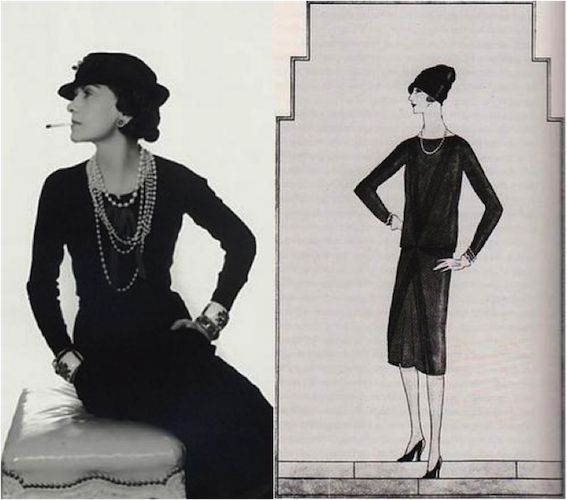
Coco Chanel, Little Black Dress Source


4. Little Black Dress

The Little Black Dress, LBD, was designed by Coco Chanel in 1926. It made a big splash in American Vogue as a key dress piece of the 1920s, standing as a symbol of practical yet fashionable dress design for the modern woman. The LBD now holds a social position of “effortless elegance”, preventing the wearer from hiding behind any distractions and letting the woman shine through. Source
Persian Riding Shoe Source


5. High Heel

The high heel has a long history, dating back to the Persian Empire. Skilled horsemen attached a wooden peg to the heel of their shoes to better stabilize themselves so they could fight with both hands while riding. This was adapted by Europeans into several forms of heels, such as stacked leather heels for men, and chopins for women in Italy during the Baroque period (a sign of wealth). The invention of the stiletto heel, supported by a steel rod in the core of the heel for weight support, changed the way shoe designers could create a heel. The removed risk of a heel cracking or bending from the weight of the walker meant heels could go as high as the wearer designered. Heels have been worn by both men and women during the 20th century, mostly for fashion, but also as a tool for particular dance styles like Vogueing and Burlesque. Readers can learn more at the Bata Shoe Museum’s Men in Heels exhibit.

Ivory Folding Fan Source

6. Hand Fans

Archaeologists uncovered remnants of hand fans dating back to the 4th century BCE. The presence of fans have appeared in cultures all over the world such as Japan, Russia, Persia, ancient Greece, pre-revolutionary France, and most colonial countries. Their intended practical purpose as a means to stay cool and drive away insects has kept them alive through most of history, including today. Their near-constant presence in fashion has resulted in numerous designs and materials like ivory, bone, feathers, jewels, mica, parchment, paper, leather, silk, lace, and other forms of fabric. In the 17th century, fans were considered high status, similar to exotic gifts and elaborately decorated gloves. Although folding fans were popular in Europe and Japan, rigid non-foldable fans were more common in China. Source

Source

7. Silk and Nylon Stockings

The word “sock” has existed for almost as long as men have been wearing fabric on their feet. The word “stump” used to refer to the bottom part of a man’s leg and ankle, so the material covering that part of the body reflected the body part it was addressing. Before the 1920s, stockings were primarily used for warmth or protection from the elements; however, after women’s hemlines rose in the 1920s, stockings soon became a necessary part of a woman’s fashion wardrobe. Stockings were soon made of rayon and nylon, much like today. The technological invention of nylon revolutionized the status of stockings from one once very high to an ordinary object. Stockings were once very expensive, fragile, and difficult to replace when made of silk. However, once stocking manufacturing used rayon and nylon, stockings became both cheap and more durable than silk, making stockings such an affordable fashion item that they fell from a luxury item to an every day object. Source
Source


8. Turban

Evidence of turban usage dates back to a sculpture from 2350 BCE in Mesopotamia. Turbans have been used throughout several histories around the world for religious, fashionable, and practical purposes, such as cleanliness, social position, religious orientation, method of protection from physical elements, or a sign of respect to others, just to name a few. Turbans are, at their core, draped unstitched cloth used as a head covering, making them one of the most versatile items of clothing for meaning making globally. Source
Romantic Tutu Source


9. Tutu

Before the French Revolution, ballet dancers wore clothing as a reflection of their contemporary audiences. This meant early ballet dancers wore long skirts referred to now as Romantic. As ballet dancers began to dance more on their toes, leading to ballet point, skirts began to rise to show off the leg work, eventually landing on the very stiff Classic tutu style commonly seen today. Source

Classic Tutu Source

10. Backpacks

The creation of what we consider now to be a typical school backpack has only been in existence for approximately 46 years. Prior a school backpack, children would use a belt to strap their books. In the 1960s, school children might put school supplies in a cross body bag, called satchels, more commonly thought of now as shoulder bags. Canvas draw string or square leather bags with buckles could be found for carrying school supplies, but the first backpack with a zipper was created in 1938 by Gerry Outdoors for hikers and mountaineers. JanSport sold the first lightweight nylon backpack in 1967. When students at Washington University began using them to carry school supplies instead of hiking equipment the school communicated the change in use to JanSport who then tailored backpacks to the needs of students, creating what we now consider the modern day backpack. Source

Gerry Outdoors Backpack Source
Garters in action Source


11. Garter belts

Despite the garter belt’s long association with nudity and sexual desire, the intended use of garter belts was to keep one’s stockings up, and not down around the wearer’s ankles. Before the invention of nylon or spandex, stockings were held up with straps called garters. Garter belts, in all forms, were either part of corsets or belts, strapped under shirts and skirts, or tied around the legs, then clipped to the top of the stockings. The tension between the stockings and whatever the garter was secured to kept the stockings up and wrinkle free. Although the use of spandex now has removed the usefulness of garters, their long association with sexual appeal and undressing has kept them alive as a decorative piece in sex culture. Source

18 January 2018

DIOR MADE WOMEN BEAUTIFUL, BUT CHANEL MADE WOMEN UNFORGETTABLE

SEW WHAT

BY: JESSICA SVENNINGSON


The Royal Ontario Museum’s newest blockbuster exhibition in the textiles gallery, titled simply Christian Dior, looks at how Dior reinvigorated women’s fashion after decades of practicality-driven, boyish women's clothes which came about because of the war years and Coco Chanel. The transition from Chanel's flapper styled dresses to Dior's hourglass and full-skirt silhouette, was a struggle many forget when viewing Dior's collections.

Christian Dior exhibition at the Royal Ontario Museum. Source

Coco Chanel opened her first fashion boutique in 1913, the first ever women's couture fashion house designed exclusively by a woman. Before Chanel, women's clothing required full skirts, petticoats, corsets, and ruffles. Her designs dropped the corsets, high waists, frills, and constricting sewing patterns worn for centuries before. Chanel changed the way women viewed fashion, which was just as much about sexual politics as design. Chanel was once quoted saying, 
“Designers have forgotten that there are women inside these dresses.”  Source
Her designs, in contrast, were simple, sophisticated, stylish, and practical. Chanel also said that she 
“…want[ed] to give women the chance to laugh and eat, without necessarily having to faint.” Source
Women loved the freedom Chanel’s dress designs gave them, with the loose boyish cuts, lower waistlines, and no enormous skirts with layers of petticoats to weigh them down or restrict movement.

Women on the streets of France in day coats, 1913. Source

Her designs gave women freedom to move without restriction, and her use of flexible jersey fabric during World War I - originally designed for men’s uniforms - meant women could comfortably work in factories and in shops, but still feel feminine. Soon her style was all the rage of both upper and lower classes. When the war ended, other fashion houses adopted Chanel’s designs, ending the era of corsets and opening to effervescent flappers. Chanel’s desire to elevate the value of women came from her value of fashion in a woman’s world.
“Dress shabbily and they remember the dress. Dress impeccably, and they remember the woman.” Source
Chanel's greatest claim to fame was the little black dress. Chanel published a photograph of her LBD in American Vogue, which to this day is considered an essential in many women’s closets. However, the little black dresses made now, often very form-fitting and revealing, are very different from the intentions of the original, which was designed to be elegant but practical. Vogue referred to it as “Chanel’s Ford”, like the Model T, saying it was "a sort of uniform for all women of taste".

Coco Chanel's Little Black Dress. Source

The fashion world fell out of love with Chanel after World War II. Fashion had become so practical some considered it unexciting. Dior felt the overtly functional and masculine clothing made for women during the Second World War looked too “square shouldered, like boxers.” Christian Dior opened his first fashion house in late 1946, designing his women to look like
“flower ladies, with soft shoulders, busts in full bloom, willowy waists, and skirts that blossomed like corollas.” Source
Dior drew inspiration from the frilly, full-skirt, and corseted women of his childhood. The designs were simpler, with clean lines and enormous skirts which could take up to 30 metres of fabric to create – an extravagance which drew much criticism after years of strict rationing during the war. His pattern designs were considered revolutionary, what with the layering of five or six petticoats sewn together inside the skirt to increase its volume. Thus, the wearer only needed to put on one layer over her undergarments. Dior's hourglass silhouettes, with full skirts, padded bras, and cinched waists, were reminiscent of wealthier pre-war years.

Christian Dior exhibition at the Royal Ontario Museum. Source

Women loved the designs for their feel of luxury and femininity. However, Chanel felt Dior’s designs stood against everything she had achieved for women. The weight, volume of fabric, exaggerated  cinching of the waist, and exquisite detailing of Dior’s dresses made it difficult for women to move. In the ROM’s Dior exhibition, there is a video showing women wearing enormous Dior ballgowns, wandering around a lavish French bedroom and household, socializing in beautifully decorated sitting rooms, acting as moving decoration.

Christian Dior exhibition at the Royal Ontario Museum. Source

This struggle for the freedom of women’s bodies in fashion continues today through independent fashion designers striving to create designs that look good on all body types, and new inclusive couture lines. Where Chanel gave freedom to women to move, breathe, and play, Dior contributed to the thinking of those who wished to remove women from the work force and put them back in the home. Although Dior's designs are exquisite, they forgot to consider the living person inside them, and women in general, are more than mere beautiful flowers to look at.

To learn more:

Extraordinary Women - Coco Chanel


Christian Dior The Man Behind the Myth

16 January 2018

CAMERA PHONE PHOTO CONVERSATION

COLLECTIONS CORNER

BY: KATLYN WOODER

Between June 27 and December 17, 2017, the Metropolitan Museum in New York City put on an exhibit: Talking Pictures: Camera-Phone Conversation Between Artists. Artists held photo or video conversations without text or captions. Check out videos of some of the conversations here.

In the spirit of this exhibit, Jessica Svenningson - a fellow Musings Contributing Editor, and writer of the Sew What column - and I, held a photo conversation from January 8th to 14th (some of you might recognize that as the first week back at school ;)). Here are the results of our photo conversation. On the right are photos by me (Katlyn Wooder) and on the left are the photos by Jessica Svenningson.


THAT'S ALL FOLKS

The photo conversation was fun but unusual. While in my texting, photos are becoming more common. Conversing through a set of photos without text is a new way of thinking. The total absence of traditional language ensures a level of uncertainty. I knew what stood out me was not necessarily why Jessica took the photo, but I responded to what stood out to me; be it a grid pattern, detail or lighting. (Side note: Jessica is scarily good at composition).

As unusual as conversing in images was, it is a liberating experience to not be reliant on the usual linguistic boundaries. When you're talking with words a similar level of uncertainty is present, the difference is the awareness of an assumption. The assumption is that when you are talking in every day conversation, you tend to be unaware that other people may interpret your word choice differently than you do. So you could be having two different conversations, and be unaware of it.

Jessica and I are both museum studies students in Toronto, and our conversation held moments of intentional or unintentional familiarity. I knew the last picture of the conversation was a picture of part of the Christian Dior Exhibit at the Royal Ontario Museum as soon as I received it because I went to see the Dior exhibit in December. (It's a good show, you should go see it!) I would love to see what type of conversation two people could have, who live in different cultures, different geographic location, and who don’t speak the same language.

It's been fun.
Please leave a comment (maybe a photo comment, if you feel so inclined).

16 November 2017

HIGH FASHION HIJAB - AND MUSLIM WOMAN'S PLACE IN THE FASHION WORLD

SEW WHAT

BY: JESSICA SVENNINGSON

High fashion has increasingly been finding its way into cultural institutions – like the ROM’s new exhibition exploring Dior in the 20th century, MoMA’s current exhibition Items: Is Fashion Modern?, and a yet-to-be-announced exhibition at the Bata Shoe Museum showcasing a designer’s collection of footwear, set to open in 2018. The strong political voice museums hold has great power to legitimize art and cultural activities, and their corresponding objects. This voice has recently spoken up in the fashion and political debates surrounding Muslim women’s fashion, more specifically hijabs.

High Fashion Hijab Queen. Source

Hijabs have been thrown under both critical and supportive media spotlights in the context of recent political turmoil in North America and abroad. Ibtihaj Muhammad competed in the 2016 summer Olympics in her hijab, Dolce and Gabbana and launched high fashion hijabs, and Halima Aden, a Somali-American, competed in Miss Minnesota USA wearing a hijab and burkini. Considering the recent backlash from American museums in the face of an Islamophobic Twitter-troll, the time is ripe to host exhibitions exploring Islamic fashion and the politics contained within it. San Francisco's de Young Museum will be hosting The Fashion of Islam, opening fall 2018, to demonstrate the complexity and variety of Islamic fashions from around the world. To quote the director, Max Hollein, 

Dolce & Gabanna, 2016. Source

"There are probably people who don't even think there is fashion in Islam. But if you look at Saudi Arabia, Dubai, and Beirut, the fashion is really vibrant, and it can speak to larger political and social developments, cultural understanding, and misunderstandings."
Hollein is hot on the heels of Australia’s Museum of Applied Arts & Science’s exhibition Faith, Fashion, Fusion: Muslim Women’s Style in Australia, currently on display at the Islamic Art Museum of Malaysia, showing the diversity in Australian Islamic fashion through photographs, garments, and interviews.
Uniqlo + Hana Tajima, 2017. Source
The presentation of these exhibitions is in direct opposition to arguments made by French women's rights and families minister Laurence Rossignol, and Yves Saint Laurent's co-founder Pierre Bergé, who both view the hijab as a form of "slavery". Berge's attitude is in reflection of a new trend in fashion for 'modest wear', clothing lines designed for Islamic women who wish to dress conservatively, and fashionably. This attitude for exclusion from an international fashion company seems short-sighted considered the massive buying power the Islamic world holds, with spending projections for the fashion industry in the Arab world expecting to reach $484 billion by 2019. Ignoring that kind of potential for growth sends a strong message of how unimportant Euro-American fashion industries view the Islamic world as a viable market.

The fashion-political opinions against Western fashion industries catering to the social needs of Muslim women is grounded in a “colonial feminist” attitude that we need to teach others how to live. This attitude, “reduce[‘s] the diverse situations and attitudes of millions of Muslim women to a single item of clothing,” without considering the opportunity for self-expression possible within the hijab itself. To no surprise, the debate over the hijab is really another debate over women’s bodies, and their agency over it. Using fashion as a tool to exercise that control, Dolce and Gabanna, Uniqlo, and Nike have launched products and clothing lines that not only give Muslim women the ability to exercise that agency over their own body, but to engage in all activities as other women do.

However, this shift in the western fashion markets catering to fashion desires of Muslim women fans the flames of a fundamental paradigm struggle currently happening in the Muslim countries all around the world. Shelina Janmohamed, author of Love In A Headscarf, describes this tension:

“Today's fashion industry is about consumerism and objectification - buy, buy, buy and be judged by what you wear. Muslim fashion is teetering between asserting a Muslim woman's right to be beautiful and well-turned out, and buying more stuff than you need, and being judged by your clothes - both of which are the opposite of Islamic values. Modesty isn't just how you look, it's what you purchase and what you waste....it might be liberating for the Muslim women purchasing these fashions on the high street, but how liberating is it for the Muslim women who made them in the sweatshops in Bangladesh and elsewhere?"
Nike Muslim women's sportswear, 2018. Source
Turning to third-year Social Anthropology student at SOAS (the School of Oriental and African Studies in London) Sabah Haneen Choudhry, she asks,
“Why is the hijab ‘acceptable’ only when it's appropriated and managed by major [Western] corporations? ... Why can't Muslim women decide the parameters of their Islamic identity and sexual morality, without facing harsh scrutiny from within and outside the 'imagined' Muslim community?"
"Legitimizing" hijabs in the Western world by western high fashion companies not only looks badly on the companies who expand their markets with the intention of monetary gain, but it also reflects badly on western museums who only now are exploring Muslim fashion. It should not have taken a high fashion Italian clothing designer and several other internationally known clothing companies to motivate western museums into exploring fashion from the Islamic world. It begs the question: what other contemporary cultures are being under-represented in museums globally, and what can be done to present these cultures without exorcising them? As gatekeepers, caregivers, and presenters of arts and culture, museums have a responsibility to provide equal opportunity to represent all angles of cultural identity. 


19 October 2017

WHY GIRLS OWN PINK

SEW WHAT

BY: JESSICA SVENNINGSON

Source

In fall of 2016, the London Science Museum was under fire for their latest neuro-science exhibition called, What Sex is Your Brain?, an interactive game that would determine if your brain was more PINK (female) or BLUE (male).

As the public raged against the museum in what social activists and neuro-scientists were calling “junk science”, I wonder – why are boys blue and girls pink? I wasn’t the only one pondering the deeper meanings of pink. In 2014, the Boston Museum of Fine Art had hosted the exhibition Think Pink, exploring, “the changing meaning of pink in art and fashion.”

Gendering colours wasn’t of much importance until the late 19th century, when ready-made-clothes became all the rage, and mail order clothing companies were growing. Marking campaigns were trying to find new ways of targeting audiences by creating new fashion styles to sell more products.

In a 1918 Earnshaw's Infants' Department catalogue, it was specified that,
“The generally accepted rule is pink for the boys, and blue for the girls. The reason is that pink, being a more decided and stronger color, is more suitable for the boy, while blue, which is more delicate and dainty, is prettier for the girl.” Source
Mamie Eisenhower, 1953. Source
In Jo B. Paoletti’s new book Pink and Blue: Telling the Girls From the Boys in America, she details how a 1927 Times Magazine fashion article claimed blues looked best on blue-eyed blonds, and pink was better on brunettes.

Pink only became associated with girls after World War Two. After the war ended, there was a power struggle in North America between men and women. Men wanted to return to work, but women didn’t want to give up their jobs. In an effort to move women back into the home, campaigns dedicated to redefining “femininity” were launched. Fashion and beauty were the most popular media methods, and with a powerful political voice was an unofficial leading figure.


Dwight Eisenhower, the general who won the war for America, became president in 1953. At his inauguration, first lady Mamie Eisenhower appeared in this enormous, rhinestone studded, bright pink ballgown. The luxury of such an impression dress, rarely seen during the war effort, made an impression upon America.

Maimi Eisenhower loved pink, and was known for it. News articles from that period would often reference pink in their tag lines about Mamie, and her favourite shade of pink was dubbed Mamie Pink. During Eisenhower’s presidential term, pink was used all over the White House, and came to be known as the “Pink Palace”.


Funny Face, "Think Pink," 1957. Source


There is a song in the movie Funny Face, produced in 1957, called Think Pink. One of the movie characters portrays a female fashion magazine editor, who is deeply based off Diana Vreeland, a New York fashion magazine editor in the 1950's. The movie fashion editor sings about who women need to “think pink”, and pointedly says, “Banish the black. Burn the blue,” which are two colours woman would have worn quite often during the war effort while working in the factories.

Donna Mae Mims, 1950s's. Source
Jayne Mansfield latched onto the idea of pink being the colour embodiment of femininity. Much like Mamie, Jayne incorporated pink into every aspect of her life, like pink car, a pink wedding gown, a pink mansion, and even dyed her pets’ fur pink. Jayne’s opinion that women should “wear pink,” and be delicate, coupled with Mamie’s opinion that women’s place was in the home, supported with statements like, “Ike runs the country, I turn the pork chops,” established a very different female role model than Rosie the Riveter had only a decade before.

Sales marketing used pink in every way they could to promote this ideal image of a dainty and delicate homemaker. Pink was seen all over women’s magazines during the 1950’s, colouring fashion, beauty, and interior decorating designs in shades of pink. “Pink as a bridal blush,” was an ad used to promote kitchen interior design, a space predominantly considered a “woman’s domain”.

Vanity Fair Cigarettes, 1950's. Source
Women embraced this change in social positioning. Working long hours in factories had to have been hard work, and many took up the opportunity to become the delicate house wives they were encouraged to be. Soon, both real and fictional women began appearing in pink, including women who didn’t fit the hyper-feminized female model. Champion race care driver, Donna Mae Mims, was known for her powder pink race car, racing helmet, and racing suit.

Now, women own pink. There are countless female icons in pop-culture who have appeared in pink, such as the Pink Ladies in their powder pink bowling jackets in the cult classic Grease. Molly Ringwald in The Breakfast Club, Pretty in Pink, and Sixteen Candles. And who could forget the Plastics from Mean Girls who wear pink on Wednesdays.

Pink is still found in contemporary politics, such as Kate Middleton at Queen Elizabeth II’s most recent birthday this past September. Hillary Clinton has appeared publicly multiple times, during both of her campaigns, in various vibrant shades of pink, including the cover of People Magazine. However, quite opposite to Mamie, Hillary makes statements like “We need to break the highest, hardest glass ceiling [for women].”

Mamie Pink vs. Millennial Pink

Mamie Pink, 1956. Source                            Millennial Pink, 2016. Source
The new generation of Millenials have embraced Mamie Pink, re-branding it as Millennial Pink, and it has taken over our homes just as much as it did in the 1950's. The popularity of millennial pink has given women the permission many needed to feel strong, and feminine, at the same time.

Jagmeet Singh, 2017. Source
The new trend in gender bending fashion means pink isn’t just for girls anymore. Pink has been prominently worn by music icons like DrakeLondon gender neutral fashion designer Lover Boy, and Canada’s latest political heartthrob and NDP leader, Jagmeet Singh.

Pink's pop-culture curated values for communicating femininity have been reshaped by contemporary have been reshaped by contemporary social media and activist campaigns challenging gender identity.

Hillary uses pink to say, “I’m just a girl like you,” and Singh uses his bright pink turbans to stand out in a political crowd with striking fashion choices. How will you use pink to shape the world around you?


Additional Reading:


Devlin, H. (2016, September 14). Science Museum under fire over Exhibit asking if brains are pink or blue. Retrieved October 13, 2017, from https://www.theguardian.com/world/2016/sep/14/science-museum-under-fire-exhibit-brains-pink-blue-gender-stereotypes#img-1

Donen, S. (2012, June 06). Funny Face. Retrieved October 13, 2017, from https://www.youtube.com/watch?v=3Ygy3-uWbfg

Maglaty, J. (2011, April 07). When Did Girls Start Wearing Pink? Retrieved October 13, 2017, from https://www.smithsonianmag.com/arts-culture/when-did-girls-start-wearing-pink-1370097/

Vox.com. (2016, August 03). Why women’s clothing sizes don’t make sense/. Retrieved July 16, 2017, from https://www.youtube.com/watch?v=7QwlT5f7H1c&index=43&list=PLMPT1ea2-YxBGXosZtkRC9OhkF5AoUkrn

Vox.com. (2015, April 14). How did pink become a girly color? Retrieved October 13, 2017, from https://www.youtube.com/watch?v=KaGSYGhUkvM&index=44&list=PLMPT1ea2-YxBGXosZtkRC9OhkF5AoUkrn