The trend to display fashion and textiles is becoming increasingly popular in museums. Curators often run into issues when it comes to displaying garments, like many objects within institutions. For decades, fashion exhibits were struggling to be accepted because they were not seen as "real art" because it was controlled by the female sector. This article will dive into these challenges and try to understand how these challenges came to be.
Christian Dior Exhibition, Glenbow Museum, June 2019
Photo Courtesy of Natalie Heaton
The National Scottish Museum, May 2019
Photo Courtesy of Natalie Heaton
One of the largest obstacles that institutions face that the guests are unable to touch the garments. When it comes to clothing, the main sense that guests use is touch as it is what is familiar to them. Most museums do not allow the guest to touch the artefacts and more often than not, the garments are kept in glass cases while on display to protect and ensure its longevity. An example of a museum that does this is The National Scottish Museum in Edinburgh. This institution keeps all its garments in glass cases while on the floor. Since guests are not able to handle the clothing, the curator of the exhibition must find a creative way to solve this problem.
An additional obstacle that fashion and textile exhibitions often encounter, despite curator’s best efforts, is the affiliation with shopping or consumerism. Often, guests will associate what is in an exhibition to what is familiar in their lives. In this case, the guest will be related to one’s personal experiences of shopping or the clothing that they are wearing. This may be a strength because the institution does not have to contextualize the item, but with that being said, the museum may struggle to make the guest understand the object in a different way; to understand it as a form art.
Christian Dior Exhibition, Glenbow Museum, June 2019
Photo Courtesy of Natalie Heaton
This struggle with guests understanding fashion and textile as a form of art is nothing new. In fact, this has been a struggle for as long as museums have been around. “The European 19th century’s male-centric curatorial view understood fashion as a form of feminine folly.” This legacy has continued to be associated with fashion and textile exhibitions within the museum setting. Critics of these exhibitions continually undermine these exhibitions as they view them as a highly feminine, and just a way to keep the institution trendy, but never as art.
However, there has been a shift in recent years within fashion exhibitions to look at the construction of the clothing instead of just the garment. Through this shift, fashion is being considered as an art form based on the construction that goes into the different aspects of a garment. An example of this would be Iris Van Herpen: Transforming Fashion at the Royal Ontario Museum (ROM) in 2018. The exhibition focused on the creation of Van Herpen’s extravagant dresses, with videos, images and didactic stations. The emphasis on craftsmanship and the creation of Van Herpen’s garments is an example of how fashion is considered a form of art.
Iris Van Herpen: Transforming Fashion, ROM, October 2018.
Photo Courtesy of Natalie Heaton
Overall, fashion and textile exhibitions continue to evolve with the times. While, there continues to be a struggle for these exhibitions to be taken seriously and viewed as a form of art, they remain some of my favourite exhibits to visit.
The Royal Ontario Museum’s newest blockbuster exhibition in the textiles gallery,
titled simply Christian Dior, looks at how Dior reinvigorated
women’s fashion after decades of practicality-driven, boyish women's clothes which came about
because of the war years and Coco Chanel. The transition from Chanel's flapper styled dresses to Dior's hourglass and full-skirt silhouette, was a struggle many forget when viewing Dior's collections.
Christian Dior exhibition at the Royal Ontario Museum. Source
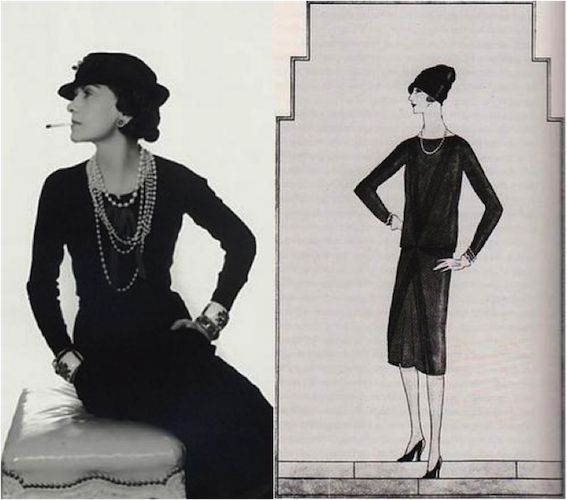
Coco Chanel opened her first fashion boutique in 1913, the first ever women's couture fashion house designed exclusively by a woman. Before Chanel, women's clothing required full skirts, petticoats, corsets, and ruffles. Her designs dropped the corsets, high waists, frills, and constricting sewing patterns worn for centuries before. Chanel changed the way women viewed fashion, which was just as much about sexual politics as design. Chanel was once quoted saying,
“Designers
have forgotten that there are women inside these dresses.” Source
Her designs, in contrast, were
simple, sophisticated, stylish, and practical. Chanel also said that she
“…want[ed]
to give women the chance to laugh and eat, without necessarily having to faint.” Source
Women loved
the freedom Chanel’s dress designs gave them, with the loose boyish cuts,
lower waistlines, and no enormous skirts with layers of petticoats to weigh them down or restrict movement.
Women on the streets of France in day coats, 1913. Source
Her designs gave women freedom to move without restriction,
and her use of flexible jersey fabric during World War I - originally designed for men’s uniforms - meant women could comfortably work in factories and in shops, but still feel
feminine. Soon her style was all the rage of both upper and
lower classes. When the war ended, other fashion houses adopted Chanel’s designs, ending the era of
corsets and opening to effervescent flappers. Chanel’s
desire to elevate the value of women came from her value of fashion in a
woman’s world.
“Dress shabbily and they remember the dress. Dress impeccably,
and they remember the woman.” Source
Chanel's greatest claim to fame was the little black dress. Chanel published a photograph of her LBD in American Vogue,
which to this day is considered an essential in many women’s closets. However,
the little black dresses made now, often very form-fitting and revealing, are
very different from the intentions of the original, which was designed
to be elegant but practical. Vogue referred to it as “Chanel’s Ford”, like the Model T, saying it was "a sort of
uniform for all women of taste".
The fashion world fell out of love with Chanel after World War II. Fashion had become
so practical some considered it unexciting. Dior felt the overtly functional and masculine clothing made for women during the Second World War looked too “square shouldered, like boxers.” Christian Dior opened his first
fashion house in late 1946, designing his women to look like
“flower ladies,
with soft shoulders, busts in full bloom, willowy waists, and skirts that
blossomed like corollas.” Source
Dior drew inspiration from the frilly, full-skirt, and corseted women of his childhood. The designs
were simpler, with clean lines and enormous skirts which could take up to 30 metres of fabric
to create – an extravagance which drew much criticism after years of strict rationing
during the war. His pattern designs were considered revolutionary, what with the layering of five or six petticoats sewn together inside the skirt to increase its volume. Thus, the wearer only needed to put on one layer over her undergarments. Dior's hourglass silhouettes, with full skirts, padded bras, and cinched waists, were reminiscent of wealthier pre-war years.
Christian Dior exhibition at the Royal Ontario Museum. Source
Women loved the designs for their feel of luxury and femininity. However, Chanel felt Dior’s
designs stood against everything she had achieved for women. The
weight, volume of fabric, exaggerated cinching of the waist, and exquisite
detailing of Dior’s dresses made it difficult for women to move. In the
ROM’s Dior exhibition, there is a
video showing women wearing enormous Dior ballgowns, wandering around a lavish
French bedroom and household, socializing in beautifully decorated sitting rooms, acting as moving decoration.
Christian Dior exhibition at the Royal Ontario Museum. Source
This struggle for the freedom of women’s bodies in fashion continues
today through independent fashion designers striving to create designs that
look good on all body types, and new inclusive couture lines. Where Chanel gave freedom to women to move, breathe, and play, Dior contributed to the thinking of those who wished to remove
women from the work force and put them back in the home. Although Dior's designs are exquisite, they forgot to consider the living person inside them, and women in general, are more than mere beautiful flowers to look at.
“The Christian Dior fashions in this exhibition are beautiful,” reads the first sentence of the curatorial statement in the Royal Ontario Museum (ROM)’s very own Christian Dior exhibition, which draws from the museum’s permanent collection. First, it is refreshing to read a curatorial statement when first walking into an exhibition space. Dr. Alexandra Palmer, the Senior Curator of Textiles & Costumes at the ROM, tells us the story of what led to this exhibition and the research and collaboration necessary for it to come to fruition.
Curatorial Statement by Alexandra Palmer. Photo courtesy of Julia Zungri.
This is the first time that the ROM’s Christian Dior collection from the postwar decade (1947 to 1957) will be on display, featuring over 100 objects. The ROM's Youtube channel features incredible footage of all of the hard work that went into conserving and preparing these objects for display. Here is a video of behind the scenes footage with the ROM team, courtesy of the ROM:
The exhibition, presented by Holt Renfrew, examines the first decade of designs by Christian Dior. This decade of design is marked by the construction of the successful “New Look:” the “New Look” introduced cuts and designs such as soft shoulders and cinched waists - a challenge to the wartime masculine silhouette. As a result, the exhibition also pays particular attention to the meticulous work that went into these pieces by designers, as seen in the video below, courtesy of the ROM.
Panel explaining the success of the "New Look." Photo courtesy of Julia Zungri.
The organization of this exhibition is one of the reasons why it is so successful and enjoyable. I was first presented with two display cases opposite each other: one briefly explaining the fashion of the 19th century, and the other, the inspiration Dior took from 19th century fashion, as well as changes he made. This is a really useful introduction to not only understand what Dior was thinking in the post-WWII period, but also (however brief) to appreciate a timeline of major fashion trends over that century. Additionally, before viewing any pieces, visitors are presented with a legend of what each fashion term that will be used throughout the exhibition means - which was really useful for someone like myself.
"Decoding Dior" legend, particularly useful for someone who is not well versed in fashion vocabulary. Photo courtesy of Julia Zungri.
The pieces are arranged thematically by Day, late Afternoon to early Evening, and Evening wears. The pieces are contextualized and interpreted in a very creative and user-friendly manner. For example, one of my absolute favourite features of this exhibition is the use of at least two iPads in every theme. The iPads allow visitors to view original sketches and swatches, detailed photos, stories and photos of models and women who wore and owned the pieces, original advertisements, and much more – and they were all related to the pieces actually on display! This is such a clever way to avoid writing too much text but also to contextualize these pieces that merit a closer examination (very fashion-forward, I must say – pun intended). I also had an incredible urge to touch all of the pieces (or why else would I be in this field)?! Having the iPads provide detailed photos settled this urge and curiosity (although I’m still hoping the ROM will one day let me touch one of the dresses).
The above three photos exemplify how the iPads work and what type of information they reveal.
Options are available to zoom in and out of photos and are directly related to pieces on display.
Photos courtesy of Julia Zungri.
The iPads were also complemented by archival videos, displayed throughout the space, of women wearing Dior’s pieces and of Christian Dior and designers creating these textiles that are featured in the exhibition (as seen in the video below). These digital applications help the pieces, worn by mannequins in the space, come to life.
Another example of where videos play throughout the space. The videos contain footage of the textiles on display either being worn and/or created. Photo and video courtesy of Julia Zungri.
These three photos (above and below) further illustrate how the digital applications used in the space help humanize and tell a story of the pieces. Note that the dress in the photo on the bottom left is being worn by the woman in the photograph on the bottom right. Photos courtesy of Julia Zungri.
I had the pleasure to visit the exhibition with fellow Musings writer, Kelly Manikoth. I feel I have no choice but to feature her absolute favourite piece from this exhibition, because it is breathtaking:
Give me a moment while I try on my prom dress and just pretend. Photos courtesy of Julia Zungri.
My personal favourite! Note the great amount of detail that the iPads provide (right)! Photos courtesy of Julia Zungri.
The exhibition also highlights textile industries that flourished alongside Dior, featuring embroidery, fabric, and ribbon samples used in Dior’s pieces.
This in particular is a Staron printed textile register from 1955. This is a page with three Bambou samples. I can just imagine the process of archiving all of this material at the time! Photos courtesy of Julia Zungri.
The garments are not the only pieces on display: the exhibition also features perfume, shoes, accessories, and original advertisements by and about Dior.
Now that's what I call a statement necklace. Photo courtesy of Julia Zungri.
The display of the perfumes is also quite clever! Positioned in a display case behind frosted glass designed to replicate a shop window, visitors are subconsciously slightly bending to look through the "shop window."
Photo of Kelly Manikoth 'shopping' for Dior perfume!
Photos courtesy of Julia Zungri.
It was extremely interesting to witness Dior’s world and what he wanted for women through fashion in the post-WWII period. This truly is an exhibition that needs to be seen: the fine details of the pieces, the array of textile samples, and most especially, the enjoyment of using the iPads and watching the videos in this space cannot be sufficiently described in words. I hope my photos and words, though, have done it enough justice and I encourage you to visit.
Until 2018, a more fashionable Julia bids you adieu.