Showing posts with label Ceramics. Show all posts

19 November 2018

THEY HIDE, YOU SEEK

Exhibition Reviews | Maddy Howard

So, what's your zodiac sign? I'm a Sagittarius, which I guess means that I'm generous, idealistic, and have a great sense of humour. I like to think that's pretty accurate.

Sagittarius. Photo courtesy of Maddy Howard.
On Friday, the Gardiner Museum welcomed a new exhibition dedicated to the twelve Zodiac signs. David R. Harper: Zodiac explores the twelve signs of the Zodiac through the medium of ceramics. The exhibition is inspired by the astrological imagery associated with each sign. These works create a rich way of looking at and interacting with the Zodiac. The artist explains the works are "not based on what we typically read for a certain sign, but how those characteristics translate into the world." 

These original works were commissioned as a part of New + Now, which is an annual celebration of emerging artists and contemporary ceramics, both in Canada and internationally.

Leo. Photo courtesy of Maddy Howard.
Now, you're probably wondering, "what on earth does hide and seek have to do with this exhibition?" Well, I'll tell you. Zodiac is one of the more interesting and unique exhibitions I've been to recently and that is because each piece is spread out throughout the entire museum.

That's right, the exhibition is not in one place! Pieces are interspersed around the museum, intervening in the regular gallery spaces and encouraging visitors to participate in this museum-wide scavenger hunt.

Aries. Photo courtesy of Maddy Howard.
I thoroughly enjoyed this exhibition and was totally invested in going through every single gallery and finding the Zodiac pieces. I would recommend grabbing the Zodiac pamphlet at the beginning of your tour (which you can grab at the counter when you purchase your ticket). This way, you can see what each piece looks like, but it won't tell you where to find them. That's all on you. 

Make sure you check every. single. room. And maybe bring a pen to check off pieces that you've found, which I did to make sure I saw every single piece. I missed Cancer and had to go back through to find it.

Zodiac map. Photo courtesy of Maddy Howard.
The exhibition encourages you to walk through the museum and enjoy the wide variety of ceramics on display. These pieces are meant to be found and enjoyed with the rest of the works in the galleries. When you're looking around the galleries, keep an eye out for the little sign beside the works that indicate the piece is a part of Zodiac. It was really enjoyable to walk through a gallery and spy that little sign and know that you've found another piece.

There are no labels to tell you about the piece, but I actually enjoyed that pieces stood alone and stood out to the visitor. All the information you need is in the pamphlet, and it allowed visitors to take their own meaning away from the works. 

Zodiac label for Aquarius. Photo courtesy of Maddy Howard.
Zodiac offers visitors a fun and unique experience. By dispersing the pieces throughout the museum, visitors are encouraged to embark on their own scavenger hunt. You become responsible for finding the pieces and seeing the complete exhibition. It also promotes visitors to hit every single room, to check and see if there is a Zodiac piece there. There are some spaces that I might not have been interested in seeing if I wasn't looking for the different signs. It was rewarding to find the installations, but to also experience the whole of the museum, instead of picking and choosing only some galleries to see. 

Pisces. Photo courtesy of Maddy Howard.
Zodiac opened November 16, 2018 and runs until January 6, 2019, so wander on over to the Gardiner Museum to find your own Zodiac sign.

Source.

17 November 2018

LET'S TALK ABOUT "POWER AND POSSESSION: THE ETHICS OF COLLECTING"

Collections Corner | Carly Hall


What do you do when you want to procrastinate productively during reading week? Go to a museum talk!

Entrance to the Gardiner Museum, Toronto, Ontario. Photo courtesy of Carly Hall.

On Wednesday November 7th, the Gardiner Museum hosted a brilliant panel titled "Power and Possession: The Ethics of Collecting." Moderated by Sean O’Neill, the panel was comprised of individuals with different experience in museums: Dr. Mark Engstrom (Deputy Director of Collections & Research at the ROM), Candice Hopkins (Senior Curator of the Toronto Biennial of Art and co-curator of the SITE Santa Fe biennial, member of Carcross/Tagish First Nation), and Adrian Stimson (interdisciplinary artist exhibited nationally and internationally, Siksika Blackfoot Nation). The panel coincided with the Gardiner’s special exhibition Obsession: Sir William Van Horne’s Japanese Ceramics; however, the discussion was geared toward how museums practice ethical collecting, using Sir William Van Horne’s collection featured in Obsession as the starting point for conversation. In this post, I will summarize the panelists' opinions on two themes: narratives and practice, and repatriation.

Before a real discussion on the exhibition and ethics of collecting could begin, moderator Sean O’Neill provided some context on Sir William Van Horne. Born in America, Van Horne moved to Winnipeg in 1881 to help with the building of the Canadian Pacific Railroad. The construction of the CP Railway was done primarily by Chinese labourers, who received less pay and lived in poorer conditions than White labourers working on the railway. In 1889, he move to Montreal, settling in a mansion located on the Golden Square Mile. During Van Horne’s residency, 70% of the Canadian economy was controlled by the small group of men living in this neighbourhood. O’Neill also highlighted that as the President of the Canadian Pacific Railroad (appointed in 1888) and overseer of its expansion into Western Canada, Van Horne was complicit in the displacement and cultural genocide of Indigenous and Metis communities.


Portrait of Sir William Van Horne. Source.

Narratives and Practice

When it came to identifying the primary issue of Obsession, all panelists agreed that the problem was Sir William Van Horne himself. The exhibition lacks an uncritical analysis and contextualizing of Van Horne as 19th century industrialist, which lead to O’Neill’s first question for the panel: “What is our obligation to contextualize exhibitions?”

Candice Hopkins began by stating that museum professionals are faced with a “deeply unethical field,” for which “there is no playbook.” Therefore, institutions must attempt to establish and negotiate authority and advocacy for artists and communities, and strive to provide transparency in their collection practices. An example of this would be providing greater availability of an object's provenance to the public.

Dr. Engstrom agreed that there is an obligation for contextualization and the consultation of communities being represented in exhibitions. The responsibility to reach out to the community lies with the curatorial team; it’s “not enough to have the singular authoritative voice of the curator.” Regarding the ROM’s Indigenous collection, the risk of dubiously acquired objects has led curators to attempt to clarify all gaps in the provenance of any given object, and make these records publicly available in the archives.

Repatriation

Adrian Stimson was the first to state the obvious: Canada does not have a working repatriation legislation. Instead, communities must rely on advocacy and activism if they want an object to be returned. Stimson recalled the efforts of his own community to repatriate Blackfoot materials; 4000 letters were sent to 4000 museums around the world, and only 400 museums responded that they were in possession of Blackfoot material culture. The act of repatriating materials is more complex than simply returning an object. As Stimson noted, materials need to be properly housed to prevent damage; unfortunately, not all Indigenous groups have the monetary power to build the storage complexes necessary to house repatriated objects.

The ROM is certainly no stranger to repatriation requests. According to Dr. Engstrom, there have been an increase in requests to have Indigenous objects repatriated. Dr. Engstrom gave a basic depiction of what repatriation looks like at the ROM: a letter of interest for an object is sent from a community, the request is sent to the Board of Directors, the Board approves, and the object is sent home. “Ultimately, the institution has the say for repatriation,” which means that the ROM decides an object’s cultural patrimony when faced with multiple claims of an object from different communities.

Hopkins suggested that it would be more productive and equitable for a repatriation request to go to an external committee. Dr. Engstrom agreed, and then in a moment of candour he stated perhaps the biggest worry of the Board (and arguably of all museums with deep colonial roots): “If we give one thing away, do we then give away all objects of all cultures?” Cue the awkward silence.


The night concluded with drinks, amazing one-on-one conversations, and after-hours access to Obsession. Before I left I took one last stroll through the gallery, reflecting on the panel and viewing the exhibition more critically than I had during my first visit. I couldn’t get Dr. Engstrom’s last question out of my head. Institutions should certainly repatriate objects to communities with legitimate claims – but what does this mean for the future of museums and collections? At the moment I honestly can't say, but it's absolutely worth thinking about.

The Gardiner Museum will be hosting Obsession: Sir William Van Horne’s Japanese Ceramics until January 20, 2019.

13 November 2018

CRACKING CERAMICS AT THE GARDINER GIFT SHOP

Beyond Tradition | Elizabeth Cytko

Front view of the Gardiner Museum.
Photo Courtesy of Elizabeth Cytko.
The Gardiner Museum is a smaller museum dedicated to ceramics. Entering the museum, the main part of the gift shop is to the left. Another part of the shop spills out into the lobby, a glass case featuring larger works of pottery which do not fit on the smaller gift shop shelves. The main aisle is wide and easily accessible within the store, except there is a smallish corner where there could be some issues if using a larger mobility device. The atmosphere is a relaxed browse, with an attendant nearby to help if necessary. The lighting is interesting because a lot of it is focused upon the objects themselves, where each piece is literally shown in the best light possible. How the objects are arranged also indicated there is care in representation. The gift shop works with the local community, such as the Toronto Potters, to promote high end ceramics.

The main part of the gift shop.
Photo Courtesy of Elizabeth Cytko.

The ceramics range from mugs, Christmas decorations, and wall pieces, to larger more abstract pieces. Due to copyright, I was unable to take photos of the various amazing ceramic pieces in the store; however if interested you can visit the online store which does contain images. The price range for the ceramics usually starts at $15 - $1000+ depending on what you are buying.

One of a kind tea towels.
Photo Courtesy of Elizabeth Cytko.
The few non-ceramic items include handmade jewelry, a few books, houseware, the ever-present kitschy wine pourer, and other smaller items like postcards. One of my favourite discoveries is the special edition tea towels featuring designs from their own collection. This meant that this specific series could only be found at the gift shop, a unique item which serves as a direct reminder of a visit to the museum.

Books relevant to the special exhibition.
Photo Courtesy of Elizabeth Cytko.

When it comes to special exhibition items, there are some ceramic pieces from Yoko Ono,who had an exhibition there earlier this year. For the Gardiner’s current exhibition, Obsession, the shop has a guide book describing the history of the collection as well as books on Japanese ceramics for people who desire  more information than what the exhibition provides.

Large sale case in the main museum lobby.
Photo Courtesy of Elizabeth Cytko.
The gift shop is a wonderful microcosm of the museum itself. This is the section where you, as a visitor, can finally purchase a fine pottery piece for your own collection. The range of items and price within the shop indicates that the main clientele of the museum are adults who value unique quality over generic quantities. While the Gardiner does host some excellent programming for families and children, the gift shop overall is not catered to lower age demographics.

Overall, I would rate the gift shop 4/5, taking a point off in regards to the minor accessibility issues.

If you are curious about my rating guide please refer to this post.

22 October 2018

HOT OFF THE (FRENCH) PRESS


A Muse Bouche Alexandra Forand


The phrase “let’s get coffee” has many meanings. It can mean “hey, I haven’t seen you in a while and I want to reaffirm our connection,” or it can mean “we do not really have a connection, but I want to get to know you better.” While this phrase has many meanings, it is usually a sign of friendliness, interest, and a desire to bond with another person. So dear readers, I hope my first article is a way for us to get that proverbial cup of coffee and help us get to know each other a little better.
I was interested in how the act of “getting coffee” became the standard for getting to know someone. It occurred to me that drinking coffee in a social sphere is not new, but has a long history. The most notable evidence of this obsession with coffee (and other hot drinks) is a vast amount of ceramics. In Bruno Blondé and Wouter Ryckbosch's chapter entitled “Arriving to a Set Table: The Integration of Hot Drinks in the Urban Consumer Culture of the Eighteenth-Century Southern Low Countries,” the authors assert that the relative abundance of hot caffeinated drinks (such as coffee) led to significant expansion of the retail market. In other words, the love of coffee created an unprecedented desire to show off the fact that you could afford this luxury, thereby spurring the growth of the ceramics industry.
Tea Pots at the Gardiner Museum. Photo courtesy of Alexandra Forand.

With this in mind, I headed down to the Gardiner Museum to check out the 18th century European porcelain collection. According to the exhibit there were three culprits that led to the mass production of ceramics or “porcelain fever” in Europe during the mid 18th century. These refreshments were coffee, tea, and chocolate (while solid chocolate was available, liquid chocolate, similar to a thicker hot chocolate we know today, was popular at this time). These goods were so readily sought after that vast amounts of porcelain were produced for the upper class in the form of full tea sets, so that they could enjoy their liquid luxuries in a way they were accustomed to. I was surprised to find out that another popular way a wealthy person could enjoy their tea, coffee, or chocolate was from their own personal solitaire. A solitaire is a tea set made for a single person with the intention of having tea alone. The thought of having tea alone seems like a dismal affair, especially since I have always seen it as a social situation.
Tea Cups. Photo courtesy of Alexandra Forand.

I noticed the solitaires were intricately designed. In many cases the designs featured on the pieces were unique to that specific article of the set. While these intricate drawings on the ceramics might feel disconnected to food studies, they are very important. Firstly, the pieces themselves are essentially primary sources. They show the availability of tea, coffee, and chocolate, which varies from nation to nation  For instance, “chocolate cups” like the one below were common in Austria, and tea cups were popular in France.
Cups designed for drinking liquid chocolate. Photo courtesy of Alexandra Forand.

Secondly, the pictures engraved on the piece usually depict social scenes. At first glance they might seem like amusing portrayals, representing what the artist was seeing at the time. For instance, the piece below depicts a crowd sharing a meal. Perhaps this is a family or a group of friends. On a different piece from the same solitaire, the scene is perhaps a festival or circus. What caught my attention was the women holding waffles with the two dogs begging nearby (a scene all too common in my house)!

Solitaires. Photo courtesy of Alexandra Forand.


No matter what your beverage of choice, I hope you enjoyed coming along to learn a little about the history of “getting coffee” and think about it next time you invite someone to do the same!

10 March 2017

REPLICATING TO UNDERSTAND? A STANFORD UNIVERSITY APPROACH TO THE MUSEUM OBJECT

OBJECT OF THE WEEK

BY: ELEANOR HOWELL-CHRISTENSEN

Reproducing a priceless (or at least very valuable) museological object is usually synonymous with the term forgery. Reproducing for money is a time-old practice that's plagued the museological community for centuries: think of the Cerne Abbas Giant or the Holly Oak Pendant.  Yet a class at Stanford University is actually encouraging its students to reproduce historical objects, not to gain money but to gain more understanding.

'Things that you learn by doing are lessons that last for a lifetime,' says lecturer Kristen Haring, who teaches the Objects of History class at Stanford. Students replicate historical objects and then interact with them, allowing them to get a literally hands-on approach to the historical eras they're studying. The course uses a combination of modern approaches (think 3D printing) and traditional approaches (think potter's wheel) to explore various objects from the Stanford Collection.

The idea isn't completely new - I remember writing on papyrus in grade school to get a feel for Egyptian Hieroglyphics - but the Stanford course takes the concept to new heights. So what do you think? A fun way to engage with history, or a waste of time?

Check out the video here:


24 March 2016

THE ROOM OF FORGOTTEN FACES: MOCHE PORTRAIT VESSELS

MUSEUM MYSTERIES

BY: CHRISTOPHER WAI

Since it is the end of the school year and quite a busy time, I'll end the semester with a tale.

Huaco Retrato Mochica, Museo Larco. Source.  Catalogue Record.

It was the first full day we had in Peru and I had just met (most of) everyone. Tomorrow we were off to Pacasmayo and the start of the field season. 

But first, the Museo Larco!

Groggy and jet-lagged after three plane trips, my mind was still on tea, casemate walls, old friends in Madaba, and the new ones here. In the back of my mind, the spectre of the uncertain job hunt that awaited after undergrad loomed large. This was the final hurrah before graduation and the happiest summer of my life so far.

So, sufficed to say when I arrived in Lima in 2014, I was a tad off guard as I stepped into a room full of faces. It's not often that one gets to meet the faces of the distant past, so to speak. 

I'd read of them, but still didn't expected it then and there (or at least, not so many).

Storage Gallery, Larco Museum. Lyndsay Ruell

At the Museo Larco were rows and rows of cases ten feet high of lifelike faces molded on clay vessels and most had tubes that joined to a spout at the top. Some were old others were young and ranged from calm, genial to grim  At somewhere only marginally over five feet, I could only squint at the top shelves and couldn't begin to figure out how to see them all.

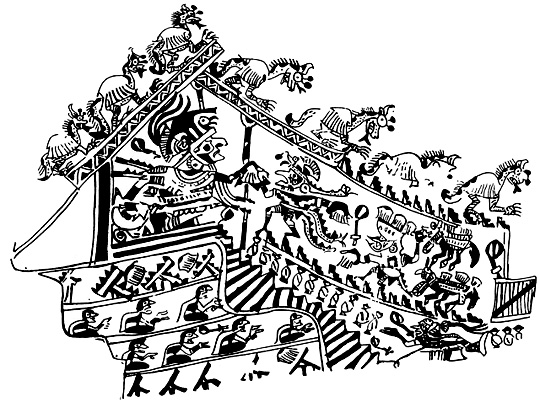
These were the portrait vessels of the Moche (100-800 CE/A.D.) of North Coast Peru who lived long before the Inca dominated the Andes. 

Out of Context?

But most of these portrait vessels unfortunately came from unknown places. By Dr. Christopher Donnan's estimate, 95 percent of all the portrait vessels in existing collections came from unknown contexts. 

The sites they came from were unknown, let alone their location within them in the ground spatially or even temporally. The related burials, middens or structures and related finds they belonged to is not completely clear. Portrait vessels in collections were recovered from second hands- huaceros (looters), old antiquarians or archaeologists of a bygone era. They have been organized more generally into phases though based on the form of their stirrups (the long tubes/ spouts) which they share with other types of "stirrup vessels" that do have their archaeological context intact.

Though one can analyze an object in many ways, it could easily be in many inaccurate ways without understanding their context in the world of the people who created them, used them and left them behind. We are the ones calling them "portraits".

Larco Collection in the earlier days. Source.

Still, progress on research has been made.

Realism?

Most depictions of the Moche are in a highly stylized forms on ceramic vessels that make it difficult to identify or imagine the people depicted in life or to parse the varied real or stylized elements.

Conch Shell Transfer Scene, rollout drawing. Donnan and Mclellan 1979. Source

Conch Shell Transfer. Source.

But from these life lifelike portraits, we have a clearer visualization of the headdresses (headcloths, head rings, feathers and tassels), ear ornaments (ear spools, tubes and discs), nose ornament, face paint and occasionally, necklaces being worn. We also see a variety of symbolic and decorative elements.

Of course, whether they represented the large majority is another matter.

The Same Persons Throughout Their Lifetimes?

One of the most amazing things is that the extant collections, along with full figured (head and body) versions, seem to show that there is a pattern of the same person being replicated at different times in their life. Not one for each period in life, but multiples.

A few of them (all nicknames of course):  "Bigote" (moustache), "Long Nose" and "Black Stripe" tell stories of their lives from warriors in full regalia to ceremonial sacrifices with nooses around their necks.

Another, called "Cut Lip" based on the scar on his upper left lip seems to be an entire category that spans from his youth into his thirties with different ornamentation.

Who and how well known were they?

Their exact stories are unknown, just as their exact locations often are.

Time will tell perhaps.

Of course, there was yet another surprise at the Larco, but that's for another time...

If you are still interested, here's a lecture by Donnan:

                     Moche Portraits From Ancient Peru, UCLA Faculty Research Lectures (Link) 
Just a picture, not embedded!

Works Consulted:

Donnan, C. (2004). Moche Portraits from Ancient Peru. University of Texas Press.

15 March 2016

BENEATH THE SURFACE: LIFE, DEATH, GOLD AND CERAMICS IN ANCIENT PANAMA

EXHIBITION REVIEWS

BY: STEPHANIE READ

I had the chance on a rainy afternoon this week to check out the current temporary exhibition at the Gardiner Museum, "Beneath the Surface: Life, Death, Gold and Ceramics in Ancient Panama", which had been recommended to me. I am not usually a patron of this type of exhibit, however I was blown away by the unique display aspects of the exhibition permitted by the fastidious note-taking of the original expedition leaders back in the 1940s as well as the sheer volume and artistic quality of the items found in several long-hidden grave sites of the Coclé people along the Rio Grande. The exhibition runs until May 29th, 2016 and entry is included in the base ticket price.

Got my museum-visit shawl on and everythang. Courtesy of E. Suharev

Unfortunately, I was not permitted to take pictures in the exhibition space, however I wouldn't want to ruin some of the surprises for those who intend to go! "Beneath the Surface" boasts an array of fabulously decorated ceramics, golden plaques, jewelry, accessories and items from every-day life discovered in complex tiered burial sites. As a fan of design, I loved the ceramic plates and bowls featuring the chimeric compositions characteristic of Coclé art. Interpretive materials in the space offer open-ended, possible explanations for the stylistic renderings of beasts and organic forms. I learned that the snakes on the plate below, for instance, have markings reminiscent of a boa constrictor, despite possessing three legs apiece and bodies contoured by sinuous bristling lines suggesting fur. 

Plate with snakes and scrolls. Sitio Conte, Panama. Ceramic, 700-900 CE. Courtesy of Penn Museum

My favourite pieces ranged from a gold charm in the shape of a vampire bat the size of the tip of my finger, to large lovingly-reassembled plates featuring twisting, antlered and quite startled-looking deer. There are also a particularly charming headless armadillo effigy and a wide-mouthed ceramic frog. Interviews with scholars and researchers on a host of topics on the Coclé people, their environment, processes of excavation and much more. This exhibition makes excellent use of supplementary digital technology, especially with regards to the mapping of the burial sites.

1940s excavation site at Sitio Conte, Panama. Courtesy of Penn Museum

What stands out for a collection like this, and why you should see this specific exhibition, is that the extensive burial sites of the Coclé people, laid over a thousand years ago near the banks of the Rio Grande, were discovered untouched by looters. Therefore, the excavation team from the Penn Museum was able to make accurate and copious notes of exactly where everything was found. Fair warning for today's museum students: unfortunately, the ethical implications of the removal and dissemination of artifacts from an indigenous burial site are not touched upon in the exhibition, but that is a topic worthy of another post altogether. "Beneath the Surface" is worth a visit due to the unique opportunity to view an immersive and thorough reconstruction of the burial sites via an admittedly very cool multi-layered display case.

Plaque. Sitio Conte, Panama. Gold, copper, silver, alloys, 700-900 CE. Courtesy of Penn Museum.

Another feature of the exhibition which captivated my attention for way too long (my museum companion left to catch some z's on a bench) was the explanation of the innovative methods of metallurgy employed by the Coclé people in the production of intricate gold ornaments and highly burnished embossed plaques. This information permitted me to engage with the golden objects on a deeper level than a McTeague-like aesthetic reverie. I am happy to admit that I came away with much food for thought and an urge to purchase a drafting curve.

If you have the chance, please visit "Beneath the Surface" at the Gardiner Museum. You can learn more about the particulars of the exhibition here. For further reading, check out the Penn Museum Blog series on Sitio Conte, which profiles the expedition through historical images, newspaper clippings, letters, diary entries and more!

Have you seen this show? Share your thoughts in the comments section below!

14 October 2014

EXHIBITION IN PIECES: PIECE BY PIECE AT THE GARDINER

EXHIBITION REVIEW

BY: MEAGHAN DALBY

I must admit, Clare Twomey’s exhibition Piece by Piece at the Gardiner is not the kind of exhibit I usually get excited about. Personally, I find a lot of "modern" art too static. However, this piece (or pieces, really) might just change my mind.

Piece By Piece as you walk into the exhibition
Photo Credit: Meaghan Dalby
Piece by Piece is an interesting installation. When you walk in, you are immediately greeted by 2,000 porcelain figurines arranged some what haphazardly on the floor. They're all unpainted and have a white unfinished feel. It's overwhelming. At first glance it kind of looks like they were running around and froze in that spot à la Toy Story (no luck catching them yet…). There are three plinths housing the original figurines, from the Gardiners' collection, which were used to cast the moulds. They are raised up, above a comfortable eye line and are turned facing away from the visitor. Many people don't like this, but to me they are positioned purposely to shut us out. They are raised above us, living in a spot light, as the image of perfection looking down at all their carbon copies relegated to the floor. Full disclosure, it took me probably two days of staring at the exhibit to come to this conclusion. So I don't blame visitors who spend 20 minutes in here for not “getting it” or finding it somewhat inaccessible. 

Some broken pieces on display
Photo Credit: Meaghan Dalby
What is a really cool element, though, is the inclusion of the “maker.” Once a day, an artist will come in, sit at a desk positioned at the other end of the room and make more porcelain figures which are to be added to the floor. The “maker” is part of the exhibit, also has her back to the visitor, and is not allowed to interact with anyone. Again the visitor is shut out, like we're intruding on this weird, almost mad process of creating more and more “perfect” figurines. It's delightfully insane.

The "Maker's" Table
Photo Credit: Meaghan Dalby

I do like this installation. There is so much going on, you could talk about themes and meanings for days. What I like is that every person who comes in has a new take on it from how I've understood it. However, from a museological standpoint, it leaves something to be desired:

1. It's hella dark. The figurines are small, and it's very hard for visitors, especially elderly ones to see them. I know this is how the artist wanted it set up, which raises some questions about balancing the look and feel of an exhibition with accessibility for the visitors.  I'd love to hear your opinions on this below...

The "Maker's" table in the spotlight, the figures in shadows
Photo Credit: Meaghan Dalby
2. There's next to no explanation. There is one wall panel, but it’s written in a way that is hard to understand. Most visitors ask for clarification, so I suppose that having a gallery attendant is in lieu of panels… Though I don't think that was the museum's intent.

3. People don't understand why they are shut out by the “maker” and the objects on the plinths. If they don't talk to the Gallery Attendant, or stay long enough to sort it out, it can be a very uninviting exhibition.
Leita, one of the original figures on the plinths, with her back to us
Photo Credit: Meaghan Dalby
4. I wanted to walk between the figurines SO BADLY. That feeling makes me wish there was some kind of interactive element, even an opportunity to respond to the exhibit in some way. For the most part it feels like we've stumbled into a workshop behind the scenes that we weren't supposed to. But I think maybe that's the whole point (art…amirite??).

Overall, I really like this exhibit. I think there is so much to talk about, and some of the museological concerns I've outlined above can't be avoided. In fact, some of them lead to conversations - which I imaging is part of the artist's intent. 

Has anyone else seen it? What do you think? It's entirely possible that I've been staring at the installation for too long and have over-thought the whole thing. Let me know!!