Showing posts with label Contemporary Art. Show all posts

25 November 2021

THE ENDURING RELEVANCE OF PIONEERING OCCULT ARTIST ROSALEEN NORTON


____________________________________________________________________________________

"I came into this world bravely, I'll go out bravely."

~ Rosaleen Norton, artist, occult practitioner, daughter of Pan, before her death in 1979

Rosaleen Norton has only recently begun to get the cultural recognition she deserves. Despite being a tremendously influential and defining artist of the mid 20th century, Rosaleen’s unapologetic artistic legacy remains relatively obscure compared to her counterparts. Perhaps this has to do with how she was outcasted, crudely mocked and relentlessly hounded by the media. She was branded by most as a depraved, satanic witch. In the 1940s and 1950s, she became a national fascination and was perceived as a major threat to the social norms and moral orthodoxy of a predominately Christian Australia. Her artwork, tragically misunderstood, was torched by the government, confiscated by police and censored by major museums and galleries in Melbourne. She remains the only Australian artist whose work was physically destroyed by order of the courts. Rosaleen also faced charges of obscenity for her provocative paintings depicting Greek gods and goddesses, female sexuality and ritual magic. In a recently made film about the artist, director Sonia Bible proclaims that Rosaleen was once “the most persecuted artist in Australia.”


Rosaleen Norton with one of her paintings, c. 1945-1950. Source.


Born in Dunedin, New Zealand in 1917 and plagued with spiritual visions as a child, Rosaleen had always been fascinated by the otherworldly. What seems now to be an instance of cosmic foreshadowing, at 14 she was expelled from school for supposedly corrupting fellow schoolgirls with her “deviant” drawings. By her twenties, Rosaleen was mastering her occult and artistic skills, practicing Aleister Crowley trance magic and creating paintings that fused her search for transcendence with her spiritual beliefs. Being openly bisexual – in addition to her unconventional appearance, love for animals, bohemian lifestyle and penchant for worshipping and painting figures like Pan (a Greek god who resembles and is often mistaken for Lucifer) – made her a true outsider amidst the hyper conservative landscape of mid-century Australia. A 1949 exhibition of her work held at the Rowen-White Library in the University of Melbourne ended with a police raid and charges of obscenity. Later, her book The Art of Rosaleen Norton with poems by Gavin Greenlees (published by Walter Glover in 1952) was heavily censored in Australia and banned in America, and resulted in Glover also facing charges.


Rosaleen with her cat, c. 1945-1950. Source.
Rosaleen Norton with her cat, c. 1950. Source.


Even though she was admired by visionaries like Carl Jung and Kenneth Anger, the scope of Rosaleen’s far-reaching cultural impact has yet to be fully realized and appreciated. She was a subversive, fearless artist who spearheaded a path forward for generations of eccentric and bold female artists to be themselves. Her unprecedented body of work has endured despite decades of backlash and unlawful attempts at suppression. Over half a century later, her art has begun to slowly resurface in various Australian exhibitions— such as one held in 2000 that was solely dedicated to the display of her paintings in Kings Cross, Sydney (where she lived most of her life) by enthusiasts of her work. Others include the S.H. Ervin Gallery’s Windows to the Sacred: An Exploration of the Esoteric in 2013, and the City Gallery Wellington’s Occulture: The Dark Arts in 2017.


Rosaleen Norton sketching, c. 1945-1950. Source.


Despite renewed interest in Rosaleen, her work is not easy to access. Other than a handful of articles and images on Google, there is no widely accessible digital archive documenting her work, nor is it featured in any permanent exhibitions. Most of it resides in archives, private collections and rare books that are hard to come by. Rosaleen’s legacy and life’s work could have easily been lost to history. That begs the question: how many brilliant female artists have we lost due to museum censorship and government persecution? How can we ensure that the bodies of work produced by visionary artists who challenge the status quo are not lost due to museum practices that support nationalistic agendas? How can we reconcile with the fact that exclusion and censorship remain prevalent issues in museum spaces, and what can we do about it? All of us have the responsibility to continuously challenge and unsettle cultural institutions by questioning what gets to be remembered and who is included.


15 November 2021

HONG KONG M+ MUSEUM OPENING AMID CENSORSHIP CONTROVERSY

Muse News | Avigayil Margolis


As I write this article, Hong Kong’s M+ museum is scheduled to open in one day. M+ is Asia’s first museum of contemporary art, built to rival the Tate Modern and Metropolitan Museum of Art. On Friday November 12th, the museum will open, displaying 1,500 works from its collections of 6,413 to the public for the first time.

Two months ago, the museum was struck by a controversy regarding its choice not to display Ai Weiwei’s Study of Perspective: Tian’anmen (1997) which features the artist raising a middle finger at Bejing’s Tiananmen Square, in its online collection. Tiananmen was the site of a massacre by the People’s Liberation Army against peaceful pro-democracy protesters on June 4, 1989, resulting in thousands of deaths, injuries and arrests, as well as a massive government cover-up. This photograph was one of several pieces criticized by pro-Beijing politicians and media as inciting hatred against China, a violation of national security law.
 
A screenshot featuring Ai Weiwei's work on the M+ website with a Study of Perspective: Tian'anmen replaced with a grey image unavailable square. Courtesy of Avigayil Margolis.

Other pieces from the Study in Perspective series remain visible in the online collection even though they are not on display in the museum, so Tiananmen’s absence is glaring. Ai’s 2003 Map of China which features wood from Qing Dynasty temples and celebrates China’s cultural diversity has also been removed from the online collections. However, Whitewash (1995-2000), containing 126 Chinese Neolithic jars painted over by Ai is still being displayed during the museum’s opening and likely serves as a major draw due to the artist’s international fame.

Ai Weiwei has always been a highly political artist who criticized the Chinese government. In 2011 he was arrested and detained for 81 days, after which the government continued to watch him and restrict his movement by taking away his passport until 2015 when he was finally able to leave and moved to Berlin, Germany. His documentary Cockroach (2020) films the 2019 Hong Kong anti-extradition protests, empathizing with the youth fighting against an authoritarian government. His vocal support of the protests may be one reason his art is being specifically highlighted by politicians and media.

"China faces a massive problem if the youth of Hong Kong continues to protest," Ai said in a 2019 interview with the Hong Kong Free Press. "It is a challenge that alarms the rest of the world as to what kind of society China is. If they don’t stop the protests, the democratic voice will get louder and there will be better conditions for freedom. But how can they stop them? Hong Kong is not just another Chinese city. If that were the case, the military would have moved in and crushed it immediately. There would not be any media coverage or international attention. This already happens all the time in China. Hong Kong is different."

Looking back to protests against his own secret detention, during which artists posted his picture and name throughout the city to demand his release, Ai describes Hong Kong’s protests as "the most beautiful. They are so peaceful, rational, and those taking part are so young."

An activist holds a doll, toy handcuffs and drawing of the detained Ai Weiwei in front of a police officers during a Hong Kong protest demanding his release. Photo: Laurent Fievet/AFP

The museum’s decision to remove the controversial pieces raises serious questions about censorship in the museum field and what our role is as museum professionals.

"This is the first contemporary museum in Hong Kong, so therefore, I want to ensure that the message is clear so that people don’t think that we are above the law," Henry Tang, the head of the West Kowloon Cultural District which includes M+ said at the museum’s opening ceremony. But does the argument of just following the law really hold weight when the law is unjust?

M+ director Suhanya Raffel had earlier said that the museum would have no problem showing works by dissident artists. This has held true in some regards, with local artist South Ho’s photographs of the city’s 2014 Occupy Central protests and Kacey Wong’s Paddling Home installation which represents his exile from Hong Kong to Taiwan to due his democracy activism both featured in the museum. M+’s agreement to remove the criticized artworks may have prevented a harder government crackdown which targeted more art or prevented the museum from opening to the public entirely. On the other hand, there is an inevitable dishonesty to only allowing government approved dissidence.

Ai Weiwei has criticized the museum for capitulating to censorship. "When you have a museum which cannot or is incapable of defending its own integrity about freedom of speech, then that raises a question. And certainly the museum cannot perform well in terms of contemporary culture," he told Reuters during a phone interview.

This raises the question of where a museum’s obligations to support freedom of speech end. Can a museum choose to break the law of the country where it is situated? Is it worthwhile for a museum to sacrifice a few high attention controversial pieces to allow itself to stay open and display a multitude of other important artworks?

There are no easy answers to this question of course. As museum professionals, we must work to maintain our own ethics and integrity, but we are still members of our countries and societies, subject to the laws and punishments that accompany them. Living in Canada with our rights to free speech and a fair trial, it is easy to say that we would defy any government censorship laws that targeted our museums. But how many of us would really risk jail time for our work? And should we even be expected to?


29 July 2020

EKOW NIMAKO: LEGO LEGEND

Walk of Fame | Martin Bierens


When it comes to art there is no limit to the medium an artist can employ. This creativity is evident in the work of Toronto-based artist Ekow Nimako, who creates his art using LEGO bricks.

The inspiration for Nimako’s art came from a lifelong love of LEGO and the odd paradoxical freedom to craft rigid geometric shapes into flowing, lifelike structures. While Nimako is able to create extremely unique sculptures he articulates that LEGO’s structure informs and shapes his art.

Ekow Nimako with his artwork (Source). 

When viewing a Nimako sculpture the first aspect of the piece that one notices is the colour. Nearly all of Nimako’s sculptures are entirely black. This reflects his own identity as a Black man in Canada. Nimako says that LEGO is not typically perceived to be part of Black culture. It is only recently that LEGO has represented ethnic minorities in Minifigures. Before the 1980s, Minifigures were exclusively the iconic LEGO Yellow. Though LEGO’s goal was to create non-racial Minifigures, they soon became associated with Whiteness. The first representation of Black people as LEGO Minifigures was the introduction of an NBA Basketball playset, and the Star Wars character Lando Calrissian. This lack of representation was obvious to Nimako, and to address and combat the issue he creates distinctively Black art.

World on the Camels Back (Triptych) in Building Black: Civilizations at the Aga Khan Museum (Photo Courtesy of Martin Bierens)

Nimako’s art explores themes of Afrofuturism. Afrofuturism is a cultural aesthetic that draws influence from science fiction, history, and fantasy to represent the Black experience, particularly the African-American experience, and is a method for Black Westerners to connect with their African heritage. Many of Nimako’s sculptures come to mind when reading this definition. Some of which were featured in the exhibition Building Black: Civilizations at the Aga Khan Museum where Nimako created pieces that explored the history of Sub-Saharan Africa through a fantastical lens. Another notable piece is titled Cavalier Noir. This sculpture features a heroic Black rider atop of a large unicorn. When describing the work, Nimako likens the sculpture to bronze statues of White colonial conquerors. His wish is for the viewer to see a representation of a Black heroic figure, and for us to question “who are our heroes?”

Two young men viewing Cavalier Noir exhibited during Nuit Blanche 2018. (Source).

Using the platform Nimako has gained through his art, he is working towards affecting societal change. Nimako’s art is intrinsically linked with his race and he considers himself an identity-based artist. As such, he has spoken to school children about the importance of everybody’s identity. Nimako also expresses the immense emotion he experiences when witnessing Black children seeing themselves represented in art. Along with his work in schools, Nimako also recently spoke about the murders of George Floyd, Regis Korchinski-Paquet, and Ashanti Carmon in an Instagram post. In this post, Nimako also speaks to the racism he himself experienced growing up in London, Ontario, and how that has influenced the artwork he creates as an adult.

The exhibition, Building Black: AMORPHIA, at The Power Plant, recently closed in June, but Nimako frequently has solo exhibitions around the GTA so make sure to keep an eye out for your next opportunity to view his work in person.

25 March 2020

2020 UNIVERSITY OF TORONTO SHELLEY PETERSON STUDENT ART EXHIBITION: A MEETING PLACE FOR STUDENT ARTISTS

Heritage Moments | Carly Wolowich and Muskoka Dittmar-McCallum

The University of Toronto Shelley Peterson Student Art Exhibition (SPSAE) is a space for exchange. An annual exhibition which celebrates the artistic excellence of University of Toronto’s tri-campus undergraduate Visual Studies students, the 2020 SPSAE offers a meeting place for students to voice ideas through their diverse artistic practice.

Originally founded by the University of Toronto’s 32nd Chancellor, David Peterson, the exhibition was an opportunity to support and exhibit the works of student artists at the University of Toronto’s St. George Campus. The exhibition—named for Shelley Peterson, an artist, author, performer, businesswoman, and the spouse of David Peterson—has continued after Petersons’ retirement, evolving from an intimate event hosted in the Chancellor’s Office at Convocation Hall to a gallery-based exhibition at the Art Museum. As curators for this year’s exhibition, our aim is to not only honour Peterson’s legacy but also cultivate new approaches to exhibiting student art.

An inquiry into contemporary art forms, the exhibition brings together works by Jasaña Alleyne, Meech Boakye, Chantel Briana Campbell, Jasmine Canaviri, Regina Caeli Dela Cruz, Gian Lorenzo Giannone, Yara Matta, Sean Morello, Liam Mullen, Purvi Qadri, sameda, Beenish Shahab, Isabella Varrasso, Jessica Velasco, Zi Yan Bai, Lana Yuan, and Agnes Zeng. The 2020 SPSAE offers nuanced reflections on contemporary issues both locally and globally. Texts, images, and stories have been transformed by these artists into installations and interventions that address themes of identity, cultural belonging, and displacement. All the artists offer gestures of questioning, of exploration, and of disturbance, inviting viewers to question the space they occupy. The exhibition abandons the traditional role of the spectator, as visitors are greeted with a multi-sensory experience and encouraged to participate with the art.

Beenish Shahab, They All Look Alike, 2019. 18x24. One of Four Photo Paper Prints. Image Courtesy of the Artist. 
Artist Beenish Shahab, a Pakistani-Canadian multidisciplinary artist, currently studying at the University of Toronto Scarborough, innovatively challenges racial stereotypes in They All Look Alike. Working with the concept of identity, challenging Western ideologies with her perspectives and experiences of South Asian culture, Shahab draws inspiration from artists like Shirin Neshat and Maria Qamar. In her sculptural photography-based project, the artist physically weaves together images of two people from the same race. Shahab’s work “examines cross-race effect, where members of one race might metaphorically perceive that members of another race all look alike” by photographing eight students from the University of Toronto who have experienced the effects of the cross-race phenomenon. 

Jessica Velasco, Statements, 2019-Ongoing. 180x120. Ink on Paper. Image Courtesy of the Artist. 
Statements, is an ongoing series by Jessica Velasco, a student from the University of Toronto Mississauga campus. Velasco notes, “being mixed race or interethnic often invites micro transgressional racism. These comments are just “subtle” enough that most who offend don’t even realize that they are doing it”. ​Statements​ explores the racist micro-transgressions that the artist has experienced throughout their life to visually assert the absurdity of “subtle racism” and just how often it occurs in today’s society, even to white-representing interethnic people. Velasco will activate this work with a performance piece, Hindi ako nagsasalita ng Tagalog, on the opening night of the exhibition.

Liam Mullen, Flat, 2019. Installation. Image Courtesy of the Artist. 
An artist and student from the University of Toronto St. George campus, Liam Mullen, experiments with photography and personal narrative. Flat​, looks to compress original pictures to create an aura-less image by way of creating a reproduced reality in a repeated pattern that obscures narrative offers an insight into the tragedy of reproduction as a means of stripping away detail in a picture. Flat is a twenty-first century reply to the writings of cultural theorist Walter Benjamin. The installation is composed of heirloom negatives, an Epson printer, and 8 ½ by 11’’ printer paper. Mullen’s work is often accompanied with a documentary video which records his installation process.

The above works are only three of the seventeen works activated in the University of Toronto Art Centre. The exhibition displays a variety of media, including; photography, works on canvas, kinetic sculpture, film, participatory art, performance art and more. Works are displayed unconventionally as they are installed on the floor, hung from the ceiling, and camouflaged into the architecture of the gallery space. Collectively, the artworks on display present current representations of contemporary art practice from across Toronto.

The University of Toronto Shelley Peterson Student Art Exhibition is projected to open April 16th and run until May 17th 2020. Due to the national response to COVID-19, the exhibition reception and opening date may change. Please consult Art Museum’s website for current information.

13 February 2020

A MUSEUM WITHOUT STUFF?: NON-COLLECTING MUSEUMS

Collections Corner | Jaime Meier 


It is safe to say that collections are a major part of museums and their adjacent institutions. While collections can serve as a cultural cornerstone of museums and galleries - defining their mission and values - there has been a unique departure in many contemporary art institutions. Many modern and contemporary art galleries have defined themselves as non-collecting institutions, meaning that they have no permanent collection. Contemporary art appears to find itself at uncommon intersection, it is deemed important for institutions to make available but not important enough to own. But, the issue is more complex than that.

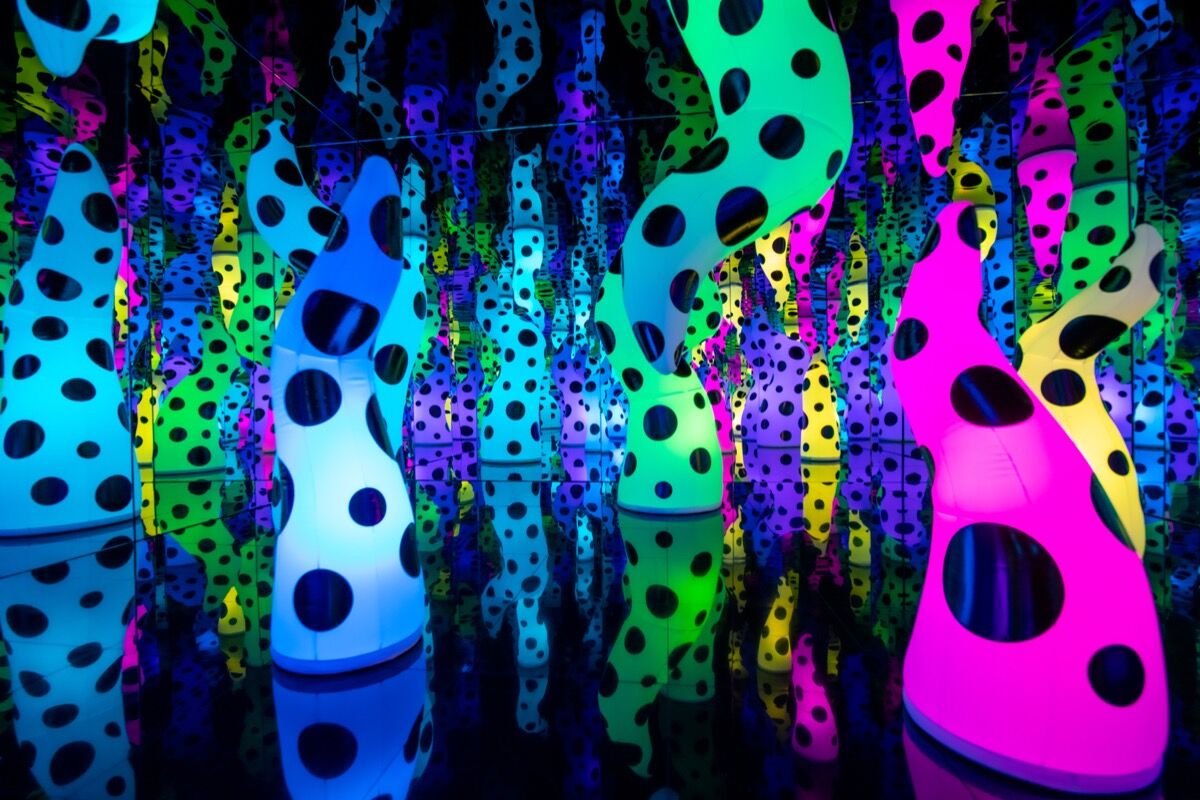
Yayoi Kusama's work is beautiful but if we focus on finding its specific meaning, it can be hard to decipher. (Source)
Contemporary art easily confounds and intimidates the public (myself included), it should be of some consolation that it also intimidates collectors. All of us have seen an abstract contemporary art form, whether it be a Warhol or Pollock, and know it has immense monetary value and yet the reason completely escapes us. Contemporary art can be experimental and strange, that deciding on the value can be nearly impossible. If an institutions invests in an artwork too early and risk never seeing the money pay off or wait too long and have the art become too expensive to purchase. The premise behind non-collecting for contemporary art emerged for these fears coupled with the desire to promote and raise awareness of challenging and evolving art practices.

With a non-collecting museum, ownership is de-centered as the foundation of the museum structure, allowing for cultural exchange to occur in other forms. Documentation fills the gap of collecting by recording visual or written information about the context, concept, and process of the art and exhibition. Instead of physically collecting and item, interaction and mediation is preserved. The lack of collections also means precious money is saved by not employing conservators and collections staff. Processes such as accessioning, deaccessioning, and repatriation become a non-issue. The lack of funds being spent on collections can be redirected into high quality public programming, outreach, and education.

Image result for powerplant toronto
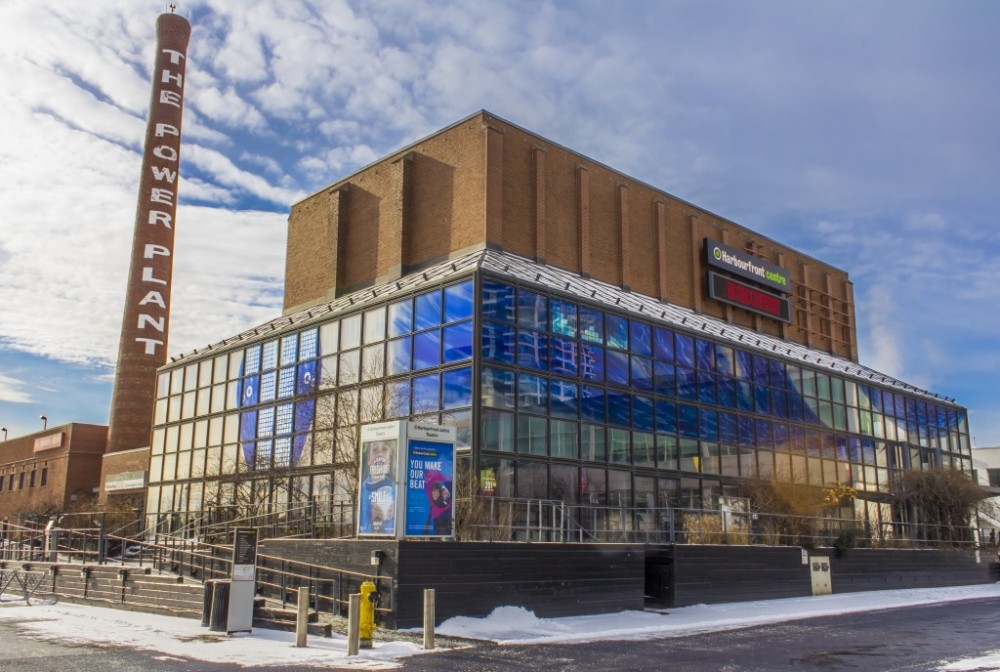
The Power Plant Contemporary Art Gallery, Toronto. (Source)
While there are many benefits  surrounding the collection of contemporary art, it brings up important concerns surrounding the livelihoods of artists. It is impossible to have a functional and thriving art community without providing monetary support to the artists. The Power Plant in Toronto has become a place, that despite its lack of collecting, provides a beneficial relation to artists. Their strategic plan for 2019-2022 outlines their mission to commission new works of art, therefore not collecting but still funding important projects. As a part of their 2018-2019 programming schedule, they also provided portfolio nights and other events for their artist members.

Non-collecting museums and institutions are almost exclusively found in the contemporary art sector. While this allows for more money to go into public engagement and projects, money is not always being used to directly support artists. I am curious to see if this model will continue and the longterm role it will play in the expansion or depreciation of contemporary art.

28 January 2020

OPENING SEQUENCE: LISTENING TO SNOW AT THE U OF T ART MUSEUM

Exhibition Reviews | Mary Wallace

It’s hard to judge a show based on its opening. Openings are often only tangentially related to the art on display; they’re more about the experience of experiencing art. I know a lot of people find contemporary art intimidating and Listening to Snow is exactly the type of show they are thinking about when they say that. I can see how self-referential sound-art would be a tough sell for many but I enjoyed the show and think it was an interesting experience even if I’m not sure if I completely “get it”.

(Photograph courtesy of Mary Wallace) 

And so, I’ve decided to create this part-review-part-how-to-guide to work through some of my art opening related anxiety and hopefully some of yours too.

Part One: Dressing for the occasion

View from my window the afternoon of the opening. (Photograph courtesy of Mary Wallace) 

Dressing for an opening is always a challenge; the level of formally is often left up to the imagination of the attendees and will vary greatly between them. On the evening of this particular opening, Toronto was hit with a thematically appropriate blizzard. A universal truth of wintertime openings is that no one will be wearing the shoes they wanted to wear and that evening at the Art Museum almost everyone was in winter boots. It was a strangely communal feeling, all of us standing in puddles of snow melting onto the floor.

Ultimately, it does not matter what you wear to the opening because there will always be someone wearing a sweatshirt and jeans and someone else wearing a designer gown, thus everyone else will fall somewhere in the middle.

Part Two: Refreshments

Most openings will have some kind of charcuterie board or cheese plate hanging around and all openings will have $5 cups of wine (always cash only). The Art Museum, to its credit had quite the spread prepared. I felt no shame in refilling my tiny plate (where do they even get such tiny plates?) several times with free food. I used to be shy about doing this but after volunteering at these types of events, it is shocking how much is left over at the end of the evening.

My advice to you, always bring cash to an opening and don’t be shy about snacking.

Part Three: Watching yourself look at the art

Michael Snow, Waiting Room, 2000. (Photograph courtesy of Mary Wallace)


One of the strangest things about art openings is that they usually get in the way of actually seeing the art on display. It’s crowded, lots of people are talking at once, you are stuck holding an empty plastic wine cup with a napkin crumpled up inside it, etc. Looking at the art ends up feeling performative, as though everyone is watching your reaction (they are not). The good thing about Michael Snow’s work in this show is that it often undermines this feeling. When you enter the main room of the show, a sign invites you to take a number from a receipt printer and wait on an adjacent couch for your number to come up on a digital display. This faux waiting room, appropriately titled Waiting Room (2000), only involves a few seconds of actual waiting but having some kind of instructions for interacting with the art and with my fellow gallery goers was a great way to break out of the initial awkwardness.

I missed my number coming up on the screen but you get the idea. (Photograph courtesy of Mary Wallace)


Part Four: Networking

Lots of people use openings as networking opportunities but I have always found it hard to achieve this. People don’t generally wear name tags at openings so there’s no way to know who is the gallery director and who is a friend-of-a-friend that has been dragged here. The only strategy that has worked for me is striking up conversations at random until you find someone who can introduce you to the artist/director/board member. In the case of Listening to Snow I did not even attempt to network and it was a welcome break.

Safety first. (Photograph courtesy of Mary Wallace) 

One of the standout pieces for me was Diagonale (1988). In this piece, several speakers have been placed in a darkened room, each is playing a humming sound that descends in tone as you walk deeper into the darkness. The initial effect is somewhat eerie; the darkness and the dissonant harmonies make the room feel like a minimalist haunted house. However, once I had a moment to let my eyes adjust, I felt strangely relaxed. There was no one to watch my reaction nor could I see anyone else’s and no sane person would attempt to network in this room, I could just stand and let the piece happen around me. It made me wish every opening had some form of sensory deprivation room from which to escape the usual cocktail party chatter.

Michel Snow, Diagonale, 1988. (Photograph courtesy of Mary Wallace) 

In conclusion, art openings, much like art galleries, can be what ever you want them to be, there’s no right or wrong way to engage with them. I encourage all of you who feel like you’re not an “art person” to try checking one out at least once. Trust me, coming from an “art person” everyone there is just as confused as you are.

Listening to Snow will be at Art Museum until March 21, 2020. Also on that day at 4 pm you can see a solo piano performance by Michael Snow himself (registration is required).

16 January 2020

VISITOR AS INVESTIGATOR IN THE CITY OF BROKEN WINDOWS

Beyond Tradition | Erika Serodio


A spine tingling array of sounds greet you as you enter The City of Broken Windows installation at the AGO. It’s hard to decipher whether the noise is coming from the sweet blowing noise of wind chimes or something fragile breaking into a million pieces. This general feeling of duality stayed with me while I tried to understand the different parts of this work.

The City of Broken Windows. Photo courtesy of Erika Serodio.

Two competing storylines are written on the walls of the large room, one above the other in a single line each. This forces the visitor, if they are intent on reading both storylines, to make two 360 degree rotations of the room. I was so intent on reading that I nearly bumped into another visitor who was doing the same. An uneasy dance ensued as we all looked over our shoulders before turning slightly here and moving there to get closer to the words we needed next. The required focus on the words is heightened by the two short films playing on opposite sides of the room. The physical screens obscure the words on the wall, forcing you to move around them to read everything, but also forcing you to tune out their competing audio. And yet the room seemed to shift quietly.


"An uneasy dance ensued as we all looked over our shoulders before turning slightly here and moving there to get closer to the words we needed next."


A secret ritual to paint. Photo courtesy of Erika Serodio

The City of Broken Windows is part of a current AGO exhibition of work by Hito Steyerl. Adelina Vlas, the AGO’s Associate Curator of Contemporary Art, says that “visitors can expect to be led on a series of often-hallucinatory, always illuminating, investigative journeys into the truth about technology and our everyday lives.”

An investigative journey flawlessly describes my experience with this installation. I walked into the room, and immediately chose where to start – with the words on the wall. But I noticed others around me walked first towards the film screens. Each short film is reflective of one of the storylines. I felt impelled to put the pieces together. There is an underlying story beneath; footnotes are at work throughout the installation both adding and distorting information. I took snapshots of the references to Frédéric Bastiat’s economic theory – something to look up later at home. This installation provided a topic I had never truly considered and when I left my mind was engulfed by that topic.

Footnoted. Photo courtesy of Erika Serodio

The City of Broken Windows made me feel like I was an active part of it. I could see the layers beneath the ideas and read deeper into them as needed. Even though the subject was a little confusing and complex, I felt empowered to figure it all out. Placing the visitor as an investigator can provide unexpected moments of surprise and delight. In so many of our classes in the Museum Studies program we touch on the importance of making visitors active participants in meaning-making. In The City of Broken Windows, Hito Steyerl has positioned the visitor to do just that. 

This city is cutting edge. Photo courtesy of Erika Serodio.


Hito Steyerl: This is the future runs from October 24, 2019 to February 23, 2020, free with the price of admission (completely free if you bring your OMA card).


4 December 2019

KIDS THESE DAYS: THE AGE OF YOU AT MOCA


Exhibition Reviews | Mary Wallace 

Toronto's Museum of Contemporary Art’s current show focuses on a very intimate and socially relevant topic: “You” or rather the concept of “you” in the face of the internet age. The Age of You examines what individuality means in an age where we have constant internet access and the internet has constant access to us. The show features work from over 70 artists in various mediums, curated by Shaman Basar, Douglas Copland and Hans Ulrich Obrist. Most of the show appears in the form of posters with images of art and related text; these posters are divided into thematic chapters. Many of my fellow editors and likely you reading this, have seen The Age of You and have probably formed a strong opinion of it. The show is divisive (I would guess intentionally so) which is why I was initially hesitant to write about it. I, personally, did not enjoy the show but I didn’t want to write a review that just amounted to venting. So after gaining some distance and taking some time to think about it, I am ready to share my opinion in my professional capacity as a critic.

I, personally, did not enjoy the show but I didn’t want to write a review that just amounted to venting.

(Photograph courtesy of Mary Wallace)


Well maybe with a little venting.

What is this exhibition saying? What is its Big Idea? I was not able to figure this out. Of course, the job of art is not always to inform; asking a question is a perfectly valid driving force for a show. However, The Age of You does not ask a lot of questions, it prefers to make statements.


(Photograph courtesy of Mary Wallace)

Lots of them.

(Photograph courtesy of Mary Wallace)

Most of the exhibition’s text is written in the second person, as though speaking to “you” directly. The use of the second person creates a sense of urgency but it has the unintended side effect of making the writers’ assumptions about the reader very clear, especially when those assumptions are wrong. For instance, the exhibition presents a very specific notion of what individuality is (or used to be) and does consider other potential versions of “the self” in a serious way. A good example of these incorrect assumptions appears in the chapter labeled “The New Crowd”.


The centre text reads: "Do you feel safe in a crowd? Do you feel in danger in a crowd? Do you feel alone in a crowd? Do you form bonds in a crowd? When does a crowd become a mob? Is a social movement a global crowd? Is it hard to be an individual when being in a crowd has never been easier?" (Photograph courtesy of Mary Wallace)

The text on the left reads: "What is the opposite of you? ...me? ...a crowd? ...a machine? ...some yet-unnamed entity?" (Photograph courtesy of Mary Wallace)


At the very least this section asks questions of the viewer. I found the question "what is the opposite of you?" very compelling but I did feel the same way about the exhibition's answer. The Age of You is deeply nostalgic for a lost sense of “classic individuality”. Classic individuality in this case is presented as some kind of Golden Age of the self; one that I don’t think has ever existed. Was the opposite of “the self” ever “the crowd”, was the opposite of “man” ever “nature”? I would hope not. To consider the notion of individuality as simply being separate from the world around you and from other people, to me is a deeply cynical position. I myself find the prevalence of social media anxiety inducing, but to long for separation from everyone and everything is not a healthy response to that anxiety.

Was the opposite of “the self” ever “the crowd”, was the opposite of “man” ever “nature”? I would hope not.

There are also sections where the text is outright mean-spirited.

The small text reads: “Dating sounds as old fashioned as courting. Chaste, consequence-free messaging, communal laptopping, asexual cuddling and body contact negotiated through legalistic consent dialogs, all followed by ghosting. The relationship’s never over, because it never really started.” (Photograph courtesy of Mary Wallace)

It sounds like this poster was written after a disappointing Tinder date or maybe the writer is upset that they had to do consent training at work. Once again, I could not relate to the exhibition’s nostalgia for a time when “consent dialogue” was not considered in the dating scene; I know very few people who would. Maybe if I knew what “communal laptopping” meant I could relate more.

The small text reads:"For a few centuries, smart people— who, being smart— more or less ran the world. The flattening effect of the internet has allowed the world to be run by people with an IQ of 100. It is the revenge of the bell curve." (Photograph courtesy of Mary Wallace)
Similarly, I could not understand this poster's longing for a time when smart people "more or less ran the world". When was that exactly? I cannot think of a time, much less a few centuries, when intelligence was the only determining factor in running the world.

This void emoji is calling to me, or maybe it's just the emergency exit. (Photograph courtesy of Mary Wallace) 
I had a hard time determining the level of irony in this exhibition; whether I was supposed to agree with these statements or if they were meant to be like the inflammatory statements of an internet troll. If that is the case then this exhibition is brilliant. It perfectly captures the feeling of reading a rant on an internet forum. One of the reasons I was hesitant to write about The Age of You was because I didn’t want to prove the exhibition right by ranting about it on the internet (the very thing that is supposedly robbing me of my very soul) but what is the alternative? Letting an artwork dictate my internet usage? Not exactly the actions of a classic individual either.

But don't just take my word for it. The Age of You will be on at MOCA until January 5, 2020.  

12 November 2019

NEW PERSPECTIVES ON REPRESENTING THE DEAD

Beyond Tradition | Erika Serodio


Artist: Gabriel Parniak. Photo courtesy of Erika Serodio.

In the middle of the night on this year’s Nuit Blanche, my friends and I stumbled upon a collection of coffins that made us think, made us tear up, and made us laugh out loud. One in particular left us all in a fit of giggles – it was decorated by the artist Gabriel Parniak, who wrapped it in home-construction paper with a clever glowing inscription: “looking for a new home that suits your lifestyle?” It was a strange feeling for me to be laughing at a coffin, a moment of cognitive dissonance.

Eulogy for the Coffin Factory. Photo courtesy of Erika Serodio.

This installation was titled Eulogy for the Coffin Factory; it was composed of 24 coffins, each decorated by an artist who had been a previous tenant in the art studios and workshops of the building at 89-109 Niagara Street in Toronto. In early 2019, the artists in the building were evicted as it was slated for redevelopment. Through this art installation, the artists paid homage to the tenants before them – the National Casket Company – and they used “creative acts as a form of grieving.”

Artist: Erick García Gómez. Photo courtesy of Erika Serodio.
Selected coffins from the original installation were shown again this past weekend at Harbourfront Centre for a Day of the Dead celebration – a tradition known for commemorating the lives of people and their achievements without focusing on sorrow and mourning. The experience of laughing and thinking about the life and death of the Coffin Factory was made more rich in this context. After the coffins, were Ofrendas – art installations that creatively commemorated those who have died seeking asylum, Latin American immigrants passed in the Sonora and Arizona deserts, and the bees – a population in alarming decline. Up one flight of stairs from here were more traditional ofrendas which took the form of alters that commemorated loved ones who had been lost. In both traditional and contemporary versions, the subject matter was heartbreaking but the bright colours and gorgeous designs had a celebratory tone. This didn’t feel so strange to me anymore.

Artist: Jade Leyva. Photo courtesy of Erika Serodio.

The Day of the Dead tradition is listed by UNESCO as an Intangible Cultural Heritage of Humanity. The creative displays made to represent this intangible piece of heritage were thought provoking. Paying homage to those who came before us does not always need to be sad. It can be fun, it can be bright, and it can be beautiful.

Artist: Brian Medina. Photo courtesy of Erika Serodio. 

22 October 2019

JUST ANOTHER WEEKEND ON THE INTERNET


Beyond Tradition | Erika Serodio


A few Saturdays ago, on September 28th, Jia Tolentino – a staff writer at the New Yorker – spoke to a sold out Toronto crowd about her new book Trick Mirror: Reflections on Self Delusion.

Trick Mirror. Photo Courtesy of Erika Serodio.

A few Sundays ago, on September 29th, I rode my bicycle to Toronto’s Museum of Contemporary Art where the Age of You exhibition has taken over floors two and three of the factory-turned-museum building.

Age of You at MOCA. Photograph courtesy of Erika Serodio. 
These two shows felt like companions to each other. Both focused broadly on two words that have become increasingly difficult to define: the self and the internet. Why, you might ask, would I choose to fill my weekend with the bleak and bitter words describing my generation’s demise? The answer is twofold. First, to compare how a more traditional museum space and a space that’s definitely not a museum engage their audiences in an important conversation. And second, because I think it’s an important conversation.

I like to think I’m not a fan-girl kind of girl. But Jia Tolentino has not only made me her fan-girl, she has forced me to reconsider the ways that I think about myself. Her new book is a collection of essays about “the incentives that shape us, and about how hard it is to see ourselves clearly through a culture that revolves around the self” (according to the book’s jacket.) Tolentino was interviewed about the book by Kathleen Newman-Bremang, senior writer for Refinery29. Over 700 people attended the sold out show at Hot Docs cinema. Obviously I’m not the only fan-girl.

Kathleen Newman-Bremang & Jia Tolentino. Photograph Courtesy of Erika Serodio.

Tolentino’s subject matter is dismal. She spoke about the performance of self, about how the internet has monetized identity and selfhood, and about how when we are burdened with an economic mandate our sense of self becomes unclear. And yet, with an uncanny lightness, both her book and her speaking event have made spaces where I feel comfortable and compelled to critique the way that I present myself on the internet compared to in-person.

Age of You at MOCA. Photograph courtesy of Erika Serodio. 

In Age of You, the MOCA exhibition curated by Shumon Basar, Douglas Coupland, and Hans Ulrich Obrist, the artworks interrogate how “you –and all your online behaviours, enriched data sets and millions of meta-data points –are this century’s most valuable resource.” Age of You was a whole lot more apocalyptic than Trick Mirror. People walked through the exhibition quietly and uncomfortably. I was disturbed by the images and the words presented. This is actually a feeling I love in museums – please, make me feel something! I thought I would come away from this weekend with a better understanding of how algorithms and data sets are affecting me. Both shows made me realize that it’s impossible to understand the effects of the internet because it’s moving faster than we can comprehend. What might be the most important thing is to remain critical of our online behaviours.

Tolentino joked about how several interviewers have commented on the fact that her essays do not have conclusions. But then she said something that had the entire audience laughing in agreement. She asked us to think about some of the best conversations we have ever had and how they usually end without a conclusion. She acted out her version of this scenario by nodding with a bewildered look and said “Yeah, man.” To Jia Tolentino, “a neat ending absolves us of productive discomfort.”

Age of You at MOCA. Photograph courtesy of Erika Serodio.
The last piece in the Age of You’s exhibition is titled The Impossibility of David Bowie Being Dead in the Minds of the Living. It’s an effigy of Bowie’s face that represents his immortal persona. Yeah, man.

18 October 2019

IS NUIT BLANCHE WORTH IT?


Exhibition Reviews | Mary Wallace

Transformation by Fezz Stenton and Daniel Lanois (Photograph courtesy of Mary Wallace)

Full disclosure. I stopped going to Nuit Blanche a few years ago after a particularly poor experience and have not revisited it since. I found the crowded streets and party atmosphere more anxiety-inducing than enriching. However, for the sake of this review I thought I’d put the past behind me and give Nuit Blanche another chance. After all, how could hundreds of people spending their hard-earned Saturday night enjoying art be a bad thing? Here are some of the best and worst experiences Nuit Blanche 2019 had to offer.

Tile-Scape by Kevin Winn, Archer Pechawis and L.C.I. CyberARTS (Photograph courtesy of Mary Wallace)
Tile-Scape.1555 Danforth Ave.

I began the evening by visiting one of the Danforth’s two listed works. Tile-Scape, a collaboration between Kevin Winn, Archer Pechawis and L.C.I. CyberARTS, consisted of a long table of interconnected scrabble boards interrupted by hand-made recreations of the forest floor. Each participant was given a small bag of letter tiles and set loose to create words in amongst the leaves and roots. The experience is meant to remind the participant to think about the mark they leave on the earth and in their community. I was delighted to find that my fellow participants had not left any rude messages but instead put in the effort to create some interesting words, highlights included “BOBA_TEA”, “PUTRID” and the surely not scrabble dictionary approved but none-the-less evocative, “BADPAIN”.

Tile-Scape detail (Photograph courtesy of Mary Wallace)


Tile-Scape was a fun community art piece, that encouraged creative interaction between neighbours. While not as flashy as other installations, it had clear heart and effort behind it. This piece was definitely worth the visit.

Project GUNK. Bay and Albert St.

Project GUNK by Reza Nik and Matthew Davis (Photograph courtesy of Mary Wallace)

In the shadow of the larger piece in Nathan Phillips Square, Reza Nik and Matthew Davis’s Project GUNK might have been easy to miss, but by the time I had reached it there was already a line to view the installation. Outdoor artworks in the Downtown area were almost universally surrounded by metal barricades with lines outside to enter, not unlike rides at the EX. Once I had gotten through the line, I was ushered into a small area filled with found object sculptures. I examined them, a little unsure of what to think, since I had not been able to read the accompanying text panel without leaving my place in line. Once I had left the barricade pen, I was able to circle back and read the text. The sculptures were made from roadside trash found in each of Toronto’s 25 wards, as a way to find use for the discarded items the city produces.

I enjoyed the idea of Project GUNK and will keep an eye out for their work in the future but the experience was hindered by the limitations of Nuit Blanche’s display methods. I could see this idea working if the sculptures were larger or had been manipulated by the artists more. As it was, even for a self-described art lover, waiting in line to see artfully stacked patio chairs was a hard sell.

Transformation. 661 University Ave. MaRS Discovery District.

Transformation by Fezz Stenton and Daniel Lanois (Photograph courtesy of Mary Wallace)

Transformation by Fezz Stenton and Daniel Lanois was among the weaker pieces available at Nuit Blanche. Inside the building’s main lobby, mammoth blow up versions of plastic trash loomed over the crowd, all under the glow of a massive LED sun. The pieces were accompanied by video footage of activists and scientists explaining the reality of climate change and how important it is that we, the audience, take action. While I fundamentally agree with the idea of Transformation, standing next to large installations made of plastic, surrounded by hundreds of electric lights and LED screens, the message rang a little hollow.

The actual experience of Nuit Blanche as an event often undermines the enjoyment and understanding of the art. It’s hard to be inspired or moved by these heavy hitting topics when you are shuffling through a line as though you’re about to ride Space Mountain. The best way I can explain this feeling is through this photo I took in the MaRS building, in which futuristic glowing Lilly pads are plastered with hastily printed signs warning the crowd not to step on the art, lest it be ruined I suppose.

Transformation by Fezz Stenton and Daniel Lanois (Photograph courtesy of Mary Wallace)

Ultimately, the piece I enjoyed the most that evening was the smaller artwork in my own neighbourhood and I don’t think this is a coincidence. Nuit Blanche is at its best when it’s displaying accessible, community oriented art that gives audiences a new chance to engage with contemporary artists right in their own backyards. If you are considering going next year, my advice to you is the same advice I’d give for picking a restaurant: skip the major installations downtown and check out the independent projects in smaller neighbourhoods, where there are some hidden gems waiting to be found.