
BY: JULIE DAECHSEL
Conservation is a task that can strike fear into the hearts of public history professionals as with one false step history is destroyed. Conservation is a high stakes game: scrub at some rust a little too hard, polish some metal too vigorously, or over-saturate a cotton swab and suddenly you’ve caused damage. Sometimes this damage is reversible or at least repairable. But there are rare occasions when even the experts make mistakes and forever change an artifact or masterpiece.
When such mistakes are made in the public area, the scrutiny can be relentless (and also hilarious). They say the road to hell is paved with good intentions. Here are some pit stops along the way:
1. Ecce Homo
 |
| The original fresco (left) versus the restoration (right). Source. |
What Is It: A 1930s fresco portrait of a solemn Jesus by Elias Garcia Martinez, a Zaragoza art professor.
Where: Sanctuary of Our Lady of Mercy in Borja, Spain.
The Conservation: In 2012, local resident and amateur artist Cecilia Giménez attempted to fix the flaking and faded fresco.
The Controversy: Saying this was an attempted restoration is a bit of a stretch. Giménez was raked over the coals by local press and made international headlines as the pensioner who turned Jesus into a monkey (there is something marsupial about the painting’s features). Ecce Homo was mocked and parodied to no end on late night television:
Where: Sanctuary of Our Lady of Mercy in Borja, Spain.
The Conservation: In 2012, local resident and amateur artist Cecilia Giménez attempted to fix the flaking and faded fresco.
The Controversy: Saying this was an attempted restoration is a bit of a stretch. Giménez was raked over the coals by local press and made international headlines as the pensioner who turned Jesus into a monkey (there is something marsupial about the painting’s features). Ecce Homo was mocked and parodied to no end on late night television:
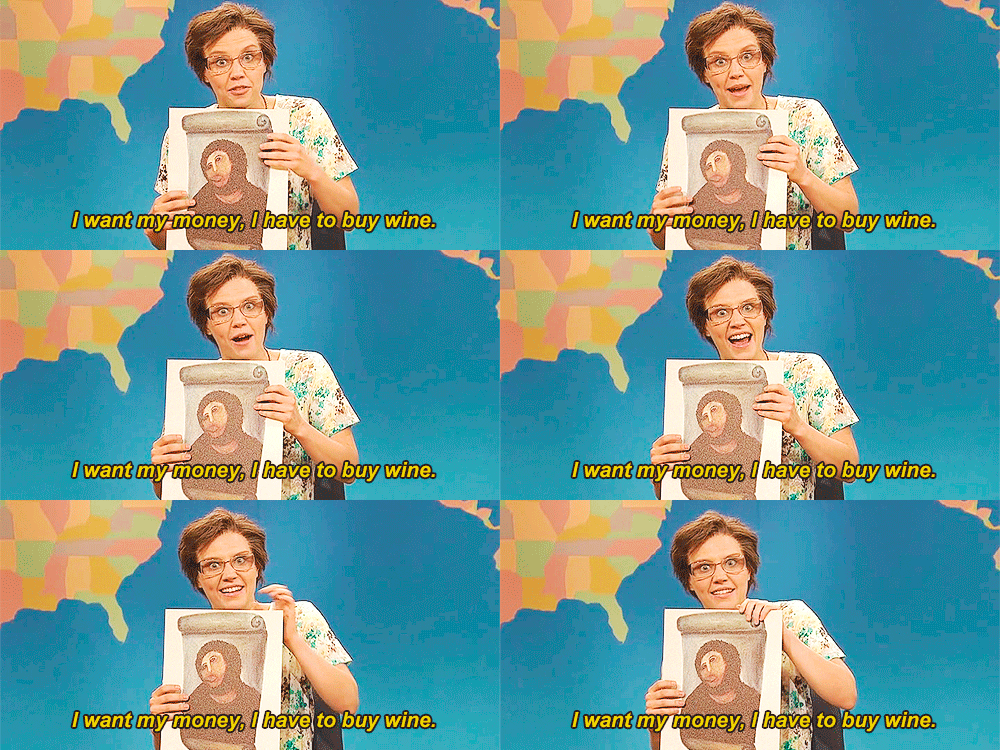 |
| Cecilia Giménez, as portrayed by Kate McKinnon, on Saturday Night Live. The character became a regular on "Weekend Update" whenever a poorly made statue of a celebrity was unveiled (Lucille Ball, Cristiano Ronaldo). Source. |
But this is the rare instance in which a botched conservation job had a positive impact, as visitors flocked to Borja to see Giménez’s Jesus and actually saved the local economy during a recession. Another little known fact is that Giménez hadn’t completed her work before the press intervened (although some question just how much better the fresco could have gotten). The New York Times wrote a follow-up article on the impact of Ecce Homo, here.
2. Ocakli Ada Castle
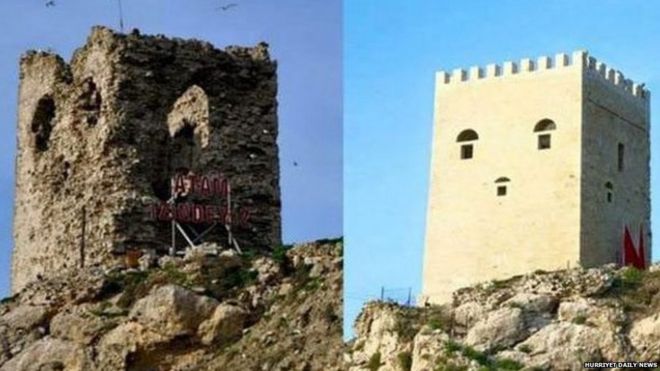 |
| The castle before restoration (left) and after (right). Source. |
What Is It: A restored fortress of the Byzantine era in Turkey that has earned the nickname “SpongeBob Castle” due to its resemblance to the cartoon character.
Where: Sile, Turkey
The Conservation: The fortress has suffered from neglect since the nineteenth century, spurring the town in 2010 to mitigate the existing damage and restore as much of the site as possible.
The Controversy: The renovations have resulted in a monument that looks brand new as new stone has replaced or covers almost all of the original stone. The awkward placement of windows has given the appearance of a face and turned a historic site into a comical castle.
3. Burial Mask of King Tutankhamun
 |
| The mask before the first attempted repair. Source. |
Where: Egyptian Museum, Cairo, Egypt
The Conservation: “Conservation” is a bit of a overstatement, as the museum’s response was to hastily glue the beard back on with epoxy.
The Controversy: The repair job has led to the involved employees facing trial after prosecutors deemed their work so terribly botched that it was negligent and violated professional standards. Prosecutors claimed the workers attempted to cover up their mistakes on three subsequent occasions. This is not the first time the beard has been repaired, as it was discovered completely broken off the mask in 1922 and reattached in 1946 using soft solder. A team took nine weeks to restore the mask: four weeks alone was spent slowly heating the epoxy and gently scraping it off with wooden sticks. The team reattached the beard using beeswax, a material common in Ancient Egypt and non-damaging to the mask: read more here.
4. Qing Dynasty Fresco
What Is It: A c. 1644 to 1911 (Qing Dynasty) fresco in the Yunjie Temple.
Where: Liaoning province
The Conservation: A team was brought in to prevent further deterioration and restore existing damage.
The Controversy: The conservation team repainted the entire fresco rather than repairing the damage. Their work vastly differed from the style of the original fresco. Chaoyang, the city responsible for the temple, claimed the project was unauthorized and halted any further progress.
5. Supper at Emmaus
Where: Louvre Museum
What Is It: A 1559 by Veronese painting depicting Christ meeting the pilgrims on the road to Emmaus.
The Conservation: The painting was cleaned and retouched by restorers in recent years on at least two occasions.
The Controversy: This is an instance of not just restoration but retouching, as the nose on one of the subjects in the painting was blatantly repainted to reflect the restorers’ perception of Renaissance beauty. As Michel Favre-Felix, president of the Association for the Respect and Integrity of Artistic Heritage (Aripa) in Paris, said: “Veronese had pictured a noble family mother, as an echo to the Virgin Mary, and it has been turned into a caricature of a 21st-century adolescent, with bloated cheeks and a ridiculous pout”. Specifically, the nose and lips have been altered. It came to light that after criticisms of the first repaint appeared in the press, the Louvre repainted it again but without recording this second restoration. The restoration team not only cleaned but removed paint and repainted facial features.
Some examples are genuine efforts to do good gone wrong, some are the ill-effects of putting power in the hands of those unprepared to wield it, and others are blatant attempts at alteration. In the immortal words of Winston Churchill (and paraphrased by Spiderman), “Where there is great power there is great responsibility”. Conservators must balance their ability to restore with their duty of care.
The Conservation: “Conservation” is a bit of a overstatement, as the museum’s response was to hastily glue the beard back on with epoxy.
 |
| The initial repair. Notice the thick layer of epoxy and scratches on the chin. Source. |
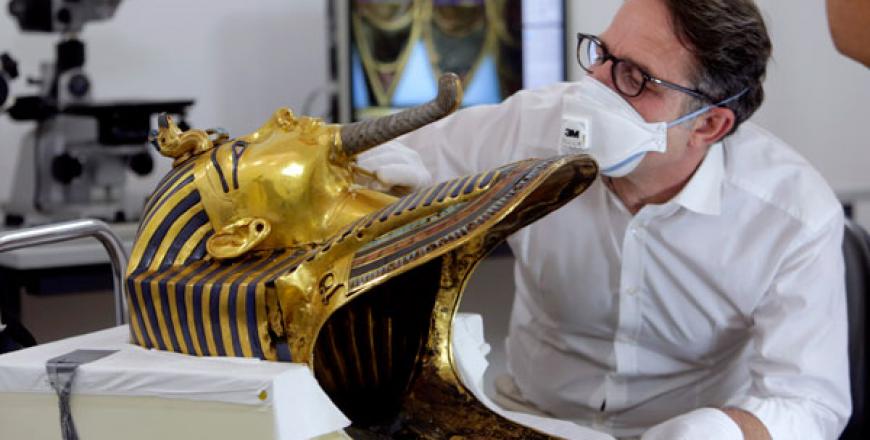 |
| The restoration in progress. All of the epoxy was removed. Source. |
 |
| The fresco before restoration (above) and after (bottom). Source. |
The Conservation: A team was brought in to prevent further deterioration and restore existing damage.
The Controversy: The conservation team repainted the entire fresco rather than repairing the damage. Their work vastly differed from the style of the original fresco. Chaoyang, the city responsible for the temple, claimed the project was unauthorized and halted any further progress.
5. Supper at Emmaus
 |
| Pay attention to the woman on the right holding the baby. Her face will soon change. Source. |
What Is It: A 1559 by Veronese painting depicting Christ meeting the pilgrims on the road to Emmaus.
The Conservation: The painting was cleaned and retouched by restorers in recent years on at least two occasions.
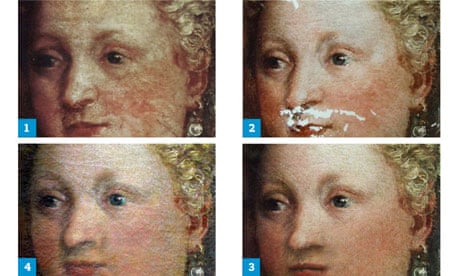 |
| 1) The original painting with the nose turning down. 2) Previous "repaints" are removed. 3) After the first restoration the nose and mouth have changed shape. 4) The second attempt tries to repair previous errors. Source. |
 |
| Source. |



