Showing posts with label curation. Show all posts

8 June 2018

JOB TITLES: TO BE OR NOT TO BE ELITIST

COLLECTIONS CORNER

BY KATLYN WOODER
Source.
In today's article of Collections Corner, I'm going to explore the responsibility of the people in charge of presenting collections to the public. Let's make a little room in the corner for their role to be explored in contemporary society.

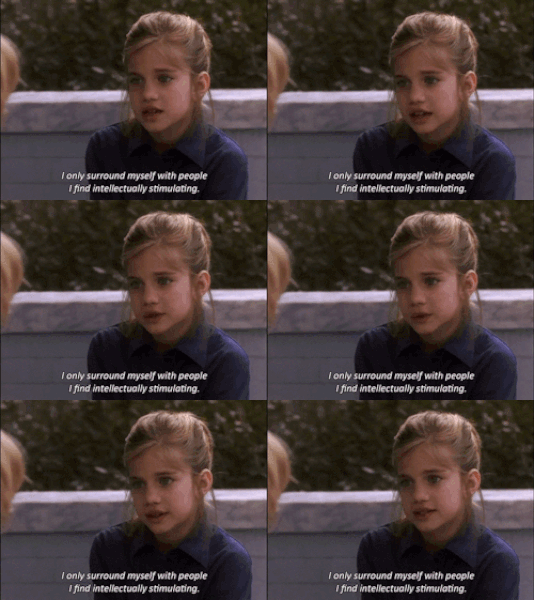
Recently I’ve been thinking about the definition of "curator" because the weather has been great and I've been escaping the heat by touring galleries and museums. Blessed are the museums, which due to condition management practices, are air conditioned. I can’t get the first class of Curatorial Practice, taught by Matthew Brower, out of my head. Prof. Brower raised an interesting question of what it means to be a curator in a society where everyone is donning their curating hats, arranging their stuff in an artsy and intent filled way, and calling themselves curators.

Which is okay, they can do that. Most job titles are made up, and are just a way of communicating your purpose in life to strangers.

But in our program, and in the larger museum field, being a curator is a serious job. One that means you research, interpret, and develop an exhibit. A curator, according to the Oxford Dictionary, is “a keeper or custodian of a museum or other collection.” It’s a lot of work, and work that tends to be reliant on people not only getting what you are doing, but finding it interesting enough to be worth it. It is a cross your fingers and pray to your deity be it a god or analytical data scenario.

Source.
Last Friday, as I was waiting in line, I couldn’t help but think about how coffee shops are curated. The products are selected to fit certain criteria, are researched (we all know or are someone who will pose questions to their local barista), and are presented to attract customers. If I was a braver person, I would take pictures of the coffee shops I go in the mornings. They are purists places that I adore, where coffee/tea/pastry specialists expose us, the uneducated masses, to the wonders of organic, sourced products. However, I usually end up in those places early in the morning, impersonating a zombie amongst a horde of other zombies. I decide to just get my hot beverage, and maybe a croissant.
Source.
The collection manager may be a more accurate representation of the coffee shop job than a curator. They are in charge of the collection, cataloging, keeping conditions optimum, dealing with bureaucracy, and much more. How many times in a coffee shop do you hear someone call themselves a collection manager? I haven't yet.

We now have this weird role in society where people are calling themselves curators, but are really a hybridization of the roles and responsibilities of curators and collection managers. I'm not upset about it because it all boils down to a bunch of people who have a passion about one thing, and want people to take them and their collections seriously. However, I don't think the existing terminology really applies to how people are using it because being a curator or a collection manager is steeped ( ;) ) in a rich/diverse history of the cultural heritage sector.

The difference between a coffee shop and a museum is standards. If a coffee shop turned out to be fraudulently misrepresenting their products I would be mad, and I wouldn’t go back. If a museum, gallery, or/and hall of fame failed their ethics test I would be outraged. Perhaps this is a result of over a hundred years of higher expectations, but I don’t think so. A museum's responsibility is to its collection or cultural product. I would hold curators to a higher standard if they worked in a museum, gallery or hall of fame. I worry about the responsibility of a curator or other museum professional diminishing when that responsibility isn’t understood by people outside of the museum world.

Maybe what we need is a new name… how about "supreme overlord of particular tastes" for curators and "supreme overlord of keeping their feet on the ground" for collection managers. Those would be fun business cards.

Source.
I'm not sure if I'm being elitist and devoutly bowing to the hierarchical structure of museums, where certain roles mean certain things done by certain people, most likely highly educated, specialists. Please let me know your opinions in the comments section.

7 March 2018

CURATING THE ANTHROPOCENE: FEARSOME OR ROMANTIC?

MUSEUMS ON EARTH

BY: LANA TRAN

The effects of the Industrial Revolution as revealed in sooted specimens.
 Red-headed Woodpeckers from 1901 (top) and 1982 (bottom), The Field Museum.
Photo: Carl Fuldner and Shane DuBay. Source.

The concept of the Anthropocene is a curiously circular thing – an age of human influence, conceived and ruminated by humans themselves. Though the thought that humans effect environmental change has been circulating since the 1800s, in recent years, coining this effect as its own epoch has catalyzed its absorption into the realm of culture. 

From artistic representations to academic conference themes, the Anthropocene is becoming a term for people of varied fields in academia and beyond to circle around. This trend is not lost on museums, where exhibitions—ranging from experimental to permanent—are addressing the topic from a huge array of perspectives. 


Is there a correct (and conversely, incorrect) way to curate the Anthropocene? 


View of Pierre Huyghe’s exhibition at Centre Pompidou, 2013. Source

To me, a would-be palaeontologist at one time, it’s both exciting and concerning when portrayals of the Anthropocene seem to bridge on science fiction: one species deciding a future for themselves and their planet. At times, creative abstractions on these ideas can teeter on romanticizing escapist post-humanism—Denizens of Earth, upload yourself into the cloud, or put in an application to an extraterrestrial colony in case nature ceases to exist. 

In actuality, teasing apart the issues that confound the Anthropocene concept—such as anthropocentrism, capitalism, colonialism…(the list goes on)—is not a task easily accomplished in a series of displays alone. Indeed, the Anthropocene concept is a conspicuous platform from which museums are challenged to communicate with the utmost nuance. 

The Anthropocene poses more questions than it answers—a rousing and intimidating thought! 


Further Reading

Möllers, Nina. 2013. “Cur(at)Ing the Planet—How to Exhibit the Anthropocene and Why.” RCC Perspectives, no. 3: 57–66. Link.

Steffen, Will, Jacques Grinevald, Paul Crutzen, and John McNeill. 2011. “The Anthropocene: Conceptual and Historical Perspectives.” Philosophical Transactions: Mathematical, Physical and Engineering Sciences 369 (1938): 842–67. Link.

Turpin, Etienne, and Heather Davis. 2015. Art in the Anthropocene: Encounters among Aesthetics, Politics, Environments and Epistemologies. Open Humanities Press. Link.

Wamberg, Jacob, and Mads Rosendahl Thomsen. 2017. “The Posthuman in the Anthropocene: A Look through the Aesthetic Field.” European Review 25 (1): 150–65. Link

Whyte, Kyle. 2017. “The Roles for Indigenous Peoples in Anthropocene Dialogues: Some Critical Notes and a Question.” Inhabiting the Anthropocene (blog). January 25, 2017. Link

9 June 2017

A GRAD STUDENT'S GUIDE TO SUCCESS

THE GRAD SCHOOL GUIDE

BY: AURORA CACIOPPO

Welcome to the second installment of Summer 2017’s The Grad School Guide! Please join me in my conversation with Bretton, Jenny, Kendra, and Shauna on the ups and downs of an academic year at the iSchool.*

Step 1: Get accepted into the MMSt program. 

Celebrate and feel extremely proud! Buy new pens and notepads and begin one of the final steps of achieving your childhood dreams of becoming a museum professional. 


A page from Aurora's grade 3 activity book. Photo courtesy of Aurora Cacioppo.

Step 2: Show up to your first day of class. Question your abilities and wonder if you really belong. Panic for a moment. Make a game plan to counter your negative thoughts.
 

Bretton: Tackling self-doubt was a big challenge during my first year. I was often worried I would fall behind, I feared my ideas and perspective would be wrong, and I was constantly struggling to get a grip with my to-do list. With a year under my belt, I know that I should proceed with more confidence in my ideas and in myself.

Jenny: I came to U of T from a program with no participation marks, so I struggled with the pressure to contribute to discussions in every class! It took a long time to feel like I could formulate a comment on the spot that was both relevant and coherent - I’m still working on it.

Shauna: Overcome the “impostor syndrome”! When you graduate from your undergrad you feel like the bee’s knees, and then you come into your grad program and see that everyone else is equally accomplished, if not more so! You might feel like a fraud and like you don’t belong in the program, or like you’re not as smart and awesome as you thought you were. But once you start talking to people about it, you realize that a lot of other people are also struggling with the same things and feeling the exact same way.

Source.
Step 3: Find your groove

Jenny: I took some time at the beginning of the year to figure out where and when I work best (Knox College Library, noon to 5 on weekday afternoons), and I work under those conditions as often as possible. Work tends to expand to fill the time you allot to it – I try to fit the readings and assignments in around my life, rather than the other way around.

Shauna: In my undergrad, I always kept an agenda with all my jobs and classes assigned a different colour. I fell off the wagon a bit this year and didn’t keep up with my agenda and I paid for it when I missed an assignment due date! I recommend investing in some coloured pens and an academic agenda/planner or calendar.

Bretton: Write things down! I have every piece of Apple technology that helps with scheduling and organizing; however, nothing is more effective than using my physical Moleskine agenda and making lists.

MMSt student Tabitha Chan's beautiful bullet journal!

Step 4: Grasp onto a museological theory or practice and drive it home

Bretton: Cheryl Meszaros' Ethical Interpretation will forever be an influence in my professional and academic practice. There is something so tangible and progressive about the theory and I see it as an influencer in the future of museological practice. Secondly, I am much more aware of the convergence of libraries, archives, and museums in the information field - while there is extensive theory and literature, it is something that is a reality in our business and poses a series of both benefits and challenges we as information professionals will have to face.

Jenny: It’s not a discrete piece of information, but once you start thinking about the relationship between museums and power – social, political, financial – it’s virtually impossible to stop looking through that lens, and it changes everything.

Kendra: Cheryl Meszaros’ writings on “Whatever Interpretation” and “Modelling Ethical Thinking” have been useful frameworks to look critically at museum discourses and understand how museums communicate or represent ideas. Another theory I often use to unpack inclusion of diverse audiences in museums is John Falk and Lynn Dierking’s Contextual Model of Learning. I’m glad that attention is increasingly being paid to the personal and sociocultural context of the visitor within the context of the museum.

Source.
Step 5: Fall in love with a course and give it your all! (For these three, Judy Koke & Keri Ryan’s Interpretation and Meaning Making took the cake)

Kendra: I appreciated that this course delved into the value and the complexity involved in an interpretative plan, as well as examined new trends in interpretative strategies and vehicles. It intersects with so many other areas of museology (ex: curation, collections, digital, and visitor research) with emphasis on effective communication and cross-collaboration in an institution.

Bretton: The content was exactly what I see myself doing in my future and Keri and Judy's professional insight into the industry was invaluable.

Jenny: It’s a great blend of theory and practice – you get to think and talk about what works in museum exhibitions and why, and the assignments are genuinely very fun.

Step 6: Reflect on your year and set goals for what’s to come 

Bretton: I hope to get more involved with the student body and engage in other campus activities!

Shauna: I volunteered and worked in museums last year but next year I would like to become more involved in the museum community and contribute more by attending (and maybe speaking at) symposiums and conferences, and possibly publishing something.

Kendra: It’s my personal goal to take advantage of the academic and professional resources that are available at the iSchool. I am hoping some of my work on inclusion provides a basis for a future conference presentation. I’ll also be closely following the workshops and research series because they really do expand and enrich in-class learning with topical examples.

Source.

After reaching out to my peers, I learned that we were experiencing similar anxieties. My final tip is to be open about the challenges you are facing with your classmates. The bond students form over the demands of grad school is unparalleled!

Source.


*Answers have been edited for clarity and length.