Showing posts with label textiles. Show all posts

4 April 2019

TRADITIONS GOING AWAY

Sew What | Rachel Dice


The wedding dress has been considered the quintessential part of every bride’s big day since the
Victorian Era.  


Custom bridal gowns by Evellyon Atelier. These elaborate, runway-ready gowns are the pinnacle of many brides' dreams
for their big day. Photo courtesy of Nicole Dice of Evellyon Atelier.
The tradition of big dresses and even bigger ceremonies is a relatively modern development and has become a large part of pop culture. Shows like Say Yes to the Dress and movies like My Big Fat Greek Wedding capitalize on the cultural importance of that oh-so-important day. What’s truly interesting, on the other hand, isn’t the tradition we all expect and follow. It’s the one that we’ve seemingly forgotten about: the going away outfit.

For those of you who aren’t familiar with the practice, the going away outfit is the clothes the bride changes into just before she and her groom rush out and away to their romantic honeymoon. This outfit would be bridal in feel, but more comfortable and easier to move around in. The idea of it was to keep up the feeling of ceremony while also providing the bride with a new outfit to greet her new life in.

The traditions of the going away outfit closely follow existing wedding traditions from different cultures and time periods.

A fashion plate from 1820 detailing different wedding dresses, styles, and colours. Source.

Back before the Victorian era, brides would simply wear their best clothing on their wedding day and would get married in any colour that dress happened to be. If they commissioned custom wedding clothes, the idea was that they would continue to wear that dress until it fell out of fashion or until it fell apart. Sometimes dresses were more elaborate on the big day but were then adjusted so they were more suitable for every-day wear. These Georgian era brides still had ceremonies as elaborate as they could afford, it was their wedding day, after all, and a time to show off.

 19th Century wedding veil from the collections of the
Aurora Museum & Archives. The veil has a crown of wax orange
blossoms. Photo courtesy of Rong Zhou.
Wearing white wasn't really a style until the marriage of Queen Victoria to Prince Albert. Along with white puffy dresses came the style of orange blossoms as the wedding flower of choice.

Many eastern wedding traditions involve changing outfits throughout the ceremony or for an after-party. Some, such as Chinese or Hindu weddings, involve wearing a bright red dress for luck and good fortune in the bride’s upcoming life. It has now become popular for Chinese brides to include a photo-shoot in a western-style white dress before changing back into traditional red.

While these traditions may hint at why going away outfits came into style, nothing actually mentions when the tradition started. Several contemporary wedding blogs and websites mention bringing the tradition back, and while one blog provides a picture of a couple in their going away clothes from 1940, there isn’t any other information. My mother fondly remembers her going away outfit from her first wedding. She made herself a cream pantsuit with a cinched waist and padded shoulders, quite a daring look for the late 80s. My grandmother always smiles when she looks
Ines Petrella and George Borg. Ines, my grandmother, wears
her going away outfit as they wave goodbye like movie stars
to their wedding guests. Photo courtesy of Rachel Dice.
at the photos of her going away outfit, and if you ask just right, she’ll take out the old Eaton’s box that holds the matching hat and purse —they were patent alligator leather, which was something she says only movie stars wore. Sometimes the going away outfit had even better memories associated with it than the wedding dress! 


Traditions like this are truly reflective of the intricacies of contemporary culture. They fade out of common use within a generation, yet no one can remember when they started or why. This is a challenge to all museums that collect textiles and local memory. Why do we only keep wedding dresses, but no going away outfits, or even bridesmaid clothes? With no rhyme or reason to most contemporary traditions, you never know what will appear or disappear next.

If I ever get married, you can bet that my going away outfit will be just as spectacular as the dress I first show up in!


While digital going away outfits aren't a thing, I'd like to say that my U of T sweatpants and my fuzzy sweater are the pinnacle of fashion for these types of events. It has been a pleasure and a privilege writing for the Sew What column of Musings! Thanks to everyone who has taken the time to read my posts thus far! May our next writer continue to enjoy your readership.  

7 March 2019

CONTEXTUAL TEXTILES

Having worked with museum textile collections quite often over the last year and a half, it has come to my attention that textile collections are consistently inconsistent. Even when preparing for my own exhibition—which is entirely textile-based—I found that I spent more time getting lost amongst the clothes and fabrics than actually finding what I set out to find. This could be due to my own shortcomings, of course, though I doubt anyone could simply ignore splendid gowns and garments when given the chance to freely look at them.


These baby trousers are made of grey wool
and red crochet trim. They close at the front
in a "Y" shape with buttons to make dressing
a baby easier. Photos courtesy of Rachel Dice
Some of the greatest challenges of working with textile collections involve curiosity. For example, if a garment is buttoned, suddenly you want to know what it looks like unbuttoned and laid flat, or the opposite; an unbuttoned, flat garment creates the desire to know what it looks like completely put together. This goes beyond simple things like shirts or coats. If the face of a garment changes because it is fastened or unfastened, wouldn’t it fascinate you to see? While working at the Aurora Museum & Archives, I found a tiny pair of wool trousers, obviously meant for a baby.

They were horribly bug-eaten, and just as clearly home-made. The little trousers are entirely one piece with no seams at all and join in the front with rows of little buttons. They were designed to be buttoned onto a baby without having to force little legs through pants, much like snap-together baby rompers work now. In short, playing around with the teeny trousers to see how they work was irresistible, but how can you know whether or not some textiles can stand up to the abuse of use?

Most of the time, the textiles will tell you themselves.

Wool and thick cottons are usually very sturdy; they retain their strength and functionality even in the face of bug-eaten holes. They rarely become stiff or immovable - we can save that for leather - and usually will not rip without concentrated effort. Sturdy velvets with short pile also fall under this category, as well as thickly woven silks. Many of these fabrics were made to withstand use and wear, so they hold up well even after a century or two of disuse. Wool is my favorite textile to work with. Yes, it is often bug-eaten, but the fabric is sturdy and
This late 19th century black wool vest with butterfly sleeves
in still in amazing condition. If it wasn't part of a museum
collection, you'd hardly believe it wasn't new. Photo
courtesy of Rachel Dice.
colour-fast. It’s resistant to all kinds of use and is even self-extinguishing! Aside from bug-eaten holes or discolouration, wool garments are most likely to suffer from the thread giving away in the stitching rather than the fabric itself tearing apart.

Oftentimes, it’s silk and sheer cottons that suffer the most. Both are made from plant fibre and are much more sensitive to changes in their environment. Additionally, unlike wool, silk or cotton are not self-extinguishing. In fact, they are likely to go up in smoke in very short amounts of time. Silk also tends to dry out faster than any other fabric; it can become so dry and brittle that it begins to flake or tear apart under its own weight or even the most negligible amount of stress. Sometimes it feels like even looking at a brittle piece of old silk too intensely will tear it. It makes conservation work tricky, and, for some reason, it is often some of the most beautiful pieces that are far too delicate to ever be displayed. Such is the burden of textile collections.

This beautiful jacket is lined with cream silk. The silk is extremely fragile and brittle, and has began
ripping apart as if it was attacked by a particularly enthusiastic cat. Now, the garment needs special
supports and a backer board - it can't support its own weight, even lying down. Photo by Rachel Dice.

What makes these collections even more interesting, however, is considering how fashions today will fit into them. Will future generations centuries from now curse me for not saving an old sweater, or for recycling old shoes? At what point do we decide what kinds of fashions are representative of an era? Will schoolchildren one day cluster around a faded pair of mom jeans like we cluster around Victorian gowns and World War uniforms today?

Here we have the classic museum student, wearing mom jeans
and a colour-blocked sweatshirt. Are these the kinds of textiles we can
expect to store in the museums of our future?
Photo courtesy of Rong Zou. 


Nobody can tell the future, but we certainly try our best to create stories of the past. If it ever comes down to it, which of your outfits would you put in a museum?

22 November 2018

MORE THAN CLOTHES

Sew What | Rachel Dice


Guislaine Lemay and Jordan Fee standing at the entrance to
Wearing Our Identity, photo courtesy of Laetitia Dandavino-Tardif.

A view of the exhibition, including a man's caribou coat
made, unusually, with winter fur. Photo courtesy of
Laetitia Dandavino-Tardif.
At the beginning of November, MUSSA organized a student trip to Montreal, which was written about by Laetitia Dandavino-Tardif this past Friday in her post ALLONS À MONTRÉAL: MUSEUM STUDIES FIELD TRIP. On this trip we were able to visit an alarming number of museums in pretty much three days (five museum visits for most of us, and six for a determined few). A specific exhibition stood out among the rest and has become a source of inspiration for my own work with textiles. 

The exhibit, titled Wearing Our Identity—The First Peoples Collection, is currently on display at the McCord Museum in Montreal. It is a permanent exhibition with a little twist—the objects on display switch out every two years in a pre-planned pattern. The main focus of the exhibition is to encourage the public to “explore the complex heritage of the First Peoples of Canada and learn more about how their dress has helped define their rich cultures and identities” (source). In a nutshell, Wearing Our Identity aims to show how Indigenous culture is  intrinsically linked with clothing and aesthetic representation.
Guislaine Lemay leads a group through her exhibit, including
Dr. Cara Krmpotich, Director of the Museum Studies program.
Photo courtesy of Laetitia Dandavino-Tardif.

The exhibition was co-curated by Guislaine Lemay, McCord’s resident curator for the Indigenous Cultures collection, and a dedicated team of Indigenous peoples who worked closely with Lemay to ensure accuracy in content as well as design. It was Guislaine Lemay herself who took our group on a guided tour of the exhibition.

Going into this exhibition, I was fascinated by the layout and the different styles of garments on display. One of my favourite pieces was a little girl’s parka, made of caribou fur and sinew from the early twentieth century. We were told that the parka showed it belonged to a little girl who had not yet reached the age of puberty. We were also told that the furs were sewn in a special way so that every layer did not have stitching holes inside, therefore making it warmer and more waterproof. The style of the parka and the stitching technique were specific to the Inuit Inuinnaq, and all of this contributed to the parka’s role in the identity of the wearer.

Clothing itself plays an extremely important role in our lives. The way we dress and choose to represent ourselves is a deliberate action we take, from buying the clothes, making them, or just grabbing them out of the closet. Some people even come to be known for their taste in clothes, whether they usually dress in blue polo shirts or vintage aesthetics with a modern twist. These clothing choices become part of their identity, influencing the way they see themselves and the way we see each other.

A display of moccasins made with different
styles depending on the cultural and regional
group. Photo courtesy of Laetitia Dandavino-Tardif.
Now, imagine that you couldn’t wear your favourite sweater. Imagine that those earrings your grandmother gave you were banned, even though you tried to wear them as often as possible. Imagine being forced to wear clothes that were selected for you by strangers, clothes that were strange, outlandish, and even just dreadfully boring. You would hardly feel like yourself, and perhaps if it went on long enough, you’d forget who you were to begin with. This is another important part of Wearing Our Identity. The exhibition addresses the cultural importance of clothing for Indigenous peoples, while also looking at points in Canadian history where their clothing was banned, appropriated, and even turned into marketing gimmicks.

So the next time you reach into your closet for that outfit that boosts your confidence or makes you feel invincible, remember that our country hasn’t always let others have that same choice. No identity deserves to be repressed through clothing. Remember, it’s more than just clothes.


For the curious ones, here's some further reading:


17 January 2017

NOT JUST FOR PLASTICS

SEW WHAT

BY: BRENNA PLADSEN

In the latest instalment of exhibitions I wish I could go to we have Scraps: Fashion, Textiles and Creative Reuse at the Cooper Hewitt, Smithsonian Design Museum. Scraps is currently on view until April 16, 2017. The exhibit highlighted, in one of the Cooper Hewitt’s small temporary exhibition spaces, is global in scope and features works from Italian label Riedzioni, founded by Luisa Cevese; Christina Kim, founder of dosa, inc., in Los Angeles; and Reiko Sudo, of Japanese textile firm NUNO.
Installation View of Scraps: Fashion,Textiles, and Creative Reuse.
Photo credit: Cooper Hewitt (source)
Each designer interrupts the typical mass production cycle at a different point to produce luxury products from the cast offs of a notoriously wasteful industry. While all three companies are commercially successfully, their approach towards their shared material, pre-consumer industrial textile waste created during garment manufacturing, and aesthetics differ dramatically. When placed together, they demonstrate differing but viable approaches to reducing waste in contemporary manufacturing.

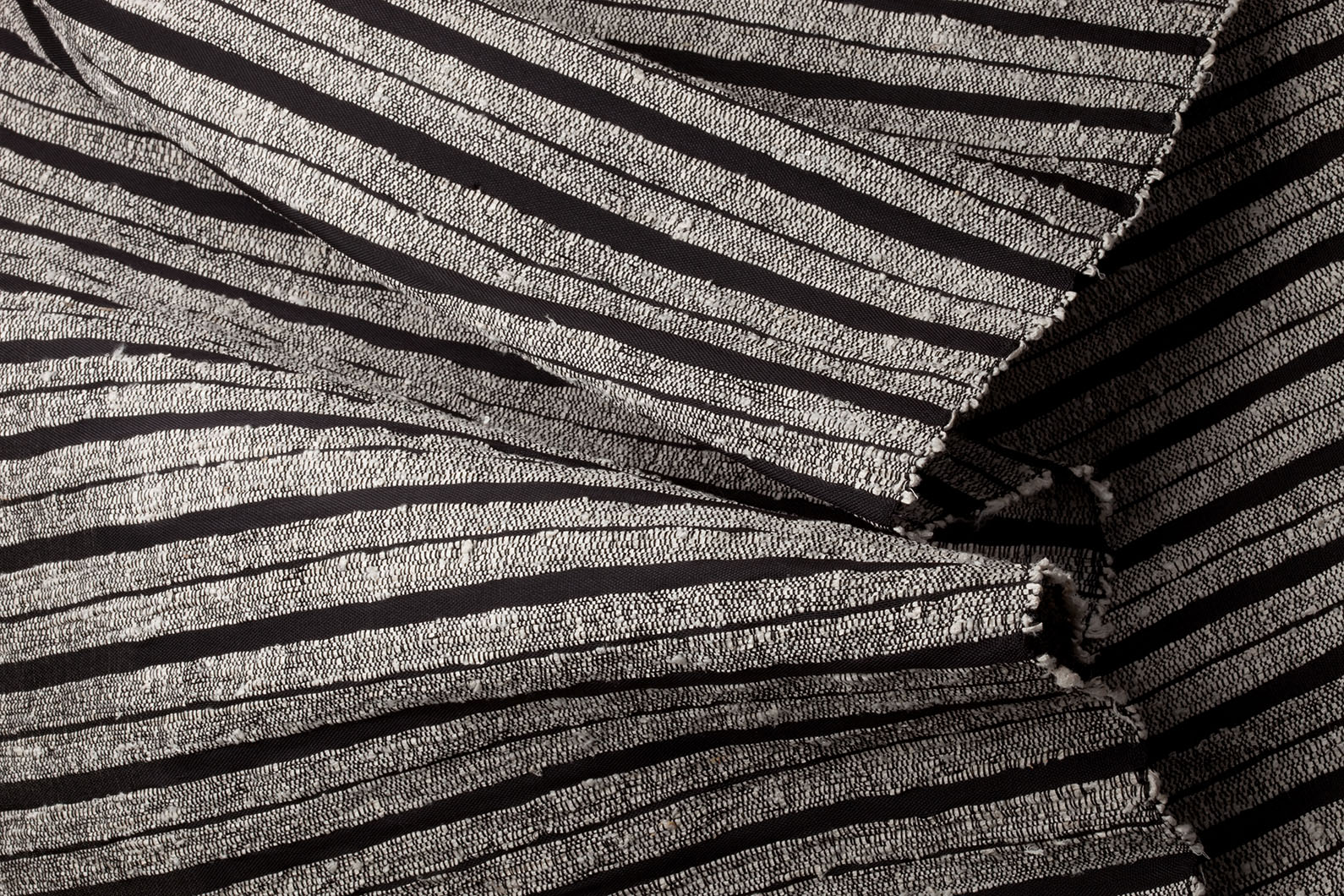
NUNO textile Kibiso Stripe from 2008. Designed by Reiko Sudo. NUNO uses materials usually discarded in the silk production process to make their textiles.
Photo credit: Matt Flynn for the Smithsonian Institution (source)
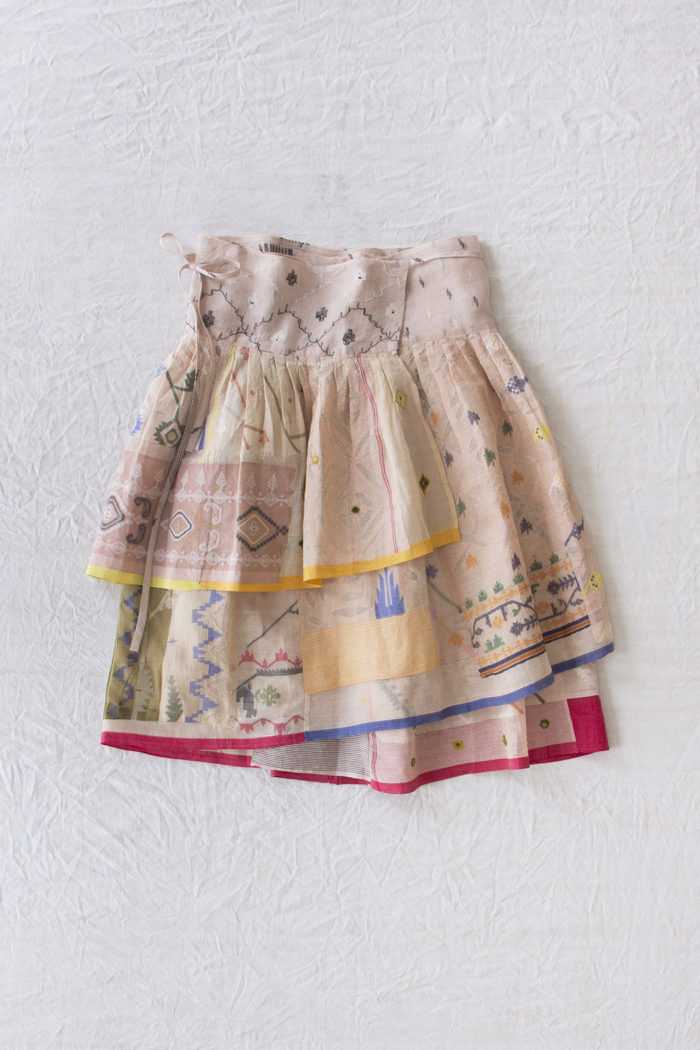
dosa skirt, 2008. Desiged by Christina Kim. This particular skirt is made from material discarded during industrial garment making. There is also a line made from the discarded materials used to make these garments.
Photo credit: dosa (source)

Large rectangular bag and very small bag by Riedizioni. 2013.
Luisa Ceverse, under the label Riedizioni, uses the discarded edges off rolls of silk and other waste textiles to create patterns in polyurethane.
Photo credit: Riedizioni (source)

There are two niggling thoughts that demand I address them. The first is to point at the tapestries of Hannah Ryggen and the works featured in Soft Monuments at KODE in Bergen as other examples of textiles as a feminine medium for political art, in part because of its status as craft or otherwise outside art. But I’ll leave/challenge Natania to tackle that in a She’s My Muse.

The second thought is more a series of questions: where else could this exhibit live? Where can we celebrate and worry at contemporary society before it becomes history?

The featured creators in Scraps point towards an answer. These three designers were selected in part because of the longevity of their environmentally motivated design practice. [source] This history is also closely tied with the art museum and gallery sector. NUNO has a decades long affair with museum exhibitions, including another show at the Cooper Hewitt in 1990. [source] Riedzoni products slide nicely into that art museum store niche. [source] dosa, the newest of the three companies, has already done collaborations with LACMA and a Pulitzer Art Foundation

Installation view of dosa's floor pillows for the Pulitzer Art Foundation in St. Louis.
The pillows are patched together and some are dyed with tea!
Photo credit: Carly Hilo for the Pulitzer (source)
So we see two potential roles of palaces of art: exhibitors and incubators/clients. Inside of the museum exhibition, visitors are asked to contemplate objects outside of their immediate use value, to take a moment and consider the networks and systems that created them, move them, and inscribe them with value. In the case of new objects, this is one place where this can be done without the immediate question of how this thing can be bought and consumed, where we can take a moment to think about how we fit into larger systems and our actions reverberate out into the world.

Final notes: if you'd like more content, including traditional upcycling textile techniques, Scraps includes blog posts by textile researcher Magali An Berthon. It looks like the digital content is updated regularly, including today's post on greenwashing! If you're on the cusp of a closet clean out but don't want to contribute to landfill, try any of these charities and shops if you're in the Toronto area.  

Resources