30 May 2014

REFLECTIVE FRIDAYS: THE RELEVANCE OF MUSEUMS, NOTES FROM THE AGO'S ARCHIVES

BY: IRINA MIHALACHE

As you all know from your museum studies courses and from your professional experiences in museums, one buzz word and continuous aspiration for cultural institutions today is relevance. All museums, from the Met in NYC to the Biltmore Estate in Ashville, North Carolina, wish to be relevant to their audiences. This is all good and well until we venture to ask questions such as: “what does it mean for a museum to be relevant?”, “what do audiences consider relevant?”, “who are the contemporary audiences”, and the list can continue. I ask you to think about relevance because of the complexity of the questions which it implies but also because I believe that relevance cannot be understood unless we take a historical and cultural approach. Both my questions and reflections on this topic have been inspired by my encounters with the history of the Art Gallery of Ontario in the Libraries & Archives of the museum.

AGO First Thursday
Edward P. Taylor Library & Archives, AGO, Toronto
http://www.ago.net/research-library-archives
And since we talked about annual reports and bulletins on Musings recently, I will make reference to these valuable archival documents as they reveal a wealth of historical information about the AGO’s projects to transform itself into a hub for community relevance. To show you an example, I start in 1946 with a note from the AGO President’s Report which describes Wednesday Open Nights at the museum – “open nights are designed to show the Toronto citizen that an Art Gallery can be fun! The Programmes consist of Tours, Informal Lectures, Artist Demonstrations, Films, Slides, and opportunities to “Try your hand” with paint, clay and various art media”. This brief quote from mid 1940s gives us a clue about some elements of continuity between AGO in the 1940s and contemporary forms of entertainment in the museum, for example AGO First Thursdays, where party goers can tour parts of the museum, chat with curators, make art and have a margarita or glass of Prosecco. While we are used today to think of museums as exciting hubs for entertaining, where art, food, drinks and music coexist almost naturally, imagining the museum of the 1940s in the same way is not something we are used to. But only by looking at museums historically can we understand that every current cultural manifestation has a history and recycles something from the past.


http://www.blogto.com/arts/2013/06/first_thursdays_make_it_a_party_at_the_ago/
To continue my conversation with Annual Reports, in 1967, the AGO Director wrote in his report that “today, especially in North America, the art museum is an educational and social instrument of surprising complexity with many different aims…perhaps what is unbelievable is the fact that this programme [reference to public events such as the Wednesday Open Nights] is conducted in an art gallery designed at a time when none of these activities were planned or perhaps even envisaged”. 

So I leave you with a question and an invitation. First, the question (but feel free to reflect on the question while enjoying the invitation): from your experience in museums, what makes them relevant today? And, for an example of relevance which of course has to do with food, take a trip to Fort York this Sunday (June 1) to celebrate Burger Day. Our iconic burger deserves a celebration and what better place to do so than a historic site famous for its foodways program? If you go, make sure to take some pictures (with you and your favorite burger/slider) and send it our way. Bon appetit!


Burger Day Fort York

28 May 2014

MUSEUM INNOVATIONS: THE PUBLIC DOMAIN AND DIGITAL COLLECTIONS

BY: JAIME CLIFTON-ROSS

Is it just me or have museums been all over the news lately? The month of May has been incredibly active in the museum world as the Royal Ontario Museum collected the beached blue whale, The American Museum of Natural History partially launched their new digital collection, and now The Metropolitan Museum of Art has provided open access to images from their digital collections for personal download and non-commercial use. After obsessing over the wonderful Rijksstudio application—launched by the Rijksmuseum in Amsterdam last year—I was delighted to discover that yet another museum has altered their digital image policy and has thus entered the realm of the public domain. These high-resolution images, that thread together multiple photographs, reveal intricate details of paintings through a zoom-in feature.

Young Woman Seated on a Sofa by Berthe Morisot
Young Woman Seated on a Sofa, Berthe Morisot, ca. 1879, MET Digital Collection

The MET’s initiative, called Open Access for Scholarly Content (OASC) is essentially created for scholarly purposes as “students, educators, researchers, curators, academic publishers, non-commercial documentary filmmakers, and others involved in scholarly or cultural work” are encouraged to use this database (Quote from MET website). While their public domain and downloading policy is not presented as liberally as that of the Rijksmuseum (who encourage anyone to download, manipulate, and repurpose their art-read about it here), I believe this is a step in the right direction. 

Study for "A Sunday on La Grande Jatte" by Georges Seurat
Study for "A Sunday on La Grande Jatte", Georges Seurat, 1884, MET Digital Collections

The reason why so many museums—typically art-based—are able to offer this digital feature to the public is because many artworks are no longer under copyright laws. That being said, not every piece in museum collections can be openly available as copyright status, ownership titles, and other restrictions are prohibitive. You will also notice that artworks within the public domain are primarily historical. So you may just have to wait another 50 years or so for your favourite contemporary artworks to hop on this wagon!

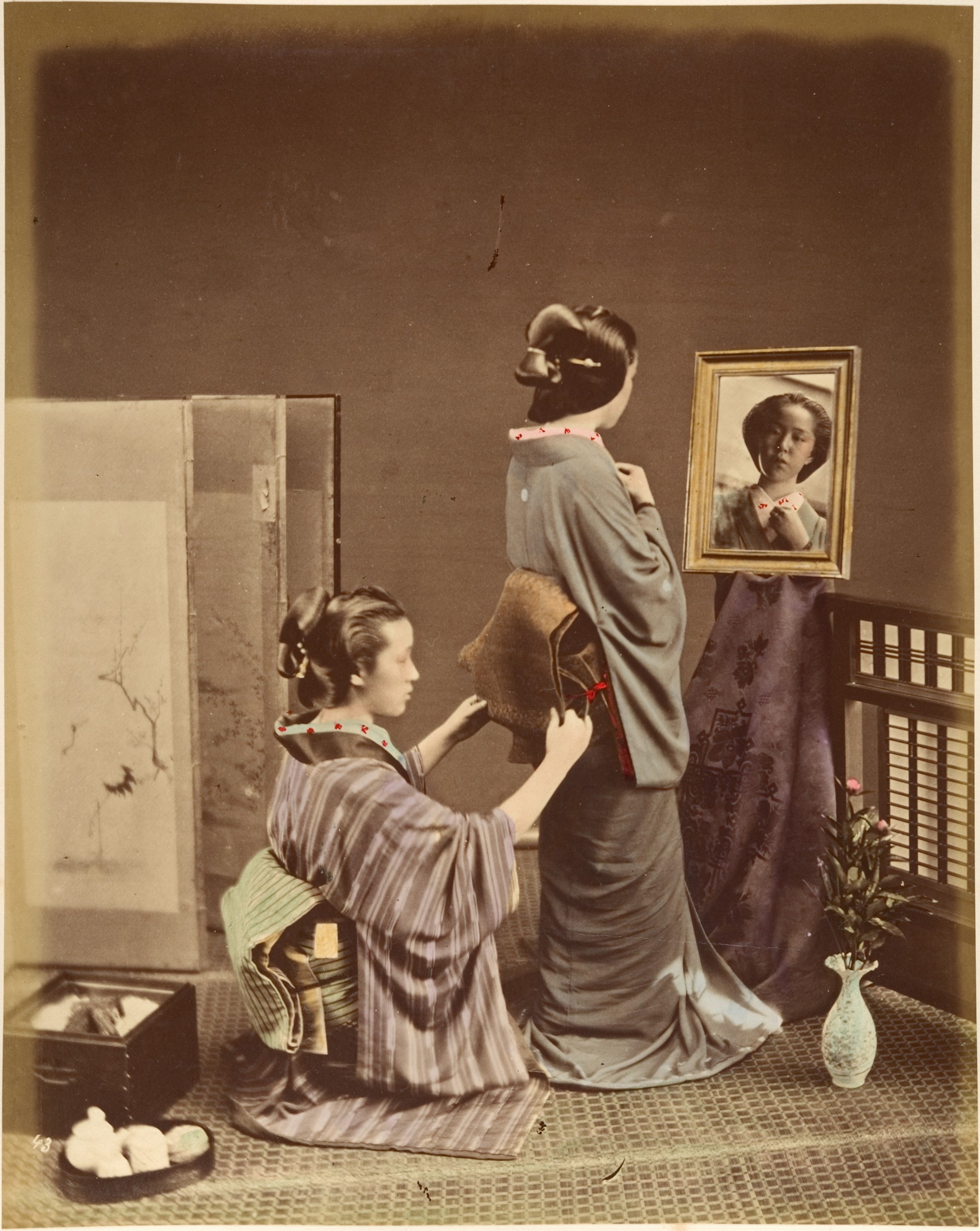
Two Japanese Women in Traditional Dress by Shinichi Suzuki
Two Japanese Women in Traditional Dress, by Shinichi Suzuki, 1870s, MET Digital Collection

While not everyone is thrilled about their favourite artworks being readily available for anyone to download, this digital trend will essentially ensure that high quality images of artworks are circulated on the internet. In doing so, these nearly flawless images will maintain the integrity of the original artwork and assert their association with the museum in which they are housed. Furthermore, each image is embedded with appropriate metadata thus optimizing search engine capabilities. This will ultimately rank them higher in Google searches than low quality renditions of artworks that currently crowd image searches.

The Unicorn is Found (from the Unicorn Tapestries)
The Unicorn is Found (from the Unicorn Tapestries), artist unknown, 1495–1505, MET Digital Collection

So what are the implications of digital museum collections? The most common argument amongst museum scholars is that digital replicas of artworks devalue the original and ultimately threaten its authenticity. Digitization more or less removes objects from their museum context and distances them from their physicality and the “essence” of the original. While this can definitely have some negative effects, digital replicas can offer a new lens in which objects can be examined. The public can now experience more intimate encounters with artworks as digital technologies tap into other human senses, such as light and touch. Imagine how engaging it would be to zoom into an artwork using your fingers on the surface of iPad or a tablet? As I have argued in my essays, digital replicas were not created as a replacement of original artworks, rather they act as supplementary devices that augment public experience—if users so choose. 

Bahram Gur Sees a Herd of Deer Mesmerized by Dilaram' s Music attributed to Miskin
Bahram Gur Sees a Herd of Deer Mesmerized by Dilaram' s Music, Folio from a Khamsa (Quintet) of Amir Khusrau Dihlavi, attributed to Miskin, 1597–98, MET Digital Collections

Do you believe digital technology should be prominently utilized in museum operations? What do you think are the positive and/or negative effects of the digitization of artworks. Please share your thoughts in the comments section.

27 May 2014

THESIS REFLECTION: DISCOVERIES AND QUESTIONS

BY: ROBIN NELSON

Prior to investigating Government of New Brunswick (GNB) cultural policy outputs from 2002-2012, I need an understanding of provincial support for museums prior to 2002. However, one of the terrifying (or exciting?) things about doing my thesis is the lack of scholarship on the subject. In this post, I am going to talk about my adventure trying to build an understanding regarding the development of provincial assistance to NB museums.

Second Annual Report of the Historical Resources Administration
Second Annual Report of the Historical Resources Administration 

In order to better understand how the provincial government has assisted museums, I’ve been reading the annual reports from the departments responsible for administrating this aid. The process has been engaging and I want to share some of what I have discovered:

Seventeenth Annual Report of the Department of Historical and Cultural Resources

The department responsible for museums has changed frequently over time. In 1967, the government established the Historical Resource Administration (HRA) to provide for the protection and development of NB heritage resources. The HRA existed until 1982 with the creation of the Department of Historical and Cultural Resources (1982-1985), which was followed by several departments including the Department of Municipalities, Culture and Housing (1991-1998), the Department of Economic Development, Tourism and Culture (1998-2000), and the Department of Tourism, Heritage and Culture (2012- Present).

I wonder what these changes say about the government’s approach to “culture.” How would a department that is also responsible for economic development approach things differently than a department that is also responsible for municipalities and housing?

Tourism, Recreation and Heritage: Annual Report 1990-1991

Early annual reports are more informative, with far less (or no) copy and pasting, than reports from 2001 or later. They often indicate who wrote a section, what institutions received financial or technical assistance, and some have pictures as examples. I was even surprised to find personal opinions in reports. For instance, in 1979, after the closing of the Atlantic Conservation Laboratory in Moncton, the report states that the regional facility was “a pawn in the cutbacks in the federal budget, despite one of the most widespread and concerted protests ever initiated in this area by normally placid museums and heritage personnel” (18).

While placid is not necessarily insulting, I would be affronted if called “normally placid,” making me wonder how heritage personnel felt about this report.


 2001-2001 Annual Report: Culture and Sport Secretariat
2001-2001 Annual Report: Culture and Sport Secretariat

Most importantly, the annual reports demonstrate the diversity in approaches to assisting museums. Since 1969, GNB has not only provided capital or operating grants, but also summer job programmes and technical assistance, which includes things like translation services, help making displays, and training workshops. Further, assistance to museums has not only been provided by a government department, but also through the provincial museum.

This is just a small amount of what I discovered in the annual reports, which were saturated with more information than I will likely need (for instance, did you know the CMA director, John McAvity, once worked as the Museum Advisor at the New Brunswick Museum? As I am from the area, this sparked a sense of regional pride).

I would love to hear any responses or questions you may have!

26 May 2014

ART IN A GIF

MUSEUM MONDAYS

BY: BRITTNEY SPROULE

This fine and toasty Monday, I thought we could take a little time to become better acquainted with a phenomenon so many of us know and love: the GIF.


Now, you may be giving me a similar look as my dear friend Mr. Ventura up there, thinking "but is this not "museum" Monday? Is Musings not a classy place for cultural discussion?" Do not fret! As much as I'd love to fill this post with an endless supply of my personal favourite genre of GIFs - hockey GIFs - I'd like to take a gander at how contemporary artists have been exploring GIFs as outlets for artistic expression within the past decade or two. As a result, these "new" artforms have begun to snag some real estate in art galleries - as part of mixed media exhibitions or as part of exhibitions entirely devoted to GIF art.

GIFs, aka Graphics Interchange Formats, have actually been around since 1987. I won't go into the technological details of how they work (click on the previous link for these details), but essentially GIFs allow one to store multiple images in a single file to create a simple animation.

NYC…. processing.
By digital artist Hateplow

But why the artistic attraction to these simple animated files? Artists and curators from a few different GIF-centered exhibitions have some thoughts on the matter:

"They attract attention. They flicker and undulate. They stutter... Focusing on work that engages both the language of the Internet and fine art, this exhibition aims to articulate the value of the GIF in the context of the gallery."
 -Paddy Johnson, curator of "Graphics Interchange Format," Denison University's Mulberry Gallery (Granville, OH).

"In a world where most Digital SLR cameras can shoot high definition video, digital technology raises questions concerning what a photograph is and how we make sense of it...Our opening show embraces the animated GIF as a uniquely screen-based image."
-Katrina Sluis, curator of "Born in 1987: The Animated GIF," The Photographers' Gallery (London UK).

Saul Chernick, "Totentanz 2.0 (After Heinrich Knoblochtzer)," 2008

In the GIF above, Saul Chernick's Renaissance-inspired GIFs raise some interesting points for ponder. According to this article, as much as this particular set of GIFs is about death, Chernick also based his animations on some of the first cheap and accessible prints of their kind, much like gifs.

After taking a look around Chernick's own website, I am particularly fascinated by his "interest in the intersection between old and new forms of media and how cultural ideas evolve, as they are adapted to new technologies over time." Chernick's use of the GIF medium to explore his fascination with religions iconography and the metaphysical also yield some very provocative results. He appears to be using computer animation to breathe life into otherwise static mystical images or intangible ideas in order to make them more tangible in a sense.


Anyway, I could go on forever and provide you with millions of GIF art examples and thoughts about them, but I'd rather know what you think!

You may want to check this Buzzfeed article (I know, my sources represent the summit of academic excellence) titled "30 Artists Proving that GIFs are the Next Great Artform" for inspiration. Could GIFs truly be "the next great artform" (whatever that means)? Perhaps a better question, do you think GIF's are effective at all as an artistic medium? Can they be affective? Are they a creative way to capture the attention of audiences and engage them? Do you ever use GIFs to express yourself, either informally (ex. facebook, text messaging, etc.) or as a more formal medium of artistic expression?

Enjoy!

23 May 2014

OBJECT OF THE WEEK: "TOUCHING STRANGERS" PHOTOGRAPHY

BY KATHERINE HANNEMANN

With my summer internship now well underway, the job so far has presented not only new and exciting tasks and learning opportunities, but also a new -- and somewhat challenging -- commute to work. Every morning and afternoon I find myself along with (what seems like) several thousands of other people coping with the slog of traffic and streetcars on King Street, its pace most glacial between about Yonge and Spadina. But the trek hasn’t been all bad. Many minutes spent at a near stand-still on King Street have allowed me to get a good look at all the area’s buildings, people, activities, and -- the focus of this week’s post -- public art.

Toronto Streetcar
King streetcar at rush hour. Source: Toronto Star
While recently gazing out the window from the King streetcar, I noticed an installation of a series of large photographs along the sidewalk. Intrigued, I decided to alter my routine that afternoon and simply walk instead of taking transit so I could get a closer look. Already analyzing the many roles and benefits of public art, in my mind the installation already scored a point by provoking me to interrupt my commute for a bit of afternoon art.

Once I approached the installation near King and John Street, large text panels on either end told me what it was all about: “Touching Strangers,” an excerpt of a larger project by photographer Richard Renaldi. To create his work, Renaldi approaches various individuals on the street, pairing them up and photographing them in close, familiar, and intimate positions usually reserved for -- well, people who aren’t strangers. To me, the art was fantastic and the placement of the installation even more so. Much of my time in that particular stretch of King Street is spent inadvertently touching strangers, squished up right up close to others in a streetcar resembling a can of sardines. I loved how the art made me think about conventions of closeness and intimacy, and where it’s acceptable to touch strangers and where it is an unusual portrait. I also appreciated how it made me think about the appropriate placement of public art, and how I might react to it differently, say, on a quiet little side street. 

"Touching Strangers" Photography
"Elaine and Arly" by Richard Renaldi.
Source: Scotiabank Contact Photography Festival
Later in the week (on yet another day when the streetcar was simply too slow to even bother boarding), I decided to conduct a little “public visitor research” study by watching passersby interact with the art. What I witnessed made me reflect on the wonderful flexibility and spontaneity of public art: some solo walkers glanced at the images as they walked by; others continued on without looking; a few pairs started to discuss the art as they passed; two bikers dismounted and went, photograph by photograph, having a long conversation about each and every one. I appreciated that, while some people wouldn’t stop today, maybe they would stop tomorrow. Maybe their curiosity would be piqued and they would make a note to read the text panel on their evening commute. However people interact with it, I always appreciate when art spills out of the “container” of the museum to find more viewers.

 
"Touching Strangers" Photography
"Claudio and David" by Richard Renaldi.
Source: Scotiabank Contact Photography Festival
One question I considered as I explored this particular art was, what are the limits of what public art can address? I thought of this when reading the introductory panel, which suggests that the images are “provocative.” In many ways, of course, this is true -- the images certainly provoked me to reflect on contact with strangers, and it is provocative, uncomfortable, and challenging to think of getting so close to a stranger on the street. But it also made me consider other definitions of “provocative,” and how public art really can’t push limits or provoke the public too drastically. I thought back to Alex’s post earlier this year, on the outcry at a particular public art installation as a “site of unnecessary distress.” When does public art cross the line from safely provocative to distressing? What do you think are the limits of public art?

Nevertheless, I love what the “Touching Strangers” installation has provoked for me -- contemplation, humour, delight, people-watching, and a new path to work. Has public art recently inspired you or provoked you to alter your commute? What have been some of your memorable responses to public art?

Touching Strangers is on display in front of Metro Hall until June 1. 

21 May 2014

EXHIBITION REVIEW: THE SECURITY OF EXHIBITIONS


BY MEAGHAN DALBY 

A couple of weekends ago I went to the National Gallery of Canada. This is the first art gallery I’ve been to in a while (I just haven't been able to get myself to the AGO for some reason… don’t judge!). Unfortunately, the first thing I noticed was not the beautiful works of art, but the copious amounts of security guards. My friend and I were the only ones in most of the galleries, but almost every room we went into a guard was there making sure we weren’t causing a ruckus.

Everyone's favourite movie: Night at the Museum
Source:  http://blogs.artinfo.com/artintheair/files/2012/06/whitneysecurity.jpg    

Obviously, I’m no stranger to museums; I understand how important it is to protect the objects housed there. Preservation is a huge part of collections management, and security falls under that prevue. But visitor experience is also important. At the National Gallery it was the first time I was very aware of them. With the exception of one guard, they weren’t overly friendly, and mostly just watched my friend and I walk through the gallery rooms. Quite frankly, they made me feel a tad uncomfortable.

Perhaps this was because there weren’t many people at the museum that day, so my friend and I got extra attention. Perhaps because it was a weekend, the security was bumped up. Perhaps because it is an art gallery, where the art is not protected by glass, and could easily be damaged by careless or aggressive visitors. These are all completely reasonable explanations, but it doesn’t change the fact that as a visitor I felt like I was being watched, judged and basically like they were waiting for me to lose it – and attack a piece of art. I moved through the gallery quicker than I would have if there were no guards, because I felt uncomfortable staying too long.
An accurate representation of me at the NGC
Source:  http://alivingston.qwriting.qc.cuny.edu/files/2011/11/Psycho.jpg    
I know this is more a reflection of me, as a museum go-er (probably a hyper aware and entitled one…) than the state of security in museums, but I thought it was an important topic we should discuss.

Clearly, security is necessary in museums. We cannot house millions of dollars worth of cultural objects without supplying some kind of security. It would be irresponsible. How do we reconcile the need for security with the visitor experience?

Perhaps there is a way to integrate the security guard less as a policing figure, and more of a knowledgeable protector. Someone who isn't so intimidating, maybe.

And, that’s not to say all visitor experiences are hampered by security guards. In fact there are many instances where visitors sing security guard’s praises. In this article in the New YorkTimes, the author is quoted as saying “Museum guards find the lost, shepherd the confused and save runaway toddlers from impending collisions with immovable sculptures.” Pretty high praise.
Source:  http://museumist.com/wp-content/uploads/2011/02/security.jpg   
Alternatively, in some galleries, they are using sensors which set off an alarm if visitors get too close to a painting. Is this a useful compromise? Or does the security guard act as more of a deterrent than an actual "police" force?

I'm fairly certain the age of the security guard is not going to end any time soon, and I don't want it to.  I expect to see security, I just didn't appreciate feeling judged and watched.  As emerging museum professionals, I think it is good to walk through museums as visitors so we can get a better sense of what the atmosphere is, and what kinds of give and take are allowable.

What are your security experiences in museums? Do you find a difference between art galleries and object-based museums? Am I out to lunch? 

20 May 2014

THESIS REFLECTION: QUEERING MUSEUMS

BY: NICOLE RITCHIE

My name is Nicole Ritchie, and I entered the Master of Museum Studies program in collaboration with Sexual Diversity Studies in September 2013.  As the third contributor to the thesis column this summer, I will give you a brief overview of my background and my research.

I graduated from the University of Alberta with a Bachelor of Arts with Distinction in Women’s Studies and Art History.  Throughout my undergrad, I volunteered at a variety of museums, galleries, and collections, which led to my interest in arts and cultural institutions and my application to the MMSt program.  This included collections management and curatorial work at the Clothing and Textile Collection at the University of Alberta, the Royal Alberta Museum, the Bata Shoe Museum, Lando Art Gallery and Auctions, and, currently, the Sexual Representation Collection. With this background in practical expertise intertwined with my love of feminist and queer theory, my thesis topic emerged.


My thesis will interrogate and conceptualize the theoretical foundation of non-normative – that is, values and ideas that do not uphold the dominant social system – arts and cultural space through the act of ‘queering’.  This will involve looking at several major academic bodies of literature – museum studies, queer theory, affect theory, and social and cultural geography studies.  I will engage with these fields, drawing innovative connections that contribute to both new theoretical dialogues as well as new possibilities for museum practice.  As well, I will engage with museums as participants within and tools of neoliberalism, which is a frame that, I believe, is valuable to interrogate in the context of queer theory – a field that insistently criticizes neoliberal values, such as that of normativity and inclusivity.  Throughout my thesis, I will reference various examples of museum practice to demonstrate current museum practices that either perpetuate a normative paradigm or develop a ‘queer’ space in order to enhance and highlight various aspects of my argument.  

This engagement will be guided by various themes that are reflected in my research questions:

  • How can queer and affect theory be utilized to think about non-normative arts and cultural space?  
  • How can these spaces be queered, and what does ‘queering’ accomplish for the theoretical development of museum identity and space and the potentialities of practice?  
  • In what ways do specific practices of museum studies, such as ‘difficult knowledge’, preservation, and commemoration, speak in dialogue with practices of queer theory, such as the formation of ‘archives’ and queer historiography? 

My project is significant for engaging museology in dialogue with queer theory, affect theory, and theories of social and cultural geography, but also for the development of non-normative museum methods, practices, and experiences that reflect the growing contemporary discussion of ‘queer’ in society. 

My thesis committee is composed of a communications and museum studies scholar, Dr. Irina Mihalache, and a feminist and queer technology studies scholar, Dr. Patrick Keilty.  Thus, my committee forms a dynamic and well-rounded grouping in order to support my diverse interests and fields of research.    

Now here’s to executing this!  Stay tuned for my progress on June 9th!

19 May 2014

THE METROPOLITAN MUSEUM OF ART

MUSEUM MONDAYS

BY: ALEXANDRA JEFFERY


Babe Paley in a Charles James gown
Babe Paley in a Charles James gown, 1950.
Photograph from The Metropolitan Museum of Art
Photograph by John Rawlings, Rawlings / Vogue / Condé Nast Archive. Copyright © Condé Nast

The Metropolitan Museum of Art recently underwent a 40 million dollar revamp of its Costume Institute galleries, including the new Anna Wintour Fashion Center. A week, and a bit, ago the Institute opened its "inaugural" exhibition called Charles James: Beyond Fashion.

The Costume Institute's Andrew Bolton and Harold Koda
The Costume Institute's Andrew Bolton (left) and Harold Koda stand among a trio of Charles James's dresses. Photograph by Matthew Kristall for Wall Street Journal

The exhibit will focus on James' innovative construction and design. About 65 of his designs are shown in two different locations in the Met. One of which is the first-floor special exhibition galleries which "spotlight the glamour and resplendent architecture of James's ball gowns from the 1940s through 1950s." Additionally the new Lizzie and Jonathan Tisch Gallery "provides the technology and flexibility to dramatize James's biography via archival pieces including sketches, pattern pieces, swatches, ephemera, and partially completed works from his last studio in New York City's Chelsea Hotel."

Charles James Ball Gowns
Charles James Ball Gowns, 1948
Photograph from The Metropolitan Museum of Art
Photograph by Cecil Beaton, Beaton / Vogue / Condé Nast Archive. Copyright © Condé Nast
Charles James "Butterfly" gown
Charles James "Butterfly" Gown, 1954
Photograph from The Metropolitan Museum of Art, Photograph by Cecil Beaton
The Cecil Beaton Studio Archive at Sotheby's

What is interesting, and intentional on the part of the museum, is the marriage between James' technological and technique based advancements in dress construction and the techniques and technology the Met is applying to the exhibit as well as the museum itself with the new upgrades courtesy of the renovation.

Part of the exhibition experience is recordings of James' voice and 3-D image projections that show the inner layers of James' designs. The use of X-ray images to show visitors a different view, or different perspective of the designs is mirrored by James' own use of complex structures for his gowns. For instance, his use of millinery net, willow and buckram for interior structure provided the basis for astounding architectural constructions.

According to the Wall Street Journal, the Met's new renovations are not restricted to gallery spaces: "a new conservation lab, equipped with wide doors to accommodate large gowns, a wet lab for treating fabrics and a fume-extraction unit. There's also an updated storage system to handle the museum's collection." 

Michelle Obama, Thomas P. Campbell, Anna Wintour, and Emily K. Rafferty cut ribbon
Michelle Obama cuts the ribbon alongside Thomas P. Campbell, director and CEO
of the Metropolitan Museum, Anna Wintour and Emily K. Rafferty,
President of the Metropolitan Museum.
Photograph from The Telegraph

It is clear that the Met's renovation is beginning with a few big names, as it were. We've got Charles James, couturier extraordinaire; Anna Wintour, editor-in-chief of American Vogue; and even Michelle Obama cut the ribbon. Sometimes, it seems when it comes to big museum exhibits all there is are big names. The name of the exhibition, the name of the gallery and the name of the museum itself. However, especially when it comes to fashion exhibits, I often wonder who these exhibits reflect. Certainly the socialites, debutantes, magazine editors who feature and wear designs like James'. With the Met's Costume Institute this seems, perhaps, natural. That the Met would feature this exhibit after recently opening it's renovated facilities is not surprising, in some ways this is where couture belongs.

Chales James: Beyond Fashion
"Charles James: Beyond Fashion," on view through August 10
Photograph from The Metropolitan Museum of Art's Instagram

This also reflects broader problems in museum collections for me (and this can certainly be said of archival collections as well), that the objects only show a certain type of individual. And this is of course for the simple reason that these are the objects that survive. In fashion collections the evening dresses of young, wealthy women are reflected in abundance. They are the dresses that are kept and remembered. We know who wore it and where they wore it, we even have the photographs to accompany them. 

I found myself contemplating this last year when the ROM had their BIG exhibit on. Not that I didn't enjoy the exhibit in some senses, but it did make me wonder what that Dior dress was doing at the ROM, in Toronto. I have recently read a few of Alexandra Palmer's (senior curator at the ROM) works on Toronto's post-war couturier's and I found them fascinating.  For me, this is the story I want to see at the ROM, or really anywhere. Not the story of a Dior gown constructed in Paris and immediately purchased for a museum collection.

But I suppose I have to remember that museum's have to work with what they've got. You cannot show gowns you do not have. Museum's must work within their collections, or what they can get on loan, and create stories from this. And really, who am I to talk about not wanting to see big names, I just posted five photographs of Charles James' gowns and would definitely want to see the exhibit.