Showing posts with label Natural History. Show all posts

14 February 2020

TEACHING CLIMATE CHANGE PART III: LEARNING BY EXAMPLE

Museums on Earth | Defne Inceoglu

Illustration courtesy of Defne Inceoglu.
Last time, we talked about language and need - using research done at the Royal Ontario Museum. For Part III of this series, we will explore other institutions who are using their natural history collections to teach about climate change.

\\\

Natural history museums stand as a legacy to the 18th and 19th centuries. Classifying and actively collecting specimens has carried through from the past two hundred years, imbuing many museums with large collections of animals. (I wrote about birds in a museum collection over the Summer of 2019 - find the article here). These specimens sit in collections or in displays across many institutions, which has always left me wondering about the role that these complicated objects play in the 21st century. 

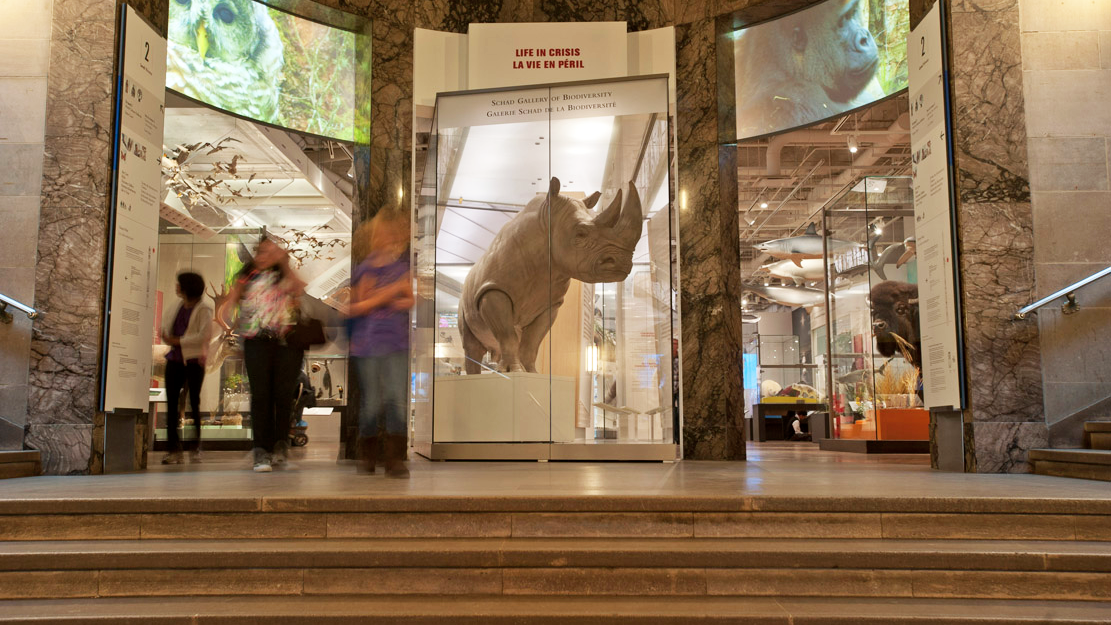
Some museums, like the Royal Ontario Museum (ROM), have re-purposed their collection to teach climate change. The Schad Gallery of Biodiversity groups animals into ecosystems and discusses human impact on the environment.

There is good intent with an idea such as this: show off the natural world in order to create interest and advocacy. If a person visits a museum and sees a polar bear, will they be inclined to do something to save them? 
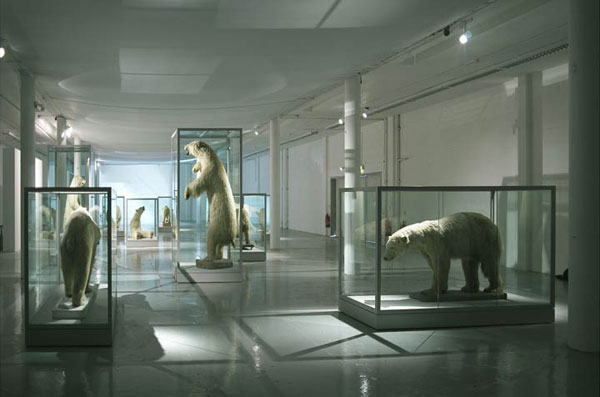
Exhibition view from nanoq: flat out and bluesome. Artists
Bryndís Snæbjörnsdóttir and Mark Wilson: (Source).


Does the visitor here need something extra, like a didactic or interactive element which will tell them how the polar bear is at risk?

Or will they be able to make the connection on their own?

Is a visitor as affected by a small rodent at risk than they are at a whale skeleton?

How do visitors give meaning or value to the objects they are seeing, what is impactful and how do they take away information?

These questions are always spinning around in my head as I go through the effectiveness of using an animal specimen or taxidermy to teach visitors about climate change. I only have the ROM's example to go by, so I decided to take a look at other big natural history institutions to see how they are using their collections to tackle this area of education.

I will highlight three institutions that have created climate-focused exhibitions or resources for visitors, all just in the past couple years. 

I. Natural History Museum at South Kensington (London, England)

An illustration showing a sign that reads 'yes you can'.
This ADORABLE illustration is from the Natural History Museum's article on how to live sustainably: Source.
   
The Museum has declared a planetary emergency, in recognition of humanity's failure to combat our destructive impact on the planet's survival systems. 
Climate change, biodiversity loss, habitat destruction, pollution and deforestation are just some of the crises caused by unsustainable human activity. These add up to an emergency on a planetary scale.
The museum has also worked in climate advocacy into their strategic plan.
Five strategic priorities will be at the core of the Museum's activities until 2031: 
1. securing the future of the collection  
2. transforming the study of natural history
3. developing the gardens and galleries
4. creating a resilient and sustainable organisation  
5. engaging and involving the widest possible audience  
The museum has also provided resources for visitors to their website on how they can make individual impacts. By giving their audience resources, the museum is really coming through for their visitors.

II. American Museum of Natural History (New York City, USA)

The American Museum of Natural history re-imagined their Hall of Planet Earth in 2018. In an official press release, they write:
The American Museum of Natural History is re-opening its climate change exhibit in the David S. and Ruth L. Gottesman Hall of Planet Earth with comprehensive updates to a section about one of the most urgent scientific issues of our time. The new installation, which opens to the public on Saturday, July 7, is anchored by a dynamic media wall featuring large-scale imagery, animations, text and graphics, and interactive panels where visitors can engage with the evidence for climate change. Updates, which have been in planning and development since 2016, also include new content in the hall’s sections on past climates as well as on convection.
Exhibition view of "What Causes Climate Change" component of the new gallery. "The climate change section features a media wall comprised of 36 high-definition 55-inch screens with “big-picture” messages about climate change. Below them, content panels and interactive stations based on data from organizations including NASA and NOAA (the National Oceanic Atmospheric Administration) explore three main themes: How Climate Works, Our Warming World, and Consequences of Climate Change": (Source).

In addition to their new hall, their biodiversity permanent exhibition contains information for visitors on how biodiversity is in jeopardy.


                                        III. University of Oslo: Natural History Museum

The University of Oslo's Natural History Museum is opening what they are calling a "Climate House" in their botanical garden section.
The Climate House opens in the Botanical gardens in Oslo spring 2020. The Climate House will be a new and exciting arena for communicating research on climate and environmental issues. Children, teenagers and their whole families will be able to learn more about what climate change means, to get to know the several solutions that exist and to get inspired towards action. From early morning until late at night, the Climate House will showcase research-based exhibitions, lectures, films and debates.
This approach caught my attention, as it is programming-focused rather than re-purposing their collection.

It's always good to learn by example. By researching other institutions that are doing work in climate education, we can select and learn new strategies for our own work. That being said, there are still lots of areas to improve in and grow. It is important to consider how the above three institutional strategies could be combined or adjusted - this tapestry of opportunity is still in the works. It's good to start keeping it in mind.


\\\


Check out the Coalition of Museums for Climate Justice, an active group that brings together museum professionals tackling the crisis.

Next time, let's chat more about obstacles and roadblocks.

4 April 2018

THE NATURAL HISTORY MUSEUM RETHOUGHT: CURRENT DIRECTIONS

MUSEUMS ON EARTH

BY: LANA TRAN

As stewards of nature, natural history museums dedicate a large proportion of their resources to the conservation and development of collections, from which an indispensable understanding of the Earth has come. It’s humbling to think that the careful categorization and analysis of specimens could create such a fundamental awareness of the history of existence itself. It seems, however, that such a feat is no longer enough.

Natural history museums need to do more, differently—or at least, that seems to be the prevailing conversation in the museum literature.

The speed of technological advancement and accompanying social movements are challenging museums to keep up. Citizen science and maker movements are finding space within museums, opening new options for visitor engagement. In collaboration with game developers of all levels, the Royal Ontario Museum's soon-to-be permanent gallery The Dawn of Life has already popped out some interactive apps—one being a dating RPG for, well, prehistoric invertebrates.
 
Screenshot of eCambrian dating game, Royal Ontario Museum. Source.

Meanwhile, more analogue, high-touch approaches could help connect urbanites with values in nature and culture that underlie contemporary issues. To do this, natural history museums will need to go beyond internally-focused practices to engage with the cultural realities of the immediate community.

One such example is the Environmental and Climate Justice Dialogue Initiative. Using object-based storytelling circles, museums can activate their collections, at the same time encouraging local people to see their individual experiences and talents as valid in the struggle for conservation.

4.5 billion-year-long story short, natural history museums are awakening to the idea that long-term relevance is not achieved in self-mummification, but adaptation. 

Further Reading

Dorfman, Eric. 2018. The Future of Natural History Museums. Milton Park, Abingdon, Oxon: Routledge.

7 February 2017

GREAT AND TERRIBLE BEAUTY AT THE ST. PETERSBURG ZOOLOGICAL MUSEUM

MUSINGS ABROAD

BY: STEPHANIE READ

Calling all natural history lovers to another installment of Musings Abroad! This post takes us to another cultural landmark of regal St. Petersburg, the Zoological Museum. Located on the Eastern tip of Vasilyevsky Island facing the Winter Palace along the Neva River, the Zoological Museum is one of the largest Natural History Museums in the world. The Museum serves not only as a testament to the diversity and beauty of the fauna of this world, but also to the evolution of the taxidermy and display of animal specimens.

Looking South toward the entrance to the Zoological Museum. Note the whale skeletons and collection of seals and walrus species. Photo credit: Stephanie Read, 2016.
The Zoological collection was originally an offshoot of Peter the Great's cabinet (read: mega warehouse) of curiosities. Collecting has been ongoing since the early 18th century. Below is a sample of taxidermied pets of Peter the Great from the same time period, situated near the entrance of the museum. It certainly brings attention to the evolution of taxidermy! (Note: Peter the Great also preserved the body of his friend, the French giant Nicholas Bourgeois, however to posterity's slightly less horrified relief,  he decided to keep Bourgeois's skeleton rather than stuff him).

Peter the Great's pets in the Entrance Hall. Photo credit: Stephanie Read, 2016.
 As you can see, these early examples of taxidermy are straight up frightening.. unless this was some breed of puppet-horse that I am not aware exists...

Ghoulish examples of early taxidermy at the Zoological Museum! Photo credit: Stephanie Read, 2016.
As we came into the Main Hall, I was started to see dozens of children dressed in all combinations of black and white rushing up the stairs. The boys were nattily dressed in formal black slacks and white shirts. The girls' hair were often intricately braided and decorated with massive white pompoms or plastic flowers. Apparently this is the dress code for school children on the Day of Learning, that is their first day back to school. Many children spend their first day back visiting museums in their city.

Children visiting the museum on Learning Day. Photo credit: Stephanie Read, 2016.
The Zoological Museum has an informal, laid-back atmosphere. As you can see below, various plants occupied the stairwells and corners. I hardly saw any attendants, and I did not see any security guards. However, the space had a lived-in feel, which is not surprising as the Museum is in fact an appendage of the Zoological Institute of the Russian Academy of Sciences. The building, completed in 1832, originally functioned as a warehouse for the city's stock exchange. It is built in the Greek Revival style, which took the architecture scene of St. Petersburg by storm in the early 19th century.
A woman watering the plants in the stairwell. Photo credit: Stephanie Read, 2016.
The Museum boasts a vast collection of insects, mammals, birds, fish, reptiles and invertebrates. It is, for all intents and purposes, an example of the traditional, encyclopedic Natural History museum. The labels do not have an overall internal integrity. The Museum bothers not with more contemporary interpretive strategies or interactive elements, preferring to present the collection in such a way that the visitor is awed and overwhelmed by its breadth.

The upper floor of the Main Hall, devoted to all types of insects. Photo credit: Stephanie Read, 2016.
I was hoping to find this Death's Head moth among the critters. Note the display of caterpillars and cocoons as well. Photo credit: Stephanie Read, 2016/
Some specimens getting some fresh air. Photo credit: Stephanie Read, 2016.
 Upon exiting the Main Hall, I entered a labyrinthine space, a single tunnel extending toward the horizon however long we walked. I felt as if I were on a subway platform inexplicably filled with animals and complex dioramas. Oh, the dioramas! They are like nothing I had ever seen: Eagles swooped over their massive nests; wolf pups tumbled over each other and tore at the carcass of a young deer; vultures scratched and bit at the body of a wild dog. These dioramas were like the insinuated scenes of Disney movies. I half expected to see old Scar being devoured by hyenas. All of these were at times juxtaposed with adorable and mundane scenes of a lumbering pair of old tortoises or a waddle of penguins. For what it's worth, the children seemed to love the dioramas.

In the diorama tunnel. Photo credit: Stephanie Read, 2016.
The diorama tunnel is not for the faint of heart! Photo credit: Stephanie Read, 2016.
A pretty beat-up and scruffy opossum- a Disney movie villain in it's own right.. Photo credit: Stephanie Read, 2016.
This mammoth fell off a cliff. It is the only stuffed and mounted adult specimen of its kind, and even swaths of its hair have been preserved over millennia. Photo credit: Stephanie Read, 2016.
These saiga antelope's live cousins are crtitically endangered. They used to thrive in the Eurasian Steppe, but now are found in Russia and parts of Kazhakstan. It amazes me that such strange looking creatures still exist today. I could not tell if the label addresses their endangered status. Photo credit: Stephanie Read, 2016.
Only a few English labels accompanied select specimens, such as the woolly mammoth. For the most part, however, I was unable to understand the labels. Therefore, I appreciated the Museum from an aesthetic perspective. I would have liked to know, foe example, whether the issues of hunting and collection and their impact on the environment had been addressed in any way.

 In fact, the experience would be much like poring over a book of animal specimens, if it were not for the fearsome yet wonderfully crafted dioramas. That being said, I hope when I someday return that the Museum will have adopted some interactive and interpretive strategies. For starters, the labels could include stickers or symbols signifying whether the species in question were vulnerable, near extinction or extinct.

A Chinese water deer. I was surprised to learn that they still exist. Photo credit: Stephanie Read, 2016.
This concludes the February installment of Musings Abroad. Join me next month in Moscow for a visit of the world-renowned State Tretyakov Gallery!

29 January 2016

I, FOR ONE, WELCOME OUR DINOSAUR OVERLORDS

OBJECT OF THE WEEK

BY: ROWENA MCGOWAN

Anyone who knows me knows that I have a soft spot for a certain kind of animal.

IT'S BUTTERFLIES, GUYS.
Photo credit: Laura Babineau


Unfortunately for me, dinosaurs went extinct years ago (although of course it was quite fortunate for the human race as a whole, as after the dinosaurs came the rise of the mammals). But what if dinosaurs hadn’t gone extinct? What if they had survived to the present? Well, humans look quite different from their Cretaceous ancestors so it makes sense that dinosaurs would have evolved, too.

This week’s Object of the Week is the subject of a thought experiment addressing exactly this idea. Meet the dinosauroid.

Source.

It was based on a dinosaur called a Troodon. Troodon was a small theropod. Theropods were bipedal, carnivorous dinosaurs running the gamut from the Tyrannosaurus rex to the Velociraptor – they were also the ancestors of birds. Troodon, meaning ‘beautiful wounding tooth,’ was originally known from a single tooth, hence the name. It would have been about 2m long.


An up to date reconstruction of Troodon by Brian Cooley. Photo credit: Rowena McGowan


The reason Troodon is so special is its intelligence. Troodon had the largest brain in proportion to its body of any known dinosaur, meaning that it was probably also the smartest of the dinosaurs. Although it was much brighter than, say, a Stegosaurus, I wouldn’t worry about Troodon taking your jobs, even if it had stuck around. It was probably only as smart as a not particularly smart modern bird. Think ostrich rather than parrot.

Troodon also had binocular vision and grasping fingers that may have allowed it to manipulate objects, at least to a certain degree. All of these traits made it a perfect base for the dinosauroid.

The dinosauroid was created by Dale Russell and Ron Seguin in 1982 and was displayed at the Canadian Museum of Nature in Ottawa. It posited a hypothetical evolution of Troodon if its brain had continued to grow. Its head is quite large, of course, to carry that big brain and the snout is shortened to compensate. Russell and Seguin gave the dinosauroid an upright bipedal posture with a severely reduced tail because they argued that this was the best way to carry the enlarged skull. They also made it viviparous (giving live birth, rather than laying eggs), because a placenta helps in cranial development. The hips are enlarged to accommodate giving birth to a large-headed baby.

Source.

Looks very human, doesn’t it? Is the human form really the default for an intelligent being? Some people say yes. But plenty of other scientists have said that the answer is no. The dinosauroid has been accused of being biased and far too humanoid. Paleontologists like Darren Naish see no reason why a dinosaur’s body plan should change so dramatically in order for its intelligence to increase. Naish believes that human posture was less the ideal form for an intelligent creature and more an artifact of our evolution. Had a dinosaur’s brain grown similarly, it might easily have retained its tail and horizontal posture and manipulated objects with snout and feet instead of hands. 

Of course, this is all speculation. The truth is, we don’t and will never know what hyper-intelligent dinosaurs would have looked like. But, if parallel universes do exist and in one of them, that comet never hit, I personally kind of hope that the dinosauroids looked a little bit like this:

Species go extinct but style is forever. Photo credit: Mike Ryan. Source.

Works Consulted

http://blogs.scientificamerican.com/tetrapod-zoology/dinosauroids-revisited-revisited/

Russel, D. & Sguin, R. 1982. Reconstruction of the small Cretaceous theropod Stenonychosaurus inequalis and a hypothetical dinosauroid. Syllogeus 37, 1-43.


12 January 2016

FEELING THE HEAT: MUSEUMS AND CLIMATE CHANGE

MUSEUM INNOVATIONS

BY: JENNY FORD

Sign at Ellis Island noting that exhibits have been removed because of Hurricane Sandy.
Sign at Ellis Island. Source: Jenny Ford
In May 2015, I took a trip to Ellis Island off the coast of New York City. The former immigrant inspection station is a museum and historic site today—but one that was quite bare when I visited. Empty display cases and missing panels were replaced with signs reading: "museum objects temporarily removed from exhibit", referencing damage by Hurricane Sandy in 2012.

I reflected on this sign as I flipped through the American Alliance of Museum’s 2015 Trendswatch guide in December, contemplating another year gone by. Out of the 2015 trends, climate change stood out to me.

The Paris talks are more than a month behind us now, and I began wondering what museums’ roles are in this climate change crux we are up against like never before.

CLIMATE AND COLLECTIONS

The AAM’s Trendswatch concentrates on the practical here—a sort of “batten down the hatches” call for museums to prepare collections for the imminent disasters ahead, from flooding to tornadoes.

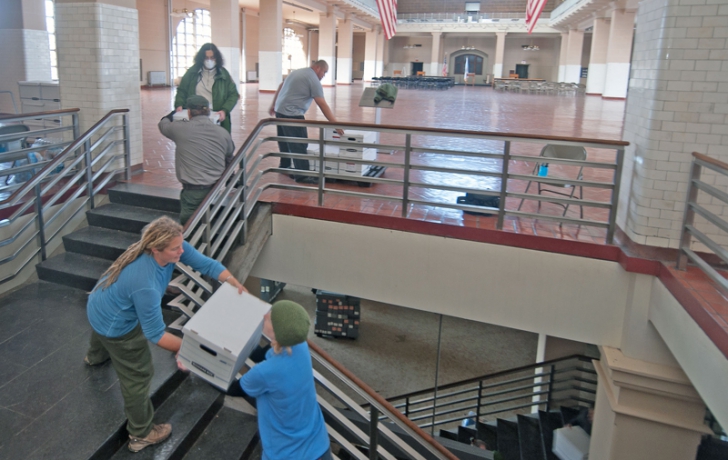
In the case of Ellis Island, the hurricane flooded the first floor and basement of the historic site, only destroying one exhibit and thankfully leaving most of the collection untouched. However, most objects had to be removed because the hurricane damaged the climate control system. The fact the cases are still empty speaks to the damage (and cost) and perhaps the feat to make the collection hurricane ready in future.


Staff removing objects from Ellis Island after Hurricane Sandy.
Staff removing archives and artifacts after the hurricane hit Ellis Island. Source.


There are a number of initiatives tackling these climate change issues, however. There's even an upcoming U.S. conference called Keeping History Above Water. The Future of Museums blog also recently posted an article about risk management tips for collections given climate change threats.

ENVIRONMENT AND EXHIBITS

But the other side to this climate change challenge is education. When I got thinking, I could list a number of permanent climate-change-related exhibits in museums. The entire story line for the Royal Ontario Museum’s permanent Schad Gallery of Biodiversity is dedicated to the effects of climate change on biodiversity.

The entrance to the ROM Biodiversity Gallery, showing a rhino.
The ROM's Schad Gallery of Biodiversity. Source.

In the states there are also a number of efforts, including the Field Museum's 2010 Climate Change exhibition in Chicago. The exhibition addressed the contributors to and consequences of climate change.

Perhaps most importantly, there's the ambitious Climate Change Museum in New York that launched in July 2015. The museum aims to create "a hub for climate science, art and dialogue: a beacon for solutions."

An exhibit showing rising sea levels at the Chicago Field Museum.
An exhibit at the Field Museum's Climate Change exhibition. Source.

The estimated opening date is 2020. By then, many of the commitments outlined at the Paris Conference will be on their way... if this round of agreements actually sticks. That being said, there are plans for pop-up exhibits, including one slated for summer 2016 that delves into fossil fuel use in the U.S. An interim museum is also planned for 2017 until the full-fledged museum is ready.

DOING OUR PART?

So, we're attempting to educate the masses, we are planning for disaster, but is the message really sticking? Or is it all falling on deaf ears?

In one skeptical Guardian article earlier this year, author Jonathan Jones questions if museums can "deal with this topic in a way that is genuinely informative, intelligent, honest and accessible without being patronising".

Many science museums, accuses Jones, have done a poor job overcoming these communication obstacles, with poorly designed interactives that concentrate more on fun than practical solutions. Specifically, he calls out the London Science Museum, which he argues is more of a playground than actually a showcase for science.

A gallery in the London Science Museum with a giant globe and rover.
Inside the London Science Museum. Source.
He advocates that in order for climate museums (and exhibits) to work, they need to reinvent the museum itself—educational, interactive, informative, and solution driven. Science and not entertainment needs to be at the core. There needs to be hope beyond the despair, but a hope that's informative, as well.

Whether this is the best or most useful path is a debate for another article. It seems innovation is still wanting when it comes to climate change and museums.

WHAT NEW MUSEUM INNOVATIONS ARE NEEDED TO COMBAT THE CLIMATE CHANGE CRISIS?

22 September 2015

ODE TO THE MUSEUM PRIZE EXCHANGE

MUSEUM INNOVATIONS

BY: JENNY FORD

Welcome to the first Museum Innovations column of the year! The first innovation of the season actually isn’t new at all. In fact, it celebrated its 30th birthday last year. But this underrated innovation still has a lot of un-tapped potential.

Nature Exchange in Sudbury. Shelves with trading items.
Nature Exchange at Science North. Source

The Nature Exchange reminds me of the prize counter at Chuck E. Cheese's – you’ve just played a bunch of games and have clambered together a couple hundred tickets to trade for prizes based on points.

Flip that to the museum. The Nature Exchange is the museum version of a prize counter. And it has SCIENCE! The exchange was the brain child of Science North in Sudbury, Ont. way back at its opening in 1984. Since then, the idea has been adopted in institutions from Las Vegas to Kamloops, B.C.


HOW IT WORKS

The goal of the exchange is for visitors to explore the natural world around them and bring that knowledge back to the museum. The Nature Exchange exhibit (if you can call it that) asks visitors to bring in their own natural history objects – rocks, shells, fossils, pinecones, etc. You then share your knowledge about the object with Nature Exchange staff.

People looking at objects at the Nature Exchange in Springs Preserve Las Vegas.
Nature Exchange at the Springs Preserve in Las Vegas. Source.
The more you know, the more points you get. The nicer or more curious the specimen, the more points you get. Visitors then cash in their points for other cool natural history objects at the exchange, like geodes or nifty shells. Bank points for some of the bigger objects.


KNOWLEDGE OUTSIDE-IN

What's fascinating about the Nature Exchange is how the experience spans beyond the museum walls. Usually, museums aim to transfer information from the inside-out; you learn something at the museum and then transfer that to your community.

But the Nature Exchange is the opposite. Visitors are learning outside the museum and bringing that knowledge into the institution. It's helping people learn more independently from the museum, you could say, while still using the institution as a forum for idea-sharing. However, I'm sure Nature Exchange staff share tidbits of information, as well.

The trading counter at the Nature Exchange at the Woodlands Park Zoo in Seattle.
Another version of the Nature Exchange at the Woodland Park Zoo in Seattle. Source

As far as I know, this outside-in approach is not too common in museums. You could say it happens when visitors share their experiences and memories about objects, but this is often knowledge they already possess.


HOW TO RE-APPLY

So, how would this model look in other museum settings? I'm not too sure of the answer to that. Maybe an "Art Exchange", like this mini-museum below, is in order.

The Mini-Art Exchange with art objects in Sudbury.
The Mini Art Exchange... also curiously from Sudbury. Credit: Jenny Ford

The applications are interesting to speculate, and there are advantages to thinking of museums not as disseminators of knowledge but forums, like at the Nature Exchange.


LET ME KNOW WHAT YOU THINK!