Showing posts with label climate change. Show all posts

3 March 2021

MANAGED RETREAT AS PREVENTATIVE CONSERVATION?


In order to mitigate the risk that climate change poses to museums, should museums in coastal areas begin a managed retreat?

One of the proposed solutions for dealing with climate change, specifically the threat of rising sea levels is managed retreat. This involves a coordinated movement of people, and if possible, buildings away from threatened areas. Unfortunately, if we continue to ignore the warning signs of climate change and do not change our behaviour, this may become our only choice.

Climate change is a global issue facing many museums. In the United States, over a third of museums in the US are within 100km of the coast, and a quarter of these museums are located in high-risk areas. This means that they will almost certainly have to deal with potentially permanent flooding and increased severe weather that posses a massive threat of damaging or destroying museum collections.

Museums within 100km of the Gulf Coast and associated risk level of sea-level rise. (Source)

There are various pros and cons that museums will need to consider if they decide that a managed retreat is necessary.

Pros:
  • Lowers the risk of environmental damage.
  • It may be the only available option to save the museum.
Cons:
  • The cost of a total collection move, and a new building.
  • High risk of potentially damaging the collection during the move.
  • Abandonment of community connections.

Flood Damage at the 9/11 Memorial Museums in New York City after Hurricane Sandy in 2012. (Source)

Along with the pros and cons of a managed retreat, there are also significant obstacles that will make the process extremely difficult.
  • Coastal areas currently offer massive benefits to museums, they have high tourism, and the coast is the location of major economic centres.
  • Currently there is no political agreement on the best course of action for undertaking a managed retreat. (Or responding to climate change in general.)
  • There is still uncertainly of the level of risk.
  • We are attached to our homes.
  • Finally, and must crucially, museums abandoning communities which they have been situated in for years sends a bad message to those that they are leaving behind. This will clearly make evident the economic inequity of the organization compared to those who do not have the opportunity to retreat despite the risk.
It is difficult to argue for or against a managed retreat. On the collections management and preservation side of the argument, a managed retreat may be the only way to ensure the preservation of museum collections in the future. If this is considered the main purpose of a museum then a managed retreat is what is best for the museum. But, if the purpose of a museum is a place to bring together diverse voices, participatory experiences, and as a centre for community togetherness, then a managed retreat is abandoning the people who we should be serving.

I really hope that this is a theoretical situation and that collectively we will find other ways to address climate change before it gets to the point of having to abandon entire cities. But, if one day in the future it gets to the tipping point where managed retreat is necessary, I do not envy whoever has to make the ultimate decision.

18 March 2020

TEACHING CLIMATE CHANGE PART IV: ROADBLOCKS AND OBSTACLES

Museums on Earth | Defne Inceoglu


Illustration courtesy of Defne Inceoglu.

Last time, we looked at examples of how international museums are speaking to the crisis. On this, my last post for Museums on Earth, I wanted to spend some time thinking about what sorts of obstacles lay ahead for museums.

\\\

Please reflect on your past and current public engagement on climate change. Your work matters, and it matters that we all perform at new levels. Allow these examples to embolden you to reach farther and to advocate in your organization, and in the field, for similarly creative and ambitious projects, then please share your learning and results widely. We must all learn and share as much as we can, as fast as we can, to create scalable and scaled change in ways that support and repair our climate. We must work at a rate never before attempted.
Sarah Sutton and Cynthia Robinson, "Museums and Public Climate Action" in the Journal of Museum Education vol. 45 (January 2020): 3.


The Journal of Museum Education's (JME) latest issue is dedicated to Museums and Climate Change - another addition of growing scholarship around museum and climate action. 

I close this chapter with more questions than answers. It is, of course, important to ask questions. Questions lead to problem-solving, discussion and action. Without addressing some very core issues, we risk overlooking issues or embracing naivety. 

I identify the following four issues below that I believe, through my research, to be the main obstacles that museums will face going forward:

Obstacle 1 |  Fighting apathy

Obstacle 2 | Funding and donorship

Obstacle 3 | Teaching accessible science-literacy

Obstacle 4 | Moving away from neutrality 


1 | Fighting apathy

It is important to address apathy. From my visitor research at the Royal Ontario Museum, I noted that visitors do not feel invigorated to take climate action if they are burdened with the sort of esoteric or existential reality of climate change. This, I claim, can lead people to apathy. One way to combat this is to ensure that our exhibits and programming focus more on local, community efforts - meetups, conversations, panels, presentations, interactive outings facilitated by the museum, etc. This sort of programming can look like a lot of things - however integrating more social action and conversation, as well as providing tangible resources for visitors. I think this is a large challenge, as the ability to create ongoing engagement and enrichment for visitors is sometimes a coin toss. Talk to your audience, your visitors - see what they want to see the museum doing - bring in new voices. Focus on real efforts being made by community groups and members in your cities and towns. 

This graph, based on the comparison of atmospheric samples contained in ice cores and more recent direct  measurements, provides evidence that atmospheric CO2 has increased  since the Industrial Revolution.  (Source: [[LINK||http://www.ncdc.noaa.gov/paleo/icecore/||NOAA]])
This graph, based on the comparison of atmospheric samples contained in ice cores and more recent direct measurements, provides evidence that atmospheric CO2 has increased since the Industrial Revolution. (Credit: Luthi, D., et al.. 2008; Etheridge, D.M., et al. 2010; Vostok ice core data/J.R. Petit et al.; NOAA Mauna Loa CO2 record.) Image courtesy of NASA's climate change website.

2 | Funding and donorship

Funding is always an uncertainty. Museum fundraising is tricky and complicated (as Samantha's column (Fun)draising for Musings spends time talking about). How do you invigorate your donors to support new, climate-focused exhibits or programming? Your institutions may not necessarily be science-oriented - art museums, galleries, historic houses, etc., can have different types of fundraising or donorship strategies that don't include convincing stakeholders to fund climate-focused content. 


Sea level rise is caused primarily by two factors related to global warming: the added water from melting ice sheets and glaciers and the expansion of seawater as it warms. The first graph tracks the change in sea level since 1993 as observed by satellites. This satellite data shows that the average sea levels rise 3.3 millimetres per year. Image courtesy of NASA.

3 | Teaching accessible science-literacy

Literacy matters, accessibility matters, and equity matters. If the content of your exhibitions is difficult to interpret, or if you do not provide a baseline for visitors, it can quickly become confusing or irrelevant. Science-literacy is not just about understanding graphs or subscribing to journals - you cannot expect all visitors to your museum to have these skills or wants. Instead, focus on taking steps to understand where visitors are coming from and what their education levels are. This way, you can tailor your content. It doesn't hurt to test your content, either. 

Take the Royal Ontario Museum's Blue Whale exhibition, which ran from March-September 2017. This exhibition was enormously popular - utilizing storytelling and community strategies to create a successful exhibit. 

This chart is what I am getting at: accessible information, explanation and resources for further research. Phew! Image courtesy of NASA.


4 |  Moving away from neutrality 

It is impossible to assume that you can achieve neutrality when talking about climate change. I talked about this in Part I, and as the months have passed it has really dawned on me that taking a stance, challenging visitors, and backing up your work with up to date literature and science is the only way to truly invigorate real change. 

///

That's all, folks! Stay safe out there. 

14 February 2020

TEACHING CLIMATE CHANGE PART III: LEARNING BY EXAMPLE

Museums on Earth | Defne Inceoglu

Illustration courtesy of Defne Inceoglu.
Last time, we talked about language and need - using research done at the Royal Ontario Museum. For Part III of this series, we will explore other institutions who are using their natural history collections to teach about climate change.

\\\

Natural history museums stand as a legacy to the 18th and 19th centuries. Classifying and actively collecting specimens has carried through from the past two hundred years, imbuing many museums with large collections of animals. (I wrote about birds in a museum collection over the Summer of 2019 - find the article here). These specimens sit in collections or in displays across many institutions, which has always left me wondering about the role that these complicated objects play in the 21st century. 

Some museums, like the Royal Ontario Museum (ROM), have re-purposed their collection to teach climate change. The Schad Gallery of Biodiversity groups animals into ecosystems and discusses human impact on the environment.

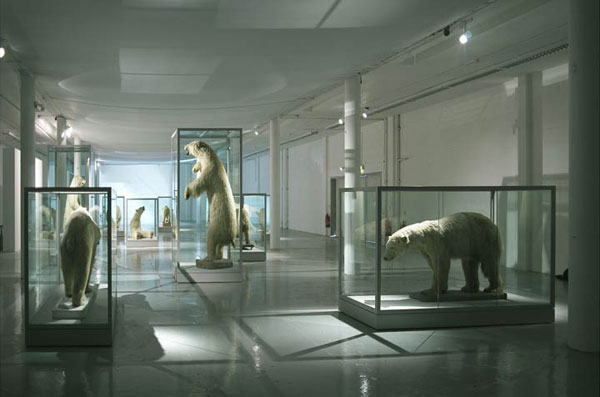
There is good intent with an idea such as this: show off the natural world in order to create interest and advocacy. If a person visits a museum and sees a polar bear, will they be inclined to do something to save them? 

Exhibition view from nanoq: flat out and bluesome. Artists
Bryndís Snæbjörnsdóttir and Mark Wilson: (Source).


Does the visitor here need something extra, like a didactic or interactive element which will tell them how the polar bear is at risk?

Or will they be able to make the connection on their own?

Is a visitor as affected by a small rodent at risk than they are at a whale skeleton?

How do visitors give meaning or value to the objects they are seeing, what is impactful and how do they take away information?

These questions are always spinning around in my head as I go through the effectiveness of using an animal specimen or taxidermy to teach visitors about climate change. I only have the ROM's example to go by, so I decided to take a look at other big natural history institutions to see how they are using their collections to tackle this area of education.

I will highlight three institutions that have created climate-focused exhibitions or resources for visitors, all just in the past couple years. 

I. Natural History Museum at South Kensington (London, England)

An illustration showing a sign that reads 'yes you can'.
This ADORABLE illustration is from the Natural History Museum's article on how to live sustainably: Source.
   
The Museum has declared a planetary emergency, in recognition of humanity's failure to combat our destructive impact on the planet's survival systems. 
Climate change, biodiversity loss, habitat destruction, pollution and deforestation are just some of the crises caused by unsustainable human activity. These add up to an emergency on a planetary scale.
The museum has also worked in climate advocacy into their strategic plan.
Five strategic priorities will be at the core of the Museum's activities until 2031: 
1. securing the future of the collection  
2. transforming the study of natural history
3. developing the gardens and galleries
4. creating a resilient and sustainable organisation  
5. engaging and involving the widest possible audience  
The museum has also provided resources for visitors to their website on how they can make individual impacts. By giving their audience resources, the museum is really coming through for their visitors.

II. American Museum of Natural History (New York City, USA)

The American Museum of Natural history re-imagined their Hall of Planet Earth in 2018. In an official press release, they write:
The American Museum of Natural History is re-opening its climate change exhibit in the David S. and Ruth L. Gottesman Hall of Planet Earth with comprehensive updates to a section about one of the most urgent scientific issues of our time. The new installation, which opens to the public on Saturday, July 7, is anchored by a dynamic media wall featuring large-scale imagery, animations, text and graphics, and interactive panels where visitors can engage with the evidence for climate change. Updates, which have been in planning and development since 2016, also include new content in the hall’s sections on past climates as well as on convection.
Exhibition view of "What Causes Climate Change" component of the new gallery. "The climate change section features a media wall comprised of 36 high-definition 55-inch screens with “big-picture” messages about climate change. Below them, content panels and interactive stations based on data from organizations including NASA and NOAA (the National Oceanic Atmospheric Administration) explore three main themes: How Climate Works, Our Warming World, and Consequences of Climate Change": (Source).

In addition to their new hall, their biodiversity permanent exhibition contains information for visitors on how biodiversity is in jeopardy.


                                        III. University of Oslo: Natural History Museum

The University of Oslo's Natural History Museum is opening what they are calling a "Climate House" in their botanical garden section.
The Climate House opens in the Botanical gardens in Oslo spring 2020. The Climate House will be a new and exciting arena for communicating research on climate and environmental issues. Children, teenagers and their whole families will be able to learn more about what climate change means, to get to know the several solutions that exist and to get inspired towards action. From early morning until late at night, the Climate House will showcase research-based exhibitions, lectures, films and debates.
This approach caught my attention, as it is programming-focused rather than re-purposing their collection.

It's always good to learn by example. By researching other institutions that are doing work in climate education, we can select and learn new strategies for our own work. That being said, there are still lots of areas to improve in and grow. It is important to consider how the above three institutional strategies could be combined or adjusted - this tapestry of opportunity is still in the works. It's good to start keeping it in mind.


\\\


Check out the Coalition of Museums for Climate Justice, an active group that brings together museum professionals tackling the crisis.

Next time, let's chat more about obstacles and roadblocks.

4 February 2020

ALL ABOUT ORBS

Technology Tuesdays | Val Masters

For my first Musings contribution, I want to talk about one of my favourite subjects: orbs--Where to find them, what they do, how to appreciate them. I want to introduce the sorts of technological orbs that you can find in museums!

Science on a Sphere

The most educational of orbs: Science on a Sphere (SOS). Created by the U.S. National Oceanic and Atmospheric Administration (NOAA), SOS is a system of computers running special software and projectors that work to display and control data on a six-foot diameter sphere.

Science on a Sphere at the Kalamazoo Valley Museum in Michigan. Notice the kiosk! Source. 

The greatest strength of SOS is that it comes with a host of resources, but is customizable to the museum and to the user. You can create a narrative from scratch or use one of the provided lesson plans. The sphere can display animations, layer datasets, and it is interactive. It can even display real-time data. The data catalog is growing, and includes work from NOAA, NASA, universities, and science centres.

Want to learn about the Aurora Borealis? Cities through time? Great White Sharks? The possibilities are nearly limitless.


Currently, the only places to see Science on a Sphere in Canada are the Museum of Natural History in Halifax, Nova Scotia, and the TELUS World of Science in Edmonton, Alberta. The United States, China, and India lead the world in the number of science spheres. I think SOS would be a magnificent addition to our local Ontario Science Centre (OSC). Speaking of OSC . . .

Life of the Earth, Death of the Sun

When I heard about this exhibition at the Ontario Science Centre, I thought it would be similar to SOS. I was wrong! It was much, much, bigger and stunningly beautiful. This orb is an art installation (in fact, it debuted at Nuit Blanche), a moving experience, and a political commentary. This work is meant to unify viewers over this simple fact that the Earth and the Sun are the only orbs we cannot live without. This puts things in perspective: each minute you spend viewing the orb during Death of the Sun represents one billion years.

During the Life of the Earth phase of the experience, you can watch our planet change over the course of 335 million years. Meanwhile a dizzying sequence of images flashes on the wall, beginning with images of nonhuman life, and then moving into art and culture through the ages. At some point, there is a shift – and we are in the future. The Earth browns, the lights wink out, and the waters rise. The images on the wall are no longer of art and culture; they are war, unrest, dire news headlines, graphs of global temperatures going up and up and up. This vision of the future is a call to action to mitigate climate change and take responsibility for the Anthropocene. I found this experience to be a unique and moving contribution to the growing body of orbs in museum collections.

The author in front of Death of the Sun, planetary nebula phase. Photo Courtesy of Val Master.

Which type of orb you find more engaging? An art installation with a story to tell, or an interactive where you can create the story?

15 January 2020

TEACHING CLIMATE CHANGE PART II: LANGUAGE & NEED

Museums on Earth | Defne Inceoglu


Illustration courtesy of Defne Inceoglu.

\\\

In Part I of this column, we discussed the necessary politicization of museums that plan to tackle the subject of climate change. In Part II, we will look over how language affects learning and begin to address the needs of visitors.

\\\

Over the months of October and November, I undertook a visitor research project at the Royal Ontario Museum (ROM), where I conducted 100 anonymous interviews with visitors of varying demographics within the Life in Crisis: Schad Gallery of Biodiversity. The intention of this research was to inform my thesis work, which is interested in analyzing what exactly is the relationship between the halls of biodiversity galleries, the stuffed animals which inhabit them and the visitor who walks through them. What sort of takeaway is a biodiversity gallery that is focused on overarching themes related to a global ‘life in crisis’? How does the visitor see this; what do they look at or absorb and how do they relay what they've learned? 

An area of the Biodiversity Gallery which has stark climate change messaging. Photograph courtesy of Defne Inceoglu.


A didactic in the gallery which details the human
impact on Great Lakes ecosystems. Photograph courtesy
of Defne Inceoglu.


LANGUAGE 

Immediately, the idea of the language or the semiotics of climate change related displays created contention. It occurred to me that using a term like ‘climate change’ is not interchangeable with other concepts such as ‘deforestation’, ‘ocean acidification’, ‘habitat loss’ – among other things. The assumption that climate change would act as an umbrella term for most visitors ended up being false. Further to this, it appeared as though visitors at the ROM do not completely correlate or group these sorts of globally-scaled events like mass habitat loss or extinction with the idea of climate change. Language, then, plays an important role in creating climate change awareness and education.


Of the 99 participants who answered the question “in your own words, what was the exhibition trying to show?” – only 7 people outright mentioned climate change as a major theme in the Biodiversity Gallery. This small number however does not represent a gap in understanding of the exhibition’s themes -- rather it represents a wide variety of understanding, again enforcing the idea that there is more meaning-making going on than meets the eye. 

A portion of a display case in the gallery, detailing life
in the Great Lakes. Photograph courtesy of
Defne Inceoglu. 
When asked the question, some visitors replied:

“Endangered species. [Humans are] destructive to habitat(s)”. 
[Participant 13, aged 25-34, Ontario resident]. 

“Reminds us of nature, what was here before us”. [Participant 38, aged 25-34, Toronto resident].

“We’re losing things that were alive when I was a child. Urgency is accelerating”. 
[Participant 54, aged 45+, BC resident].

“Trying to show us nature and making us realize we are out there in the world. In our hands to see if these creatures are protected or destroyed”. 
[Participant 78, aged 35-44, Mississauga resident].


These four participants, while giving answers unrelated in terminology to climate change, demonstrate that the exhibition offered to them a divergent understanding. Here then, we see where the gaps emerge. A low percentage of visitors picked up on the explicit climate change message, opting instead to mention personal anecdotes or speak directly to a non-specific or generalized 'negative' human impact. This is a good start, and shows that visitors are in fact engaged and relating the content back to themselves in a way. However, we can now consider language as a barrier to universal understanding and we must shrug off the assumption that all visitors relate-to and can speak-to climate change terminology. Instead, we have to listen to our audiences and connect to what is really being asked for. 

NEED

When asked, "Do you have anything else you would like to share with me? Be they concerns or praises?" some visitors replied:

"Nice exhibit. Not a lot of actions steps, doom and gloom; what can you do? Missed opportunity". [Participant 51, aged 25-34, US resident].

"Needs stuff more prescriptive and non-intimidating. Small steps people can take".
[Participant 66, aged 25-34, Toronto resident].

"What is climate change, what are some of the effects, actually explaining it. The science, the challenge, [is it] attainable?"
[Participant 68, aged 45+, New York resident]. 

The arctic display case in the gallery. Photograph courtesy of
Defne Inceoglu.
I want to address this area of need. We took a long look at the language discrepancies that visitors presented. Now we see a request, a demand or want. Teaching hard-to-digest topics to museum visitors can be daunting, and discovering what visitors are looking for is a way to ensure that your messages are communicated effectively. In the ROM's case, it is clear that visitors are seeking out tangible, attainable action and information. This discovery is crucial in understanding how we can begin to create a running dialogue which will both educate, un-intimidate and invigorate visitors.


///

Next time, we'll cover a few different international institutions and their efforts in creating climate awareness using a biodiversity collection.

I did not go into detail on my research methods -- if you have questions please reach out through a comment and I can get back to you with more information.

This research was conducted with deep gratitude to the Social Sciences and Humanities Research Council for funding. The human research component of the project is approved by the University of Toronto's Research Ethics Board.

5 December 2019

TEACHING CLIMATE CHANGE PART I: THE POLITICIZATION OF CLIMATE CHANGE OPINION IN CANADA

Museums on Earth | Defne Inceoglu


Illustration courtesy of Defne Inceoglu.

\\\

This is the beginning of a series on teaching climate change in museums. In this first article, I will be addressing the political divides that influence public opinion on climate change and where the Canadian public's minds may lie. This in turn can influence our audiences opinions - and may create conflict - within our museum spaces. Because of this, we must contend with the idea that we need to politicize our museum spaces in order to fulfill any future mandates based on education, truth, trust and advocacy.

\\\

There is really no sort of global topic as pressing or urgent than the current climate crisis. It is entrenched in the public’s psyche from media outlets reporting on unusual weather, droughts and floods. It is in the discussions amongst our world leaders and political parties; with whole political platforms dedicated to reducing carbon emissions and creating new policies and taxations.

The climate crisis has also made out to guilt the individual consumer: from companies greenwashing products to viral videos of sea animals suffering at the hands of plastic pollution.

On top of all of this, there is also the overwhelming pressure from the scientific community fighting just to be heard - one particular story which came out in the science journal Nature this past September, "‘Ecological grief’ grips scientists witnessing Great Barrier Reef’s decline", discusses the emotional toll that ecosystem researchers feel when witnessing decline.
"An emerging body of research shows that many people feel loss due to environmental degradation caused by global warming, a phenomenon called ‘ecological grief’. Although researchers are often on the front lines of ecosystem collapse, few studies have investigated the mental and emotional consequences of such work" (Source).
This emotional burden of the climate crisis is felt across all sides of the political spectrum; it is permeated into our everyday lives. A number of recent studies have been published on the psychological and physiological effects of climate change; unfortunately many of these studies are walled up and kept away from the public by expensive journal subscription fees. Having open access to these journals is a luxury that maybe only university students or faculty members can take for granted- such studies have only been touched few and far between by media.

This barrier of knowledge leaves publics to learn about climate change studies only from media sources - or the public are left to scour for sources on their own. Publics who find science inaccessible or uninteresting will presumably not look to primary source material. Not to mention these sorts of studies are upsetting and hard to stomach. This is not necessarily something someone would subject themselves to on purpose, especially considering that most people are burdened already with debt, physical/mental health issues, interpersonal relationships and work.

Additionally, the politics of this country are ever polarized and becoming more so still. This can be seen in our last election, but also tellingly in a 2011-2016 study that the Université de Montréal undertook in partnership with the Yale Program on Climate Change Communication, the University of California Santa Barbara and Utah State University. It is a study that has really stuck with me as I have been thinking through Canadian perspectives on climate change. The only criticism I have of this study is that it does not include any participants from the Territories or Labrador, seriously under-representing a large population of residents.

It is a project really unmatched and unparalleled in its scale in Canada, (with a sample size of almost 10,000 people), the researchers deduced by riding the climate change beliefs held by Canadians. The maps really speak for themselves; most surprisingly the statistic that only 60% of Canadians believe that the earth is getting warmer due to human interventions.

Below are three maps of interest that I pulled out of the study:


Image used with permission from the Université de Montréal's website. (Source).
Image used with permission from the Université de Montréal's website. (Source).

Image used with permission from the Université de Montréal's website. (Source).
Compare these maps to the 2019 election results by riding, and a pattern emerges:


Image courtesy of  CTV News' election coverage. (Source).


There is clear tension between our provinces in terms of political beliefs- mapped now into this is the question of climate change.

The question lies then, how do museums factor into all of this?

What is the role of the museum, or the responsibility of one, to discuss climate change? Can we use our spaces to discuss this – should we tackle this issue, keeping in mind the divided opinions and beliefs of the Canadian public - who are in turn our audiences?

To create exhibitions or facilitate programming with the intent on teaching or advocating for climate action, climate change in your institution will automatically destabilize any notion of the museum as apolitical. Instead, it will be invigorated with choice and conflict: with your museum audience divided by politics around policy, oil, taxation and climate change apathy.

\\\

Next time, we'll cover some strategies for talking with visitors about climate change, using my visitor research project at the Royal Ontario Museum as a case study.

15 October 2019

RISKY BEHAVIOUR IS 'STICKING TO THE STATUS QUO': CLIMATE STRIKES AND MUSEUM FUTURES WITH DOUGLAS WORTS


Illustration courtesy of Defne Inceoglu.
On September 27th 2019, people around the world gathered and rallied for action on the global climate crisis.

Simultaneously, Museum Studies alumni, faculty members and students were celebrating the 50th year as a program with the Unconference. (Read Jordan Fee’s in-depth summary of the day here). It was emphasized to us in the morning that if any attendees wished to leave to join the march at Queen’s Park - just a stone’s throw from campus - were encouraged to do so. So, many of us did- joining the crowds to return to the conference later in the afternoon.

The city was a-buzz with thousands upon thousands streaming into the Queen’s Park area. Folks of all ages gathered to voice their concerns about the climbing and alarming climate crisis that is plaguing many people around the planet both geographically and psychologically. Image courtesy of Defne Inceoglu.
In keeping up with the themes of both the conference, the conversations around museum risk-taking, climate change and the future action (or inaction) of museums, I had the opportunity to invite alumnus Douglas Worts to join in and speak with me briefly on these very poignant issues.

Image courtesy of Defne Inceoglu.
A bit about Worts:

Worts graduated the Museum Studies program in 1982, going on to work at the AGO as an Educator in the Adult Programs department. Worts introduced the practice of integrated audience research into the exhibit development process – with a focus on exploring experimental interpretive strategies. Through his work, he became a founding member of the US-based Visitor Studies Association. In 1997, his focus shifted from individual visitors to how museums could help catalyze meaningful cultural impacts and adaptation in a fast-changing world – specifically related to local/global sustainability.

Worts’ current project is WorldViews Consulting as a culture and sustainability expert. Worts also consults on the ‘Sustainability Task Force’ for the American Association for State and Local History. Read Worts’ full bio here.

I: You attended the climate strike in Toronto. Can you speak a bit about your experience during this strike? What were some positive things you took away from this?

W: The enthusiasm of the youth leaders and their willingness to step up and become voices in this moment, has been inspiring to me. Joining in the march was pretty amazing! I had no idea how many tens of thousands of people were there - but there were lot of people! Part of me was thrilled to hear the chanting and singing and the strength that comes from large groups of people. I kept hearing the refrain “Climate Justice Now!” and I wondered, how many people in the crowd would be able to describe what that phrase meant to them. I knew that it was important that large numbers needed to make a loud noise.

A Google Maps screenshot of Queen's Park and College Street. The protestors shut down the roads and created congestion in the city; evidence of a massive turnout. Courtesy of Defne Inceoglu.

(con't)
But the next day, the leaders needed to be able to move forward with:

- An understanding of what Climate Justice actually requires
- The causes and impacts of current climate change trends
- The leverage points across our society where change must happen in order to affect the climate change trends (because these trends are symptoms of much larger, cultural dysfunction).

In my view the drivers of climate change, as well as social and economic inequity, are rooted deep in the values, behaviours and structures upon which our economic, social, political and legal systems are based. These are in fact the core of our cultural reality - and yet not even discussed by this thing we call the ‘cultural sector’. Given the global scale of existing museum networks, our sector has the ability to re-tool itself to become catalysts of cultural change and adaptation. And yet, this really doesn’t even seem to be on the table in museological circles.

Toronto Climate Strike. Image courtesy of Defne Inceoglu.

I: Going off of the theme of the Unconference, “risk-taking”, what do you feel is the most important, yet risky, change we must make in our institutions?

W: As for the idea of "risk" - there is altogether too much focus on 'risk-taking’ as an attribute of ‘excellence’. I certainly have witnessed directors talk about ‘risk’ as a brand characteristic. To me, this kind of thinking is mostly marketing hyperbole and a misunderstanding of the notion of risk. There are risks associated with absolutely everything.


At this point in time, the ‘risky’ behaviour is sticking with the status quo.

We know that human overconsumption, unconscious systems, greed, self-interest, wastefulness are all attributes of the status quo. Perhaps the most serious risk that museums can take is to remain committed to their three historical pillars - buildings, collections and exhibits. It seems so obvious to me that buildings, collections and exhibits are strategies in the service of catalyzing public value. Yet few museums truly plan for, or measure, the catalyzing of public value. I see this absence of planning as being risky behaviour, because the potential for negative consequences is very high.

Museums, for me, embody the potential for generating ‘the place of the muses’, which is not fundamentally a physical place - but a psychological and social space. The muses belong everywhere where our living culture is playing it self out hopefully in adaptive ways. Risk must be consciously calculated in order to maximize the potential for adaptive impacts and minimize non-adaptive impacts. Risk assessment is fundamental and central to what all parts of our society must be doing. Museums could be helping to catalyze these processes across society, but it will require significant internal transformation of the historical and existing assumptions about the core goals, activities, and measures of success of museums.

What are some other things you would like Musings readers to know about you?

I taught Museum Education in the MMSt program from about 1991 to 1996 and have been guest lecturing in the program across my entire career. In 2014, I had the honour of being the first Research Fellow in Museum Studies at the Georgia O’Keeffe Museum Research Center in Santa Fe, New Mexico.
_

The future of the museums' role in participating in, teaching and pursuing climate action is a sentiment that must be pushed further than our current efforts as museum professionals. It will not be easy, it will not be quick and it will not be without growing pains and resistance. However, we can now see the public, our potential and probable audiences, rallying all over the world for action. Is this the sign of change to come? Can we begin to pick up the pieces of what needs to be fixed, or should we rebuild it all together? Keeping these important questions in our minds as we go forward will be paramount to the ability to incite real institutional change. The challenge will be, as Worts mentioned, internal transformations to our mandates, missions and values that will reflect response versus reflection.


This interview has been edited for length and clarity.

11 February 2019

HUMILITY AND ACTION: AN OMA CLIMATE CHANGE WEBINAR

Program Reviews | Samantha Kilpatrick


On January 16th, the Ontario Museums Association hosted a webinar titled "Climate Change: Implications for your museum practice." Thankfully, if you missed it, you can still find it embedded at the bottom of this article.

I've been thinking about Climate Change more and more the past few months, for obvious reasons, and it can be a hard topic to dwell on without succumbing to angst and despair. When I heard about this webinar, I was looking forward to a talk that gave some direction to that amorphous, all-consuming dread. 

A Photo of the Anthropocene exhibit at the AGO- pictured here, an example of the "good Anthropocene"; these are part of lithium processing, increasingly necessary for the creation of electric vehicles. Photo courtesy of Samantha Kilpatrick. 

Moderated by Robert Janes, founder and Co-chair of Museums for Climate Justice, the webinar featured three museum professionals discussing initiatives they had enacted in their own institutions to address the climate crisis we as a species have found ourselves living in.

 Laurie Carmount, Curator of Minden Hills Cultural Centre & Nature’s Place, spoke about her efforts in using historic collections to demonstrate what a world without plastic might look like, her efforts to improve the sustainability of the physical buildings these sites operate within, and partnerships with local environmental groups.

Shiralee Hudson Hill, Lead Interpretive Planner at the Art Gallery of Ontario, spoke about Anthropocene and the effect of the exhibition rippling through the institution, from attempts to reduce plastic in the gallery's cafeteria and the emotional push in interpretive planning- "revelatory, not accusatory.

Ian Kerr-Wilson, Manager of Heritage Resource Management for the City of Hamilton, spoke about incorporating municipal priorities around sustainability into museum practice, and the use of museums as a tool to work on a problem, rather than an end unto themselves. 

    A photo of Hamilton's Ice Harvesting Industry, which Ian Kerr-Wilson notes doesn't exist anymore "for a variety of reasons, including the fact that the harbour doesn't freeze anymore." Image via Hamilton Public Library. 

    I am firmly of the opinion that we have now moved beyond the 'raising awareness' stage of the climate crisis. This is not to say that we should stop trying to convince those around us that this is a pressing and important issue, or that convincing people is a waste of time (as many as 8% of Americans have changed their minds in the past year about climate change) but if the only action we are taking as institutions is raising awareness, it will soon be too late to do anything.

    Cathedral Grove, British Colombia. The key to wanting to save nature is to love it, but I wonder also at the heartbreak of loss that comes with that, the present certainty of knowing that many of the places you love will be forever changed by climate change that you are helping to cause. Photo courtesy of Samantha Kilpatrick. 
    There is a certain humility that you must adopt as an institution attempting to address an issue as large as global climate change. This humility includes putting your trust in other groups, to let your own mission serve as a piece (and only a piece) of something greater. Laurie Carmount shared that the following quote is painted on a wall at Nature's Place:

    Nature is careless of the individual but careful of the species. We have reversed the maxim; we are careful of the individuals and careless of the species. That is the road to extinction. If you kill the species, the individual will follow.” —R.D. Lawrence

    Museums are not the species. We are the individual-- part of a much larger web, infinite and wonderful and more delicate than we can possibly imagine. When we make that paradigm shift, when we stop thinking of museums as a network unto themselves and begin thinking of ourselves as points of a much, much wider network, we can begin to think of our impact in a very different way. No individual caused this problem, and no individual can fix it. But no species is made up of anything other than many individuals working together.

    So call your MP.

    Reduce your plastic consumption.

    And think about how your institution can begin working as part of a much, much larger system in a time of crisis.


    13 December 2018

    RISING TIDES, SWELLING COLLECTIONS

    Museums on Earth | Jordan Fee


    For the past two weeks, an image has sprung up in my mind. I imagine the Royal Ontario Museum during a flood. Correction: I imagine the ROM during the flood, the one that is creeping up on us as I write this article. I imagine basements and storage rooms filled to the brim with water and objects, taxidermied animals being thrust forth from the depths of the museum, and spilling out into the main halls. Perhaps this would be another chance for the museum to discover yet another long-lost dinosaur skeleton.

    Gordo, the Borasaurus discovered in 2007 at the ROM. Source.
    This vision began after I started to look into the connections between waste, sustainability, climate change, and museums. A professor had assigned our class some readings on museum collections – one of them was a chapter from Active Collections, a book that explores how many museums are being “held hostage” by their massive, cumbersome collections. You can read the Active Collections manifesto on their website, and there you can also explore the different resources, case studies and “crazy ideas” that they are attempting to promote in the museological world.

    "Stop...The Collections Avalanche!" Source.
    The chapter that we read dealt mainly with the notion of assessing museum objects for their value to society, rather than simply acquiring them for the sake of doing so. This sentiment also is echoed in the Active Collections manifesto:

    “There’s little point in preserving collections if they don’t actively support the mission. We believe collections must either advance the mission or they must go.

    In most cases, museums don’t even know what their storage rooms contain – the article about the ROM that I mentioned earlier shows this, but similar stories could probably be found at all levels of the museum world. The fact is that museums – and history museums, in particular – are becoming hoarder houses. In an article titled "Museums and Sustainability", published by the journal Cultural Trends in 2008, Nick Merriman notes that most museum professionals “were unwilling to embark on programmes of rationalization until they had greater knowledge of their collections through documentation initiatives.” However, to gain full knowledge of their collections would in most cases take years and years. In that time, the museum would most likely continue the annual 1-2% growth in their collections, thereby extending the improbability that such a task could ever be accomplished. When I mentioned this fact to my professor, he noted with a grin that these people are not museum professionals–instead, they are addicts.

    What might this addiction say about the future of museums? To be perfectly honest, it saddens me that so little has been done to confront this issue. Clearly most museum professionals are aware of this problem. Many museums across the world acknowledge their lack of storage, and yet these same museums continue to house more and more objects. The fact is that sometime this century, many museums across the world will come face to face with the realities of climate change.

    Hurricane Sandy spelled catastrophe for a number of New York City’s museums and galleries, and this storm was by no means an anomaly. Storms like this will continue to occur around the world, with increasing frequency, for the rest of our lives. We can develop new preservation techniques to combat them, but one day these disasters will overwhelm our abilities. Nature always does. Here, I think it is fitting to include a quote from a gallery worker from New York responding to the storm that swept up so many artworks:

         “We prepared, but the amount of water that came in was above all the highest estimates.”

    At the risk of sounding melodramatic, I must say that this is only a tepid sign of what’s to come.

    "Hurricane Sandy Flooding East Village 2012." Source.
    Recently, in my free time, I have been reading A Song For a Blue Ocean by Carl Safina, which examines the destruction of tuna fisheries across the world. In this book, Safina provides details on a wide variety of conferences, meetings and debates between government officials, conservationists and recreational fishers about what should be done to halt the rapid decrease in tuna populations. In each and every case, absolutely nothing is achieved that might realistically slow or stay the decline. Quotas are cut in half, yet are quickly restored. The conversation exists, but action is never taken.

    Just as fishing corporations and recreationalists have a historically unhealthy relationship with tuna,  museums have an unhealthy relationship with objects. As many articles on the subject of deaccessioning state, what museums are doing is the very antithesis of sustainability. Museums stack up objects in decrepit, unkempt storage rooms until one day they can hand it off. To who?

    To us.

    We inherit the world that generations before us have created. We also inherit the collections that these professionals have been collecting. What matters now is what we choose to do with them. Do we continue on this Sisyphisian quest towards creating comprehensive museums, or do we take real action to change our collecting practices? Ultimately, this is not simply a question of objects; it is a question of how we perceive material culture in a world affected by climate change. Collections have a massive carbon footprint, and while deaccessioning objects may only make a tiny, tiny dent in our flawed environmental practices, it would nevertheless serve as a statement of acceptance.

    "Flooded Piazza San Marco in Venice." Source.
    Acceptance of what, might you ask? Acceptance of the fact that collections are meaningless if they are hidden away. Acceptance of the fact that the world will wait no longer. A flood will one day take place in our backyard, and in various backyards across the world. Perhaps we should engage in some extreme measures of preventative conservation and begin a drastic program of deaccessioning. What good is an object if it sits, unseen by the public, in a poorly kept storage space? I can only hope that something will be done with these collections before a storm like Hurricane Sandy hits Toronto.

    If you’d like to read more about which areas of the world are at risk of flooding, here is an insightful article from Der Speigel. While I understand that this is not necessarily the cheerful kind of content that people look for at this time of the year, I do find it necessary to improve our understanding of future implications for the museum world. Happy holidays, everyone! I'll see you all in the new year.

    6 February 2018

    FRAMEWORKS FOR THE FUTURE: 12 WAYS MUSEUMS CAN TAKE ACTION AGAINST CLIMATE CHANGE

    MUSEUM INNOVATIONS

    BY: HANNAH MONKMAN

    Museums often specialize in preserving and exhibiting the past for the present publics, but what are we doing as a collective to ensure that the heritages we safeguard will even have a future to exist in? Climate change has been a hot topic for such a long time, advocates often seem to be shouting into the void. But we all need to take action, now more than ever - so what innovations are museums producing to lead the fight against climate change?

    We have already surpassed some of the measurable limitations of our planet, so how can we get back into the "safe space" before it's too late? Source.

    Museums are not neutral, and climate change is not a debate. 


    As museums, we often look to educate our publics rather than to reflect inwardly, as I discussed back in May 2017. I want to reemphasize that now, as more resources along these lines have been produced since then and the case is growing more urgent every day. When the very core of many museum operations contribute to an enlarged carbon footprint, including the high cost of energy for environmental controls vital for the preservation of collections, should we not take responsibility for preserving our future as well as our past?

    We should be empowered as cultural institutions to take responsibility for our roles in contributing to climate change, and take actions to mitigate our impact. Source.
    Julie’s Bicycle, a company aimed at bringing climate action to the creative arts, has partnered with the Arts Council of England and numerous other institutions in the UK’s cultural sector to produce Museums’ Environmental Framework in November 2017. This new resource provides tangible and measurable actions that museums can take as leaders in the environmental practice. The outline identifies twelve main areas museums can integrate climate justice into their operations:
    • "Aligning environmental values and stewardship with museum values and mission
    • Embedding environmental sustainability in governance and management
    • Commitment to environmental improvement and action
    • Understanding environmental impacts and measuring what matters
    • Communicating and engaging internally on environmental impacts and action
    • Communicating and engaging externally on environmental impacts and action
    • Engaging visitors and audiences on environmental values, understanding and action
    • Taking action to make buildings and sites more environmentally sustainable
    • Developing environmentally sustainable practice for collections care and exhibitions
    • Embedding environmental sustainability in commercial services
    • Integrating environmental sustainability in financial and investment decision-making and fundraising
    • Developing environmental collaboration and partnerships"

    This provides a solid framework that expands on previous models to include every facet of the museum’s activities, and that can be overlaid any current museum model. While each institution will have to find their own way to best incorporate climate justice into their operations, the Museums’ Environmental Framework concludes by drawing together examples across the world of museums leading environmental action – proving it can be done.

    Just say NO to those deniers and defeatists! Source.
    In order to truly preserve heritage in the long-term, we must face climate change with optimistic action rather than passive defeat.


    What action will you take?

    (Keep your eyes out for fellow Musings Contributing Editor Lana Tran’s piece tomorrow to look at what museums are doing now, here in Ontario!)