Showing posts with label climate action. Show all posts

18 March 2020

TEACHING CLIMATE CHANGE PART IV: ROADBLOCKS AND OBSTACLES

Museums on Earth | Defne Inceoglu


Illustration courtesy of Defne Inceoglu.

Last time, we looked at examples of how international museums are speaking to the crisis. On this, my last post for Museums on Earth, I wanted to spend some time thinking about what sorts of obstacles lay ahead for museums.

\\\

Please reflect on your past and current public engagement on climate change. Your work matters, and it matters that we all perform at new levels. Allow these examples to embolden you to reach farther and to advocate in your organization, and in the field, for similarly creative and ambitious projects, then please share your learning and results widely. We must all learn and share as much as we can, as fast as we can, to create scalable and scaled change in ways that support and repair our climate. We must work at a rate never before attempted.
Sarah Sutton and Cynthia Robinson, "Museums and Public Climate Action" in the Journal of Museum Education vol. 45 (January 2020): 3.


The Journal of Museum Education's (JME) latest issue is dedicated to Museums and Climate Change - another addition of growing scholarship around museum and climate action. 

I close this chapter with more questions than answers. It is, of course, important to ask questions. Questions lead to problem-solving, discussion and action. Without addressing some very core issues, we risk overlooking issues or embracing naivety. 

I identify the following four issues below that I believe, through my research, to be the main obstacles that museums will face going forward:

Obstacle 1 |  Fighting apathy

Obstacle 2 | Funding and donorship

Obstacle 3 | Teaching accessible science-literacy

Obstacle 4 | Moving away from neutrality 


1 | Fighting apathy

It is important to address apathy. From my visitor research at the Royal Ontario Museum, I noted that visitors do not feel invigorated to take climate action if they are burdened with the sort of esoteric or existential reality of climate change. This, I claim, can lead people to apathy. One way to combat this is to ensure that our exhibits and programming focus more on local, community efforts - meetups, conversations, panels, presentations, interactive outings facilitated by the museum, etc. This sort of programming can look like a lot of things - however integrating more social action and conversation, as well as providing tangible resources for visitors. I think this is a large challenge, as the ability to create ongoing engagement and enrichment for visitors is sometimes a coin toss. Talk to your audience, your visitors - see what they want to see the museum doing - bring in new voices. Focus on real efforts being made by community groups and members in your cities and towns. 
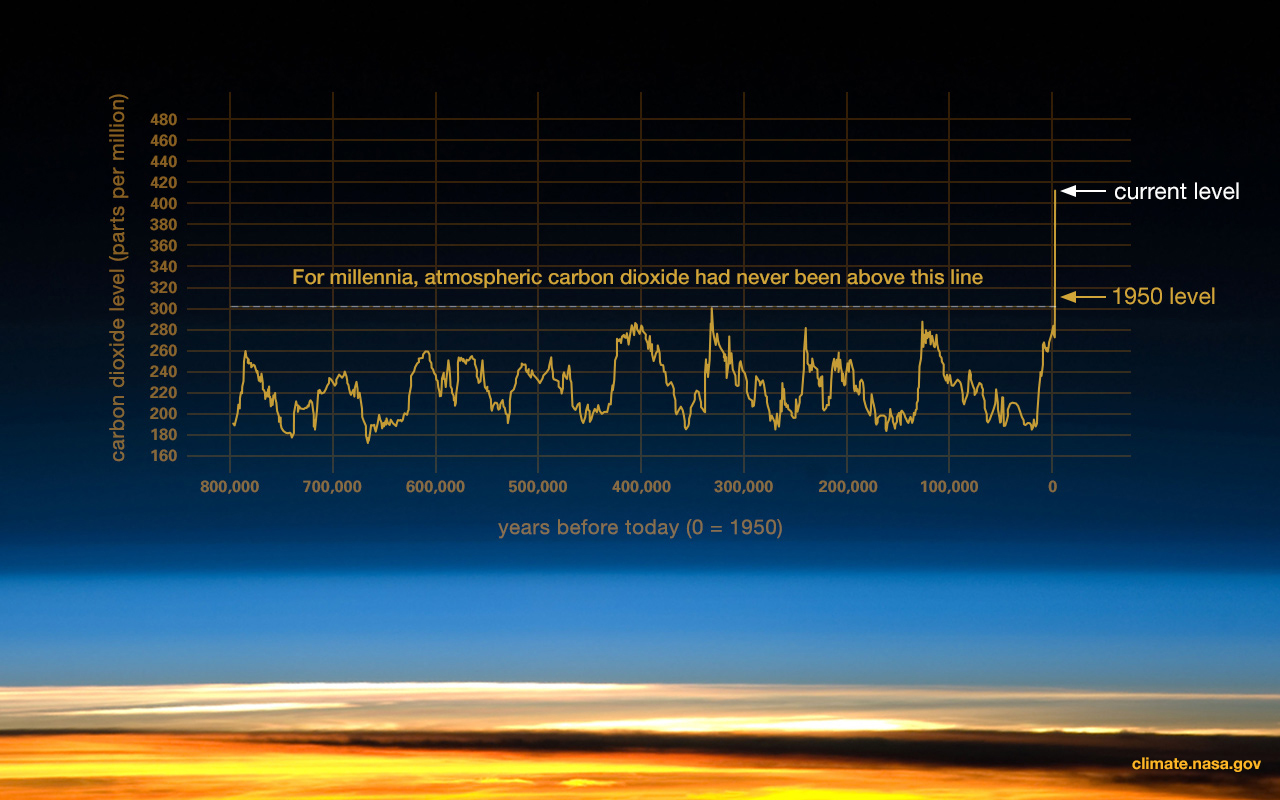
This graph, based on the comparison of atmospheric samples contained in ice cores and more recent direct  measurements, provides evidence that atmospheric CO2 has increased  since the Industrial Revolution.  (Source: [[LINK||http://www.ncdc.noaa.gov/paleo/icecore/||NOAA]])
This graph, based on the comparison of atmospheric samples contained in ice cores and more recent direct measurements, provides evidence that atmospheric CO2 has increased since the Industrial Revolution. (Credit: Luthi, D., et al.. 2008; Etheridge, D.M., et al. 2010; Vostok ice core data/J.R. Petit et al.; NOAA Mauna Loa CO2 record.) Image courtesy of NASA's climate change website.

2 | Funding and donorship

Funding is always an uncertainty. Museum fundraising is tricky and complicated (as Samantha's column (Fun)draising for Musings spends time talking about). How do you invigorate your donors to support new, climate-focused exhibits or programming? Your institutions may not necessarily be science-oriented - art museums, galleries, historic houses, etc., can have different types of fundraising or donorship strategies that don't include convincing stakeholders to fund climate-focused content. 


Sea level rise is caused primarily by two factors related to global warming: the added water from melting ice sheets and glaciers and the expansion of seawater as it warms. The first graph tracks the change in sea level since 1993 as observed by satellites. This satellite data shows that the average sea levels rise 3.3 millimetres per year. Image courtesy of NASA.

3 | Teaching accessible science-literacy

Literacy matters, accessibility matters, and equity matters. If the content of your exhibitions is difficult to interpret, or if you do not provide a baseline for visitors, it can quickly become confusing or irrelevant. Science-literacy is not just about understanding graphs or subscribing to journals - you cannot expect all visitors to your museum to have these skills or wants. Instead, focus on taking steps to understand where visitors are coming from and what their education levels are. This way, you can tailor your content. It doesn't hurt to test your content, either. 

Take the Royal Ontario Museum's Blue Whale exhibition, which ran from March-September 2017. This exhibition was enormously popular - utilizing storytelling and community strategies to create a successful exhibit. 

This chart is what I am getting at: accessible information, explanation and resources for further research. Phew! Image courtesy of NASA.


4 |  Moving away from neutrality 

It is impossible to assume that you can achieve neutrality when talking about climate change. I talked about this in Part I, and as the months have passed it has really dawned on me that taking a stance, challenging visitors, and backing up your work with up to date literature and science is the only way to truly invigorate real change. 

///

That's all, folks! Stay safe out there. 

15 October 2019

RISKY BEHAVIOUR IS 'STICKING TO THE STATUS QUO': CLIMATE STRIKES AND MUSEUM FUTURES WITH DOUGLAS WORTS


Illustration courtesy of Defne Inceoglu.
On September 27th 2019, people around the world gathered and rallied for action on the global climate crisis.

Simultaneously, Museum Studies alumni, faculty members and students were celebrating the 50th year as a program with the Unconference. (Read Jordan Fee’s in-depth summary of the day here). It was emphasized to us in the morning that if any attendees wished to leave to join the march at Queen’s Park - just a stone’s throw from campus - were encouraged to do so. So, many of us did- joining the crowds to return to the conference later in the afternoon.

The city was a-buzz with thousands upon thousands streaming into the Queen’s Park area. Folks of all ages gathered to voice their concerns about the climbing and alarming climate crisis that is plaguing many people around the planet both geographically and psychologically. Image courtesy of Defne Inceoglu.
In keeping up with the themes of both the conference, the conversations around museum risk-taking, climate change and the future action (or inaction) of museums, I had the opportunity to invite alumnus Douglas Worts to join in and speak with me briefly on these very poignant issues.

Image courtesy of Defne Inceoglu.
A bit about Worts:

Worts graduated the Museum Studies program in 1982, going on to work at the AGO as an Educator in the Adult Programs department. Worts introduced the practice of integrated audience research into the exhibit development process – with a focus on exploring experimental interpretive strategies. Through his work, he became a founding member of the US-based Visitor Studies Association. In 1997, his focus shifted from individual visitors to how museums could help catalyze meaningful cultural impacts and adaptation in a fast-changing world – specifically related to local/global sustainability.

Worts’ current project is WorldViews Consulting as a culture and sustainability expert. Worts also consults on the ‘Sustainability Task Force’ for the American Association for State and Local History. Read Worts’ full bio here.

I: You attended the climate strike in Toronto. Can you speak a bit about your experience during this strike? What were some positive things you took away from this?

W: The enthusiasm of the youth leaders and their willingness to step up and become voices in this moment, has been inspiring to me. Joining in the march was pretty amazing! I had no idea how many tens of thousands of people were there - but there were lot of people! Part of me was thrilled to hear the chanting and singing and the strength that comes from large groups of people. I kept hearing the refrain “Climate Justice Now!” and I wondered, how many people in the crowd would be able to describe what that phrase meant to them. I knew that it was important that large numbers needed to make a loud noise.

A Google Maps screenshot of Queen's Park and College Street. The protestors shut down the roads and created congestion in the city; evidence of a massive turnout. Courtesy of Defne Inceoglu.

(con't)
But the next day, the leaders needed to be able to move forward with:

- An understanding of what Climate Justice actually requires
- The causes and impacts of current climate change trends
- The leverage points across our society where change must happen in order to affect the climate change trends (because these trends are symptoms of much larger, cultural dysfunction).

In my view the drivers of climate change, as well as social and economic inequity, are rooted deep in the values, behaviours and structures upon which our economic, social, political and legal systems are based. These are in fact the core of our cultural reality - and yet not even discussed by this thing we call the ‘cultural sector’. Given the global scale of existing museum networks, our sector has the ability to re-tool itself to become catalysts of cultural change and adaptation. And yet, this really doesn’t even seem to be on the table in museological circles.

Toronto Climate Strike. Image courtesy of Defne Inceoglu.

I: Going off of the theme of the Unconference, “risk-taking”, what do you feel is the most important, yet risky, change we must make in our institutions?

W: As for the idea of "risk" - there is altogether too much focus on 'risk-taking’ as an attribute of ‘excellence’. I certainly have witnessed directors talk about ‘risk’ as a brand characteristic. To me, this kind of thinking is mostly marketing hyperbole and a misunderstanding of the notion of risk. There are risks associated with absolutely everything.


At this point in time, the ‘risky’ behaviour is sticking with the status quo.

We know that human overconsumption, unconscious systems, greed, self-interest, wastefulness are all attributes of the status quo. Perhaps the most serious risk that museums can take is to remain committed to their three historical pillars - buildings, collections and exhibits. It seems so obvious to me that buildings, collections and exhibits are strategies in the service of catalyzing public value. Yet few museums truly plan for, or measure, the catalyzing of public value. I see this absence of planning as being risky behaviour, because the potential for negative consequences is very high.

Museums, for me, embody the potential for generating ‘the place of the muses’, which is not fundamentally a physical place - but a psychological and social space. The muses belong everywhere where our living culture is playing it self out hopefully in adaptive ways. Risk must be consciously calculated in order to maximize the potential for adaptive impacts and minimize non-adaptive impacts. Risk assessment is fundamental and central to what all parts of our society must be doing. Museums could be helping to catalyze these processes across society, but it will require significant internal transformation of the historical and existing assumptions about the core goals, activities, and measures of success of museums.

What are some other things you would like Musings readers to know about you?

I taught Museum Education in the MMSt program from about 1991 to 1996 and have been guest lecturing in the program across my entire career. In 2014, I had the honour of being the first Research Fellow in Museum Studies at the Georgia O’Keeffe Museum Research Center in Santa Fe, New Mexico.
_

The future of the museums' role in participating in, teaching and pursuing climate action is a sentiment that must be pushed further than our current efforts as museum professionals. It will not be easy, it will not be quick and it will not be without growing pains and resistance. However, we can now see the public, our potential and probable audiences, rallying all over the world for action. Is this the sign of change to come? Can we begin to pick up the pieces of what needs to be fixed, or should we rebuild it all together? Keeping these important questions in our minds as we go forward will be paramount to the ability to incite real institutional change. The challenge will be, as Worts mentioned, internal transformations to our mandates, missions and values that will reflect response versus reflection.


This interview has been edited for length and clarity.