Showing posts with label commemoration. Show all posts

19 March 2018

YELLOW BIRDS AND PAINTED STOVES: THE MAUD LEWIS GALLERY AT THE ART GALLERY OF NOVA SCOTIA

EXHIBITION REVIEWS

BY: SADIE MACDONALD

For my last exhibition review for Musings, I decided to turn to an exhibition that's close to my heart: the Maud Lewis Gallery at the Art Gallery of Nova Scotia in Halifax.

Maud Lewis is Nova Scotia's most famous folk artist, and she is currently enjoying something of a moment after the release of the excellent film Maudie starring Sally Hawkins and Ethan Hawke in 2016. The 2017 discovery of a Lewis painting in a thrift store in New Hamburg, Ontario, also couldn't have hurt the increasing interest in her life and work.

Lewis's story is atypical for an artist. She never received formal art training and spent her entire life within the radius of Yarmouth and Digby County in Nova Scotia. After marrying Everett Lewis in 1938, the couple lived together in a small house without electricity or plumbing, which Maud lovingly covered with her own painted designs. To help bring some money, Lewis began selling paintings from her home, propping up a sign by the road that proclaimed "Paintings, for sale."
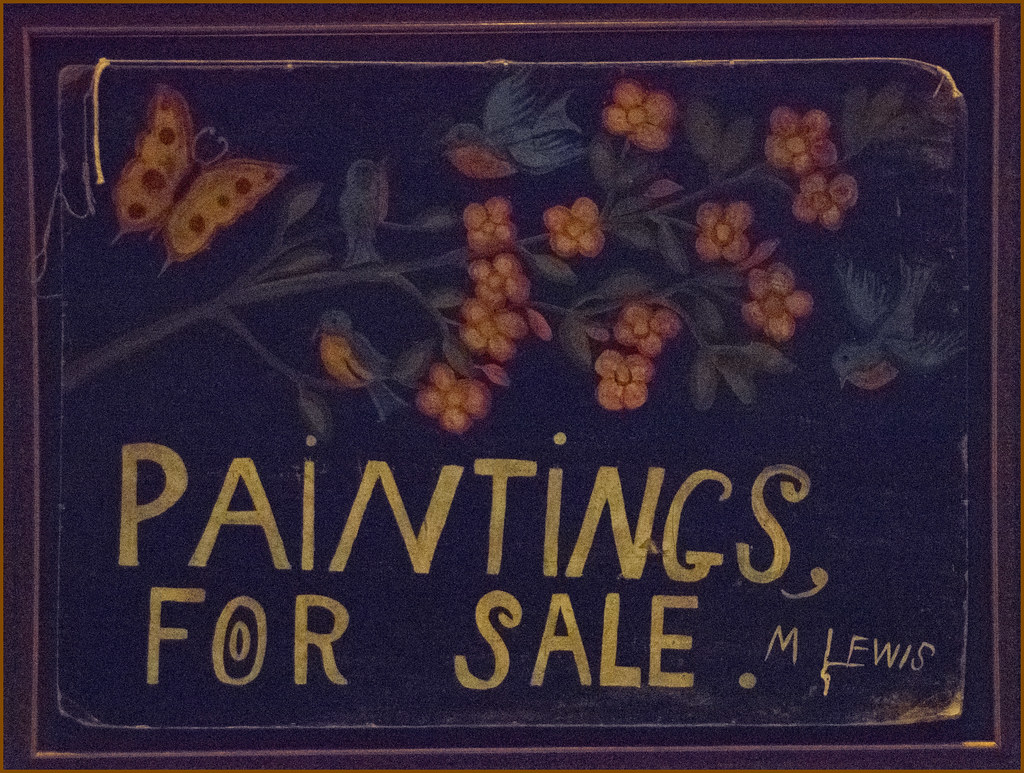
Maud Lewis's sign. Source.

Lewis's bright paintings of animals and rural Nova Scotian scenes, as well as her cheerful demeanour, caught the eye of the Canadian public. In 1965, she was the subject of a CBC-produced documentary, a clip from which you can find below. Lewis died in 1970 after contracting pneumonia. While Lewis typically sold her paintings at about $2 apiece in her lifetime, her works now sell for up to $45,000, and firmly occupy a place in the Canadian pantheon of art.


Lewis's paintings are simple and happy, qualities which appear to form a contrast to her own life experiences. Lewis was born with physical disabilities and developed juvenile rheumatoid arthritis, which worsened with age. Mocked by other schoolchildren for her disabilities as a youth, Lewis left school early. As a young woman she became pregnant out of wedlock, with the baby being put up for adoption; despite her daughter's attempts to make contact, Lewis never had a relationship with her child. Lewis's relationship with her husband, which is the focus of the film Maudie, is said to have been volatile. This all stands in juxtaposition to her sweet, smiling disposition and cheerful, colourful art.
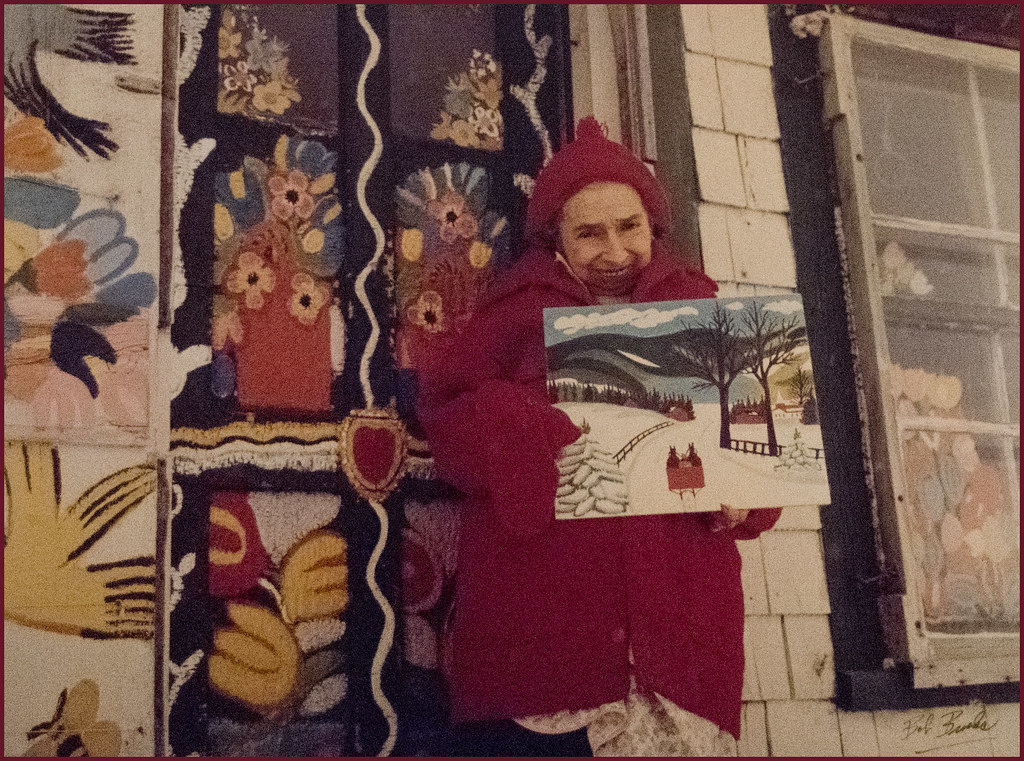
Maud Lewis holding one of her paintings in front of her house. Source.

Lewis's art is simplistic in form, but it has understandably captured the affection of many. It makes you happy.

Maud Lewis. Three black cats, 1955. Oil on rpulpboard. Private Collection. Photo courtesy of the Art Gallery of Nova Scotia.

Many of Lewis's paintings can be found at the Art Gallery of Nova Scotia in their permanent exhibit of her work. Lewis's most famous artwork, however, is not a painting, but rather her house. Like her other works, this house too can be found at the Art Gallery of Nova Scotia!

Maud Lewis House. Mixed Media, 4.1 x 3.8 m. Collection of the Art Gallery of Nova Scotia. Photo courtesy of Steve Farmer.

Throughout her lifetime Lewis covered every surface of the house, inside and out, with paintings of birds and flowers. Sadly, the house lay abandoned after Lewis's husband Everett was killed in a struggle with an intruder in 1979. Years later a Digby group, the Maud Lewis Painted House Society, organized with the goal of saving the house. In 1984, the house was sold to the provincial government of Nova Scotia and placed in the care of the Art Gallery of Nova Scotia. Restorations began in 1996, and the house was eventually moved to the Gallery. It has remained there on permanent display since 1998.

Standing next to the tiny house, a visitor to the Gallery can peer into the window and door and see Lewis's paintings on the stairs, walls, and furniture. Made to look as it would have been when the Lewises lived in it, the house offers an intimate glimpse into their lives. One might wonder how Maud and Everett could have managed in this low, small space; I am barely over 5 feet tall, and I would have felt crammed living here. The house, however, has its own beauty. After looking at the house, I feel the urge to paint my everyday surroundings like Lewis did.

Maud Lewis House. Mixed Media, 4.1 x 3.8 m. Collection of the Art Gallery of Nova Scotia. Photo courtesy of Steve Farmer.

The house itself exemplifies why Maud Lewis is so fondly regarded. She made the rural world around her artistic by capturing everyday scenes in her paintings and physically transforming her own domestic surroundings into art. Not all of us are so lucky to see things in this way.

Thus ends my run with Musings. While I will now vacate the position of Exhibition Reviews contributor, I'm sure there will be other writing adventures in the future!
Source.

1 March 2018

GOING FOR GOLD: OLYMPIC STADIUMS OF THE PAST

THROWBACK THURSDAY

BY: LEORE ZECHARIA

With the 2018 PyeongChang Olympics having come to a close, have you ever wondered what happens to Olympic stadiums and venues once the closing ceremonies happen?

Countries around the world invest billions of dollars into preparing stadiums and other various venues when they host a coveted Olympic Games. But what happens once the games are finished? In recent years, the International Olympic Committee (IOC) have endorsed the idea of “legacy” to justify the value of this expenditure. But what legacies do they leave? Repurposing or relocating buildings are the ideal for finished Olympic venues; however, more often than not, these venues become physical and financial burdens on their countries. Therefore, this week, I'd like to throw it back to some of the world's past Olympic stadiums and venues.

1936 Berlin, Germany – Olympic Village

In 1936, the Nazis used the Olympic Games as a propaganda tool to promote Germany and the German “master race”. Some venues remained active post-Olympics; however, most were abandoned and fell into disrepair. Today, most of the venues from the 1936 Olympic Games still exist, although they are in poor condition. In the last ten years, the German government has begun to save these sites as historic buildings. Most famously, the room Jesse Owens – the African American track and field athlete who won four golds and defied Nazi race laws – stayed in has been fully restored and is a living museum with pictures and other artifacts honouring his legacy.

Abandoned olympic village used at Nazi barracks during WWII. Source
Renovated dorm of Jesse Owens as a museum. Source.
Inside of Jesse Owens dorm, Olympic Village, Berlin, 1936. Source.
1976 Montreal, Canada – Olympic Stadium

In 1976, Montreal hosted the Summer Olympic Games. The stadium has not been used since the Expos played their last game in 2004, and is not only a symbol of financial debt, but a reminder of controversy that was the 1976 Summer Olympic Games. Twenty-two African nations refused to participate after New Zealand was not banned for sending the All Blacks rugby team to tour Apartheid South Africa.

Due to the terrorist attacks in Munich four years earlier, security cost more than 80% of what the entire event was supposed to cost. Multiple athletes were accused of doping (some not even aware they had been doped), and Canada was the first nation to fail to win a gold medal on home soil. The entire costs of the Games were close to two billion dollars, majority coming from the rushed completion of the Olympic stadium. It has taken Montreal over forty years to complete its debt, and today the stadium still exists. The stadium cannot be used if there is over 3cm of snow, and the only thing more expensive than a permanent steel roof would be to completely tear it down. 

Olympic Stadium, Montreal, Quebec, Canada. Source.
1984 Sarajevo, Yugoslavia (now Bosnia) – Bobsled Course and Medal Podium

In 1984, Sarajevo, the capital of Bosnia, was home to the Winter Olympic Games as the capital of Yugoslavia. This was the first time the Olympics were being hosted by a Communist state, and less than ten years later, civil war broke out. These sites that once feted athletic excellence, was now are sites of brutal conflict. The sites were immediately abandoned as instability grew. The bobsled course became a military station through the Bosnian war, and the medal podium was used as a site of execution. Today, these sites are riddled with bullet holes, and the only legacy they hold are relics of war and conflict.

Abandoned and overgrown bobsled course in Sarajevo. Source.
Medals Podium in Sarajevo, Bosnia (then Yugoslavia). Source
2004 Athens, Greece – the Olympia

In 2004, in the birthplace of the Olympics, Athens hosted the Summer Olympic Games. Greece spent over fifteen billion dollars for world-class sporting venues that over a decade later are no longer used and decaying. At the height of the 2004 Olympics, this sports complex was the most complex in all of Europe, but today it represents misplaced indulgence and a ruined economy. Many Greeks blame the 2004 Olympics as a main contributor to the nation’s economic collapse and current instability.

The Panathinaikon in Athens, Greece. Source.

A monument is defined as "a building, structure, or site that is of historical importance or interest". In my mind, and I'm sure in the minds of some of you, monuments are erected to represent significant points in history. However, these Olympic sites do carry a legacy and hold significance for certain points in our world's history.

But can these sites be considered monuments when more often than not these places are left abandoned and decaying? What value and kinds of reminders do these sites really hold for the nations who house them? What legacy do the Olympic Games hold for each country that host?  How can we, museum professionals, assist in this legacy? I don't have answers to these questions, but in light of the Olympic Games, I believe these are important questions to ask ourselves as we emerge into the world of museums, heritage, and legacy.

23 February 2018

DON'T FORGET TO REMEMBER

GHOSTS OF TORONTO'S PAST

BY: KATIE PAOLOZZA

This is the first in a short series of blog entries that attempts to explore the Indigenous history of Toronto. I'm very excited to shift the focus from a post-colonial, post-modern bias to a narrative that is more inclusive of Indigenous Peoples. More importantly I want to question our notions of home and identity, and how fragile those concepts are when we remember that we live on stolen land. In this first article, I'll muse about our collective ignorance.

Source
How do you define yourself? More specifically, how disenchanted with your native country would you have to be to leave your nationality out of a description about yourself? I acknowledge that it's a particularly difficult question to answer as a Canadian. Canadians as a culture tend to admire modesty and an understated approach to nationalism. However, I could argue that it's equally Canadian to shrug off any sort of nationalistic, umbrella designation. 

Source
There is, of course, probably a middle ground that is closer to the truth. The issue is not what percentage of a traditional Canadian stereotype we happen to embody, since no one is immune to their environment, especially during their formative years. It's a difficult question for anyone living in a post-colonial environment because our homes and cultures are transparent artificial constructs. There are signs everywhere of other cultures that had deep roots in this land before British and French occupation. I couldn't count the number of times I cut through Huron Street on campus.

Source

TheBata Shoe Museum has these moccasins from the Wyandot people in their collection
Source
The Huron-Sussex neighbourhood is just one example of a historical place that has its own post-modern identity, though a large part of that identity seems to have been shaped around acknowledging its own complex history. A few years ago it was even featured in the Globe and Mail, but like a lot of charming and distinct Canadian places, it cultivated a post-colonial identity and only retained small vestiges of its Indigenous past.

Everywhere in Ontario there are places like this. I grew up east of the city in Whitby, a town that borders Lake Ontario and takes its name from a similar British port town made famous in literature as the place where Count Dracula enters England. As a child, Mississauga was nothing more than the Western equivalent of Whitby. I was wrong about that in many ways, but more importantly I had no clue how to contextualize Canada as a young country. I skated at a place called Iroquois Park, had friends who cottaged in Muskoka, classmates who went to Nipissing, and I hung out at Wasaga Beach and took family day trips to Niagara Falls, not realizing that every one of those places had Indigenous names. Many of our museums also display First Nations items on stolen land, and it is only relatively recently that they have begun to acknowledge this irony.

Source
Even the title of this column, "Ghost of Toronto's Past," is a throwback to a Victorian idea of the past and death. But Toronto has more than one kind of ghost. We don't have our anglicized associations with places simply because of the natural evolution of culture. We work with vestiges because that is all we have. The nations that lived here before us had their own epic successes and tragedies, and we've compounded all of those tragedies with our dismissiveness. We've willfully forgotten things worth remembering, and it's shameful. 

I've loved creating and writing this column. I'm graduating soon, and I don't want my last blog entries to be Eurocentric. Toronto's history did not begin with European contact, and despite tremendous, violent force, there are still First Peoples who live and flourish here. Please join me for the next part of this journey, and please do not hesitate to share your opinions or suggestions for the upcoming articles. We produce stronger, more honest work when we are willing to collaborate and share.

9 February 2018

RICHARD PIERPOINT: UNSUNG DEFENDER OF CANADA

WALK OF FAME

BY: SERENA YPELAAR

Welcome back to Walk of Fame, where we look at biographies in the context of museums and heritage! For this edition, I'd like to highlight Richard Pierpoint, a Black Loyalist and an important player in the War of 1812.

But why am I writing about him now, and not any other time of the year? In some ways, my reasons for doing so mirror that of the well-intentioned museums and historic sites in Ontario who routinely commemorate him every February, taking cues from the designation of Black History Month. I find this dynamic interesting at the least; while we should of course commemorate Black individuals and recognize their contributions throughout history, I can't help but wonder if the designation of Black History Month ultimately relegates these important narratives to one month of the year.

Richard Pierpoint. Photo courtesy of the Canadian War Museum 1.E.2.4-CGR2.
I wasn't overly familiar with Richard Pierpoint until I noticed on one of my (many) visits to Fort York National Historic Site that there is a small panel upstairs in one of the blockhouses about his role in the War of 1812. I learned that Pierpoint was born c. 1744 in Senegal and as a teenager was sold into slavery and given the name "Pierpoint". He fought as a private in Butler's Rangers during the American Revolution, after which he settled in the Niagara region in Upper Canada. He is known for petitioning for an all-Black military unit in the War of 1812, aged 68. Though initially rejected, he ended up fighting in the "Coloured Corps", as it was named at the time (the racist legacy of such a term renders it inappropriate today). 

Upon researching Pierpoint, I noted that the majority of events commemorating him were specifically organized for Black History Month programming. Why is Pierpoint only commemorated within this restrictive framework? Why not integrate his story into the widely shared narratives about the war?

Pierpoint isn't overtly celebrated within the commemorative view of the War of 1812. If you saw the Conservative government's commemoration of the Bicentennial of the War of 1812 between 2012 and 2014, you may have noticed the strategic choices made in featuring leaders from various groups involved in the war: 

On another note, Brock didn't really look like that, did he? 
  • Major-General Sir Isaac Brock represents the British military
  • Tecumseh represents Indigenous peoples (though as a Shawnee Chief he was from one of many distinct Indigenous nations) 
  • Charles de Salaberry is depicted on behalf of French Canadians 
  • Laura Secord is included as the only woman, recognized for warning the British of an impending American attack 
Using each of these figures as representative of a whole demographic is somewhat irresponsible. You may also notice that one face/voice is missing from this campaign: Pierpoint petitioned for the all-Black military corps to help repel the Americans, yet he (or any of the Black soldiers in his unit) is nowhere to be seen. The campaign oversimplifies the various cultural communities and their relationships for the sake of nationalism, but the absence of a Black presence is startling. Black Loyalists made up at least 10% of the Loyalist emigration from America after the Revolutionary War, with many defending Canada against invasion. Hence, this reductive depiction of the war minimizes Pierpoint's contribution. 

When Pierpoint is commemorated, he is mythologized as a Black hero, suggesting that he accurately represents a portrait of Black life in early nineteenth century Upper Canada. However, this is another oversimplification which demonstrates the dangers of using an individual to foster an understanding of a varied and complex experience. Our veneration of Pierpoint (no matter how understated) as a Black hero of Upper Canada can lead to oversight in the way we learn about the Black experience as a whole. 

The interesting element of his involvement in an all-Black corps as early as 1812 may also result in the common complacency we often feel when comparing Canadian history to that of our southern neighbours in the United States. Pierpoint is portrayed as an exceptional leader, but his petitioning to defend Canada was rejected and he faced numerous obstacles. The same can be said for his appeal in 1821 for passage back to Senegal, when he was "old and without property; ... he finds it difficult to obtain a livelihood by his labour; that he is above all things desirous to return to his native Country..." This request was also denied, with Pierpoint instead receiving a land grant outside present-day Fergus, Ontario. Pierpoint died there in 1838.

I'll leave you with this Heritage Minute from 2015 describing Pierpoint's significance. 

So what can we learn from the way Pierpoint's life is commemorated? For one thing, in engaging with his story we can gain an understanding of the nuances of interpreting Black history, and what is left out tells us just as much as what's included. We know that Pierpoint is celebrated as a Black hero, but there is still much to be done to illustrate Black life in Upper Canada before, during, and after the War of 1812. The question, I think, isn't when we should remember Pierpoint and his contributions (ideally every time we examine the War of 1812), but rather, how will we remember him going forward?

25 January 2018

DEMYSTIFYING THE CANADIAN HISTORY HALL: PART ONE

MUSEUM MYSTERIES

BY: SERENA YPELAAR

It's been four months since fellow Musings blogger Emily Welsh and I first visited the new Canadian History Hall at the Canadian Museum of History in Gatineau, and I still feel overwhelmed by the size, scope, and content of the comprehensive exhibition.

Pathway leading to the Canadian History Hall. The streamlined walkways take you through Canada's history in a chronological fashion. Photo courtesy of Serena Ypelaar
The museum fatigue was real. I sometimes think wryly about how the Hall opened after I finished my undergraduate degree at the University of Ottawa; if I'd stuck around longer, I would've been able to return and focus on each section in separate visits. Instead, I squeezed it all into one short trip to the capital. As I wandered the Hall, I felt the need to take some time for reflection both during and after the experience.

Since the Canadian History Hall is so large and presents many opportunities for museological discourse, I've decided to make this written exploration into a series. For its first installment, here are a few pleasantly surprising stories about lesser-known, non-white historical figures I discovered in the Hall.


Depiction of Marie Marguerite Rose in the Canadian
History Hall. Photo courtesy of Serena Ypelaar.
Marie Marguerite Rose Slavery in New France 

As an African-born woman sold into slavery in Canada, Marie Marguerite Rose was baptized and given her French name after being purchased at age 19 by French naval officer Jean Chrysostome Loppinot. She was manumitted in 1755 and married a free Mi'kmaw man, Jean-Baptiste Laurent, that same year. They went on to operate a tavern in Louisbourg, on what is now Cape Breton Island. In 1757, she died after being free for less than two years, and was buried at the Fortress of Louisbourg. Her legacy as a slave in Canada undercuts the misconception that Canada was historically free of slavery. Though our American neighbours took longer to abolish slavery (1865), Canada itself did not completely eradicate it until 1834. Rose's experience highlights those similarities. Her biographical presence in the Canadian History Hall calls for a conscious accountability and acceptance that our nation's history contains these damaging societal systems.

Photo courtesy of Serena Ypelaar.
This panel (left) clearly describes that the objects on display, which were found in the slave owners' well, were likely objects Rose used when performing domestic tasks during her enslavement. Their provenance is confirmed, while their connection to Rose is not – but the narrative centres more on her experience of life in New France. Though the panel refers to both Rose and slave owner Loppinot by name, the same is not true for Rose's Mi'kmaw husband. I'm unsure as to why this is, but I'd be interested in learning about the curatorial or interpretive decisions that influenced this omission. Regardless of its significance to the story, and irrespective of his centrality to the panel narrative, Laurent's name would have more clearly put him on equal footing as the other individuals in the story. Despite the lack of specificity regarding Indigenous Peoples in a panel like this one, the museum does well to illustrate other Indigenous-led episodes of history in other parts of the exhibition.

"The Four [Indigenous] Kings of Canada" – A British-Canadian Alliance

This story emphasizes the value of addressing contested narratives in museum content. In 1710, four Indigenous delegates – three Haudenosaunee ("Iroquois" to the British) and one Mohican – travelled to London, England, to meet Queen Anne. To cement a British alliance, the "Four Kings" hoped to obtain assistance in driving the French from their lands. The sensational appeal of the four Indigenous leaders exploded in London, and the Queen had these four portraits (below) commissioned by court painter John Verelst. Thought to be some of the oldest portraits of Indigenous Peoples taken from life, the circumstances of their creation are certainly unusual. An instance of Canadian history overseas (yet at such an early point in our post-contact history), these portraits were among the most memorable objects I encountered in the exhibition.

Portraits of "The Four Kings of Canada" in the Canadian History Hall. From left: Onigoheriago (Mohican), Sagayenkwaraton (Haudenosaunee), Etowaucun (Haudenosaunee), Tejonihokarawa (Haudenosaunee). Photos courtesy of Serena Ypelaar.


Photo courtesy of Serena Ypelaar.
The Royal Family presented the paintings to Library and Archives Canada in 1977. Mirroring history, contemporary Chiefs of the Mohawk people of the Bay of Quinte and those of the Six Nations Reserve, Ohsweken, greeted Queen Elizabeth II, this time on this side of the Atlantic.

Again, the object label (right) doesn't delve into this modern context, but it does acknowledge the divided viewpoints of many Haudenosaunee as to the legitimacy of the delegations. Likely owing to space limitations, this panel's storyline is object-focused, acting as an extended label within a much larger exhibition. In the Hall, microhistorical stories such as this one tend to be simplified as a result, but they can still act as useful prompts for visitors to pursue information afterward.

It would be ideal to have more information on the object's provenance and even a discussion on ownership if the scope of the Hall allowed it. Since the portraits were commissioned by the English monarch at the time, but depict Indigenous Canadian leaders, to whom do they belong? How accurate are these depictions? Information about the current Queen's gift to Canada is important because it contextualizes that discussion.

The Indigenous Perspective – Throughout History

In contrast to the previous iteration of the History Hall (which was on display until 2014, and known simply as "Canada Hall"), the new Canadian History Hall places much more focus on minorities, and the Indigenous content is explicit in its prevalence. I remember feeling a sense of relief as I saw Indigenous content integrated throughout the chronological galleries, and a similar satisfaction upon noticing written panels that, rather than attempting a studious neutrality, approached instances of cultural genocide with a frankness of tone that has recently gained more traction. On the national scale, it's crucial to acknowledge such injustices in our history, and emphasizing Indigenous perspectives on their own ancestral land is long overdue. 


Still think Canada's history is boring and/or predicable? Go see the exhibition if you can! Though the Canadian History Hall is overwhelming, its curatorial voice demonstrates a greater understanding of the diversity of our nation, taking steps toward understanding the colonial nuances and legacies that continue to shape Canada's development as a country. I believe the Hall excels in its ability to reveal stories of lesser-known individuals who played a part in Canada's history, offering us powerful insights and opening up further mysteries for us to solve. 

Stay tuned for Part Two of the "Demystifying the Canadian History Hall" series, in which I will explore the power of language and communication in shedding light on difficult histories. 

16 January 2018

POST COMMUNISM IN THE EASTERN BLOC: GERMANY, HUNGARY, AND THE CZECH REPUBLIC

MUSINGS ABROAD

BY: KRISTEN MCLAUGHLIN

A brief search through Google or a Europe travel guide will show what the majority of post-communist Eastern European museums focus on: World War II, Jewish heritage, and memorialization of atrocities, particularly during the communist era. Portrayals of communism in particular are fascinating, as the Cold War is fairly recent in the memory of the world, with many people who lived through it still around. It can tell us plenty about how a country views heritage preservation, history, storytelling, and what they deem important aspects of their country's identity.

There is a fascination in North America with the Cold War and all it entailed, and what it has meant for politics and society still today. However, I am interested in how some of the smaller museums in post-communist nations decide to tell certain parts of the larger story.


A map showing the Eastern Bloc, or Communist European countries, in red. Source.

To be sure, the aftereffects of communism--or any type of government regime--can last decades or even centuries. The Cold War ended only in 1989, when museological discourse was going through large shifts throughout Europe. Where and when different countries picked up and began working on institutions like museums again varies. I will be looking at three countries and three museums that tell us different ways countries memorialize communism (or not).

Germany -- Stasi Museum, East Berlin

Germany is well-known for recognizing and telling the stories of the atrocities that occurred both within and outside of their borders. Examples like Berlin's Jewish Museum and Holocaust Museum are well known, but there are other museums that hold fascinating stories about the recent past.

Last year I read a book titled Stasiland by Anna Funder, that covered the work of the female journalist as she went to East Berlin to find stories about the Stasi, the secret police (or Ministry of State Security) of East Berlin, created in 1950. It was an insightful look into a world I hadn't known about. The level of surveillance, espionage, and manipulation of everyday people by the Stasi is heart-breaking. There was virtually no part of life that was not monitored by the Stasi in East Berlin. So when the author went to a little museum in the original Stasi office buildings, I knew it was a place I'd want to visit someday (and still do). The museum is run by the Antistalinistische Aktion Berlin-Normannenstrasse (ASTAK), which was founded by civil rights activists in Berlin in 1990. The building was taken over by activists, who wanted all the information in the building kept secure and safe for the future. They wanted it to be kept a memorial and research centre on GDR Stalinism.

Since 1990, ASTAK has used these original Stasi offices as a museum to showcase different exhibitions and provide information, not only on the Stasi itself, but also for citizens, so they could know what and how the government had been keeping track of people or--in some instances--how they disposed of loved ones.

The story of the Stasi is a lesser known one in life behind the Iron Curtain. This museum uses a combination of artifacts and archival records from these very buildings to demonstrate the dangerous level of power and control the Stasi possessed. This museum is where 68 miles of shelved records were saved, as well as 41 million file cards, 1.7 million photos and negatives, and 15,000 bags of shredded remnants, which are now being slowly pieced back together.


Espionage technology on display at the Stasi Museum, which was used by the secret police everyday to monitor the citizens of East Berlin. 

Hungary -- Memento Park, Budapest 

Memento Park, or Szoborpark, is an open-air museum in Budapest, dedicated to the monumental communist era statues of Hungary. There are statues of Lenin, Marx, Engels, and several well-known Hungarian communist leaders. A quote by the architect of the park, Akos Eleod:

"This park is about dictatorship. And at the same time, because it can be talked about, described, built, this park is about democracy. After all, only democracy is able to give the opportunity to let us think freely about dictatorship."

After the fall of the communist regime in Hungary in 1989, many of the communist statues were immediately removed. These form the basis of the current collection in the park. The park was not created as a symbol of heroism for the individuals on display, but rather, as a critique of the ideology that used these statues as symbols of authority. It walks a fine line of memorializing, critiquing, and showcasing, without giving too much power to these statued figures of history.


Welcome to Memento Park. Source.

Czech Republic -- Museum of Communism, Prague 

In the Czech Republic, reminders of communism outside of museums are hard to find, with nothing like Memento Park on display in the nation. Czech people were quick to get rid of anything that reminded them of communism. A memorial for Jan Palach, who set himself on fire to protest the Soviet invasion of the Prague Spring in 1968, sits outside of the National Museum in Prague. This is one of the few public reminders of this time. It lacks the concrete architecture of other communist cities; its grand cathedrals and spires are of a medieval era preceding that of the mid-1900s.

The one thing they do have is the Museum of Communism, which is dedicated to presenting an account of the post World War II communist regime in, what was at the time, Czechoslovakia. However, this is an example of a museum that does not tell an objective story: it tells an emotive one, one with a point of view, where labels are never simply "the regime" but "the oppressive regime".


Diorama set-ups in the Museum of Communism in Prague. Source.

Museums about a topic like this--so life-altering, so dangerous, so dark--can be difficult to keep unbiased, difficult to keep objective. The question becomes: do museums about this type of history need to be objective? Can they have emotion, points of view? Or must they do a better job to convey a neutral point of view on a painful topic so as to not bias visitors?

In fact, the Museum of Communism is a private collection created by US businessman Glenn Spicker in 2001. According to one disgruntled visitor, "As far as I'm concerned, Prague doesn't have a Museum of Communism as of yet . . . for now, at least its streets continue to serve that purpose."


These three museums/memorial are three different examples of how some post-communist countries are choosing to remember the roughly 50 year period of their history. If anyone has visited the old Eastern Bloc and can recommend good/interesting/difficult museums to visit, leave a comment with your suggestions!


8 December 2017

HOW CAN WE REMEMBER ANNIE POOTOOGOOK?

SHE'S MY MUSE

BY: KATHLEEN LEW

Annie Pootoogook, Bringing Home Food, 2003-2004. Photo courtesy of Kathleen Lew (2017) at the McMichael Canadian Art Collection.
I first discovered the art of Annie Pootoogook in 2015, during an undergraduate Indigenous Art History course at Queen’s University. I was immediately drawn to her honest depictions of life in the North, whether it was watching television, eating with family, exploring her sexuality, or drawing experiences of abuse and addiction. I wrote my course paper on Pootoogook and her contentious place in both understandings of Inuit authenticity, and contemporary art.

Following my initial research, I came across articles about Annie’s life in Ottawa, but felt uncomfortable reading her struggles as headlines. Reporters were intruding on the artist’s personal life, and I was torn about how to interact with her career. When Annie was found dead in the Rideau River in September of 2016, I witnessed how my surrounding community mourned the loss of the artist. This was most visible through a student article in the Queen’s Journal, and statements from the Agnes Etherington Art Centre, who had shown a solo exhibition of Pootoogook in 2011.

Years later, I am still grappling with my admiration and knowledge of Pootoogook’s art. This time, it is in the context of a masters course on Museums and Indigenous Communities at the University of Toronto, and a visit to the first retrospective exhibition of Pootoogook since her death, McMichael Canadian Art Collection's Annie Pootoogook: Cutting Ice, curated by Nancy Campbell.

The same question remains as it did a year ago: How can I remember Annie Pootoogook?

There are many perspectives, including voices from the Kinngait community, Pootoogook’s colleagues in Toronto, art historians, and the press. Remembering is an active process, and like her art, we should honour Pootoogook within her complexities. It is impossible to approach Pootoogook's career just from her drawings, her biography, her womanhood, her place in the Canadian art world, or the larger systemic oppression of Inuit peoples in Canada. We must understand how these approaches intersect. 

Annie Pootoogook, Red Bra, 2006. Photo courtesy of Kathleen Lew (2017) at the McMichael Canadian Art Collection.
Remembering Poootoogook as a great Canadian artist is one step, but I think there can be more action. We can ask how to remember Pootoogook, and continually improve these methods of remembering. By framing her legacy as a question, we can grapple with the significance of her life and work over time.

So here is my working list, one that will inevitably change. My attempt to answer the question—how can we remember Annie Pootoogook? The following list is what I have learned from Annie, and what I can continue to learn through her art.

1) See beauty and significance in the mundane. 

Annie Pootoogook, Ritz Crackers, 2004. Photo courtesy of Kathleen Lew (2017) at the McMichael Canadian Art Collection. 
Pootoogook drew life in Cape Dorset, showing viewers the simplicity of moments at home, and the significance of everyday objects. It could be ingredients for making Bannock, a box of Ritz crackers, a pair of scissors, or her grandmother’s glasses—all were given importance and care. Pootoogook demonstrates the value of documenting tradition, the present, and how they work together.

“Annie’s work is very different. Annie’s work is, like today and yesterday and…daily happenings, shopping, music, the feast. Sometimes she will draw very hurt feelings from her heart which she’s not afraid to say on paper.” – Jimmy Manning, manager at Kinngait Studios 

2) Create to heal. 

Annie Pootoogook, Memory of My Life: Breaking Bottles, 2001-2002, Photo Courtesy of Kathleen Lew (2017) at the McMichael Canadian Art Collection. 
Pootoogook’s drawings of anguish communicate Indigenous realities of addiction, mental illness, and violence. By drawing her memories on paper, Pootoogook could begin to make sense of her experiences from a distance. At the same time, these depictions force viewers to confront the hardships of Inuit communities.

“It seems that I throw that shit out of my mind and start drawing. Well, drawing makes me feel better… better a lot than before.” -Annie Pootoogook

3) Embrace sexuality. 

Annie Pootoogook, Woman at Her Mirror (Playboy Pose), 2003. Photo courtesy of Kathleen Lew (2017) at the McMichael Canadian Art Collection. 
Pootoogook was unafraid to depict the body, using drawing to explore herself and her relationships. Through art, Pootoogook legitimizes female and Indigenous sexuality, challenging the viewer’s discomfort of gender and sexual identities that are considered "other". 

4) Support and celebrate our family, friends, and communities. 

Annie Pootoogook, Pitseolak Drawing with Two Girls on her Bed (detail), 2006. Photo courtesy of Kathleen Lew (2017) at the McMichael Canadian Art Collection. 
Pootoogook’s practice was largely influenced by her family and her community. Pootoogook continually celebrated Pitseolak’s influence in her drawings, signified by her grandmother's black-rimmed glasses. Pootoogook’s career began with support from the Kinngait Studio, an artist community that creates prints for the Inuit art market. Pootoogook used the influence of her ancestors and community to chronicle her own surroundings and experiences.

5) Listen to contemporary Inuit voices. 

Annie Pootoogook, Dr. Phil, 2006. Photo courtesy of Kathleen Lew (2017) at the McMichael Canadian Art Collection. 
Pootoogook challenged assumptions of Kinngait as a pure, untouched North. She demonstrated the presence of Western influence, and the unique hybrid identities of Inuit artists. Nancy Campbell works to include community voices with Cutting Ice, exhibiting artists influenced by Pootoogook, such as Ohotaq Mikkigak, Siassie Kenneally, Shuvinai Ashoona, Itee Pootoogook, and Jutai Toonoo. Supporting contemporary Inuit art provides an awareness of Inuit realities, and further expands conceptions of Canadian art. 

6) Challenge Western art historical categories. 

Annie Pootoogook, Gossip, 2006. Photo courtesy of Kathleen Lew (2017) at the McMichael Canadian Art Collection 

Pootoogook’s drawings are both familiar and foreign, making them difficult to classify within a Western art world. Her mixing of cultures creates instability, as Southern viewers connect with aspects of contemporary life, while simultaneously feeling isolated from Inuit tradition. Pootoogook’s career broke the glass ceiling for Inuit art, insisting that Inuit, female, and contemporary identities can exist simultaneously.

7) Question how we depict Indigenous artists in the media.

How is art world fame constructed, and how does it affect the artists on display? 

Annie Pootoogook, Sobey Award, 2006. Photo courtesy of Kathleen Lew (2017) at the McMichael Canadian Art Collection. 
Pootoogook winning the Sobey Art Award in 2006 provided opportunity for the artist’s career, while also profoundly influencing her approach to the art world. The press’ invasive treatment of Pootoogook’s struggles with alcoholism and homelessness leading up to her death demonstrate the importance of representing artists with honesty and dignity.

Who creates fame for artists? For what audience? Where is the distinction between an artist’s work and their personal life?

8) Understand Pootoogook’s death within a larger context of gender-based violence.

Annie Pootoogook, Man Abusing his Partner, 2002. Photo courtesy of Kathleen Lew (2017) at the McMichael Canadian Art Collection.
While the cause of Pootoogook’s death is unknown, it is important to acknowledge the thousands of missing and murdered Indigenous women in Canada. Pootoogook’s gender and cultural identity intersect with her experiences of violence. Sexual violence was a reality in Pootoogook’s life and art. Pootoogook’s death is a reminder that communities are continually fighting to stop violence against Indigenous women.

9) Acknowledge colonial violence and work towards reconciliation. 

Annie Pootoogook, Begging for Money, 2006. Photo courtesy of Kathleen Lew (2017) at the McMichael Canadian Art Collection.
Pootoogook’s drawings of contemporary struggles in Cape Dorset, and her experiences living in Ottawa and Montreal, demonstrate the continual existence of colonial violence. The systemic oppression of Indigenous peoples persists in Canada. Colonial oppression is something that needs to be addressed both locally and nationally. Like Pootoogook's legacy, reconciliation is an active process, as we work towards more equitable relationships.

10) Act with the belief that we can be better.

Annie Pootoogook, Composition (Happy Woman), 2003-2004. Photo courtesy of Kathleen Lew (2017) at the McMichael Canadian Art Collection.
Pootoogook took many risks throughout her career and embraced opportunities to further her practice. She exhibited work in Toronto, completed the Glenfiddich Residency in Scotland, exhibited at Documenta 12 in Germany, and experimented with individual objects and cinematic scale. Pootoogook did not limit her art-making to Western perceptions of Inuit or contemporary art, and neither should we. There is always more to learn.

I encourage you to visit the McMichael before Cutting Ice closes in February. Confront your own understandings of Annie Pootoogook and contemporary Inuit art. Explore how you will remember Annie, and keep questioning long past when you leave the gallery.

29 November 2017

RESPONSE, REJECTION, RECONCILIATION: EXHIBITING CANADA 150

GREATEST HITS

BY: AMY INTRATOR

Welcome back to the final edition of Greatest Hits 2017! Writing for this column has allowed me to look to the recent past to make sense of developments in the museum world today. With the end of the year quickly approaching, I thought it would be fitting to turn to the very recent past to make sense of the year-long “celebration” that’s about to end: Canada 150.

Official logo for Canada 150. Source

The Government of Canada has been planning Canada 150 for years as a celebration of the 150-year anniversary of Canadian confederation. From the very beginning of this project, however, many communities in Canada have rejected this celebratory narrative of Canadian history. The Government of Canada includes reconciliation with Indigenous peoples as one of the themes of Canada 150, but the celebration of Confederation is at odds with most Indigenous peoples’ experience. Indigenous peoples have lived in “Canada” for hundreds of years, so this year marks 150 years of colonial persecution, not nationhood.

Tweet from the artist who designed Colonialism 150 logo, a response to Canada 150. Source.
Where do museums fit into this Canada 150 narrative? Over the past year museums across the country have hosted exhibits that critically reflect on Canada 150. For many curators, artists, and creators, museums have provided a space to stage a counter-narrative and incorporate non-celebratory perspectives on the 150-year anniversary of Confederation. Since there have been so many fantastic exhibits that reflect on Canada 150, for my last Greatest Hits post I have included not one, but three Musings posts, all of which reflect on exhibits that challenge Canada’s sesquicentennial celebration.


Shame and Prejudice: A Story of Resilience 

Miss Chief Eagle Testickle in front of the Fathers of Confederation. The Daddies, Kent Monkman, 2016. Collection of Christine Armstrong and Irfhan Rawji. Photo courtesy of Sadie MacDonald. Source.
In February, Sadie MacDonald reviewed the Art Museum at University of Toronto’s exhibit Shame and Prejudice: A Story of Resilience. The exhibit was on display at the Art Museum from January until March 2017 and is slated to tour museums throughout Canada until 2020. Kent Monkman organized the exhibit, which spanned 300 years and included hundreds of works. I used the word “organized” because Monkman played the role of creator, artist, and curator in this exhibit as several of his own paintings, dioramas, and other pieces were included, but he also put these objects in dialogue with pieces from museums across Canada. I had to visit the exhibit four times to completely take in the exhibit’s objects and text. Sadie’s review of the exhibit immediately picks up on the fact that Monkman organized a narrative that responds to Canada 150 by exploring the Indigenous experience with colonizers that began long before 1867. Even the timeline in the exhibit is a commentary on Canada 150, as Monkman cleverly begins his narrative 150 years before confederation in 1717. Monkman uses the museum as a stage for his narrative that contests Confederation as the beginning of life in Canada.


Jane Ash Poitras: New Acquisitions of Contemporary First Nations Art


Buffalo Seed by Jane Ash Poitras. Photo courtesy of Natania Sherman. Source.

In March, former Musings Editor-in-Chief Natania Sherman reviewed a display at the ROM entitled Jane Ash Poitras: New Acquisitions of Contemporary First Nations Art. Unlike Monkman’s exhibit which spanned centuries and included numerous works, the display Natania reviewed was extremely small in scale. The display included four new acquisitions by the Indigenous artist, Jane Ash Poitras, and while this form of display is common, Natania examined how the works were positioned to stage an anti-colonial dialogue. Poitras paintings feature colonial symbols, like the Hudson’s Bay stripes, in dialogue with symbols of traditional Indigenous knowledge. The paintings themselves were staged next to objects like a school desk and a basket to gather herbs to create a dialogue between the art and the ethnographic objects in the ROM collection. Natania’s thoughtful review of a small exhibit proves that there are many ways to challenge Canada 150 narratives in museums.


Witness Blanket


An unknown boy in from of the Chesterfield Inlet Residential School (top). Photo courtesy of Sadie MacDonald. Source.
For the final exhibit review I’m including in my Canada 150 retrospective, we’re returning to Sadie but leaving Toronto. In June, Sadie reviewed Witness Blanket after visiting the exhibit at Museum London. The exhibit has been touring Canada since 2015, and currently the exhibit is slated to continue touring the country until 2021. The exhibit is composed of 887 artifacts from residential school survivors, which were collected by Carey Newman, a Kwagiulth sculptor and carver. Together, the hundreds of pieces create a patchwork of lost narratives from survivors of the schools, and in the process hundreds of narratives of loss and pain emerge. Sadie’s review examines the power of these objects curated together, both as a way for residential school survivors to heal and remember, but she also examines the power of this exhibit for the non-Indigenous population of Canada. The exhibit may have begun touring two years before Canada 150 celebrations began, but the powerful counter-narratives take on another layer of significance when remembering confederation. 

I tried to provide a brief snapshot of some of the important, challenging, and brave exhibits that have responded to Canada 150. If you have the time please read the amazing reviews of each exhibit! The exhibits take different approaches to staging a counter-narrative in the museum, from a small display of new acquisitions, to creating a dialogue between artifacts and contemporary art, to creating a collage of objects of trauma. These counter-narratives in museums are likely to continue for years to come, especially with many of these exhibits touring years into the future. Museums may help shift the legacy of Canada 150 from a celebration of nationhood to a rejection of colonial glory.
