Showing posts with label farming. Show all posts

8 October 2019

CULTIVATING CREATIVITY: HOW ART CAN SERVE FOOD

A Muse Bouche | Jordan Fee


In the world of cultural institutions, we sometimes need to make comparisons. Comparing say, a library to a museum offers interesting insights into how each serves their respective publics. I’ve even thought myself that great restaurants are like museums in some ways, where each moving piece – the food, the diners, the staff – are all working within a choreographed ritual, much like people move through a museum (albeit perhaps with less haste).

However, there is one comparison that I do not generally entertain, and that is as to whether or not food can be art. To me, this idea seems somewhat redundant; why does food have to be anything else, other than food? I can appreciate that there are aesthetic pleasures that derive from seeing and eating food, but I just don’t see the reason why we need to put it on such a high pedestal. This is coming from someone who absolutely loves food.


Working on the exhibition con-nect-ed-ness we are inspired from many different angles and want to share practises that we find striking and exciting with our followers. Like the upcoming exhibition at the Danish Pavilion at the 17th Venice Architecture Biennale these practices are concerned with matters of the Anthropocene, views of nature and human interactions and relations.⁣ ⁣ We are pleased to share with you the following work:⁣ ⁣ Rirkrit Tiravanija, ‘Do we dream under the same sky’, 2015⁣ Mark Dion, ‘The Library for the Birds of New York’, 2016⁣ Pierre Huyghe, ’After ALife Ahead’, 2017⁣ Jochen Lempert, ‘Untitled (Feathers)’, 2014⁣ --⁣ Photo 1: Felix Bröcker⁣ Photo 2: Genevieve Hanson⁣ Photo 3: Henning Rogge⁣ Photo 4: Roberto Ruiz⁣ --⁣ #anthropocene #rirkrittiravanija #markdion #pierrehuyghe #jochenlempert #connectedness_biennale #danishpavilion #LTvenice #biennalearchitettura2020 #lundgaardtranberg #danisharchitecturecenter #realdania #danishartsfoundation #statenskunstfond #labiennale #venicebiennale #venice
A post shared by con-nect-ed-ness (@connectedness_danishpavilion) on


I’m not trying to completely deny the possibility that food can act as a vessel for art. There are many artists working today who use food as an expressive material. Perhaps most famously, Rirkrit Tiravanija chose to forgo traditional mediums of art entirely, deciding instead to serve food to his guests as an artistic act. Therefore, it is evident that food can serve art.

 In fact, I am beginning to think that there may even be a way for art to serve food.

Before we get ahead of ourselves, lets deal with the issue at hand. Carolyn Korsmeyer, who is a Professor of Philosophy at the University of Buffalo, has claimed that we should not ask the same questions of food as we do of art, as food exists as a distinct material object. In her words:

                              “Food does not last but spoils [and] because it not only nourishes but poisons, food is a small exercise in mortality.”

Now, I wouldn’t say that I necessarily agree with that final point. However, I do believe that there is some truth contained within her reasoning when it comes to the distinct material qualities of food. Furthermore, I would argue that food is bound much more to its sensory qualities than art, and although we all have our own preferences, it is not often that art coan literally make one physically sick.

In any case, the debate over food as art may not be the most pressing issue at hand. In some ways, I think that the dialogue between food and art is what matters most. This brings us back to the potential for art to serve food, and the other way around.

Recently, I was lucky enough to pick up the most recent issue of frieze magazine. This particular issue focuses on the intersections between contemporary art and food. I’ve gained so much information from all of the articles contained within the magazine, but there is one that has truly caught my eye in the past week or so. I won’t go too far into the specifics of the article, as it mentions a number of important projects and endeavours. However, there is one element that I would like to highlight, and this is the story of Fritz Haeg and Salmon Creek Farm.


Originally established as a commune in the 1960s, Salmon Creek Farm grew out of a general distaste for the industrial-military complex that dominated the North American landscape. In 2014, the farm was purchased by American artist Fritz Haeg, who has transformed it into a space for artists, archivists, and a myriad of other professions. The website describes all of its attendees as “artist-hyphenates”, which includes: “archivists, activists, astronomers, bakers, bodyworkers, carpenters, cooks, designers, dancers, gardeners, filmmakers, knitters, farmers, fermenters, foragers, foresters, herbalists, musicians, performers, permaculturists, poets, potters, publishers, teachers, weavers, welders, woodworkers, writers, etc.” Most importantly, Salmon Creek Farm asks individuals to "surrender to the land, [to] take care of ourselves and each other, to give more than [they] take, and to leave things better than [they] found them." From this expansive list of "artist-hyphenates", we can see that Haeg clearly see's this farm as existing within a vast series of relationships and exchanges.


Fritz Haeg (Source)
Haeg speaks of a time when, as a student, he planted hundreds of cloves of garlic and handed them out to passersby for cultivation at home. While, one could draw parallels between this act and that of Rirkrit Tiravanija, I do believe that there is a fundamental difference between the two.

By asking recipients of these garlic cloves to cultivate them at home, Haeg acknowledged that food isn’t just about what we eat,  but a vast system of relationships that has no real beginning or end. He is forcing us to conceive of food within a larger sphere of production and consumption by sending these plants out into the world, . This, I think, is how art can come to serve food.

Art asks us to think relationally about the world and forces us to confront questions that are outside the realm of immediate possibility. For better or for worse, art forces us into systems thinking, rather than conceiving of the world as binary structures of thought. Haeg himself believes that food is not what we find in gardens or in markets; rather, food should be defined by the relationships that exist between these things, and between the natural world at large, from air to sea to streams to oceans to trash dumps. This is put directly into practice at Salmon Creek Farm, which is meant to be a place for food in its fullest sense. They even use human waste - dubbed "humanure" -  to fertilize the soils on the farm.

While, I do not necessarily believe that food has to be anything else other than food, I do believe that artistic modes of thought can serve food in challenging typical conceptions of meaning and definition. Food does not need to be art. Instead, we should try to use artistic modes of thinking to reshape our understanding of food into a vast series of networks and relationships, each forming a link in the chain.

12 June 2019

HERITAGE PIGS: CONSERVING THE PAST THROUGH AGRICULTURE

A Muse Bouche | Jordan Fee


Squinting my eyes from the sunlight, I step over a small wire fence and approach a large grouping of animals, all of whom are breathing heavily between bites. Just moments before this, a farmhand has tossed a box of eggs into the pen, letting them all shatter on the ground. Staring at the collage of brightly coloured shells and yokes, I wonder why the decision was made to throw all of this valuable produce away. Noticing my perplexity, the farmhand informs me that the calcium in the eggshells holds great nutritional value for the animals. Smiling, I think to myself how consumers in the downtown core of Toronto would happily pay seven to nine dollars for a carton of the very same eggs. What a life to lead.

Photograph courtesy of Jordan Fee
Why is it that these animals were eating so well? Perhaps it is because of the story they tell; theirs is a story that could have ended a long time ago had it not been for the efforts of a small handful of passionate farmers, dedicated to conserving the biological wealth of a time long gone. It is a story of intangible cultural heritage, one that is generally overlooked in a time when the word agriculture is met with general disdain.

Photograph courtesy of Jordan Fee
Tamworth, Berkshire, Old Spot, Saddleback, Hereford. Do any of these names ring a bell? Perhaps not, since we tend to know them all by one name: pig. It is not unreasonable that we think of pigs in the singular; in fact, there has been much effort put into ensuring that producers and consumers alike have had a singular view of these animals. In 1955, following the end of WWII food rations, the British government issued the Howitt report, which claimed that the largest threat to the British pork industry was the diversity of breeds that existed throughout the country. The report advised farmers to limit their production to just three breeds: the Large White, the Landrace, and the Welsh. 

To be honest, I had never thought that the words “pig” and ‘biodiversity” could be placed within the same sentence. That was until about three years ago, when I visited a small farm, located about an hour and a half west of Toronto. I had heard of some specific breeds of pig at this point, like the now relatively famous Black Iberian pigs, which produce the most expensive ham in the world. 

Photograph courtesy of Jordan Fee
When I arrived at this farm three years ago, I noticed immediately how unique and colourful the pigs were. Tamworth pigs have reddish-brown hair (hence their nickname, the Ginger Pig), while Berkshires are black like the Iberico pigs, only with white hair around their hooves. The Saddleback pigs, which as I have learned are a particularly rare breed, have a long pale stripe running along their shoulders. Each of the breeds also have distinct ears and snouts by which you can distinguish them. I was amazed when the aforementioned farmhand listed off all of these names, none of which I had really heard before. Just two weeks ago, I found out about yet another breed of pig, the Meishan, which is at this point critically endangered.

Photograph courtesy of Jordan Fee

I understand that this topic may seem like somewhat of an odd choice, but I honestly believe some of the breeds that I’ve mentioned are a part of Canadian heritage, and that these animals should be acknowledged as such. In some cases, I am saddened by the lack of communication between Toronto and the surrounding areas. Anyone with access to a car (which, I understand, can be quite difficult) can spend time on a summer day learning about the amazing agricultural work taking place just outside of the GTA in Ontario's Green Belt. I may have learned more at that farm than I ever have at a museum.


Photograph courtesy of Jordan Fee

Finally, I want to say that I completely acknowledge and understand the ambivalence that some people feel towards the agricultural industry. However, the farm that I have written about in this article is not engaged in mass production in any way, shape, or form. In fact, he is part of a global population of farmers that are working very hard to sustain their livelihood for years to come.  It is certainly true that industrial agriculture has become somewhat of a sprawling mess, but I do think that one could probably make the same argument about cities like Toronto.

15 January 2018

ROOTS: SEED SAVING, COMMUNITY, AND HERITAGE

A MUSE BOUCHE

BY: JENNIFER LEE

Flowers and fruit are only the beginning.
In the seed lies the life and the future.

- Marion Zimmer Bradley

Even the earliest of heritage professionals recognized the importance of collecting plant material. Hans Sloane’s collection, which became the foundational collection of the British Museum, included plant cuttings from his travels - now held in the Natural History Museum, London. Non-museum collections also collect and store plants: seed banks like the Millennium Seed Bank and Svalbard Global Seed Trust act as repositories for millions of seeds, protecting Earth’s biodiversity in the face of species loss and climate change. In a bleak post-apocalyptic future, we may need to call upon seed banks to repopulate plant species lost to climate change and disease. 

The Svalbard Global Seed Trust in Spitsbergen, Norway, has a storage capacity of 4.5 million samples. Source.

If this sounds somewhat anxiety-producing, fear not; seed saving isn’t just for doomsday preppers and biologists. Seeds are more than containers for plant DNA: they represent rich cultural and personal histories, and the possibility of stewardship, partnership, and reconciliation.

Global capitalism, in the form of huge farms breeding fruit and vegetables designed to travel long distances and last on the shelf, has eliminated thousands of plant varieties over the last century. We’ve moved away from seasonal consumption and diverse native varieties and toward imported foods and privately-patented seed varieties. In 1903, there were more than 500 varieties of cabbage in North America; eighty years later, there were 28. These varieties are often patented by large corporations, depend on pesticides, and are susceptible to disease and pest damage. It’s not unusual to hear news reports that imported foods Western consumers take for granted, like coffee, bananas, chocolate, and peanuts, may be extinct within decades due to climate change.

This flattening of our once-diverse food and plant cultures has a cultural toll as well as an ecological one. We stand to lose our understanding of where and how our food is grown, and our agency over our own health and consumption. Indigenous peoples, disconnected from their traditional territories, agriculture practices, and foodways by colonial reservation and residential school systems, are particularly vulnerable to the loss of their cultural knowledge and health.

Heirloom vegetables like this Glass Gem corn (available from Native Seeds/SEARCH) have been endangered by large-scale operations and imported varieties. Source. 

This is where seed saving comes in.

Individual seed savers and seed saving organizations are working to preserve, grow, and distribute native plant varieties. This can be itself a form of intangible cultural heritage. In some Indigenous nations, seed keepers traditionally safeguarded seeds, shared them with others, and passed heirloom varietals down to family members. For seed keepers, growing and keeping seeds strengthens connections to their cultures and ancestors. (Indigenous seed saving initiatives include plants for medicinal and ritual purposes as well as food.) Terrylynn Brant, a Haudenosaunee seed keeper, told the CBC, "There's so many foods that we have and enjoy that make us strong emotionally, physically, mentally, spiritually, that we couldn't continue to exist as Haudenosaunee people if we didn't continue to eat the foods of our ancestors."

It can also be a way to Indigenize health education. Dream of Wild Health, a non-profit seed saving organization in Minnesota, aims to recover “knowledge of and access to healthy Indigenous foods, medicine, and lifeways”, working through a community garden, public demonstrations and classes, and an Indigenous foodshare. A cornerstone program hosts a summer camp for Native American youth which incorporates organic farming, health, and traditional knowledge.

Youth gardening at the Dream of Wild Health farm. Source. 

It can also be a way to bridge divides, start conversations, and form working relationships. The CMU farm at Canadian Mennonite University (Winnipeg, MB) occupies a former Métis river lot. In 2015, CMU farm workers collaborated with Métis seed keeper Caroline Chartrand and the local Métis community in order to grow squash seeds cultivated by gardeners from the Miami nation in Indiana. Collaborative projects like this one open up space for settler-Indigenous dialogue over the land on which food is grown and create partnerships while saving vegetable varietals and Indigenous history.

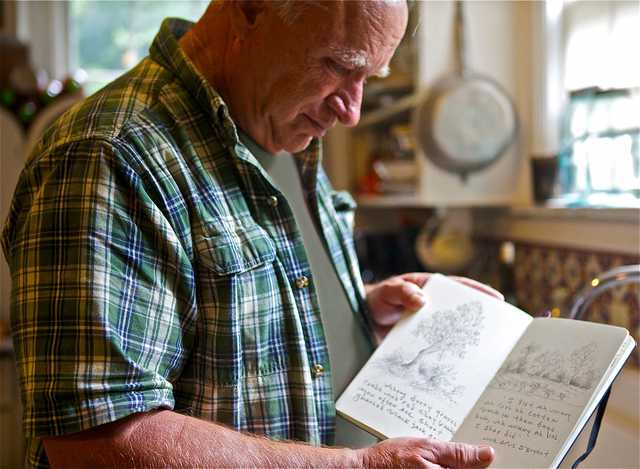
Other communities are also making use of seed saving to preserve their heritage alongside their vegetables. The seed saver John Coykendall, who collects heirloom seeds in Appalachia, keeps details journals of his collecting expeditions, which he calls ‘memory banking’. Like a collections database, his notes record valuable contextual and historical information.

John Coykendall with a 'memory bank', a notebook used to record cultural memories and contextual information in his search for heirloom seeds. Source. 

“A little bit of ancestral history … Where were you living? Where did this seed come from? Did it come from your grandmother or grandfather? Was it brought here from somewhere else? How do you grow it? How was it cooked? ... If someone doesn’t record it, put it down, it is going to be lost for all time. That goes for the seeds. This is the living part of it. Living heritage. Our agricultural heritage.”

While global seed banks work to preserve our biodiversity and health at a macro scale, community and individual projects can work at the micro level, protecting cultural heritage and public health on a personal level. Many libraries (including our own at the iSchool!) house seed libraries – but given their potential to start conversations around culture, food security, health, and heritage, they might not be out of place at a museum either.