Showing posts with label sustainability. Show all posts

24 March 2021

SUSTAINABILITY IN 18TH CENTURY STYLE: REMAKING AND REUSING GARMENTS

 Sew What | Natalie Scola 


Sustainability in fashion has grown as people become more aware of the products they buy and consume. There is a huge interest in thrifting and upcycling clothes in an effort to reduce the environmental impact of the fashion industry. This seems like a new, green movement but the remaking of older clothes and reusing textiles is a centuries-old concept.

Extant garments (original garments that are still in existence in museums or private collections) are interesting because they reveal so much about the life of the object itself. Clothes are fascinating items to study as they hold a personal, intimate connection across time and place. We all wear clothes – styles change but clothing still holds thaziz  e same functions.

Clothing tells us how people lived their lives. They are a visual and physical marker of time periods, the wearer’s status and even represent important events in people’s lives. There is a prevailing idea that the wealthy wore an outfit only once. Scholarship and analysis of extant garments has proved this false. Clothes have been made and remade for centuries. Extant garments are rare partially because of the fragility and decay of textiles over time but also because they were continually remade into other clothes or items. Diaries and account books of women living in the 17th and 18th centuries show that women were concerned with cost, usefulness and aesthetics when making purchases. Studying how clothing was altered provides contextualization and gives life to an otherwise static object.
 
This dress (robe a la anglais) dates to the 1760s. However the large silk pattern is earlier, from the 1740s. The MFA Boston lists the provenance as being originally worn as a wedding dress in 1740. The dress was remade and worn by the original owner's daughter in 1760. Source. 

While it is generally understood that museums want the most pristine, undamaged objects for their collections, there is a great value placed on altered garments because it shows how construction techniques changed, how fashions evolved and how people used clothes. While remaking and reusing of clothes and textiles probably existed since people starting wearing them, this article focuses on garments from the 18th century. The 18th century saw a massive growth in consumer culture, with new imported materials and advancements in industry. Styles also changed a great deal over the century, notably with the shift towards the Regency style at the end of the 1700s and the rise of new materials for clothing. Because of these factors, there are many examples of extant garments that show evidence of alteration.

One of the main reasons why people remade garments was changing clothing styles. During the first half of the 18th century, women wore dramatic, wide gowns, which gradually narrowed by the 1770s and 1780s. Aside from fashion, people’s bodies went through natural changes, such as growth, pregnancy or weight. The large second-hand trade market meant that clothes needed to be altered to fit a new wearer. Clothes were remade also as a function of economy. The material purchased for clothes (cloth, metal, lace etc.) was often more expensive than the labour needed to make them. It made sense to remake clothes to get the maximum use out of costly textiles and trimmings. This allowed people to keep current fashions without having to purchase new materials each time.

How is it possible to tell that an extant garment is remade? It can be difficult because the level of craftsmanship in the alterations is so fine that it is hard to distinguish between the original and altered construction. Telltale signs of altering include: small holes left behind where fabric was unpicked, such as along the sleeve cuffs or the waist. Another clue are pleats that were taken out but retain their original crease.

The fabric itself provides a visual clue as to the age of the garment. Silk was an extremely popular fabric throughout the 18th century. Silk patterns changed over the course of the century. Large, abstract prints were popular in the earlier decades and more rigid, striped designs in the latter part. Some garments are made of silk that dates to earlier decades but the style and construction of the piece itself is much later; the clothes would have been remade in a newer, fashionable style while being economical in reusing an older piece. 

The large decorative pattern on this silk indicates a weaving date of the 1730s. The dress was remade in the 1770s. Source.

Some extant garments from the 19th century are also made from older, 18th century clothes. With the shift to neoclassical styles at the end of the 1700s, lighter fabrics, like muslin and cotton, were used; they evoked the specific ancient aesthetic of the period and silk was no longer as fashionable. The introduction of cotton to the British market in the 1780s also led to the decline in the silk market. By the 1820s and 30s, styles had changed again and silk was back in fashion. Contemporary silks were not as well made as older their older counterparts and could not hold up to the desired construction. The large sleeves and finely pleated skirts could be achieved with the stiffer fabrics from the 18th century.

This dress shows the fashionable style of the late 1820s with a wide neckline and puffy sleeves. The neckline featured deep, stiff pleats. The fabric of this dress was woven between 1770 and 1780. Source.

Visible alterations like patches and hemming are indicators that clothes were remade. Patching can be seen on the inside of garments, particularly bodices. Some dressmakers and tailors tried to match the original lining with a similar fabric but others used different fabrics. On visible outside areas that were widened, such as around the torso or at the skirt waist, similarly patterned fabric to the original was used; although the patterns were not identical, patching would not be noticed unless it was examined close up. The materials used in alterations are also indicative of when the garment was changed. 19th century alterations can be noted by the use of cotton thread which was introduced in the 1800s. Machine stitching and manufactured lace also point to 19th century alterations, as these would have been done by hand prior to the 1800s. 

Evidence of alterations are often minute and hard to see without high resolution photographs or in-person examinations. Museums also rarely show the interior of garments. This jacket in the collection of the MET shows careful piecing of the lining. The reusing of scraps demonstrates how fabric was used and nothing was wasted as clothes were reused. Source.

 With the rise of consumer culture, fashion became central to self-image. Altering clothes to remain fashionable was a smart economic move, ensuring that you could be dressed in the latest style for less money. The 18th century saw huge shifts in fashion as new materials became available and reflected economic and political changes. By the 1730s, the sack-back gown (robe à la française, or sacque) had become a popular style, replacing the older mantua gown. The sack-back gown featured a fitted, conical bodice with long pleats that fell from the shoulders. Square hoops or panniers were worn under the skirt to support the fabric and create a wide silhouette. As styles changed throughout the mid-1700s, the silhouette became less wide and the fullness moved to the back of the body. Close-bodied gowns (robe à l'anglaise) became fashionable by the 1770s. These gowns had less width at the sides and had fitted back pleats. Many examples of altered gowns are from this period, reflecting the change in fashion over a short period of time. By the end of the 18th century, the French Revolution ushered in an entirely new era inspired by Ancient Greece and Rome, shifting the style away from structured gowns. 

The chintz fabric of this gown was woven in the 1740s but the dress dates from the 1780s. The dress is a close-bodied gown (robe à l'anglaise) and has a fitted back with no flowing pleats as was the style later in the century. It may have been remade from an earlier sack gown. Source.

Changing fashion was not the only driving force behind altering clothes. A person’s body changes in many ways and clothes need to reflect that. As a person gained or lost weight, their clothes could be let out or taken in to fit their body. Pregnancy was also a consideration as a woman’s body would change shape for nine months! There was no maternity wear as we have today (although a rare maternity set does exist in the collection of Colonial Williamsburg) so clothes needed to be designed for a long-term, continual change. Dresses could be let out at the waist or have ties loosened in the back to allow for an expanding belly. These garments could then be taken in and altered after the pregnancy; in this way, a woman remained fashionable throughout her pregnancy and beyond.

Children’s clothes also followed the practical need for alterations as they grew: it was more economical to have clothes that grew with a child than to continually make new clothes. Adult clothes could also be altered down to fit smaller children – there were no “children’s clothes” as children wore miniature versions of adult clothes. In other instances, entirely different garments were constructed from the original. Some of these follow a logical process based on the design of the item. Short jackets like caracos or casaquins could be made by shortening a longer dress. Others were completely different, like making gloves from stockings, or shoes from a jacket! Fabric household items were repurposed as well. Quilted fabrics were commonly reused as they were sturdy and warm. Some quilted petticoats found second lives as bedcovers while original quilts became petticoats. 

The deep hem on this girl's dress from 1771-1780 may indicate extra fabric for future alterations as the child grows. Source. 

The piecing of fabric on the skirt (same garment of above) shows evidence of alteration, possibly to accommodate growth. Source.

The thriving trade in second-hand clothes also necessitated clothes being remade: whether they were given to a friend or a maid or sold to a shop, the new owners of these garments needed them altered to fit their body. Once clothes were worn down, they became rags or other useful scraps. Metal trimmings or threads were stripped from fabrics and melted down for reuse. Fabric rags ended their lives in mills to be made into paper for a growing literate society.

The reuse and remaking of clothes continued throughout the 19th century and were widely adopted for fancy dress balls. This marked the transition of the garment from clothing to costume. Fancy dress balls were a common entertainment throughout the 19th century. At fancy dress balls, people would dress in a variety of themes, including as mythological, allegorical and natural subjects. Historical themes were very popular as people could look into their attics and closets to find old clothes to repurpose. The extremely wealthy often had their fancy dress costumes made from scratch by dressmakers or couturiers – but that’s a whole other article! Older clothing could be altered to fit new wearers for fancy dress balls but also needed to be altered to align with contemporary styles. For example, the style throughout the majority of the 18th century was a flat, conical torso which was created by wearing stays. When corsets became the dominant undergarment, they produced a different shape of the body with a full bust and hips. The garments would need to be altered to accommodate this difference in support and structure.
 
Here an 18th century men's waistcoat has been altered to become a 19th century woman's fancy dress bodice. Darts were added to the front to shape the waistcoat to create a curved silhouette and the back features boning. The sleeves are a 19th century addition. Source.

This photograph shows Mrs. Louis de Lotbinière Harwood in historical dress when she attended a fancy dress ball at the Chateau de Ramezay (Montreal) in 1898. Her outfit is not a remake of an earlier garment. The dress shows elements of 18th century costume but the silhouette is distinctly late 1890s, especially the cut of the bodice which is very curved. Source. 

Aside from fancy dress events, fabrics and clothing from other cultures were made into clothing which reflected the European interest in non-Western cultures. In the early 1800s, Kashmir shawls became fashionable wear after Empress Josephine of France popularized it as a luxury symbol. They were not just used as shawls but the fabric was made into dresses. The light weight fabric lent itself well to the neoclassical style of fashion and the teardrop motif of the pattern, called buta, was visually interesting and appealed to expensive tastes. These shawls originated in the Kashmir region and were primarily worn by men. In Europe, the shawls were brought back by European officials who gave them as gifts to their wives. Several paintings exist showing upper-class women wearing dresses made from Kashmir shawls. They became ingrained in European society as indicators of class and wealth and were seen as women’s items, given to a woman upon her marriage. The shawls were removed from their original meaning, use, and cultural context and were adapted to suit Orientalist tastes in Europe. The popularity of the shawls, particularly for their patterns, led to the rise of imitation weavers in Europe. The Paisley design, copied from the buta, derives its name from the weaving town of Paisley in Scotland, where imitation Kashmir shawls were mass-produced. 

An 1812 fashion plate shows a dress made from a Kashmir shawl. Source

Empress Josephine wearing a dress made from a Kashmir shawl. She is wearing another shawl wrapped around her body. Antoine-Jean Gros, 1808. Source.

Like the Kashmir shawls, the European interest in the East led to a rise in Japonism throughout the 19th century. Japanese patterns and aesthetics were adapted for Western dress. Contemporary paintings and extant garments reflect this interest as clothes were made from kimono fabric. Some kimonos were even taken apart and made into entirely new clothes, mainly women’s dresses.

The gown on this 1870s bustle dress was made from a kimono. Source.

Altered and remade garments are important parts of museum collections as they provide so many clues about the lifecycle of an object and provide a glimpse into consumer culture of the 18th century. Extending the life of garments by reuse and alteration exists into the modern day. Wedding dresses, baptismal gowns, prom dresses and university jackets are all common items that are passed down as heirlooms and used by new generations. These reuses add another chapter of history to the story of the garment.

I am extremely grateful to Dr. Carolyn Dowdell for sharing her dissertation and bibliography with me. Dr. Dowdell is a dress historian whose work focuses on the remaking of historical garments. I will be interviewing her for this column next month, discussing dress history and historical costuming. You can see her work on her blog and Instagram.

20 May 2019

FOOD, CREATIVITY AND INNOVATION: A REVIEW OF "YOU AND I EAT THE SAME"

A Muse Bouche | Jordan Fee

Though we are currently living in a world where many are trying to draw distinctions between people and place, there are still some who choose to bring us together. You and I Eat the Same, the first in a series of “Dispatches” by the Danish non-profit organization MAD, seeks to serve this very purpose by showing how food can connect us in ways that are exciting and unexpected.

Photograph Courtesy of Jordan Fee
The book itself is comprised of a series of short essays, some of which only amount to a single page. However, while the passages themselves can be quite brief, the arguments contained within them are no less powerful as a result. The topics range from dinner manners, to the science behind fire, to the history of the sesame seed. In one entry, titled “People Will Eat Anything," Aralyn Beaumont and Marissa Gery provide a six-page list of foods that people eat around the world. While the concept might seem simplistic, the sheer number of different foods is quite astounding. Overall, each of the essays present a complex idea in a manner that is legible and engaging.

Stylistically, the book itself is quite beautiful. It is more sizeable than average, but it does not feel heavy. In many ways, it resembles the art-books and catalogues that museums publish following the opening of an exhibition. The photography in the book is also quite stunning, providing visual stimulation even when the text itself is fun enough.

Ultimately, it is a book that is both humble and extraordinary. It includes some of the most emotionally powerful writing that I have read in a very long time, which I believe is something that the museum field lacks quite heavily. Most institutions tend to be overly didactic, but could use a heavy dose of what I will call affectionate writing – something that speaks to the heart, rather than to the mind.

Even though the book is quite modest - it is, after all, only the first in the series – the people who produced it have extensive backgrounds when it comes to the development of modern food culture. René Redzepi, the founder of MAD, is also the founder of the restaurant Noma, which received the award for Best Restaurant in the World for three years in a row, from 2010 to 2012. This restaurant is famous for creating food using ingredients from the Nordic countries, which at the time was a groundbreaking idea in the world of gastronomy.


Additionally, just two months ago, the Danish government announced a partnership with MAD to create a food academy in Denmark, according to this New York Times Article, will “tentatively called the Gastro Academi." This is a great step forward in the world of sustainable food, as it proves that an area that was once overlooked has now become a powerful source of creativity and environmentalism.

I would highly recommend this book to anyone that is interested in the topics of food, sustainability, and immigration. I believe that it can serve as an example of the kind of writing that we can produce as professionals in our own field.

If that doesn't fill you up, you can also check out this lecture on "The Taste of Wheat," or this lecture about tracing coffee back to its producers. Both offer insight into some of the most pressing issues in the world of food!

6 February 2018

FRAMEWORKS FOR THE FUTURE: 12 WAYS MUSEUMS CAN TAKE ACTION AGAINST CLIMATE CHANGE

MUSEUM INNOVATIONS

BY: HANNAH MONKMAN

Museums often specialize in preserving and exhibiting the past for the present publics, but what are we doing as a collective to ensure that the heritages we safeguard will even have a future to exist in? Climate change has been a hot topic for such a long time, advocates often seem to be shouting into the void. But we all need to take action, now more than ever - so what innovations are museums producing to lead the fight against climate change?

We have already surpassed some of the measurable limitations of our planet, so how can we get back into the "safe space" before it's too late? Source.

Museums are not neutral, and climate change is not a debate. 


As museums, we often look to educate our publics rather than to reflect inwardly, as I discussed back in May 2017. I want to reemphasize that now, as more resources along these lines have been produced since then and the case is growing more urgent every day. When the very core of many museum operations contribute to an enlarged carbon footprint, including the high cost of energy for environmental controls vital for the preservation of collections, should we not take responsibility for preserving our future as well as our past?

We should be empowered as cultural institutions to take responsibility for our roles in contributing to climate change, and take actions to mitigate our impact. Source.
Julie’s Bicycle, a company aimed at bringing climate action to the creative arts, has partnered with the Arts Council of England and numerous other institutions in the UK’s cultural sector to produce Museums’ Environmental Framework in November 2017. This new resource provides tangible and measurable actions that museums can take as leaders in the environmental practice. The outline identifies twelve main areas museums can integrate climate justice into their operations:
  • "Aligning environmental values and stewardship with museum values and mission
  • Embedding environmental sustainability in governance and management
  • Commitment to environmental improvement and action
  • Understanding environmental impacts and measuring what matters
  • Communicating and engaging internally on environmental impacts and action
  • Communicating and engaging externally on environmental impacts and action
  • Engaging visitors and audiences on environmental values, understanding and action
  • Taking action to make buildings and sites more environmentally sustainable
  • Developing environmentally sustainable practice for collections care and exhibitions
  • Embedding environmental sustainability in commercial services
  • Integrating environmental sustainability in financial and investment decision-making and fundraising
  • Developing environmental collaboration and partnerships"

This provides a solid framework that expands on previous models to include every facet of the museum’s activities, and that can be overlaid any current museum model. While each institution will have to find their own way to best incorporate climate justice into their operations, the Museums’ Environmental Framework concludes by drawing together examples across the world of museums leading environmental action – proving it can be done.

Just say NO to those deniers and defeatists! Source.
In order to truly preserve heritage in the long-term, we must face climate change with optimistic action rather than passive defeat.


What action will you take?

(Keep your eyes out for fellow Musings Contributing Editor Lana Tran’s piece tomorrow to look at what museums are doing now, here in Ontario!)

16 May 2017

IT'S NOT EASY BEING GREEN: MUSEUM ACTION IN THE FACE OF A CHANGING EARTH

MUSEUM INNOVATIONS

BY: HANNAH MONKMAN

Hello all! I am very excited to join the Musings team as the Contributing Editor for Museum Innovations this summer! Today, I wanted to explore a topic near and dear to my heart (and one often neglected in discussions of information studies): environmental sustainability. While many Canadian museums are addressing sustainability in terms of cultural relevance and community involvement, less seem to be integrating green strategies in their operations – perhaps the idea of "going green" is daunting to museum professionals who are already struggling with a lack of resources. Whatever the situation, environmental sustainability should be a concern to all museums on some level.
After all, museums must navigate not only changing societies, but also a changing planet. So, what are museums doing to address this issue, and how can we incorporate those innovations into our future actions as museum professionals?

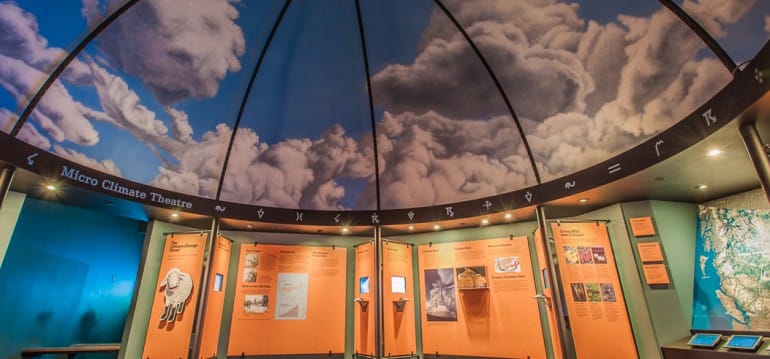
Educating Our Publics: The first (and more intuitive) role museums can take on with regards to environmental sustainability is that of the interpreter or educator. Through events and programming, art installations, exhibit displays, or even through the dedication of entire galleries, museums can help to educate the public about any and all of the issues related to the environment, including climate change, pollution, and species at risk of extinction.


"Climate Rules!" at the Royal BC Museum in Victoria is "one of the first galleries ever built that explains how climate is changing as a consequence of global warming."  Source. (Photo © RBCM.)
Of course, natural history galleries and science centres lend themselves more readily to these kind of programs, and some museums may feel that programming related to environmental sustainability is (rightly) well outside of their mandate. So I asked myself – what can ALL museums do?

Reflecting Within: Museums can – and should – address environmental sustainability by being mindful of their own internal operations. Some museums have already gone to great lengths in their pursuit for sustainability. For example, the Auckland War Memorial Museum in New Zealand has reduced its carbon footprint by 50% and reduced their waste to landfill carbon emissions by 72% since 2010. With such impressive numbers, there's a good reason to be optimistic about implementing our own initiatives in more Canadian museums!

Yayy!! Source.
But where do we start? At the Summit on Sustainability Standards in Museums 2013, the American Association of Museums worked to address the particular concerns museums face in environmentally sustainable development. "A Sustainable Development Guide for Canada’s Museums" was subsequently published in 2015, detailing the importance of sustainable development in Canada and how museums might approach it. However, the uptake of these guidelines seems to have been slow or nonexistent thus far in the majority of Canadian museums. These standards can help guide museums to be more environmentally conscious when considering their own internal practices.

Rooftop solar panels in Hanover, Germany. Source.
Just to get our brains thinking about how we might integrate environmental sustainability in practice, I've summarized some of the most important and/or easiest strategies to implement:
  1. A Sustainable Building. New museums or those undergoing renovations have the advantage of establishing sustainable buildings or building components into the design of the new architecture, such as by installing solar panels. The Kentucky Coal Mining Museum is doing just that – perhaps ironic due to the nature of the museum's theme. This project is not just a shift to a green energy source for the sake of being environmentally conscious, but is also expected to pay itself off in 5-7 years and then start saving the museum a substantial amount of money in energy costs. How's that for incentive?
  2. Energy-efficient Operations. From maintaining vital climate controls for collection preservation to powering computers in office spaces, the daily operations of a museum can consume a huge amount of energy. Lighting is typically a major part of this, but costs can be cut down by using automated systems to light rooms only when in use, or even simply by using energy-efficient bulbs. Of course, if the rooms are housing collections, energy-efficient lighting should always be in sync with preservation considerations. LED lights are typically ideal, since they cut down on energy usage as well as not producing excess heat or UV rays that may damage artifacts. The Biosphere (the Environment Museum in Montréal) models this strategy – amongst other green technologies – with motion sensor lights in its washrooms and offices, in addition to an automated system throughout the building so that its lights are only on during opening hours. Water consumption is also a concern, and it's typically a good idea to install water meters to monitor usage.
  3. Green Exhibit Design. On a smaller scale than the building itself, museums can also look to their future exhibits when thinking about sustainability.  In 2013, the AAM published a "Green Exhibit Checklist" through a project called exhibitSEED, which promoted sustainable practices for exhibit design  –  unfortunately, its website is no longer running. Nevertheless, the checklist helps guide museum professionals in thinking about their exhibits in terms of sustainability by focusing on five main areas: reducing new material consumption; using local resources; reducing waste; reducing energy consumption; and reducing products with toxic emissions.
  4. Management and Documentation Policies. All organizations produce large amounts of waste as a by-product of their operations, and museums are no exception; however, museums can reduce their waste by implementing policies across their organization. For example, creating a printing and paper policy that requires employees to physically print documents only when absolutely necessary, or to only print double-sided, can cut down on the number of paper documents destined for the recycling bin. It is also important to ensure that your museum has a thorough waste management policy. As a general guideline, it's good to follow the 4R's: reduce at the source, reuse, recycle, and reclaim. 
This is not even close to an exhaustive list of potential actions a museum might take to address environmental sustainability, and it is important to remember that any strategy is flexible to match each individual institution – whether that means undergoing extensive renovations or simply implementing policies to reduce waste. As stewards of our past and present for our future generations, museums have an obligation to be mindful not only of their authority in educating their publics, but also of their own environmental impact as institutions. After all, unless you're a certain frog, it's really pretty easy being green.

9 March 2017

PILLOW FORT AS CITY: COMMUNITY SPACES AND SUSTAINABILITY


MUSEUM INNOVATIONS
BY CASSY KIST

Gardiner Museum Community Arts Space
Last week, the class Museums and Cultural Heritage, was lucky enough to have a talk by Douglas Worts on museum sustainability. In essence this refers to the museum’s ability to maintain relevance to communities by helping them adapt to changing realities. As he discussed, a museum’s cultural relevance requires an analysis of current trends of the surrounding community, identifying current issues and then considering what type of engagement the museum can employ to contribute to change.

I have been contemplating Worts’ talk and what strategies museums are currently pursuing to facilitate cultural dynamics and discussion on current events.

In other words, how are museums creating conditions for new possibilities?

I was recently struck by an article about an innovative method that the New York Historical Museum and Library was employing to not just represent an issue but allow a space for people to interact, discuss and imagine new possibilities. The museum recently held an exhibit called President- Elect, which preserved part of an art work – an installation called Subway Therapy by artist Matthew “Levee” Chavez, which he created following the 2016 presidential election. In Manhattan Square subway station he asked passerby’s to write their emotions about the recent election on sticky notes and post them on the wall. It grew to over 20 000. The exhibit not only preserves a section of these sticky notes but also encourages museum visitors to create notes of their own in the museum.
Subway Therapy by Matthew Levee Chavez
But how are museums in Toronto contributing to the city’s ability to adapt to changing realities?

I think a good example of this is the Gardiner Museum’s community art space. This space operates during the summer based on community proposals, allowing cultural organisations to suggest and facilitate different interactive programs that are focused on art as change. The Gardiner Museum prioritises propositions for the space from minority communities and requires that the suggestions involve community participation. Last year, they had a duo called Crazy Dames use the space with museum visitors to create pillow forts as part of a larger program meant to encourage discussion and reflection on how the city is organised and built. This space provides an opportunity for community engagement and intervention on current events and social issues, making the museum relevant to current and changing culture. I am excited to see what happens in the space during the upcoming summer!

We Built This City: Pillow Fort workshop at the Gardiner Museum by The Crazy Dames

The AGO similarly has a Community Art Gallery which seeks to draw upon voices that are usually repressed or marginalised by mainstream institutions. In doing so they hope to expand ideas of communities and encourage new interpretations and creative processes of art making. Currently in the exhibit is a work by Artful City called Mapping Toronto’s Public Art Landscape 1967–2015, which traces the evolution of Toronto’s public art through the last 50 years. This piece not only shows the changes and trends of Toronto public over time, but also gives the city a vantage point from which to discuss social issues such as access and disparity within and outside the gallery space. 

Artful City's Mapping Toronto Public Art Landscapes 1967-2015
With the upcoming 150th anniversary of Canada I can’t help but wonder if one of theses spaces will allow, like subway therapy, discussion and contemplation about it’s controversies. How would it look and how would it engage?