31 March 2016

WINDOWS TO THE PAST: MUSEUMS IN PAINTINGS

THROWBACK THURSDAY

BY: KATE SEALLY

I recently got the Google Cultural Institute plug-in for my browser. This plug-in means that every time I open a new tab in my browser, I see a new painting or work of art. The other day, the painting that came up when I opened a new tab was the one below, Jan Brueghel the Elder and Hieronymus Francken II’s The Archdukes Albert and Isabella Visiting the Collection of Pierre Roose.
The Archdukes Albert and Isabella Visiting the Collection of Pierre Roose, c. 1621-23. Source
This painting caught my eye because it is set in a cabinet of curiosities. In the painting, Albert and Isabella are visiting Pierre Roose’s private collection of art and artefacts. The painting, completed in the early 17th century, shows an early phase of cabinets of curiosities. During this phase, collections were often encyclopaedic, featuring a variety of objects and art from a variety of periods. In fact, art works, scientific instruments, naturalia and artefacts were all the object of study and admiration. This painting, and others like it, is populated by persons who were as interested in discussing scientific instruments as they were in admiring paintings.

Exploring this painting and its history and background led me to wonder how other artists in different centuries depicted museums and their visitors.

One hundred and fifty years after Brueghel and Francken depicted a private cabinet of curiosity, Johan Joseph Zoffany was commissioned by Queen Charlotte to paint the Uffizi’s Tribuna room, which held some of the Grand Duke of Tuscany’s collection. This painting depicts a real room in a real palace. Zoffany, however, added some artworks to the Tribuna’s walls, some of which were really elsewhere in the Uffizi or even in the Pitti Palace.
The Tribuna of the Uffizi, c. 1772-1777. Source.
Zoffany’s creative liberties also led him to put lots and lots of people in the room, which would not have been normal. In fact, the overabundance of spectators is what led Queen Charlotte to refuse to hang the painting in her private apartments.

The Tribuna was organised to show the different styles of the masters, and Zoffany and the custodians of the Uffizi collection seemed to be more interested in suggesting a multitude of ideas than in providing a coherent program, as we would today.

Bullock's Napoleonic exhibition. Source
William Bullock was an English collector who owned and operated a museum-come-exhibition hall. Bullock first opened the Museum of Natural Curiosities in Liverpool in 1795. This museum featured many objects brought back from Cook’s expeditions. Bullock and his collection moved to London, where the Egyptian Hall was erected in 1812. The Egyptian Hall at first held Bullock’s collection of artefacts, but became an exhibition space in 1819 when Bullock auctioned off his 32,000 piece collection.

In 1816, Bullock and the Egyptian Hall hosted an exhibit of Napoleonic objects, including Napoleon’s carriage taken from Waterloo. The exhibition received about 220,000 visitors, which was a significant number since the population of London at that time was just over 1 million inhabitants.
Bullock's Laplander exhibition. Source
In 1822, Bullock brought a family of Laplanders (Sami) to London. This exhibition featured a snowy, painted backdrop and the exhibition itself ‘displayed’ a family of Sami and their reindeer.
For modern readers, displaying humans in a museum exhibit is unacceptable. Unfortunately, even 100 years after Bullock's exhibition it remained acceptable to display humans in museum exhibitions. At the Colonial Exposition, held in Paris in 1931, people from colonies all over the world were brought to Paris to be displayed for visitors.

But what do these paintings and postcards tell us about museums in the past, and what lessons do they have for museums today?

As we can see in the Brueghel and Zoffany paintings, display practices in the 17th and 18th century were different than today. Cabinets of curiosities and private collections like the one held in the Uffizi were not necessarily organised by a particular theme. I think that this method of display should not necessarily be discounted by modern museum professionals, since it can allow visitors to make connections between objects or paintings and styles that they would not be able to do if everything was sorted into different rooms.

These paintings and postcards also serve to illustrate how access to museum collections has been growing since the 17th century. For example, in the first painting only Roose and his wealthy elite guests have access to his works of art and artefacts. However, in the early 19th century anyone who could afford the 1 shilling admission fee could see one of Bullock's exhibitions.

Bullock's exhibitions also have two important lessons for museums today: a) museum content should be topical and relevant to its visitors, and b) including interactive elements in exhibits engages visitors. Now these concepts seem obvious to museum professionals today, but I for one was surprised that Bullock's exhibits included these things in the 19th century.

Do you know of any other paintings which feature museums or cabinets of curiosity? Let me know in the comments!

30 March 2016

TATTOOS, EXHIBITIONS AND JULIA CHILD'S KITCHEN!

WHAT'S HAPPENING WEDNESDAYS

BY: NATANIA SHERMAN

Welcome to Wednesday! There’s only a few short weeks left to this academic year, but there’s no shortage of events happening in the museum community. Here’s a short list of some upcoming events:

Come party with your peers! (Source)

1.Save the date! The MMST end of year party is on April 8th from 7:30- 9:30 pm at Campbell House Museum. Come celebrate the end of the academic year with faculty and friends over hors d’oeuvres and drinks.

Tattoo: Ritual, Identity,Obsession, Art at the Royal Ontario Museum (Source)

2. On Saturday April 2nd, Tattoo: Ritual. Identity. Obsession. Art, a travelling exhibition from the Musée du Quai Branly in France opens at the Royal Ontario Museum. The exhibition will explore the history and craft of tattoos from ancient to contemporary with displays featuring photographs, tools and tattooed silicon body forms!

Find one of a kind easter eggs at 401 Richmond. (Source)

3. Tonight there is a Last Wednesday event at 401 Richmond. Today they will be hosting their second annual easter egg hunt. Artists and galleries from the arts building will be hiding original hand painted easter eggs throughout the building. They will be sharing clues on social media as to where objects are hidden. Admission is free.

Learn about the women's committee at AGO's Library and Archives Unshelved. (Source)

4. Another event that may be of interest to anyone who was in Exhibitions Interpretation and Communication last semester is AGO’s Library and Archives Unshelved: The Legendary Work of the Women’s Committees. This free drop-in event hosted by AGO librarians and archivists tonight from 5-7 pm in honouring #Women’sHistoryMonth about the Women’s and Junior Women’s Committees at the AGO. Between 1945 and 1975 these groups made significant contributions to the Art Gallery.

A Tapestry of Voices, curated by MMST students (source)

5. On the 31st of March at 5 pm, come to the opening of A Tapestry of Voices: Celebrating Canada’s Languages, an exhibition curated my MMST students. This exhibition is all about the linguistic diversity of Canadian society. This event takes place at Wilson Lounge, New College, University of Toronto at 40 Willcocks Street.

6. Last but not least, tomorrow, March 31st, join us for the last MMST Colloquia talk. Our final speaker will be Paula Johnson, the curator of the National Museum of American History Smithsonian, who collected Julia Child’s kitchen! This event takes place from 4-6 pm in room BL728.

Hope to see you all there!

29 March 2016

DOES YOUR MUSEUM'S EMERGENCY PREPAREDNESS PLAN INCLUDE RANSOMWARE?

TECHNOLOGY TUESDAYS

BY: ORVIS STARKWEATHER

This research question has been dogging me for the past couple weeks. It lurks in the corners of my mind until I’ll be lounging on the subway or eating dinner and it floats back up to the surface. One of my passions is software-based art and while I can find some sources that address cyber security in regards to archives, I haven’t seen the same level of discussion within museum circles.

Ransomware is a type of malware that demands a ransom payment to regain access to infected files. Early ransomware was often aimed at individuals, but the networks of businesses are increasingly being targeted. Businesses with sensitive or valuable data such as law firms, hospitals, and accounting firms are more likely to be targeted and many of these companies are paying the ransom. For example, in February Hollywood Presbyterian Medical Center in Los Angeles paid a ransom of $17,000. 

Source.

Museums develop emergency preparedness plans with the goal of avoiding or mitigating any damage to the collection should a disaster occur. Most commonly these plans tackle floods, earthquakes, and other natural disasters, but any threat to the museum's collection should be tackled, which would include cyber crime for some institutions.

Often when talking about cyber security, the predictions of mayhem can be vastly blown out of proportions. I want to be explicitly clear that I have not yet encountered a case where a museum has been infected by ransomware. That being said, it would be proactive to consider cybercrime next time you make your emergency preparedness plan. This is one of my on-going research questions, but here are some suggestions to get the ball rolling:

1. Employ Preventative Measures 

Make sure your anti-virus, browser, and plug-ins are up to date. Backing up your data is essential, but there are instances of ransomware lying dormant for long periods which allows it to infiltrate backed up files as well. Ideally, you should consult with an expert to make sure you have backup architecture suitable to your needs.

2. Assess the Risk of Ransomware to your Museum

Each museum will have different areas of risk. Having a good understanding of your institution’s vulnerabilities let’s decision makers better manage your options. You might consider the following factors:
  • - Are there items in your collection that only exist in digital form?
  • - How secure is your backup architecture? 
  • - Is there a way to recover data if all digital copies were compromised? For example, if you have a paper copy of your collections records then the information could be recovered even if your backups were compromised. 
  • - How much time and/or labour it would take to recover your files? 
  • - Would your insurance cover these costs? 

3. Add Cyber Security Experts to your List of Emergency Contacts

Most emergency preparedness plans will incorporate a list of contact numbers. Make sure you have identified a couple people who could do a forensic examination to determine the magnitude of the situation.

4. Decide in Advance if you would Consider Paying the Ransom

It is a good idea to devote the proper time and energy into evaluating your options and tensions can run high after a network has been infected. If you would consider paying the ransom, put a ballpark on how much you’d be willing to pay. Transferring dollars into bitcoins can take time so make sure you know how long the process would take and plan accordingly. Radiolab has a great podcast titled "Darkode" that details the problems one individual had paying the ransom.

28 March 2016

3 EXHIBITIONS IN 1 DAY, BROUGHT TO YOU BY CANADA’S NATIONAL MUSEUMS

EXHIBITION REVIEWS

BY: MADELINE SMOLARZ

I completed a 4-year undergraduate degree and a 2015 summer internship in Ottawa; some of my favourite memories were made in the capital and I’ve developed a strong attachment for it. Therefore, when contributing editor Leah Moncada said she wanted to head north for a couple days to visit an exhibition she worked on during her own internship, I jumped at the chance. Little did we know at the time that “a couple days” would really mean “26 hours.” We ended up arriving in Ottawa on a Thursday around 4:30pm and were on a train again the following day at 6:30pm.

It was a quick trip, but to no one’s surprise (at least, those folks who know us well), we managed to fit in 3 national museums. Granted, we did not go through every gallery and exhibition in these institutions. We travelled with a specific set of exhibitions in mind. I will be rating these exhibitions on a series of characteristics that they all share on a 5-star scale, so please join me in reliving our ambitious museum tour of the capital!

A view of Parliament on the misty night we walked to the Canadian Museum of History. Photo Credit: Madeline Smolarz.


Canadian Museum of History – “Vikings” December 3, 2015 – April 17, 2016


Layout: ★★★ - The layout of “Vikings” was determined by a set of colour-coded themes, which seemed great in theory and started off strong. However, they were not executed well overall and seemed to disintegrate as one moved through the exhibition.

Ambiance: ★★★★★ - Whoever came up with the lighting, sound, and colour palette for “Vikings” deserves a raise. It was dimly lit in the exhibition space with various sounds of Viking life blending together and pinpricks of light, bringing to mind a longhouse with sun shining in through various spots. I’m all in favour of this kind of immersive experience.

Interpretive Text: ★★ - Too. Much. Text. Between the doubling of French and English and the fact that the English was too long to begin with, you would be in there for hours if you wanted to read all of the text. Repetition in text also occurred frequently, which was slightly frustrating.

Objects / Artworks: ★★★★ - The artefacts chosen for the exhibition were quite excellent and represented the huge variety in the Viking experience well. The most breathtaking display was that of a longboat’s rivets suspended in mid-air to give the shape of the ship they once held together.

Interactive Elements: ★★★★★ - There was animal skins to touch, at least three games to play, a Viking table to sit at, rope to feel, a reproduction sword to lift, and more. Fantastic.

Accessibility: ★★ - Some of the text panels were very low to the ground. Coupled with somewhat small text, this made reading sometimes difficult. Certain areas also created bottlenecks that made it tricky for those with mobility devices to move freely.

Overall Execution of Core Theme: ★★★ - As a half-Scandinavian person, I appreciated the exhibition’s strong efforts to demystify Vikings. However, I did not enjoy the overload of information and the questionable layout.

Nearly all of the rivets from 1 longship were strung together to form its shape. Photo Credit: Madeline Smolarz.


Canadian War Museum – “World War Women” October 23, 2015 – April 3, 2016


Layout: ★★★★ This exhibition also used a layout driven by colour-coded themes, but “World War Women” (“WWW”) actually used these colours for the paint and text panels, which clearly delineated different areas. I did get a little lost at one point as to where to go next due to the twisting paths.

Ambiance: ★★★★ - The main sound track was a series of wistful songs played on a record, but inside various areas, there were pockets of sounds suited to the themes. In this bright exhibition, you saw women’s faces, heard their voices, and noticed their memorabilia everywhere.

Interpretive Text: ★★★★★ - In stark contrast to “Vikings,” “WWW” had the most perfect length of text I’ve ever encountered. So much was said with very few words. Shorter paragraphs and sentences did not take away from the visitor’s learning experience, but rather enhanced it.

Objects / Artworks: ★★★★★ - A round of applause for the exhibition developers who gathered all of the objects and stories attached to every single one for “WWW!” There was at least 1 artefact for every role women had during the World Wars, and I was incredibly impressed.

Interactive Elements: ★★ - Here’s where “WWW” fell short. There were three interactives, and two were response-wall based that required writing. The third was a knitting table with an interpreter present, but for those of us who can’t knit, it was intimidating.

Accessibility: ★★★★ - The size of text was great in most areas, cases were at a good height, and seating was scattered throughout the space. However, some corners might have been tough for wheelchairs, and certain panels had an annoying sheen that made them hard to read.

Overall Execution of Core Theme: ★★★★ - I was really pleased by the wide representation of the roles women had and the powerful weight of the personal stories the exhibition tells.

One area of WWW demonstrated the impact of propaganda during the World Wars. Photo Credit: Madeline Smolarz.


National Gallery of Canada – “Human Scale” March 11 – April 10, 2016


Layout: ★★★★ - The temporary exhibition space on the first floor used for “Human Scale” sports cavernous rooms and alcoves, perfect for to-scale and larger-than life depictions of the human body. I was startled by what I saw as I turned a corner twice, which I actually liked!

Ambiance: ★★★★★ - Overall, the sparse backdrop of pale walls and wood floors allowed the complex and sometimes uncomfortable feelings the works produce to take center stage.

Interpretive Text: ★★ - I am not a contemporary art expert, but I know enough to recognize when there is a disconnection between interpretive text and the works at hand. It didn’t happen for every piece, but I was shaking my head at half of what was written on the walls.

Objects / Artworks: ★★★★ - “Human Scale” contains just 8 sculptures spread out across a large floor plan, but they are each so jarring and thought-provoking that any more and the exhibition would be overwhelming.

Interactive Elements: ★ - Other than the ability to walk 360 degrees around the majority of the pieces, there was no other way to engage with the artwork, unless you count a video in one room depicting one of the artists at work.

Accessibility: ★★★ - There was lots of room to move around in the exhibition, and space to park mobility devices in the video room. However, the understated style and small size of the text panels made it hard for a number of people to read them at once.

Overall Execution of Core Theme: ★★★★★ - Although this is by no means a perfect show, the way in which it forces viewers to confront and renegotiate their ideas about the human body by presenting it on various scales was unexpectedly brilliant and will stick with me for a long time.

One of the massive representations of an infant in "Human Scale", with Leah for scale. Photo Credit: Madeline Smolarz.


Have you seen any of these exhibitions yet? If so, do you agree / disagree with my ratings? Please share your thoughts and comments below!

25 March 2016

THESE ARE A FEW OF MY FAVOURITE THINGS

OBJECT(s) OF THE WEEK

BY: ROWENA MCGOWAN

It’s that time of the year. I, too, am graduating and moving on from Musings. Unfortunately for me, I haven’t come close to running out of objects to rant about. So I thought I’d change up the formula and talk a bit about several of the objects I love but ran out of time to devote a full column to. So, without further ado:

Source

Robovie 


Source

We’ve thought a lot about the industrial and economic consequences of an increasingly automated world but what about the cultural ones? How will people relate to the robots who are probably in our very near future? Is our robotic world going to be more I, Robot or Terminator?

Robovie was part of an experiment to determine how children (ages 9, 12 and 15) reacted to a robot which acts like a human and in particular, how they reacted to a perceived injustice being done to that robot (although Robovie was not technically a robot, since it was actually controlled by a technician in another room).

Each child interacted individually with Robovie. Robovie showed them an aquarium, taught them about the ocean, asked them for a hug and played ‘I Spy’ with them. During Robovie’s turn to guess, a technician would come in and tell Robovie that it was time to get into the closet. Robovie would respond that it was unfair to make him go into the closet before the game finished and that he was frightened.


Afterwards, the children were given a questionnaire to see what their opinions of Robovie were. Over 2/3 of the children were willing to be friends with Robovie but only a little over half of them thought that it was wrong to put Robovie in the closet (compared to putting a person in the closet, which almost all of them thought was wrong).

As robots become more advanced, we’re going to have to grapple with how we treat them and eventually, perhaps, what it means to be human. As for me, I got upset just watching the video!

The Great Omar 

Source

Sorry to any bibliophiles that I just made cry by reminding them of this book. The Rubáiyát of Omar Khayyám is actually the name given to a collection of poems written by Omar Khayyám, a Persian poet, astronomer and mathematician, and first translated by Edward Fitzgerald.

In the early twentieth century, Sangorsky and Sutcliffe, a British bookbinding company, were commissioned to bind a copy of The Rubáiyát of Omar Khayyám, money no object. The spectacularly beautiful final product was called The Great Omar.

In 1912, the book was sold to an American collector. Since the book was so valuable, they sent it over on the safest ship available at the time.

Source


Yeah. That didn’t go so well. The book has never been found but the legend of the ‘priceless book’ lost on the Titanic lives on.

Not the quitting type, Sutcliffe created a second version of The Great Omar and, taking no chances, it was locked in a bank vault for safekeeping. The vault was subsequently bombed to smithereens in World War II, because some objects can’t get a break.

A third copy is currently resting in the British Library. If I was them, I would be very, very nervous.

Apatosaurus tail 

Source

If I had any Photoshop skills whatsoever, I would put an Indiana Jones hat on an Apatosaurus. Why? Well, partially because I have an extremely weird sense of humour but mostly because, like Indy, the Apatosaurus was a master of the whip.

Recent research has suggested that Apatosaurus and its relatives could crack its tail hard enough to break the sound barrier, much like a bullwhip.

The evidence comes from tail vertebrae. Tails have been found with fusions of the bones between the thick, muscular section and the thin, flexible part. These kinds of fusions are often caused by stress – like the stress of being repeatedly cracked. Recently, paleontologists have built and tested a model of the tail, which proves that such a whip crack was physically possible.

The model in action. Source.
 Why did an Apatosaurus need a whip? Probably not to fight Nazis. The latest theory is that they used them for communication and especially courtship.

Shiri 


Source

No, this hasn’t become a porn blog. Shiri is a robot (yes, I’m having two robots. It’s my swansong and I like robots). Shiri was created by the University of Electro-Communications in Tokyo and responds to stimuli in the same way a human would. When touched unexpectedly, it flinches. When struck, it clenches.


But what’s the point of making a robot butt? It’s not the reason you’re thinking! Shiri is actually an innovation in expressing sensation organically. The hope is that through Shiri, researchers will eventually be able to create a robot which responds exactly like a human. Freaky? Yes. But a robot that behaves like a human is also easier for a human to interpret and understand.


And that’s it for me! Thanks, everyone, it’s been a treat. And, when things get tough, remember:


Source


References

http://www.forbes.com/sites/daviddisalvo/2012/05/14/meet-shiri-the-freakishly-realistic-robotic-buttocks/#62b8d14c6794

Kahn, P. H., Jr., Kanda, T., Ishiguro, H., Freier, N. G., Severson, R. L., Gill, B. T., . . . Shen, S. (2012). “Robovie, you'll have to go into the closet now”: Children's social and moral relationships with a humanoid robot. Developmental Psychology, 48(2), 303-314.

24 March 2016

THE ROOM OF FORGOTTEN FACES: MOCHE PORTRAIT VESSELS

MUSEUM MYSTERIES

BY: CHRISTOPHER WAI

Since it is the end of the school year and quite a busy time, I'll end the semester with a tale.

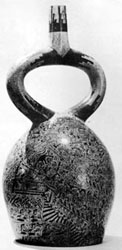
Huaco Retrato Mochica, Museo Larco. Source.  Catalogue Record.

It was the first full day we had in Peru and I had just met (most of) everyone. Tomorrow we were off to Pacasmayo and the start of the field season. 

But first, the Museo Larco!

Groggy and jet-lagged after three plane trips, my mind was still on tea, casemate walls, old friends in Madaba, and the new ones here. In the back of my mind, the spectre of the uncertain job hunt that awaited after undergrad loomed large. This was the final hurrah before graduation and the happiest summer of my life so far.

So, sufficed to say when I arrived in Lima in 2014, I was a tad off guard as I stepped into a room full of faces. It's not often that one gets to meet the faces of the distant past, so to speak. 

I'd read of them, but still didn't expected it then and there (or at least, not so many).

Storage Gallery, Larco Museum. Lyndsay Ruell

At the Museo Larco were rows and rows of cases ten feet high of lifelike faces molded on clay vessels and most had tubes that joined to a spout at the top. Some were old others were young and ranged from calm, genial to grim  At somewhere only marginally over five feet, I could only squint at the top shelves and couldn't begin to figure out how to see them all.

These were the portrait vessels of the Moche (100-800 CE/A.D.) of North Coast Peru who lived long before the Inca dominated the Andes. 

Out of Context?

But most of these portrait vessels unfortunately came from unknown places. By Dr. Christopher Donnan's estimate, 95 percent of all the portrait vessels in existing collections came from unknown contexts. 

The sites they came from were unknown, let alone their location within them in the ground spatially or even temporally. The related burials, middens or structures and related finds they belonged to is not completely clear. Portrait vessels in collections were recovered from second hands- huaceros (looters), old antiquarians or archaeologists of a bygone era. They have been organized more generally into phases though based on the form of their stirrups (the long tubes/ spouts) which they share with other types of "stirrup vessels" that do have their archaeological context intact.

Though one can analyze an object in many ways, it could easily be in many inaccurate ways without understanding their context in the world of the people who created them, used them and left them behind. We are the ones calling them "portraits".

Larco Collection in the earlier days. Source.

Still, progress on research has been made.

Realism?

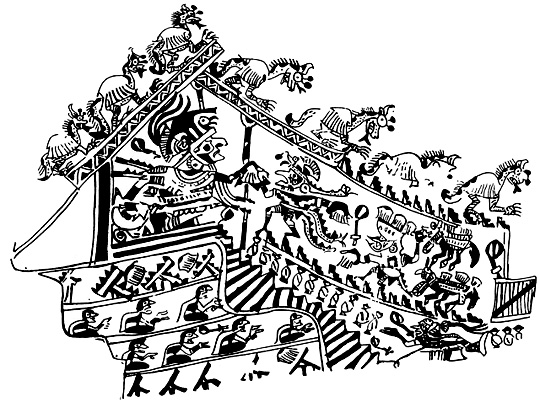
Most depictions of the Moche are in a highly stylized forms on ceramic vessels that make it difficult to identify or imagine the people depicted in life or to parse the varied real or stylized elements.

Conch Shell Transfer Scene, rollout drawing. Donnan and Mclellan 1979. Source

Conch Shell Transfer. Source.

But from these life lifelike portraits, we have a clearer visualization of the headdresses (headcloths, head rings, feathers and tassels), ear ornaments (ear spools, tubes and discs), nose ornament, face paint and occasionally, necklaces being worn. We also see a variety of symbolic and decorative elements.

Of course, whether they represented the large majority is another matter.

The Same Persons Throughout Their Lifetimes?

One of the most amazing things is that the extant collections, along with full figured (head and body) versions, seem to show that there is a pattern of the same person being replicated at different times in their life. Not one for each period in life, but multiples.

A few of them (all nicknames of course):  "Bigote" (moustache), "Long Nose" and "Black Stripe" tell stories of their lives from warriors in full regalia to ceremonial sacrifices with nooses around their necks.

Another, called "Cut Lip" based on the scar on his upper left lip seems to be an entire category that spans from his youth into his thirties with different ornamentation.

Who and how well known were they?

Their exact stories are unknown, just as their exact locations often are.

Time will tell perhaps.

Of course, there was yet another surprise at the Larco, but that's for another time...

If you are still interested, here's a lecture by Donnan:

                     Moche Portraits From Ancient Peru, UCLA Faculty Research Lectures (Link) 
Just a picture, not embedded!

Works Consulted:

Donnan, C. (2004). Moche Portraits from Ancient Peru. University of Texas Press.

23 March 2016

THE COLLECTIONS MANAGER WEARS PRADA

COLLECTIONS CORNER

BY: JENNIFER MAXWELL

Walk, walk. Fashion, baby. 

What do collections managers wear to work? Do they wear head-to-toe black or outrageous red fur coats? Far from black tie, collections managers (and their staff) often have very relaxed dress codes with a variety of styles. Many collections managers dress in a way that reflects the nature of the work they have to perform on any given day. In other words, a collections manager would not wear a cocktail dress and stilettos when cleaning out collections storage…or at least they shouldn’t.

So let’s talk about some of the more appropriate fashion choices when working with collections on a daily basis. Please note that these tips are merely suggestions – every museum is different and it’s up to you to ensure that you’re always dressed appropriately. 

Consider some of these tips for collections fashion, and you too can look as chic and sophisticated as Ms. Hepburn.  Source
Tops

There is quite a range when it comes to tops. From blouses, shirts, camisoles, t-shirts to polos, button-downs, jackets and more. The key is to assemble some dependable basics that look effortless and polished, but are also comfortable for the most mundane of collections tasks. As well, classic separates can easily be played with layers throughout the seasons. Breathable fabrics (think cotton, linen, and chambray) are also something to consider, since some collections work can be quite laborious. Movement is definitely important. 

A colleague once told me that an oversize chambray shirt should be a wardrobe staple for collections work. For an everyday look that’s put-together yet super comfortable, a chambray shirt is perfect for sitting at a computer doing researching or moving about in collections storage. Brilliant!

Zoolander modelling a muscle shirt like a boss.  Take notes!  Source
Bottoms

As wardrobe indispensables, nothing is as versatile as denim jeans. But when it comes to pants, there are more options available besides denim. There are so many types of fabric that can work in a collections-setting, such as Ponte knit, stretch cotton twill, corduroy, and wool gabardine. Also consider a fabric with stretch; about 3 to 5% Lycra (AKA spandex) is best. A pair of leggings is a good option too, if worn under long tunics, skirts, or dresses. But so long as the pants/jeans/leggings are comfortable, versatile, washable, and work appropriate it’s all good. 

However, for those times it is appropriate to step-up an outfit (i.e., visiting donors, collectors, and galleries), dresses, skirts, and nice trousers will do. 

MC Hammer pants would provide loads of movement and comfort for collections work.  Source
Layers

Layering clothing is a tried-and-true way to maximize comfort and style. The beauty of this simple concept is that it allows for quick adjustments based on activity levels and changes in temperature without having to change an outfit completely. My go-to is a 3-layer system – a base, middle, and an outer layer – which is quite practical since the outfit can be swiftly dressed up or down depending on the activity (i.e., working in cold collections storage versus warm office space). And a little tip from the wise, keep a nice jacket or blazer on-hand for those last minute meetings with stakeholders or potential collections donors!

Choosing the right clothing for layering is also important, as some loose and baggy cuts can potentially catch or snag an object. Always let the collection be your guide.

There is the 3-layer system, and then there is the Joey-layering system....  Source
Accessories

While the most boring outfits can be transformed with the help of a few key accessories, those some pieces can also cause damage to many museum collections. It’s best to remove or secure dangling jewellery and badges before handling collections to avoid catching an object. Consider removing rings and belt buckles as well, especially if the artefact being handled can crack or get scratched.

Gloves will be the number one accessory of choice when working with collections!

Wearing gloves is serious business in collections work, as demonstrated by TSwift.  Source
Shoes

The right shoes will make or break an outfit – and I’m not talking about tricky-to-wear statement shoes that will be worn only once. Selecting footwear that are solid and practical for collections work but are also versatile enough to wear again and again is the goal for collections staff. While open-toe stunners with bejewelled details may accent the outfit, will those same shoes be suitable when standing for extended periods of time, climbing ladders, or installing an exhibition? 

Also, depending on the type of museum and the nature of the collections work, steel-toe boots are usually a good investment piece. Keep in mind that many artefacts are sizeable and heavy, and workplace safety is very important – so protect those toes! 

Chris Pratt can teeter/skip/strut his high heeled stuff in my museum anytime - far away from the collections storage, of course.  Source

Thank you to everyone who read and supported my blog posts over the past year!  Farewell, my collections-minded friends.

22 March 2016

JASON DECAIRES TAYLOR AND UNDERWATER MUSEUMS!

WALK OF FAME

BY: AMANDA BARBOSA

Just recently, I stumbled upon a really fascinating story about underwater sculptures created by Jason deCaires Taylor, a marine conservationist, underwater photographer, scuba diver instructor and sculptor. His work is really inspiring and is not only visually-stunning but is also thought-provoking and seeks to preserve marine life.

Jason deCaires Taylor. Source.

Taylor is the first to imagine and create an underwater museum of sculptures. The first one opened off the west coast of Grenada in 2006. It is actually considered one of the Top 25 Wonders of the World. Another major project of his opened in 2009 and is called “Museo Subacuático de Arte” or MUSA, located off the coast of Cancun, Mexico. On display, are over 500 pieces! Currently, he is working off the coast of Spain’a Canary Islands in Lanzarote. It is called “Museo Atlantico.” 

To make his sculptures, Taylor uses non-toxic material. His goals are to protect underwater habitats and to create spaces for various sea life forms to call home. Many of the sculptures have even formed into artificial coral reefs. However, his projects are also commentaries on political, social and environmental issues. For example, in Lanzarote, Taylor has included a sculpted boat with 13 people as a tribute to the Syrian refugees. Another example consists of a sculpture of a man sitting on a couch in front of a television. With this piece, Taylor is demonstrating our failure to acknowledge environmental issues. 

Let the sculptures speak for themselves. Here are a few images (for more information and to see more of Taylor’s work/projects, click here):

Moilinere Underwater Sculpture Park in Grenada. “Viccisitudes.” Source.

MUSA Collection in Cancun, Mexico. “The Silent Evolution.” Source.

MUSA Collection in Cancun, Mexico.  “Man on Fire.” Source. 

“The Raft of Lampedusa.” (Tribute to Syrian Refugees). Museo Atlantico in Lanzarote, Spain. Source. 

MUSA Collection in Cancun, Mexico. “Inertia.” Source.


Sources Consulted: 

Underwater Sculpture by Jason deCaires Taylor website. (n.d.). “About: Biography.” Retrieved from http://www.underwatersculpture.com/about/biography/ 

Underwater Sculpture by Jason deCaires Taylor website. (n.d.). “About: Overview.” Retrieved from http://www.underwatersculpture.com/about/overview/


21 March 2016

VIEWS FROM THE CLIQUE

AFRICAN CANADIAN HISTORY

BY: ANNISSA MALVOISIN

Time really flies.

As my time as Contributing Editor to this lovely column, I have tried to bring contemporary histories to light - emphasizing the efforts of African Canadians today as relevant and important. I hope that my personal efforts have succeeded, and that you readers enjoyed what I believe was a needed cultural update. Finally, I hope that the events and movements that I've written about have been engaged with. 

As my final post for musings I would like to shamelessly promote my upcoming group exhibition titled Common Ground: ART x BISSELL 2016. Further, I would like to highlight the lit local talent that we will be featuring, many of which are of African descent and address issues in Black communities through their work.

I am not going to give away too much information (because I want you to come to the opening of course...) but I am going to give you a brief preview of what to expect.

Protest


One of the photographic works document a specific protest against the killing of an African-American teenager. Through the artists' lens and by way of your own interpretation, you may experiences scenes of resistance during a climate of racial inequality.

Artists
http://vsco.co/willmars/grid/1


Migration and Immigration


A dominant subject of works across the entirety of the exhibition, artists attempt to deal with their diverse cultural identities. From the Ivory Coast to Tanzania, artists take you on an expressive journey through their struggle, acceptance, and understanding of movement.

Artists
@black.lenses

Culture


To understand one's Blackness independent of any type of stereotype or classification is a feat that one artist has explored in her snapshots. A diverse array of people of African descent are featured, in all of their individual glory. 

Artists
http://www.sierranallo.com


(Image Source: Camille-Mary Sharp)

If you haven't caught onto my clever little hints, the theme of the exhibition deals with experiences and views of displacement by the clique of artists featured in the show (and I've only named a few!). They've poured themselves onto a tabla rasa opening on April 7, 2016.

Facebook Event
https://www.facebook.com/events/1749914988558238


It's been a pleasure.