Showing posts with label Conservation. Show all posts

6 November 2019

WHO CARES?: CARING FOR THE SPIRITUAL ELEMENTS OF OBJECTS IN MUSEUM COLLECTIONS

Breaking the Glass Case | Alexandra Forand 

“Some pieces were stolen out from graves or families, individuals, but when they came to the museum does that mean that in the grand scheme of things, that’s where they were meant to be? You know, that their perceived end is at a museum? Or is that just part of their life?” – Don Bain (Lheit-lit’en--Carrier) 
Museums have amassed diverse and dense collections, and within these collections there are a number of Indigenous artifacts--objects that were once used for ceremonial practises and continue to be sacred to this day. These artifacts are physically conserved and cared for by museum staff, but what about the spiritual needs of these items? These artifacts aren’t simply inanimate objects, but instead they’re living beings and hold power even if they are removed from their original community. Until very recently the need to spiritually look after these objects has been largely ignored.

What I am trying to impress on you, dear reader, is that these spiritual objects are not simply artifacts within a collection, but are still a part of the outside world. The National Museum of the American Indian (NMAI) was one of the first institutions to recognize this and thus the museum’s Cultural Resource Centre was born. The centre creates a nurturing environment that properly honours the wishes of Indigenous peoples: to care, protect, and allow access to these objects. The Cultural Resource Centre at the NMAI acknowledges the dual life of these objects.

The NMAI (Source). 
The NMAI isn’t the only institution striving to care for more than the physical elements of these objects. During a revitalization project at the University of British Columbia’s Museum of Anthropology, the Vancouver Hindu community conducted an abishekam (ritual renewal) for a bronze figure of the Hindu God Vishnu that had been in the collection for 24 years. The abishekam involved anointing the figure with auspicious liquids including water mixed with turmeric, milk, oil, honey, and a type of fruit salad. The figure was dressed with regalia and floral garlands, before being offered a feast of fruits and sweets.

Another way ritual objects can be spiritually cared for is through smudging the collection or a specific object (smudging is the exposure to smoke from plants such as sweetgrass, tobacco, or sage).  In 2017, Kim Wheatley offered traditional blessings with water and tobacco for the Out of Depths: The Blue Whale Story exhibition at the Royal Ontario Museum.

Ritual smudging is one of many ways to care for ceremonial objects (Source). 
The way objects are stored in collections can also reflect the intervention of spiritual care. For instance, when displaying or storing a ceremonial pipe, the stem and bowl should be separated when not performing sacred ceremonies (If you are interested in a version the traditional story behind the ceremonial pipe, I’ve included the link here).

Up until this point I have focused on examples where members from the community came into the collection and cared for these object, but there are instances where community members have borrowed objects from museums’ collections. Mariam Clavir recalls:

“ a Kwakwaka’wakw family that was moving their old regalia from the Kwagiulth Museum in Cape Mudge, B.C., to the U’mista Cultural Center in Alert Bay gave a potlatch for this event. The objects were central to the celebration, and normally regalia would be worn and danced at a potlatch. The family, however, chose to show the fragile old pieces but not to dance them. Out of respect for this ancestral regalia, it was, as tradition demanded, witnessed by those at the event, but handled by its First Nations owners according to museum conservation standards.”

This story told by Clavir harkens back to the idea that led to the NMAI’s Cultural Resource Centre: preserved, but available to communities.

In museum collection there is a set protocol and a laundry list of best practises designed to care for the physical elements of museum artifacts. While I am not arguing to throw out these measures, I am urging museum collections (and the staff who work there) to prioritize the spiritual care the objects. At present these objects are being kept in a mausoleum, but these objects aren’t at the end of their life, instead they are still very much connected to the communities from which they originated. The benefits of caring for the spiritual elements of these objects greatly out-weighs the risks to the physical objects.

What do you think? Should spiritual care be applied to all museum objects? Have you seen it in praise or do you care for collections beyond the physical? Let me know! As always, you can leave a comment, send me an email (allyforand@gmail.com), or if Twitter and Instagram are more your speed my handle on both is @Ally_but_online.

29 November 2018

DEBATING THE AUTHENTICITY OF RESTORATION

Conservation Tips & Tricks | Selin Kahramanoglu

Welcome to the second article of my three-part series about different conservation methods! This week, I will discuss restoration practices, and use a recently reworked famous Italian painting as our case study. Cominciano!

The Last Supper, by Leonardo da Vinci, found at Santa Maria delle Grazie in Milan. Source.
What's the story?

According to a report by The Independent in 2012, The Last Supper was restored out of Leonardo da Vinci's modern studio, by Pinin Brambilla Barcilon and Pietro Marani. The painting had particular damage from grime and also suffered from bad restoration techniques in the past. In 1999, the artwork was finally revealed after twenty years of conservation efforts, but not everyone was pleased.

In situ, the 1498 painting is located on the wall of the Santa Maria delle Grazie in Milan. In true Leonardo da Vinci fashion, the tempera painting is on top of sealed stone, which is prone to discolouration and deterioration, especially when exposed to humid climates overtime. However, some people think that the recent restoration overwhelms the painting, and the original work is barely present. People start asking the question: Is it even a Leonardo da Vinci anymore?

Why bother with restoration?

As mentioned in my previous article of this series, humidity is a major threat to historical artifacts and sites! In this case, there were only two options: 1) The conservators intervene and restore the painting, or 2) The painting continues to deteriorate naturally. What do we do when it comes to an original Leonardo da Vinci masterpiece? Most conservators will choose to rescue it.

The choice to restore a piece of history is not an easy one. For The Last Supper, there isn't much to think about, because the painting was produced from a famous artist. It is culturally valuable, and thus deserves conservation efforts. Yet, other artifacts are not so smussato - for example, some pieces may be ancient and historically interesting, but not too publicized, and often overlooked by the general public. Both scholars and the average person needs to be able to find the object culturally important, so that the artifact is worth the money, labour, and resources for conservation.

Focus on the good!

Apart from saving an artifact from completely disappearing off the face of the earth, restoration is useful for two related reasons: First, a restored piece gives the impression that it is one "whole." From the outside, a good restoration job means that you can't tell between the original and the recent reworkings. The artifact gives the illusion that it has not been slowly deteriorating, but instead seems visually complete and untouched. Molto bene!

Second, a restored artifact (especially a Leonardo da Vinci work) attracts tourists. It is the same idea when something new and sparkly comes on display at a jewelry store. When a historical objects comes out of storage for the first time in years, the public wants to see it - in its entirety. Speaking from experience, visitors don't typically enjoy seeing a tiny fragment of an object, while the rest of the item is lost, or fading to dust.

We can't ignore the bad...

Restoration involves intervention. In my opinion, the moment you alter an artifact, it is no longer 100% original. The Last Supper, for example, is still an authentic work, but the object's identity now has an added layer. Despite efforts to replicate the item as smooth and exact as possible, the object's biography changes, and we add a chapter of restoration to its history. 

Not only this, restoration resources are expensive, difficult to acquire, and need advanced expertise - not the easiest to come by! Mi dispiace, but you need a large amount of funding and support to get a restoration project approved and completed. Moreover, in the past, a bad restoration job is often met with a fierce public outcry and have not always been fixable.


I'll leave the decision up to you! Which do you prefer, restoration or natural deterioration? It's a bit of a debate among conservators, but one thing is for sure - as long as the conservation technique is reversible without causing damage, why not give it a try? Arrivederci amici!

Additional References


1 October 2018

FROM THE ASHES: THE AFTERMATH OF THE FIRE THAT DESTROYED BRAZIL’S NATIONAL MUSEUM

Muse News | Amy Intrator 


Yesterday marked four weeks since the devastating fire that consumed Brazil’s 200-year old National Museum. The past month has been filled with accounts of the museum’s losses and speculation about the systematic problems that led to the fire. The fire has been described as a “global tragedy” but now it’s time to consider how a “global recovery” can take shape.

Photograph capturing the fire at the National Museum of Brazil. Source.


What happened?

On September 2, 2018 an enormous fire broke out at Brazil’s National Museum in Rio de Janeiro. Officials estimated that the fire destroyed 90% of the museum’s collection of 20 million artifacts. There has been an outpouring of anger and disappointment across the world in the wake of the fire. Although the exact cause of the fire is unknown, many blame the government of Brazil for neglecting the country’s cultural institutions and letting the museum fall into disrepair. Brazil’s National Development Bank was in the process of disbursing a loan to the museum, but the funds to provide an “adequate fire safety system” came too late to save the museum.

Photograph of the exterior of the National Museum of Brazil before the fire. Source.


What was lost?

The museum’s staff are still trying to account for the losses in the collection, but the outlook is bleak for the majority of the artifacts. The museum had diverse collections including artifacts from Brazil’s Indigenous cultures, an Ancient Egypt collection, and artifacts related to anthropology and archaeology – including 11,500 year-old “Luzia,” the oldest human fossil discovered in the Americas. Many members of Brazil’s Indigenous communities have expressed the tragic loss of the museum’s Indigenous collection. The Indigenous collection included audio recordings of Indigenous leaders who have since died, and writings of languages that are now extinct. The collection represented a tangible connection to history, which has now been irrevocably severed.

Photograph of the National Museum of Brazil's display of "Luzia," an 11,500 year-old skull that was used to create a digital reconstruction of her face. Luzia was lost in the fire. Source. 


Where does recovery begin?
It is difficult to imagine a way to “rebuild” a museum that has lost such a significant piece of their collection, but there are several efforts to assist the museum. The physical rebuilding of the museum will be extremely costly, and Brazil’s government is in the process of seeking local and international assistance to fund the project. Funding the physical rebuild is one problem, but questions remain: How do you begin “recovering” a collection with few remaining traces? How can the global community support the National Museum?

“The [University of Toronto Museum Studies program] has sent a letter of support and an offer of assistance to the National Museum in Brazil,” states Dr. Cara Krmpotich, the Director of the University of Toronto Museum Studies Program. “We are approaching the situation from both top down, and bottom up, offering assistance based on needs identified by museum and scholarly colleagues in Brazil.” According to Krmpotich, assistance may come in the form of digital transcription here in Toronto, or skilled labour on the ground in Rio. The faculty will take their lead from the staff of the museum, who are likely in the process of mobilizing a strategy in the wake of the fire.

In addition to financial and scholarly efforts to help the museum, there have been several initiatives to digitally “reconstruct” the collection. Wikipedia recently launched a crowd-sourcing initiative to encourage the global community to upload photos to Wikimedia of any artifacts from the National Museum collection.


Similar digital recovery projects have sprung up across the internet, but is this the answer to large-scale restoration? Krmpotich, and many other museum professionals, would prefer to hear what the museum wants “on their terms” rather than follow the lead of a 3rd party platform. Another notable project is underway at the Federal University of Rio de Janeiro. The students of the University’s Museum Studies program are gathering images, videos, documents, and drawings of exhibits and artifacts in order to create a digital archive. The Federal University was in charge of the museum’s operations and collections, so the students are extremely close to situation.

The restoration of the National Museum is the priority in the wake of this tragedy, but the fire begs the question of how we can implement policies to protect the structural integrity of museums across the world. We may assume that the fire in Brazil couldn't happen here in Canada, but as Krmpotich states, “we shouldn’t be so hasty to assume this is a problem in other places.”

11 July 2018

TO SAVE OR NOT TO SAVE?


CONSERVATION TIPS & TRICKS

BY: SELIN KAHRAMANOGLU

Welcome to my final article for the summer! I'd like to indulge in a little ancient Greek symposium, and explore a hotly debated topic in conservation practices: How do you decide which artifacts deserve saving? *sips wine* Let’s discuss.


The reason why this question raises some eyebrows is because everyone’s has an opinion. Even professionals disagree on the circumstances surrounding object conservation. Unfortunately, the alternative is quite drastic: Without conscious care, objects will naturally disintegrate, and in most cases there’s no possible recovery. As a conservator, quite literally, the object’s life is in your hands. Will you save it, or let it go?

Let’s look at three common criteria that help conservators make this decision easier:

1) Quality of Condition 


Friend, if your artifact looks like it's beyond repair, then it’s probably too late. Based on how much time and resources is needed to recover the original state of the object, then the conservator will decide if it is worth the effort. It doesn’t matter how wonderful the object may be, if it’s already too damaged, then conservators are less likely to work with it.
  • A shattered vase, a skull with missing teeth, a painting with discolouration, a book with an unraveling binding, etc. – These are all objects that can be saved. The tasks may be complex, but that just means that it will take more time. It is not impossible.
2) Necessary Tools


Do you need the pigment of a plant that only grows in some inhabitable land? Then, my condolences, your object can't be saved. Not all conservators are fortunate enough to have every tool at their disposal. Even if the conservator is prepared to put in the extra effort, acquiring new tools takes funding, and not every institution is willing to pay a few thousand dollars to save a single ceramic plate. 
  • Let’s say that you have a generous sponsor, who buys all the tools you’ve been dreaming about. Do you know how to use them? Even with all the latest technologies, conservators must have the expertise needed to use these tools, which can take years to learn and special training.
3) Cultural Heritage Value


Here’s where things get tricky. When discussing conservation, this is the topic that causes the most disagreements among professionals. Conservators need to decide whether or not the object is a cherished part of history to determine if it should be saved. There's lots of questions that need answering, and decisions can be swayed by personal views. 
  • Is the artifact the only one of its kind? Who has the right to decide if it's historically valuable? What criteria are they using? How was the object acquired by the museum? Is it useful in the future? – There’s a lot of uncertainty that accompanies questions of value because it is based on individual perspectives and interpretation.
Thankfully, conservation is not always so complex. Conservators often debate with each other to gain new insights, and challenge one another for alternative approaches. Professionals practice open communication and partnership when deciding to conserve an object. Many times, conservators agree about how to best protect an artifact. 


Remember: If an object is considered unqualified for conservation treatment, it is not lost forever. Some artifacts are meant to deteriorate as part of their meaningfulness to the culture. These days, objects can be reproduced, or preserved through digital means (i.e. 3D scanning, virtual archaeology). Conservators just try to do the best that they can for each object, and roll with the punches!

The next time you think about conservation at the museum or archaeological site (check out my first and second articles), consider the above criteria and don’t be afraid to ask the tougher questions! Discussions have the potential to spark new ideas. *sips more wine* 


What do you think? Comment below! 

Further Reading:
https://www.nedcc.org/preservation101/session-9/9selection-for-preservation.
https://www.huffingtonpost.com/steve-berry/why-preserving-history-matters_b_1446631.html.
 

5 April 2018

OPEN DOOR POLICY: CONSERVATION LABS ON VIEW

CONSERVATION TIPS & TRICKS

BY: SERENA YPELAAR & AMY INTRATOR

Some of the most popular features of many museums are their open conservation labs, in which visitors can see conservators at work (often through glass). It's another nod to visitors' love of behind-the-scenes opportunities, and seeing the process allows a transparency we don't always get in museums. We've compiled a list of some institutions where you can see conservation labs up close!

Royal Tyrrell Museum, Drumheller, Alberta

During the summer, the Royal Tyrrell Museum processes fossils discovered by the archaeological team in the field. Their work is done in the Preparation Lab (formerly the Fossil Lab), which is accessible to visitors in the form of a large glass window. Visitors can watch conservators and archaeologists at work with new fossil discoveries of various sizes and types. Many of the specimens were discovered in the local area in Alberta, such as Dinosaur Provincial Park, which is where the field station is located. Some specimens take up to five years to prepare completely, so the Preparation Lab often has conservators working on long-term projects.


The Fossil Lab in 2007. Source.

Museum of Fine Arts, Boston (MFA)
Photo courtesy of Amy Intrator.

At the Museum of Fine Arts, Boston (MFA) the Conservation in Action display allows visitors to see conservators working on artifacts up close and personal. The Conservation in Action Gallery is a space dedicated to displaying the conservation processes undertaken in the gallery, but conservation displays have also been set up in the Asian Painting Gallery and other parts of the Museum.

The conservation displays change with new acquisitions and projects, and the developing display fits into the museum’s larger initiative to merge front-of-house programming with behind-the-scenes access. In addition to the Conservation in Action display, the MFA has displays dedicated to the choices, decisions, and efforts made by Museum staff. From a display about “Making Choices” between displaying different artifacts, to an explanation of classifying processes, the Museum is extremely transparent about processes that are usually kept behind closed doors.


Boston MFA's Making Choices Display. Photo
courtesy of Amy Intrator.
Penn Museum, Philadelphia

The Penn Museum in Philadelphia has displayed their conservation process since 2012, with the opening of In the Artifact Lab: Conserving Egyptian Mummies. In 2017, the lab reopened as The Artifact Lab: Conservation in Action, which now focuses on a variety of artifact conservation. The lab is described as “part exhibition, part working laboratory” and visitors have the opportunity to look into the glass as conservators work on artifacts, but they can also explore objects in the gallery and learn about the conservation process each artifact underwent. The combination of exploration and observation allows visitors to engage in a dialogue about conservation, rather than passively watch conservators at work. The Museum also makes an effort to keep visitors informed and engaged through a blog with information about the Museum’s current and past conservation initiatives. The combination of resources helps the visitor learn about the scientific, artistic, and practical knowledge necessary to properly conserve the museum’s artifacts.


National Trust, Knole House, UK

The Knole Conservation Studio is the first National Trust offering of its kind. Free to all visitors, it is located in Knole House in West Kent and offers an interactive look at the conservation process. Housed in a 15th century barn, the first floor holds a display of historic items laid out and waiting to be conserved. The building's windows have been blocked for preservation against light damage, but a timed lighting system allows visitors to view the conservation area for limited periods. The second floor holds the conservation studio itself, where visitors can watch conservators at work and engage with interactive displays such as drawers. Tours of the space are also available, and conservators and volunteers can answer questions in the space itself. The studio even has UV light box that can illuminate areas of an object that have been restored. It also has an iPad with a decision-making game allowing visitors to "play the conservator".

Knole House, West Kent, UK. Source.

Northwest Museum of Arts and Culture, Spokane, Washington

The Northwest Museum of Arts and Culture has a “working Collections Lab” with a variety of displays and programs that bring visitors behind-the-scenes and into the collections process. While many galleries feature conservation labs that visitors can peek into, this museum features several different programs that allow for a more open dialogue between visitors and museum staff. From an “Artifact Boot Camp” featuring chats with museum staff and volunteers as they work, to a display about the science of decay, there are multiple opportunities for visitors to engage in the collections process. The full and changing display connects the Museum’s dedication to collections stewardship with their commitment to lifelong learning by opening a dialogue between visitors and the museum collection.


The openness of these conservation labs provides an additional level of learning and offers a special glimpse into the work museum professionals - namely conservators and collections managers - do. The transparency of these labs brings an awareness of the importance of preserving these artifacts for the future - have you been to any museums with open conservation labs?

9 November 2017

DUST, RUST, AND ALL THE REST: PART TWO

CONSERVATION TIPS & TRICKS

BY: JULIE DAECHSEL

Welcome to part two of “Dust, Rust, and All the Rest”. For those of you who missed part one, it can be found here. This final installment will recount the epic saga of Julie vs. the Cow Hair Trimmer, aka my first foray into conservation. During my time this summer as a Curatorial Collections Assistant at the Markham Museum, Janet Reid, the curator, arranged for conservator Miriam Harris (Professor of Cultural Heritage Conservation and Management at Fleming College) to lead a one-day conservation boot camp.

But what does a cow hair trimmer have to do with this? The short answer: it is a challenge I bested. The long (and less conceited) answer: Geared for Growing.

Source.
Geared for Growing is the current exhibition at the Markham Museum and showcases innovations in farming. In the museum’s teaching collection is a cow hair trimmer: a device that uses a hank crank to power a hair trimmer.

Colour me surprised when Janet told me she wanted it in the upcoming (now current) exhibition. I’m assuming this shock showed on my face as she told me that since dairy farms have to be extremely hygienic cows need regular haircuts. How does a farmer achieve this standard? A cow hair trimmer.

For a device that promotes cleanliness and hygiene, it could not be more disgusting. It was caked with dirt, rust, and cobwebs.

Photo courtesy of Julie Daechsel.
We brought the trimmer to the curatorial department and the conservation gauntlet was thrown down. Somewhere beneath the grime was a fantastic teaching object: I just had to find it.

In the curatorial armour (aka a lab coat and gloves), I used the first weapon in my arsenal: a vacuum cleaner. BOOM – the cobwebs were gone (and so was the spider that crawled out). With a dry brush, I brushed as much dirt and dust into the vacuum attachment.

The various brushes in a conservator's toolkit. Source.
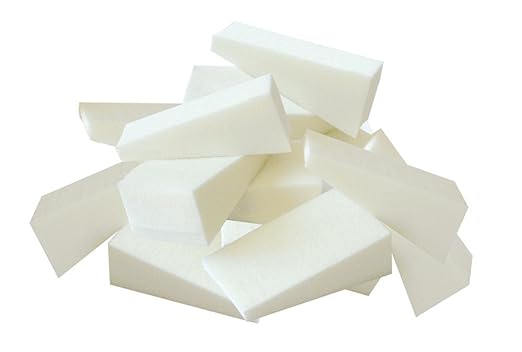
Next came makeup sponges. The miraculous power of makeup sponges should never be underestimated: porous yet strong, these little wonders are dirt magnets (and cheap too). The trick is to gently sweep them over a surface – try not to rub or scrub as this can potentially damage the object and causes the sponge to deteriorate. And because they are cheap, use as many as you need – dispose of a sponge as soon as it gets dirty or you’ll be spreading that dirt back onto the object. Also, sometimes surfaces need to be cleaned with sponges more than one time – keep cleaning this way until the sponge comes back clean.

Makeup sponges. Prepare yourself for a enormous pile of dirty ones. Source.
To my great surprise (and eventual disgust), what I thought was painted metal turned out to be caked on grime. This grime was a lovely mixture of grease, dirt, cow hair, and what smelled like cow sweat. Once I numbed myself to the smell, scrapping this gunk out became really fun. Using scrapers and picks of various sizes, I eventually de-gunked the trimmer.

Some scrapers. Source.

At this point, the trimmer was no longer disgustingly dirty or smelly. But the rust was not attractive. After cleaning my picks and scrapers, I attacked the rust. Most of the rust was on the trimmer attachment.

The trimmer attachment. It was already broken when I got it, I swear. Photo courtesy of Julie Daechsel.
Usually, it is not suggested to take apart what you are cleaning for two reasons: one, you may not know how to put it back together; and two, once the rust is removed, the pieces may not fit back together. The voice of experience (Janet) gave me the all-clear to remove the screw that held the blades together.

The trimmer blades after being removed from the trimmer. Photo courtesy of Julie Daechsel.
I happily spent days scraping active rust (orangey-brown rust) off the trimmer (it’s not weird that this was extremely satisfying, right?). Don’t even get me started on the rush I felt after scrubbing it with heavy duty scouring pads and fine grit sandpaper.

These were super fun to use. Source.
If I thought old cow sweat was smelly, it ain’t got nothing on mineral spirits. A word to the wise: wear a mask! It removes rust but at the cost of your sense of smell.

And ta-da! The beauty beneath the grime was revealed!


No more rust! Photo courtesy of Julie Daechsel.
Lessons Learned:

· Brush and vac: boring, but effective. Contain your excitement at the sight of a rusty object and take the time to dry brush and vacuum it first.

· Horde makeup sponges: incredibly effective and easy to use. Just change your sponge frequently!

· Scrapers and picks: never try this without permission. Any cleaning beyond light dirt removal requires permission from an experienced conservator. Play with different shapes and sizes to find the one with the perfect angle.

· Mineral spirits (aka paint thinner): removes nearly everything, which can be problematic. Remember, it will remove paint as well so avoid using it on certain surfaces.

· Lee Valley is a conservation goldmine

If you are nervous about conservation, practice on a less valuable object. A great way to dip your toe in the waters of conservation is to try cleaning a demo/teaching collection object: the stakes are much lower.

Finally in the exhibition! Photo courtesy of  Julie Daechsel.
Source.
Thanks for tuning in!