Showing posts with label Conservation: Tips & Tricks. Show all posts

8 April 2019

HOW FAR IS TOO FAR?

Conservation Tips & Tricks | Selin Kahramanoglu


Let's talk about ethics.

Picture this: You're a conservator in a prestigious museum (congrats!), and you are tasked with restoring the painting, Woman with a Parasol, by Claude Monet. In this scenario, the painting has been cut along the top of the canvas during its transportation to the museum's collection storage.

It's only ripped. No big deal. Just patch it up, right?

Yes, the tear is near the frame, but in this imaginary scenario the tear also thinly runs down the canvas, and clearly strikes through the image of the young woman in the painting. There's no way to hide the damage. Suddenly, the slashed painting is more problematic than we initially thought. You sure that you want to keep going?

Woman with a Parasol, painted by Claude Monet. Source.
Door Number One: If you choose not to restore the painting, the rip would likely get bigger over time, and it could never be displayed in such a state. Shame would cast a shadow over your institution (sorry, I'm excited for Game of Thrones), because the Monet painting was damaged while in your care. Too bad. There goes your reputation

Door Number Two: If you choose to restore the painting, you will need to repair the canvas in the back, but also paint over the front image to cover the ripped edges. The question is, are you willing to paint over an original Monet? If the answer is yes, then welcome to the dark side of conservation practices.


The restoration of art is a task frequently given to conservators. Sometimes objects get accidentally damaged when moving between spaces, and other times it is an action that was purposefully done. Still, how much work can reasonably be done to repair a work of art, or an artifact, before the restoration impedes the integrity of the original work? At what point would a conservator become a contributing artist?

Now, I know these ethical decisions are hard to make, but don't worry. Remember our golden rule: The point of conservation is to protect the current state of the object, using techniques that are reversible in the future.


Ethically, conservators are restricted to doing only what is necessary to conserve the object. That's why we would have to repair the painting's canvas. However, adding more paint to the artwork, on top of Monet's existing work, is another moral dilemma.

Here's the good news: Paint can be removed. Impressionism art has layers upon layers of paint, which can be taken off, even if the paint has been dry for decades. If a conservator chooses to paint on top of Monet's work in order to cover the rip, then yes, the conservator's paint job is reversible. So far, so good.

Sorry, there's bad news: The extent of conservation on an object is subjective. Unfortunately, each conservator is not watched by a jury of experts in the lab, telling them when they've overdone it. How can we trust that a conservator knows when to stop tinkering, repairing, altering?


Don't forget, you are the conservator in this scenario. No one else. The decision is yours to make. The mistakes are also yours to make. Here are four important tips to following best practices when it comes to ethical dilemmas in conservation:
  1. Consult another conservator or specialized expert. Try to not to pick a friend, or a colleague in the same institution, when consulting for a second opinion. You wouldn't want any biased remarks in this case. You need brutal truths on how to proceed with the job.
  2. Research previously completed conservation treatments. There are many examples of a job gone wrong, and it is equally helpful to see what decisions you shouldn't be making. At the same time, a similar situation would show you the processes that someone else has already tested out before you.
  3. Trust your instincts. If you think that you're in danger of going too far, then the answer is probably yes. Do you think your hand is too shaky to patch up the painting today? Then, take a break. Are you unsure as to which solvent test to do? Ask someone. Don't guess, and don't push yourself to do the job.
  4. Take some risks. I know ethical dilemmas are scary, especially if you're the one in charge. Still, we should be trying to push the boundaries of our professions. Demand an answer to tough questions. If you have a strong rationale behind your decision, then do it!

Like most ethical issues, this topic can be debated, and I won't pretend to have a definite solution. However, I encourage you to think about these problems when you go on a museum visit, or tour a historical site this summer. Take a walk through the unknown and dangerous side of conservation!

13 March 2019

MORE THAN JUST BROKEN ARTIFACTS

Conservation Tips & Tricks | Selin Kahramanoglu


Imagine if the wings of Winged Victory were smashed into so many little pieces that it was impossible to recover. It is true that the statue’s head and arm are already missing, but the artwork is made famous by its wings. Currently housed at the Louvre, and dated to almost the 2nd century BCE, this statue demonstrates the essence of Hellenistic marble and artistry. The wings are the iconic part of the statue. They are at the very core of the statue’s significance. The wings are everything.

For conservators, this is a critical moment.

Do they make plaster replicas of the wings, and add it back to the statue so that it is whole again?
Or, do they leave it the way it is?

Statue of Winged Victory, also called Nike of Samothrace. Source.
When it comes to restoration, some of our conservation decisions will be questionable. People will agree with us, and people will certainly disagree too. Still, these tough decisions need to be made. Who is to stay which choice is right? In this post, we think about the general advantages and disadvantages to the restoration of artifacts, and how they are more than just broken objects. 


Advantages

There are a lot of reasons why we might choose to restore a damaged artifact. Especially if it is within the museum’s budget, expertise, and resources to do so, why wouldn’t we try to rescue it? The whole point of conservation is to try to keep the original state of the artifact as much as possible, so of course, conservators would try their best to accomplish that. 

To add, if an artifact is damaged while under the protection of the museum, the institution may wish to erase any evidence of the incident. A museum’s reputation is at risk when pursuing future acquisitions, if the museum has a history of not keeping good care of its artifacts. 

Generally, restoration helps…
  • visitors envision the historical, original state of the artifact on display 
  • forget that the artifact was ever damaged
  • show that the museum has sufficient and up-to-date resources to assist conservation efforts
  • demonstrate the knowledge and skill of the conservator 


Disadvantages

Here's where things get fuzzy. Choosing not to restore an artifact can be considered brave, forward-thinking, or more often, risky. If a museum decides to keep a damaged artifact on display, this might show visitors that the incident is now a part of the object's biography. Conservators might say that the damage has been done, and we need to acknowledge this history, not erase it.

Many people might disagree with this tactic, because the sight of the damage could overwhelm the entirety of the artifact. Perhaps, the broken outline is all you see, and any hope at restoring the whole artifact fades. Sometimes, visitors might be angered when seeing the damaged artifact on display, because it reminds us of the damage that had been unwillingly inflicted. However, should we try to subdue this anger? Couldn't this frustration add more significance to the artifact?

Briefly, the lack of restoration means...
  • acknowledging the incident that caused the damage
  • accepting that the original state of the artifact is now unattainable
  • possibly insinuating that the museum does not have the conservation resources to restore it
  • allowing visitors to think critically about not restoring every artifact


Whether we choose to save a damaged artifact, or not, the decision is difficult and with some consequences. The next time you visit a gallery with a damaged artifact on display, or an object that has had obvious repairs made, let's consider why a conservator might choose to present the object in that way. Maybe, there's more to the story?

See you next month for the next post!


11 February 2019

DIGITIZATION TO THE RESCUE

Conservation Tips & Tricks | Selin Kahramanoglu


The much-anticipated (just humour me, you guys) third and final part of the "Alternative Conservation" series has arrived! This post will address the digitization approach to conservation, using the Lascaux Caves as our case study. Hold onto your floppy disks and let's get going!

Wall painting in the Lascaux Caves. Source.
Don't Get Too Excited

Now, I'm not going to sugar coat this (partly because I'm on a diet), but digitization is some tricky business. Creating digital records is an everyday occurrence that can't be helped. Left and right, born-digital records are being produced almost as often as superhero movies. Unfortunately, with digital records, we can never go back to the original context of the record's creation. For this reason, records are unstable.

Let's say that I want to remember my trip to the Lascaux Caves. I can take a picture, a video, an audio recording, or even a 3D scan of the site. What if I want to post a shorter version of the video of my trip on Instagram? Then, it's no longer the same video. It doesn't matter that the edited video is from the same source, and has the same content. It's been changed, and that's that. No turning back.

Tip: Metadata is always changing and updating, so it's important to acknowledge that it's difficult to keep up with digital records, but not impossible.


More Bad News

One thing we can't ignore is that digital records live fast, and die young. In the next couple decades, some hardware and software will be obsolete. This means that some records will no longer be accessible, retrievable, or even comprehensible. If you want to record an audio file on your visit to the Lascaux Caves using the recording app of your smartphone, think twice. In two years, that phone won't charge anymore, the battery will die, and your file will be lost.

With planned consumerism, the lifespan of digital mechanics are getting shorter and shorter. Still, the digital method is convenient. Especially when it comes to phones, laptops, and tablets, these digital resources are right at our fingertips. The question is, do you think constantly paying for the newer update is worth the trouble?

Tip: The reality of the matter is that restoring an older digital format or reader is time-consuming, requires resources, expertise, and money. A lot of money.


ANYTHING Positive to Say?

After all those limitations, why in the world would we use digitization as a conservation method? Remember that digital records are easy to create, to manipulate, and to dispose of. That's why it can be an excellent method for conservation! Let's say that you want to teach someone about how the light dances in the Lascaux Caves. Just take a video and show them. You've just created a digital record of an entire experience, easy-peasy.

With so many artifacts in a museum collection, it is not very realistic to put them all on display. However, digitizing the catalogue and making it available for public online viewing is similar to displaying them. Some museums are strictly digitally accessible. In any case, digitization allows the museum visitor to see and experience much more, pushing the boundaries of the physical museum.

Tip: Limited exhibition space? Place a tablet containing digitized artifacts relevant to the exhibition theme in the gallery to compliment the physical objects on display.


Finally, Good News

With the digitization of artifacts, rare, and unique object can be seen at any time, and anywhere in the world. We can simulate realistic, and immersive, interpretations of lost heritage to our heart's content! Through landscape digitization, we can visit the Lascaux Caves, and even walk among the site in a virtual reality experience. Digital copies of artifacts and archaeological sites also protects the originals from the damages that can occur from too many physical interactions. Not only that, digitization can be useful for wayfinding. Have you ever gotten lost, or unsure of what your destination looks like? The Google Maps app and Street View can get you to where you need to go because global geography has been digitized!

Tip: The digital record has the potential to become an exact replication of the original, but it can never replace it. Rather, the digital adds another dimension to comprehending information.


The next time you're considering alternative conservation methods, digitization is a very real and frequently used approach in the modern age. Of course, the more traditional methods of preservation and restoration are good options too. It all depends on what you're trying to salvage, for how long, and if you have enough resources to do so. Good luck with your upcoming conservation practices, my friends, because I know that choosing one method is not as easy as it looks.

29 November 2018

DEBATING THE AUTHENTICITY OF RESTORATION

Conservation Tips & Tricks | Selin Kahramanoglu

Welcome to the second article of my three-part series about different conservation methods! This week, I will discuss restoration practices, and use a recently reworked famous Italian painting as our case study. Cominciano!

The Last Supper, by Leonardo da Vinci, found at Santa Maria delle Grazie in Milan. Source.
What's the story?

According to a report by The Independent in 2012, The Last Supper was restored out of Leonardo da Vinci's modern studio, by Pinin Brambilla Barcilon and Pietro Marani. The painting had particular damage from grime and also suffered from bad restoration techniques in the past. In 1999, the artwork was finally revealed after twenty years of conservation efforts, but not everyone was pleased.

In situ, the 1498 painting is located on the wall of the Santa Maria delle Grazie in Milan. In true Leonardo da Vinci fashion, the tempera painting is on top of sealed stone, which is prone to discolouration and deterioration, especially when exposed to humid climates overtime. However, some people think that the recent restoration overwhelms the painting, and the original work is barely present. People start asking the question: Is it even a Leonardo da Vinci anymore?

Why bother with restoration?

As mentioned in my previous article of this series, humidity is a major threat to historical artifacts and sites! In this case, there were only two options: 1) The conservators intervene and restore the painting, or 2) The painting continues to deteriorate naturally. What do we do when it comes to an original Leonardo da Vinci masterpiece? Most conservators will choose to rescue it.

The choice to restore a piece of history is not an easy one. For The Last Supper, there isn't much to think about, because the painting was produced from a famous artist. It is culturally valuable, and thus deserves conservation efforts. Yet, other artifacts are not so smussato - for example, some pieces may be ancient and historically interesting, but not too publicized, and often overlooked by the general public. Both scholars and the average person needs to be able to find the object culturally important, so that the artifact is worth the money, labour, and resources for conservation.

Focus on the good!

Apart from saving an artifact from completely disappearing off the face of the earth, restoration is useful for two related reasons: First, a restored piece gives the impression that it is one "whole." From the outside, a good restoration job means that you can't tell between the original and the recent reworkings. The artifact gives the illusion that it has not been slowly deteriorating, but instead seems visually complete and untouched. Molto bene!

Second, a restored artifact (especially a Leonardo da Vinci work) attracts tourists. It is the same idea when something new and sparkly comes on display at a jewelry store. When a historical objects comes out of storage for the first time in years, the public wants to see it - in its entirety. Speaking from experience, visitors don't typically enjoy seeing a tiny fragment of an object, while the rest of the item is lost, or fading to dust.

We can't ignore the bad...

Restoration involves intervention. In my opinion, the moment you alter an artifact, it is no longer 100% original. The Last Supper, for example, is still an authentic work, but the object's identity now has an added layer. Despite efforts to replicate the item as smooth and exact as possible, the object's biography changes, and we add a chapter of restoration to its history. 

Not only this, restoration resources are expensive, difficult to acquire, and need advanced expertise - not the easiest to come by! Mi dispiace, but you need a large amount of funding and support to get a restoration project approved and completed. Moreover, in the past, a bad restoration job is often met with a fierce public outcry and have not always been fixable.


I'll leave the decision up to you! Which do you prefer, restoration or natural deterioration? It's a bit of a debate among conservators, but one thing is for sure - as long as the conservation technique is reversible without causing damage, why not give it a try? Arrivederci amici!

Additional References


8 March 2018

A SHERLOCKIAN APPROACH TO CONSERVATION

CONSERVATION TIPS & TRICKS

BY: JULIE DAECHSEL

This post wouldn’t exist without Sherlock Holmes – technically, the American adaptation of London’s detective. Most viewers are familiar with the BBC’s version of Sherlock Holmes (surprisingly called Sherlock), and not the less critically acclaimed series on CBS, Elementary, starring Jonny Lee Miller as Sherlock and Lucy Liu as Dr. Joan Watson.

Benedict Cumberbatch in Sherlock versus Jonny Lee Miller in Elementary. The two actors co-starred in a stage production of "Frankenstein" in which they alternated in the roles of Dr. Frankenstein and the Creature before starring in their Sherlock series. Source.
But what does Elementary have to do with conservation? Everything, my dear Watson. I’ll try to avoid any spoilers, although the upcoming scene is a flashback so it doesn’t reveal a major plot point. So during a flashback, we see how Sherlock meets Irene Adler.


While on a case, Sherlock consults Irene, a conservator, as to whether a Turner painting is a forgery (spoiler: it is). Sherlock identifies a painting in Adler’s studio that she claims to be a copy of one she restored for a museum (surprise, it’s actually the original). The museum wanted Adler to repair damage caused by shelling in WWI by filing down the paint, an act she argued “compromised what the artist had intended”. So she made a restored copy to return to the museum and kept the original in its damaged state.

This scene stuck with me. What is the line between damage and history? I’ve written in my previous posts about the responsibility conservators have to the object’s well-being, but Irene makes an intriguing point. What constitutes damage? And what is the effect aesthetic has on conservation?

What do museum professionals do in the face of uncertainty? Research.

Case #1: Saint Andrea Corsini (1630) by Giovan Francesco Barbieri looks, well, a little morbid – but for a good reason?

Detail from Saint Andrea Corsini that shows a bullet hole. The Corsini was as prominent as the Medici family - their family crest is at the top of the Trevi Fountain. Source.
This portrait of Saint Andrea Corsini has two bullet holes as badges of honour. During WWII German soldiers attempted to steal the painting for the Führermuseum from the Corsini family in Italy in 1944. Princess Elena Corsini feared this would happen, so she had hidden smaller works from the family collection in an empty crypt. Larger works were packed in a truck and driven to Villa Le Corti, where she hid them behind a false wall, except for this painting, which she hung on the wall in the hope that her ancestor would protect the artworks. German soldiers noticed the still-wet plaster but in the face of advancing Allied troops, couldn’t examine it further and shot the painting in frustration.

After the war, the Corsini family decided not to restore the work to serve as a reminder of the ravages of the war on both humanity and art.

Case #2: The Sistine Chapel is clean, but was that Michelangelo’s intention?

The Sistine Chapel ceiling post-restoration. Source.
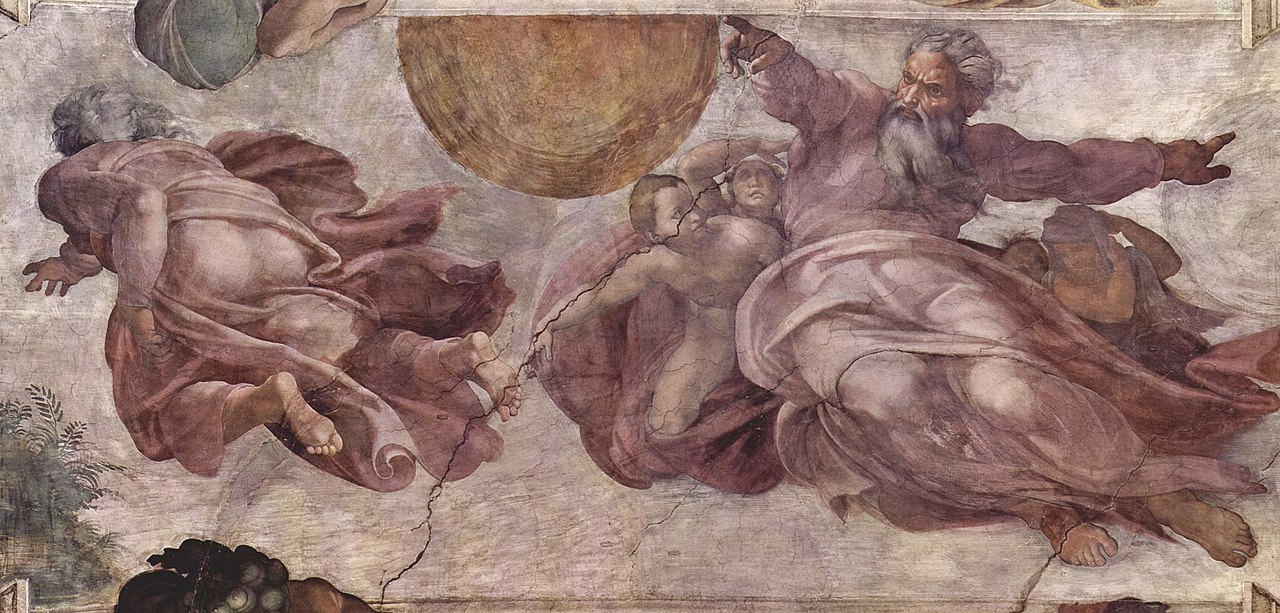
The Creation of the Sun, Moon and Vegetation from the image above, pre-restoration. Source.
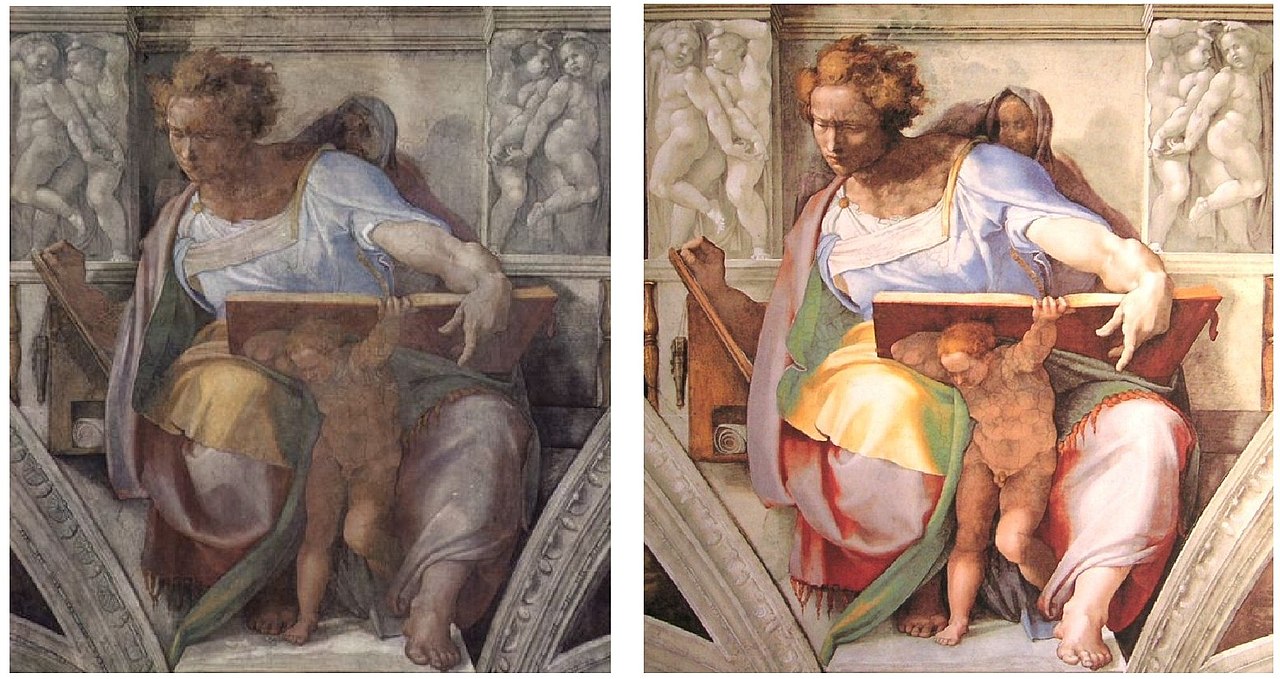
In the 1980s and 1990s, the Sistine Chapel underwent a cleaning to remove centuries of dust and candle soot. Critics feared that the cleaning process might damage the masterpieces, while some argued that visible age was part of the art. After the cleaning, people marvelled at the brighter colours and declared that the Michelangelo’s “true” masterpiece was revealed. But the cleaning, while removing dirt, had lifted away certain details and shadows (some to the extent of removing pupils from the eyes of figures). Any details that were added on top of the fresco, whether by Michelangelo or other artists, were removed.

Detail from Daniel. On the unrestored fresco, the red underpainting shows through the black a secco wash adding luminesce to the shadows. The form under the garment is achieved by the black wash which was removed during the restoration. Source.
While the colours were brighter, critics argued that the compositions were flatter and modelling on figures seemed cruder as shadows Michelangelo had intentionally painted were accidentally removed. As Michael Daley of ArtWatch noted, restorers removed layers of varnish Michelangelo had deliberately applied in order to harmonize and tone down his colours. Moreover, stripping these varnishes exposed the fresco surfaces to atmospheric pollution.

Now what?

Source.
We have an example from each group of thought. The Corsini family thought like Adler, that the painting’s damage added to its aesthetic: that its physical change enhanced the work’s intended meaning. In contrast, the Sistine Chapel restoration removed what was perceived as dirt and damage to reveal stunningly bright colours. But both actions have consequences. Saint Andrea Corsini will forever be known as the painting with a bullet through the head of a saint. The Sistine Chapel sacrificed arguable intention darkening varnishes and overpainting on the fresco.

If these posts have proven anything, it’s that conservation is much more complex than wiping off dust and rust. It’s knowing how to care for an object, and more importantly, when to. It’s knowing the difference between help and harm. But most importantly, it’s recognizing the consequences, permanent or impermanent, of our actions. Sometimes the hardest choice is not action but passivity. And sometimes it’s vice versa.

7 December 2017

DUST, RUST, AND ALL THE REST: SPECIAL HOLIDAY EDITION

CONSERVATION TIPS & TRICKS

BY: JULIE DAECHSEL

Surprise! "Dust, Rust, and All the Rest" is back for one last edition. This post is dedicated to the Royal Ontario Museum’s iconic totem poles.

The holidays are nearly upon us, and for some this means hanging out with friends, entertaining visiting family, or relaxing after the marathon known as final term assignments. All three activities can quite nicely be enjoyed at the ROM – and while you’re there, you can wow your guests (or yourself) with some historical and conservationist facts about the famous ROM totem poles.

Like all great stories, this one begins over one hundred years ago when Bill 138 passed on April 16, 1912. This bill officially created the Royal Ontario Museum, yet the University of Toronto, who first proposed a museum in Toronto, had been collecting objects for a museum long before this legislation. The university tasked Charles Trick Currelly, a graduate of Victoria College and self-taught archaeologist, with filling their proposed museum, which he did with unmatched vigor and passion. 

Charles Trick Currelly. Source.
In the spring of 1913, as the administration and management plans for the new museum were being finalized, Currelly was sent out on a lecture tour. By all accounts, Currelly was a tad overenthusiastic and this series was intended to keep him from meddling. In British Columbia, he was intrigued by the craftsmanship of the west coast people. Through Canadian anthropologist Marius Barbeau, Currelly purchased three totem poles for the museum.

It is important to contextualize this purchase as it occurred during the Indian Act, under which the potlatch ban criminalized the creation of Indigenous ceremonial and cultural art. There was a mad rush to acquire (although in some instance “seize” might be more appropriate) Indigenous objects and art. A fourth totem pole was collected by British medical doctor and hobbyist ethnographer Charles Newcombe in the 1920s.

Transporting artifacts is a test of ingenuity and planning. Transporting totem poles, the tallest of which was twenty-four metres, from British Columbia to Toronto is a logistical nightmare. The poles were floated down the Portland Canal to the ocean, then towed to Prince Rupert. The largest pole was cut into three sections while afloat before it could be loaded into a railway car. 

The Portland Canal to Stewart, BC. Source.
All of this work was almost for nothing, as there was no room in the original museum for the totem poles. They could be erected outside the building, but Currelly had been told that they wouldn’t last for more than one hundred years outdoors. What follows is perhaps the greatest example of collections management-obsession ever.

A hundred years sounds like a long time to most. But remember when I said that Currelly was obsessively passionate about his museum? A hundred years wasn’t good enough (especially when people were certain that Indigenous craftsmanship would end). Currelly was so certain that the museum would warrant an expansion in the upcoming years that he decided to preserve and store the totem poles until they had a home inside.

By no means a conservator, really by any standards, Currelly remembered his time at dig sites and the unconventional methods of artifact handling to create a preservation method. He soaked the poles in petroleum until they were completely saturated, then poured gallons of floor wax over them. Finally, they were wrapped in protective bandages and burlap then lain outside the museum until a new wing was built in 1933 with a specially designed area to display the poles (fun fact: this is the Queen’s Park wing with the old entrance the will be reopened). Incredibly, the totem poles were perfectly preserved after more than a decade outside.

Now they sit in the two stairwells off the Rotunda, still preserved after more than one hundred years. But there was a casualty of Currelly’s conservation treatment: the petroleum oil destroyed the original paint decorations. Otherwise, the totem poles are in great condition.

The totem poles in their specially crafted home. Source.
By displaying the totem poles inside, there are fewer conservation dangers: the CCI Notes for indoor totem poles only warns about the wood cracking, as red cedar is a moist wood that splits as the moisture evaporates after logging.

The poles should be dusted infrequently to prevent uneven polishing or abrasion. When dusting is needed, use a vacuum with a long-haired attachment, as Rick Mercer did at the Canadian Museum of History.


This is officially the last Conservation Tips and Tricks post of 2017. Hopefully on your next visit to the ROM you’ll see the totem poles in a new light. Happy Holidays!

Further Reading:

Dickson, Lovat. The Museum Makers: The Story of the Royal Ontario Museum. Canada: The Bryant Press, 1986.

Horrill, Mallory. "81 Years in a Museum". Musings. October 2, 2014.

Kenter, Peter. "Work of indigenous builders lives on in ROM totem poles". Daily Commercial News. July 28, 2016.

9 December 2016

NAUGHTY OR NICE: PROPER CONSERVATION PROTOCOL

CONSERVATION TIPS & TRICKS

BY KRISTEN MCLAUGHLIN

In the spirit of the holidays, Conservation Santa has decided to pay a visit to the Musings blog! He was very concerned that there are some naughty people out there, ignoring some basic conservation protocols. But don’t worry, he’s very understanding and just wants everyone to be safe and to protect the objects! So he's offered to share his criteria with us on what are some good and not-so-good conservation practices in museum spaces.


Conservation Santa, sporting protective glovewear… and shocked at what he sees!


Conservation Naughty List Conservation Nice List
• Touching artifacts with bare hands. • Wearing protective gloves. Cotton gloves are more common and work well for objects of more durable materials
(rock, ceramic, but it DOES get slippery), but nitrile gloves work best for items that may snag on cotton, such as organic materials like wood, cord, or textiles.
• NOTE: cotton gloves, despite washes, may not actually be clean. Be cautious about reusing them.
• Improper preparation and movement of objects. • Clear spaces and paths before moving objects.
• Never lift by protruding parts like handles or rims;
always pick up by the bottom to support the weight. Use two or more people if necessary.
• Letting small items roll around in transport. • Place small items in a protected tray before transport
• Using improper storage materials, such as regular cardboard boxes, regular tissue paper, etc. These items can
increase the speed of degradation, particularly if your object is protein-based like leather.
• Use archival quality storage materials to preserve the objects (especially if they are organic)
• Archival quality cardboard boxes
• Archival quality tissue
• Archival quality foam (for support and shelving)
• Archive quality pens (for number writing)
• Artifact photography: Improper stage set (no protective materials like cloth, supports, etc.) and unnecessary use of flash. • Artifact photography: prepare stage with proper materials and consider lighting and flash, particularly with artwork.
• Not filling out condition reports when needed! • Condition reports must be filled out with objects arrive in the museum, when status is updated,
and when items are loaned out of the museum or into the museum. This keeps track of the condition of the artifact and allows staff to know when damage has occurred.
• NOTE: Google for condition report templates if you are unsure what criteria to use!
• Improper monitoring of air quality, relative humidity, and temperature, or not keeping track of it at all!
• Otherwise can cause moulding, flaking, breaking,
• It is important to the life of an object that environmental monitoring is performed regularly.
• Invest in air conditioners, humidifiers, air purifiers, and hygrothermographs for accurate room-specific readings. Try to put one of
each in rooms that house collections and galleries.
• Not having a pest control procedure and letting them run wild in your museum!
• This includes mould.
• Create a pest control procedure so all staff know what to do to preemptively stop pests or what to do if pests are sighted.
• Prevalent pests are silverfish, moths, beetles, and mould.
• Templates can be found on Google but important things to consider are: how and when to inspect rooms,
what to look for on each possible pest, insect control strategy (i.e.: keeping food out of the backrooms) and who to contact if pests are sighted.
• NOTE: be aware of incoming collections and where they are coming from/their storage. If not sure, un-box items off-site and monitor before allowing into the museum.
• Dangerous storage rooms: rooms with heating or drainage pipes, storage where boxes of artifacts are on the ground
and not raised up, storage rooms where temperature and humidity fluctuate.
• Find storage rooms that are clear of pipes (if possible); make sure there are shelves that raise boxes up off of the ground; make sure to monitor temperature and humidity (as above); lock the space; no eating or drinking.

Does your museum land on the naughty list or the nice list? Make sure to update your conservation procedures if you are unsure (or sure you’re on the naughty list)!

SOURCES

http://canada.pch.gc.ca/eng/1439925169939

http://canada.pch.gc.ca/eng/1439925170131/1439925167388

http://nautarch.tamu.edu/CRL/conservationmanual/

https://www.nps.gov/museum/publications/conserveogram/01-12.pdf

http://thestillroomblog.com/2013/02/25/museum-monday-get-rid-of-those-white-cotton-gloves-time-for-nitrile/