Showing posts with label Digital Collections. Show all posts

30 March 2020

DIGITAL FASHION: THE BEST ONLINE TEXTILE COLLECTIONS

Sew What | Natalie Heaton


Source Kyoto Costume Institution 

The cancellation and closures due to the COVID-19 virus have left people inside their homes and the doors to cultural institutions are closed. While the closure of these institutions is devastating, many museums as using this as an opportunity to highlight their digital collection and online resources such as tours and education resources. In this article, I will highlight the top 5 best online fashion and textile collections!

5. FIDM Museum and Galleries, Los Angeles, USA


19th Annual Art of Motion Picture Costume Design, 2011
Source FIDM
Founded in 1978, Fashion Institute of Design and Merchandising Museum (FIDM) has a collection of over 12,000 costumes. This institution is known for its collection which specializes in early Hollywood costumes, with items such as Norma Sherer’s gown for the 1936 film Romeo & Juliet. Every year the FIDM holds an exhibition in the spring called Art of Motion Picture Costume Design. This exhibition features costume from top Hollywood Films, including The Great Gatsby (2013) and The Young Victoria (2009). FIDM’s online collection is sorted into different collections and images from past exhibitions. All photos are high resolution and feature pieces from the collection that date back to the 18th century, through to contemporary fashion.


4. The Kyoto Costume Institution (KCI), Kyoto, Japan

The KCI aims to collect, preserve and understand Western and Asian fashion and textiles. Their online collection highlights stunning gowns and garments from the museum along with access to all the institution’s publications, past exhibition catalogues, and more! Anyone that holds an interest in fashion and textiles, especially in the museum sector, this is a webpage that one could easily spend hours on! The museum also has a very active Instagram account that is filled with photos of the collection, the building, and different events that are taking place at the KCI.


View this post on Instagram

3. The Victoria & Albert Museum, London, England

The Victoria & Albert Museum (V&A) is one of the leading institutions in the world. The museum is known for having a massive collection of over 2.2 million objects with over half of them being digitalized and available in their online collection. A good number of these artefacts are textiles and garments. They have gowns that would have been worn near Marie Antoinette, to original Balenciaga, to Alexander McQueen, there is something that is bound to spark everyone’s interest!

Fashion "Search Collection" Home Page.
Source: Victoria and Albert Museum Website.

If stunning images wasn’t enough to intrigue you to check out of there website, there are also great articles, behind the screen videos and catalogues from past exhibitions.


2. Palais Galliera, Paris, France

Photo From Palais Galliera's Online Collection
Source: Palais Galliera

This institution has no permanent exhibitions due to conservational issues, so they only put on temporary exhibitions. Palais Galliera’s focus is on historical fashion and the fashion industry. Since the museum isn’t often open unless there is a temporary exhibition on, there is a lot of effort that goes into their website, and the viewers can tell. The website is organized into various categories to make for a smoother search, and help the viewer find exactly what they are looking for. Like many of the other institutions on this list, Palais Galliera offers past exhibition’s catalogues and publications, as well as workshops. What makes this online content stand out is that is it focused on French fashion history. With this narrow scope, the institution is able to dive into the content in a way that encyclopedic museums, such as the V&A or MET are unable to do.


Photo from Palais Galliera's Online Collection
Source: Palais Galliera


1. The Metropolitan Museum of Art, New York City, USA

The first thing that pops into a lot of people’s heads when talking about fashion and museums is the annual MET Gala. This fundraising event for The Metropolitan Museum of Art’s (MET) costume institute.

With the MET being so well known for their costume institute, it is no surprise that their website and the online collection is fabulous! I have spent many hours on it, and I know that as I continue in this field, I will spend many more. This website not only has thousands upon thousands of high-quality photographs of textiles, but they also have an Art History timeline, numerous publications, blog posts, videos, and much more. If you only end up visiting one website, the MET would be my top choice!

Costume Institute's Past Exhibitions
Source: Metropolitan Museum of Art webpage


Overall, even with museums around the world having to close their doors, their online resources are always open. From reading about past exhibitions, searching through thousands of stunning images, or reading more into the institution itself, there is always something new to learn in the museum, despite your location.

24 October 2019

OPEN UP: ACCESS, EXPERIENCE, & PARTICIPATION IN THE GLAM SECTOR


GLAM Guide | Madison Carmichael


In his presentation at re:publica 2019, the thirteenth edition of that conference, Douglas McCarthy centered his keynote talk around the following quote from the American judge and legal philosopher Learned Hand

“The spirit of liberty is the spirit which is not too sure that it is right...it seeks to understand the minds of other men and women.” (Learned Hand, 1872-1961)

He tells us that in this quote is a humility that he would like to see more of in the museum sector, though I’d argue that it’s applicable to the GLAM sector writ large. Certainly, there is a beautiful sort of freedom in the admittance of I don’t know. When we don’t know something, we reach out. We ask questions. And when others answer, hopefully we listen. 

McCarthy goes on to say that museums should embrace “a confident but unsure listening mode.” The time is past for top-down dictation to the public. There’s been a shift in how people interact with GLAM content and with the institutions themselves, so we’re faced with a more participatory reality, and the challenge for the GLAM sector, McCarthy says, lies in embracing it.  

So, it’s time for the GLAM sector to open up. Or, to continue opening up. This includes both opening the GLAM mindset to experiences that are immersive and innovative and opening the sector’s extensive collections to the public. It means re-establishing GLAM institutions as places for community. 

I’ll admit that this is a very lofty assertion. But it is a worthwhile one, and it’s not as though we’re starting from scratch. In the GLAM sector, several institutions have already begun to embrace a more accessible, experiential, and participatory approach to their work. 

Through the Rijksstudio, the Rijksmuseum has allowed for much of their collection to be viewed by the public. Source.

Perhaps the most well-known and widespread trend in the GLAM sector is growing access to the full collection of an institution through digitization. These collections are available in their entirety, rather than as curated exhibits. The Rijksstudio, a project from the Rijksmuseum, takes this a step further. By allowing visitors to create their own “studio,” or collection of artworks and objects, the Rijksstudio makes apparent the stories that each and every visitor uncovers within the collection. Flowers, fancy headgear, animals and more – studios created by users reveals the multitude of stories hidden within the collection that are yet to be told. 

With less than 5% of the collection shown in the museum, the SFMOMA decided that the best way to show off their artwork was to bring it out from the museum. Source.

In the same vein, GLAM institutions are changing how they display their collections physically. For museums like the San Francisco Museum of Modern Art, an institution that displays less than 5% of their collection within the actual museum, physical display isn’t enough. In June 2017, SFMOMA launched “Send me SFMOMA,” a digital initiative wherein a person would text a number, with a keyword, colour, or emoji, and the SFMOMA would send them a related artwork by text. The aim was to show more of SFMOMA’s collection with people across the United States, and through this service, people could personalize what artwork they received. The response was overwhelming; by the end of July 2017, SFMOMA had received over 3.7 million text requests. Many, many people invited art and culture into their daily lives, and they didn’t have to visit the museum to do it.  

More than just their collections, GLAM institutions have also begun to digitize exhibits, opening up their content and stories to audiences beyond their buildings. The Warsaw Rising Museum exhibits decades of Polish history online. Source

Part of that “listening mode” I mentioned earlier is learning where people are at. For some, that is not within a GLAM institution, for a multitude of reasons. As with moving collections online, many institutions have begun to move visitor experiences beyond their walls as well. SFMOMA did so through a digital service, bringing a personally curated art experience to people across the United States. The Warsaw Rising Museum  delivered an entire exhibit through a website. “Warsaw Rising” depicts the history of Warsaw from 1918 onward. The focus is, of course, is the Warsaw Rising, but there is certainly a thematic emphasis on Warsaw as a dynamic, developing city, despite its hardships. It is a fully interactive exhibit with compelling text, audio, and visuals – it is indeed an entire exhibit online. 

Europeana provides access for 50 million digitized items from many European institutions. Source.

I want to close by returning to Douglas McCarthy for a moment. As Collections Manager for Europeana Collections, McCarthy is part of an organization that works with thousands of European archives, libraries, and museums to share cultural heritage with the aim of making it easier to use, whether that be for work, learning, or fun. This approach is useful, I think, for the GLAM sector wholesale; in working to make cultural heritage easier to use, access, and explore, we make it accessible to a wider public, thereby opening up our institutions to a greater world of possibility. 


11 February 2019

DIGITIZATION TO THE RESCUE

Conservation Tips & Tricks | Selin Kahramanoglu


The much-anticipated (just humour me, you guys) third and final part of the "Alternative Conservation" series has arrived! This post will address the digitization approach to conservation, using the Lascaux Caves as our case study. Hold onto your floppy disks and let's get going!

Wall painting in the Lascaux Caves. Source.
Don't Get Too Excited

Now, I'm not going to sugar coat this (partly because I'm on a diet), but digitization is some tricky business. Creating digital records is an everyday occurrence that can't be helped. Left and right, born-digital records are being produced almost as often as superhero movies. Unfortunately, with digital records, we can never go back to the original context of the record's creation. For this reason, records are unstable.

Let's say that I want to remember my trip to the Lascaux Caves. I can take a picture, a video, an audio recording, or even a 3D scan of the site. What if I want to post a shorter version of the video of my trip on Instagram? Then, it's no longer the same video. It doesn't matter that the edited video is from the same source, and has the same content. It's been changed, and that's that. No turning back.

Tip: Metadata is always changing and updating, so it's important to acknowledge that it's difficult to keep up with digital records, but not impossible.


More Bad News

One thing we can't ignore is that digital records live fast, and die young. In the next couple decades, some hardware and software will be obsolete. This means that some records will no longer be accessible, retrievable, or even comprehensible. If you want to record an audio file on your visit to the Lascaux Caves using the recording app of your smartphone, think twice. In two years, that phone won't charge anymore, the battery will die, and your file will be lost.

With planned consumerism, the lifespan of digital mechanics are getting shorter and shorter. Still, the digital method is convenient. Especially when it comes to phones, laptops, and tablets, these digital resources are right at our fingertips. The question is, do you think constantly paying for the newer update is worth the trouble?

Tip: The reality of the matter is that restoring an older digital format or reader is time-consuming, requires resources, expertise, and money. A lot of money.


ANYTHING Positive to Say?

After all those limitations, why in the world would we use digitization as a conservation method? Remember that digital records are easy to create, to manipulate, and to dispose of. That's why it can be an excellent method for conservation! Let's say that you want to teach someone about how the light dances in the Lascaux Caves. Just take a video and show them. You've just created a digital record of an entire experience, easy-peasy.

With so many artifacts in a museum collection, it is not very realistic to put them all on display. However, digitizing the catalogue and making it available for public online viewing is similar to displaying them. Some museums are strictly digitally accessible. In any case, digitization allows the museum visitor to see and experience much more, pushing the boundaries of the physical museum.

Tip: Limited exhibition space? Place a tablet containing digitized artifacts relevant to the exhibition theme in the gallery to compliment the physical objects on display.


Finally, Good News

With the digitization of artifacts, rare, and unique object can be seen at any time, and anywhere in the world. We can simulate realistic, and immersive, interpretations of lost heritage to our heart's content! Through landscape digitization, we can visit the Lascaux Caves, and even walk among the site in a virtual reality experience. Digital copies of artifacts and archaeological sites also protects the originals from the damages that can occur from too many physical interactions. Not only that, digitization can be useful for wayfinding. Have you ever gotten lost, or unsure of what your destination looks like? The Google Maps app and Street View can get you to where you need to go because global geography has been digitized!

Tip: The digital record has the potential to become an exact replication of the original, but it can never replace it. Rather, the digital adds another dimension to comprehending information.


The next time you're considering alternative conservation methods, digitization is a very real and frequently used approach in the modern age. Of course, the more traditional methods of preservation and restoration are good options too. It all depends on what you're trying to salvage, for how long, and if you have enough resources to do so. Good luck with your upcoming conservation practices, my friends, because I know that choosing one method is not as easy as it looks.

1 March 2016

NO BUDGET, NO PROBLEM; 4 CHEAP & EASY WAYS FOR MUSEUMS TO ENGAGE THEIR DIGITAL AUDIENCE

TECHNOLOGY TUESDAYS

BY: ORVIS STARKWEATHER

I have been noticing that many of the smaller museums I’ve been visiting have implemented impressively large and expensive digital projects. Yet the resources these projects require, often mean that the museum will only undertake a new initiative every few years. Even if audience members are impressed with a digital initiative, they are likely to forget by the time the next project is developed. Which raises the question 'How do you create sustainable projects which cultivate your online audience?' One way would be to create smaller projects that simply require fewer resources to create. Below I have included four quick and easy ways to energise your digital audience.

A great example of a colouring page from the Mütter Museum. Source.

#1 - Create Colouring Pages Based on Your Collection

I admit to being a strong supporter of adult colouring, but this latest trend of museums getting on board has me beyond excited as I’ve watched my twitter feed light up with images tagged #ColourOurCollections (#ColorOurCollections is used in the United States). In case you missed out on the phenomenon, throughout the week of February 1-7, museums have been releasing black and white images of their collections, designed for users to download and colour themselves at home. Some of the creations are stunning and definitely lets users look at the objects with new eyes. 

#2 - Make a Quiz

In my Museums and New Media class, we broke up into groups and were tasked with developing a tool for enlivening museum collections online. My group came up with a personality quiz, like those on Buzzfeed or Zimbio that would allow social users to develop personal connections with objects in the collection. Examples of quizzes could be: “Who is your historical BFF?”, “What iconic fashion accessory should you wear?”, “Which dinosaur would you like as a pet?”. I went ahead and made a quick example on “What Historic Toronto House Should you Have Lived in?” If done well, visitors will share the quiz results over social media.

#3 - Run a Photo Editing, Gif Creating, or Other Kind of Contest

When I first saw the Tate’s 1840s Gif Party I was smitten. The creations were delightfully fun and made me notice details about the artworks that I would have otherwise glanced over. While certainly impressive, not all contests have to have to be done on such a large scale. You could send people on a scavenger hunt of your collections to win coupons. Another possibility would be to offer free coffee for the best museum selfie.
One of the creations from the 1840s gif party. Source.

#4 - Create a fill in the blanks game

I used to love laughing over Mad Libs at sleepovers as a child, but they are still great fun as an adult. The basic premise is that you generate a list of words based on prompts and then transfer them to the paragraph below. The results are normally pretty hilarious and it’s easy to create your own. You can circulate them as text or use one of the fancy online generators like Word Blanks. Feel free to leave your results in the comments section.


BONUS: Fill in the Blanks Game

____________________ The name your favourite museum
____________________ Adjective
____________________ Plural noun
____________________ Noun
____________________ Emotion
____________________ Verb (past tense)
____________________ Adverb
____________________ Noun
____________________ Noun 
____________________ Noun
____________________ Adjective 
____________________ Plural Noun
____________________ Adjective
____________________ Noun
____________________ Verb (past tense)


A Trip to the Museum

Today I went to the _________________________ (the name your favourite museum) . They had a new exhibition on _________________________ (adjective) _________________________ (plural noun). My favourite part of the exhibit was the terracotta _________________________ (noun). When I saw it I was so _________________________ (emotion) that I _________________________ (verb - past tense). A _________________________ (adverb) security guard came over to ask if everything was alright, but I reassured her that I was fine and just needed a _________________________ (noun). I then visited the _________________________ (noun) gallery and saw a giant _________________________ (noun). There was a _________________________ (adjective) class in the gallery studying _________________________ (plural noun). Before leaving, I stopped at the gift shop and bought a/an _________________________ (adjective) _________________________ (noun). I was so excited that I _________________________ (verb - past tense). 


20 October 2015

DRAKE MEETS 19th-CENTURY VASE

MUSEUM INNOVATIONS

BY: JENNY FORD

Is there a more natural pairing than Drake and Renaissance art? It’s not a typical duo, but late last month the Metropolitan Museum of Art (Met) in New York City launched an online project that melded the two, combining their digitized collections with hip-hop lyrics.

The Hiphop Project, part of the Met’s media lab, uses the main words from hip-hop songs as key terms to search the museum’s digital collections. The songs were chosen from 13 artists, including the Notorious B.I.G., Missy Elliot, Jay-Z, and Kanye West.

Homepage to the Hiphop Project. Source.

CREATING LINKS OR MISSING LINKS

The project was the brainchild of Regina Flores Mir, a grad student at Parsons School of Design in New York. She was inspired after discovering that students in the Bailey Housing Project in Jamaica, Queens had never visited the Met despite being a subway ride away.

The hope is the website will engage nontraditional and younger audiences with the Met's collection. Sure, the search results don’t always match lyrics exactly but, as the website states, it’s getting viewers to explore the collection and view pieces they wouldn’t see otherwise.

Tea service or public service? One of Jay-Z's objects. Source.

I’m sure some would bock at this model – tying Jay-Z’s “Public Service Announcement” to images of tea services doesn’t seem to quite mesh. On top of this, none of the objects have captions to explain the connection to the lyrics, raising some concerns about reducing a single word from a song and attaching it to an un-associated art piece.

But, regardless of the critiques, is the Hiphop Project the new wave of what should be done with collections? We’ve known all along there is no such thing as the “general public”, but this really hits home in reaching out to those nontraditional audiences.

So, perhaps new communities require radical new narratives.

RADICAL ENTRY POINTS

Most of us are familiar with the unorthodox tours run by Museum Hack. As founder Nick Gray describes in his TEDx Talk (everyone should watch it), museums are boring… for most people, anyway. Personalized narratives are needed to engage audiences – a trend echoed in the Centre for the Future of Museums 2015 TrendsWatch guide.

Gray gives the example of delivering tours at the Met to “Finance Bros”. These are usually young guys in finance with a lot of disposable income, often dragged to the museum on unsuspecting dates. For these tours, Gray starts off by showing the art piece the museum paid the most money for.

Some Museum Hack people. Source.
As Gray states in his TEDx Talk, “Today’s audiences have to be entertained before they can be educated.”

Could hip hop be another entry point for a community to access the museum, providing entertainment before the education begins? Are there other entry points we’re missing out on that we’re just afraid to try? Or are these new narratives inadvertently oversimplifying our collections?

LEAVE YOUR THOUGHTS IN THE COMMENTS!

24 March 2015

CAN DIGITIZATION SAVE WHAT ISIS DESTROYED?

TECHNOLOGY TUESDAYS

BY: JENNY FORD

Last month, the museum world – and much of the general public – watched in horror as ISIS destroyed irreplaceable artifacts at the Mosul Museum in Iraq. In the propaganda video released by ISIS, members of the Islamic-extremist group smashed and defaced statues using sledgehammers and power tools. Mercifully, it later came to light many of the objects were reproductions, but many genuine Assyrian artifacts were either looted or destroyed.

ISIS fighter destroys face of statue with power tools.
An ISIS fighter defaces an Assyrian statue. Source
As often happens, the Internet has rallied to the cause. The Initial Training Network for Digital Cultural Heritage has spearheaded a crowdsourcing project to recreate the destroyed and looted artifacts virtually. Project Mosul will use photographs to recreate the objects in 3-D with a technique called photogrammetry.

THE MAGIC OF PHOTOGRAMMETRY

By taking measurements from multiple photographs, photogrammetry can recover exact surface points to develop 3-D models of objects or places. The different photograph angles create a stereoscopic image, much in the same way our eyes do. Software then overlays the photograph textures and colours. There's no special equipment necessary. A simple point and shoot camera and some 3-D modeling software will do the job.

Incense table with god Nirgul relief.
Incense table with god Nirgul relief. Source.
Using this technique, Project Mosul has already partially reconstructed five damaged objects based on photos submitted by the public. These include a lion relief, an iron gate and an incense table. Many of the submitted photos are vacation shots, combined together to show an object from multiple angles.

Photogrammetry has been used by museum conservators and researchers for years, but usually when examining archeological sites or large objects that can’t be taken back to the lab for analysis or restoration. Photogrammetry can help examine the complex surface of a fresco in a an Egyptian tomb, for example, or record every aspect and texture of a statue that can't be moved from its original location. It can also map an archeological site, making detailed models of terrain change and distance between areas.

Photogrammertry of Egyptian hieroglyphs
Photogrammetry process of an Egyptian tomb wall. Source.
Appropriately, the British Museum made 3-D images of some of their Assyrian reliefs back in late 2014 for the CyArk project using photogrammetry. CyArk aims to develop 3-D models of heritage sites, with photogrammetry as one of the main techniques for digitization.

PROJECT MOSUL'S 3-D OBJECTS AT WORK

The purpose of these 3-D models is two-fold for Project Mosul. They can not only help with restoration, but also help identify looted artifacts that may appear on the antiquities market. However, getting photographs to recreate objects may be a bit more difficult than first throught. The Mosul Museum has been closed since 2003, meaning digital photographs are harder to come by.

Project Mosul is asking the public to join in the preservation efforts by providing pictures of artifacts, help code the framework for the project's website, mask images and process artifacts, or simply spread the word to those who may have visited the museum.

Virtual objects will never be the perfect replacement for what was lost, but it helps keep the object's memory alive and lets the museum world fight back. 


14 March 2015

MEDIA ARCHAEOLOGY AND ARCHIVING INTERNET PHENOMENA

WEEKEND EDITION

BY LEAH MONCADA

As a trained archaeologist, sometimes I take a step back and look at our ephemeral world and just panic for a second. If you remember my last post, you might be surprised to learn that despite my interest in the immense possibilities of digital creativity and social phenomena, online content (such as this very blog!) terrify me, just a little. The very idea of prolific social discourses that permeate multiple layers of our cultural existence (and even the human condition), but which are not recorded in such a format that can be read in 500 years make me question whether this era will be tragically misunderstood in centuries to come. Historians and archaeologists heavily rely upon the physical texts of papyri, cuneiform tablets, wall carvings, and other media to discover valuable information about the peoples they are researching. Having studied cultures whose writings are either lost in the archaeological record or are indecipherable, I understand how little we can definitively know about such groups.

Internet web tree map branch link
A map of a (small) section of the internet. Source.

When I then cast my eye on our modern world, it is almost impossible to quantify the amount of our lives that leave only digital traces. Just think of the amount of data only found in emails, usb keys, computer files, external hard-drives, and cloud internet storage. The amount of phenomena that have no *physical* record, (such as the twitterverse, viral videos, memes, commercials, broadcast networks, photo or mp3 music libraries, apps, operating systems, video games, online communities like Ravelry, FanFiction or Tumblr), make up such a huge part of both the infrastructure of our culture and also the culture itself, yet are entirely dependent upon a compatible power source and reading mechanism.

Will technology in the future be incompatible to ours, and be unable to read or access our material remains? There are a plethora of potential issues, many of which (such as with the floppy disk or other forms of early media storage) that we already encounter, including inaccessible data file formats such as obsolete word processing programs, and damaged file storage devices.

floppy disk
The infamous Floppy Disk. Source.
Many museums have acted with wise foresight to these issues. Cataloguing records are frequently stored both in print and online in case the hard drive is damaged or wiped. (Usually these steps are taken in case of fire or flood, but I rest my case on citing 'fear of inaccessible hard drive due to damage'.) As well, conservation methods usually avoid the digitization of certain media types, such as analogue film and photography, whose negatives can still be accessed and read using non-electronic means (and where digitization sometimes risks damaging the original). Over the past few decades, the wealth of digital publications has spurred the creation of new departments dedicated to digital media, and sometimes even entire museums dedicated to digital heritage.

Outside of museums, the development of measures to preserve our digital culture has also begun, such as the partnership between the Library of Congress and Twitter to archive all 170 billion+ tweets (counted as of January 2013). We are now collecting digital heritage in the moment it is created. I can almost sense an increased taste of anxiety in the air, as though the rest of the world has slowly woken to our future problem of preserving non-published and unstable (i.e. evolving) digital records.

Fittingly, there is a new field of archaeology called ‘Media Archaeology’, where trowels are traded in for complex computer codes. To assist in this future method of archaeology, the Olive Executable Archive at Carnegie Mellon University has created an archive of digital programs, whose records do not need to be read using devices that have pre-installed compatible software. *Anyone* can read these files and programs, even archaeologists far in the future. (Potentially. That is, at least, the hope.) The Olive Archive creates virtual machine 'snapshots’, so as to reproduce the software specifics needed to run each saved program. Other such programs like Archive Team or the Wayback machine work to preserve websites who have either been deleted or heavily overwritten. The act of archiving the internet (and specifically the 'edit history' of the internet) has raised profound implications and narratives that contribute to our understanding of modern events, but also raise issues of privacy, personal property, and numerous ethical questions surrounding erased and deleted web items.

I cannot presume to predict the future. Will the efforts of these organizations, who work to preserve the ephemeral world of today for the knowledge of tomorrow, facilitate the 'excavation' of today's cultures 500 years from now? (Will we as a species even exist 500 years from now?) Or will archaeologists in 2515 brush the dirt off cracked and dented laptops, and like we do with many archaeological objects, make a note of their physical existence but only hypothesize on what they actually say, leaving our era to be regarded as simply yet another 'dark age'?


24 February 2015

CAN ART SURVIVE THE DIGITAL AGE?

TECHNOLOGY TUESDAYS

BY: JENNY FORD

Lately, I’ve been reading a lot about digital art preservation. This isn’t a new topic, nor is it the most thrilling at first blush, but my inner museum geek is genuinely concerned about preserving digital art for future generations to enjoy.

A report earlier this month from the Council of Canadian Academies found that “Canada is falling behind as the vast amounts of digital information created are at risk of being lost because many traditional tools are no longer adequate.” Galleries and art museums are not excluded here.

Electronic Superhighway by Nam June Paik. Source.
Digital art is any artwork born digitally, no matter the presentation medium. Some of these pieces use crowd sourcing or are even designed to be ever changeable. So, how do you preserve something that’s meant to be ever changing? Moreover, how do you preserve a work whose mode of presentation will eventually become obsolete?

An example of this challenge is the work Heaven and Earth by Bill Viola. Viola used old school CRT television monitors to present the work, where images projected on one TV reflect off the glass of the other. Newer LCD screens would fail to create the same desired effect. So what’s a museum to do, knowing the old monitors won’t last forever? Stockpile old TVs?

An image on one TV screen reflects off another TV screen.
Heaven and Earth by Bill Viola. Source.
One solution spearheaded by the Guggenheim was to have artists describe their art and its concepts independently of the actual medium of presentation. That way future curators can replicate the same “effects” without relying on hard-to-find and obsolete technologies.

Viola’s work is only the tip of the iceberg in terms of challenges. The artwork Loops poses all sorts of headaches for collections. The artwork by Paul Kaiser and Marc Downie uses motion capture technology to map the movements of subject Merce Cunningham. An algorithm created by Downie makes the sensor nodes appear differently at random. On top of this, there is narration and music. The digital portrait loops indefinitely and never repeats.

This is a little bit of a conservation nightmare. The layers of technology and the regenerative nature of the piece beg the question if there is even a proper method that can house this piece for the long-term. Is there a way to preserve the artwork's desired effect accurately?

Dots and lines against a black background.
Loops by Paul Kaiser and Marc Downie. Source.

Both these examples showcase the challenges of digital art that curators, conservators and collections managers face alike. As the Council of Canadian Academies outlines in their report,  the much-lauded issues of accuracy, authenticity, and software obsolescence are still facing many Canadian institutions.

Time will tell what happens to art pieces like Heaven and Earth and Loops. But Canadian institutions are still coping with the ever-growing amount of digital material and what exactly should be done with it.

WANT TO LEARN MORE?

INTERSECTIONS: Art in the Digital Age
As an artist working at the intersections art and code, eepmon will present two of his art projects where use of computers play a key role into his creative process. Specifically: - See more at: http://www.ischool.utoronto.ca/content/ischool-colloquia-series-intersections-art-digital-age#sthash.aJ4i987A.dpuf
Join us for the iSchool Colliquia Series! Eepmon, an artist working at the intersections of art and code, presents two of his art projects where computers play a key role into his creative process.
Thursday, Feb. 26, 2015, 4:00-6:00, Bissell Building, Room 728

SOURCES:
Dismantling the Monolith: Post-media Art and the Culture of Instability by Nora Almeida
Preservation of Electronic Media in Libraries, Museums and Archives by Carey Stumm
Date: 
Thursday, February 26, 2015 - 16:00 to 18:00
Location: 
Rm 728, 140 St. George Street
- See more at: http://www.ischool.utoronto.ca/content/ischool-colloquia-series-intersections-art-digital-age#sthash.ZZRxxImR.dpuf

28 May 2014

MUSEUM INNOVATIONS: THE PUBLIC DOMAIN AND DIGITAL COLLECTIONS

BY: JAIME CLIFTON-ROSS

Is it just me or have museums been all over the news lately? The month of May has been incredibly active in the museum world as the Royal Ontario Museum collected the beached blue whale, The American Museum of Natural History partially launched their new digital collection, and now The Metropolitan Museum of Art has provided open access to images from their digital collections for personal download and non-commercial use. After obsessing over the wonderful Rijksstudio application—launched by the Rijksmuseum in Amsterdam last year—I was delighted to discover that yet another museum has altered their digital image policy and has thus entered the realm of the public domain. These high-resolution images, that thread together multiple photographs, reveal intricate details of paintings through a zoom-in feature.

Young Woman Seated on a Sofa by Berthe Morisot
Young Woman Seated on a Sofa, Berthe Morisot, ca. 1879, MET Digital Collection

The MET’s initiative, called Open Access for Scholarly Content (OASC) is essentially created for scholarly purposes as “students, educators, researchers, curators, academic publishers, non-commercial documentary filmmakers, and others involved in scholarly or cultural work” are encouraged to use this database (Quote from MET website). While their public domain and downloading policy is not presented as liberally as that of the Rijksmuseum (who encourage anyone to download, manipulate, and repurpose their art-read about it here), I believe this is a step in the right direction. 

Study for "A Sunday on La Grande Jatte" by Georges Seurat
Study for "A Sunday on La Grande Jatte", Georges Seurat, 1884, MET Digital Collections

The reason why so many museums—typically art-based—are able to offer this digital feature to the public is because many artworks are no longer under copyright laws. That being said, not every piece in museum collections can be openly available as copyright status, ownership titles, and other restrictions are prohibitive. You will also notice that artworks within the public domain are primarily historical. So you may just have to wait another 50 years or so for your favourite contemporary artworks to hop on this wagon!

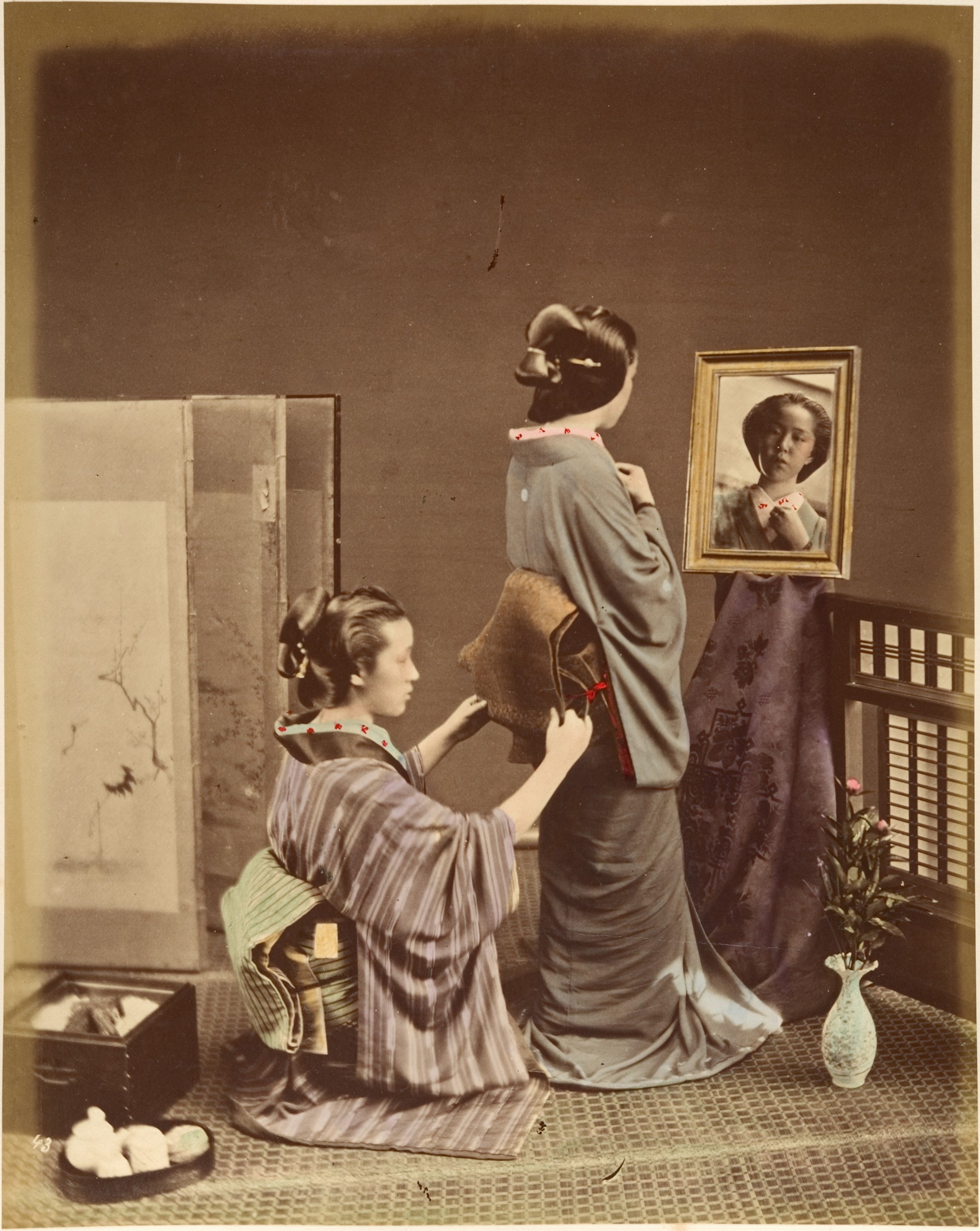
Two Japanese Women in Traditional Dress by Shinichi Suzuki
Two Japanese Women in Traditional Dress, by Shinichi Suzuki, 1870s, MET Digital Collection

While not everyone is thrilled about their favourite artworks being readily available for anyone to download, this digital trend will essentially ensure that high quality images of artworks are circulated on the internet. In doing so, these nearly flawless images will maintain the integrity of the original artwork and assert their association with the museum in which they are housed. Furthermore, each image is embedded with appropriate metadata thus optimizing search engine capabilities. This will ultimately rank them higher in Google searches than low quality renditions of artworks that currently crowd image searches.

The Unicorn is Found (from the Unicorn Tapestries)
The Unicorn is Found (from the Unicorn Tapestries), artist unknown, 1495–1505, MET Digital Collection

So what are the implications of digital museum collections? The most common argument amongst museum scholars is that digital replicas of artworks devalue the original and ultimately threaten its authenticity. Digitization more or less removes objects from their museum context and distances them from their physicality and the “essence” of the original. While this can definitely have some negative effects, digital replicas can offer a new lens in which objects can be examined. The public can now experience more intimate encounters with artworks as digital technologies tap into other human senses, such as light and touch. Imagine how engaging it would be to zoom into an artwork using your fingers on the surface of iPad or a tablet? As I have argued in my essays, digital replicas were not created as a replacement of original artworks, rather they act as supplementary devices that augment public experience—if users so choose. 

Bahram Gur Sees a Herd of Deer Mesmerized by Dilaram' s Music attributed to Miskin
Bahram Gur Sees a Herd of Deer Mesmerized by Dilaram' s Music, Folio from a Khamsa (Quintet) of Amir Khusrau Dihlavi, attributed to Miskin, 1597–98, MET Digital Collections

Do you believe digital technology should be prominently utilized in museum operations? What do you think are the positive and/or negative effects of the digitization of artworks. Please share your thoughts in the comments section.