Showing posts with label Costumes. Show all posts

15 April 2021

DRESSING FOR THE PAST: AN INTERVIEW WITH DR. CAROLYN DOWDELL

 Sew What | Natalie Scola


Natalie Scola: Hi Carolyn, it is so wonderful to have the chance to speak with you and thank you for taking the time to meet with me.

Carolyn Dowell: No problem at all, I am excited to be here!

NS: So my first question is how did you become interested in historical dress?

CD: It was probably in a very Canadian way! When I was a little girl, the CBC version of Anne of Green Gables came out and I was reading the books at the same time. I’m an Anne girl and the costumes in that were really good – you watch it today and they still look really good. You can see little of the fluffy 80’s hairstyles and all that in it, but for the most part it was really well done and I was absolutely enamoured of the costumes in that production. I just loved period movies and stuff ever since then. That kind of sparked the initial interest. I didn’t follow that path right away, my undergrad was in visual art. I ended up taking all the costume courses in the theatre department at my school, so by the time I finished my undergrad I thought I was going to go into costume design. But then I was exposed to the Pattern of Fashions books by Janet Arnold, and I discovered that I was really into actual historical clothing and how it was made and learning more about it - and that drove me towards my graduate studies in actual dress history. So it started nascently really early but it took quite a bit of time to develop into what it would become.

NS: When did you start making your own historical costumes? Did it come from those theatre courses?

CD: A little bit, it was a little bit the other way around, they started very close to each other but I started sewing when I was I think 17, I started making clothes for myself and I make pretty well all my own clothes still. So I started with that but I already knew I loved period movies and costumes so I pretty quickly started dabbling in that. And it was around about the same time that I was taking the costuming courses in the theatre department and so that was when I started to learn about drafting, and I made my first corset and started learning theatre versions of period techniques and I kind of just kept going with it. It was still very movie oriented, I would make costumes based on movies and TV shows that I saw. And so I was gradually realizing that I was interested in these original garments more and more. An exhibition I saw that made a really big impression on me was the Dangerous Liaisons exhibition [at the MET], that just completely sucked me in, especially because it was 18th century. Even though Anne of Green Gables was the first, I really developed a love for the 18th century and that exhibition blew me out of the water. There was so much that was really great about that exhibition. It had a really strong impression on me because it was about a year after that I moved out west to go to the University of Alberta to start my masters. As part of my degree, I did a large scale 18th century reproduction project. I was learning 18th century sewing while I was doing it and already started doing object based research for my masters. I made clothing that was from the years 1750 to 1775-ish. There was a set of foundation garments, a robe a la francaise, a robe a la anglais, a riding habit, a matching calico jacket and petticoat, a pet-en-l’air and a quilted petticoat. I put that on exhibition at University of Alberta, they have a small exhibition space in the department that I was in. It was all about the making of and showing the fashion and it was about how they were made and what it was like to be like a dressmaker or mantua maker at that time.
French dress, 1775, Costume Institute at the Met | Source


NS: When you’re making all these costumes, what does the research process look like? Do you start with sourcing material or looking for inspiration first, or do you look at the references first?

CD: Yes, all kind of at the same time! No two projects happen exactly the same way, it's kind of inorganic process. I have a ton of Pinterest boards constantly looking for new images visual sources on Pinterest. I have lots of books, like my patterns of fashion books are one of the most used sources for both styles and then how to visualize making them and what the pattern pieces should look like things. But also various types of books like from the Kyoto Costume Institute and then books of fashion plates. Mostly I do use images of extant garments and images of fashion plates, I do tend to use those more than portraiture; I mean there's definitely things that you can sometimes get from portraiture that you can't get from those other sources. Usually what ends up happening too is I almost never directly reproduce something. It's usually a combination of a few different inspirations because a lot of the times I'll see something and think “oh I really love this except I don't like this about it” or “I really love this but is there some way that I can modify this that is a way that they still would have done.” I do a lot of "franken-patterning" where I'll take patterns from different sources and squish them together.

NS: I can't read patterns at all, I have very basic sewing skills but I still have all the Janet Arnold books. I just can't truly read them so every time I see someone put a pattern together I think it’s the coolest thing ever – like how can you even read that!

CD: I mean you actually do sewing the more you understand patterns, and I was kind of thrown into the deep end with it too. My first sewing project was a dress, like every day dress for myself. But it had like a fitted bodice with darts, it had gathered skirt, it had pockets, it had a zipper and a lace up back, it really had every component possible. It was the biggest hot mess on the inside, it was atrocious! I remember there was somebody once who asked if they could borrow it and I said “no I'm not going to lend it to you just in case it falls apart”. I really wish now that I had kept it because it would be amazing to show what I started with. I started with something complicated and most people don't - for most people it's a good idea not to start with something complicated because you can easily get discouraged. But for myself it was the right thing, so having a challenging project as my first one even though was it was such a mess and perhaps only barely wearable, I was still so proud of myself.

NS: That leads really well into my next question which is: what is your favourite piece of clothing to make?

CD: I like making so many different things it's easier to say what I don't like making! I don't like making pants! My favourite things to make are probably 18th century gowns. After I did that reproduction project is part of my masters I didn't want to do 18th century again for a while because was six full months sewing eight to twelve hours a day, but now it's probably my favorite. 18th century fashion is probably my deepest love and it's why I did two graduate degrees on that. It ended up becoming kind of like my comfort sewing; I understand 18th century sewing so well that it's so easy for me to go into and do it. I really do enjoy hand sewing, I find it very relaxing - you can kind of do it anywhere, you can do it while you're watching TV and stuff which you can't really do with the machine. I find it visually and aesthetically really appealing and I really like the particular process of construction of 18th century gowns. There's that element of feeling like you're communing with historical dressmakers, particularly when you're doing hand sewing projects because it is so particularly physical and kind of visceral as opposed to when you're using a machine. Now that I feel really comfortable with it, it doesn't take as long as when I first started doing it. Like that project that I did as part of my masters I could probably do that in noticeably less time.

NS: 18th century fashion is so interesting because the fashion changes so much from the beginning to the end of the century.

CD: There's a lot of variety! When you get to know it well, you read more you start to see more in it, so I really enjoyed exploring the variety that is in the 18th century. I need to do some more from the first third of the century, I’m focusing a lot towards the end. I did a like a 1690s mantua and that was a really interesting exploration of dress.

NS: With all these outfits that you’ve made, what was the most challenging project you’ve worked on?

CD: Well actually it's one that I wouldn't really call historical more vintage. The most challenging project I think is when I reproduced Charles James' tree gown. The only reason that I was able to do it is because when I was back in London in 2012-2013 to do research for my PhD, the new assistant curator at the Museum of London was Timothy Long. He had come from the Chicago History Museum and did the Charles James exhibition there and he had taken patterns from of the foundation layers of several of James’ gowns. They had done reproductions of the foundation layers to display alongside the gowns to show what was underneath and the structure of the gown. He sent me pattern pieces for the foundation layers of the tree gown and so the next year I made my own. It was it was an amazing learning experience. I can say that it is a standing dress! I made it to go to the 2014 Toronto Officers' Garrison, my husband and I have gone several times; I love to go because it gives me an excuse to make a ballgown. It definitely made an impact that year I was there but it was it was the worst to wear it. There's a dinner that's part of the ball and the skirt of this dress just did not fit under the table! And there is an element of the under structure almost sort of like cones or buttresses that are right behind your thighs to give shape at the back and it's right where you want to sit! So my dress doesn't really fit under the table and I'm having to sit at the edge of my chair, it wasn't fun to wear. But I really love looking at it on the mannequin as a decorative dress now!

NS: Obviously you love dress history a lot, you've done two degrees in it. So why do you think that the study of dress history is important?

CD: There are a bunch of reasons. It is something you know people really do respond to. Dress is something that all human beings have in common; even if you're not in a culture that wears what we would call clothing you still practice some form of dress. Every single human being on the planet is connected by dress - we are connected to it and we are impacted by it literally from the moment we're born to death. It's our most intimate environment, it's what is literally next to our skins and it's sort of like our second skin or public skin. Dress has been so important to other aspects of history and society and culture. It’s the reason why the Industrial Revolution happened. Textiles have been the foundations of numerous countries’ economies in past centuries and it's what civilizations and empires were built on. Dress touches every single facet of life and it factors in so much to knowing who we were, which tells us who we are, which helps inform us about where we're going.

NS: That's great, I think that's a really great answer! Thank you so much for your time, you have provided such a great look into the world of historical costuming.

11 December 2015

3 PERIOD FILMS (AND 1 AMAZING TV SHOW) THAT USE COSTUME TO GIVE A SENSE OF HISTORY

SEW WHAT?

BY: ANYA BAKER

This is not going to be about Jane Austen adaptations. There are already numerous whole blog posts about why the 2005 Pride and Prejudice adaptation is a stain on costuming history.

(I disagree, but only because director Joe Wright demanded more flattering waistlines than period-appropriate empire waists, and if I were in a movie I would want my costumes to look supremely flattering, too. Fight me, 1995 BBC adaptation purists!)

Like all institutions involved in history, the film industry has to wrangle with balancing a budget, the attention span and tastes of its audience, and the ideal of an authentic pseudo-historical experience. This ideal applies more to historic houses than to science centres and art galleries, but the yearning for a connection with the past is found in almost any institution. In a museum setting, the municipal government may grouse if you start slapping the wrong colour of paint on a historic house--if you are a costume designer and you cut the wrong corners during film production you might end up skewered in a national newspaper because you put a dress with a zipper on a 15th-century queen.

I'm not fussy when it comes to accuracy in costuming; mostly, because I sympathize with being too broke to spring for the real deal, and because people who are unused to being shaped by period corsetry and foundation garments do not tend to look authentic in them. Often, accurately representing an era or a look ends up being a lot more effective than accurately reproducing it. Making an audience feel like a costume has been born out of its environment is what convinces them that the experience of the film is authentic. Some movies make my heart go pit-a-pat with their costuming choices, and these three recent movies engage so successfully with historic storytelling through costuming that I need to share them:

The Dressmaker (2015)
Image credit: Universal Pictures
My new favourite blog Clothes on Film recently did a feature on Margot Wilson and Marion Boyce, the costume designers for the new film about a 1950s dressmaker who returns to small-town Australia after working in Paris and Milan under the likes of Madame Vionnet and Cristóbal Balenciaga.

The character's role as a dressmaker, not a designer, is taken into account--her clothes therefore strongly, and expertly, reference the lead designers of the day. Key costume pieces clearly tie to a huge moment in fashion history: Christian Dior's New Look (plus the incredible fabrics made in the early part of the 20th century and and the glamorous colour palette of mid-century haute couture). Wilson mentions that securing real vintage for films is becoming difficult, because nobody fits in to pieces designed for average 1950s measurements. Even authentic-looking reproductions are difficult to create with modern fabrics. But the story of Kate Winslet's onscreen wardrobe, and its integration into the character's role as a dressmaker, is what creates the feeling of authenticity.

Costumes are displayed in a special exhibition.

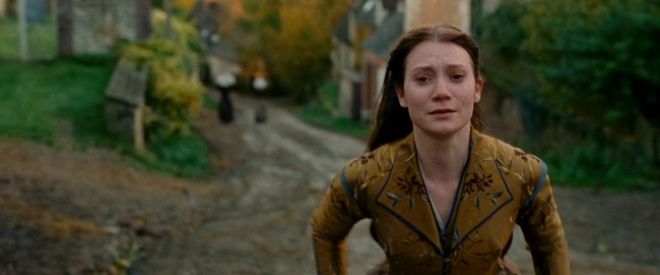
Madame Bovary (2014)
Image credit: A Company Filmproduktiongesellschaft.
Christina Gasc and Valeri Ranchoux's costumes for Madame Bovary are probably the best thing about the film. They took their job of creating the most exquisite Parisian fashions a naïve 19th-century woman could buy on bad credit very seriously.

Mia Wasikowski's character stands out in her environment, but it is the stifling provincial town that generates her creative interest in the beautiful clothing imaginable. As a respectable middle-class woman, creation is outside of her prescribed abilities, so she turns to the next best avenue: patronage of the arts. It is the sort of lifestyle decision often warned against in 19th-century novels, of the rising middle class trying too hard to take on the airs of the upper class with newfound wealth--or the promise of it, in investment schemes or credit. It's also very familiar to contemporary audiences, who recognize the yearning for something a little grander and chic than what everybody else is wearing.

Bright Star (2009)
Image credit: Pathé Renn Productions.
Janet Patterson was costume designer and production designer for my favourite literary movie: the John Keats biopic Bright Star. 

In an interview with W Magazine, Patterson explains how costuming Abbie Cornish's seamstress character in the film exemplified the daring spirit of young women of any time period to experiment wildly with style. Cornish's costumes are sometimes a little weird, but they reflect a sense of reality in being so overtly curated. She may look a little out-of-place and overly done-up even by 19th-century standards, but so do contemporary fashion bloggers like the Man Repeller. To be on the cutting edge is to stand apart; it's a notion that transcends time periods and gives a sense of relatable authenticity to this Regency seamstress.

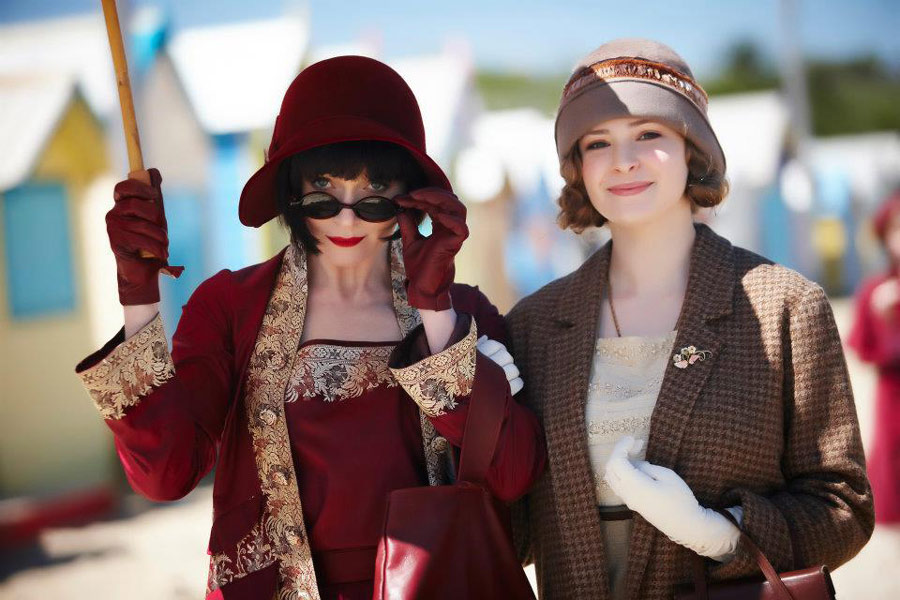
Miss Fisher's Murder Mysteries (2012-present)
Image credit: Every Cloud Productions.
If I could have any movie wardrobe as my own, I would want the clothes costume designer Marion Boyce has assembled for Essie Davis in Miss Fisher's Murder Mysteries. In an interview with Vanity Fair, Boyce describes the challenges of costuming a 1920s show: real vintage is too small, an "action hero" like Davis' character needs a lot of hardy multiples during shooting, and the shiny fabrics of real 1920s vintage have dulled and gone funky after nearly 100 years.

Boyce also incorporated 1920s sewing techniques into reproducing clothing: narrower rolls of cloth and a disuse of darts meant that clothing in the 1920s was often sewn from panels. Many costumes are outrageous and colourful, matching the personality of Davis' character; it is everything the audience expects from the Roaring Twenties, but also makes nods towards Boyce's research. The audience ends up delighting in how the maverick Miss Fisher manages to get away with wearing so many pantsuits.

Costumes are displayed in a special exhibition.

Costume designers who I love but did not get to write about: Sandy Powell, Jacqueline Durran (of 2005 Pride and Prejudice fame!), Eiko Ishioka, and Kate Hawley. 

23 January 2015

FUTURE-FASHION PREDICTIONS SAY AS MUCH ABOUT THE PRESENT AS THEY DO THE FUTURE

SEW WHAT?

BY: ANYA BAKER

It’s 2015. We’re living in the future predicted by Back to the Future II--only we were promised a lot more neon fabric and translucent plastic accessories (and hoverboards).

Four people in outlandish clothes stand outdoors.
Credit: Universal Pictures.
Two children in bright clothing stand beside a gaming machine.
Credit: Universal Pictures.

The costume department wasn’t too far off, though. The basic cuts, silhouettes, and embellishments favoured by the film are currently being purloined for contemporary fashion--even at fast fashion stores like H&M and Forever 21. The thing of it is, though, that the clothing is not being described as future-fashion, or a bold new look for 2015. What people in 1989 thought that ordinary people might wear in 2015 is what people in 2015 think that ordinary people in 1989 might have worn. We’re not wearing lucite headbands yet, but it’s considered an homage to the 80s to be wearing high-waisted denim and big slouchy sweaters right now. Current designers are quite happy to take what was popular anywhere from 20 to 100 years ago and give it a contemporary spin. Similarly, the designers for Back to the Future II, when faced with predicting what style might be 20 years down the road, decided that people would probably dress about the same, only weirder. Other film costumers did the same: we’re only a five years away from seeing if Blade Runner’s prediction for the return of very aggressive 80s shoulder pads is accurate (they're already returning to high fashion). 
 
Polaroid photo of a young woman against a neutral backdrop.
Credit: Sean Young.

Obviously, Back the Future II and Blade Runner are not controlling the fashion industry, and though their existence and continued popularity certainly fuels runway homages and 80s nostalgia, current designers are probably not intent on fulfilling 20-year-old predictions from sci-fi movies in their Spring collections. But future-fashion, when held up against the endless cycle of influence and recycled trends, starts to look less like a bold vision of what is to come, and more like a distillation and exaggeration of whatever is current. People can only predict based on what they already know; people can only create based on what they know. Even current designers, exhibiting Fall trends months in advance of Fall, are doing their own small-scale future-fashion predictions. 

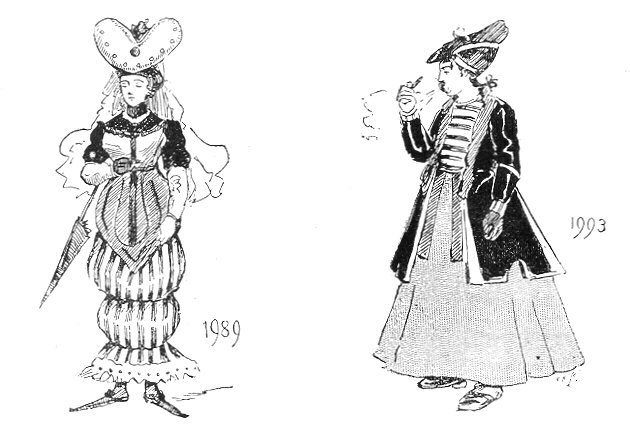
The expectation that future people will wear slightly distorted versions of whatever is in our own wardrobes is not a new idea. I started to think about future-fashion when I stumbled across an online version of a satirical article for The Strand Magazine by W. Cade Gall, published originally in 1893, called the “Future Dictates of Fashion.” 

Drawing of two women in long dresses and wild hats.
Credit: W. Cade Gall.

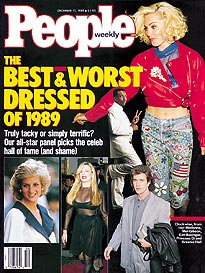
The year 2015 falls outside of its predictions; the last drawing is for 1993. But we do get a great get-up for 1989, the year both Back the Future II and Blade Runner were released. With more than 100 years between Gall and 1989, he couldn't know that it would look like this:

Magazine cover from 1989 showing photos of men and women in contemporary styles.
Credit: People Magazine.

The weird hat (future-fashion seems to expect a lot of strange head-gear) is also a little far removed from fashion in Gall's time, but the 1989 outfit is very much a satirized and exaggerated version of a woman's dress in 1893. Moreover, even though he didn't guess that everyone would be wearing jeans, he did predict Gunne Sax and the 1960s-80s fascination with faux-Victorian and faux-Edwardian clothing.

So, what does the future hold for us in terms of fashion? More importantly, what should we save in the backs our closets in order to preserve the essence of 2015 style? 

Photo of three people standing in a large crowd, wearing formal attire.
Credit: Warner Bros.

From the upcoming film Jupiter Ascending, we have more strange headgear predicted for the future, lots of colourful fabrics, and the see-through, beaded formal dresses that have been everywhere on the runway in the past few years.

Three people and one tree being standing in front of a circular doorway.
Credit: Marvel.

And from Guardians of the Galaxy (itself an homage to the 1980s), we have leather. In 20 years or so we can browse through the stores and see what we got it right, and if our 2015 beaded dresses and leather jackets will be in textile museums as examples of original 2015 style.


31 October 2014

IT'S HALLOWEEN--IS YOUR COSTUME AUTHENTIC?

SEW WHAT?

BY: ANYA BAKER

I'm tickled to be writing on a holiday so geared towards my interest in textiles. On a day dedicated to dressing up as something other than yourself, it's time to take a look at an issue at the heart of costuming: authenticity.

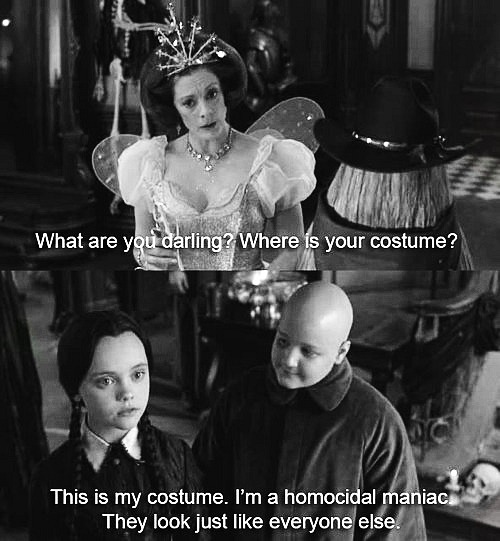
Black and white photographs with text of a woman in a sparkly dress and two children in sober, dark clothing.
Credit: The Addams Family (1991); image.

The joke is that Wednesday Addams really has dressed up as herself--she is a homicidal maniac! Hers is a startlingly authentic costume, to the point where it can hardly be called a costume. It begs the question: what is authentic dress, and how does it differ from an authentic costume? Ideally, authentic dress would be a natural representation of a person's aesthetic likes and intentions. This is obviously complicated by ever-changing trends and economic limitations. An authentic costume would ideally be a true representation of a character. But, it is impossible to authentically be someone else--you can only authentically be yourself. If Wednesday had dressed up as me, and declared the same costume, would she be dressed authentically? If I dressed up as Wednesday and declared the same costume, am I dressed authentically? In both cases, it's an uneasy "no"--the costume becomes a reference to me, in the former case, or to Wednesday, in the latter. In either case, she and I are not authentically "everyone else" or the other person. We remain ourselves, referencing another person. The costume only works if you dress as yourself--and then it's not a costume!

We can turn to another space for costuming, where it's appropriate to blur the line between who you are and who you're dressed as--the theatre. I recently came across a conservation success story that's a couple years old: that of the famous Beetle Dress created in 1888 for Ellen Terry's run as Lady Macbeth. You might recognize it from the 1889 portrait John Singer Sargent painted of Terry in-costume and in-character.

Painting of a women with long, red hair holding a crown above her head; she is dressed in a brilliant emerald gown in a medieval style.
Credit: John Singer Sargent (1889);  Tate Gallery

The dress is now displayed in Smallhythe Place. Whether it is authentic or not is a delightfully messy story.

Prior to conservation the dress had been amalgamated with another, similar dress as a means of repairing or altering it; conservators returned the dress to its original form by taking the whole thing apart and reassembling what they consider to be the real dress, using photographs and the Sargent portrait as a guide. They also extensively repaired the intricately crocheted fabric and beadwork (done entirely with beetle wings!) to make the dress look as close as possible to what it was when Terry wore it as Lady Macbeth. Terry was a superstar of her time; she is as much a part of the costume as the character.

But Sargent himself bends the perception of authenticity--even though the portrait is inextricably linked to that particular run of the play, Sargent made up a more dramatic pose for Terry. Now the dress is displayed in that pose--is this appropriate? Is it more authentic as a relic of the portrait, the actress, or of the play? And remember, the creator of the play and the character of Lady Macbeth, William Shakespeare, was dead and gone long before 1889. Is the portrait then even authentic, if the Sargent painting is the 19th-century equivalent of a Marvel fan posting Captain America fan-art on tumblr?

Collection of colour photographs of a green gown in a medieval style; some show various pieces of the gown from various angles.
Credit: Smallhythe Place/Zenkie Tinker

As a textile and object of study, the dress has been stripped of the information and value that it had accumulated about 19th-century costuming practices. Its many alterations pointed to the costume being an object of use; its authenticity was tied to its history of exhibition on the stage, and its 'patina' of degradation. In its restored state, it is now technically inauthentic. It is no longer what it was, as its category has changed.

For, now, in its new category as a culturally-significant object of experience, the dress is wildly authentic. It has been restored to the spectacular showpiece that it was in its day. To view it is to experience history from the outlook of your own personal time machine. The display forces the viewer to reckon with the accumulated cultural heritage referenced by the object itself, its pose, its former wearer, and the research and workmanship that went into restoring it. It brings the viewer into an associative space--the experience is, at least, authentic.

Fashion often teeters on the line between creating objects of use and showpieces; how useful, really, are stilettos or palazzo pants? That particularly evocative pieces often end up in museums as culturally-significant objects, removed from usefulness and aimed at creating an association with the zeitgeist of a particular moment, makes it very clear that ordinary clothes and costumes are not much different. Your hip new outfit could be the costume of tomorrow! When future generations of children dress up as hipsters for Halloween, just as current generations dress up as hippies and ad men from Mad Men and flappers, remember the zeitgeist of our time and consider if you authentically embodied this cultural moment in your dress. Don't let it change your wardrobe now though--wouldn't want to be inauthentic!

Anyway, I was originally going to write this post about creepy mid-century children and their terrifying Halloween costumes, so here's a photo to keep you looking over your shoulder all night:

A man and a woman stand outdoors, both wearing large animal masks.
Credit: SickChirpse
Happy Halloween!

Sources:
Smallhythe Place
The Guardian
eCouterre