Showing posts with label Film. Show all posts

13 June 2016

ARCHITECTURAL HERITAGE AS CINEMATIC HERO AND VILLAIN

HERITAGE MOMENTS

BY: JOCELYN KENT

While summer blockbusters have a tendency to obliterate architectural landmarks with high explosives, it seems to like a good time to reflect on the more constructive ways architecture has shaped cinematic story telling.

Heritage buildings are regularly used for television and movie sets because they easily create a sense of time, place and atmosphere that is costly to achieve in studio.

But, architectural heritage doesn't have to be just backdrop, or even a real place. It can become a character or plot point unto itself. In today's Heritage Moments, we take a look at films in which built heritage or its preservation has played into the storyline, whether for good or ill.

Beware, spoilers ahead!

THE GOOD

1. BACK TO THE FUTURE (1985)

The Hill Valley clock tower plays a pivotal role in the film’s climax when it's struck by lightning, providing the enough electricity to send Marty McFly and his time-traveling DeLorean back to 1985.
The power of 1.21 gigawatts! Source.
But, as Doc points out, one can never predict when or where lightning will strike. So how do they figure it out, and ultimately prevent Marty from being stuck in the past?

It all comes down to the advocacy of the Hill Valley Preservation Society.

#Clockblocked. Source.

In the beginning of the film, when Marty is still safe and sound in 1985, a local heritage activist confronts him for a donation to help protect the clock (fused solid since the lightning strike) from being replaced by city council.

Heritage campaigns can be so gruelling. Source. 
Her “Save the Clock Tower” flyer - which travels back to 1955 in Marty’s pocket - provides Marty and Doc with the crucial information about the timing of the lightning strike they need to know to get Marty back to the future.

2. NANCY DREW (2007)

When teen super detective Nancy Drew moves to Los Angeles with her father, she arranges to move into a Hollywood mansion connected to the unsolved murder of a famous starlet, to keep herself occupied.
Sleuthing in progress. Source.
Nancy’s love of the past is the key to her success, giving her insights others lack. Her knowledge of classic West Coast architecture in particular helps her snoop around unseen, escape kidnappers, and uncover hidden passageways at several points in the film.

Nancy isn't particularly surprised to find a secret door in her bedroom closet either. Source.
Somehow she manages to do it all without getting her tasteful penny loafers and vintage beige capri pant suit dirty.

One part Girl Guide, one part Batman. Source.
Her love of architecture also adds to her know-it-all credentials.

Did I mention that she likes architecture? Source.

3. THE GRAND BUDAPEST HOTEL (2014)

A zany celebration of nostalgia and Old World charm. The Grand Budapest Hotel presents two, nested frame narratives, as a famous novelist describes his meeting Zero Mustafa - the elderly owner of the Grand Budapest Hotel - in 1968, who in turn describes how he came to work there thirty-five years before.
The Grand Budapest in its prime; looks good enough to eat. Source.
Despite the hotel's prestigious past, it is shown to have fallen into disrepair following the violence and upheavals of the mid-20th century. Now only a shadow of its former self, Zero struggles to maintain the hotel, stating that it is his last reminder of his happier youth.

The lobby in the 1932, its glory days. Source.
The lobby in the 1968, much diminished. Source.
The Grand Budapest Hotel is itself a character in the story. Much like the head concierge, Monsieur Gustave, the hotel is portrayed as charming, professional, esteemed, and endearing to those who know it, a symbol of a bygone age. Much like Zero, it suffers the passage of time as well.
"Very good." Source.

THE BAD

4. THE SHINING (1980)

The evil twin of The Grand Budapest Hotel, The Shining chronicles the Torrance family’s term as winter caretakers of the remote Overlook Hotel in the Colorado Rockies.

The Timberline Lodge, used for exterior shots. Rustic Cascadian architecture in all its horror. Source.
Snowed-in for the season with his wife and son, Jack Torrance is slowly driven insane by the cavernous and storied hotel – a Progressive Era artifact. Whether his breakdown is purely cabin fever or driven by the ghosts of the Overlook's past is never made clear.

No one likes to drink alone. Source.
The Overlook itself is attributed a malevolent personality, one continually reinforced by the lonely and disconcerting interiors.

At least the wood flooring doesn't creak. Source.
Director Stanley Kubrick famously had the entire Overlook set built in studio rather than using an existing hotel, so that he could add strange doors, foreshortened walls, and bizarre transitions between rooms, to enhance the confusing atmosphere. He even hired the inventor of the Steadicam, Garrett Brown, to help him film smooth transitions from room to room.
Vroom vroom! Source.

5. HOT FUZZ (2007)


Although initially suspecting a financial motivation for a series of murders in the sleepy village of Sandford, Sergeant Nick Angel discovers that a fanatical civic association – the Neighborhood Watch Alliance (NWA) – is behind the crimes. Its goal: to ensure that Sanford wins the Village of the Year award by killing problematic residents.

They also killed Eve Draper for her annoying laugh and Tim Messenger for his typos. Source.
Beyond the NWA’s zealous pursuit of aesthetic consistency and the restoration of the church roof, the architectural theme of Hot Fuzz is reinforced by the frequent appearance of miniature buildings – a play on Sandford’s desire to been seen as a “model village.”

Those crenellations look sharp! Source.
This culminates in a Godzilla-esque clash between Sgt. Angel and the NWA.

"You want to be a big cop in a small town? Head up to the model village." Source.

YOUR TURN: 
Do you have a favourite film or television episode that would fit within this list? Share it below in the comments.

23 May 2016

LOST IN THEIR OWN MUSEUM: PART 1

MUSEUM MYSTERIES

BY: CHRISTOPHER WAI 

Dr. Henry Jones Jr. and Curator Marcus Brody, Source: Raiders of the Lost Ark (1981)
On Marcus Brody, "Curator of the National Museum" 
“'He's got a two day head start on you, which is more than he needs. Brody's got friends in every town and village from here to the Sudan, he speaks a dozen languages, knows every local custom, he'll blend in, disappear, you'll never see him again. With any luck, he's got the grail already.'

[LATER] 
'But you said he had a two day head start. That he would blend in, disappear.' 
'Are you kidding? I made all that up. You know Marcus. He once got lost in his own museum.'” 
Indiana Jones and the Last Crusade (1989)

What museums, archives or universities hold in their modest, grand or frequently cramped quarters is often a mystery. To the public there is the allure and frustration of only being able to see a portion of the museums entire collection at any one time.

But this holds true for professionals too. After all, there are many museums out there and many collections and for all the catalogues available online for the British Museum or the Met, there are many that simply don’t have the resources for it.

Sometimes an artifact gets misfiled or lost in the maze. Maybe the handwriting is just too illegible. Documentation gets lost. People retire and the accumulation of decades of knowledge isn’t passed down. Contracts end and turnovers with seasonal staffing can lead to inconsistencies. Subject expertise and proper conservation is also not always available. Values and priorities change. Perhaps they were even acquired by questionable means many decades ago. Perhaps a war or disaster meant a hasty transfer of collections.

The allure of new discoveries is important, but for all that and the romanticism attached, there is a lot to be said about the assemblage we already have. 

Here are five notable ones:

1. Ramesses I in Niagara Falls- Niagara Falls Museum and Dare Devil Hall of Fame (1827-1999)
Statue Head of Paramessu (Ramesses I), Boston Museum of Fine Arts Source.
At around 1860, James Douglas Jr. sold a mummy to the Niagara Falls Museum and Daredevil Hall of Fame for a grand total of 7 pounds (about 767.74 pounds in 2015).

This mummy then became one amongst a number of other mummies as curio attractions that at one point in the mid to late 1990s was advertised as being a part of “Over 700 000 Authentic Artifacts”. Said "artifacts" included a two headed calf, and a “Japanese Warrior" (in the Gallery G's “Oriental Curios”). 

Reminder: this is from the mid to late 1990s... Source

When the museum closed in 1999 after a few relocations of the museum and at least one involving a dump truck, it was acquired by the Michael C. Carlos Museum at Emory University.

Based on X-rays, and CT scans and comparisons with other New Kingdom burial practices and resemblances to Seti I and Ramesses the II, it's strongly suggested that this was mummy was most likely Ramesses I.
Reconstruction of Ramesses I Source: Emory University
In 2003, 143 years since he was bought by the Niagara Falls Museum and even longer since it's possible looting from a group of royal mummies at Deir el-Baihri, Ramesses I was returned to Egypt.


2. Fritz Lang and Thea von Harbou's’s Metropolis (1927)- Museo del Cine

Metropolis (1927)
Metropolis is a major piece of film history that still affects our culture today (i.e. music, movies, fashion, etc.), most notably, in the popular consciousness through Star Wars' C3PO and a fair number of its themes in subtle ways. 

C3PO Source
Left: Lady Gaga. Right: Metropolis Source  
Thematically, it covers a lot of the core elements of science fiction and dystopian fiction, from the dominance of corporations, socioeconomic inequality, messianic themes, robots posing as people and giant cityscapes with aircraft flying through. 


It says a lot about this film when a near complete print of the original film was only reconstructed in 2010. Reconstructions have been attempted through the decades, but in 2008, the longest single print was found in the Museo del Cine in Buenos Aires.

3. Skeleton from Ur- Penn Museum
Source: Penn Museum
In 1929, Leonard Woolley's excavation team at Ur discovered a set of 48 Ubaid period graves but recovered only one of them from this specific level. The body was preserved relatively intact by block-lifting it: the body and part of the surrounding soil was coated in wax before being removed as a single piece from the ground.

Along with the other finds at Ur, the collection was divided between Iraq, Philadelphia and London.

In 2014, during the Penn Museum's effort to digitize its collection, William Hafford found that one of two skeletons brought to Philadelphia were missing.
Penn Museum records. Source
Thankfully, the curator, Janet Monge, remembered that there was an undocumented skeleton in a box at the museum and managed to match it with Woolley's description. Despite Ur and Woolley's reputation, even the most famous site can risk losing parts of the collection if they are blindsided by the more well known finds.

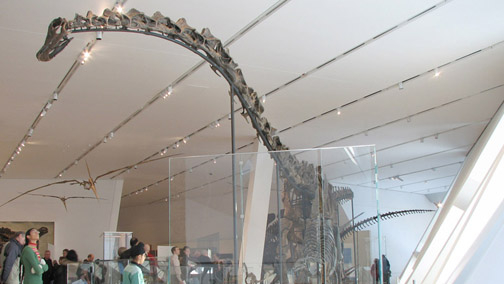
4. Gordo The Barosaurus- Royal Ontario Museum
Gordo. Source: ROM
If you've ever walked through the dinosaur galleries in the Michael Lee-Chin Crystal galleries then you've probably already met Gordo, even if you didn't realize it. But that seems to be its lot in life.

Found a little over a century ago in Utah amongst a number of other rare Barosaurus specimens, Gordo was transferred to the ROM in 1962 from the Carnegie Museum of Natural History.. During this time, it was misclassified as a different dinosaur, a Diplodocus.

In 2007, curator David Evans set off to add a sauropod specimen to the revamped Crystal gallery and it was only in Wyoming when he found a reference to Gordo from paleontologist Jack McIntosh that correctly identified it as a Barosaurus.

And at last, after 45 years and 8 weeks of reconstruction work, Gordo was finally on display at the ROM.

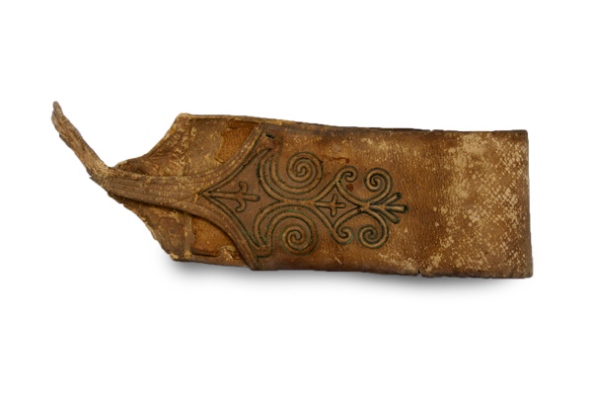
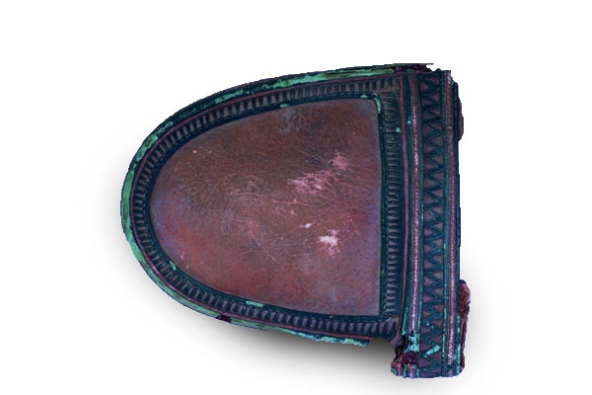
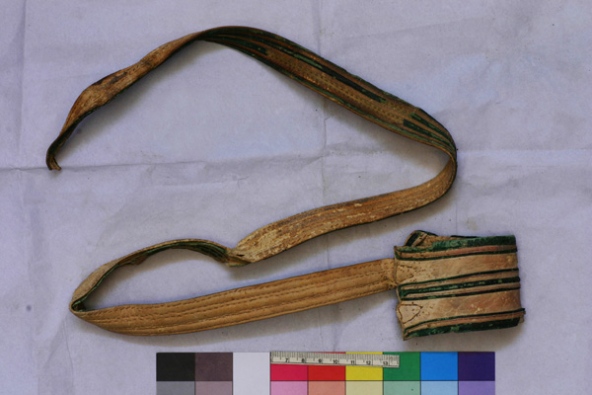
5. Leather Chariot Trappings –Cairo Museum
Organics don’t generally survive very well, especially after a few thousand years without careful conservation, but miracles do happen.

Hip Strap: Source
In 2007, Dutch archaeologist Andre Veldmeijer came a cross a set images of surviving chariot trappings in a 1957 text during his research into ancient leatherwork, but initially came up empty when he asked the Egyptian Museum about them. Thankfully. Ibrahim El Gawad, the curator of the Egyptian Museum managed to find the set in the back room drawers of the museum by accident. 
Bottom of a quiver. Source

They have since been the subject of a research study on Egyptian chariots in collaboration with Egyptologist Salima Ikram. 
Horse Harness. Source
Unfortunately, there is another problem. While the “provenance” (the history of ownership) goes back to a 1932 transaction from a Greek dealer by the name of Georges Tanos, the archaeological “provenience” (with the “i”) is unknown. Its relationship with a site, region, and associated objects or burials are all still severed. 
Gauntlet. Source
In 2012, the First International Chariot Conference was held in Cairo.


To be continued…

11 December 2015

3 PERIOD FILMS (AND 1 AMAZING TV SHOW) THAT USE COSTUME TO GIVE A SENSE OF HISTORY

SEW WHAT?

BY: ANYA BAKER

This is not going to be about Jane Austen adaptations. There are already numerous whole blog posts about why the 2005 Pride and Prejudice adaptation is a stain on costuming history.

(I disagree, but only because director Joe Wright demanded more flattering waistlines than period-appropriate empire waists, and if I were in a movie I would want my costumes to look supremely flattering, too. Fight me, 1995 BBC adaptation purists!)

Like all institutions involved in history, the film industry has to wrangle with balancing a budget, the attention span and tastes of its audience, and the ideal of an authentic pseudo-historical experience. This ideal applies more to historic houses than to science centres and art galleries, but the yearning for a connection with the past is found in almost any institution. In a museum setting, the municipal government may grouse if you start slapping the wrong colour of paint on a historic house--if you are a costume designer and you cut the wrong corners during film production you might end up skewered in a national newspaper because you put a dress with a zipper on a 15th-century queen.

I'm not fussy when it comes to accuracy in costuming; mostly, because I sympathize with being too broke to spring for the real deal, and because people who are unused to being shaped by period corsetry and foundation garments do not tend to look authentic in them. Often, accurately representing an era or a look ends up being a lot more effective than accurately reproducing it. Making an audience feel like a costume has been born out of its environment is what convinces them that the experience of the film is authentic. Some movies make my heart go pit-a-pat with their costuming choices, and these three recent movies engage so successfully with historic storytelling through costuming that I need to share them:

The Dressmaker (2015)
Image credit: Universal Pictures
My new favourite blog Clothes on Film recently did a feature on Margot Wilson and Marion Boyce, the costume designers for the new film about a 1950s dressmaker who returns to small-town Australia after working in Paris and Milan under the likes of Madame Vionnet and Cristóbal Balenciaga.

The character's role as a dressmaker, not a designer, is taken into account--her clothes therefore strongly, and expertly, reference the lead designers of the day. Key costume pieces clearly tie to a huge moment in fashion history: Christian Dior's New Look (plus the incredible fabrics made in the early part of the 20th century and and the glamorous colour palette of mid-century haute couture). Wilson mentions that securing real vintage for films is becoming difficult, because nobody fits in to pieces designed for average 1950s measurements. Even authentic-looking reproductions are difficult to create with modern fabrics. But the story of Kate Winslet's onscreen wardrobe, and its integration into the character's role as a dressmaker, is what creates the feeling of authenticity.

Costumes are displayed in a special exhibition.

Madame Bovary (2014)
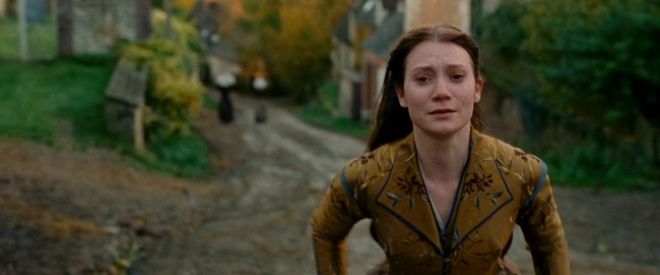
Image credit: A Company Filmproduktiongesellschaft.
Christina Gasc and Valeri Ranchoux's costumes for Madame Bovary are probably the best thing about the film. They took their job of creating the most exquisite Parisian fashions a naïve 19th-century woman could buy on bad credit very seriously.

Mia Wasikowski's character stands out in her environment, but it is the stifling provincial town that generates her creative interest in the beautiful clothing imaginable. As a respectable middle-class woman, creation is outside of her prescribed abilities, so she turns to the next best avenue: patronage of the arts. It is the sort of lifestyle decision often warned against in 19th-century novels, of the rising middle class trying too hard to take on the airs of the upper class with newfound wealth--or the promise of it, in investment schemes or credit. It's also very familiar to contemporary audiences, who recognize the yearning for something a little grander and chic than what everybody else is wearing.

Bright Star (2009)
Image credit: Pathé Renn Productions.
Janet Patterson was costume designer and production designer for my favourite literary movie: the John Keats biopic Bright Star. 

In an interview with W Magazine, Patterson explains how costuming Abbie Cornish's seamstress character in the film exemplified the daring spirit of young women of any time period to experiment wildly with style. Cornish's costumes are sometimes a little weird, but they reflect a sense of reality in being so overtly curated. She may look a little out-of-place and overly done-up even by 19th-century standards, but so do contemporary fashion bloggers like the Man Repeller. To be on the cutting edge is to stand apart; it's a notion that transcends time periods and gives a sense of relatable authenticity to this Regency seamstress.

Miss Fisher's Murder Mysteries (2012-present)
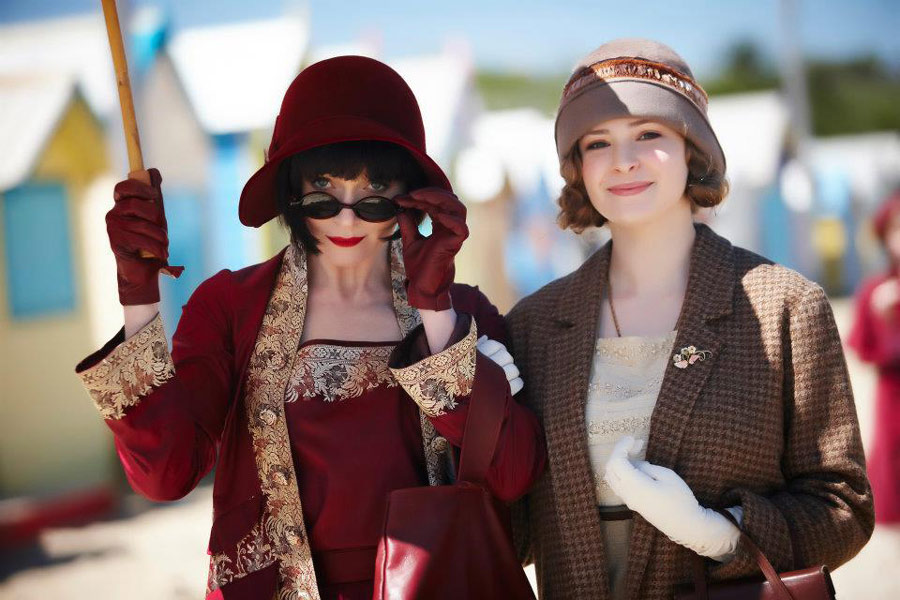
Image credit: Every Cloud Productions.
If I could have any movie wardrobe as my own, I would want the clothes costume designer Marion Boyce has assembled for Essie Davis in Miss Fisher's Murder Mysteries. In an interview with Vanity Fair, Boyce describes the challenges of costuming a 1920s show: real vintage is too small, an "action hero" like Davis' character needs a lot of hardy multiples during shooting, and the shiny fabrics of real 1920s vintage have dulled and gone funky after nearly 100 years.

Boyce also incorporated 1920s sewing techniques into reproducing clothing: narrower rolls of cloth and a disuse of darts meant that clothing in the 1920s was often sewn from panels. Many costumes are outrageous and colourful, matching the personality of Davis' character; it is everything the audience expects from the Roaring Twenties, but also makes nods towards Boyce's research. The audience ends up delighting in how the maverick Miss Fisher manages to get away with wearing so many pantsuits.

Costumes are displayed in a special exhibition.

Costume designers who I love but did not get to write about: Sandy Powell, Jacqueline Durran (of 2005 Pride and Prejudice fame!), Eiko Ishioka, and Kate Hawley. 

19 March 2015

CASA LOMA'S SCREEN APPEARANCES

THROWBACK THURSDAY 

BY: MALLORY HORRILL

Calling all television and movie buffs! Remember when Toronto’s iconic Casa Loma was featured in these productions?

1. Cocktail (1988)
This less than thrilling film starred Tom Cruise as the highly successful bartender Brian Flanagan. Casa Loma graced the screen in the film as the setting of Flanagan’s wealthy father's home. 

Colour photo of blue upper class room. Tom Cruise speaking with an older man who has his back to the photo.
http://torontoist.com/2009/01/reel_toronto_cocktail/
2. Goosebumps, A Night in Terror Tower (1996) 
While you may not remember this exact episode, I’m sure you remember the series! In this episode Sue and her brother Eddie while on a family trip to the UK get scared out of their wits at an old historic castle. 

3. X-Men (2000)
Casa Loma was used as the interior of Dr. Xavier’s (Patrick Stewart) school for ‘gifted youth’.

http://torontoist.com/2007/12/reel_toronto_th_1/
4. Chicago (2002)
The lawyer, Billy Flynn (Richard Geere) uses Casa Loma’s Oak Room for the setting of his office. 

Rich looking man behind desk, 1920s style, upper class room.
http://www.nytimes.com/2007/03/11/style/tmagazine/11tgere.html?_r=0 
5. Scott Pilgrim vs The World (2010)
The outside staircase of Casa Loma was used as the site of Pilgrim’s (Michael Cera) showdown with Ramona Flowers’ (Mary Elizabeth Winstead) second evil ex, Lucas Lee.

Night scene. A young couple (male and female) are standing side by side looking at the castle (Casa Loma).
http://torontoist.com/2010/11/reel_toronto_edgar_wright_talks_scott_pligrim_vs_the_world/
These five films and television shows are by no means the only famed filming that has taken place at Toronto’s castle. Can you name any other productions that have used Case Loma?

2 March 2015

"HOUSEWIVES OF AMERICA!"

MUSEUM MONDAYS

BY ALEXANDRA JEFFERY

Lately I've been searching a lot of film archives and a lot of online archives. Recently this led me to the Indiana University Libraries Moving Image Archive. While snooping around in their collection I came across their online exhibit WWII Propaganda Films and IU: Audiovisual Production, Circulation, and Education. 

Screenshot from Survival of the Fittest
 The exhibit features films from Indiana University's Bureau of Audio-Visual Aids. According to the website the I.U. distributed 16mm films as a  a way to provide a "vital link in the distribution of information from the Federal government's Office of War Information to the citizens of Indiana and throughout the mid-west."

Screenshot form Indiana University Goes to War
 I watched quite a few of the videos which are organized by subject and include topics like health, agriculture, production and women in wartime.

Some of the films I watched included some really great dialogue like: "they're not naturally familiar with mechanical processes nor machines" (Supervising Women Workers), "Food to keep our husky young fighting men fit" (The Gardens of Victory) and "every year 2 billion pounds of waste kitchen fat is thrown away" (Out of the Frying Pan and into the Firing Line).

Here is a list of the other things that I liked: the music was peppy and made me want to support 'Merica, there was a lot of corporate involvement in the films, the Office of Civilian Defense logo looks a lot like the Deathly Hallows symbol and the narrators have the olde tyme news voice.

Screenshot from The Gardens of Victory

 My favorite and most informative film was "Out of the frying pan and into the firing line."


23 February 2015

DON'T KNOW WHAT TO WATCH TONIGHT? TAKE THE MUSEUM MYSTERY MOVIE QUIZ

MUSEUM MYSTERIES

BY: MADELINE SMOLARZ

The days are getting longer, but the snow continues to fall and temperatures are still consistently below zero. Yes, spring is coming, but it remains beyond our reach. Sometimes, hunkering down with a good film, a bowl of popcorn, and a warm blanket is the only thing to do this time of the year. It was the 87th Academy Awards last night after all, so film is a hot topic at the moment. Since there’s nothing like a little suspense to make movie night more thrilling, I have put together a quick questionnaire to help you decide which museum mystery-themed film you should watch. Sit back, pretend you’re on Buzzfeed for a few minutes, and take Musings’ Museum Mystery Movie Quiz!

You too could be gobbling down popcorn while watching a great movie. On to question 1! Source.

1. Which museum would you visit if you could be transported to one right this instant?

a) The Louvre, Paris, France
b) Madame Toussauds Wax Museum, London, England
c) The American Museum of Natural History, New York, USA
d) The Topkapi Palace Museum, Istanbul, Turkey
e) The Metropolitan Museum of Art, New York, USA

2. What kind of book do you reach for before bed?

a) A detective-style mystery
b) A horror story
c) An action-adventure
d) A classic heist book
e) A romance novel

3. If you could time travel, which time period would you visit?

a) An ancient era, maybe around the time of Christ
b) The 1930s
c) Nowhere, I’m perfectly happy right here
d) The 1960s
e) The 1990s

4. Pick a museum object:

a) The Holy Grail
b) A wax sculpture of Marie Antoinette
c) The skeleton of a Tyrannosaurus Rex
d) An emerald-encrusted dagger
e) A priceless Monet painting

5. Which kind of lead movie character do you most admire?

a) The intelligent professional
b) The twisted, mastermind villain
c) The rateable and down-to-earth type
d) The smart, capable female
e) The confident billionaire


Time to total up your answers.


If you chose mostly As…
Watch: THE DA VINCI CODE (2006)
It’s up to a Harvard religious studies professor to clear his own name when he is framed for the murder of a Louvre curator, a process that happens to involve searching for the Holy Grail.

Source.

If you chose mostly Bs…

Watch: THE MYSTERY OF THE WAX MUSEUM (1933)
Someone is stealing bodies from the local morgue and the figures at the Wax Museum are beginning to resemble the recently dead.

Source.

If you chose mostly Cs…

Watch: NIGHT AT THE MUSEUM (2006)
Under the watch of a new security guard, the exhibitions at the American Museum of Natural History come to life at night.

Source.

If you chose mostly Ds…

Watch: TOPKAPI (1964)
A gang of assorted criminals assemble to carry out a classic heist in order to steal the jewelled dagger their female mastermind is fascinated with.

Source.

If you chose mostly Es…

Watch: THE THOMAS CROWN AFFAIR (1999)
A bored, brilliant billionaire stages the theft of a $100 million Monet from the Metropolitan Museum of Art, but he may have met his match in the detective hired to solve his complex crime.

Source.

I highly recommend any of the options listed above, so if a film other than the one you were matched with catches your eye, keep it in mind for your next movie night. Enjoy!


23 January 2015

FUTURE-FASHION PREDICTIONS SAY AS MUCH ABOUT THE PRESENT AS THEY DO THE FUTURE

SEW WHAT?

BY: ANYA BAKER

It’s 2015. We’re living in the future predicted by Back to the Future II--only we were promised a lot more neon fabric and translucent plastic accessories (and hoverboards).

Four people in outlandish clothes stand outdoors.
Credit: Universal Pictures.
Two children in bright clothing stand beside a gaming machine.
Credit: Universal Pictures.

The costume department wasn’t too far off, though. The basic cuts, silhouettes, and embellishments favoured by the film are currently being purloined for contemporary fashion--even at fast fashion stores like H&M and Forever 21. The thing of it is, though, that the clothing is not being described as future-fashion, or a bold new look for 2015. What people in 1989 thought that ordinary people might wear in 2015 is what people in 2015 think that ordinary people in 1989 might have worn. We’re not wearing lucite headbands yet, but it’s considered an homage to the 80s to be wearing high-waisted denim and big slouchy sweaters right now. Current designers are quite happy to take what was popular anywhere from 20 to 100 years ago and give it a contemporary spin. Similarly, the designers for Back to the Future II, when faced with predicting what style might be 20 years down the road, decided that people would probably dress about the same, only weirder. Other film costumers did the same: we’re only a five years away from seeing if Blade Runner’s prediction for the return of very aggressive 80s shoulder pads is accurate (they're already returning to high fashion). 
 
Polaroid photo of a young woman against a neutral backdrop.
Credit: Sean Young.

Obviously, Back the Future II and Blade Runner are not controlling the fashion industry, and though their existence and continued popularity certainly fuels runway homages and 80s nostalgia, current designers are probably not intent on fulfilling 20-year-old predictions from sci-fi movies in their Spring collections. But future-fashion, when held up against the endless cycle of influence and recycled trends, starts to look less like a bold vision of what is to come, and more like a distillation and exaggeration of whatever is current. People can only predict based on what they already know; people can only create based on what they know. Even current designers, exhibiting Fall trends months in advance of Fall, are doing their own small-scale future-fashion predictions. 

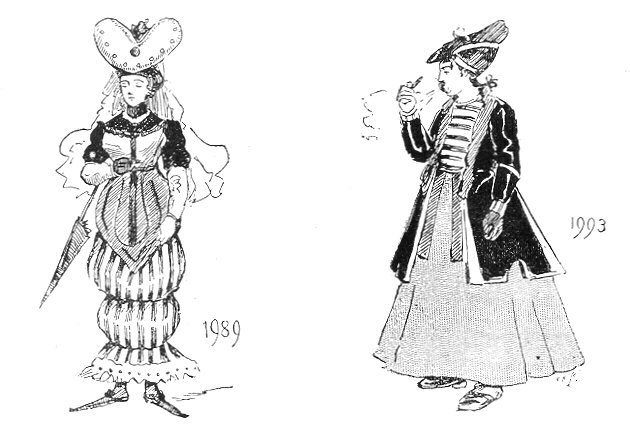
The expectation that future people will wear slightly distorted versions of whatever is in our own wardrobes is not a new idea. I started to think about future-fashion when I stumbled across an online version of a satirical article for The Strand Magazine by W. Cade Gall, published originally in 1893, called the “Future Dictates of Fashion.” 

Drawing of two women in long dresses and wild hats.
Credit: W. Cade Gall.

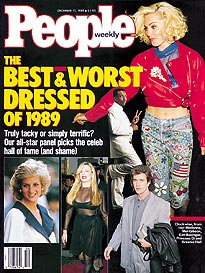
The year 2015 falls outside of its predictions; the last drawing is for 1993. But we do get a great get-up for 1989, the year both Back the Future II and Blade Runner were released. With more than 100 years between Gall and 1989, he couldn't know that it would look like this:

Magazine cover from 1989 showing photos of men and women in contemporary styles.
Credit: People Magazine.

The weird hat (future-fashion seems to expect a lot of strange head-gear) is also a little far removed from fashion in Gall's time, but the 1989 outfit is very much a satirized and exaggerated version of a woman's dress in 1893. Moreover, even though he didn't guess that everyone would be wearing jeans, he did predict Gunne Sax and the 1960s-80s fascination with faux-Victorian and faux-Edwardian clothing.

So, what does the future hold for us in terms of fashion? More importantly, what should we save in the backs our closets in order to preserve the essence of 2015 style? 

Photo of three people standing in a large crowd, wearing formal attire.
Credit: Warner Bros.

From the upcoming film Jupiter Ascending, we have more strange headgear predicted for the future, lots of colourful fabrics, and the see-through, beaded formal dresses that have been everywhere on the runway in the past few years.

Three people and one tree being standing in front of a circular doorway.
Credit: Marvel.

And from Guardians of the Galaxy (itself an homage to the 1980s), we have leather. In 20 years or so we can browse through the stores and see what we got it right, and if our 2015 beaded dresses and leather jackets will be in textile museums as examples of original 2015 style.