Showing posts with label fashion friday. Show all posts

1 April 2016

INTERPRETATION, MERCHANDISING, AND HISTORY: THE HISTORIC COSTUMERS OF INSTAGRAM

SEW WHAT?

BY: ANYA BAKER

I had to take a credit in Drama & Theatre to fulfill the requirements for my English Lit. undergrad--I chose (no surprise) a course in Theatre Costuming. Twelve of us in the course were tasked with outfitting the entire student cast of a production of Caryl Churchill's Cloud 9: a play set half in the 19th century, half in the 1979. Costuming is hard. I made a tailored Victorian frock coat for a very muscular man (and therefore, not a beginner's tailoring project), and spent more time ripping out the stitches than sewing them. This wouldn't have been a problem, if the deadlines of a stage production weren't looming over my head as I sewed.

So, I didn't go on with costuming, even though it marries my two great loves: sewing and fashion history. Instead, I just follow dozens of costumers on Instagram. Interestingly, many of them have connections to museums or related heritage institutions. 

Professional costumers, in researching and expertly executing authentic-looking pieces for the stage or screen, are fantastic resources for museums to use for programming, research, or artefact creation. The thing about costuming for the stage is that the lighting, elevation of the stage in relation to the audience, and the shape and required actions of a performer all affect the interpretation of the historic dress. Some things get simplified, because no one is going to be able to see them. A historic interpreter sitting in an exhibit isn't forty rows away from the visitor, like an audience member might be from a performer; in a museum, the costumes can be interpreted as reproduction artefacts. Moreover, in the hands of the public, a reproduction artefact can be a special-occasion dress or even a part of a regular wardrobe.

People really love dressing up. Costumers can make a living off of merchandising their knowledge of history and skillful reproduction capabilities, like the historical shoemaker of Instagram, Lauren (@americanduchess) of American Duchess:

Image credit: Lauren.

Others, like Cynthia Settje (@redthreaded), owner of bespoke costume business Redthreaded, are well-known for making custom and ready-to-wear pieces for the public, and bespoke costumes for the stage. A specialized knowledge of fiddly garments like corsets, stays, and everything ruffled is required in building a customer base both in and outside of the theatre:

Cynthia's caption declared that her studio sewed 53 petticoats over the course of several months. That's 53 more petticoats than I ever want to sew. Image credit: Cynthia Settje.

In terms of museum work, many costumers merchandise not only the finished product, but also their skill sets as historic textile experts. Izabela Pitcher (@izabelapriorattire), who owns the bespoke costume business Prior Attire, advertises herself not only as a costumer, but as a for-hire interpreter for Living History demonstrations or costume-making sessions. The breadth of her knowledge of historic dress is astounding, as are number of related skills involved in performing as an interpreter in different time periods: everything from fencing to making bobbin lace! This medieval dressmaking workshop at the Valence House Museum in Dagenham is my everything:


My kind of afternoon. Image credit: Izabela Pitcher.

Looking authentically historic makes people connect with the past. Making costumes that ooze authenticity, like Jasper and Angela (@walking_through_history) of the blog Walking Through History, and providing built-in programming opportunities appeal both to museums and members of the public. They run a historic banquet business, in addition to making highly detailed costumes for themselves modelled off of paintings:

Look at that lace! Image credit: Jasper and Angela.
Costumers like Ruth Watkin (@ruthwatkincostumes) work directly with museums to interpret the exhibited artefacts into textile programmes, like these amazing Vermeer reproductions at Kenwood House in London:

Image credit: Ruth Watkin.

Can you imagine taking a museum selfie with a Vermeer, looking like you stepped out of a Vermeer painting? The role of interactive artefacts in this programme elevates the visitor from being a passive viewer of the artwork to being a part of the exhibit.

There are plenty more costumers on Instagram and they are hugely inspirational, not only for my dressmaking practice, but for my museum practice, too!

Finally, it is a truth universally acknowledged, that a museum professional finally in possession of a graduate degree must be in want of a new gig. This is the end of my time writing for Musings.


I'm shifting my blogging efforts over to Baboushka Buttons, if you want to keep up with what I'm stitching. Good luck to whoever takes over "Sew What?", and thanks for reading!

4 March 2016

THE HOME SEWER AND HER PATTERNS

SEW WHAT?

BY: ANYA BAKER

Image credit: Anya Baker.

Sewing close-fitted and tailored clothing takes a fair bit of skill. When tailoring came in to fashion in the Middle Ages, it helped develop a garment-making industry that set apart those with enough money to hire someone to do it for them, and those who had to do it themselves. Patterns for home-sewers were fashion's original great equalizer--sort of like a 19th-century Forever 21. And despite the fragility of paper, it's a history that is still preserved and interpreted in both academic and commercial archives.

Yes: 19th-century. It seems late, but commercial pattern production and distribution depended entirely on the rise of cheap printing and the infrastructure necessary to support mail delivery. Although tailors were publishing guides for other tailors as early as the 14th century, guides for the non-professional were not developed until the very end of the 17th century. For more info, look at Joy Spanabel Emery's article. What is important to me is that home-sewers, instead of just using "cheats" like gathers, loose fits, and drawstrings to make home-drafted clothes fit better, could recreate the latest tailored fashions from afar as fashion magazines began including free pattern as magazine supplements in the 1840s.

Can you imagine how excited you would be, if you were a 19th-century woman in a little village far from the fashion centres of America and Europe, to have well-made, on-trend clothes? There were limitations, of course: patterns only came in one size. The home sewer still had to figure out how to grade the pattern up or down according to her measurements. One of the greatest breakthroughs for the likes of me and you was the development of the graded pattern in 1863; you just cut along the lines that indicated your size. That was the start of one of the big names in patterns: Butterick.

If you recognize the name Butterick, you might know its famous sister companies: McCall and Vogue. They're all owned by the McCall Pattern Company. When sorting through the bins of $0.69 vintage patterns at the local Goodwill or Value Village, those names come up a lot.

These are very 80s, but you get my point.
Image credit: Anya Baker.
Finding older vintage patterns can be tricky. You can buy them online, but they can be expensive. The Commercial Pattern Archive outlines a number of repositories for commercial patterns: the University of Rhode Island, the Fashion Institute of Technology, the Glenbow Museum, The Fashion Museum, and even the ROM! But unless you know what you are looking for, are allowed to copy the pattern itself, and can puzzle together the sizing and expected measurements, actually using vintage patterns is more trouble than a fancy dress is worth.

Which makes the secret archives of Vogue, McCall's, and Butterick alluring. I call them secret only because I can find no information on them. But they exist; they must! Each company has a collection of 20th-century patterns conveniently resized for 21st-century measurements: Vogue's Vintage Vogue, McCall's The Archive Collection, and Butterick's Retro Style. The pattern gives its date of origin, and whether its use is courtesy of an individual or a collection outside of Vogue. Re-releasing these patterns is a magnificent union of archiving, research, adaptation, repeated commercialization, and intense public appeal.

I have a few Vintage Vogue patterns (they go on super sale to $5 every couple months) and they're incredibly beautiful. But, as with all commercial patterns--even graded ones--from their first inception to the present day, it takes a fair bit of skill to sew something close-fitted and tailored. The home sewer still has to know how to adapt a pattern to her own unique measurements and proportions.

If you want a taste of that sweet 20th-century home-sewing style without the fuss, here's a little project I worked on recently with Historic Kitchen's Leah. Look for it in her next post. To make it easy, draft your own pattern as you go; just use your measurements. Mark the outline or corners with pins or a bit of tailor's chalk and start cutting. It's based on aprons from the mid-20th century, when home-sewing was booming, commercial patterns were incredibly popular, and fashionable, decorative frills and jazzy prints were all within reach of anyone with a needle and thread. You need about a metre to a metre-and-a-half of print cotton.

Image credit: Anya Baker.


The idea is to make everything simple and boxy and then "cheat" with gathers. Measure your waist and decide how long you want your apron, and guesstimate the rest--add a button and a couple of button holes on the waistband for customized fit, and gathers along the top of the bodice so that you don't need to put in darts. You cut out two waistbands because sewing them together, one as the outside-facing waistband and one as the inner, makes it look cleaner and gives the band some weight. Same with the halter.

Decorative touches give the air of having tried hard. Image credit: Anya Baker

Bind the edges with ribbon or make bias-tape from fabric scraps. The whole thing should take you an hour if you have a sewing machine, or a couple of hours if you prefer to hand-sew while binge-watching costume dramas.

Add pockets, if you want; just cut out squares. Image credit: Anya Baker.
Leah! Image credit: Leah Moncada.


As fast fashion has eliminated the need to sew fashionable clothes for yourself, all that might have been clear as mud to you, dear Reader. That's the weird thing about garment production in the 21st-century; commercial patterns and home sewing were the democratizing forces of 19th- and 20th-century fashion, but sewing and tailoring have become specialized skills once again. So Medieval, man!


11 December 2015

3 PERIOD FILMS (AND 1 AMAZING TV SHOW) THAT USE COSTUME TO GIVE A SENSE OF HISTORY

SEW WHAT?

BY: ANYA BAKER

This is not going to be about Jane Austen adaptations. There are already numerous whole blog posts about why the 2005 Pride and Prejudice adaptation is a stain on costuming history.

(I disagree, but only because director Joe Wright demanded more flattering waistlines than period-appropriate empire waists, and if I were in a movie I would want my costumes to look supremely flattering, too. Fight me, 1995 BBC adaptation purists!)

Like all institutions involved in history, the film industry has to wrangle with balancing a budget, the attention span and tastes of its audience, and the ideal of an authentic pseudo-historical experience. This ideal applies more to historic houses than to science centres and art galleries, but the yearning for a connection with the past is found in almost any institution. In a museum setting, the municipal government may grouse if you start slapping the wrong colour of paint on a historic house--if you are a costume designer and you cut the wrong corners during film production you might end up skewered in a national newspaper because you put a dress with a zipper on a 15th-century queen.

I'm not fussy when it comes to accuracy in costuming; mostly, because I sympathize with being too broke to spring for the real deal, and because people who are unused to being shaped by period corsetry and foundation garments do not tend to look authentic in them. Often, accurately representing an era or a look ends up being a lot more effective than accurately reproducing it. Making an audience feel like a costume has been born out of its environment is what convinces them that the experience of the film is authentic. Some movies make my heart go pit-a-pat with their costuming choices, and these three recent movies engage so successfully with historic storytelling through costuming that I need to share them:

The Dressmaker (2015)
Image credit: Universal Pictures
My new favourite blog Clothes on Film recently did a feature on Margot Wilson and Marion Boyce, the costume designers for the new film about a 1950s dressmaker who returns to small-town Australia after working in Paris and Milan under the likes of Madame Vionnet and Cristóbal Balenciaga.

The character's role as a dressmaker, not a designer, is taken into account--her clothes therefore strongly, and expertly, reference the lead designers of the day. Key costume pieces clearly tie to a huge moment in fashion history: Christian Dior's New Look (plus the incredible fabrics made in the early part of the 20th century and and the glamorous colour palette of mid-century haute couture). Wilson mentions that securing real vintage for films is becoming difficult, because nobody fits in to pieces designed for average 1950s measurements. Even authentic-looking reproductions are difficult to create with modern fabrics. But the story of Kate Winslet's onscreen wardrobe, and its integration into the character's role as a dressmaker, is what creates the feeling of authenticity.

Costumes are displayed in a special exhibition.

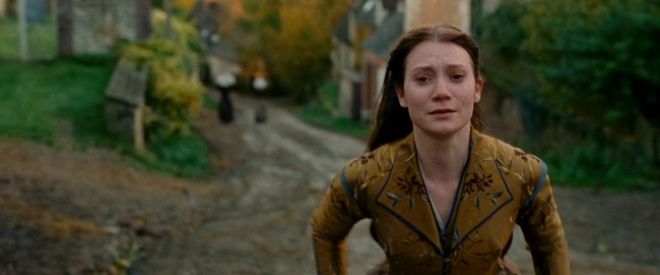
Madame Bovary (2014)
Image credit: A Company Filmproduktiongesellschaft.
Christina Gasc and Valeri Ranchoux's costumes for Madame Bovary are probably the best thing about the film. They took their job of creating the most exquisite Parisian fashions a naïve 19th-century woman could buy on bad credit very seriously.

Mia Wasikowski's character stands out in her environment, but it is the stifling provincial town that generates her creative interest in the beautiful clothing imaginable. As a respectable middle-class woman, creation is outside of her prescribed abilities, so she turns to the next best avenue: patronage of the arts. It is the sort of lifestyle decision often warned against in 19th-century novels, of the rising middle class trying too hard to take on the airs of the upper class with newfound wealth--or the promise of it, in investment schemes or credit. It's also very familiar to contemporary audiences, who recognize the yearning for something a little grander and chic than what everybody else is wearing.

Bright Star (2009)
Image credit: Pathé Renn Productions.
Janet Patterson was costume designer and production designer for my favourite literary movie: the John Keats biopic Bright Star. 

In an interview with W Magazine, Patterson explains how costuming Abbie Cornish's seamstress character in the film exemplified the daring spirit of young women of any time period to experiment wildly with style. Cornish's costumes are sometimes a little weird, but they reflect a sense of reality in being so overtly curated. She may look a little out-of-place and overly done-up even by 19th-century standards, but so do contemporary fashion bloggers like the Man Repeller. To be on the cutting edge is to stand apart; it's a notion that transcends time periods and gives a sense of relatable authenticity to this Regency seamstress.

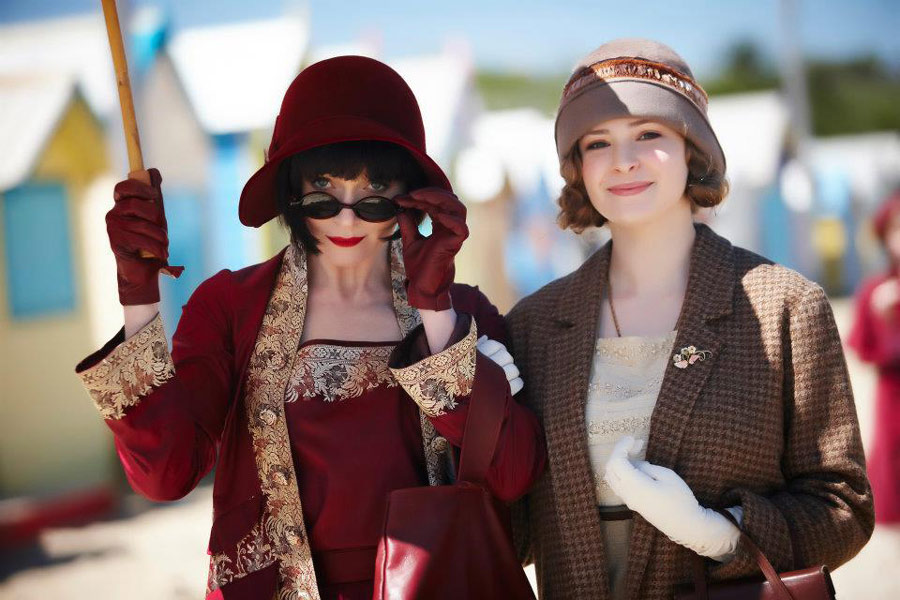
Miss Fisher's Murder Mysteries (2012-present)
Image credit: Every Cloud Productions.
If I could have any movie wardrobe as my own, I would want the clothes costume designer Marion Boyce has assembled for Essie Davis in Miss Fisher's Murder Mysteries. In an interview with Vanity Fair, Boyce describes the challenges of costuming a 1920s show: real vintage is too small, an "action hero" like Davis' character needs a lot of hardy multiples during shooting, and the shiny fabrics of real 1920s vintage have dulled and gone funky after nearly 100 years.

Boyce also incorporated 1920s sewing techniques into reproducing clothing: narrower rolls of cloth and a disuse of darts meant that clothing in the 1920s was often sewn from panels. Many costumes are outrageous and colourful, matching the personality of Davis' character; it is everything the audience expects from the Roaring Twenties, but also makes nods towards Boyce's research. The audience ends up delighting in how the maverick Miss Fisher manages to get away with wearing so many pantsuits.

Costumes are displayed in a special exhibition.

Costume designers who I love but did not get to write about: Sandy Powell, Jacqueline Durran (of 2005 Pride and Prejudice fame!), Eiko Ishioka, and Kate Hawley. 

13 November 2015

TROUSSEAUS AND VINTAGE SEWING MANUALS, AND THE SOCIETAL EXPECTATIONS THEY PERPETUATE

BY: ANYA BAKER

I bought my first sewing manual in a little antique shop in small-town Southern Ontario--Dorothy Moore's Pattern Drafting and Dressmaking, 1968, drew me in with its groovy, groovy cover and $3 price tag.


That anecdote was a false start, because the only reason I bring up sewing manuals at all is to introduce you to the jewel of my antique sewing guide collection: Sewing Made Easy by Mary Lynch, 1950.

Moreover, the only reason I bring up Sewing Made Easy is because it is a goldmine of information on prescribed dress practices for women in the mid-twentieth century. I say "prescribed" because sections of the book read like contemporary "Fashion Police" columns, outlining the faults of different figure types and the means of rectifying them through dress. According to the book's diagrams, I am "pear-shaped," and so I was disconcerted and a little peeved to read: 'that "hippy" look is the saddest thing in life' (p. 17). Sixty-five years after this book was published, this sentiment is eerily similar to judgment I've read in contemporary fashion magazines. Intense scrutiny still lingers on women and their aesthetic choices, and numerous industries benefit from pushing onto consumers the products and fashions that uphold prescribed notions of how women ought to be appear.

Tall women can wear the "striking, unusual clothes shown in fashion magazines" (p. 15) but not tall hats, apparently.
From Sewing Made Easy, 1950. 

But, flipping through this 1950s version of "What Not to Wear," I was struck with one thing that has changed: the concept of preparing a trousseau. The process of preparing a trousseau, as described in Sewing Made Easy, is when a woman (or her mother) collects a bunch of personal items, linens, and household items in the expectation of the woman's future wedding. Trousseaus were popular in 19th-century Europe among the middle and upper classes. Home Dressmaking--A Complete Guide to Household Sewing by Annie E. Meyers, 1892, suggests that for "a young woman in moderate circumstance, moving in a modest circle of society," they be designed to contain "just enough clothing to last the bride one year, at the furthest," as the "old fashion of stocking a bride with clothes enough to last her the remainder of her natural life has passed into history" (p. 213). Meyers suggests (p. 214):

- 6 night dresses
- 6 drawers, undervests, corset-covers and dressing sacques
- 6 petticoats (one being black silk, two of them being short flannels)
- 6 pairs of hose
- 2 pairs of walking boots
- 2 pairs of house shoes
- 6-10 pairs of gloves
- unlimited handkerchiefs
- 3 wraps for different seasons
- 3 hats of varying levels of fanciness
- 2 woollen street dresses
- one evening dress
- 2 house dresses
- 1 wrapper
- 1 teagown

When I was a teenager, my mother would occasionally joke that she was putting something like a kettle or some sheets in my "hope chest" for when I moved out. The driving force behind my moving--the "hope" part of the "hope chest"--was always understood as the university education I was working towards. In reading these seemingly innocuous manuals about stitches and how to sew a hem, it is impossible to overlook pointed reminders that marriage and wifehood was a woman's inevitable role. Presumably, these trousseau lists are a reflection of what women wanted to read, but in providing authoritative guidance these books also justifies the presumed need for such advice in the first place. Especially when presented alongside prescribed standards of dress, this casual governance of women and their bodies is uncomfortable. These are the eras that are so readily romanticized in contemporary entertainment (i.e. Austen- and Brontë-mania, Mad Men, etc.), and whose fashions are constantly recycled and held up as idealized visions of femininity in women's wear (for example, Raf Simon's entire tenure as creative director of Dior).

I wasn't expecting a mid-century book to be exceptionally progressive or match contemporary marketing tastes for subliminal, rather than overt, societal messaging. It did force me, though, to reflect critically on women in society and the forces that pressure us into conforming to certain aesthetics, when I was just looking for instructions on how to set a sleeve in its armhole. Sewing Made Easy is slightly less condescending in its recommendations than Home Dressmaking; Lynch focuses on the materiality of the garments (useful for a sewer!) and the chapter is geared towards building a wardrobe (sensible!). Still, it prefaces the useful bits of the book with overt reminders that the sole purpose of all this sewing is to look a certain way and follow predetermined social roles. My disappointment with this isn't so much a criticism as an acknowledgement that fashion history is not all satin and lace.

I know you just want to know what a 1950s housewife requires in her underwear drawer (Lynch appears to recognize that unmarried women also wear clothes, and so her general wardrobe advice does not assume marital status), so in closing, here are Lynch's suggestions for a trousseau from Sewing Made Easy (p. 250):

- tailored slips, nightgowns, panties, pajamas, and bed jacket (of nylon silk, rayon or cotton)
- lace-trimmed or embroidered slips, nightgowns, panties, and bed jacket (of rayon, nylon, silk, or sheer cotton)
- full-length evening slip (of nylon, rayon, or silk)
- tailored hostess gown and house coat (of cotton, quilted cotton, wool, or corduroy)
- dress-up hostess gown, house coat, and negligee (of silk, rayon, velvet, or sheer wool)
- lounging pajamas ["...if you're the type who looks glamorous in them" (p. 250)!]
- bathrobe (terry cloth, candlewick cotton, or wool)
- brassières (of cotton, rayon, nylon, net, or lace)

Sources:
Lynch, Mary. Sewing Made Easy. USA: Nelson Doubleday, 1950.
Meyers, Annie E. Home Dressmaking--A Complete Guide to Household Sewing. Chicago: Charles H. Sergel & Company, 1892.

16 October 2015

WHAT ARE YOU WEARING? iSCHOOL STUDENTS TALK STYLE

SEW WHAT?

BY: ANYA BAKER

All of my peers here at the iSchool have great personal style. Unique, fashion-forward, sophisticated, edgy: there is so much variety in the fashions I see in class every day. I recruited a number of my peers to talk to me briefly about their outfits--a miniature study in contemporary consumer culture. I wish I could have interviewed everyone; this is but a small sampling of the snappy dressers of the programme.

As museum people, we can go beyond just listing brand names, so the framework of the interview was that the subject was to act as a curator, and speak about their outfit as if describing its meaning and influences in an exhibit label. I have transcribed some highlights below from the interviews. A few questions structured the mini interviews:

  • What is special or meaningful about what you're wearing today?
  • Who or what do you look to for style inspiration?
  • If 2015 has a style, is your personal style representative of it?

I only had three questions, but forgot to ask at least one of them during every interview. Luckily, my interview subjects more than made up for my lack of planning with their thoughtful interpretations of their own outfits. Casual and candid--here's the very latest from the iSchool!

Madeline Smolarz, 2nd Year

Who else could I start the column with but our very own, very stylish Musings Editor-in-Chief, Madeline? She emphasized the cohesion of design in all the pieces of her outfit: "there is a colour palette and [my skirt] has additional visual interest. Neat pleats and a pattern, and extra pockets. I like things that would surprise people, that maybe they haven't seen before. A fun pattern or a cool shoe. Something that would make someone take a second look and make myself smile. When I am out in the world, I like my clothing to reflect who I am on the inside, and for there to be cohesion throughout all my looks."

Noting that her jacket is thrifted, she brought up an incredibly important and contentious critical issue in the textile industry right now: sustainability, especially "in terms of overproduction, and the people making the clothing. People throwing out perfectly good clothes when that could go to a good cause. I like to go to places that are either saving clothes from landfills or the money [from the purchase] goes to a good cause. Before I go to a department store, I definitely go to a thrift or vintage store."

She considers thrifting and sustainable fashion to be a very 2015 thing: "I do fit in to today's style. It's interesting because there does seem to be several vintage throwbacks--the 70s is having a moment right now. I fit in--I think about vintage, and the colour palettes I choose are on trend. But I'll have pieces for several years, that I've kept, and they come back in to style again."

Jessica Lin Zhang, 1st Year

Jessica's take on her "warm!" sweater, jean shirt, and skirt combo evoked an artist describing a painting. She stressed that the materiality of each piece influenced the others. She wore "mixed textiles: jean and knitwear. I read something about how the eye is sensitive to different textures. The clash of textures. If you wear a cotton sweater with a knit sweater it wouldn't stand out as much. There's no contrast. If you wear jean, or silk, with a knit sweater, then your eye easily picks that up." 

Her inspiration comes from blogs and streetwear photography--and she considers herself as fitting in to the current fashion ethos. "Simplicity is the style" for 2015.

Rowena McGowan, 2nd Year

Rowena noted that she wore something out-of-the-ordinary on the day of the interview--she didn't feel that it was her usual style, which usually features impressive handmade knitwear, button-up shirts, and bright colours. The topic of special-occasion wear is important to any museum's textile collection, and to the vintage clothing industry--the kind of clothing that gets photographed at special events and saved in cedar chests, but is removed from everyday wear. She invoked nostalgia and self-awareness in her interpretation of her outfit: a "vintage dress that was way too expensive, but is really cute. It makes me think of the Second World War, which I really shouldn't romanticize, but I feel Millenials always do. I'm wearing dinosaur earrings. I don't really try to match my outfits, I just wear what I want to wear, which sometimes works, and sometimes ends up ridiculous. Like my vintage dress and my plastic dinosaur earrings. But they make me happy."

This postmodern mashup of dinos and dresses stresses the individuality of personal expression and style. Rowena brought up that I had asked her what her style influence is a while ago: "I told you my style influence is a My Little Pony, and I still stand by that."

Brenna Pladsen, 1st Year

Perhaps taking a cue from her morning Context and Critical Issues class, Brenna emphasized that "context is very important" to her style. She described her sweater dress and stockings as "collegiate while also being a bit exciting" due to the duelling contexts of her surroundings and her body. She laughed that she was able to get away with wearing thigh-highs to class because of her height, and due to the contrasting structure of her loose, tunic-length sweater dress. 

The theme of the outfit is "interesting things: capsule collections or independent designers." That is where she draws inspiration, as well as from a variety of subcultures that subvert and play with the mainstream. Finding ways to mix her slightly punk aesthetic into her everyday outfits is "fun, and exciting, and occasionally a little bit off."

Maureen Marshall, 1st Year

Maureen brought up some very important influences on many of our wardrobe choices: heritage and nostalgia. About her skirt she said: "It's English tartan and my heritage is from back there. It was nice when I saw it advertised as from being there, from the old mills, but with a modern twist." The necessity of re-interpreting older or classic styles to suit contemporary times was evident in her description of her own personal style: "I like really classic lines and clean lines, but it doesn't have to be an Audrey Hepburn classic look. That is something I gravitate towards. But I also have some very funky things that Audrey Hepburn would never wear."

Individuality is key to fashion in 2015: "I don't think there is such a thing as 2015 fashion. Everyone has their own individual interpretation of what they want to do. If we all looked the same it would be so incredibly boring. There are models out there that are in vogue and then you put your own personal twist on it."

Leah Moncada, 2nd Year

From her adorable dress and tights, to her meaningful jewellery, to her incredible, colourful shoes made by a Quebec tailor, Leah's style is incredibly detail-oriented. What ties it all together is memory: "I like wearing things that have memory. Those are the things that I re-wear again and again. Ones that are very important to me I never get rid of." Clothing as a tactile receptacle for meaning is exemplified in her attachment to things like a shawl her friend knit her, or her mother's earrings, or the wool sweater that belonged to her grandmother: "It doesn't fit very well, but it's warm. It's got a lot of personality. There's literally sheep on it. It's kind of like a hug, both physically and mentally."

As any given outfit is "like a walking exhibit of my memories," Leah is unconcerned with fitting in to any prescribed subgroup. She thought that many people shared her opinion: "It's become more popular to shop at thrift store, but we're all so unique. I wear things that have memories to me. I wear shawls five out of seven days of the week; I don't think that's normal. I wear granny dresses, literally. But I also wear jeans and a t-shirt and crewneck frequently. I think we're all so diverse and different; people can be representative of certain subgroups, but I genuinely don't think about what other people wear."

*****

Thanks to those interviewed for the great conversations! I leave you on this Fashion Friday with an anonymous quote from one interview subjects, which perfectly embodies our collective fashion fear: "I don't want to conform. Oh my god--I sound like such a hipster."
A final look at Leah's amazing shoes.

18 September 2015

MOM JEANS RENAISSANCE: FASHION CAUGHT IN A REFERENTIAL TIME AND SPACE WARP

SEW WHAT?

BY: ANYA BAKER

I was planning to make a fun list article today of all the museum-y fashion stuff I found on the internet this summer--a look back at 100 years of fashion history, my favourite costume-related procrastination site, and a rant to bear in mind while staring down the H&M sales rack in a couple months when the current 70s revival fizzles.

But then I indulged in my favourite "research" activity--scrolling through Forever21's new arrivals--and stumbled on to the season's latest fashion revelation. Mom jeans: they're back!


Image credit: Forever21.


I am no stranger to the lure of high-waisted denim. Mom jeans are practically my family heirlooms.

To the left, some original Mom jeans/Mom pants on my mom. To the right, Mom jeans on teenaged me.
Image credit: Anya Baker.

Wanting to investigate the implications of this development in the world of denim, I reached out to an eyewitness of the first iteration of Mom jeans: my mom. She wishes to make it clear that the Forever21 Mom jeans are but paltry reproductions of the original, as "original mom jeans would not have been so short OR cuffed (rolled). Moms didn't do that."

Compared to the skintight flares of the 1970s (to which she was also a horrified teenaged eyewitness), this new, relaxed cut of jeans was considered very flattering--odd then, to its fans, that it has taken on an association with dowdiness and outdatedness. As waistlines on trousers dropped through the 90s to the hip-baring bootcut jeans of the early 2000s, the fashionable young things from the 80s and early 90s continued to wear what they considered "normal" jeans: high-waisted, relaxed, and straight-legged. 

My private collection of Mom jeans, pilfered from my mother's closet. Image credit: Anya Baker.

The current Mom jeans trend isn't quite an homage to 80s trousers. Associating them by name with the popular mockery and backlash against such jeans in the decades post-80s makes it clear that this self-reference is meant in irony. I can't even tell if there's such thing as hipsters anymore--ironic ugliness has been curated and elevated to an ideal. Is it even anti-fashion irony if everyone is wearing Mom jeans in order to look fashionable? No! And I love it. To mangle the famous Brooke Shields ad for Calvin Klein (Mom!) jeans: nothing, not even irony, comes between me and my Calvins. 

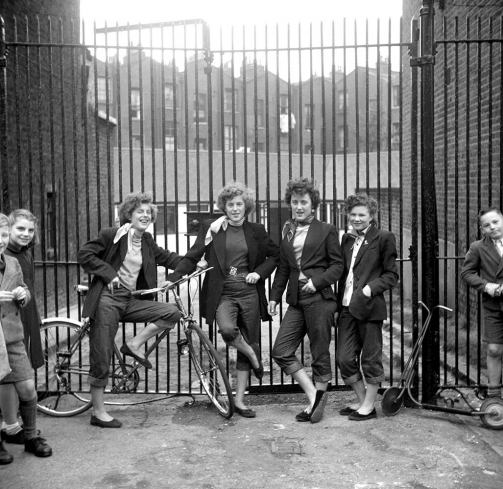
And my mother is right--the Forever21 jeans are not accurate, in spite of their designation as fashionable 80s nostalgia. The whole outfit shown in the top image recalls the hot look for rebellious youth in 1950s Britain: the Teddy Boys and Teddy Girls.

Image credit: Ken Russell, 1955.

Unlike Mom jeans, this style of dress marked the wearer as highly fashionable and a little dangerous. Teddy Boys were a subculture with a reputation for forming gangs and causing violent mischief. In some areas, they developed as fascist and racist gangs, further cementing the negative reputation of the subculture as a whole. The upper classes stopped wearing Edwardian-style dress entirely because it was being adopted by the working-class youth as a self-developed, referential style.

In an attempt to get everyone to spend some cash updating their denim, retailers are casting about rather haphazardly for a reference point. In the case of the modern Mom jeans, designers are mixing references and trying to sell the whole look as a vehicle for ironic detachment from fashion.

Mom jeans also have some competition: fast fashion stores are determined to make skintight flares the next big thing this fall, and other relaxed cuts with mid-rise waists have been popular in the last couple years. The Jean of the Decade, the Skinny Jean, is being heralded as this generation's embarrassing denim. Guard your closets. The Berenstain/Berenstein Bears Parallel Universe Theory, as proposed by science blogger Reece in 2012, has been regurgitated by the internet recently. It is heartening to see cutting-edge physics applied to the world of fashion by young people on Tumblr.

Tumblr user sapphicwerewolves notes the possessive hold each generation has on their notable denim cut.

I look forward to ignoring the next three decades of trends as I desperately maintain that the jeans I consider "normal" are still cool. Can you dig it?  

Image credit: Saturday Night Live.

17 July 2015

I DID IT MYSELF: EXPLORING SOCIAL HISTORY AND AMATEUR VINTAGE REPRODUCTION

SEW WHAT?

BY: ANYA BAKER

Years and years ago, there was a groovy little vintage clothing store in my hometown. Everything was incredibly cheap, which was probably why it went out of business--the owner could have been selling her pristine $30 1950s party dresses for $200, but chose not to.

Anyway, for fourteen-year-old, broke Anya, this place was amazing. I once found the same dress that my grandmother wore as her wedding dress (hers had yellowed and been thrown out years ago), but I didn't buy it. My fascination with historical fashion and family history hadn't hit yet. Really, all I wanted was cheap clothes. Practicality was my fashion mantra.

I bought this red dress instead, because I could see myself wearing it practically every day. And I did for years. This dress changed me.

Colour photo of a young woman in a red dress.
Image credit: Anya Baker.
I had never seen inner garment construction like it--the design of the placket had strategic snaps that made the front attach and stay together invisibly; the darts were beautifully planned; the fabric had been chosen carefully to fall lightly and sway with movement. I almost didn't care what it looked like when worn: the insides were so beautifully done.

When I bit the dust on a patch of ice outside my apartment a few frosty springtimes ago, I ripped a huge hole in the knee of the skirt--and my heart! By that point, I had started sewing, and was competent enough to patch the skirt. It was obvious though, how worn and battered the dress had become. I wasn't sewing anything major at the time; a series of ugly blouses was my perpetual project. I had never considered remaking a beloved design, especially one so complicated. But, I had inspiration: the museum.

Historical re-enactments are a big thing in my town; the museum I worked at has a whole dress-up room of 1812 gear made out of old curtains and sheets from Value Village and the like buy a talented volunteer seamstress. She researched the period's fashions as it related to rural Canada, and the reproductions are beautiful. If she could do it with 1812, I could do it with the 1950s. Research was the next step. I consulted 1940s and 50s sewing books, learning about waist tapes and couture hand-sewing techniques. I used the red dress as a primary resource, studying and measuring, and slowly drafting a paper pattern that would yield the same darts, gathers, and pleats.

Black and white photo of a young woman on a dock.
Image credit: Al Grabowski.
My grandmother re-enters the story at this point. She showed me a photo of her on her honeymoon in the early 50s, wearing the most gorgeous dress with a star-shaped bodice edge. Deep in my dress research as I was, I recognized the value of an eyewitness! She told me about her dresses, and showed me more photos, and eventually I couldn't stop thinking about the design of her honeymoon dress, and how it related to my design for the reproduction dress. I decided on a mashup: ditch the collar, make the bodice into a star, and choose a lighter material for the fabric.

Reproductions are meant for use--whether for display or for wear. They save the original from damage, and can be produced by a competent researcher to stand in for a garment that the researcher cannot get their hands on. The feeling and design intentions of the period are more important sometimes than complete accuracy; being able to wear (and better yet, to construct) a piece of social history is a thrill, and a very different learning experience from reading a history of fashion.

This is the story of my first foray into social history. I made a 1950s dress in the same way that a seamstress would have made it in the 50s, drafted a pattern according to the tastes and popular design features of other dresses of the period, and learned how to bind buttonholes. And, after all that hand-sewing and research, ripping seams apart to start again and difficult stitching and new techniques--

Colour photo of a young woman in a blue dress.
Image credit: Anya Baker
I still haven't hemmed it. Ah!

26 June 2015

TEXTILE LITERACY: WHAT I DON'T KNOW IS GONNA MESS UP MY DATABASE

SEW WHAT?

BY: ANYA BAKER

I once worked in a museum that was digitizing its entire catalogue of artefacts and archival material. Group after group of summer students, staff, and volunteers had worked over the years to bring all the original typed accession and cataloguing sheets into the 21st century--a lot of cook's spoons were in that pot of catalogue soup. Having done my share of data entry for the project, I was simpatico with the location fond categorizing system that the museum was using, and was given the task of standardizing all of the digitized catalogue entries.

A lot of problems were centred around how objects were named. We all use a lot of different words for something like a shirt: a blouse, a top, a tee. Before the museum's new categorizing system came along, cataloguers were being as specific as possible when naming objects--which was a great, until someone tried to search for all shirts in the system and came up with a suspiciously low number.

Other times, the original cataloguers were not specific enough, either because they could not identify the object, or because they assumed a universal knowledge of its use. Forty years later, only a large-scale matching project began to connect entries for "collars" with jabots and revealed why the museum seemed to be hanging on to a lot of "tattered" hankies.

Not to toot my own horn or anything, but I solved the Great Museum Mystery of our age. I kept seeing whole collections of tattered textiles--everything was in tatters! Why were we keeping this stuff? When did we accession this stuff? WWNDD (What Would Nancy Drew Do)? Investigate!

Turns out--after taking a peek at the original accessions sheets and matching a couple of artefacts to their new catalogue entries--the linens weren't in tatters at all.

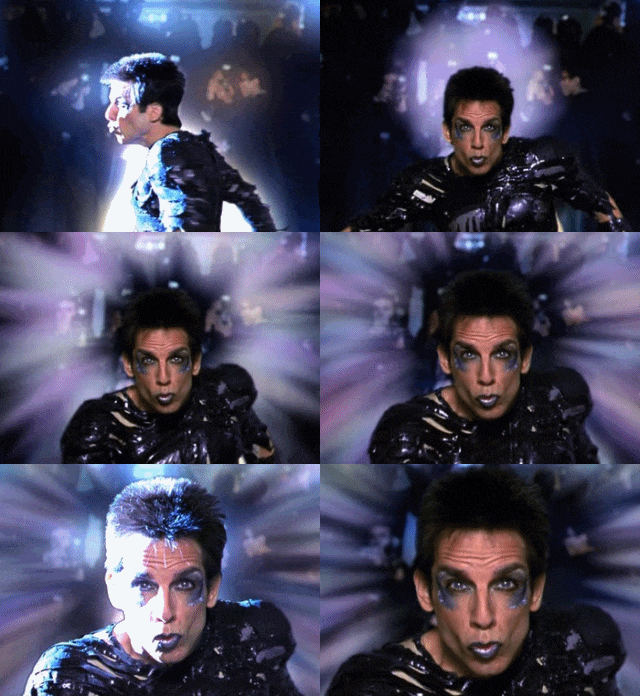
This is a somewhat tattered shirt:

Credit: Paramount Pictures.
This is a tatted mouse:

Not in tatters. Image credit: Anya Baker.
Someone, suspecting a spelling error in the original accession sheets, changed "tatted" to "tattered" when they were entering the record into the database. Tatting, although a wonderfully quick and rewarding method of lace-making, is not really on the level of knitting or crochet in the world of hobbies. To the average person, even the average museum person, it is more obscure.

What's a museum person to do? Cataloguers cannot be all-knowing. Google is! But what if you don't have a clue how to start your search? This is where I find myself lately; mired in my own ignorance.

I'm interning at a very special museum this summer: it is a heritage museum inside of a hospital and long-term care residence for older adults. My main task is to do programming and small exhibits that help the clients at the hospital connect with their heritage. Its collection is largely made up of Judaica and artefacts that reflect the culture and history of the local Jewish community. It's a wonderful internship, and I am lucky to have the opportunity to learn in this environment. It is very challenging--I'm cataloguing objects that I have never seen before in my life, and delivering programming on pretty basic topics that require a long stint of reading on my part. I do a lot of research before I start typing or saying anything. As much as I am learning professional skills, I am getting a major education in Judaism and Jewish culture. That's not the point, though--I am not meant to be an expert or stand in for a curator. I'm there to facilitate a connection between client and heritage. Still, it's making me think.

One of the artefacts that I am bringing around for programmes is an intricately embroidered tallis bag--a tallis is a special shawl that is worn by some Jewish people to fulfill a Torah commandment to wear a four-cornered garment with fringes on the corners. My supervisor explained what the bag was, and pointed out all the clues that indicate what the bag was used for--the Star of David embroidered on the back, the velvet fabric, and a line of Hebrew that indicated that it was a Bar Mitvah gift. Even with the help of Google, I don't think I would have figured out how to connect all that on my own.

It was a good moment, to realize that even in the field of Textile Arts, I can be the bumbling ignoramus.  I can be the Nancy Drew of one museum, swooping in to smugly reveal my knowledge of an obscure hobby to solve the Great Museum Mystery of the day, and then be completely out of the loop at my very next job. I am not all-knowing, and that's okay! The more I work at museums, the more I realize how distinct museum jobs can be--I always considered becoming a jack-of-all-trades curator at a small museum. Now I'm wondering if I should narrow my focus. There's a reason why curators at big museums are so specialized--somebody has to be know enough to repair the tatters the database could be left in by an unknowing cataloguer (like me)!

20 March 2015

WHEN FASHION KILLS: DISPLAYING MILITARY DRESS AFTER THE BATTLE

SEW WHAT?

BY: ANYA BAKER

Fashion is not just a means of personal expression. It is also a tool for guiding public thought and remembrance, and in the hands of the state can be a powerful means of building useful national narratives around highly traumatic events. Let us then briefly look at three instances where the use and display of military dress influenced the narratives of battles, even after the battles themselves had taken place.

1. Sir Isaac Brock's scarlet coat at the Battle of Queenston Heights, Canada

The towering Brock's Monument at Queenston Heights is a testament to early Canada's veneration of one of the great heroes of the War of 1812: Major General Sir Isaac Brock. His coat, with an intact bullet hole, is at the War Museum.
Colour photograph of a red military jacket, a rifle, and a hat.
Sir Isaac Brock's coat on display at the Canadian War Museum, Ottawa.
Photo credit: Lone Primate on flickr.
His death--he was shot in the chest by an American sharpshooter as he led a charge up Queenston Heights--was a terrible loss for the Canadian and British forces. But the figure of Brock, resplendent in his attention-getting scarlet coat and the various accoutrements of his officer's uniform, lived on as part of a Canadian narrative of heroic sacrifice and resistance to American invasion. It is understandable then, to display a relic of Brock's heroic final act at a national museum.

And yet, it is also an uncomfortable display. Brock did not decide his own uniform, and yet, he fought and died for that same uniform. The iconic red coats of the imperial British army, with scarlet reserved at this time for officers like Brock, was a means of branding, and of gaining a psychological advantage over the opposing force. It is a highly attractive uniform, fashionable both in its appearance and for what it stands for: alliance to the British Empire, heroism and resistance to invasion.

It is also hard to miss on a battlefield. The imposed uniform, the glorification of a resultant death, and the continued use of the remaining jacket to stand in for the same values of the imposed uniform create a fascinating cycle of narrative-building.

2. Archduke Franz Ferdinand's blue jacket at Sarajevo

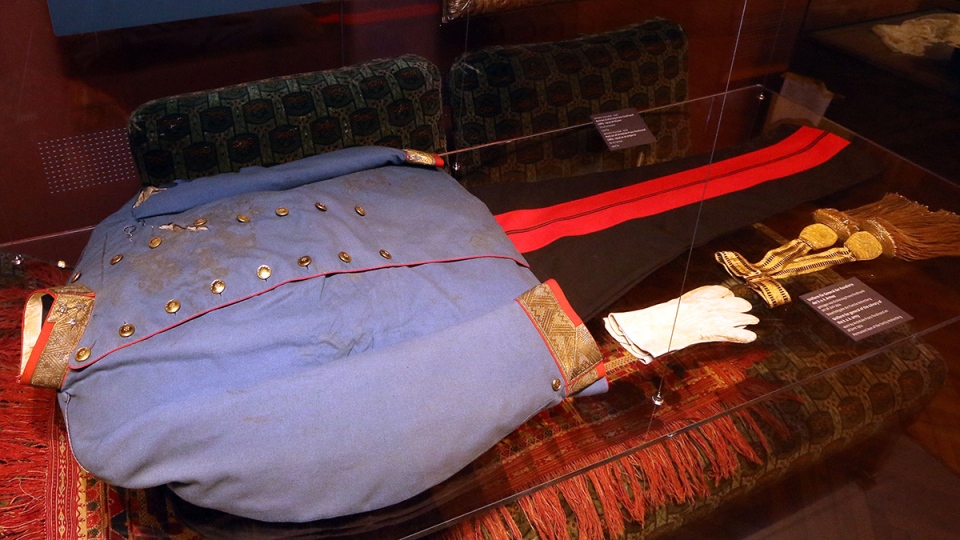
Archduke Franz Ferdinand's jacket is displayed at the Museum of Military History, Vienna, for much the same reasons as Brock's jacket is on display at the War Museum. The blood stain spread across the chest of the jacket embodies the violent changes in world geopolitics resulting from Ferdinand's assassination; it bridges the 'before' and 'after' in our understanding of the start of WWI.

Colour photograph of a blue military uniform, with a stain on the chest.
Archduke Franz Ferdinand's jacket on display at the Museum of Military History, Vienna.
Photo credit: AP/Ronald Zak.
If the bullet hole in Brock's jacket is unsettling, then the prominent stains on Ferdinand's jacket are downright macabre.

Ferdinand was a victim of both human will and mysterious circumstance; an assassination attempt had been mangled throughout the day, and his eventual assassin, Gavrilo Princip, had, in fact, given up on killing the archduke. A series of bizarre coincidences later--a changed route for the archduke's car, Princip's decision to stop for a sandwich--and suddenly Ferdinand appeared right before his assassin, who took his opportunity to fire on the car. Interestingly, many sources offer a harsh aside, that it was Ferdinand's vanity that hastened his death, and subsequently, the onset of war.

You see, Ferdinand had reportedly been sewn in to his jacket, in order for it to look more streamlined. Unable to strip the archduke of his clothes in order to see the wound, those who tried to help him were apparently forced to waste time cutting the jacket off of him.

As with Brock, the jacket was not the cause of the man's death, but its display is tangled up in notions of narrative-building and representation; the (possibly untrue!) story of the coat has become caught up with the representation of the archduke, and by extension, the history of Europe.

3. Red wool coats at the Battle of Ridgeway, Canada

In the fifty-odd years between 1812 and 1866, red coats did not disappear for anyone involved in the British army.  

Illustrated print, showing a battle, with soldiers in green on the left and soldiers in red on the right.
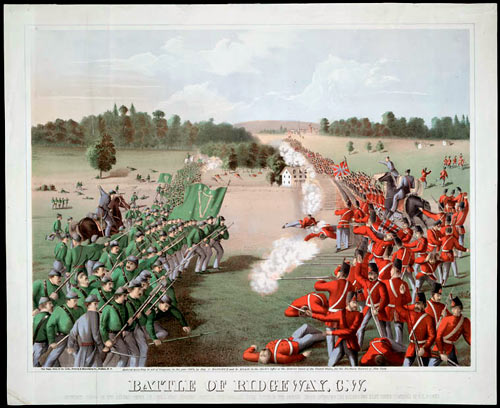
Fenians on the left in green, the 13th Battalion and the Queen's Own Rifles in red on the right.
Image credit: The Sage, Sons & Co. Lith. (Library and Archives Canada, Acc. No. 1946-35-1).

Unfortunately, the Battle of Ridgeway was in June. Sent out to battle without canteens for water, and wearing wool greatcoats on top of their red jackets, the soldiers were nearly overcome with heat. They eventually took to carrying the coats over their arms, before leaving them in piles when they neared a battle site.

It is not so much the wearing of wool in the summer or the wearing of the red coats that I want to focus on--obviously, as in 1812, the Canadians were highly visible on the battlefield--but the depiction of the two sides in highly publicized, highly inaccurate illustrations of the battle. The redcoats, in their usual bright splendour, face off against green-coated, Irish-American Fenians. In reality, the Fenians largely wore repurposed uniforms from the American Civil War, in greys and blues that easily blended in with the landscape. The display of such images build a narrative around the battle and the combatants, as if the Fenians engaged in using clothing to define their cause and character in a manner similar to the British. The display of the ubiquitous redcoats influences what is displayed around it--and thus the narrative grip of fashion can entirely muddle reality.

Sources Consulted: 

Barnes, Major R.M. 1972. A History of the Regiments & Uniforms of the British Army. London: Sphere Books Ltd.

Houze, Rebecca. 2015. Textiles, Fashion, and Design Reforms in Austria-Hungary Before the First World War: Principles of Dress. The Histories of Material Culture and Collecting, 1700-1950. Burlinton, V.T.: Ashgate Publishing Company. 

Marsh, James H. 2013. "Isaac Brock: Fallen Hero." The Canadian Encyclopedia. http://www.thecanadianencyclopedia.ca/en/article/isaac-brock-fallen-hero-feature/

Vronsky, Peter. 2012. Ridgeway: The American Fenian Invasion and the 1866 Battle that Made Canada: The History of Canada. Penguin Global. 

20 February 2015

SMALL-SCALE STYLE: DOLLS, DOLL CLOTHES, AND PROVENANCE

SEW WHAT?

BY: ANYA BAKER

There used to be a museum in my hometown of Fort Erie, Ontario called the Mildred M. Mahoney Dollhouse Museum. The museum was a historic home full of small-scale historic homes, either built and furnished by Mrs. Mahoney, or acquired by her. It closed in 2010, but, after being a fixture of the local museum scene for almost two-and-a-half decades, people still know the building by the museum's name, and tourists still ask directions to it, unaware of its closing.

As far as museums go, it was a bit unconventional. Labels were minimalist. The owner, Mrs. Mahoney, had built the collection privately over thirty-seven years, and had then secured the building to showcase and house all of the dollhouses. As a result, it was a collection of stuff that she had either made herself, or that she subjectively liked, presented almost as if they were art pieces in a gallery. It really was a collections-based space, with little attempt at storytelling or interpretation.

I was reminded of the Dollhouse Museum while on a tour of the City of Toronto Museums' Historical Collection last week. A recent acquisition to that collection was a pair of dolls from Eaton's, which were accompanied by a box full of handmade clothes.

Colour photo of a group of people standing in a room around a table bearing two dolls and some boxes; bookshelves line the wall behind them.
Neil Brochu (centre) talks about the two well-dressed dolls on the table at the City of Toronto Museums' Historical Collection.
Image credit: Anya Baker.
 I think a lot of people have dolls like these packed up in a box in their attic or basement. My family sure does--my mother's knock-off Barbie doll from the 1960s with matted hair, wearing a groovy shift dress that my grandmother made. The dolls at the Historical Collection are in much better condition, and have a truly spectacular wardrobe--they were obviously cherished and carefully stored. Taken as an example of period fashion, they are great distillations of whatever was popular and stylish at the time.

But more than that, they have a story attached to them. They have provenance! 

The two dolls and their box of clothes have a really cute story; all outfits were made in complementary pairs so that both dolls could be dressed alike, and there were particular outfits for special occasions like Christmas. But the connection of the mother to her child's dolls is of special interest to me; her artistry and sewing skills were very apparent in the outfits. Yet, this kind of domestic artistry is often overlooked or dismissed--ordinary clothing sewn for family members or playthings sewn or crafted out of scraps are not necessarily on the same level as wedding dresses and pocket watches in the public appreciation of heirlooms.

That provenance, and particularly, the connection of a maker to her handicraft, is so important to museum collections elevates domestic sewing to the level of art. In thinking back on Mrs. Mahoney's self-constructed collection--and her determination in showcasing it like art, without embellishment or contextualization--it is clear that she saw serious artistic value in her own domestic handicrafts. She owned dollhouses from all parts of the world and from many different time periods: the provenance of her pieces as being owned by her, whether self-created or acquired elsewhere, were what justified their inclusion in the museum space. Having museum spaces that prioritize the provenance of their collections gives the domestic sewing and crafting of ordinary women a space in which to be celebrated and recognized as historically important. 

A dollhouse from the Mahoney collection, up for auction.
Image credit: Plato Auctions, auctionsfind.com
The Mildren M. Mahoney Dollhouse Museum was as much about the personality and life of Mrs. Mahoney as it was about the dollhouses. Her contributions to her own collection, her careful artistry over the years, and her commitment to preserving what she had built as a non-professional artisan and self-guided collector endear her to me, at least, as someone with a keen sense for what make museum collections important and valuable.

23 January 2015

FUTURE-FASHION PREDICTIONS SAY AS MUCH ABOUT THE PRESENT AS THEY DO THE FUTURE

SEW WHAT?

BY: ANYA BAKER

It’s 2015. We’re living in the future predicted by Back to the Future II--only we were promised a lot more neon fabric and translucent plastic accessories (and hoverboards).

Four people in outlandish clothes stand outdoors.
Credit: Universal Pictures.
Two children in bright clothing stand beside a gaming machine.
Credit: Universal Pictures.

The costume department wasn’t too far off, though. The basic cuts, silhouettes, and embellishments favoured by the film are currently being purloined for contemporary fashion--even at fast fashion stores like H&M and Forever 21. The thing of it is, though, that the clothing is not being described as future-fashion, or a bold new look for 2015. What people in 1989 thought that ordinary people might wear in 2015 is what people in 2015 think that ordinary people in 1989 might have worn. We’re not wearing lucite headbands yet, but it’s considered an homage to the 80s to be wearing high-waisted denim and big slouchy sweaters right now. Current designers are quite happy to take what was popular anywhere from 20 to 100 years ago and give it a contemporary spin. Similarly, the designers for Back to the Future II, when faced with predicting what style might be 20 years down the road, decided that people would probably dress about the same, only weirder. Other film costumers did the same: we’re only a five years away from seeing if Blade Runner’s prediction for the return of very aggressive 80s shoulder pads is accurate (they're already returning to high fashion). 
 
Polaroid photo of a young woman against a neutral backdrop.
Credit: Sean Young.

Obviously, Back the Future II and Blade Runner are not controlling the fashion industry, and though their existence and continued popularity certainly fuels runway homages and 80s nostalgia, current designers are probably not intent on fulfilling 20-year-old predictions from sci-fi movies in their Spring collections. But future-fashion, when held up against the endless cycle of influence and recycled trends, starts to look less like a bold vision of what is to come, and more like a distillation and exaggeration of whatever is current. People can only predict based on what they already know; people can only create based on what they know. Even current designers, exhibiting Fall trends months in advance of Fall, are doing their own small-scale future-fashion predictions. 

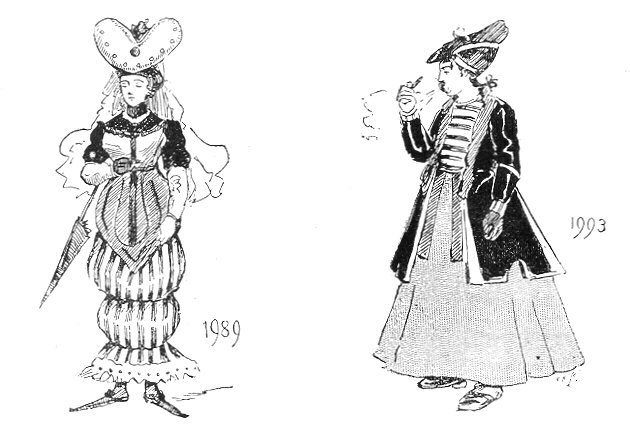
The expectation that future people will wear slightly distorted versions of whatever is in our own wardrobes is not a new idea. I started to think about future-fashion when I stumbled across an online version of a satirical article for The Strand Magazine by W. Cade Gall, published originally in 1893, called the “Future Dictates of Fashion.” 

Drawing of two women in long dresses and wild hats.
Credit: W. Cade Gall.

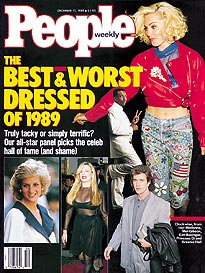
The year 2015 falls outside of its predictions; the last drawing is for 1993. But we do get a great get-up for 1989, the year both Back the Future II and Blade Runner were released. With more than 100 years between Gall and 1989, he couldn't know that it would look like this:

Magazine cover from 1989 showing photos of men and women in contemporary styles.
Credit: People Magazine.

The weird hat (future-fashion seems to expect a lot of strange head-gear) is also a little far removed from fashion in Gall's time, but the 1989 outfit is very much a satirized and exaggerated version of a woman's dress in 1893. Moreover, even though he didn't guess that everyone would be wearing jeans, he did predict Gunne Sax and the 1960s-80s fascination with faux-Victorian and faux-Edwardian clothing.

So, what does the future hold for us in terms of fashion? More importantly, what should we save in the backs our closets in order to preserve the essence of 2015 style? 

Photo of three people standing in a large crowd, wearing formal attire.
Credit: Warner Bros.

From the upcoming film Jupiter Ascending, we have more strange headgear predicted for the future, lots of colourful fabrics, and the see-through, beaded formal dresses that have been everywhere on the runway in the past few years.

Three people and one tree being standing in front of a circular doorway.
Credit: Marvel.

And from Guardians of the Galaxy (itself an homage to the 1980s), we have leather. In 20 years or so we can browse through the stores and see what we got it right, and if our 2015 beaded dresses and leather jackets will be in textile museums as examples of original 2015 style.