Showing posts with label Featured Object. Show all posts

4 December 2015

THE DARKER SIDE OF 3D PRINTING

OBJECT OF THE WEEK

BY: ROWENA MCGOWAN

Before I get into the meat of this post, there is something that I want to make absolutely clear: Semaphore has never made a functional gun. Semaphore will never make a functional gun, unless it is legal and in full cooperation with the police.

Now that’s over with – man, is 3D printing the coolest thing ever or what?

3D printing is just what it sounds like – printing 3-dimensional objects. An object is built up through the laying down of thousands of thin layers. It’s most commonly done in plastic but objects can also be printed in nylon, metal and other materials. It’s a wild new frontier in manufacturing. It’s even been suggested that 3D printing could overthrow the current capitalist system by putting the means of production in the hands of ordinary people.

We made it, guys! It's the future! Source.

It sounds wonderfully utopian in theory. Who wouldn’t want to print their own toys, their own clothes, even their own food? But what happens when a less desirable pattern becomes available?

That question jumped to the forefront of many people’s minds on May 5, 2013, when Cody Wilson released his pattern for a 3D printed gun, which he named the Liberator. I wouldn’t call it a panic exactly but people began to ask questions about what 3D printing was really capable of. There are currently no regulations on 3D printer ownership and use. And, unlike a traditional gun, the Liberator can be printed completely out of plastic, making it undetectable using traditional methods.

The Liberator in the process of being printed. Photo credit: Daniel Southwick.

I’ll be the first to admit that the idea of anyone being able to print a gun at any time is pretty scary. But how much of that fear is just hype? Is it actually possible to just download the pattern and go?

The iSchool’s own Semaphore, a research cluster dedicated to investigating emergent technologies and society’s relationship with them, decided to wrestle with that question. A team consisting of Dr. Matt Ratto, Isaac Record, ginger coons and Daniel Southwick attempted to print the Liberator.

The original plan was to print a fully functional gun and see just how easy it was to create such a thing. But, unfortunately for the team (although perhaps fortunately for us!), gun control laws in Canada are pretty strict. The team did attempt to partner with the police but things just didn’t work out in the timeframe they had.

So, they altered the pattern, to make sure that their gun didn’t actually function. The gun they eventually came up with had several parts reoriented, a plug glued into the slot for the firing pin and was printed in clear resin, a far more delicate material than called for in the pattern. It took 17 hours to print the full gun.

Showing off some of the Liberator's alterations. Photo credit: Daniel Southwick.

Can anyone print a gun now? The team concluded that, theoretically, yes. But in practice, no.

3D printers are not cheap, especially 3D printers which are good enough to make large and complex prints. And 3D printing does in fact require skill. It took four people who study 3D printing three days to get the gun printed and together. And even if they hadn’t altered the final product, the team doesn’t consider the gun to be particularly dangerous. As Dr. Ratto pointed out, you could kill someone with it. . . if they were only three feet away.


The Liberator, before assembly. Photo credit: Daniel Southwick.

Does that mean that we never have to worry about 3D printed weapons? Of course not. 3D printing is advancing in leaps and bounds. Someday, it probably will be that easy to print a gun (or a sword or a bomb). And that means we’ll have to grapple with these big questions of control. How do you keep someone from printing a gun? The simplest answer is to ban or regulate 3D printers. But is that really the route we want to go? 3D printing has the potential to be dangerous but it also has the potential to be amazing. Let’s take the time to really think about how society should and will adapt to 3D printing, before we panic and outlaw something that could literally revolutionize our world.

The team with the fully assembled Liberator. From left: Matt Ratto, Isaac Record, Daniel Southwick and ginger coons. Source.


Works Consulted:

Record, I., Southwick, D., coons, g., & Ratto, M. (2014). Regulating the Liberator: Prospects for government regulation of 3D printing. Journal of Peer Production.

Giovannetti, J. (2013, July 2). U of T team's DIY handgun tests the potential of 3-d printing. The Globe and Mail. Retrieved from http://www.theglobeandmail.com/technology/u-of-t-teams-diy-handgun-tests-the-potential-of-3-d-printing/article12943852/


Special thanks to Daniel Southwick and Dr. Matt Ratto, two men I would trust with a 3D printer any day of the week.


If you would like to experience the wonders of 3D printing for yourself, Semaphore holds an open Critical Making Lab almost every Friday from 9:30 - 11:30. I can personally attest that everyone in the lab is knowledgeable, patient and willing to answer endless questions.

6 November 2015

REMARKING ON THE UNREMARKABLE

OBJECT OF THE WEEK

BY: ROWENA MCGOWAN

There are some artifacts that are universally acknowledged as pretty darn cool. No one is going to give you a strange look if you say you love Tutankhamun’s mask, the Venus de Milo or the Antikythera Mechanism. But then there are the other objects in museums – the small ones, the obscure ones, the ones that most people breeze right past. This is one such object:

Tomb figure at the Royal Ontario Museum. Photo by Rowena McGowan

It’s a Ming tomb figure located in the Chinese Architecture Gallery at the Royal Ontario Museum and, even if you’ve been to the ROM a hundred times, you may have missed it. It’s not set apart in any way. It’s in a case with a bunch of other, incredibly similar figures. It’s not even a particularly centrally placed case.

Culturally, there’s nothing particularly special about this particular figure either. It’s a tomb figure, which have been used in China since the Western Zhou Dynasty (1046–771 BC). Tomb figures are fairly interesting as a broad cultural phenomenon. They were figures of people, animals or household implements placed in the tomb. They were also, in many ways, a compassionate item – before the introduction of tomb figures, those servants in the afterlife would be living humans and animals, buried alive to serve their master in death as they had in life.

Tomb figures arguably reached their zenith during the Tang Dynasty. They were produced en masse and there were actually rules governing how many figures a person of each rank could place in their tomb. These rules tended to be ignored, of course, because people are people. Aesthetically, Tang figures were beautifully made, with a great deal of life and movement.

Tang tomb figure in the British Museum. Source.

By the Ming Dynasty, the creation of tomb figures was not so skilled. A quick history lesson: the Ming Dynasty was the first dynasty after Mongol rule was overthrown in China.

Yep, these guys. Source.

The creation of tomb figures hadn’t stopped during Mongol Rule but it had declined. The Mongols had different burial traditions, less rooted in ancestor worship and feng shui. However, after so many years under the rule of invaders, it was important to the Ming government to return to more traditional Chinese culture. Cultural cues were deliberately taken from both the Song and Tang Dynasties, which means that tomb figures were very much back in fashion.

Unfortunately, the figures produced during the Ming Dynasty were not nearly as aesthetically beautiful as those from the Tang Dynasty. Figures were much stiffer and had far less personality. You can see that stiffness in my figure; the movement of the horse is quite unnatural.

So, having established that there is absolutely nothing remarkable about this particular figure, either historically or aesthetically, why on Earth is it the Object of the Week?

Put simply, because I like it and even I’m not really sure why. Is it because it’s ever so slightly different from the other figures? Is it that little face turned up towards mine or the horse tossing its head, be it ever so stiffly?

It’s easy to see why a person would fall in love with a big, romantic artifact like the Parthenon Marbles. But I don’t think I’m alone in also occasionally falling in love with something completely and totally unremarkable. And why not? We’re museum people. We are all about the objects. Let’s celebrate not only the big but the small, not only the well-known but the obscure. Let’s love unremarkable objects without having to justify ourselves. Let’s love objects just because we do.


Shine on, you crazy diamond.


Works Consulted:

Vainker, S. J. (1991). Chinese pottery and porcelain: From prehistory to the present. New York: George Braziller.

Jacobsen, R. D. (2013). Celestial horses & long sleeve dancers: The David W. Dewey collection of ancient Chinese tomb sculpture.

9 October 2015

THE WORLD'S OLDEST COMPUTER?

OBJECT OF THE WEEK

BY: ROWENA MCGOWAN

What came first, the printing press or the computer? What a silly, obvious question, right? It’s clearly the computer!

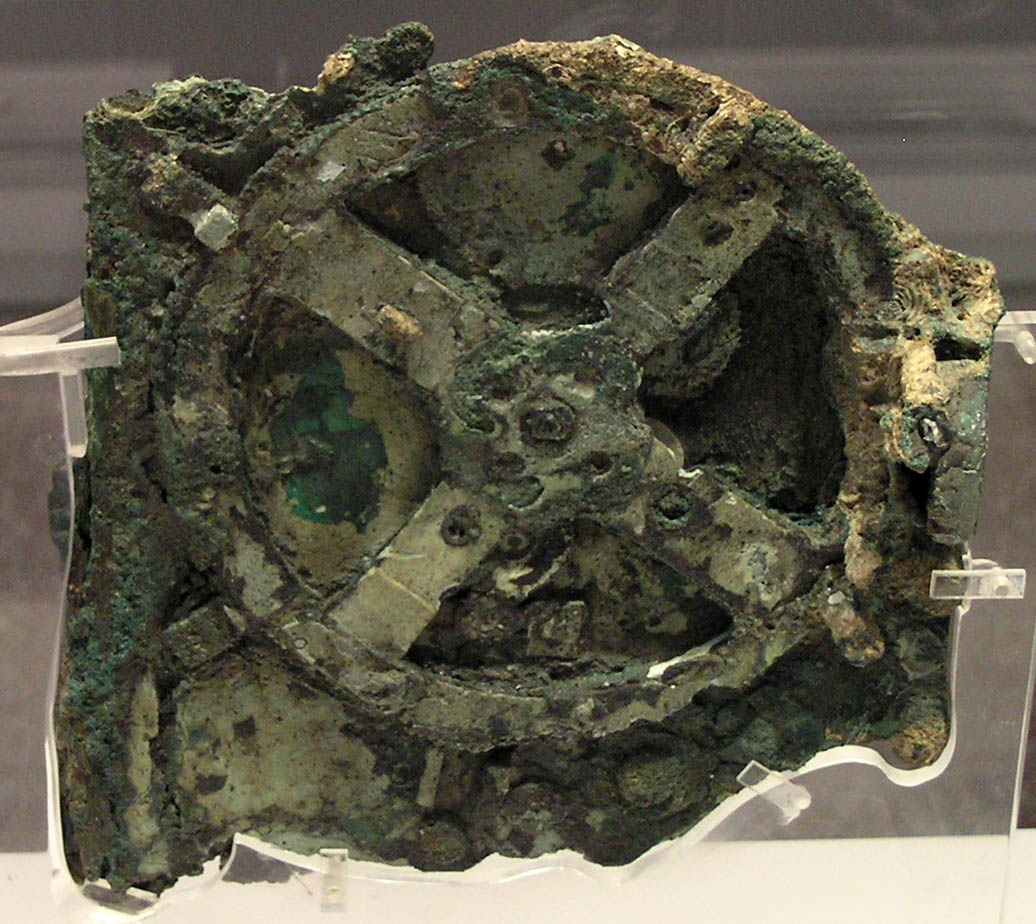
Meet the Antikythera Mechanism, which could have been made as early as 220 B.C. (yes, that’s B.C.). Looks a bit steampunk, doesn’t it?

 
Fragment of the Antikythera Mechanism. Source.

The Antikythera Mechanism comes from a submerged Roman-era shipwreck, which was discovered by sponge divers off the coast of Antikythera, Greece (hence the name) in 1900. Excavations of the ship started later that year and continued until 1901, although it has been investigated many times since, including this year! Since the ship was a merchant vessel, it was filled with statues and other artifacts.

The Antikythera Mechanism wasn’t a particularly impressive sight when it was first found, just lumps of corroded metal. 82 fragments were recovered. They, along with the rest of the shipwreck’s objects, were sent to the National Museum of Archaeology in Athens, where they remain to this day.

 
Fragments of the Antikythera Mechanism on display at the National Museum of Archaeology. 
Photo by Rowena McGowan.

It didn’t take researchers long to discover that the mechanism was something special. The development of techniques such as radiography and CT scans allowed the interior of the mechanism to be examined, which revealed new details about how it might have worked and inscriptions on the inside.

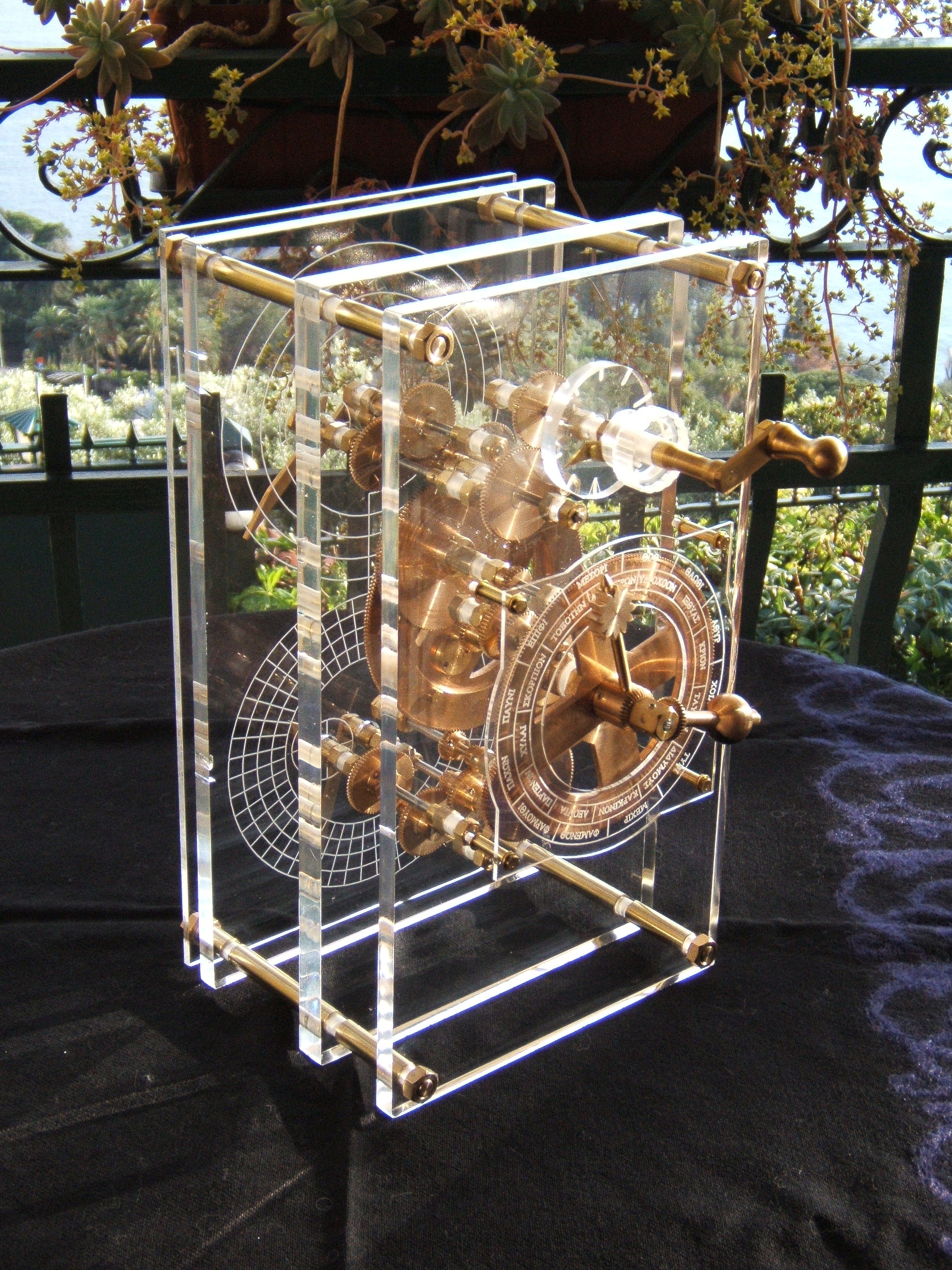
Calling it a ‘computer’ is actually a bit of an exaggeration and I’ll explain why I deliberately used that word in a paragraph or two. That doesn’t mean it’s not a complex and important piece of technology, however. The mechanism is more correctly referred to as an astronomical calculator. It was capable of showing lunar and solar cycles, as well as the positions of various stars and planets. We still aren’t completely sure how it worked or what the full mechanism would have looked like, although various theories have been proposed.

 Reconstruction of the mechanism. Source.

The story of the Antikythera Mechanism provides an interesting lesson on spin and publicity. Some accounts of the mechanism like to dress it up as centuries before its time, an ancient marvel (hence why I initially referred to it as an ancient computer). In fact, three of the top frequently asked questions on the Antikythera Mechanism Research Project website are ‘Is it fake?’, ‘Is it evidence of time travel?’ and ‘Was it left by aliens?’ The answer to all of these questions is a resounding NO!

The Antikythera Mechanism is an extraordinary artifact and, yes, unique – but only because of its survival. Ancient Greece had a long and well-documented history of scientific, mechanical and astronomical development. The mechanism, far from being ahead of its time, fits neatly into that history. We have evidence from no less a person than Cicero that Archimedes was making astronomical machines, years before the creation of the Antikythera Mechanism. The strangest thing about the mechanism is that it managed to survive into the 21st century – it’s special because of its uniqueness now, not because of its uniqueness at the time it was made.

Which raises an interesting question about the way we perceive the ancient world. Why are we so likely to assume that people who lived in the past were primitives, incapable of the same complex reasoning and technological skill that we are today? Why is it more logical to some people that aliens came to Earth and left their technology behind, rather than that people back then were just as curious, just as clever and just as inventive as we are today?


Sources

Academic Team of the Antikythera Mechanism Research Project. (2015).The Antikythera Mechanism Research Project. Retrieved from http://www.antikythera-mechanism.gr

Edmunds, M. G. (2014). The antikythera mechanism and the mechanical universe. Contemporary Physics, 55(4), 263-285. doi:10.1080/00107514.2014.927280

Freeth, T. (2009). Decoding an Ancient Computer. Scientific American. Retrieved from http://www.cs.virginia.edu/~robins/Decoding_an_Ancient_Computer.pdf


25 September 2015

ONLY IN DREAMS: THE SURREALIST DREAM OBJECT


OBJECT OF THE WEEK

BY: NATANIA SHERMAN

There’s something to be said for the allure of objects. The world is full of things that inspire our desire, sentiment, nostalgia and countless other emotions. I, myself form deep emotional attachments to inanimate objects, and a major part of my attraction to Museum Studies was a love and passion for objects. Being part of a consumer society means living with stuff. There is no piece of art or design that reveals our complicated relationship with our stuff quite as much as the Surrealist dream object.

The Surrealist dream object has its origins in the book L'Amour Fou, published in 1937, by poet André Breton, de-facto leader of the Surrealist movement. Breton describes coming across a “slipper spoon” in a flea market. The “slipper spoon” is a tiny spoon like-object that might be used as a shoehorn. André Breton didn’t know exactly what it was, only that when he saw it, he was overwhelmed with a sense of déja-vu, because the obscure little spoon was an artifact from his dreams (Malt 77). Breton then went on to write rapturous stories about his experience of finding the "slipper spoon."

Andre Breton's "Slipper Spoon":
Andre Breton's slipper spoon, photographed by Man Ray (Image Source)

Breton was not a visual artist, he was a poet and writer, but his ideas about dream objects resonated with the group of artists and poets who would come to form the Surrealists in the years between World War I and World War II from 1919 until 1939. In Surrealist art, there are many incarnations of the dream object. The Surrealists, influenced by the burgeoning field of psychoanalysis, began to create artistic experiments based on dreams, and the element of chance. The dream object engages with both of these ideas because it is something that one finds through luck, and its power lies in the objects’ impact on the finder’s imagination (Malt 78). The act of confronting a dream object is much like browsing a department store for something that you can’t quite describe until you find yourself in it's presence. Some artists interpreted Breton’s ideas as found objects, and used junk shop ephemera in their art. Eventually many artists began to create their own dream objects out of composites of other items. These fabricated dream objects were likewise a response to André Breton’s ideas. “I recently proposed to fabricate, in so far as possible, certain objects which are approached only in dreams… To throw further discredit on those creatures and things of reason” (Ades 73). The resulting sculptures, in Breton’s words, are as “beautiful as the chance encounter of the sewing machine and the umbrella on a dissecting table.”

My personal favourite of these composite dream objects is Meret Oppenheim’s Fur Cup also known as Breakfast in Fur from 1936. The sensuality of this fur lined teacup is tinged with disgust, because despite the teacups inherent beauty, try to drink from it and you’re in for a surprise!

Breakfast in Fur by Meret Oppenheim from 1936 (Image Source)

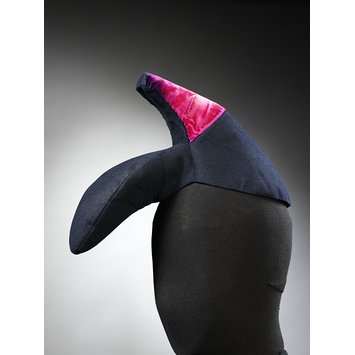
The breadth of the Surrealist dream object doesn’t stop at sculpture. The Surrealists dabbled in the commercial world as well (Wood 2). Elsa Schiaparelli, a prominent fashion designer at the time, incorporated Surrealist visual language into her couture collections, most notably in a series of shoe hats inspired by the drawings of painter, Salvador Dali, and in the packaging for her perfume, aptly named for the Surrealist raison d'etre, "Shocking."

Hat - Shoe Hat
Chapeau by Schiaparelli from 1937-8 (Image Source)

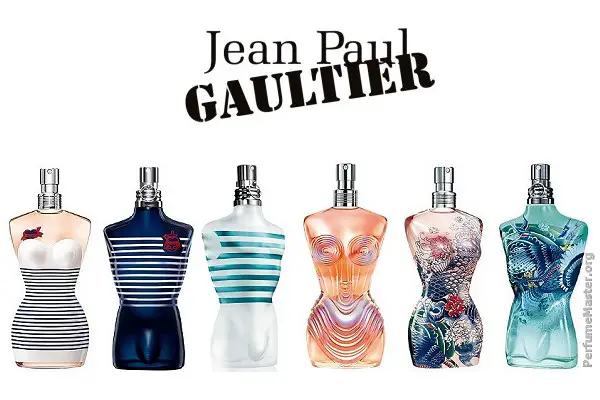
There has always been a tension in surrealist visual language between high art and commercial art. Even today, the legacy of the composite dream object exists in designer goods for consumption. One need only look in the perfume section of your local department store to see the impact that the Surrealist imagination has had on today’s design world.

Jean Paul Gaultier Perfume Collection 2013
Designer Jean Paul Gaultier's perfume bottles referencing a Schiaparelli design (Image source)

The surrealist dream object is a stand in for our desires. On the one hand, objects are an anchor. Their allure lies in their sensuality and ability to ground us in the physical world. On the other hand, objects allow us to travel through time. They can inspire dreams of the future or nostalgia for the past.  The objects in our dreams take on many forms, and the sense of recognition that André Breton describes upon first seeing his slipper spoon is one I’m sure many of us have once felt. It can happen in a sample sale downtown, a flea market in the suburbs or a collections vault in a museum. We are surrounded by objects both useful and otherwise, and if we can understand their power to enthral us, then we can begin to better understand ourselves.


Sources:

Ades, D. “Surrealism: Fetishism’s Job.” In Fetishism: Visualizing Power and Desire. London: The South Bank Centre; Brighton: Brighton Museum and Art Gallery, 1995, pp. 67-87.

Breton, André, "L'amour Fou/Mad Love" trans. May Anne Caws, Bison Books; Reprint edition 1988.

Malt J. “ The Surrealist Object in Theory.” In Obscure Objects of Desire: Surrealism, Fetishism and Politics. Oxford: Oxford University Press, 2004, pp.76-112.

Wood, Ghislaine ed. "Surreal Things: Surrealism and Design" V & A Publications, 2007.

3 April 2015

OLYMPIC PARTICIPATION MEDAL

FEATURED OBJECT

BY: KATHERINE HANNEMANN

You’ve almost arrived at the finish line -- you can see it just over the horizon. Maybe the sight of the finish inspires a burst of energy and allows you to sprint to the end, or maybe you are using every last bit of effort you can muster as you drag yourself along the last few metres.

Stephen Kiprotich, winner of the 2012 London Olympic Marathon. Source: OC Register 
However you approach it, our finish line is slightly different from that of a competitive running race: here, there is no first place winner who will grab a coveted trophy or medal before everyone else. As we cross our finish line of this academic year and, for some of us, the Museum Studies degree, we all have a victory to celebrate.

In this program, everyone has exerted enormous effort and will reap his or her own value from what we’ve all experienced and learned. Interestingly, while “going for gold” is clearly the focus of the Olympic Games, we can draw parallels between recognizing the efforts of all participants in our own program and in the Games. This leads me to today’s featured object: the Olympic Participation Medal.

Obverse of 1896 Olympic Participation Medal, featuring the goddess Nike holding a laurel wreath and a phoenix emerging from flames. Source: Olympic-Museum.de

The Olympic Participation Medal is the lesser-known counterpart to the gold, silver, and bronze medals that generate the most buzz during the Games. However, instead of being awarded to only a select few, all athletes, functionaries, and participants from the first modern Olympics in 1896 up until the most recent Games in Sochi has received one of these medals. Far from the blanket feel-good statement that “everyone’s a winner!”, the Olympic Participation Medal notably recognizes the enormous effort that is required in order to even make it to the Olympic Games.

Helsinki 1952 Olympic Participation Medal. Source: The Olympic Design
In my opinion, it is important to acknowledge athletic accomplishment outside of those few individuals who reach the podium. Too often in sports (and arguably in other fields as well), we are concerned with a single moment of “glory” as a qualifier for the worth and accomplishments of an individual or team. Yet it can be detrimental to let a single moment define who we are, whether we excel in sport or in another realm. Instead, pursuing a goal over the course of a lifetime with passion, dedication, and perseverance is what the Olympic Participation Medal attempts to reward.

Vancouver 2010 Olympic Participation Medal. Source: The Olympic Design
  
While several museums collect and display Olympic Participation Medals, notably museums that specialize in sport or Olympic history such as the Lake Placid Olympic Museum, they do not become the artifacts placed on a pedestal with their own security guard. (I'm thinking of the Stanley Cup on display in the Hockey Hall of Fame -- though the extra staff member might just be there to help visitors with their photos.) Instead, these medals represent personal and individual experiences, signifying memories unique to each owner.

And so, here’s to your own achievement as you reach the end of this term or the end of your degree. Regardless of how you feel when you cross the finish line -- whether you leap across victoriously or limp along, huffing and puffing -- try to remind yourself that it is not one job interview, presentation, or publication that defines you, but rather your ongoing dedication to your passion. And just drink some Gatorade and don’t forget to stretch, and you’ll be fine!

6 March 2015

THE COMIC BOOK AND SPEAKING THE "UNSPEAKABLE"

FEATURED OBJECT

BY: KATHERINE HANNEMANN

Did you read comic books when you were growing up? If so, did you follow the antics of Archie and his crew, or was it the death-defying adventures of Marvel superheroes that left you at the edge of your seat? Comic books are so often associated with free-wheeling, carefree, even rebellious youth -- a vision of Bart Simpson hiding his comics behind a history textbook comes to mind.

Bart Simpson can't help his love of comic books. Source: Simpsons Wikia 
Yet in recent years, comics and graphic novels have become recognized as a “legitimate” art form and literary genre. Through the work of many contemporary artists and authors, we have seen that comics are capable of so much more than previous understandings of the form as “low-brow,” mass-produced, bubble gum wrapper entertainment.

Case in point: the expansive and provocative career of Art Spiegelman. His body of work, which spans over four decades and continues to grow, grapples with some of the most intense personal and political struggles of his life and of recent history. Further, Spiegelman and his creations have been honoured by heavyweight literary establishments -- his graphic novel Maus won the Pulitzer Prize in 1992 -- and his work has been exhibited in museums and galleries worldwide. The exhibition “Art Spiegelman’s CO-MIX: A Retrospective” is currently installed at the AGO and features a hefty selection of Spiegelman’s drawings, trading cards, magazine covers, and manuscripts.

"Art Spiegelman's CO-MIX: A Retrospective" at the AGO. Source: Girl About Toronto

Art Spiegelman, "Self-portrait with Maus mask," 1989. Source: Tablet Mag

Arguably, the most influential and profound creations of his career are Maus and Maus II, a graphic novel and its sequel that took Spiegelman thirteen years to create. Through Maus, he attempts to grasp his parents’ history as Holocaust survivors by reviving and conveying his father’s devastating memories. While the Holocaust often has been described as “unspeakable” or “unrepresentable” because of the horrors beyond rationale that occurred in concentration camps, artists of countless media have been trying to cope with their own past or with cultural memories of the Holocaust since its occurrence. Spiegelman is no exception, and he too self-reflexively acknowledges the problems of representing the Holocaust in his own art:

Excerpt from Maus. Source: Maus and the Mask

“Just thinking about my book… it’s so presumptuous of me. I mean, I can’t even make any sense out of my relationship with my father… How am I supposed to make any sense out of Auschwitz?... of the Holocaust?”

However plagued by guilt and self-doubt, from Spiegelman’s memoir emerges the essence of grief, despair, and horror experienced by his parents and ultimately passed down to him. It also documents a historical memory of the Holocaust that can be accessible to generations well beyond our own.

Back cover art from Maus. Source: English 8: Intro to Maus

Although Spiegelman proves to be a master of the medium, not everyone agrees that the medium should be part of the literary canon. As it happens, the morning I visited the CO-MIX exhibition, I read the article “College, Poetry and Purpose” in the New York Times, which reflects on the meaning and value of higher education today. While I agree with the notion put forth in the article that a crucial element of the undergraduate experience is “developing the muscle of thoughtfulness,” there is some derision of particular English courses such as “Comic Books and Graphic Novels” as merely “capitalizing on what is fashionable.” In the case of Art Spiegelman, I sincerely doubt that the searing effects of his artistry will fade with the fashions of the times.

What do you think? Where else do we see the distinctions between “high” and “low” art blurred? Do graphic novels deserve a place in the canon?

Art Spiegelman’s CO-MIX: A Retrospective” will be on display at the AGO until March 15, 2015.

6 February 2015

A CANADIAN CONIFER

FEATURED OBJECT

BY: KATHERINE HANNEMANN

At this point I suppose I should know well enough that an object can contain any number of meanings -- and whether that object is living or artificial is beside the point. Sadly, I often find myself oblivious to natural elements when in “curated” spaces like museums, historic sites, or memorials, focusing instead on a building’s architecture, its interior design, and the arrangement of art and artifacts.
 
The Philosopher's Walk alongside the ROM. Source: lostphotograph
Of course, as Leah Maconda reminded us last week with her post about gardens, a natural space in or around a museum can be “a peripheral place where unique things happen and escape of a different nature is facilitated.” Leah’s discussion, paired with recent lessons on the possible interpretations of the coniferous tree, jolted me from my obliviousness and demanded my improved attention to natural details.

Learning about the potential meanings of the coniferous tree happened during a recent event at the ROM. On January 25, I attended the panel discussion “Memorializing the Holocaust in the 21st Century,” featuring the planners and designers of the National Holocaust Monument in Ottawa. The team brings an incredible diversity of disciplines and expertise to the project, and includes architect Daniel Libeskind, photographer Edward Burtynsky, landscape architect Claude Cormier, Lord Cultural Resources president Gail Lord and principal consultant Dov Goldstein, and content advisor and U of T professor Doris Bergen.

A birds-eye rendering of the National Holocaust Monument. Source: Holocaustmonument.ca

As each member of the team discussed his or her own contribution to the monument, it was clear how every square inch of it would be imbued with meaning. Libeskind talked about the symbolism of the star in this and other Jewish memorials and museums he has designed, as well as possible feelings evoked by the different angles of light and shadow the structure would create. Burtynsky ruminated on his haunting photographs of former concentration camps, overgrown after 70 years but still retaining traces of horror, which would be permanently impressed upon the walls of the monument.

A rendering of the monument from within. Source: Holocaustmonument.ca

When landscape architect Claude Cormier rose to discuss his contribution to the design using natural elements, I was struck by all the possible meanings of the coniferous trees that will surround the structure. Inspired by the resilience and persistent growth of coniferous trees in a far north climate that nurtures so little life, the trees will serve as a symbol of hope and life within the devastating context of the Holocaust. The conifers will also bring a Canadian element to the monument. Additionally, instead of soil, small pebbles will surround the trees: These pebbles were once jagged but have been softened over time, again acknowledging the years passed since the Holocaust happened but signalling its lasting presence -- and the need to continue to remember it.

Conifers in a boreal forest. Source: GlobalPost
Perhaps this approach to trees felt new to me, because whenever I have wandered through a forest or stepped through a grove, I’ve never been faced with their possible symbolic meanings -- but rather, I’ve taken the opportunity to experience them solely for their inherent features: the smell of sap, the stinging points of needles, the visual magnificence of a fully-grown fir. Now I know better to appreciate them both for their natural construction as well as their potential for interpretation.

9 January 2015

HOCKEY, FIGURE, SPEED ... SKATES!

FEATURED OBJECT

BY: KATHERINE HANNEMANN

Is it cold enough for you yet? This week of sub-zero temperatures was the first true test of my resolution to get out and embrace winter this year, instead of avoiding the outdoors and complaining bitterly about the cold until spring -- which is what I usually do.

One strategy that is helping me hold fast to my resolution: go ice skating as often as possible. With several free and well-maintained municipal ice rinks within a short walking distance of my apartment, it’s an easy strategy to adopt. To me, this abundance of accessible ice rinks is one of the great things about living in Toronto -- as well as a signifier of something quintessentially Canadian (although this is somewhat stereotypical, it’s also grounded in 19th- and 20th-century Canadian history, as we’ll explore in this post.)

Girls ice skating in Toronto, ca. 1910-1912. Source: City of Toronto Archives, via BlogTO

During my time at the iSchool, I have been examining connections between sport and identity, on both individual and national levels. In part, this has led me to consider the clear yet complex connection between skating (and its attendant activities: hockey, ice dancing, figure skating, recreation, etc.) and Canadian identity. In addition to my very important “research trips” (*ahem*) to my local ice rink, I have also been looking at historical objects and images and how they are represented in museums and halls of fame, in order to understand some of the connections between sport and identity.

Ice skates (ca. 1900-1910) manufactured by a blacksmith in the Montreal region. Source: McCord Museum

As my own athletic experience in ice skating remains recreational, for the purpose of this blog I will focus on recreational ice skating and skates in Canada. According to the McCord Museum in Montreal, ice skating was introduced in Canada around 1840 by British army officers. Over the next several decades, the trend took hold in Montreal and in other Canadian cities. As discussed in the Canadian Museum of History’s exhibition Lace Up: Canada’s Passion for Skating, Canada led the construction of indoor public rinks between 1860 and 1890, most notably with architecturally stunning buildings such as the Victoria Skating Rink in Montreal (pictured below).

A skating carnival at the Victoria Rink in Montreal, ca. 1870. Source: Canadian Museum of History

In the nineteenth century, recreational skating seemed to be an activity dominated by an elite subculture. However, the expansion of public skating rinks in the early twentieth century began to make skating more widely accessible. Another factor in the popularization of recreational ice skating was the increasing availability of skates themselves. For example, the Starr Manufacturing Company, a skate company founded in the 1860s in Dartmouth, Nova Scotia, was credited by the federal government for having “helped to establish ice skating and hockey as two of Canada’s favourite winter recreations.” The Starr skate and advertisement below come from the Nova Scotia Sport Hall of Fame.
Skate produced by the Starr Manufacturing Company in Dartmouth, NS. Source: Nova Scotia Sport Hall of Fame

An advertisement for the Starr ice skate pictured above, ca. 1910. Source: Nova Scotia Sport Hall of Fame

Although the diversity of Canada’s population makes it difficult to describe certain activities and symbols as “universally Canadian,” ice skating unquestionably has become associated with Canadian identity roughly since Confederation. Do you cope with winter by participating in this tradition? If skating isn’t your thing, try another cold-busting strategy -- hot chocolate!

14 November 2014

LUNCH, WITH A SIDE OF HERITAGE

FEATURED OBJECT

BY: KATHERINE HANNEMANN

One of the reasons why I love to write for the Featured Object column on Musings (and one of the reasons why I entered the Museum Studies program in the first place) is rooted in a great joy of mine: to wonder about, research, and uncover secrets and stories about the places we live in and the objects we encounter on a daily basis.

So you can imagine my delight and surprise while eating lunch at the Maple Leaf Gardens Loblaws recently, when a story itself jumped out from the lunch table and served up a side of heritage with my spicy rapini salad.

Public lunch table at Maple Leaf Gardens. Source: BlogTO

I sat at a public table on the second floor of the 60 Carlton Street Loblaws, finishing my meal and planning my next move into Joe Fresh for some post-lunch browsing. Suddenly I noticed that the table was covered not only in a collage of hockey photographs, but also featured a small square of text (or, to draw upon museum terminology -- a text panel!). On this panel I began to read about Bill Barilko, a legendary player for the Toronto Maple Leafs from 1947 to 1951. Within the span of a few minutes, I not only received my daily vitamin C intake, but also learned that Barilko scored the winning goal for the Toronto Maple Leafs at the 1951 Stanley Cup -- his final goal before his tragic death in a plane crash in August 1951.

This brief yet informative heritage lesson in the middle of my day was a welcome and unexpected addition to my routine. While providing an interesting moment in Toronto’s sport history, this lunch table collage also prompted me to reflect on how heritage buildings can remember and share their own rich history, as the Maple Leaf Gardens Loblaws does here.

Maple Leaf Gardens floorplan. Source: Heritage Toronto
Maple Leaf Gardens exterior. Source: SportsNet

Let’s take an even bigger step back from the table and take a look at the whole building itself. While newcomers to Toronto may only know Maple Leaf Gardens for its flagship Loblaws and Ryerson’s Mattamy Athletic Centre, the building’s life has encompassed so much more. Opened on November 12, 1931, Maple Leaf Gardens was, for many years, the primary sports arena in Toronto. Perhaps best known as the home rink for the Toronto Maple Leafs hockey team, Maple Leaf Gardens was also the site of multiple other sports games, such as Toronto Raptors (NBA) and Toronto Rock (National Lacrosse League). It also held major concerts (among them, The Beatles -- swoon) and events, such as Winston Churchill’s 1932 speech in Toronto. The original arena held its last function in 2000, a Toronto Rock lacrosse game.

Montreal Canadiens vs. Toronto Maple Leafs at Maple Leaf Gardens, 1964. Source: Heritage Toronto

In 2011, Loblaws opened its flagship grocery store in the historic Maple Leaf Gardens building. Amid the overwhelming amount of food and departments in this complex, including the “Amazing Wall of Cheese,” sushi bar, bakery, and cooking school, among others, it might be easy for shoppers to forget quickly the long and rich history of the original building.

Yet the store appears determined not to let the history of Maple Leaf Gardens fall by the wayside: in addition to the images and texts on the lunch tables that I encountered, evidence of the building’s heritage is peppered all throughout the store. Posters of The Beatles, Frank Sinatra, and other stars who performed at the Gardens wave above the aisles. Behind the main escalator hangs an unmissable larger-than-life maple leaf, crafted entirely out of the blue folding chairs that once lined the stadium -- an innovative display of artifacts, if I’ve ever seen one.

Stadium chairs on display at Loblaws. Source: Urban Toronto

All of these displays and artifacts work to retain memories of a building, whose current purpose varies significantly from its years as Toronto’s sports and entertainment hub. So go ahead, enjoy a side of heritage with your lunch -- and don’t forget to hit the Patisserie on your way out.

Cupcakes at Loblaws. Source: Suzie the Foodie Blog

17 October 2014

A MIDWESTERN MILKSHAKE MACHINE

FEATURED OBJECT

BY: KATHERINE HANNEMANN

For those of you who know me for my proud Midwestern heritage (and for my previous Object of the Week post on butter sculptures), you know well already that I am a lifelong fan of the Minnesota State Fair. To set the stage for those who haven’t yet heard me sing the praises of the Fair, visualize a 12-day festival spread out across several city blocks that brings together agriculture, crafts, music, farm animals, Garrison Keillor, rides, politicians, dairy products, and, of course, fried foods galore -- all proudly Minnesotan. And there you have it: the Great Minnesota Get-Together.

 
The entrance to the Minnesota State Fair. Photo Credit: Alfred Hannemann
So you may imagine my delight when my travels this summer not only brought me to Minnesota to attend the Fair, but also corresponded with the opening of the State Fair History and Heritage Center. A heritage center based on a cultural institution that I already love, developed by the ever-innovative Minnesota Historical Society and supplied with artifacts from the Minnesota State Fair Foundation? What could be more delightful? 

The History & Heritage Center at the Minnesota State Fair. Photo Credit: Katherine Hannemann
Aside from my unabashed child-like glee at this hybrid of two of my favourite institutions, from an objective standpoint I think that there can be a lot to learn from the methods, practices of display, and goals of the State Fair History and Heritage Center.

First, the History and Heritage Center provides a wonderful opportunity for fair-goers to explore an institution that they already attend and love -- but whose deeper knowledge of it just barely scratches the surface (which was certainly my case). Often one’s experience of the Fair can be pre-occupied with devouring the latest and most outrageous food trend or seeing the big-name headliner at the Grandstand. But to me, what makes that classic State Fair milkshake taste even sweeter is seeing its connection to the past, with photographs of similarly eager Dairy Building visitors in 1949 or the vintage milkshake machine that cranked out those frosty beverages in State Fairs past. The heritage center takes what we already love and shows us its origins, its connections to the state’s history, and others like us who enjoyed it in the past.

Frosty goodness: the Milkshake Machine at the Heritage Center. Photo Credit: Katherine Hannemann
The State Fair History and Heritage Center also takes a balanced and unique approach to presenting information and artifacts. The rotating text panel set-up allows for oodles of State Fair factoids -- without overwhelming visitors with massive amounts of text. These text panels also move to create larger images, like a puzzle, which creates interactive displays in a very analog way. 

Manually-rotating text panels at the Heritage Center. Photo Credit: Katherine Hannemann
Text panels can rotate to create a bigger image. Photo Credit: Katherine Hannemann
The building design itself is the perfect invitation for visitors to step in out of the hot August sun and explore the Fair’s past, with rows of open doors on either side of the triangular-shaped exhibit space. Of course this is not a viable option for year-round museums, but the design provides food for thought on how visitor and heritage centres within parks or public spaces could invite casual visitors walking by. This also created a multi-sensory museum experience -- the warm summer air wafted in, along with the smell of fried chicken and waffles from the food stand next door!

And as a permanent exhibit to be featured at the Fair in years to come, the exhibit developers welcomed and encouraged feedback from visitors to add their voices and opinions on the exhibit. The comment forms asked visitors, “What would you like to see added?” “What is your favorite fair memory and why?” and “For you, what is the importance of the new State Fair History & Heritage Center?” Along with the comment forms, the exhibit featured -- get this -- a real live curator and historian present to interact with visitors! My family obviously abandoned me because I spent too much time talking to the museum professional. 

Comment book at the Heritage Center. (I believe I was the only visitor taking a photo of the comment book.) Photo Credit: Katherine Hannemann

Above all, the History and Heritage Center was consistently packed with enthusiastic fair-goers interested in learning more about the Fair’s 150-year lifetime. I was certainly not the only one devouring all the offerings of the center like a delicious chocolatey milkshake. Kudos to the Fair Foundation and the Minnesota Historical Society for seizing an opportunity to share history and heritage with thousands of willing pupils.

An engaged visitor at the Heritage Center. Photo Credit: Katherine Hannemann

19 September 2014

STRINDBERG'S SELF PORTRAIT (OR SELFIE?)

FEATURED OBJECT

BY: KATHERINE HANNEMANN

At what point do you distinguish a self portrait from a selfie? Do you think the two are so similar as to have barely any difference at all, or do you think they are utterly opposite forms of self-expression? (Or, perhaps more likely, does your opinion lie somewhere in between?)

On several occasions over the past few years, I’ve noticed certain museums running with this selfie/self-portrait comparison. In some cases, I find this to be a forced connection, awkwardly yoking together two very different forms of expression for the sake of appealing to a young, tech-savvy crowd. I even wonder if in some ways it does a disservice to both artwork and visitor, wrongfully implying that, for example, a 15th-century Renaissance painting and an Instagram photo have more similarities than differences. Though I think visitors are clever enough to recognize the key differences, at times I think it’s an easy (and sometimes inappropriate) grab for museum programming.

So many selfies. Source: bms.co.in 
Of course, in this post I’m going to go against what I’ve just expressed and discuss an exhibition that, in my opinion, artfully and appropriately compares the self portrait and the selfie. And since you already know that the Object of the Week is Strindberg’s image, you guessed it: I’m talking about August Strindberg’s 19th-century “selfie.”  

August Strindberg. Source: American Swedish Institute

The exhibition I refer to, The Image of Strindberg, is currently on display at the American Swedish Institute (ASI) in Minneapolis, Minnesota. Instead of highlighting Strindberg’s most recognized contributions as a playwright, however, the exhibition focuses on a series of his self portraits. It distinguishes the images into the varied identities Strindberg attempted to create for himself; among them, “the Madman,” “the Jealous One,” and my personal favourite, “the Vain One.”
The Image of Strindberg at the American Swedish Institute. Source: @AmSwedInstitute

Among the many reasons why I think the exhibition appropriately draws the selfie connection is the emphasis on Strindberg’s careful creation (or, buzzword, “curation”) of his own brand -- and then the massive distribution of his brand and images. Through hundreds of self portrait postcards he distributed to quite literally his entire social network, Strindberg created a 19th-century equivalent of the Instagram, Facebook post or tweet. Further, self-portraiture wasn’t his primary occupation or art form (“Miss Julie,” anyone?) -- so, like social media, it was something he kept up on the side to fuel the aura of his personality.

 
August Strindberg. Source: Stockholm Our Way

And the ASI does not just make a clean comparison to the selfie and leave it at that. Importantly, it notes that Strindberg created a “visual calling card” in a way that was uncommon in his time. Unlike social media today, in which everyone participates and anyone can craft a half-decent selfie, Strindberg was a “master storyteller,” innovating and dominating in a medium that was as yet uncharted territory.

But what I think is most valuable in the ASI’s approach to Strindberg’s self portrait is its questioning of how we really can read Strindberg’s identity in his images. The exhibition asks, “Out of the hundreds of self-promoting images he produced, do any of them accurately capture the man himself?” And while the ASI has fun with the concept of the selfie (see the opportunity to take a "Strindberg Selfie" below), with this question it allows us to ask ourselves what kind of identities our selfies project, and whether they can ever really align with the identities outside of the pictures. And throwing the selfie in a critical light is something I can stand behind.

Karin Hannemann and the author taking a "Strindberg Selfie" at the ASI. Source: Alfred Hannemann