Showing posts with label Sport Heritage. Show all posts

21 January 2016

TOBOGGANING: THRILL RIDE OR THE SLIPPERY SLOPE OF SIN?

THROWBACK THURSDAY

BY: JOCELYN KENT

With Toronto’s winter weather returning this month to a semblance of its usual snowy self, it may soon by possible to partake in the beloved pastime of tobogganing in city parks. One hundred years ago, though, tobogganing was not a childhood game, but an athletic craze sweeping the Western world... with a supposedly seedy underbelly.

LIVE FAST, DIE YOUNG. TOBOGGANERS DO IT WELL.

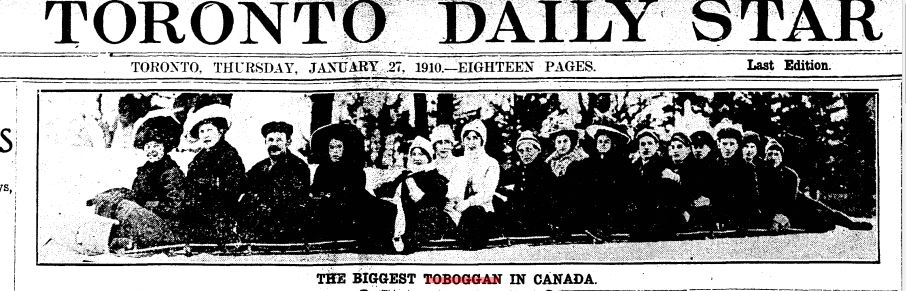
Front page of the Toronto Star featuring a 16-person toboggan built by Torontonian Walter Denis. Source.
The toboggan first rose to popularity amongst Canadian colonists in the late nineteenth-century, given a shot of respectability by the much-publicized construction of a toboggan run at Rideau Hall in 1872 to accommodate Lady Dufferin, wife of the Governor General and an early fan of the sport.

In the era prior to the automobile and powered flight, tobogganing was the ultimate thrill. Journalist Ed Ruthven, writing in 1884, found it:

“more than merely exhilarating. A quarter of a mile in fourteen seconds, the first part of the journey down a hill the descent of which is like falling off a roof of a four-storey house, is calculated to quicken the pulse to a point which ‘exhilaration’ is not sufficiently strong to do justice. Yes, tobogganing is becoming an institution and a hair-raising, breath-catching, glorious institution it is.”

Tourism brochure illustrating Montreal's famous tobogganing runs (1926). Source.
Tobogganing was soon part of winter festivals throughout eastern Canada, drawing the attention of American visitors, men and women, who flocked northward in ever-greater numbers to indulge in the sport.

A conspicuous part of the craze was the tobogganing outfit, made popular by Canadian tobogganing clubs. In 1891, an American periodical, Ladies’ Home Journal, proclaimed that “no more becoming costume has ever been devised than that which is sacred to snow-shoeing and tobogganing. The constituents are simple enough: a toque, a blanket coat, a sash and a pair of moccasins.”

Members of the Tuque Bleu Toboggan Club all decked out (c. 1880). Source.
Being seen on the snow hill in “the Canadian style” became so popular that American tourists prepared their ensembles, and personalizing them with their own colour schemes, in advance. Canadian photography studios specialized in tobogganing scenes (with powdered salt for snow) in which subjects could flaunt their outfits for posterity.

So popular was tobogganing, that a means of enjoying in summer was devised: the rollercoaster, a toboggan (or coaster) on wheels.

Critical to the success to tobogganing was the inclusion of women. Other sporting clubs could restrict female membership by claiming that their delicate constitutions could not handle the rigours of athletic activity. In tobogganing, commonly seen as a leisure activity, women could face the danger and demands of the sport alongside men – making it a breakthrough sport for women. The character of the “fast girl,” the expert female tobogganer, was created.

“THE TOBOGGAN HILLS AT NIGHT… NOTHING LESS THAN MORAL RUIN”

The sexual tension on this toboggan is palpable. Source.
Tobogganing, during the Victorian period, quickly drew criticism for the proximity, even the intimacy, of male and female participants. A guest to Rideau Hall in 1871 first noticed of tobogganing that “Ladies go in for it. I think they like rolling over and over with the gentlemen." In Montreal, one clergyman denounced toboggan runs as “places of immorality for young girls,” another argued that “the temptation young men and young women were exposed to on the toboggan hills at night was nothing less than moral ruin.”

It's a short ride from cider to grave. Temperance movement poster from 1887. Source.
So synonymous with sin was tobogganing that a Ministerial Association meeting in 1912 gave equal time to discussing the evils of the sport and the plague of prostitution rings supplied by white slavers. Toboggan runs even became a common metaphor for the irreversible downward trajectory of sinful living.

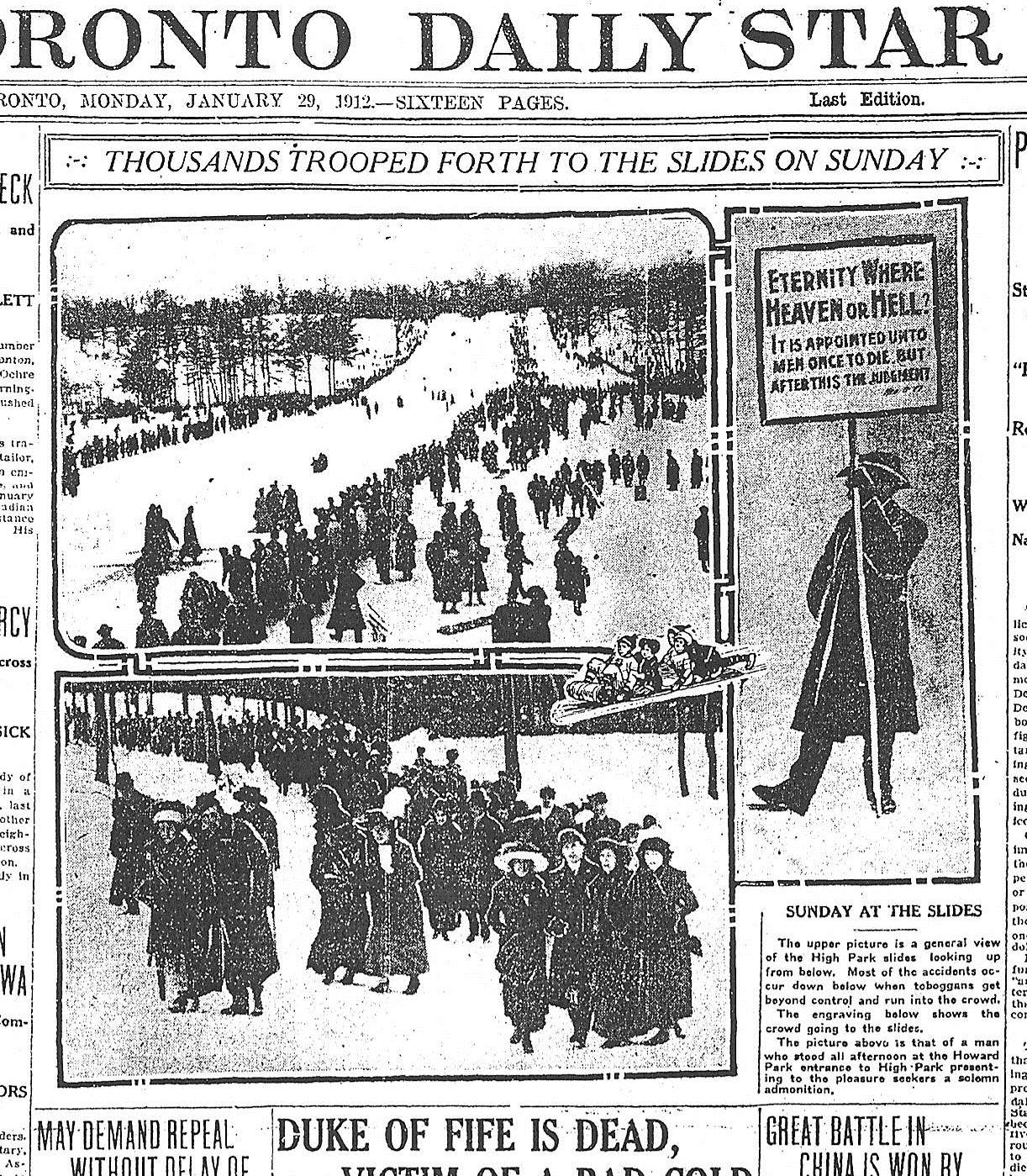
Tobogganing and demonstrator in High Park article in the Toronto Star. Source.
In Toronto, tobogganing drew the ire of the Protestant establishment. The Lord's Day Alliance, a powerful lobby group, singled tobogganing out as the most egregious example of the flaunting of the Sunday rest. In 1912, pressured by the Alliance and anxious to maintain the pious image of "Toronto the Good," the City Council banned the use of toboggan slides in parks on Sundays. Despite the public's defiance, city park slopes remained closed on Sundays until 1938.

Can you think of any other practices controversial in the past we now find tame?

Do you think anything we find scandalous now will appear risible in the future?

3 April 2015

OLYMPIC PARTICIPATION MEDAL

FEATURED OBJECT

BY: KATHERINE HANNEMANN

You’ve almost arrived at the finish line -- you can see it just over the horizon. Maybe the sight of the finish inspires a burst of energy and allows you to sprint to the end, or maybe you are using every last bit of effort you can muster as you drag yourself along the last few metres.

Stephen Kiprotich, winner of the 2012 London Olympic Marathon. Source: OC Register 
However you approach it, our finish line is slightly different from that of a competitive running race: here, there is no first place winner who will grab a coveted trophy or medal before everyone else. As we cross our finish line of this academic year and, for some of us, the Museum Studies degree, we all have a victory to celebrate.

In this program, everyone has exerted enormous effort and will reap his or her own value from what we’ve all experienced and learned. Interestingly, while “going for gold” is clearly the focus of the Olympic Games, we can draw parallels between recognizing the efforts of all participants in our own program and in the Games. This leads me to today’s featured object: the Olympic Participation Medal.

Obverse of 1896 Olympic Participation Medal, featuring the goddess Nike holding a laurel wreath and a phoenix emerging from flames. Source: Olympic-Museum.de

The Olympic Participation Medal is the lesser-known counterpart to the gold, silver, and bronze medals that generate the most buzz during the Games. However, instead of being awarded to only a select few, all athletes, functionaries, and participants from the first modern Olympics in 1896 up until the most recent Games in Sochi has received one of these medals. Far from the blanket feel-good statement that “everyone’s a winner!”, the Olympic Participation Medal notably recognizes the enormous effort that is required in order to even make it to the Olympic Games.

Helsinki 1952 Olympic Participation Medal. Source: The Olympic Design
In my opinion, it is important to acknowledge athletic accomplishment outside of those few individuals who reach the podium. Too often in sports (and arguably in other fields as well), we are concerned with a single moment of “glory” as a qualifier for the worth and accomplishments of an individual or team. Yet it can be detrimental to let a single moment define who we are, whether we excel in sport or in another realm. Instead, pursuing a goal over the course of a lifetime with passion, dedication, and perseverance is what the Olympic Participation Medal attempts to reward.

Vancouver 2010 Olympic Participation Medal. Source: The Olympic Design
  
While several museums collect and display Olympic Participation Medals, notably museums that specialize in sport or Olympic history such as the Lake Placid Olympic Museum, they do not become the artifacts placed on a pedestal with their own security guard. (I'm thinking of the Stanley Cup on display in the Hockey Hall of Fame -- though the extra staff member might just be there to help visitors with their photos.) Instead, these medals represent personal and individual experiences, signifying memories unique to each owner.

And so, here’s to your own achievement as you reach the end of this term or the end of your degree. Regardless of how you feel when you cross the finish line -- whether you leap across victoriously or limp along, huffing and puffing -- try to remind yourself that it is not one job interview, presentation, or publication that defines you, but rather your ongoing dedication to your passion. And just drink some Gatorade and don’t forget to stretch, and you’ll be fine!

9 January 2015

HOCKEY, FIGURE, SPEED ... SKATES!

FEATURED OBJECT

BY: KATHERINE HANNEMANN

Is it cold enough for you yet? This week of sub-zero temperatures was the first true test of my resolution to get out and embrace winter this year, instead of avoiding the outdoors and complaining bitterly about the cold until spring -- which is what I usually do.

One strategy that is helping me hold fast to my resolution: go ice skating as often as possible. With several free and well-maintained municipal ice rinks within a short walking distance of my apartment, it’s an easy strategy to adopt. To me, this abundance of accessible ice rinks is one of the great things about living in Toronto -- as well as a signifier of something quintessentially Canadian (although this is somewhat stereotypical, it’s also grounded in 19th- and 20th-century Canadian history, as we’ll explore in this post.)

Girls ice skating in Toronto, ca. 1910-1912. Source: City of Toronto Archives, via BlogTO

During my time at the iSchool, I have been examining connections between sport and identity, on both individual and national levels. In part, this has led me to consider the clear yet complex connection between skating (and its attendant activities: hockey, ice dancing, figure skating, recreation, etc.) and Canadian identity. In addition to my very important “research trips” (*ahem*) to my local ice rink, I have also been looking at historical objects and images and how they are represented in museums and halls of fame, in order to understand some of the connections between sport and identity.

Ice skates (ca. 1900-1910) manufactured by a blacksmith in the Montreal region. Source: McCord Museum

As my own athletic experience in ice skating remains recreational, for the purpose of this blog I will focus on recreational ice skating and skates in Canada. According to the McCord Museum in Montreal, ice skating was introduced in Canada around 1840 by British army officers. Over the next several decades, the trend took hold in Montreal and in other Canadian cities. As discussed in the Canadian Museum of History’s exhibition Lace Up: Canada’s Passion for Skating, Canada led the construction of indoor public rinks between 1860 and 1890, most notably with architecturally stunning buildings such as the Victoria Skating Rink in Montreal (pictured below).

A skating carnival at the Victoria Rink in Montreal, ca. 1870. Source: Canadian Museum of History

In the nineteenth century, recreational skating seemed to be an activity dominated by an elite subculture. However, the expansion of public skating rinks in the early twentieth century began to make skating more widely accessible. Another factor in the popularization of recreational ice skating was the increasing availability of skates themselves. For example, the Starr Manufacturing Company, a skate company founded in the 1860s in Dartmouth, Nova Scotia, was credited by the federal government for having “helped to establish ice skating and hockey as two of Canada’s favourite winter recreations.” The Starr skate and advertisement below come from the Nova Scotia Sport Hall of Fame.
Skate produced by the Starr Manufacturing Company in Dartmouth, NS. Source: Nova Scotia Sport Hall of Fame

An advertisement for the Starr ice skate pictured above, ca. 1910. Source: Nova Scotia Sport Hall of Fame

Although the diversity of Canada’s population makes it difficult to describe certain activities and symbols as “universally Canadian,” ice skating unquestionably has become associated with Canadian identity roughly since Confederation. Do you cope with winter by participating in this tradition? If skating isn’t your thing, try another cold-busting strategy -- hot chocolate!