Showing posts with label Kathleen Lew. Show all posts

18 April 2019

MAKING MUSINGS PART 5: IT TAKES (MORE THAN) TWO

Letter from the Editors | Kathleen Lew & Amy Intrator


This is the fifth and final post of a series in celebration of the Master of Museum Studies program at the University of Toronto's 50th anniversary (MMSt50). To reflect on Musings' past, present, and future, we invited all previous Editors-in-Chief to return to Musings to write special Letter from the Editor posts. These articles highlight the significance of Musings both within the MMSt program, and for writers' professional careers. Kathleen Lew and Amy Intrator are the fifth (and outgoing!) Editors-in-Chief of Musings from 2018-2019.

As the first ever Musings Editor-in-Chief team, this year has been an extremely rewarding exercise of collaboration. We hope this practice of community– among Musings Executive, Contributing Editors, MMSt, and wider museum communities– continues with future years of blogging.

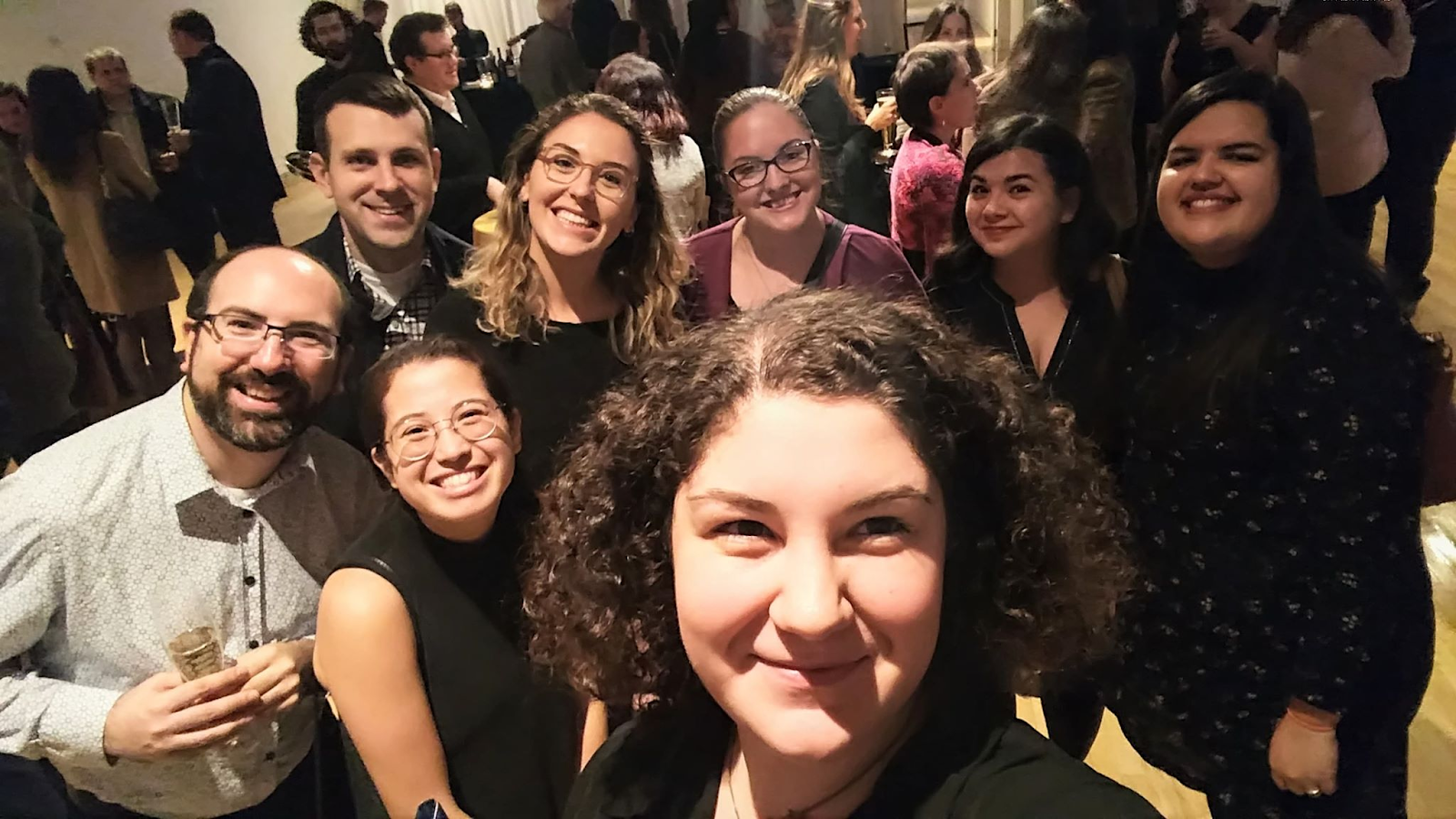
Musings' 5th Birthday Party: Amy Intrator [Left] and Kathleen Lew [Right]. Photo courtesy of Musings.

In Summer of 2018, we sat at a coffee shop in Kensington market and talked at length about our goals for Musings. This included creating a writing environment in which Contributing Editors felt comfortable asking each other for guidance and insight, further integrating ourselves into the MMSt community, and continuing to collaborate with institutions. Soon enough we had updated the Musings interface and logos, incorporated two new response-based columns (Program Reviews and Muse News), and were reaching out to fellow MMSt students, faculty, and alumni to join our community.


We made some major strides this year, but absolutely none of this would be possible without our committed Contributing Editors. We started our tenure as Editors-in-Chief as a duo, but our team grew larger and stronger as the year went on. In September, we were lucky to have Jordan Fee join Musings as the Communications Officer (you may recognize his handiwork if you frequent our Instagram page). We know it’s impossible to do justice to our amazing writers in a short blog post, but here is a list of some of our must-read articles written by some marvelous Musers:
  1. Rebecca Barrett - WEIRD HERITAGE: 6 OF TORONTO'S QUIRKIEST LANDMARKS
  2. Keelan Cashmore - ACCESSIBILITY: MORE THAN A BUTTON ON A DOOR
  3. Elizabeth Cytko - MANAGEMENT SKILLS, ENVIRONMENTAL SCANNING AND GOSSIP: ALUMNI CHECK-IN WITH DEBORAH ROBICHAUD
  4. Rachel Dice - MORE THAN CLOTHES
  5. Jordan Fee - "I DON'T WANT TO TALK ABOUT THAT RIGHT NOW": HOW ANTHROPOCENE SUCCEEDS IN STAYING SILENT
  6. Evelyn Feldman - ALLOWING "PUSSY" IN THE LIBRARY: ART CONTROVERSY ACROSS GLAM SPACES
  7. Alexandra Forand - WE NEED TO TALK, OR NOT: LANGUAGE IN MUSEUMS AS A FORM OF CONTROL
  8. Carly Hall - LET'S TALK ABOUT "POWER AND POSSESSION: THE ETHICS OF COLLECTING"
  9. Casarina Hocevar - FINDING FOODWAYS, PART I.
  10. Maddy Howard - WORTH A THOUSAND WORDS
  11. Selin Kahramanoglu - MONSTERS ON DISPLAY: AN EXHIBITION AT THE THOMAS FISHER RARE BOOK LIBRARY
  12. Samantha Kilpatrick- A FUTURE TO IMAGINE FOR
  13. Amelia Smith - WHERE'S THE T? TRANSGENDER INCLUSION IN THE MUSEUM
  14. Samantha Summers - DANCING THROUGH LIFE: MMSt ALUM JOHN DALRYMPLE ON HIS WORK AT CANADA’S NATIONAL BALLET SCHOOL
  15. Joanna Wreakes - MUSEUMS OR NOT? PART 3: SUBWAY SERIES STOCKHOLM
In addition to being Editors-in-Chief, we both continued our true passion project: writing for Musings! Here are a couple of our articles that we’re especially proud of...

Kathleen - GLOSSY GAL PALS MAKE THEIR OWN MUSES

Amy - EXHIBITING BANKSY: ACCESSIBLE ART OR VIOLATION OF ARTISTIC INTENT?

This year, three of our Contributing Editors created columns that addressed some of the most pressing issues in museums today. Amelia started Not Your Average Cistory, a column that aims to bridge the gap between Transgender Studies and Museum Studies. Ally started Breaking the Glass Case, a column dedicated to exploring the relationship between Indigenous communities and cultural heritage organizations. Evelyn started GLAM Guide, a column that looks at the intersections between galleries, libraries, archives, and museums. All of these columns are necessary additions to the Musings roster, and we can’t wait to see the future direction of the columns as they continue to evolve over time.

Having a team that consistently delivered awe-worthy content made it easier to expand our focus to include more outreach and professional development. For our first-EVER writing workshop, held in November, Sarah Hill from Lord Cultural Resources led a workshop about risk-taking and digital strategies. The workshop went so well that we offered a second one in March, led by Pym Buitenhuis, the Director of Marketing at Rotman School of Management, which focused on transferable writing skills. The workshops were possible thanks to the support of the MMSt50 organizing committee, who have been hard at work all year to celebrate the 50th anniversary of the Master of Museum Studies program. The partnership with MMSt50 is proof that collaboration makes Musings stronger.

Celebrating the past, present, and future of Musings! Photo courtesy of Musings. 

Although parting is such sweet sorrow, we are immensely grateful that we got to throw a 5th birthday party for Musings and celebrate the blog’s contributions over the past 5 years with Contributing Editors, alumni, faculty, and MMSt students. It is an enormous privilege to be a part of Musings’ legacy. We had the opportunity to celebrate this legacy with the Making Musings series, where we reconnected to all past EICs and continued to learn from the inspiring accomplishments of Jaime, Madeline, Natania, and Serena. We can’t wait to watch Musings evolve over the next 5-years and challenge the museum field to become a more critical, inclusive space.

Thank you to all of our readers for joining us on this year-long journey. These two Editors-in-Chief can’t wait to become two of Musings' most passionate readers and strongest advocates.

Source.

29 March 2019

THE LAST ONE FOR THE LADIES (WITH A REDUCED PRICE TAG)

She’s My Muse | Kathleen Lew


Laurie Simmons, detail of Kaleidoscope House, 2001. Source.

It’s fitting that my final She’s My Muse article after nearly two years of writing under this column happens in the final days of Women’s History Month. As I stated (quite loudly) last year, March is almost over, but sexism and oppression remain in the art world, museums, and beyond. As my Museum Studies degree comes to an end, I can’t help but take a moment to be self-reflective. But in true She’s My Muse fashion, I will follow it quickly with a connection to current museum news and calls to action.

This column has been a place to grapple with how gender and feminism interact with museums, and how these spaces of power can be—and are currently being—transformed. She’s My Muse has not been an easy column to write; however, the moments of heartbreak and anger have been accompanied with learning and inspiration (and a healthy amount of self-doubt sprinkled in between). Together, we saw the rise of #MeToo and reflected on the memory (and re-memory) of prolific artists. I had the privilege of speaking with institutions that are advocating for marginalized creators and was continually inspired by the women in my class, in Toronto, and in the wider museum sector.

Finally, I set out to find muses and give other women a platform to share their own. I’d like to present you with a final one:

This post’s muse will look at the events surrounding photographer Laurie Simmons’ retrospective exhibition at the Museum of Contemporary Art in Chicago (MCA). Big Camera/Little Camera was curated by Andrea Karnes at the Modern Art Museum of Fort Worth. Chicago is the second stop of the travelling exhibition and MCA Director Madeleine Grynsztejn added an exciting twist.


The MCA has introduced a new tier of discounted admission. Anyone who believes they have been negatively affected by the gender pay gap can pay $12 admission rather than the full $15 price (from February 24 to May 5). This approximately 81% difference represents the 81 cents women make to every male dollar (source). The new admission price supports Simmons’ practice, which challenges gendered archetypes and disturbs the ‘American Dream’ through photography. Her constructed scenes use models, dolls, and props to challenge understandings of femininity.

Source.

Lack of representation, the pay gap, and its affects on artists and museum professionals is something the National Museum of Women in the Arts (NMWA) draws attention to year-round, with added social media campaigns in March. The NMWA’s #5WomenArtists campaign blasts these numbers across online platforms to draw attention to the sexism present in institutions. For example, out of a 2018 study of 820,000 exhibitions across public and commercial sectors, only one third were by women artists. When looking at museum professionals, women are still underrepresented in leadership positions, and the director positions they do hold are at museums with smaller budgets. The top three museums in the world (British Museum, Louvre, Metropolitan Museum of Art) have never had women directors.


Source.

MCA’s recent dedication to women in the arts is a positive step, especially with the MCA’s 2018 exhibition What Remains to Be Seen, which looked at Howardena Pindell and studied demographics of women artists in New York museums. However, these efforts are not without their limitations. Most notably, a single admission discount does not account for the even wider pay gap for women of colour. An admission price difference is a strong (temporary) statement, but this should not be without looking into further action that accounts for intersectionality.

We also need to consider how these initiatives can be implemented in local contexts, such as supporting Canadian women in the arts. The recently closed Mickalene Thomas: Femme Noires was a beautiful exhibition at the Art Gallery of Ontario (AGO). Through monumental collages, Thomas’ work highlights the intersections between gender, race, and sexuality. She puts Black women at the forefront of her practice and critiques erasure in Western art history. However, Femme Noires is among only one other solo exhibition by a Black woman artist at the AGO, neither of which have been Canadian.

While the MCA is a leading example of what we have accomplished, there is always more to do to improve our structures and institutions. Change goes beyond the confines of this column, but I will be forever grateful for this tiny corner of the internet that has given me a place to discover powerful, intelligent, and dedicated women.

4 March 2019

“THIS IS NOT JUST A GRAB-BAG CANDY GAME”: WHY MUSEUMS SHOULD LOOK TO DIY

She’s My Muse | Kathleen Lew


As my time at UofT is coming to an end, it has become increasingly important for me to look to my peers for insight and support in the process of shaping my practice as a museum professional and feminist. After covering Atleigh Homma’s If I’ve Been Enveloped in Tenderness (Curated by MMSt candidate Kesang Nanglu), I felt inspired to find other cool projects women in MMSt are accomplishing and discuss their take on intersectional feminism in the arts & culture sector.

My last post was a conversation with Margin of Eras Gallery, which highlighted the importance of DIY spaces in Toronto to support marginalized artists. DIY projects are community-driven platforms that support underrepresented groups through artistic appreciation and experimentation. Lately I’ve been exploring how DIY spaces can foster intersectional feminist communities. I’ve also wondered how DIY projects can contribute to a museum practice.

It became clear that Melina Mehr (MMSt candidate, web developer, writer, and zine-maker) was the person to speak to. Melina founded invisibilities a series of self-published zines that seek to make visible narratives that have been omitted or erased, and act as a platform for marginalized groups to expand their creative networks. After being involved in small DIY communities for nearly ten years, Melina sought to fill a gap of diversity and intersectionality she found in Toronto zines.

invisibilities issue No. 1. Photo courtesy of Melina Mehr.

Read our conversation below:*

Why do you think DIY culture in the arts is important?

In a lot of ways, it seems like one of the few genuine outlets left to share work. You’re not relying on other people’s money, and therefore don’t need to satisfy the particular preferences, requirements, or politics of the organizations or people who are paying you. It’s entirely up to the artist to create whatever they want without barriers or filters.

How do DIY projects complement and/or challenge your more traditional museum practice/studies?

DIY projects provide the space for experimentation and are anti-capitalist in nature and practice. It challenges traditional museum structures in that they don’t require donor funding, which in turn affects the work created, as mentioned above. It complements museum practice in that DIY projects allow for community building, conversation, and network growth in a similar way to an institution’s educational and public programming. Curators and interpretive planners also have the ability to be radical in their work by rejecting the colonial frameworks that museums did and still do function within.

Both issues No. 1 and 2 of invisibilities directly call for writing and visualizations from womxn, why was this an important distinction for you?

The distinction to only include work from womxn for Issue No. 1 was important because it related to the medical field, which has a history of violently under-representing, misrepresenting, and generally misguiding womxn — particularly womxn of colour. Womxn’s experiences of navigating healthcare and dealing with doctors is vastly different than the experiences of men, so I wanted to highlight that. Issue No. 2 relates more to creating a space for histories and narratives which have often been unacknowledged or unrecorded. I have never described invisibilities zine as a project explicitly for womxn by womxn, but rather as an attempt to uncover certain narratives, which so far, have been by womxn. That doesn’t mean I won’t open up submission to all genders in the future. But I do like the idea of someone picking up the zine and perhaps not even initially clicking in to the fact that all the content has been created by womxn. Where it becomes so natural that it doesn’t need to be stated.

“’What does she do all day?’ Reflections on isolation and the cycle of healing incurable illness” by Amanda Lovell (invisibilities issue No.1). Photo courtesy of Melina Mehr.

How does your gender inform your creative practice (in museums, with invisibilities)?

Being a woman does not necessarily inform my practice as much as being a woman of colour does. The intersections between race, gender, and class are deeply rooted and not often recognized in much of the contemporary political discourse. In all the work I do, both professionally and personally, I try to put inclusivity and access at the forefront. I often refer back to this quote by Toni Morrison, who said, “When you get these jobs that you have been so brilliantly trained for, just remember that your real job is that if you are free, you need to free somebody else. If you have some power, then your job is to empower somebody else. This is not just a grab-bag candy game.”

Has a community formed around invisibilities? What does that look like?

The launch for Issue No. 1 was so unbelievable that I still can’t wrap my head around it. It was at Wise Bar in Bloordale. I wanted to choose a fully accessible space (which is few and far between!!!) and Wise Bar’s cozy atmosphere seemed like the perfect spot for my expected turnout of maybe 20 people. Before the readings even started, we were beyond capacity and had to turn away folks for the rest of the night! Over 100 people ended up coming out and the zine’s first run of 80 sold out. It was wild! That felt like a community event because all the contributors got to meet each other, I got to meet them for the first time, and the space was just full of conversation and connection. The community since then has mainly been through the Instagram account. I am still trying to think of more ways for people to connect. I’ll get messages on IG or emails from people who have read the zine, but I want there to be a way for those comments to reach publicly so that all the contributors know how important their work has been for others.


Can you tell me a bit about the theme for issue No. 2 and what it means to you?

The theme centers on stories of womxn from the diaspora and immigrant families as a way to record transgenerational memories and reflections of identity. The themes in each issue also relate to myself (it would be a bit odd to create a platform for a group that I have no knowledge about or experience with myself, no?) Both of my parents are immigrants, and my family members have these unbelievable stories of escaping Iran during the Revolution as religious refugees. I have been making an effort to record some of those stories, as my grandmothers are getting quite old now. I know other people have similar experiences, so I thought an issue focused on these kinds of transnational memories and how they shape people’s own identities would be valuable.

Who are your museum muses in Toronto?

People I’ve worked with at the AGO who I also currently work with at MOCA in the visitor experience teams have been amazing. They’re so dedicated to creating positive interactions with visitors and producing fun and engaging tours. The ladies over at Margins of Eras Gallery and CUE are really active in changing the landscape of museums (although I’ve never personally met any of them). My OG muse is my friend Khristine, who graduated from MMSt a few years ago and was the one who helped me figure out the steps I needed to take in order to grow more in the field. She shares my sentiments about decolonizing art institutions and trying to think more progressively in how we approach our jobs. Anytime I find myself struggling in the field, she’s a great person to talk to. My non-Toronto shoutouts are to the three female directors of Studio Museum Harlem and Kimberly Drew in NYC, and the ladies running the programming at Alserkal Avenue and Jameel Arts Centre in Dubai.

 invisibilities issue No. 1 open to film photograph of Krystle Nacion, one of 5 womxn Melina interviewed. 
Photo courtesy of Melina Mehr. 

*This interview has been edited for length and clarity.

4 February 2019

“IT’S NOT JUST TICKING OFF BOXES”: INTERVIEW WITH MARGIN OF ERAS

She’s My Muse | Kathleen Lew


This week, I had the pleasure of sitting down with Zanette Singh (Creative Director) and Roya DelSol (Gallery Coordinator) of Margin of Eras Gallery to talk about running a multidisciplinary art space dedicated to new generation artists who live and work on the margins. Read our conversation below*:

Margin of Eras Gallery (interior) at 1684 Queen St W. Photo courtesy of Margin of Eras Gallery. 

KL: Can you tell me about the history of Margin of Eras Gallery and its relationship to CUE?

ZS: Margin of Eras Gallery is a project of CUE and it opened two years ago. CUE is an arts organization that is primarily an arts funder. We realized there was a huge need and gap, much like in the funding world, for a space for young, emerging, marginalized artists to show their work. We opened this space to fill that gap and to exhibit work from the artists that CUE had been supporting and other artists as well.

KL: Can you speak about how this socially conscious work continues internally as an organization?

ZS: Everyone on our team reflects the community we are supporting, has lived experience, and are practicing artists. The employment structure as an entire eco-system is accessible. We’re making sure as an organization we are not re-creating environments that are continuing the same problems we see in traditional models. We want to be malleable, adaptable, and accessible for each person. Traditional structures are in a reactive place which perpetrates the same problems. Planning ahead has allowed us to keep the adaptability within the employment structure.

KL: Can you give me an example of this strategy in practice?

ZS: If someone on your team is struggling with mental health issues, you make sure there is enough time to adapt and you have back up plans. You create an environment where that barrier is recognized and it’s safe to say, “I’m struggling, I can’t do this” and it’s not punitive. There is a real struggle for marginalized folks who are dealing with multiple things to fit into conventional and rigid structures that perpetuate alienation and exclusion. It compounds what people are already struggling with. It is important for everyone who works here to have that lived experience so it’s easy for them to understand why that adaptability exists, embody it, and ripple it to the rest of the community. That’s the foundation of CUE.

KL: There’s concern that specifically branding projects for people on the margins risks further othering participants. Was this a consideration when branding Margin of Eras, and how does this contribute to the gallery’s mission?

ZS: It’s a really fine line for me, it’s a really hard thing. As someone who as been through multiple programs targeted towards the “marginalized young person”, I have felt very patronized and not taken seriously as an artist—how can I create something that’s not patronizing while also making it clear that this space is for people on the margins and have that be empowering? It’s in the name, we are not shying away from that. It is important to me that the money we raise for grants goes to marginalized people and the people showing in this gallery are marginalized. It has to be at the forefront of everything. Marginalization is a very complex issue, it’s not just ticking off boxes.

RD: We definitely speak about language, it has a lot of power. What colloquial terms have been used in the past to describe marginalized peoples that we don't want associated with the work we are trying to do? The wording in the window says ‘new generation’ as opposed to ‘youth’ which was a distinct decision to not be patronizing to folks coming into the space. While branding something for marginalized voices can feel patronizing, it’s also very freeing for certain folks who have not had space to say their narrative. For example, the last show that happened here was Shatha Al-Husseini. Shatha mentioned that she felt there wasn’t a lot of spaces in Toronto where she could put forth this narrative. Because we are so blatant about what we want to do, people know it’s a safe space. It’s tricky, but at the same time it’s important to put that forward because I think people who have not spoken up feel safe to tell those stories.

Margin of Eras Gallery (exterior) at 1684 Queen St W. Photo courtesy of Margin of Eras Gallery. 

KL: How do you think Margin of Eras challenges and/or fits into Toronto’s arts and culture sector?

ZS: I think this space challenges a narrative around inclusivity that exists in large institutions. Curators say, “well there just hasn’t been that many artists of colour”. What are you talking about? If you don’t know that there are huge communities of artists that need to be shown and supported, then I don’t know what planet you are living on. This is what I have heard for my entire adult life as an artist, that artists of colours don’t exist. This space challenges that notion. There is something that everyone who comes here feels, it’s just different.

RD: It’s warm and communal. A lot of people mention that, which is different than your regular white cube space. I consider this space a bridge between community and contemporary art in Toronto. A lot of artists we have shown were very emergent. It’s a good bridge to show work within a contemporary gallery type space but with support. We provide lots of mentorship and support, not just with putting up your work, but anything needed to ensure that you’re comfortable.

ZS: There is something missing from the trajectory of artists on the margins, which is the opportunity to try something and fail. When you are stuck in the scarcity model of “only one of us gets to be the one token artist,” it’s not a good place to be. The opportunity to learn and fail is so often given to privileged white folks. People need experience, to build their practice, and understand who they are as cultural producers. You can’t do that if you don’t have a space, or an opportunity, or people supporting you and recognizing that what you have to say is valuable. It needs to happen for culture to exist and move forward. I am very committed to the emergent demographic because that’s the seeds, people gain experience and change the landscape of the larger Toronto art scene.

KL: What are the challenges and rewards of incorporating activism into a gallery space?

RD: A challenge is ensuring that you are representing things properly and making sure you are always being thoughtful of the narrative the artist is trying to put forth. You need to understand where that lived experience and is coming from and make sure you are really putting their voice first.

ZS: We don’t work from the top-down, everything is artist led. We offer advice and mentorship, but we are not referencing the traditional ways of thinking about art. I went to art school, I know how I’m supposed to think about my work, all in relation to whiteness and the canon. Removing that and having the artist leading the vision is both the best thing and the most challenging. Being fluid all the time is challenging. I understand why those rigid models exist, it makes linear sense. Choosing as an institution to be in contact with someone’s humanity is a very bold choice. You are now responsible in a different way. That is both a challenge and a thing that separates us from other spaces.

RD: Another challenge is that marginalization is so broad. What does it mean to be marginalized? What’s your conception of that? Our conception of that? What does that mean when determining the artists we work with? I think that’s a minefield that we have really evolved to navigate. It has been so beautiful and mind-blowing to see communities gather around the work, feel like the work is speaking to them, and consume something that they have been looking for but haven’t been able to find.

ZS: Being able to see someone execute their vision? As an artist, that is so exciting for me. A huge reward is building an amazing team. I do not dread coming to work, everyone is very caring and we all respect each other. It makes me feel like something different in this world is possible when you see this machine function.

KL: Who are your museum muses in Toronto?

RD: Black Artist Union is an incredibly strong collective. They unapologetically center Blackness and black artists, prioritize creating opportunities for and re-distributing money directly to artists, and are willing to speak on issues that others will not touch. Brianna Roye [from Blank Canvas] is a photographer whose work is centered on the queer Caribbean experience, and has really increased representation and opened up conversation for Black Queer West Indians of the diaspora in Toronto.

ZS: Rosina Kazi from Unit 2 is old school Toronto. She has done so much in this city for DIY culture. I’m also really excited about the energy of zine and comic culture that is happening in Toronto.

RD: Amber Williams King is really amazing artist, so sharp and thoughtful. Very soft-spoken but also unafraid to ask the hard and important questions, she’s rad.

HABIBIZ at Margin of Eras Gallery. Photo courtesy of Margin of Eras Gallery. 

What’s next for Margin of Eras? Their exhibition, Habibiz, opens Thursday February 7 (7-10pm) and runs until February 23 (1684 Queen Street West). Curated by Jessica Kirk and Mitra Fakhrashrafi of the artist collective Way Past Kennedy Road, the show is about the intersection of place-making and surveillance focused on the motif of the shisha lounge. Read more about it here.

*This interview has been edited for length and clarity.

21 December 2018

HAVE YOURSELF A MERRY LITTLE HIATUS

Letter from the Editors | Amy Intrator & Kathleen Lew


It has been an unbelievably amazing term for Musings! Now it’s time for our brief holiday hiatus, but before we go, your Editors-in-Chief are excited to look back on all the accomplishments from the past four months and prepare for another great term at Musings. 

Editors-in-Chief, Amy [far left] and Kathleen [middle], strike a pose with Communications Officer, Jordan Fee [far right], at the MUSSA End-of-Year Celebration. Photo courtesy of Amy Intrator.

With our first ever professional development event, Musings provided a writing workshop on risk-taking and digital strategies led by Sarah Hill from Lord Cultural Resources. This event was in partnership with MMSt50, featuring delicious Almond Butterfly Cookies and a full room of MMSt students and Contributing Editors. Read Sam’s coverage of the workshop here. Musings is excited to continue this successful workshop series in the new year, so stay tuned for details!


Our instagram has also been busy with various event coverage featuring our Communication Officer Jordan Fee and Contributing Editors. Be sure to take a look back at our story highlights from the OMA conference and the MMSt Montreal field trip, in addition to some thoughtful posts about grad student life and Musings articles.

From exhibition reviews to articles about museum innovations, Musings’ Contributing Editors covered it all over the past few months! If you’re looking for some museum reading material over the holidays, we’ve provided some must-read articles from our Fall 2018 term:

If you’re looking for Toronto reading material, check out Rebecca’s article about Toronto’s quirky landmarks. For more Toronto heritage, Ally’s latest article explores the history of dining establishments in Toronto. Interested about how Toronto Muji is pushing the boundaries of art exhibitions through marketing strategies? Amy’s latest article is for you!

For those readers looking to step outside of the province, check out some of our Montreal reads! Laetitia covered the Museum Studies field trip to Montreal, which was full of visits to some amazing cultural institutions. Rachel explored an awe-inspiring exhibition at the McCord Museum focused on the complex relationship between clothing and the First Peoples of Canada. And if you’re still not ready to leave Montreal, Elizabeth’s latest article explores the McCord Giftshop.


To catch up on some of the amazing professional development that took place this term, check out Kathleen’s article about discomfort in the museum, spurred by a panel at the annual OMA conference. For more OMA content, read Evelyn’s article about GLAM (Galleries, Libraries, Archives, Museums) analogies that were explored during the conference. If you’re looking to explore the experience of Museum Studies students, check out Katlyn’s review of the second-year mandatory classes.

Current Museum Studies students pose with MMSt alum at the annual Ontario Museum Association Conference.
Photo courtesy of Selin Kahramanoglu.

To explore some fascinating museum innovations, take a look at Keelan’s analysis of a museum that displays taxidermy… with a twist. If you want to explore another out-of-the-ordinary exhibition, Maddy reviews an exhibit that is interspersed around the Gardiner Museum!

Looking for the inside scoop on fascinating museum programs? Samantha Summers provides highlights from the 10th Anniversary Celebration of ROMCAN, a program dedicated to inclusion at the Royal Ontario Museum. If you want to know what’s happening inside Toronto’s heritage sites, Samantha Kilpatrick looks at the diverse programming at Montgomery’s Inn. And if you want to explore the ethics of collecting, power, and possession, you have to check out Carly’s review of a recent program at the Gardiner Museum.

Lastly, for anyone looking for a read about museum collections, make sure to check out Selin’s exploration of preventive conservation. And if you want to muse further about the ethics of collecting after reading Carly’s article, check out Jordan’s most recent article about the connection between over-collecting at museums and sustainability.

Thank you to all Musings readers for such a rewarding term of blogging! The new year will bring more exciting events, alumni Editor-in-Chief features, and new columns. If you are an MMSt student and interested in joining the team, stay tuned for applications. We hope everyone has a happy holiday and we will be back in January with more engaging and insightful museum content!

5 December 2018

GLOSSY GAL PALS MAKE THEIR OWN MUSES

She’s My Muse | Kathleen Lew


What does it mean to “get ready with” Atleigh Homma?

If I've Been Enveloped in Tenderness at the Brandscape. Photo courtesy of Jamie A.M.

This Toronto-based multidisciplinary artist showed us her beauty routine from Nov 22-29 at The Brandscape with her first solo show. Curated by Kesang Nanglu, Master of Museum Studies student, curator, artist— If I’ve Been Enveloped in Tenderness made the beauty world a palette for art criticism and friendship.

If I’ve Been Enveloped in Tenderness references the closing song of the 1989 animated film Kiki’s Delivery Service, addressing themes of vulnerability and self-doubt—a soft-hitting familiarity to young women and emerging artists.

"It can be difficult to own your success as an arts professional and I think this is especially the case for many women. However, I don’t think vulnerability and self-doubt are necessarily weaknesses—they grant a curator (or anyone), compassion and empathy in the work that they do," Nanglu shares.


“Priming your face is really important you know? You prime your canvases… you need to do the same for your face.” (source)
Homma’s voice welcomed visitors entering the exhibition with a video installation of her series The Joy of Atleigh (Bob Ross anyone?). The project lives on YouTube, Homma taking on the role of Beauty Guru and Vlogger to explore her identity as an artist, mixed-race woman, and young person. Homma blends the boundaries between influencer and parody, with videos such as "GRWM: ART OPENINGS | The Joy of Atleigh". The work juxtaposes expectations of women artists with make-up tips, a criticism so casual that you almost miss it. These subtle subversions position Homma as the subject in a digital world full of objects for social media consumption.
“With going to art events there’s always other expectations involved that need to be maintained like socializing and networking. Here I am doing my mascara, I use waterproof mascara after curling my eyelashes because it holds the curl better.” (source)

Atleigh Homma, I like the idea of romantic thoughts, but I’m just not that poetic of a person, 2018.
Photo courtesy of Jamie A.M.

The exhibition continues with paintings and embroidery, Homma navigating images of the western art historical muse in a millennial context. An aesthetic self-portrait in her bedroom is sprinkled with imperfections of an old flannel shirt and a strange feeling of disturbing privacy. Glossier Balm Dotcom and a Stiegl Grapefruit Radler are turned into a hazy still life in embroidery. Homma’s work explores how millennial culture and digital media filter women’s image-making.

Homma explains, "I often feel like I am not taken seriously as a female artist because of my femininity (as well as being bi-racial) which expands to being overlooked or unheard. When I talk to other women about how I feel there is exchange of shared experience, validation and solidarity. So when I make work, I try to ask the art world (but also the digital world) how do we engage with women?"

Atleigh Homma, I Don’t Feel Better Yet, 2018. Photo courtesy of Jamie A.M.
Homma may be familiar to you, Nanglu wrote about The Joy of Atleigh in November 2017 with “Girls who Like ‘Urban Decay’ and Social Theory”. Almost a year later, Nanglu curates her friend’s first solo exhibition.

Nanglu and Homma’s relationship was clear the moment I entered, whether it was the portrait of Nanglu front and center or the subtle colour match of their opening night outfits. This intimate layer of the exhibition stayed with me long past the opening. It caused me to consider, how can emerging museum professionals and women in the arts & culture sector practice Shine Theory?

Shine Theory, coined by Anne Friedman and Aminatou Sow, refers to women supporting their peers without seeing it as a threat to their own success. Shine Theory’s solution to “intimidating women” is simple: befriend them, “surrounding yourself with the best people doesn’t make you look worse by comparison. It makes you better” (source). As two young artists in Toronto, Homma and Nanglu could easily perceive each other as competition, but If I’ve Been Enveloped in Tenderness makes it very clear that they, like many of us, are allies.

Kesang Nanglu [left] and Atleigh Homma [right] interact with visitors on opening night.
Photo courtesy of Jamie A.M.
"Ideally, I believe that collaboration between an artist and a curator should operate on equal ground, so having trust and respect for each other before the project even began really allowed for that" Nanglu recalls.

Homma describes the process of working with Nanglu as a blessing, "we are very good friends so she was undoubtedly an expert on my work. Furthermore, she was an expert on the YouTube genre itself as well as all the critical theory within my work (she’s brilliant!). I know for me I felt cared for in this experience, she made these amazing pamphlets and designed a fantastic hanging layout. But she also went shopping with me right before the show when I was in a state of panic and helped me. I think that’s really special."

As women in the art world, we are all simultaneously the idealized and the idealizer. When we turn our muses into friends, we support a culture that is collaborative rather than competitive. Perhaps a partial entry to vulnerability is a deeper awareness of how personal relationships shape our practice—enveloping ourselves in tenderness.