
BY: JENNIFER LEE
Flowers and fruit are only the beginning.
In the seed lies the life and the future.
- Marion Zimmer Bradley
Even the earliest of heritage professionals recognized the importance of collecting plant material. Hans Sloane’s collection, which became the foundational collection of the British Museum, included plant cuttings from his travels - now held in the Natural History Museum, London. Non-museum collections also collect and store plants: seed banks like the Millennium Seed Bank and Svalbard Global Seed Trust act as repositories for millions of seeds, protecting Earth’s biodiversity in the face of species loss and climate change. In a bleak post-apocalyptic future, we may need to call upon seed banks to repopulate plant species lost to climate change and disease.
 |
| The Svalbard Global Seed Trust in Spitsbergen, Norway, has a storage capacity of 4.5 million samples. Source. |
If this sounds somewhat anxiety-producing, fear not; seed saving isn’t just for doomsday preppers and biologists. Seeds are more than containers for plant DNA: they represent rich cultural and personal histories, and the possibility of stewardship, partnership, and reconciliation.
This flattening of our once-diverse food and plant cultures has a cultural toll as well as an ecological one. We stand to lose our understanding of where and how our food is grown, and our agency over our own health and consumption. Indigenous peoples, disconnected from their traditional territories, agriculture practices, and foodways by colonial reservation and residential school systems, are particularly vulnerable to the loss of their cultural knowledge and health.
 |
| Heirloom vegetables like this Glass Gem corn (available from Native Seeds/SEARCH) have been endangered by large-scale operations and imported varieties. Source. |
This is where seed saving comes in.
Individual seed savers and seed saving organizations are working to preserve, grow, and distribute native plant varieties. This can be itself a form of intangible cultural heritage. In some Indigenous nations, seed keepers traditionally safeguarded seeds, shared them with others, and passed heirloom varietals down to family members. For seed keepers, growing and keeping seeds strengthens connections to their cultures and ancestors. (Indigenous seed saving initiatives include plants for medicinal and ritual purposes as well as food.) Terrylynn Brant, a Haudenosaunee seed keeper, told the CBC, "There's so many foods that we have and enjoy that make us strong emotionally, physically, mentally, spiritually, that we couldn't continue to exist as Haudenosaunee people if we didn't continue to eat the foods of our ancestors."
It can also be a way to Indigenize health education. Dream of Wild Health, a non-profit seed saving organization in Minnesota, aims to recover “knowledge of and access to healthy Indigenous foods, medicine, and lifeways”, working through a community garden, public demonstrations and classes, and an Indigenous foodshare. A cornerstone program hosts a summer camp for Native American youth which incorporates organic farming, health, and traditional knowledge.
 |
| Youth gardening at the Dream of Wild Health farm. Source. |
It can also be a way to bridge divides, start conversations, and form working relationships. The CMU farm at Canadian Mennonite University (Winnipeg, MB) occupies a former Métis river lot. In 2015, CMU farm workers collaborated with Métis seed keeper Caroline Chartrand and the local Métis community in order to grow squash seeds cultivated by gardeners from the Miami nation in Indiana. Collaborative projects like this one open up space for settler-Indigenous dialogue over the land on which food is grown and create partnerships while saving vegetable varietals and Indigenous history.
Other communities are also making use of seed saving to preserve their heritage alongside their vegetables. The seed saver John Coykendall, who collects heirloom seeds in Appalachia, keeps details journals of his collecting expeditions, which he calls ‘memory banking’. Like a collections database, his notes record valuable contextual and historical information.
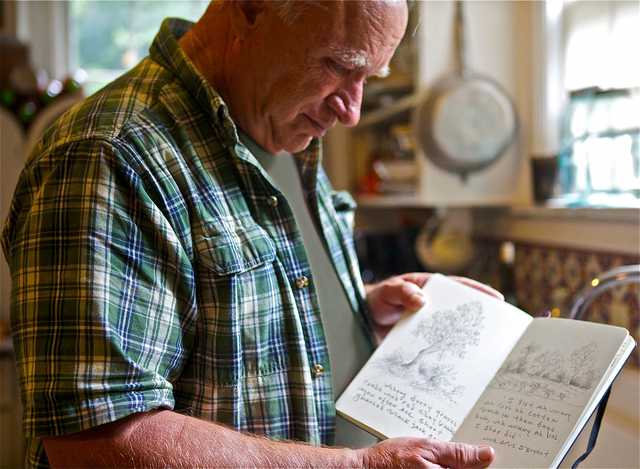 |
| John Coykendall with a 'memory bank', a notebook used to record cultural memories and contextual information in his search for heirloom seeds. Source. |
“A little bit of ancestral history … Where were you living? Where did this seed come from? Did it come from your grandmother or grandfather? Was it brought here from somewhere else? How do you grow it? How was it cooked? ... If someone doesn’t record it, put it down, it is going to be lost for all time. That goes for the seeds. This is the living part of it. Living heritage. Our agricultural heritage.”
While global seed banks work to preserve our biodiversity and health at a macro scale, community and individual projects can work at the micro level, protecting cultural heritage and public health on a personal level. Many libraries (including our own at the iSchool!) house seed libraries – but given their potential to start conversations around culture, food security, health, and heritage, they might not be out of place at a museum either.



