Showing posts with label Gardens. Show all posts

29 June 2018

WHY REPEAT THE PAST: SPADINA HOUSE'S GATSBY GARDEN PARTY

PROGRAM REVIEWS

BY: SAMANTHA KILPATRICK

The Great Gatsby Garden party hosted by the Spadina House Museum is an era-appropriate bash held in a beautiful outdoor garden every year in late June. Running since 2014, this event has exploded into a success for the museum, as well as a social media phenomenon in its own right. This year, the weather was damper than preferable for an event that advertises itself as a picnic as much as a party, but the drizzle didn’t stop hundreds of people turning up for the event.

Attendees at the grey and cheerful Gatsby Garden Party (Spadina House). Photo courtesy of Samantha Kilpatrick.
The main event is a bring-your-own-food-picnic in advertising, but in truth is a meandering, cheerful wander through Spadina House’s grounds, doubling back and back again. Dotted across the grounds were vendors and historic society booths, offering to take your picture or quiz you on the uses of historic silver wear implements. Spadina House also had a pair of bands playing music, as well as an array of vintage gramophones playing to make the event sound the part of a party in the 20s.

One of two bands playing the Gatsby Garden
party, trying to stay dry (Spadina
House), photo courtesy of the Samantha Kilpatrick..

For the more involved, there was also a gambling den, a chance to learn several 20s dances on the dance floor under a tent, a screening of several silent movies courtesy of the Toronto Silent Film Society, and the opportunity to play croquette.

Vendors sold food and drinks, and many of them offered themed items. Chau offered, among others, ‘Daisy’s Dainty Tea Sandwiches,’ and Crystal Head Vodka, a sponsor of the event, offered several themed drinks, including the ‘across the bay’ cocktail. This, of course, was green. Throughout the entire event, there were also those who brought their own food, and had set up picnic blankets and were enjoying the event in jackets and dresses and headbands and hats.

I would like now to dwell on the other attendees because the other attendees are worth remarking on. Of the hundreds of people I saw at the party, only a dozen or so made no attempt to dress for the event at all. To be fair, my perhaps generous definition of ‘dressing for the event’ runs the gamut from ‘wearing an old-fashioned dress and a necklace as a headband,’ all the way to button-perfect recreations of suits and dresses. Some of the more creative and adventurous party goers came dressed as 20’s police officers, or aviators, (and one Charlie Chapman) and many were chattering happily with others about how they created their costumes.

The dance floor at the Great Gatsby Garden Party, where the wide array of costumes can be seen. (Spadina House). Video curtosy of Samantha Kilpatrick..
Again, the vast majority made some effort- this is not to say that everyone came in pink suits with straw hats, but that even most of the men found a pastel collared shirt and a pair of khakis to take pictures in. It created an atmosphere not only of a party but also a shared, secret experience, common only to the hundreds of other people at the party. I should, now, admit that I was one of these costumed attendees. There seemed no better way to experience the event than enthusiastically, without reservation, and with an additional dozen hours of work to create an era-appropriate costume before the event itself. 

The author (left), and Elizabeth Patti, maker of these dresses, and companion to the event (right). Photo taken on Spadina House porch, by fellow attendees. Photo courtesy of author.
A side effect of this mass costuming is the feeling that the experience of this party starts well before the event itself. For one thing, there is always the delightful ride on public transit in period dress, and the attempt to suss out whether or not your fellow passengers are simply dressed well or attending the same event. If you have never ridden public transit in costume before, I recommend the experience highly. It is in my experience, an event that brings you much closer to those who you are riding with, and makes you acutely aware of how comfortable you are with being stared at. As you draw closer and closer to the party, you begin spotting more ropes of pearls, and boater hats, and long dripping 20s shawls. It creates an atmosphere of anticipation and mutual excitement, this spotting of other partygoers, that is difficult to describe except to someone who has experienced a similar event.

Even before the ride itself, of course, there is not inconsiderable effort if you are one of those attending in more dedicated period dress. There is the effort of looking up historic photos, illustrations, or advertisements to attempt to find inspiration and ideas. There is the scouring of thrift stores, fabric stores, flea markets, or the back of one’s closet in search of a material you can wear or transform into something era-appropriate. There is the negotiation of ‘close enough’, where compromises are made to make outfits more fun, or flattering. Drop-waist 20s style dresses have the same tendency that high-waisted regency gowns do, to make the wearer look slightly pregnant. Many attendees opted to nip the actual waist of the dress in slightly, to create a more modern silhouette while maintaining much of the look of the 20s.

This pre-event energy is something that Spadina house plays into quite consciously. Spadina Museum has an incredibly robust social media presence, and their Instagram, as well as their Facebook page, has been promoting the event with great humour and success. Pictures from previous years, two-minute etiquette guides, and daily posts meant to run a countdown to when the tickets went on sale all served to heighten the excitement. It’s an annual event that’s a roaring success, and Spadina House has seized it as their blockbuster event of the year.

The event this year was a delight to attend, and I can’t wait to see how Spadina house harnesses this energy again next year.

20 June 2018

5 HIDDEN SPOTS ON CAMPUS TO RELAX

THE GRAD SCHOOL GUIDE

BY: LAETITIA DANDAVINO-TARDIF

Sometimes, we all need to relax, especially when the semester kicks in. It is important to keep a balance between your studies and your wellness. The University of Toronto’s St. George campus has wonderful and magical quiet places to study, relax or disconnect. You just have to know where to find them! Here are some of my favourite hidden gems around the campus where I like to escape as I am completing my Masters.

1. Terrence Donnelly Centre’s Indoor Bamboo Garden

160 College St, Toronto, ON M5S 3E2

The Terrence Donnelly Centre for Cellular and Biomolecular Research building, opened in 2005, has one of the only indoor green spaces at the University of Toronto. The Bamboo Garden is the ideal place to go to find a moment of peace. There are benches on the various patio levels where you can relax, eat your lunch or chat with friends.  The Bamboo Garden remains little known across the student body, so make sure to check it out!


2. University College’s Quadrangle

15 King’s College Circle, Toronto, Ontario M5S 3H7

University College’s Quadrangle is a serene haven minutes away from the Faculty of Information. Surrounded by the beautiful medieval-inspired 1850s University College building, this green space is my favourite on campus as it feels like I enter in another era. I enjoy grabbing a coffee at Diabolo’s Cafe (as listed in my previous Grad School Guide article) and sitting in the Quad to eat my lunch, read a book or let my mind wander. As you are there, I recommend visiting the latest exhibition of the nearby University of Toronto Art Centre!

A post shared by Alexandra (@alexandrakazia) on


3. Rotman School of Management’s Rooftop Terrace

5th floor, 105 St George St, Toronto, ON M5S 3E6

You might have been wondering what is in that glass building in from of the Faculty of Information. The Rotman School of Management offers many services such as a coffee shop, a cafeteria and the Milt Harris Library. But my favourite part of this building is its green rooftop patio. Located on the same floor as the library, the patio offers you one of the best views of Toronto from campus. The only inconvenience is that the Wi-Fi is quite weak outside. However, why not enjoy some time really disconnected!


4. Philosopher’s Walk

Access on Bloor St W. through the Queen Alexandra Gates (between the Royal Ontario Museum and the Royal Conservatory of Music).

While Philosopher’s Walk is mostly used as a shortcut between Bloor St. W. and Hoskin Ave., away from cars, it is an ideal place to go reflect (as its name indicates). With many benches along the way, I enjoy sitting down there to read a book, and sometimes, listen to the music practices coming out from the Faculty of Music building, which is just beside! This park is as scenic throughout all seasons (Fall being my favourite one).


A post shared by Allana (@solostris) on


5. Innis Cafe's Patio

2 Sussex Ave, Toronto, ON M5S 1J5

Another neighbour to the Faculty of Information is Innis College. The Innis Café has a lovely hidden rooftop patio that is yet to be known! You, certainly, will not feel on campus when you head up there. This patio does not only have comfortable seating, but it is small, intimate and secluded. You can grab a lunch on the first floor or use the microwave to heat up your own.


A post shared by AnnyYu42 (@annyyu42) on


BONUS: Hart House

7 Hart House Circle Road, Toronto, ON M5S 3H3

Hart House, as a whole, is my number one place on campus. This cultural hub doesn’t only offer many activities (such as Get Crafty or Board Game Cafe), workshops, theatre plays and fitness classes, but it is a beautiful building that makes you feel like in Harry Potter. It has so many rooms and quiet corners where you can go relax (and even take a nap!), such as the Reading Room and the Library. If you do not know what to do, there is always something going on or for you to do at Hart House, day and night.


A post shared by Brett Snyder (@brett_snyder) on

As you can see, there is so much to explore around the University of Toronto. I hope these places may become sources of inspiration as you are completing various research papers throughout your degree. Also, to complement with your Masters of Museum Studies, I suggest learning more about the history of these sites as each and every one of them captures an essence of the University of Toronto. Finally, as this is only a handful of what the campus has to offer, I recommend wondering around to discover your own gem to unwind and let your mind escape.


15 January 2018

ROOTS: SEED SAVING, COMMUNITY, AND HERITAGE

A MUSE BOUCHE

BY: JENNIFER LEE

Flowers and fruit are only the beginning.
In the seed lies the life and the future.

- Marion Zimmer Bradley

Even the earliest of heritage professionals recognized the importance of collecting plant material. Hans Sloane’s collection, which became the foundational collection of the British Museum, included plant cuttings from his travels - now held in the Natural History Museum, London. Non-museum collections also collect and store plants: seed banks like the Millennium Seed Bank and Svalbard Global Seed Trust act as repositories for millions of seeds, protecting Earth’s biodiversity in the face of species loss and climate change. In a bleak post-apocalyptic future, we may need to call upon seed banks to repopulate plant species lost to climate change and disease. 

The Svalbard Global Seed Trust in Spitsbergen, Norway, has a storage capacity of 4.5 million samples. Source.

If this sounds somewhat anxiety-producing, fear not; seed saving isn’t just for doomsday preppers and biologists. Seeds are more than containers for plant DNA: they represent rich cultural and personal histories, and the possibility of stewardship, partnership, and reconciliation.

Global capitalism, in the form of huge farms breeding fruit and vegetables designed to travel long distances and last on the shelf, has eliminated thousands of plant varieties over the last century. We’ve moved away from seasonal consumption and diverse native varieties and toward imported foods and privately-patented seed varieties. In 1903, there were more than 500 varieties of cabbage in North America; eighty years later, there were 28. These varieties are often patented by large corporations, depend on pesticides, and are susceptible to disease and pest damage. It’s not unusual to hear news reports that imported foods Western consumers take for granted, like coffee, bananas, chocolate, and peanuts, may be extinct within decades due to climate change.

This flattening of our once-diverse food and plant cultures has a cultural toll as well as an ecological one. We stand to lose our understanding of where and how our food is grown, and our agency over our own health and consumption. Indigenous peoples, disconnected from their traditional territories, agriculture practices, and foodways by colonial reservation and residential school systems, are particularly vulnerable to the loss of their cultural knowledge and health.

Heirloom vegetables like this Glass Gem corn (available from Native Seeds/SEARCH) have been endangered by large-scale operations and imported varieties. Source. 

This is where seed saving comes in.

Individual seed savers and seed saving organizations are working to preserve, grow, and distribute native plant varieties. This can be itself a form of intangible cultural heritage. In some Indigenous nations, seed keepers traditionally safeguarded seeds, shared them with others, and passed heirloom varietals down to family members. For seed keepers, growing and keeping seeds strengthens connections to their cultures and ancestors. (Indigenous seed saving initiatives include plants for medicinal and ritual purposes as well as food.) Terrylynn Brant, a Haudenosaunee seed keeper, told the CBC, "There's so many foods that we have and enjoy that make us strong emotionally, physically, mentally, spiritually, that we couldn't continue to exist as Haudenosaunee people if we didn't continue to eat the foods of our ancestors."

It can also be a way to Indigenize health education. Dream of Wild Health, a non-profit seed saving organization in Minnesota, aims to recover “knowledge of and access to healthy Indigenous foods, medicine, and lifeways”, working through a community garden, public demonstrations and classes, and an Indigenous foodshare. A cornerstone program hosts a summer camp for Native American youth which incorporates organic farming, health, and traditional knowledge.

Youth gardening at the Dream of Wild Health farm. Source. 

It can also be a way to bridge divides, start conversations, and form working relationships. The CMU farm at Canadian Mennonite University (Winnipeg, MB) occupies a former Métis river lot. In 2015, CMU farm workers collaborated with Métis seed keeper Caroline Chartrand and the local Métis community in order to grow squash seeds cultivated by gardeners from the Miami nation in Indiana. Collaborative projects like this one open up space for settler-Indigenous dialogue over the land on which food is grown and create partnerships while saving vegetable varietals and Indigenous history.

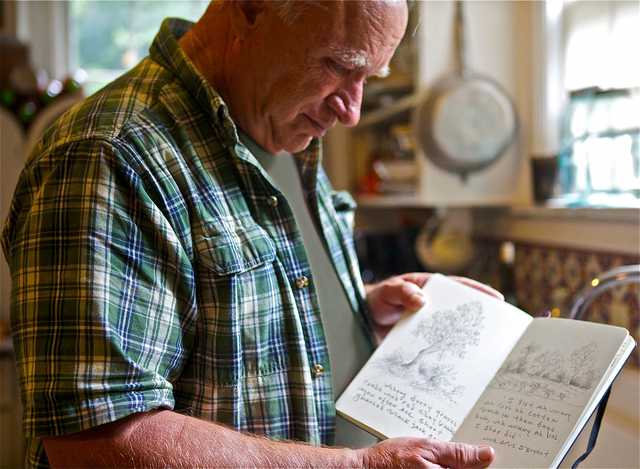
Other communities are also making use of seed saving to preserve their heritage alongside their vegetables. The seed saver John Coykendall, who collects heirloom seeds in Appalachia, keeps details journals of his collecting expeditions, which he calls ‘memory banking’. Like a collections database, his notes record valuable contextual and historical information.

John Coykendall with a 'memory bank', a notebook used to record cultural memories and contextual information in his search for heirloom seeds. Source. 

“A little bit of ancestral history … Where were you living? Where did this seed come from? Did it come from your grandmother or grandfather? Was it brought here from somewhere else? How do you grow it? How was it cooked? ... If someone doesn’t record it, put it down, it is going to be lost for all time. That goes for the seeds. This is the living part of it. Living heritage. Our agricultural heritage.”

While global seed banks work to preserve our biodiversity and health at a macro scale, community and individual projects can work at the micro level, protecting cultural heritage and public health on a personal level. Many libraries (including our own at the iSchool!) house seed libraries – but given their potential to start conversations around culture, food security, health, and heritage, they might not be out of place at a museum either.

31 January 2015

GARDENS: A LIMINAL SPACE FOR EXCITING OPPORTUNITIES

SPECIAL POST

BY GUEST MMSt BLOGGER: LEAH MONCADA

When does your museum visit start: when you walk in the door? Are the liminal spaces, such as lawns, gardens and other landscape features part of the exhibit or the façade? The landscape of a museum should be recognized as a part of the exhibit space, a peripheral place where unique things happen and escape of a different nature is facilitated. Some have been waiting for this movement in Museology for a very long time.
Getty Villa Gardens
Getty Villa Gardens

Gardens are a particular feature I find exceedingly delightful, especially if they have enchanting pockets and places in which to hide amongst the lush greenery and floral scents. It is always wonderful to find little secret benches and enclosed alcoves; it appeals to the part of me that thinks I have discovered something and a part of this museum is mine alone. A very astute blog post explored this notion of the joy and visitor loyalty it inspires to find a special place that feels like a personal refuge within a large institution. If museums are charged with providing a space for everyone, or at least trying cultivate a dialogic environment that appeals to many, is not a tranquil place to relax and ruminate an important consideration? Nature often inspires reflection. Not just upon itself, but acts as a welcoming environment that (persuasively) whispers, “Come, think deep thoughts.”

Another delightful thing about museum gardens is that they often hold some of the most interesting exhibits. Such as Dwarves. Or many, many gnomes. The York Museum Gardens near the Abbey Ruins showcases sarcophagi, not lined up as one is used to seeing them, but propped in the oddest positions as decorative features. The local community thinks it is a delightful way to repurpose and enliven the ruins, which have now become a popular walking spot.

Gnome Reserve Museum

If we look at gardens as simply another exhibit space, we see how they reflect the nature of their host museum; they can be reminiscent of absolutist control over nature, a utilitarian collection of useful plants and herbs, or an oasis of tranquility in the midst of a busy urban landscape. Heritage homes commonly have ‘Grounds’ with sprawling lawns and kitchen gardens. Herbs, flowers, pruning and architecture reflect the tastes and uses of the historic house. For example, the gardens of the Getty Villa are historically reconstructed to resemble an elite Roman villa.

Heritage gardens are also common, perhaps most spectacularly at Versailles, or more humbly in homesteads such as those in BC, and the workhouse kitchens of the Ripon Museums in the UK. They are also wonderful for showcasing the landscape aesthetic of other cultures, or even the particular plant environment of an older era. The Royal Museum of Physicians includes the famed medicinal gardens, teaching visitors on historical medicinal uses for their plants.

Similarly, the Cloisters Museum in NY uses their beautiful gardens to illustrate which medieval plants and botanical motifs that were commonly found in tapestries, art and ornaments. Visitors can learn about the lively folkloric beliefs, medicinal uses and recipes in which these plants were included. The lush, peaceful gardens also serve as a wonderful enhancement to the museum’s atmosphere.

Morikami Museum and Garden

Mandates, such as the Smithsonian Gardens’, prioritize education and compliment the museum experience: “To enrich the Smithsonian experience through exceptional gardens, horticultural exhibits, collections, and education.” Like the Smithsonian, the Horniman Museum utilizes its gardens like an outdoor classroom, with not only an insect reserve and living natural history exhibit, but also as a soundscape exhibit for school groups. Other gardens serve as temporary exhibition spaces, such as the Hermitage Museum and Gardens, which hosts a variety of community programming.

Museums should strive to follow these examples and utilize their landscapes as exciting and usable spaces to enrich the museum experience. Gardens and liminal landscapes are commonly overlooked as active gallery spaces, and should be recognized as much more than simply a front yard.

Check out a previous post that also explores how The Butchart Gardens fit within the museum framework.

8 January 2015

THE CURATED GARDEN: A MUSEUM?

MUSEUM INNOVATIONS

BY: JAIME CLIFTON-ROSS

As I discussed in a previous post, many MMSt students consider a variety of organizations and institutions as museums. Our studies at the iSchool encourage us to think outside the box and explore venues beyond the realm of the traditional artefact-based institutions (be sure to check out our Mission page, which lists some sites that we consider as museums). As I learned last semester in Dr. Irina Mihalache’s class, Interpretation and Meaning Making, interpretive planning originated in parks before migrating to museums. Considering museums adopted practices developed to enhance education and engagement in parks, can we not consider public gardens as museums as well?
Butchart Gardens Spring, Summer, Fall, and Winter Collage
Butchart Gardens Spring, Summer, Fall, and Winter Collage. All photos from Butchart Gardens Website
During my winter holidays, I travelled to Victoria, BC—the self-titled garden city of Canada, which also happens to be my hometown. I’ve visited the lovely Butchart Gardens numerous times over the years, often during Christmas, as it became a holiday tradition. The site is made up of a variety of “curated” and manicured floral displays, reminiscent of historical British, French, Italian, and Japanese gardening practices. Because it preserves 19th and 20th century gardening aesthetics (often uncommon in Canada as a result of our cold climate), the gardens are officially designated a National Historic Site. Vancouver Island’s incredibly mild climate, one that heavily contrasts the rest of Canada, makes it the perfect locale for such a site.

My experience at the gardens this year was quite different from my previous visits. For whatever reason, I had never noticed the series of plaques placed throughout the gardens that explore the story of its creation. Armed with museum insight, I couldn’t help but notice the garden’s approach to interpreting the history of the site. Short yet equally compelling descriptions, strategically placed in front of noteworthy spaces, helped convey the “provenance” of the sites of display.

Before and After: From Quarry to Garden. University of Waterloo.
Unbeknownst to me, the gardens were originally a limestone quarry owned and operated by American cement pioneer, Robert Pim Butchart (1856-1943). He also owned a cement plant at Tod Inlet that supplied cement across the west, from Victoria to San Francisco. After the quarry was exhausted of limestone deposits in 1909, his wife, Jennie Butchart (1866-1950), transformed the barren site into a breathtakingly lush “sunken garden”. She worked with the prominent Canadian architect, Samuel Maclure, who channelled the English Arts and Crafts aesthetic in his landscaping designs.
Robert and Jennie Butchart.
Robert and Jennie Butchart. 
Between 1906 and 1929, Jennie continued to build grandiose floral displays, which now include a seaside Japanese Garden, an Italian Baroque Garden, a Mediterranean Garden, a Rose Garden, as well as various sculptures and water displays. She even built a star-shaped pond for her husband’s family of ducks! But don’t worry about the the environmental impact of the gardens, as they are maintained by a self-sufficient irrigated water system that is supplied by wells and reservoirs filled with rain water. Be sure to check out their official website for more details.


Because the family gardens were passed down from generation to generation, they gradually transformed into what they are today. The family began hosting outdoor symphony concerts, theatrical stage shows, operatic performances, water and firework spectacles, and even puppet shows. These events helped establish the gardens as a world class tourist site. During Christmas the gardens are decorated in spectacular light displays guided by the traditional Christmas song, The Twelve Days of Christmas. Visitors can also enjoy an outdoor skating rink (a complete phenomenon on Southern Vancouver Island) as well as Christmas carollers. Visitors can also dine at The Dining Room Restaurant, explore their gift shop, and even ride a carousel.

This site truly embodies the spirit of museums (and theme parks to an extent) as it encourages visitors to engage with historical gardening practices and preserves natural and architectural landscapes all while celebrating the beautiful, lush nature of the West Coast of Canada.