Showing posts with label Indigenous. Show all posts

1 March 2021

LAND ACKNOWLEDGEMENTS: MEANING AND ACTION

 Breaking the Glass Case | Chantelle Perreault


I have lived in Canada all of my life – in big cities like Toronto and Ottawa, and in suburban towns like Whitby, Ontario – and in all of these instances, I have been culpable of knowing far too little about the Indigenous history of the land I was occupying.

Kanyon Sayers-Roods, a Mutsun Ohlone activist, affirms that "there have always been Indigenous peoples in the spaces we call home, and there always will be". All land in Canada, from coast to coast to coast, has Indigenous connections, and the increasing practice of Land Acknowledgments provides an opportunity for settlers to gain an introductory understanding about past and present Indigenous relationships to this territory. While the practice of acknowledging connections to both the land and the people who reside on it is not new – this has been a tradition amongst many Indigenous cultures long before the arrival of European settlers, and Karyn Recollet, an urban-Cree professor at the University of Toronto, describes it as “an ancient practice that flows into the future” – today, organisations and individuals alike are engaging in the practice of crafting Land Acknowledgements more frequently.

Land Acknowledgments – intentional statements that recognise the relationships between Indigenous people and their traditional land – act to remind settlers of a place’s Indigenous history and the continued presence of Indigenous people in that place today, and encourage settlers to understand how they have come to live on this land, explains Indigenous U of T. You may have heard a Land Acknowledgement spoken aloud at an event, or read one in a syllabus at school. Museums and heritage institutions, in an effort to reconcile their own colonial roots, are also increasingly turning towards the use of Land Acknowledgements.

The process of creating the Land Acknowledgment and the content included in the statement are equally important aspects of the practice. The Native Governance Centre explains that, as a settler, it is essential to begin with self-reflection and an understanding of the goals of Land Acknowledgements — specific goals can differ depending on the institution, but should include the empowerment of Indigenous voices and a commitment to ongoing action. Before beginning, knowledge of the land you are occupying and the Indigenous groups that reside there (historically and presently) is crucial, and this will require research and time. Anishinaabe academic Sheila Cote-Meek also emphasises the importance of connecting with Indigenous people of the territory when possible (and with proper compensation for labour).

The language of Land Acknowledgments is significant: the use of present tense rather than historical references to Indigenous communities reiterates that Indigenous people continue to live on this territory today — colonialism is an ongoing process. 

Land Acknowledgement from the website of the Royal Ontario Museum

Similarly, when Land Acknowledgments are read aloud, accurate pronunciation is required: Emily Riddle of Alexander First Nation in Treaty 6 territory explains that mispronunciation indicates “a lack of effort and consideration” by the organisation. An emphasis on correct pronunciation can be encouraged by including a pronunciation guide, as seen in the City of Toronto’s official Land Acknowledgement.

Pronunciation guide from the City of Toronto's Land Acknowledgment webpage

Land Acknowledgements should also be accompanied by further action – these statements are not made to "check a box", but stem from a commitment to empower Indigenous voices. The Manitoba Museum, following their Land Acknowledgement, lists a series of further commitments towards reconciliation, such as developing collaborative relationships with Indigenous communities and partnering with local communities to share more Indigenous stories. This transparency encourages accountability and makes clear to the museum’s audience that they are committed to specific goals when it comes to reconciliation.

We Are All Treaty People, exhibit at the Manitoba Museum. (Image: manitobamuseum.ca)

Museums often have a colonial past to reckon with, and have a responsibility to understand their connection to the physical land that they occupy. Anishinaabe writer and educator Hayden King reminds us that Land Acknowledgements are not done to validate Canadian presence on the land, but rather to empower and uplift the voices of Indigenous people. At a time where Land Acknowledgements are becoming increasingly common, and can sometimes seem redundant or meaningless, museums have an obligation to reflect on the purposes of these statements, and how they will impact museum practices going forward.

9 March 2020

ANCIENT DNA: A LINK TO THE PAST


_________________________________________________________________________________

It would not be a stretch for me to say that one of museums’ major roles is to illuminate human history. Many museums do this by using timelines or installing a linear progression through exhibits. The first thing audiences see when entering The Canadian Museum for Human Rights (CMHR) is the massive, multimedia timeline with 100 points in history. While the CMHR’s timeline spans the globe there are timelines that focus on a particular topic, such as a place, a phenomenon, or a certain group of people. For instance, the Royal Saskatchewan Museum (RSM) First Nations Gallery traces the history of the first peoples in Saskatchewan, starting nearly 6,000 years ago to present day.

The CMHR's gallery with the timeline on the left (Source).
The timeline that is present the RSM shows a direct link between the people who were present 6,000 years ago to the people present on the land today. With the employment of science when conducting historical and archeological research, especially the study of DNA pulled from ancient humans (known as aDNA), this idea has become doubly enforced. You see, aDNA promotes a different kind of timeline.

The study of, understanding, and potential for ancient DNA has rapidly advanced, providing important insights into a range of biological, historical, and social questions. The study of aDNA has illuminated many answers to questions such as disease, migration patterns, impacts of European colonization and much more, it isn’t without its controversies—namely the ethical issues of collecting human genetic material of the past. 

A hotly debated topic amongst scientists is the peopling of North America, a question aDNA could potentially answer (Source). 
There have been numerous instances reported where scientists have used samples without permission, disregarded customs of communities, and resisted obtaining any form of consent from the people involved in studies (in some cases, these people were involved involuntarily). In 2013, Ian Mosby, an assistant professor at Ryerson, revealed that a number of highly unethical nutritional experiments were performed on children at six residential schools between 1942 and 1952. In turn, Indigenous communities have had to become sceptical of any sort of scientific and social testing to protect themselves, communities, and autonomy.

Ripan Malhi, a molecular anthropologist at the University of Illinois, is part of an effort to change this relationship. In 2011, Malhi helped found the Summer Internship for Indigenous Peoples in Genomics (SING), a weeklong program funded by the National Institute of Health and the National Science Foundation (NSF). The program both aims to train indigenous scientists, but also so bring their much needed perspective to the research. In 2018, SING faculty and alumni publishes ethical guidelines for genomics studies, which call for community engagement, pose questions to tackle, and protocols on how to handle samples and data. You will notice these protocols are very much focused on the present communities and the future of genomics research. But, what about the science of the past? The ethical concerns of research are often not applied to aDNA studies, even though they have implications rooted in the present.

But this is changing.

In October of 2019, the National Science Foundation has awarded 350, 882$ to a collaborative team from the University of Connecticut, The Denver Museum of Nature and and independent scholars across the United States, Europe and Canada. 

(Source.)
“In many cases, aDNA studies continue to fall in a gray area of ethical oversight, despite greater awareness by researchers of the potential pitfalls,” says Deborah Bolnick, associate professor of anthropology at UConn. “With this project, we will include Indigenous leaders in the conversation alongside researchers to attempt to build an ethical framework that encourages positive, collaborative relationships between scientists and Indigenous communities.”

The team hopes to develop resources to enable informed decision making for researchers and indigenous communities in North America.
Both this project and SING inform how research is being done with, for, and by Indigenous communities pertaining to tracing history through DNA. The significance of these interventions cannot be over stated and affect the way the general public understands certain histories of Indigenous communities.

What are your thoughts? I really want to know! Leave a comment or if Twitter and Instagram are more your speed my handle on both is @Ally_but_online.

18 December 2019

LET'S ERASE HISTORY: THE PRIVILEGE OF SAVING AND FORGETTING

Collections Corner | Jaime Meier 

It is a safe assumption that a majority of us have heard the classic quote attributed to Winston Churchill, "History is written by victors." While the ideas revolving around objectivity and the reinforcement of single narrative histories have rightfully come under fire, who and where can we learn about history? One of my amazing Art History professors, Felicia Gay, once told our class in relation with working with Indigenous peoples that we must "Speak with the community instead of for the community." This allows for a historical record to emerge that has been repressed by the colonization politics of Canada, a repression that Library and Archives Canada (LAC) continue to implement to this day.

LAC has been involved in several digitization projects with Nunavummiut (the peoples residing in Nunavut), including "Project Naming" and "Listen, Hear Our Voices." "Project Naming" was created by Nunavut Sivuniksavut with the eventual formation of a partnership between the Government of Nunavut and LAC. Since its inception in 2002, over 10,000 images have been digitized and thousands of Indigenous peoples, activities, and places have been identified by numerous generations. LAC acknowledges that this improves not only their own records but also "helps members of communities connect with their past and create inter-generational bridges."

Young Denis with his mother, Iqaluit, Nunavut. [Dennis Okpik and his mother, Rosie Okpik] (item 1)
"Young Denis and his mother" were identified through "Project Naming." (Source)
The foundation for what would become "Listen, Hear Our Voices" started with the work of Leah Otak, an Inuit woman who digitized hundreds of interviews with elders and made plentiful contribution to Arctic science. Instead of photos, this initiative focuses on saving the stories, songs, and other spoken word recordings captured on deteriorating tape records. These recordings are invaluable to the revitalization of traditional Indigenous languages and cultural growth. LAC is "proud to assist Indigenous communities in their efforts to secure a sustainable future for their heritage recordings."

Leah Otak digitizing recordings. (Source)
The financial support provided by LAC was monumental for the continued success of the projects, but it is a convenient way for LAC to focus on the documents they willingly share with the public instead of the many they have been accused of hiding. A majority of these "hidden" documents are related to residential schools, especially the abuses inflicted on the children attending. This has left survivors to fight for their right to have their histories accepted and understood. Even in a disappointingly bleak post-Truth and Reconciliation Commission Canada, the government and its collection continue to shrink away from the burden of the horrors of residential schools that they aided in perpetrating. 

Where the Canadian government has continuously failed, many museums are ready to step up. Myseum Toronto has completely abandoned the notion of a permanent collection. Nathan Heuvingh, Curatorial and Program Lead at Myseum, said that the non-traditional set up of Myseum does not allow for a space to hold objects, instantly overcoming the inherent problems that come with collecting certain objects over others. This allows the voice of Myseum to evolve with the needs of the communities they work with instead of imposing a strict model.

Some of the works from the AGO being deaccessioned for sale. (Source)
While the lack of collection succeeds at Myseum, in order for artists to thrive and produce new works, we need to financially support them. Art institutions, such as the Art Gallery of Ontario (AGO), have begun to deaccession works by artists who are over represented in their collections. By removing and selling these artworks, it allows for the collection to diversify and invest in underrepresented gender identities and people of colour. Art created by marginalized groups deserves to take up space and arguably demonstrates a more comprehensive representation of Canada's past and future.

As we move into the holiday season, be mindful of how one sided histories have affected your friends and families and create, at times, haughty discussions. This does not mean we avoid challenging their often ignorant, racist, and/or prejudice options but instead, meeting them where they are. Even if you do not succeed with these discussions, you can find solace in the fact that your history reflects so much more than the "victor."

26 November 2019

THE TRY GUYS TRY A LAND ACKNOWLEDGMENT

Breaking the Glass Case | Alexandra Forand 


If you are anything like me, you consume the art that is short-form video content, AKA YouTube videos. On November 2, 2019 the Try Guys released the video “The Try Guys Become Zookeepers for a Day,” which was the first video of their 4 part mini-series Try Australia. This video is unique because it opens with a land acknowledgement. The Try Guys are an American online comedy company that produces YouTube videos among other things. The YouTube Channel that promotes these videos has 6.5 million subscribers (at the time this article is being written).

(Source)


The land acknowledgement in the video reads:

“We acknowledge that this series was filmed on Wurundjerland, and we pay our respects to the elders past, present, and emerging.”
It was brief. It was simple. But it was there.

As Canadians, this may not be a new experience, since we read (or are read) a version of a land acknowledgment from an approved template at meetings, the first day of school, or various celebrations. This practise of reading a land acknowledgment gained momentum after the Truth and Reconciliation Commission of Canada released its final report. Although, it is important to understand that land acknowledgments were being done before the TRC released their report and the practise of acknowledgment started spreading on its own accord with little to no government intervention. It should be noted that there is no one single acknowledgment, but many depending on where you are in the country.

In Australia, another country with a similar dark colonial history like Canada, it isn’t called a land acknowledgment. Instead the statement that the Try Guys featured in their video is a Welcome to Country statement, which has been practised since the early 00s and incorporated into parliament opening ceremonies since 2008. The Welcome to Country statement is often performed by an elder and accompanied with traditional smoking ceremonies, dance and/or music. In the event that an elder isn’t present a simpler welcome is offered.

Another example of Welcome to Country Australia employs (Source).


The practise of a land acknowledgment and Welcome to Country, both in Canada and in Australia, has attracted criticism from politicians, journalist, and historians as being a form of tokenism (Tokenism: the practice of making only a perfunctory or symbolic effort to be inclusive to members of minority groups).

Other critics, such as Stephen Marche points out that practising a land acknowledgment is the equivalent of saying sorry and not meaning it, because speech is easy and speech is free. Unless there is a true movement towards reconciliation these words are empty. This would include paying for the education of First Nation Schoolchildren, who still receive 30% less funding than their white counterparts or ending long term drinking water advisories which disproportionately affects Indigenous communities.

At the University of Toronto, the acknowledgment reads: 
“I (we) wish to acknowledge this land on which the University of Toronto operates. For thousands of years it has been the traditional land of the Huron-Wendat, the Seneca, and most recently, the Mississaugas of the Credit River. Today, this meeting place is still the home to many Indigenous people from across Turtle Island and we are grateful to have the opportunity to work on this land.
While there is no wrong way to do a land acknowledgment, when writing, giving, or hearing one, it is important that they are approached with humility and treated as a learning opportunity. The example above is a template, and only a template  and the larger purpose of a land acknowledgment is to transmit knowledge to people who may not know the history of where they are standing. The example above is prescriptive, but there is plenty of room to bring your own voice and meaning to a land acknowledgment.

No matter what your feelings are towards land acknowledgments, the video that inspired this article has 2 million views (again, at the time this article is being written). If we turn to the comments section (a notoriously inhospitable place in the online community) we see that the comments that mention the Welcome to Country are positive and thankful it is present.


Comments reacting to the Try Guy's Land Acknowledgment on a recent video. Photo courtesy of Alexandra Forand. 

 This is not to say that the Try Guys solved colonialism, but it is heartening to see them using their immense platform to set a precedence for other Youtube channels, artists, and dare I say… Museums?

As always, I encourage you to leave a comment, send me an email (allyforand@gmail.com), or if Twitter and Instagram are more your speed my handle on both is @Ally_but_online.

28 October 2019

SURVIVING AND THRIVING: LIVING PLANT COLLECTIONS


Collections Corner | Jaime Meier 


As a plant parent, there is an undeniable joy that comes from taking care of a living creature and watching it flourish in return. Needing only a small investment of time, soil, and water to keep it alive, plants are one of the most cost efficient living things. The accessibility of owning plants and the mood enhancing experience that accompanies them has caused the plant economy in Canada to increase 8% to 1.5 billion dollars from 2013 to 2018.

Cactus House Allan Gardens Conservatory
The arid room hosts a plethora of unique succulents and cacti.
Source

Not everyone is capable of keeping plants alive but there are other possibilities for plant appreciation. Instead of consistently reverting to static and inanimate objects, there are important living collections in most Canadian cities – plant conservatories. Toronto is fortunate enough to have one with free admission in the heart of the city, the Allen Gardens Conservatory. Similar to an art gallery that displays different eras of art, the Allen Gardens Conservatory features six green houses that include palms, cacti and succulents, tropical plants, and many more.

I have happily spent many afternoons in plant conservatories across North America and whether you are a plant lover or not, it is impossible to not be struck by their beauty, which is an immersive experience. Each room offers a new adventures, teleporting you from desserts covered in succulents and cacti to tropical forests complete with waterfalls and lush greenery. Curtis Evoy, the supervisor at the Allen Gardens Conservatory, says that “Live plants can tickle all of our senses – sight, touch, smell, hearing, and taste. Whereas an inanimate object may just satisfy one or two  of the senses.”

In full bloom
The tropical room in full bloom.
Source

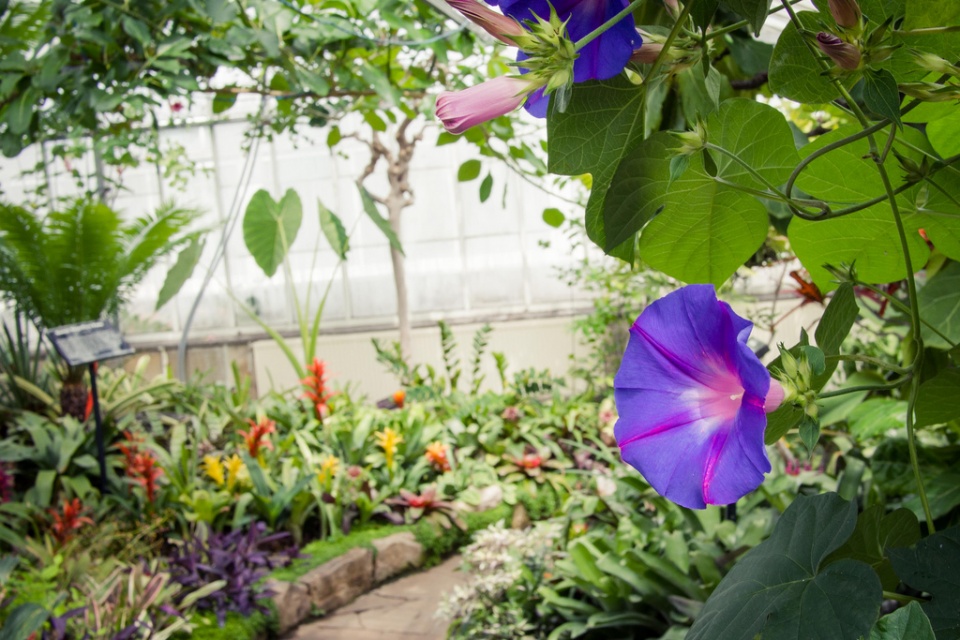
Beyond the beauty, plant conservatories, especially the Allen Gardens, serve as an important place for discussions about Indigenous connections to the land. Every institution has a land acknowledge that recognizes the presence of Indigenous groups and their unique connection to the land long before settlers. This good natured gesture rarely goes beyond an acknowledgement, even though it is meant to play an important role in decolonization and putting Indigenization into action. Allen Gardens is one of the few places putting land back into the hands of Indigenous peoples through gardening and art.


Plants have always played an important role in Indigenous cultures. There is a permanent Indigenous Medicinal Garden outside the conservatory growing traditional plants with the local Indigenous community. It includes staples such as sage, sweetgrass, and tobacco. Making space for traditional Indigenous plants and allowing the community to utilize them re-affirms the history of the land and its stewards through action rather than words.

Image
The banners in front of the conservatory.
Source

The gardens also demonstrated their commitment to Indigenous peoples and their resilience through an installation called “Red Embers.” It was created by 15 Indigenous women artists to publicly speak out against the systematic violence and discrimination that has caused the national tragedy of Missing and Murdered Indigenous Women and Girls (MMIWG). The red banners were utilized by the artists to display their personal experience of how MMIWG has affected them and the charred cedar holding the banners demonstrates the “strength and resilience of women, even when they’ve been scorched and hurt.” Curtis Evoy commented that “Art and gardens have gone hand in hand for centuries, from fountains to sculptures.” The “Red Embers” installation replaces, and effectively destroys, the gaze of European sculpture and art forms associated with gardens. It then becomes impossible to ignore the historic and current presence of Indigenous peoples and forces us to consider how, in spite of colonial legacies, Indigenous peoples will always retain an unbreakable connection to their lands and cultures.

The Allen Gardens Conservatory is the perfect place to spend a sunny or dreary Toronto day. It has something for plant admirers and adversaries. I look forward to seeing how the conservatory continues to work with Indigenous peoples and that other institutions follow their lead. 


15 July 2019

THE REMBRANDT RULE AND REPRESENTATION IN MUSEUMS


Breaking the Glass Case | Alexandra Forand


“Treat every object as if it were a Rembrandt.” This good intentioned notion has become appropriately dubbed the Rembrandt Rule. This simple idea has been internalized in the psyche of museum professionals for decades and caused a lot of tension and heartache. This rule isn’t inherently bad, in fact it is what museums have built themselves around, because we want to keep objects for future generations to enjoy. This is the very reason we have departments like collection management and conservation.

An Actual Rembrandt painting of Rembrandt. Source.

Recently, this idea has come under fire, with some scholars (and insurance agents) pointing out not every artifact IS a Rembrandt. There are certain objects a collections manager is going to try and grab in a fire before evacuating the building. Even the most stringent conservator would agree that there is an unofficial object hierarchy in the museum, yet nobody talks about it.

Not only is the Rembrandt Rule unfeasible for many different reasons, I argue it dangerous and destructive for Indigenous objects, the communities and people those objects originally came from, and the future of how we remember their stories.


Should these Moccasins also be treated like a Rembrandt Painting? Source.
You see Indigenous objects left the places they originated under many different circumstances and for many different reasons. These objects are taken out of context and physically put behind glass, effectively removing them from history. Freezing them in time, if you will. This physical barrier is erected between object and the people it came from, but another wall is created, and this is not made out of plexiglass. Instead the second obstruction is the Rembrandt Rule. All of sudden that jingle dress that has been in your family for generations or those moccasins that look just like the ones your sister made for you become a museum object. When the object becomes a museum object, the people, heritage, and knowledge it represents can be overlooked in favor of making sure that object survives for future generations. It no longer matters that this rattle was supposed to be heated by the hands of a musician on certain feast days or that blanket was meant to keep children warm on chilly September nights. These museum objects are left there for people to look at, but never to touch, impossible to connect with, and easy to forget.

Jingle dress being danced at a celebration in PEI. Source.


A Jingle dress in the Glenbow Museum. Source. 

I do not mean to be so doom and gloom In this article. In fact, there are many institutions, armed with the Truth and Reconciliation Commission report, that are breaking the Rembrandt Rule. For example, in 2010, five historic Blackfoot hide shirts from the Pitt Rivers Museum came to Alberta. For a brief time, people from Blackfoot communities were able to learn about, visit with, and even try on these pieces of their history.


According to Laura Phillips, “Museums play a critical role in sharing history and providing context and meaning to this history,” but when the object, and by association the history, is frozen in time, what exactly is being shared? Are we not just looking after the physical element of the object and thereby removing it further from the community it whence came? Or, is the Rembrandt Rule just another sacrifice museum professionals have to make to keep their collection healthy, safe, and available for the public? What are your thoughts? I really want to know! Leave a comment, send me an email (allyforand@gmail.com), or if Twitter and Instagram are more your speed my handle on both is @Ally_but_online.

19 June 2019

FINDERS KEEPERS?: WHAT DO YOU DO WHEN YOU FIND AN ARTIFACT BY CHANCE


Breaking the Glass Case | Alexandra Forand 


Imagine, you are outside walking on a beautiful sun-shining day and you catch a glint of light in your peripheral vision. You take a closer look and you see it’s a quartz arrowhead! You pick it up, it is blue grey in color and about the size of your palm. The tip is chipped off. Perhaps the hunter who knapped this arrow head did this accidently and discarded it. Your first thought is probably, “this should be in a museum!” But… is that the right instinct? This exact scenario happened to my friend Kirsten, who works in and around different lakes in Saskatchewan. While on the job, Kirsten regularly finds amazing treasures, such as fossils, bones, and cultural heritage items. This is no surprise since lakes and rivers have been the heart of social interactions for Prairie peoples. Kirsten has built herself a collection made up of artifacts and pictures of specimens she has left behind.


The arrowhead that started it all. Photo curtesy of Kirsten Sepos. 


This scenario is actually quite common in rural areas, like the Prairie provinces. Chances of finding heritage items (arrow heads, medicines wheels, spear points, stone axes, hammerstones and tipi rings) are quiet high. This is because the Prairie provinces were (and still are) significant places for Indigenous communities to live, hunt, trade, and celebrate for nearly 400 generations! So it is no surprise that Indigenous material culture is densely deposited across the land.

Today, farmers, fishers, conservation officers, gardeners, and people enjoying nature find these remnants of ancient (and sometimes modern) Indigenous communities. So the question remains: what do you do when you find these objects?

Bodies of water, such as Lake Diefenbaker, were and are significant meeting areas in Saskatchewan (source.)

The province of Alberta is taking steps to answer this question. One of the first things they recommend is reporting the spot you found the artifact on the Alberta culture website. Here, they ask you to include a digital photograph, a location, your personal information (phone number, email, address, etc), and a description and circumstance of how you came across the artifact. After you submit this information, an Archeological Information Coordinator will confirm this is a new archeological site, which will be entered into the Archeological Site Inventory database.


While I was writing this piece, I came across an instance where construction of a road was being halted because of the uncovered Indigenous objects. Jim Gilroy, the farmer whose land the construction was taking place on, contacted the Federation of Sovereign Indigenous Nations (FSIN) and together they signed a memorandum of understand which signified the groups commitment to protecting the land. Both parties hope the land will be designated as a heritage site and see this partnership as an act of reconciliation.

It is not uncommon for farmers to have an extensive collection of artifacts which have been collected over the years (source.)

But that does not answer the question at hand. Let us return to Kirsten, her arrow head, and what she should do. In Saskatchewan the protocol is much less clear. If you want to donate your artifact to a museum, there is a good possibility they will not accept the object. Some of the larger museums in Saskatchewan such as the Western Development Museum, focuses on collecting artifacts from the 20thcentury. The Royal Saskatchewan Museum, does collect artifacts from all time periods, but they too may say no. Artifacts such as arrowheads, hammerstones, and spear points tend to be extremely common in Prairie museums and often have little, or no known history associated with the artifact.


So for now Kirsten curates her small collection and when she comes across an artifact in the bush, she reflects on the fact that she might be the first person in one thousand years to touch this object.

Have you ever found anything on your adventures? I want to know! Contact me at allyforand@gmail.com or if Twitter and Instagram are more your speed my handle on both is @Ally_but_online.